
Economic Importance of Bacteria and Fungi | ICSE Class 9 Biology Notes
On this page

This note covers bacteria and fungi, their useful roles in medicine, agriculture and industry, the nitrogen cycle, harmful bacterial activities, and the importance of fungi in brewing, baking, cheese processing and mushroom cultivation.
Why are bacteria and fungi economically important?
Economic importance means the useful and harmful effects of organisms on human activities and resources. Bacteria and fungi influence food production, health, agriculture and the processing of materials. Their importance includes both products that people obtain and losses caused by their activities.
What are bacteria and fungi?
Bacteria are microscopic organisms with a prokaryotic cell organisation, meaning that their cells lack a membrane-bound nucleus. Fungi are eukaryotic organisms, whose cells have a membrane-bound nucleus. They include yeasts, moulds and mushrooms.
A micro-organism, or microbe, is an organism too small to be seen clearly without a microscope. Many fungi are microscopic, but a familiar mushroom is visible without one. Yeasts are single-celled fungi; moulds have a thread-like body.
Hyphae are the long, slender threads forming a fungal body. A network of these threads is called a mycelium. Fungi depend on organic food, meaning material obtained from living or once-living organisms. Most fungi absorb soluble organic matter from dead material.
Why does the particular organism matter?
Some bacteria cause disease, whereas others help to make foods or enrich soil. Similarly, fungi may provide food or useful substances, while other fungi cause diseases. A useful effect in one example cannot be extended to every member of the group.
The same broad activity, such as breaking down organic matter, can have different consequences. Decomposition in soil returns nutrients, whereas microbial activity in stored food can spoil it. The material affected and the result determine the economic significance.
What the figure shows
Visible microbial colonies
Panel (a) shows many separate pale bacterial colonies in a circular dish. Panel (b) shows a circular green fungal growth labelled “Fungal colony” in another dish. A colony is a visible population growing together.
The visible colony should not be mistaken for a single bacterial cell. Bacteria and many fungi can grow on a nutritive medium, a material that supplies nutrients, substances needed for growth and normal functioning, forming colonies that can be seen with the naked eye.
How do microbes provide useful antibiotics?
Definition: Antibiotics are chemical substances produced by some microbes that kill or retard the growth of disease-causing microbes. “Retard” means slow down. A pathogen is an organism that causes disease.
Antibiotic production is a useful role of bacteria and fungi in medicine. The valuable product is a chemical made by the microbe. The producing organism and the disease-causing organism affected by its product have different roles.
What does the discovery of penicillin show?
Penicillin was the first antibiotic discovered. A culture is a population of microbes grown on a suitable nutrient material for study. Alexander Fleming observed a mould growing in an unwashed culture plate while working on Staphylococci, a group of bacteria. The bacteria could not grow around the mould.
Fleming found that the mould produced a chemical responsible for this effect. He named the chemical penicillin after the mould Penicillium notatum.
Ernest Chain and Howard Florey established penicillin’s full potential as an effective antibiotic much later. This example links an observation of inhibited bacterial growth with the useful chemical made by a fungus.
How does this connect with bacterial importance?
Heterotrophic bacteria, which obtain food from other organisms or dead organic matter, include useful antibiotic producers. Penicillin is a fungal example, so it should not be assigned to bacteria merely because it acts against them.
Antibiotics have greatly improved the ability to treat diseases such as plague, whooping cough, diphtheria and leprosy. Their usefulness comes from the effect of the substance on susceptible disease-causing microbes. “Kills” and “slows growth” are both part of the definition.
Note: Keep three ideas separate: the microbe that produces an antibiotic, the antibiotic itself, and the pathogen affected by it. Penicillium is a fungus; penicillin is its useful chemical product.
Medicinal importance is therefore broader than the statement that microbes cause illness. Some microbes provide substances that help control other microbes. This is a direct example of biological activity being used for human welfare.
How do vaccines and protective serums differ?
Immunity is the body’s ability to fight disease-causing organisms. Antibodies are protective proteins produced by the body in response to foreign substances. An antigen is a substance recognised by the immune system that can stimulate such a response.
A vaccine is a preparation containing antigenic proteins of a pathogen or an inactivated or weakened pathogen. Vaccination introduces this preparation into the body so that its immune system responds and develops memory of the pathogen.
What happens after vaccination?
- A vaccine introduces an antigenic preparation into the body.
- The body produces antibodies against the introduced antigens.
- The immune system develops memory of the pathogen.
- On later exposure, the immune system recognises the pathogen quickly and mounts a stronger response.
This is active immunity: the person’s own body makes the protective response. Active immunity is slow and takes time to give its full effective response. Vaccines have controlled diseases such as diphtheria and tetanus to a large extent.
What does a protective serum supply?
Serum is the liquid remaining after blood has clotted. A medicinal antiserum contains antibodies against a particular antigen. It supplies ready-made antibodies rather than relying on the recipient to produce them first.
Giving ready-made antibodies produces passive immunity. An antitoxin is a preparation containing antibodies against a toxin, a poisonous substance. When a quick immune response is required, as in tetanus, preformed antibodies can be given directly.
Bacterial antigens are relevant to producing protective responses against bacterial disease. Bacteria do not make the antibodies in a protective serum; the immune system of the organism responding to the antigen makes them.
| Basis of comparison | Vaccination | Protective antiserum |
|---|---|---|
| Material supplied | An antigenic preparation | Ready-made antibodies |
| Source of protective antibodies | The recipient’s own immune response | Antibodies supplied from outside the recipient |
| Type of immunity | Active immunity | Passive immunity |
| Response time | Takes time to become fully effective | Supplies antibodies for a quick response |
| Main distinction | Stimulates the body to respond to an antigen | Transfers an existing protective product |
Antibiotics, vaccines and antiserums are different kinds of medical aid. An antibiotic acts on susceptible microbes; a vaccine stimulates an immune response; an antiserum supplies antibodies. Keeping these actions distinct explains their different biological roles.
Why are nitrogen-fixing bacteria important in agriculture?
Nitrogen is an element needed to make proteins and nucleic acids, the molecules associated with hereditary information. The atmosphere is its largest reservoir. Atmospheric nitrogen gas cannot be directly used by plants and animals; it must first be converted into usable compounds.
Nitrogen fixation is the conversion of atmospheric nitrogen into usable nitrogen compounds. Nitrogen-fixing bacteria such as Rhizobium and Azotobacter convert atmospheric nitrogen into ammonia, a nitrogen-containing compound. This supplies nitrogen in a form that can enter further biological and soil processes.
How do root-associated and free-living bacteria differ?
Rhizobium occurs in root nodules, swellings on the roots of leguminous plants. Leguminous plants belong to the bean and pea family. The association is symbiotic, meaning that the partners live together in a mutually beneficial relationship.
These bacteria fix atmospheric nitrogen into organic forms used by the plant as nutrients. A nutrient is a substance required for growth and normal functioning. The plant’s association with the bacteria therefore has a direct nutritional benefit.
Other bacteria fix atmospheric nitrogen while living freely in soil. Examples include Azotobacter and Azospirillum. Their activity enriches the nitrogen content of the soil. Nitrogen fixation is therefore not restricted to bacteria living in root nodules.
What is a biofertiliser?
Biofertilisers are organisms that enrich the nutrient quality of soil. Nitrogen-fixing bacteria are useful examples because their activity adds biologically usable nitrogen. The term describes the organism providing the benefit, rather than a bag of a manufactured nitrogen compound.
The distinction between atmospheric nitrogen and usable nitrogen compounds explains the importance of these bacteria. A plant may be surrounded by nitrogen-rich air and still depend on nitrogen compounds available through soil and biological associations.
Note: Nitrogen fixation is not the same as taking up nitrates, nitrogen-containing compounds, from soil. Fixation starts with atmospheric nitrogen. Plant uptake uses nitrogen compounds already made available in the environment.
How do bacteria keep nitrogen moving through the nitrogen cycle?
The nitrogen cycle is the movement of nitrogen between air, soil, water and living organisms. Different groups of bacteria carry out different conversions. The cycle connects atmospheric nitrogen, soil compounds, plant nutrition, animal feeding and the return of materials after death or excretion.
What are the main stages?
- Nitrogen fixation: bacteria such as Rhizobium and Azotobacter convert atmospheric nitrogen into ammonia.
- Nitrification: bacteria convert ammonia into nitrite and then nitrate, two different nitrogen-containing compounds.
- Assimilation: plants take up nitrogen compounds from soil and incorporate nitrogen into their bodies. Animals obtain nitrogen by consuming plants or other animals.
- Ammonification: decomposers, organisms that break down dead material and wastes, return nitrogen to soil as compounds such as ammonia.
- Denitrification: bacteria convert some nitrates back into nitrogen gas, returning nitrogen to the atmosphere.
These stages are connected parts of a cycle, not a claim that every atom passes through every stage in one fixed journey. Feeding transfers nitrogen between organisms, while bacterial transformations change the forms in which nitrogen occurs.
Which bacteria carry out nitrification?
Nitrosomonas converts ammonia into nitrite. Nitrobacter converts nitrite into nitrate. Together these transformations are called nitrification. The names are similar, but the starting material and product of each step identify its particular role.
Denitrifying bacteria, such as Pseudomonas, convert some nitrates into nitrogen gas. This differs from fixation, which brings atmospheric nitrogen into usable compounds. Denitrification completes the return towards the atmospheric reservoir and helps maintain the cycle.
| Process | Starting material | Result | Organism or group involved |
|---|---|---|---|
| Nitrogen fixation | Atmospheric nitrogen | Ammonia | Rhizobium and Azotobacter |
| First nitrification step | Ammonia | Nitrite | Nitrosomonas |
| Second nitrification step | Nitrite | Nitrate | Nitrobacter |
| Ammonification | Organic material in remains and wastes | Nitrogen compounds such as ammonia | Decomposers including bacteria and fungi |
| Denitrification | Some nitrates | Nitrogen gas | Pseudomonas |
What the figure shows
Nitrogen cycle
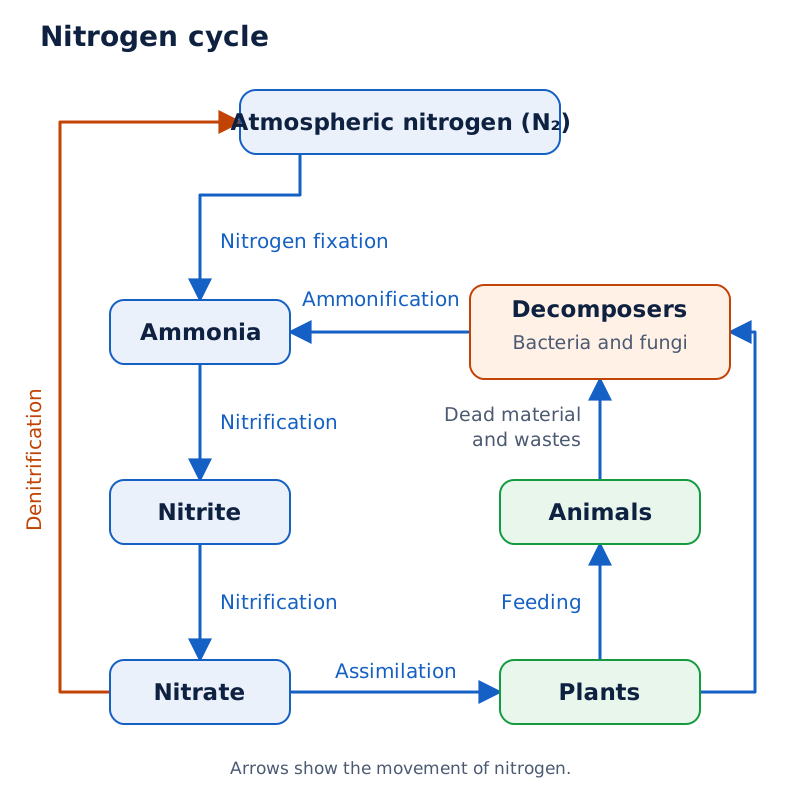
The figure links atmospheric nitrogen at the top to ammonia, nitrite and nitrate. Arrows show nitrogen fixation, nitrification, assimilation, ammonification and denitrification. Plants, an animal and decomposers connect living organisms with the cycle.
Drawn by One Young India.
In this figure, N₂ means nitrogen gas; the small 2 indicates two nitrogen atoms in a molecule. In a written explanation, the names of substances can be used throughout. The essential information is the direction of each conversion and the process responsible.
Fixation, nitrification and denitrification must not be treated as interchangeable terms. Fixation begins with atmospheric nitrogen, nitrification begins with ammonia, and denitrification returns nitrogen from some nitrates to the air. Ammonification provides another route by which ammonia enters the soil.
How are bacteria useful in industry and food processing?
Bacterial activities are useful in the curing of tea and the tanning of leather. Curing refers to processing tea leaves to develop the finished product’s qualities. Tanning is the treatment of animal hides or skins to produce leather.
These are industrial uses because biological activity contributes to processing a material into a useful product. The two applications should be paired correctly: tea curing concerns tea leaves, while leather tanning concerns hides and skins. They are distinct from medicinal and agricultural uses.
How does a bacterial starter change milk?
Lactic acid bacteria, abbreviated as LAB, include Lactobacillus. They grow in milk and convert it into curd. A small amount of curd added to fresh milk acts as an inoculum or starter, meaning material containing the microbes that begin the process.
- A small quantity of curd containing lactic acid bacteria is added to fresh milk as a starter.
- At suitable temperatures, the bacteria multiply in the milk.
- During growth, the bacteria produce acids that coagulate and partially digest milk proteins. Coagulation means causing proteins to form a clot.
- The milk changes into curd, and its nutritional quality improves through an increase in vitamin B₁₂, a vitamin present in the food.
The starter is important because it introduces living bacteria. Their growth and acid production explain the change in milk. The proteins are partially digested; this should not be replaced by a claim that all the proteins disappear or are completely digested.
How does the usefulness depend on the product?
Lactobacillus is also used for producing lactic acid commercially. Acetobacter aceti, another bacterium, produces acetic acid. Both are examples of useful chemical production, but the acids and their producing organisms must be matched correctly.
These examples illustrate different outcomes of bacterial activity: processing materials, changing a food and producing a chemical. Calling every bacterial change “spoilage” would ignore such benefits. Equally, recognising useful food bacteria does not mean that uncontrolled bacterial growth in food is desirable.
What harmful effects can bacteria have?
The harmful roles of bacteria include food spoilage, diseases in plants and animals, and their deliberate misuse as biological weapons. Food spoilage means deterioration that makes food unsuitable for use. These harmful roles must be considered alongside the useful roles of other bacteria.
How are spoilage and disease different?
Food spoilage concerns damage to the food material. Disease concerns damage to a living organism. The two ideas are related to microbial activity but describe different outcomes. A statement about one should not be used as the definition of the other.
Bacterial or fungal growth can cause food to go bad. Refrigeration is used to help prevent this deterioration. Fungi prefer warm and humid places, which explains why moisture and suitable warmth favour fungal growth on materials such as bread and fruit.
Cholera, typhoid and tetanus are examples of bacterial diseases in humans. Citrus canker is a bacterial disease affecting plants. These examples show that bacterial disease is not restricted to one kind of host, the organism in which or on which another organism lives.
Some pathogenic bacteria damage crops, farm animals and pets as well as humans. Their harmful importance includes damage to living resources used by people. Disease-causing bacteria are a subset of bacteria, so it is inaccurate to label the entire group as pathogens.
What is meant by a biological weapon?
A biological weapon involves the deliberate use of disease-causing organisms or their toxic products to cause harm. This differs from the normal occurrence of microbes in the environment. The harmful role here is deliberate misuse of biological agents.
Note: “Microbe”, “bacterium” and “pathogen” are not interchangeable words. Microbes include several groups; a bacterium belongs to one group; a pathogen is identified by its disease-causing role.
A balanced account therefore connects each effect with its context. Bacteria can help produce medicine and food, cycle nutrients, spoil food or cause disease. The name of the group alone does not establish whether a particular activity is useful or harmful.
Why is yeast useful in bakeries and breweries?
Fermentation is the microbial breakdown of substances such as sugars; in yeast, this can produce alcohol and carbon dioxide. Saccharomyces cerevisiae is a yeast used in bread-making and in the production of alcoholic beverages, or drinks.
What is the useful effect in a bakery?
A bakery produces foods such as bread. Baker’s yeast ferments bread dough. Dough is the mixture prepared for making bread, and carbon dioxide released during fermentation gives fermented dough its puffed-up appearance.
CO₂ is the chemical formula for carbon dioxide: one carbon atom and two oxygen atoms form each molecule. This gas is the important product when explaining the rising of dough. The yeast is the living organism responsible for the fermentation.
Bread-making therefore provides a clear connection between a fungal activity and a useful change in food. The yeast is not a bacterium. Its use in a bakery is an example of the economic importance of a single-celled fungus.
What is the useful effect in a brewery?
A brewery makes beer. Brewer’s yeast ferments malted cereals and fruit juices to produce ethanol, the alcohol present in alcoholic drinks. Malted cereals are grains prepared by allowing germination, the start of seed growth, to begin.
The yeast species used for this purpose is also Saccharomyces cerevisiae. Thus, baker’s yeast and brewer’s yeast illustrate different uses of the same named species. One explanation emphasises carbon dioxide in dough; the other emphasises ethanol in fermented beverages.
The raw material and subsequent processing affect the type of alcoholic beverage obtained. For this topic, the useful fungal role is the conversion associated with fermentation. The organism, material acted upon and useful product together provide a complete biological explanation.
Diagram
Comparing useful yeast products
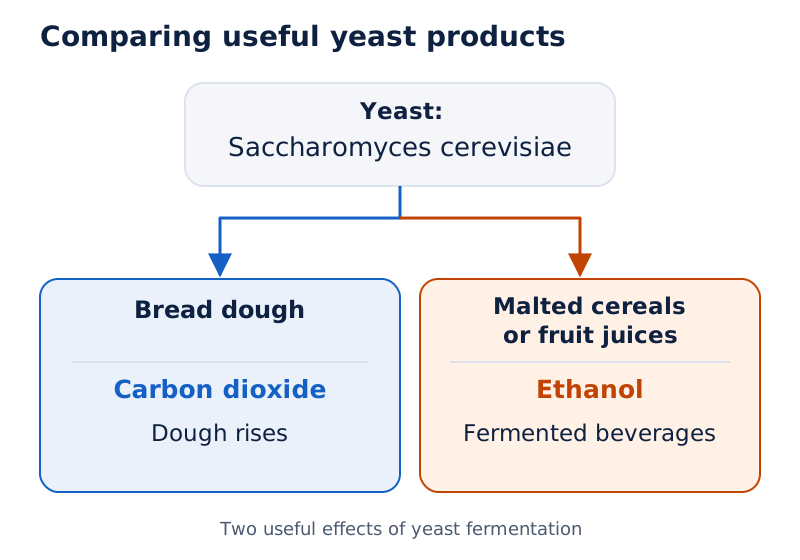
Draw a central box labelled “Yeast: Saccharomyces cerevisiae”. Branch towards bread dough, labelled “carbon dioxide; dough rises”, and towards malted cereals or fruit juices, labelled “ethanol; fermented beverages”. This is a comparison diagram, not a manufacturing sequence.
Drawn by One Young India.
How do fungi contribute to cheese processing?
Cheese processing uses microbial activity to help develop particular qualities in cheese. Different varieties have characteristic texture, flavour and taste, with their specificity coming from the microbes used. Both bacteria and fungi have useful roles, depending on the cheese.
What is the fungal example?
Roquefort cheese is ripened by growing a specific fungus on it. Ripening means the development of the cheese’s characteristic qualities during processing. The fungal growth gives this cheese a particular flavour.
The important relationship is between the selected fungus and the characteristic result. This is not a statement that any fungus growing on any food will improve it. Useful fungal growth in cheese processing and unwanted fungal spoilage are different contexts.
How does Swiss cheese provide a comparison?
The large holes in Swiss cheese result from a large amount of carbon dioxide produced by the bacterium Propionibacterium sharmanii. The gas helps explain the visible holes, whereas the Roquefort example emphasises flavour produced through fungal ripening.
| Feature | Roquefort cheese | Swiss cheese |
|---|---|---|
| Microbial group in the example | Fungus | Bacterium |
| Activity highlighted | Fungal growth during ripening | Production of carbon dioxide |
| Characteristic result | Particular flavour | Large holes |
The comparison prevents a common confusion: the organism associated with holes in Swiss cheese is bacterial, while the organism involved in Roquefort ripening is fungal. Both belong in a wider discussion of useful microbes, but their groups and effects remain distinct.
Cheese processing also shows why “fungus” does not mean “food spoilage”. Some fungal activities are deliberately used to obtain a desired food quality. The benefit depends on the particular organism and its use, rather than on fungal growth in general.
Why is mushroom cultivation economically useful?
Mushroom cultivation means growing edible mushrooms for use as food. A mushroom is a fungus, so its cultivation provides a direct example of fungi being used as food organisms. Here the organism itself is useful, rather than just a chemical it produces.
How does a mushroom obtain food?
Most fungi absorb soluble organic matter from dead material and are called saprophytes. This mode of nutrition differs from making food by photosynthesis, the use of light energy to make organic food. Cultivated edible mushrooms depend on a suitable source of organic nutrients.
The fungal body includes a mycelium of hyphae. The visible mushroom is a reproductive structure called a fruiting body. Thus, the familiar visible part is connected with a wider fungal body rather than representing a green plant with roots and leaves.
How does cultivation compare with other fungal uses?
In mushroom cultivation, the edible fungal material is the useful product. In a bakery, yeast changes dough. In a brewery, yeast produces ethanol. In cheese processing, a fungus helps develop flavour. These examples represent several ways in which fungal life processes become useful.
The examples should therefore be described using precise verbs: mushrooms are grown for food, yeast ferments, and the fungus in Roquefort cheese helps ripen it. These descriptions show the difference between using a fungus directly and using a change brought about by it.
Note: An edible mushroom illustrates a useful fungus. It does not establish that every fungus is edible or that all fungal growth on food is beneficial.
Together, mushroom cultivation and microbial food processing demonstrate the range of fungal economic importance. Some uses depend on visible fungi, while others depend on microscopic yeast cells or fungal growth whose effects are recognised through changes in the food.
Glossary
- Antibiotic — A chemical produced by some microbes that kills or retards the growth of disease-causing microbes.
- Antibody — A protective protein produced by the body in response to a particular foreign substance.
- Vaccine — An antigenic preparation introduced into the body to stimulate an immune response and immune memory.
- Antiserum — A medicinal serum containing ready-made antibodies against a particular antigen, used to provide passive protection.
- Antitoxin — A preparation containing antibodies against a toxin, used when this form of protection is required.
- Nitrogen fixation — Conversion of atmospheric nitrogen into usable nitrogen compounds, carried out by bacteria such as Rhizobium.
- Nitrification — The bacterial conversion of ammonia into nitrite and then nitrite into nitrate in the nitrogen cycle.
- Ammonification — Breakdown of organic material by decomposers, returning nitrogen compounds such as ammonia to the soil.
- Denitrification — Conversion of some nitrates back into nitrogen gas by bacteria, returning nitrogen to the atmosphere.
- Biofertiliser — An organism that enriches the nutrient quality of soil through its biological activity.
- Fermentation — Microbial breakdown of substances such as sugars, producing ethanol and carbon dioxide in yeast.
- Mycelium — The network of long, slender threads called hyphae that forms the body of a filamentous fungus.
- Saprophyte — An organism that obtains nutrients by absorbing soluble organic matter from dead material.
- Pathogen — An organism that causes disease in another organism, which is known as its host.
- Inoculum — Material containing micro-organisms introduced to start their growth, such as curd added to fresh milk.
Common errors and misconceptions
- Misconception: Every bacterium is harmful. Correct: Useful bacteria produce antibiotics, help process food and materials, and transform nitrogen compounds; some other bacteria cause disease.
- Misconception: Penicillin is a bacterium that attacks fungi. Correct: Penicillin is an antibiotic associated with the mould Penicillium; Fleming observed its effect on bacterial growth.
- Misconception: Vaccines and protective antiserums supply the same material. Correct: Vaccines supply antigenic preparations that stimulate an immune response, whereas antiserums supply ready-made antibodies.
- Misconception: Nitrogen fixation and nitrification are identical. Correct: Fixation begins with atmospheric nitrogen; nitrification converts ammonia into nitrite and then nitrate.
- Misconception: Denitrification converts nitrogen gas into nitrate. Correct: Denitrifying bacteria convert some nitrates into nitrogen gas, returning nitrogen to the atmosphere.
- Misconception: Yeast is a bacterium because it is microscopic. Correct: Yeast is a single-celled fungus; Saccharomyces cerevisiae is used in baking and brewing.
- Misconception: Fungi cause the large holes in Swiss cheese. Correct: Carbon dioxide from a bacterium produces those holes; fungal ripening gives Roquefort cheese its particular flavour.
- Misconception: Useful fungal growth means that all fungi on food are desirable. Correct: Selected fungi have useful food applications, but other fungal growth can spoil food.
Exam-style questions with model answers
Q1. A comparison card states that vaccines contain antigenic preparations and stimulate the recipient’s response, whereas protective antiserums contain ready-made antibodies. State two differences using this information. [2 marks]
- A vaccine supplies an antigenic preparation, while a protective antiserum supplies antibodies that have already been made.
- A vaccine stimulates the recipient to respond, whereas an antiserum transfers the protective antibodies directly to the recipient.
Q2. A process chart gives these conversions: Rhizobium converts atmospheric nitrogen into usable ammonia; Nitrosomonas converts ammonia into nitrite; Nitrobacter converts nitrite into nitrate; Pseudomonas converts some nitrates into nitrogen gas. Nitrogen fixation starts with atmospheric nitrogen, nitrification converts ammonia to nitrate through nitrite, and denitrification returns nitrogen gas. Explain the role of each bacterium. [4 marks]
- Rhizobium carries out nitrogen fixation by converting atmospheric nitrogen into ammonia, bringing nitrogen from the air into a usable compound.
- Nitrosomonas carries out the first nitrification step, using ammonia as the starting material and producing nitrite.
- Nitrobacter carries out the second nitrification step by converting the nitrite formed in the preceding step into nitrate.
- Pseudomonas carries out denitrification by converting some nitrates back into nitrogen gas, returning nitrogen to the atmospheric reservoir.
Q3. A milk-processing account states that a little curd supplies lactic acid bacteria, these multiply at suitable temperatures, and their acids coagulate and partially digest milk proteins. It also states that vitamin B₁₂ increases as curd forms. Explain the starter’s role, the protein change and the nutritional change. [3 marks]
- The added curd is a starter because it introduces lactic acid bacteria, which multiply in the fresh milk when the temperature is suitable.
- The growing bacteria produce acids that coagulate and partially digest the milk proteins. The change is partial digestion, not complete destruction of all milk protein.
- The curd has improved nutritional quality because the process increases vitamin B₁₂. This benefit is additional to the change in the milk’s proteins.
Q4. A food-use chart states: Saccharomyces cerevisiae is a yeast fungus; it ferments bread dough, releasing carbon dioxide that makes dough rise; it ferments malted cereals and fruit juices to produce ethanol for beverages; a fungus ripens Roquefort cheese and gives it a particular flavour; edible mushrooms are cultivated as food. Explain five useful connections shown by the chart. [5 marks]
- Saccharomyces cerevisiae is identified as a yeast fungus. Its useful activities therefore illustrate fungal economic importance rather than an example of bacterial food processing.
- In bread dough, yeast fermentation releases carbon dioxide. The gas makes the dough rise, connecting a microbial product with a useful change in baking.
- In malted cereals and fruit juices, yeast fermentation produces ethanol. This connects the fungal activity with the production of fermented beverages.
- In Roquefort cheese, fungal ripening gives a particular flavour. The useful effect here concerns the development of the food’s characteristic quality.
- Edible mushrooms are cultivated as food. In this example, fungal material itself is used, rather than just a chemical or food change produced by fungi.
Q5. Fleming observed Staphylococci bacteria failing to grow around a mould. The mould was Penicillium notatum, and its inhibitory chemical was called penicillin. Identify the producing organism and the useful product, explaining the observation. [2 marks]
- The producing organism was the mould Penicillium notatum, which grew in the culture containing Staphylococci bacteria.
- The useful product was penicillin; its inhibitory effect explains why the bacteria failed to grow around the mould.
Q6. An application list pairs bacteria with the industrial uses of tea curing and leather tanning, food spoilage, citrus canker in plants, and the deliberate misuse of disease-causing organisms as biological weapons. Tea curing processes leaves, tanning processes hides into leather, and spoilage makes food unsuitable for use. Explain each application or harm in one separate point. [5 marks]
- Tea curing is a useful processing role involving tea leaves. It belongs to the industrial importance of bacteria because the activity contributes to preparing a useful product.
- Leather tanning is another useful industrial role. It concerns the treatment of hides to produce leather, so its material differs from that used in tea curing.
- Food spoilage is harmful because the food deteriorates and becomes unsuitable for use. This represents damage to a food resource rather than useful processing.
- Citrus canker illustrates a harmful bacterial disease of plants. It demonstrates that bacterial disease is not restricted to humans or other animals.
- Biological weapons involve deliberate misuse of disease-causing organisms to cause harm. This harmful application differs from their ordinary presence in the environment.
Key takeaways
- Bacteria and fungi have useful and harmful effects; their economic importance depends on the organism, its activity and the material affected.
- Antibiotics are microbial chemicals that kill or retard pathogens; vaccines stimulate immune responses, while protective antiserums supply ready-made antibodies.
- Nitrogen fixation brings atmospheric nitrogen into usable compounds; nitrification converts ammonia into nitrite and then nitrate.
- Ammonification returns nitrogen compounds from organic remains and wastes to soil, while denitrification returns nitrogen from some nitrates to the atmosphere.
- Bacterial uses include tea curing, leather tanning and curd formation; harmful roles include spoilage, disease and deliberate misuse as biological weapons.
- Saccharomyces cerevisiae is a yeast fungus used in baking and brewing, with carbon dioxide and ethanol as useful fermentation products.
- Fungal ripening gives Roquefort cheese a particular flavour, whereas bacterial carbon dioxide produces the large holes in Swiss cheese.
- Mushroom cultivation provides edible fungal material as food, showing a direct use of fungi alongside their roles in food processing.
Test yourself
Why can plants not simply use the nitrogen gas surrounding them?
Nitrogen gas is relatively unreactive and cannot be used directly by plants. It must first be converted into soluble nitrogen compounds that plants can absorb.
What distinguishes Nitrosomonas from Nitrobacter in the nitrogen cycle?
Nitrosomonas converts ammonia into nitrite; Nitrobacter converts nitrite into nitrate. Both steps form part of nitrification.
What does Pseudomonas do in denitrification?
It converts some nitrates back into nitrogen gas, returning nitrogen to the atmosphere.
Why is an antiserum associated with passive immunity?
It supplies ready-made antibodies directly, rather than depending on the recipient to produce those antibodies first.
Which fungal species connects bread-making with fermented beverages?
Saccharomyces cerevisiae is the yeast used for fermenting bread dough and producing ethanol in fermented beverages.
Why should penicillin not be described as a bacterium?
Penicillin is an antibiotic chemical associated with the mould Penicillium, not a bacterial organism.
What is the difference between fungal ripening of Roquefort and bacterial activity in Swiss cheese?
Fungal ripening gives Roquefort its particular flavour, while bacterial carbon dioxide produces the large holes in Swiss cheese.
How does mushroom cultivation differ from using yeast to produce ethanol?
Mushroom cultivation supplies edible fungal material itself, whereas yeast fermentation supplies a useful chemical product, ethanol.
Write about it
Turn a question from this chapter into a paper.
The Writing Studio has a structure guide, a rubric and citation tools for 15 formats, from essays to research papers. Drafting is free with an account. Learnacy Essential adds feedback from an AI writing coach and submission to The OYI Review.
Publication depends on review and is not guaranteed.