
Diversity in Animal Kingdom | ICSE Class 9 Biology Notes
On this page
Watch & explore
Start with a few high-quality watches, then dive into the notes below.
This note covers the basis of animal classification, body organisation, symmetry, body cavities, non-chordate groups, chordate features, fishes, amphibians, reptiles, birds and mammals, with identifying characters, comparisons and examples.
How are animals classified using their body organisation?
Classification groups animals by shared features of their structure and organisation. It helps place newly described animals systematically. All members of Animalia, the animal kingdom, are multicellular, meaning that their bodies contain many cells. Their cells are not all arranged in the same way.
A phylum is a major group within the animal kingdom; its plural is phyla. A class is a smaller classification group within a phylum. Shared body features allow animals to be compared beyond differences in their outward appearance.
What are the levels of organisation?
| Level | Arrangement | Example |
|---|---|---|
| Cellular | Cells form loose aggregates, with some division of labour between cells. | Sponges |
| Tissue | Cells performing the same function are organised into tissues. | Coelenterates |
| Organ | Tissues combine into organs specialised for particular functions. | Flatworms |
| Organ system | Organs work together in systems carrying out particular body functions. | Annelids, arthropods, molluscs, echinoderms and chordates |
Division of labour means that different cells or structures perform different activities. A tissue is an organised group of cells performing the same function; an organ combines tissues. An organ system brings organs together for a particular function.
How do digestive and circulatory arrangements differ?
A digestive system breaks down food. An incomplete digestive system has one opening serving as both mouth and anus. A complete digestive system has separate openings: the mouth for entry and the anus for the exit of undigested material.
A circulatory system transports blood. In an open system, blood pumped from the heart directly bathes cells and tissues. In a closed system, blood travels through vessels. These different arrangements help distinguish animal groups alongside symmetry and the presence of a body cavity.
Note: Multicellular does not mean that an animal has organs. Sponges contain many cells but show cellular organisation. The number of cells and the way those cells are organised are different classification features.
How do symmetry, body layers and body cavities distinguish animals?
Symmetry describes how an animal's body can be divided into matching halves. Mostly asymmetrical sponges cannot be divided into equal halves by a plane through the centre. Here, a plane means an imaginary flat cutting surface through the body.
In radial symmetry, any plane through the central body axis produces identical halves. In bilateral symmetry, only one plane divides the body into matching left and right halves. Coelenterates are radial; annelids and arthropods are bilateral.
What the figure shows
Radial and bilateral symmetry
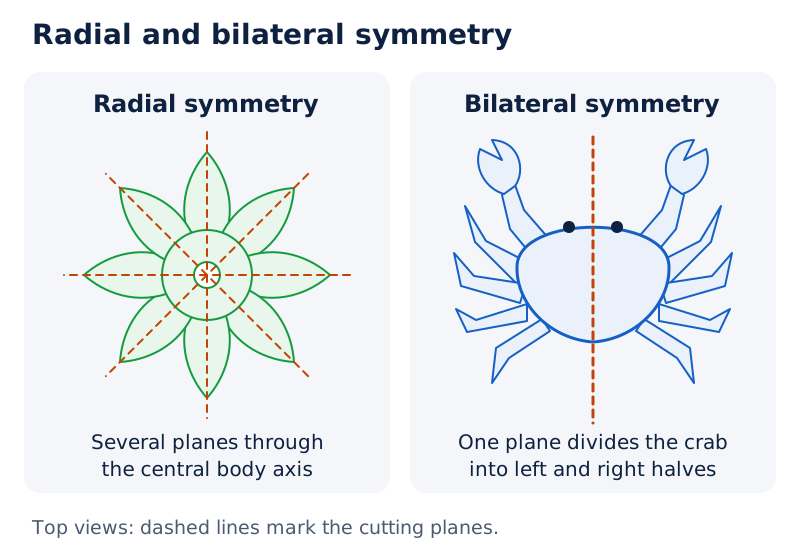
The radial drawing shows several planes through the centre of an animal with spreading arms. The bilateral drawing shows a crab divided into left and right halves by one central plane.
Drawn by One Young India.
What are embryonic layers?
An embryo is an animal in an early stage of development. Its developing cell layers are called germinal or embryonic layers. Ectoderm is the outer layer and endoderm the inner layer. Animals with these two layers are diploblastic, as in coelenterates.
Mesoglea is the undifferentiated layer between ectoderm and endoderm in this arrangement. Triploblastic animals have a third embryonic layer, the mesoderm, between ectoderm and endoderm. Flatworms and the groups from them to chordates show this three-layered organisation.
What is a coelom?
The coelom is a body cavity between the body wall and the gut wall, lined by mesoderm. The gut is the food-processing passage. Coelomates possess this cavity; examples include annelids, arthropods, molluscs, echinoderms and chordates.
A pseudocoelom is a body cavity not lined by mesoderm, which instead occurs as scattered pouches between ectoderm and endoderm. Roundworms are pseudocoelomates. Acoelomates, such as flatworms, lack a body cavity between the body wall and gut.
What the figure shows
Types of body cavity
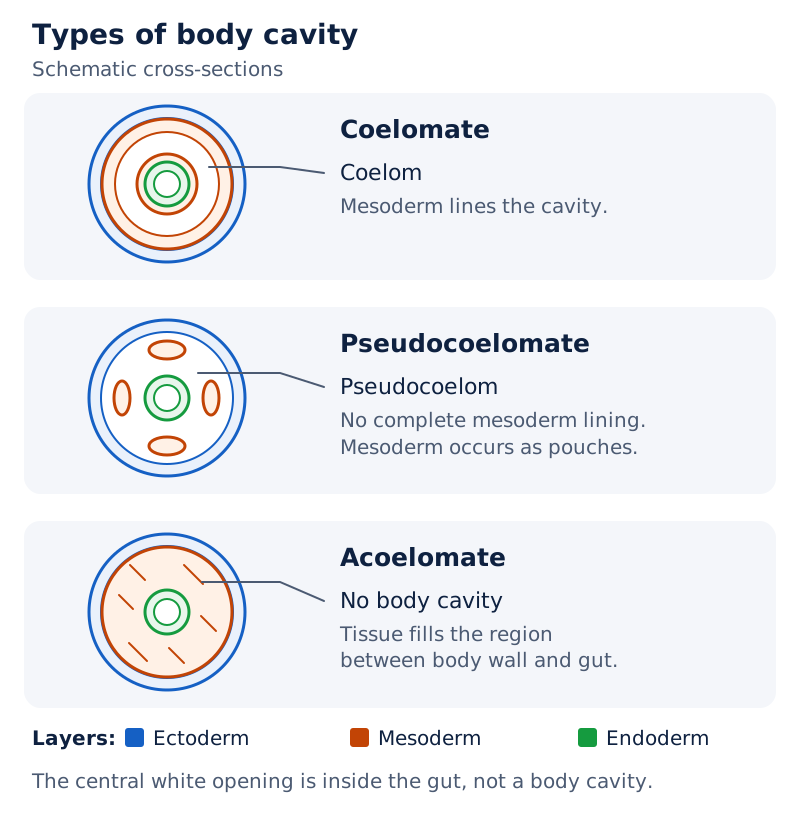
Three circular sections are labelled coelomate, pseudocoelomate and acoelomate. The first two show spaces labelled coelom and pseudocoelom respectively; the acoelomate section shows tissue filling the region around the central gut.
Drawn by One Young India.
What identifies Porifera and how does water move through a sponge?
Porifera includes sponges. They are generally marine, meaning that they live in the sea, and mostly asymmetrical. Their cells form loose aggregates with cellular organisation. A particularly useful identifying feature is their water transport system, also called the canal system.
What are the parts of the canal system?
Water enters the sponge through ostia, the minute pores in its body wall. It reaches the spongocoel, the central cavity, and leaves through the osculum, the outlet opening. This pathway helps in collecting food, exchanging respiratory gases and removing waste.
Choanocytes, also called collar cells, line the spongocoel and canals. Digestion is intracellular, meaning that food is broken down inside cells. The body is supported by a skeleton of spicules, small supporting elements, or spongin fibres, supporting fibres in the sponge body.
How do sponges reproduce?
Sponges are hermaphrodites: the same individual produces eggs and sperms. These reproductive cells are called gametes. Sexual reproduction involves gametes, while asexual reproduction does not involve their fusion. Sponges reproduce asexually by fragmentation, in which body fragments give rise to new individuals.
Fertilisation is the fusion of male and female gametes. It is internal in sponges, meaning that fusion occurs inside the body. Their development is indirect: a larva, an immature stage with a body form different from the adult, occurs during development.
What is the sequence of sexual reproduction in sponges?
- The adult sponge produces eggs and sperms; the same individual produces both kinds of gametes.
- Internal fertilisation occurs within the body.
- Development includes a larval stage whose body form differs from that of the adult.
- The larval stage is followed by the adult stage, completing indirect development.
Examples are Sycon, also called Scypha; Spongilla, the freshwater sponge; and Euspongia, the bath sponge. Spongilla is an important reminder to retain the description “generally marine”. It would be incorrect to change this into a claim that every sponge lives in the sea.
What distinguishes Coelenterata and its two body forms?
Coelenterata, also called Cnidaria, includes aquatic animals, meaning animals living in water. They are mostly marine and have radial symmetry. They may be sessile, attached in one place, or free-swimming. Their organisation is at the tissue level and they are diploblastic.
What is special about their stinging cells?
Cnidoblasts, or cnidocytes, are cells containing stinging capsules called nematocysts. They occur on the body and tentacles, the projecting structures around the mouth. These cells help with attachment, defence and capturing prey, the animals taken as food.
The central gastro-vascular cavity is a cavity for digestion with a single opening. Digestion is both extracellular, outside cells, and intracellular. Some cnidarians, such as corals, have a skeleton made of calcium carbonate, a mineral compound. This skeleton is not a feature to assign to every cnidarian.
How do polyp and medusa differ?
A polyp is a sessile, cylindrical body form, represented by Hydra and Adamsia, the sea anemone. A medusa is an umbrella-shaped, free-swimming form, represented by Aurelia, the jellyfish. These are body forms within the same animal group.
What the figure shows
Polyp and medusa
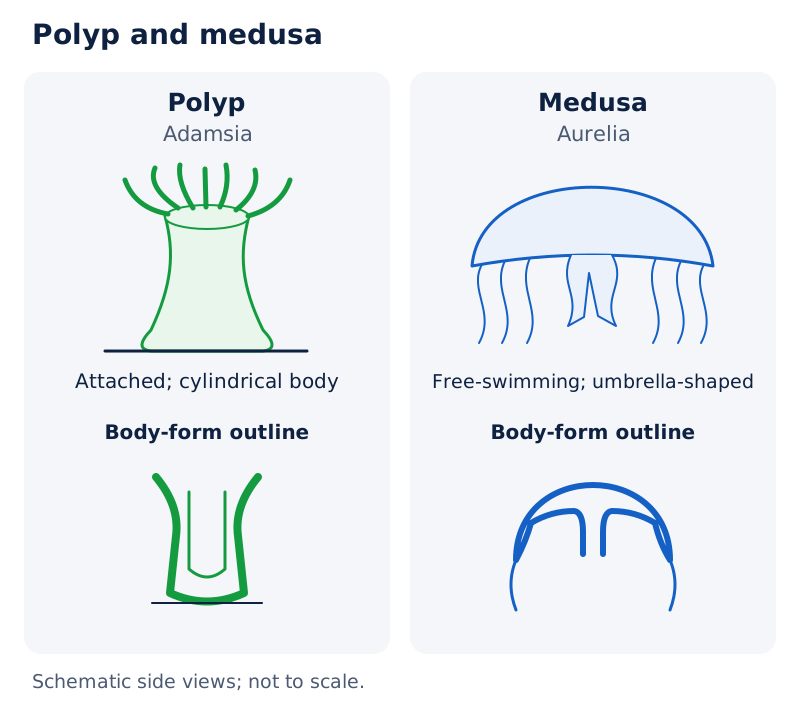
Aurelia is drawn with an umbrella-shaped body and hanging structures below it. Adamsia is drawn as an upright column attached at its base, with tentacles at the top. Outline drawings beneath them compare the two body forms.
Drawn by One Young India.
Metagenesis is the alternation of these forms in cnidarians that possess both. In Obelia, polyps produce medusae asexually, while medusae produce polyps sexually. The condition belongs to cnidarians that have both forms; it should not be extended to every member of Coelenterata.
What is the sequence of metagenesis in Obelia?
- Begin with the polyp phase of the life cycle.
- The polyps reproduce asexually to produce medusae.
- The cycle now has a medusa phase, the other body form.
- The medusae reproduce sexually to form polyps, returning the cycle to the polyp phase.
Other examples include Physalia, the Portuguese man-of-war; Pennatula, the sea-pen; Gorgonia, the sea-fan; and Meandrina, the brain coral. Stinging cells provide a stronger identifying character for this group than simply living in water or having tentacles.
How are comb jellies different from cnidarians?
Ctenophora includes the animals commonly called comb jellies or sea walnuts. They are exclusively marine, radially symmetrical and diploblastic, with tissue-level organisation. These features overlap with features of cnidarians, so more distinctive structures are needed to tell the groups apart.
What are comb plates?
Ctenophores have eight external rows of comb plates, structures bearing cilia, small hair-like projections. These plates help in locomotion, movement from place to place. The defining movement-related feature is therefore the comb plates, while cnidarians are recognised by their stinging cells, the cnidoblasts.
Digestion in ctenophores is both extracellular and intracellular. Bioluminescence, the ability of a living organism to emit light, is well-marked in this group. Examples are Pleurobrachia and Ctenoplana. Their exclusive marine habitat contrasts with the description of cnidarians as mostly marine.
How do ctenophores reproduce?
Sexes are not separate. Reproduction takes place only sexually; fertilisation is external and development is indirect. This differs from the asexual and sexual phases described for Obelia. Radial symmetry alone therefore does not identify an animal as a cnidarian or establish its reproductive pattern.
How do flatworms differ from roundworms?
Platyhelminthes are flatworms with bodies flattened from the back towards the belly. They are mostly endoparasites, animals living inside another animal and obtaining nourishment from it. The animal that supports a parasite is its host. Flatworms occur in animal hosts including human beings.
Flatworms are bilateral, triploblastic and acoelomate, with organ-level organisation. Parasitic forms possess hooks and suckers. Some absorb nutrients directly through their body surface. Flame cells are specialised cells for excretion, the removal of body wastes, and osmoregulation, the regulation of water and salt balance.
Examples include Taenia, the tapeworm, and Fasciola, the liver fluke. Planaria has a high capacity for regeneration, the replacement of lost body parts. The word “mostly” matters: the group must not be described as consisting entirely of internal parasites.
What identifies the roundworm group?
Nemathelminthes is the roundworm group, here considered with Aschelminthes. These animals have bodies circular in cross-section. They may live freely in water or on land, or as parasites in plants and animals. They have organ-system organisation and a pseudocoelom.
Their complete digestive passage includes a muscular pharynx, a region that helps move food along the passage. An excretory tube removes wastes through an excretory pore. They are dioecious, meaning that males and females are separate individuals. Often females are longer than males.
| Feature | Flatworms | Roundworms |
|---|---|---|
| Body shape | Flattened from back to belly | Circular in cross-section |
| Body cavity | Absent: acoelomate | Pseudocoelom present |
| Organisation | Organ level | Organ-system level |
| Sexes | Not separate | Separate |
| Excretion | Flame cells | Excretory tube and pore |
| Examples | Taenia and Fasciola | Ascaris and Wuchereria |
Roundworm fertilisation is internal. Development may be direct, with young resembling adults, or indirect. Besides Ascaris, the roundworm, and Wuchereria, the filarial worm, the group includes Ancylostoma, the hookworm. A worm-like shape alone does not distinguish flatworms from roundworms.
What makes annelids segmented worms?
Annelida includes animals whose body surface is distinctly divided into repeated segments or metameres. They are bilateral, triploblastic and coelomate, with organ-system organisation. They may live in marine water, fresh water or on land; they are free-living and sometimes parasitic.
What does metameric segmentation mean?
Metameric segmentation means that the body is divided externally and internally into segments, with serial repetition of at least some organs. This arrangement is also called metamerism. The earthworm provides an example of this body plan.
True segmentation and a true coelom distinguish annelids from the flatworm and roundworm groups. Flatworms are acoelomate and roundworms are pseudocoelomate. Annelids combine a mesoderm-lined body cavity with repeated body segments, so the classification depends on more than an elongated body shape.
How do annelids move and remove waste?
Muscles running along the body and circular muscles help in locomotion, movement from place to place. Aquatic annelids such as Nereis also possess parapodia, lateral body appendages that help in swimming. An appendage is a structure projecting from the body.
Annelids have a closed circulatory system. Nephridia are organs that help with excretion and osmoregulation; one such organ is a nephridium. Blood transport and waste removal are separate functions, although both are features useful in describing the organisation of the group.
Reproduction is sexual. Nereis has separate sexes, but earthworms and leeches are monoecious, meaning that male and female reproductive functions occur in the same individual. Examples include Nereis, Pheretima, the earthworm, and Hirudinaria, the blood-sucking leech. Separate sexes are therefore not a universal annelid character.
Why are jointed appendages important in identifying arthropods?
Arthropoda is the largest animal phylum and includes insects. Arthropods have jointed appendages, meaning body projections with joints. They are bilateral, triploblastic, segmented and coelomate animals with organ-system organisation. Their jointed appendages are a key feature when identifying the group.
The body has an exoskeleton, an external supporting covering, made of chitin, the material forming the arthropod body covering. The body consists of head, thorax and abdomen; thorax names the region after the head, and abdomen the region following it.
How are circulation, respiration and reproduction described?
Circulation is open: blood pumped from the heart directly bathes the tissues. Respiratory structures, which exchange gases, include gills, gas-exchanging organs, or a tracheal system, an arrangement of air tubes. Different members have different respiratory structures.
Antennae are sensory appendages, while eyes and balancing organs also help animals detect their surroundings or orientation. Malpighian tubules are structures involved in excretion. These features supplement the more immediately recognisable combination of a segmented body, external covering and jointed appendages.
Arthropods are mostly dioecious, fertilisation is usually internal, and they are mostly oviparous, meaning egg-laying. Development may be direct or indirect. Keep “mostly” and “usually” in these statements: the general reproductive pattern must not be turned into an exceptionless rule.
Which examples belong here?
Examples include locusts, butterflies, scorpions and prawns. Economically important insects include Apis, the honey bee; Bombyx, the silkworm; and Laccifer, the lac insect. These examples show that Arthropoda contains insects as well as other animals with the defining group features.
Annelids and arthropods both possess segmentation and a coelom. Their circulatory systems differ: annelids have closed circulation, while arthropods have open circulation. Jointed appendages and the chitinous external covering provide additional evidence for recognising arthropods.
What are the identifying features of molluscs?
Mollusca is the second largest animal phylum. Molluscs live on land or in water, including marine and freshwater habitats. They have organ-system organisation, bilateral symmetry, three embryonic layers and a coelom. Their bodies are unsegmented.
How is the body arranged?
The body has a distinct head, a muscular foot, a muscular body region, and a visceral hump, the region containing internal organs. A soft, spongy skin layer called the mantle lies over the visceral hump. An external shell is usually present.
The shell is calcareous, meaning made of calcium carbonate. The space between the mantle and visceral hump is the mantle cavity. Feather-like gills occur in this cavity and perform respiratory and excretory functions. The head region bears sensory tentacles.
A radula is the file-like rasping structure used in feeding. This term refers to a feeding structure, while mantle refers to a covering layer and mantle cavity to a space. Keeping these three descriptions distinct helps connect each structure with its position and function.
Which examples and reproductive features matter?
Molluscs are usually dioecious and oviparous with indirect development. Examples include Pila, the apple snail; Pinctada, the pearl oyster; Sepia, the cuttlefish; Loligo, the squid; and Octopus, the devil fish. A common name containing “fish” does not place an animal among fishes.
Compared with annelids and arthropods, molluscs have an unsegmented body. Compared with arthropods, their usual external covering is a calcareous shell, while the arthropod exoskeleton is chitinous. Use the head, muscular foot, visceral hump and mantle together to recognise the molluscan body plan.
How do echinoderms combine a spiny body with a water vascular system?
Echinodermata includes marine animals with a supporting skeleton of calcareous ossicles, small skeletal elements. Their endoskeleton is an internal supporting skeleton. They have organ-system organisation, three embryonic layers and a coelom. The group name refers to their spiny bodies.
Does symmetry stay the same throughout life?
Adult echinoderms are radially symmetrical, but their larvae are bilaterally symmetrical. Both descriptions are needed. It is misleading to assign one symmetry to every stage of an echinoderm's life. The developmental stage must be stated when describing this classification feature.
The digestive system is complete. The mouth is on the lower or ventral side, while the anus is on the upper or dorsal side. Ventral refers to the belly side of an animal; dorsal refers to its back side.
What does the water vascular system do?
The water vascular system, a water-based system within the body, is the most distinctive echinoderm feature. It helps with locomotion, capture and transport of food, and respiration. An excretory system is absent. These functions must not be confused with the sponge canal system.
Sponges use water passing through pores, the central cavity and the outlet for food gathering, gas exchange and waste removal. Echinoderms possess a water vascular system that also assists movement. The shared involvement of water does not make the systems identical.
Sexes are separate and reproduction is sexual. Fertilisation is usually external, meaning that gametes fuse outside the body. Development is indirect, with a free-swimming larva. Examples include Asterias, the starfish; Echinus, the sea urchin; Antedon, the sea lily; Cucumaria, the sea cucumber; and Ophiura, the brittle star.
How does an echinoderm develop from reproduction to adulthood?
- Reproduction is sexual, with males and females occurring as separate individuals.
- Fertilisation takes place and is usually external.
- Indirect development includes a free-swimming larva with bilateral symmetry.
- The larval stage is followed by an adult with radial symmetry.
What distinguishes chordates from non-chordates?
A notochord is a rod-like structure formed from mesoderm on the dorsal side during embryonic development. Chordates possess a notochord throughout life or during early development. Non-chordates do not form this structure. Porifera through Echinodermata belong among the non-chordate groups.
Which structures define the chordate body plan?
Chordates have a dorsal, hollow nerve cord, an elongated nervous structure, and paired pharyngeal gill slits, openings in the pharynx. They also possess a post-anal tail, a body extension beyond the anus. They are bilateral, triploblastic and coelomate, with organ-system organisation.
What the figure shows
Chordate characteristics
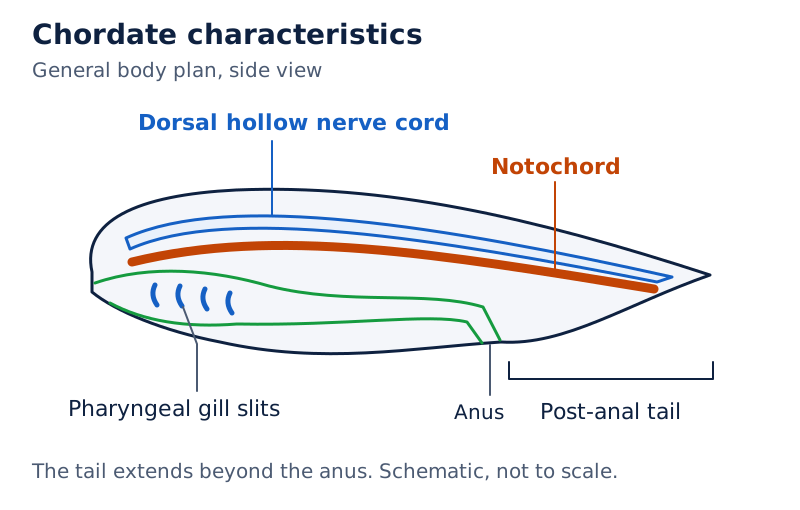
The elongated body drawing labels the nerve cord above the notochord, gill slits towards the front, and a post-anal part at the tail end. The two long dorsal structures are labelled separately.
Drawn by One Young India.
Are all chordates vertebrates?
Vertebrates are chordates with a vertebral column, or backbone. They have a notochord during embryonic development, with a cartilaginous or bony vertebral column in the adult. Cartilage is a supporting skeletal tissue distinct from bone. All vertebrates are chordates, but not all chordates are vertebrates.
In Urochordata, a chordate subgroup, the notochord occurs only in the larval tail. In Cephalochordata, another subgroup, it extends from head to tail and persists throughout life. Examples are Ascidia for Urochordata and Branchiostoma, also called Amphioxus, for Cephalochordata. Both groups are exclusively marine.
The five groups considered next are Pisces, the fishes; Amphibia, the amphibians; Reptilia, the reptiles; Aves, the birds; and Mammalia, the mammals. They share the basic chordate plan while differing in body covering, movement, gas exchange, temperature regulation and reproduction.
How do cartilaginous and bony fishes compare within Pisces?
Pisces groups fishes that bear fins for locomotion. Two groups are Chondrichthyes, with a cartilaginous internal skeleton, and Osteichthyes, with a bony internal skeleton. Both have streamlined bodies, shaped to pass through water, and use gills for gas exchange.
Both groups have a two-chambered heart: one auricle, a receiving chamber, and one ventricle, a pumping chamber. They are poikilothermous, or cold-blooded, meaning they lack the capacity to regulate their body temperature. The term does not mean their blood is always cold.
Which features distinguish the two groups?
| Feature | Cartilaginous fishes | Bony fishes |
|---|---|---|
| Habitat | Marine | Marine and fresh water |
| Skeleton | Cartilage | Bone |
| Mouth | On the ventral side | Mostly at the front end |
| Gill covering | Separate gill slits without an operculum, or gill cover | Four pairs of gills covered by an operculum on each side |
| Air bladder | Absent | Present; regulates buoyancy |
| Fertilisation | Internal | Usually external |
| Examples | Scoliodon, the dogfish; Pristis, the sawfish | Labeo, the rohu; Catla, the katla |
An air bladder is an internal air-containing structure that regulates buoyancy, the tendency to remain supported in water. Cartilaginous fishes lack an air bladder and have to swim constantly to avoid sinking. Bony fishes possess an air bladder that regulates buoyancy.
Cartilaginous fishes have separate sexes and internal fertilisation; many are viviparous, meaning they give birth to young. Bony fishes also have separate sexes, but fertilisation is usually external. They are mostly oviparous and their development is direct.
Note: Do not replace “many” with “all” for live-bearing cartilaginous fishes. Equally, retain “usually” for external fertilisation and “mostly” for egg-laying in bony fishes. These are group patterns with the qualifications kept intact.
How can amphibians and reptiles be distinguished?
Amphibia includes animals that can live in aquatic and terrestrial habitats; terrestrial means on land. Most have two pairs of limbs. Their bodies have a head and trunk, the main body region, and a tail may be present in some.
Their skin is moist and lacks scales. Respiration occurs through gills, lungs and skin. Their heart has three chambers, two auricles and one ventricle. They are cold-blooded, have separate sexes, show external fertilisation and are oviparous with indirect development.
Which amphibian examples show variety?
Examples include Bufo, the toad; Rana, the frog; Hyla, the tree frog; Salamandra, the salamander; and Ichthyophis, a limbless amphibian. Ichthyophis shows why “most have two pairs of limbs” is more accurate than saying every amphibian has four limbs.
What are the main reptile characters?
Reptilia includes mostly terrestrial animals with dry, cornified, or hardened, skin and scales or scutes, the protective plates of the covering. Limbs, when present, occur in two pairs. Snakes lack limbs. Reptiles are cold-blooded.
The reptilian heart is usually three-chambered, but crocodiles have four chambers. Sexes are separate, fertilisation is internal, and reptiles are oviparous with direct development. Examples include Chelone, the turtle; Testudo, the tortoise; Chameleon, the tree lizard; Crocodilus, the crocodile; and Naja, the cobra.
| Feature | Amphibians | Reptiles |
|---|---|---|
| Skin | Moist, without scales | Dry, cornified, with scales or scutes |
| Limbs | Most have two pairs | Two pairs when present |
| Heart | Three chambers | Usually three chambers; four in crocodiles |
| Fertilisation | External | Internal |
| Development | Indirect | Direct |
Use several features together when identifying these groups. Moist, scaleless skin supports identification as an amphibian, whereas dry skin with scales or scutes supports identification as a reptile. The crocodile exception prevents heart chamber number alone from becoming a misleading rule.
How do birds and mammals differ despite sharing temperature regulation?
Aves includes birds, recognised by feathers and a beak. Their forelimbs are modified into wings. Most can fly, with flightless birds such as the ostrich as exceptions. Their hindlimbs generally have scales and are adapted for walking, swimming or clasping branches.
What other features identify birds?
Birds have a bony endoskeleton; their long bones are hollow with air cavities, described as pneumatic. The heart has four chambers. Respiration occurs through lungs, with connected air sacs supplementing respiration. Sexes are separate, fertilisation is internal, and birds are oviparous with direct development.
Birds are homoiothermous, or warm-blooded: they can maintain a constant body temperature. This feature is shared with mammals. Examples of birds include Corvus, the crow; Columba, the pigeon; Psittacula, the parrot; Struthio, the ostrich; and Pavo, the peacock.
Which features identify mammals?
Mammalia is distinguished by mammary glands, the milk-producing glands used to nourish young. Mammals have hair, external ears called pinnae, and different types of teeth in the jaws. Their four-chambered heart and lungs support circulation and respiration.
Mammals occur in varied habitats, and some are adapted to fly or live in water. Their limbs are adapted for activities including walking, running, climbing, burrowing, swimming or flying. Examples include Pteropus, the flying fox; Delphinus, the common dolphin; and Balaenoptera, the blue whale.
Sexes are separate and fertilisation is internal. Mammals are viviparous with few exceptions, and development is direct. Ornithorhynchus, the platypus, is an oviparous mammal. Its egg-laying habit is an exception to the usual reproductive pattern, not a reason to remove it from Mammalia.
Feathers distinguish birds, while hair and mammary glands distinguish mammals. A four-chambered heart alone cannot separate the groups because both possess it. Flight is also insufficient: most birds fly, some birds are flightless, and some mammals are adapted for flight.
Glossary
- Classification — Grouping animals systematically by shared features of their structure and body organisation.
- Radial symmetry — A body arrangement allowing any plane through the central axis to produce identical halves.
- Bilateral symmetry — A body arrangement in which only one plane produces matching left and right halves.
- Diploblastic — Having two embryonic cell layers, the outer ectoderm and the inner endoderm.
- Triploblastic — Having three embryonic layers, with mesoderm between the ectoderm and the endoderm.
- Coelom — A mesoderm-lined body cavity situated between the body wall and the gut wall.
- Pseudocoelom — A body cavity not lined by mesoderm, with mesoderm instead occurring as scattered pouches.
- Acoelomate — An animal without a body cavity between its body wall and gut.
- Metamerism — External and internal body segmentation with serial repetition of at least some organs.
- Notochord — A rod-like structure derived from mesoderm and formed dorsally during embryonic development.
- Oviparous — Describes egg-laying animals, including birds and the platypus among the examples considered here.
- Viviparous — Describes animals that give birth to young, including mammals with few exceptions.
- Poikilothermous — Describes animals lacking the capacity to regulate body temperature, including fishes, amphibians and reptiles.
- Homoiothermous — Describes animals able to maintain a constant body temperature, including birds and mammals.
- Indirect development — Development involving a larval stage whose body form differs from that of the adult.
Common errors and misconceptions
- Misconception: Every sponge is marine. Correct: Sponges are generally marine. Spongilla is a freshwater sponge, so the habitat statement must retain its qualification.
- Misconception: Every worm belongs to the same phylum. Correct: Flatworms, roundworms and annelids differ in body shape, body cavity and segmentation and belong to different phyla.
- Misconception: Every radially symmetrical animal is a cnidarian. Correct: Ctenophores and adult echinoderms also have radial symmetry; stinging cells, comb plates and the water vascular system distinguish these groups.
- Misconception: Echinoderms are radially symmetrical at every stage. Correct: Adults are radial, while larvae are bilateral. State the stage when describing their symmetry.
- Misconception: Every chordate is a vertebrate. Correct: All vertebrates are chordates, but chordates also include Urochordata and Cephalochordata outside Vertebrata.
- Misconception: Every reptile has a three-chambered heart. Correct: The heart is usually three-chambered, but crocodiles have four chambers.
- Misconception: Flight identifies birds, and every mammal gives birth to young. Correct: Ostriches are flightless birds, some mammals fly, and the platypus is an egg-laying mammal.
Exam-style questions with model answers
Q1. Adult echinoderms can be divided into identical halves by any plane through the central body axis. Their larvae can be divided into matching left and right halves in only one plane. Name the symmetry at each stage, using the given descriptions. [2 marks]
- The adult has radial symmetry because any plane through its central body axis produces identical halves.
- The larva has bilateral symmetry because only one plane produces matching left and right halves.
Q2. In a sponge, water enters through minute body-wall pores called ostia, reaches the central spongocoel and exits through the osculum. The pathway assists food gathering, respiratory gas exchange and waste removal. State the complete route, then describe any two of these functions in separate points. [3 marks]
- The complete water route is from the ostia, the minute body-wall pores, into the central spongocoel and then out through the osculum.
- The water transport pathway helps in food gathering. Collecting food is one of the functions served by water passing through the sponge.
- The pathway also supports respiratory gas exchange. Thus, its role includes exchanging gases as well as helping the animal gather food.
Q3. Flatworms are flattened from back to belly, lack a body cavity, have organ-level organisation and have sexes that are not separate. Roundworms are circular in cross-section, possess a pseudocoelom, have organ-system organisation and have separate sexes. Give four paired differences, using only these observations. [4 marks]
- Body shape differs: a flatworm is flattened from its back towards its belly, whereas a roundworm has a body that is circular in cross-section.
- Body cavity differs: a flatworm is acoelomate, with no body cavity, whereas a roundworm possesses a pseudocoelom.
- Organisation differs: flatworms show organ-level organisation, while roundworms show organ-system organisation, in which organs work together in functional systems.
- Sexes differ: they are not separate in flatworms, whereas roundworms are dioecious, with distinct male and female individuals.
Q4. Cartilaginous fishes have a cartilage skeleton, an uncovered set of separate gill slits, no air bladder, internal fertilisation and many live-bearing members. Bony fishes have a bone skeleton, gills covered by an operculum, an air bladder regulating buoyancy, usually external fertilisation and mostly egg-laying members. Compare the groups on these five stated features, retaining every qualification. [5 marks]
- The internal supporting skeleton is made of cartilage in cartilaginous fishes. In bony fishes, the internal supporting skeleton is made of bone.
- Cartilaginous fishes have separate gill slits without a gill cover. Bony fishes have gills covered by an operculum, which means a gill cover.
- Cartilaginous fishes lack an air bladder. Bony fishes possess this structure, which regulates buoyancy, helping them remain supported in the water.
- Fertilisation is internal in cartilaginous fishes. In bony fishes it is usually external; the word “usually” must remain part of the comparison.
- Many cartilaginous fishes are viviparous, or live-bearing. Bony fishes are mostly oviparous, or egg-laying. Neither of these statements makes the reproductive pattern universal.
Q5. Use this identification information: Pisces bear fins; Amphibia have moist skin without scales; Reptilia have dry skin with scales or scutes; Aves possess feathers; Mammalia possess hair and mammary glands. Catla bears fins, Rana has moist scaleless skin, Naja has dry scaly skin, Columba has feathers, and Canis has hair and mammary glands. Classify each named animal and state the supplied identifying evidence. [5 marks]
- Catla belongs to Pisces. The supplied evidence is the presence of fins, which matches the identifying character given for fishes in the question.
- Rana belongs to Amphibia. Its moist skin without scales matches the stated amphibian covering, so this observation supports identification with that group.
- Naja belongs to Reptilia. Its dry, scaly skin matches the reptilian covering described in the identification information provided with the question.
- Columba belongs to Aves. The presence of feathers is the supplied identifying evidence, and feathers are the distinguishing character given for birds.
- Canis belongs to Mammalia. The supplied combination of hair and mammary glands matches the mammalian characters, providing the stated evidence for this classification.
Q6. Most amphibians have two pairs of limbs, but Ichthyophis is limbless. Reptiles usually have three-chambered hearts, but crocodiles have four chambers. Mammals are viviparous with few exceptions, including the egg-laying platypus. Correct the claims “all amphibians have four limbs”, “all reptiles have three heart chambers” and “all mammals give birth to young”, using these facts. [3 marks]
- Most amphibians have two pairs of limbs, rather than all amphibians having four limbs. Ichthyophis is the given example of a limbless amphibian.
- Reptilian hearts are usually three-chambered. Crocodiles have four chambers, so the three-chambered condition cannot be applied to every reptile.
- Mammals are viviparous with few exceptions. The platypus is oviparous, or egg-laying, so live birth must not be treated as universal among mammals.
Key takeaways
- Animal classification uses body organisation, symmetry, embryonic layers, body cavity, segmentation and the presence or absence of a notochord.
- Sponges have cellular organisation and a canal system; cnidarians have tissue organisation and stinging cells used for several functions.
- Flatworms lack a body cavity, roundworms possess a pseudocoelom, and annelids combine a true coelom with metameric segmentation.
- Jointed appendages identify arthropods, while the molluscan body plan includes a head, muscular foot, visceral hump and mantle.
- Echinoderms are marine animals with a water vascular system; their adults are radially symmetrical and their larvae bilaterally symmetrical.
- Chordates possess a notochord during at least part of development; vertebrates form a subgroup within the chordates.
- Birds and mammals both maintain a constant body temperature, but feathers distinguish birds while mammary glands characterise mammals.
- Preserve qualifications in group descriptions, including generally marine sponges, usually three-chambered reptilian hearts and mammals being viviparous with few exceptions.
Test yourself
What distinguishes cellular organisation from tissue organisation?
Cellular organisation has loose cell aggregates, as in sponges. Tissue organisation groups cells performing the same function into tissues, as in coelenterates.
What is the water pathway through a sponge?
Water enters through the minute ostia, reaches the central spongocoel and leaves through the osculum.
Which group has comb plates, and what do they do?
Ctenophores have eight external rows of ciliated comb plates that help in locomotion.
How does a pseudocoelom differ from a coelom?
A coelom is lined by mesoderm. A pseudocoelom is not; mesoderm occurs as scattered pouches between ectoderm and endoderm.
What is the most distinctive echinoderm system?
The water vascular system helps in locomotion, capture and transport of food, and respiration.
How do annelid and arthropod circulatory systems differ?
Annelids have closed circulation through vessels. Arthropods have open circulation, with blood directly bathing tissues.
Why does a four-chambered heart not identify an animal as a mammal?
Birds also have four-chambered hearts, and crocodiles have four chambers despite belonging to Reptilia.
Which mammal is an egg-laying exception?
Ornithorhynchus, the platypus, is an oviparous mammal, unlike the usual live-bearing mammalian pattern.
Write about it
Turn a question from this chapter into a paper.
The Writing Studio has a structure guide, a rubric and citation tools for 15 formats, from essays to research papers. Drafting is free with an account. Learnacy Essential adds feedback from an AI writing coach and submission to The OYI Review.
Learnacy Essential is ₹1,499 for the year. Publication depends on review and is not guaranteed.