
Permutations and Combinations | CBSE Class 11 Maths Notes
On this page
Watch & explore
Start with a few high-quality watches, then dive into the notes below.
These Mathematics notes cover the fundamental principle of counting, factorial notation, permutations of distinct and repeated objects, combinations, counting identities, restricted arrangements, and problems involving words, numbers, teams and cards.
How does the fundamental principle of counting work?
Counting techniques find the number of possible arrangements or selections without listing every possibility. Begin by identifying the choices that make one complete outcome. Count those choices in a fixed sequence, even when the actual actions could be performed in another order.
Definition: The fundamental principle of counting multiplies the numbers of choices at successive stages. Let be the number of first-stage choices and the number available at the second stage after each first-stage choice. The total is .
How are successive choices counted?
For three stages, let denote the number of third-stage choices available after each earlier pair. The total becomes . The same reasoning extends to any finite number of stages. Each completed route through the choices represents one outcome.
Worked example 1. Mohan has three pants and two shirts. Find the number of outfits containing one pant and one shirt.
Answer:
- Choose a pant. There are choices for this first stage.
- For each chosen pant, choose a shirt. There are choices at the second stage.
- Multiply the successive choices: Thus, there are six outfits.
What the figure shows
Pant and shirt choices
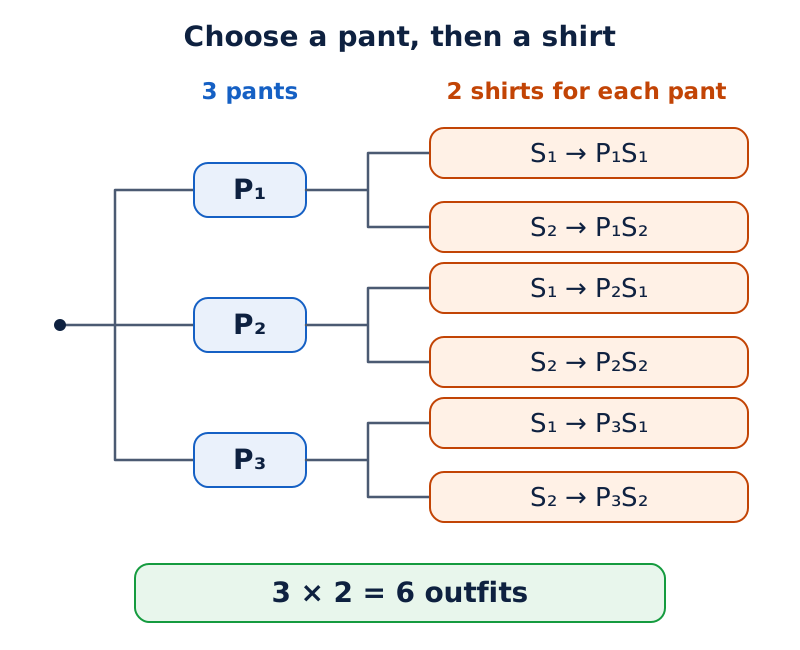
The tree begins with three branches labelled , representing the pants. Each divides into branches labelled , representing the shirts. Six endpoints show the possible pant-shirt pairs.
Drawn by One Young India. See Fig. 6.1 in your NCERT textbook
The tree diagram explains the multiplication: each initial branch has the same number of continuations. In Sabnam's example, two bags, three tiffin boxes and two bottles create three successive stages. Choosing one item from each category completes the selection.
- Choose a bag and a tiffin box:
- Choose one bottle for each pair:
What the figure shows
Bag, tiffin box and bottle choices
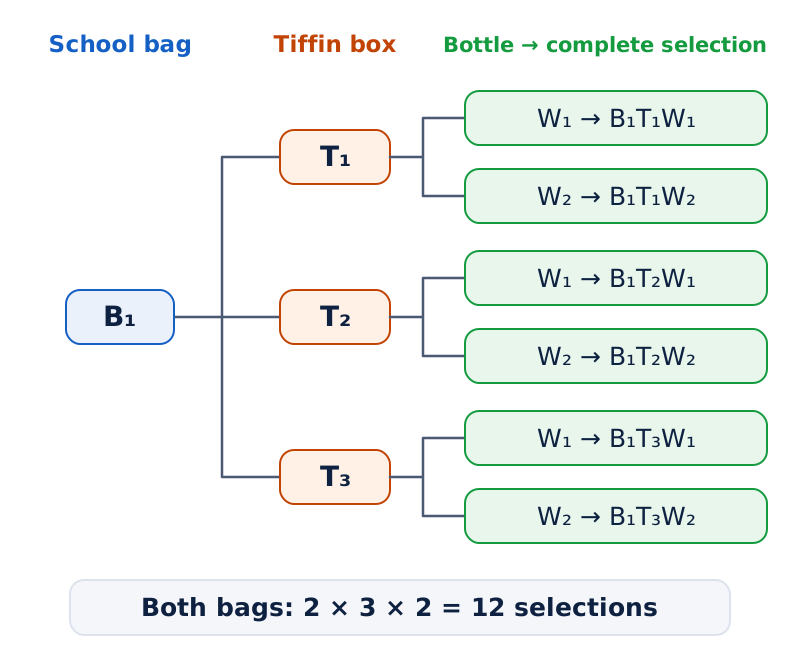
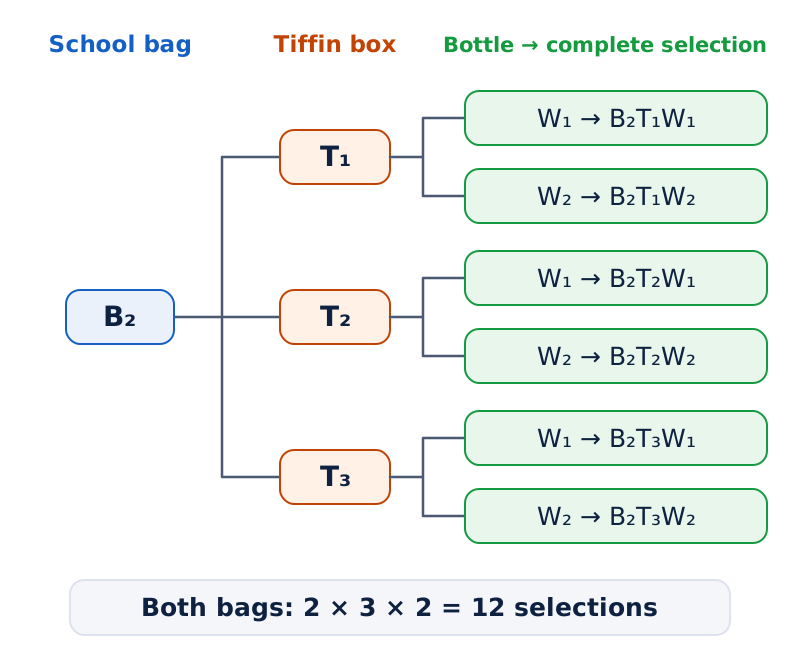
Two branches labelled represent bags. Each branches into , representing tiffin boxes, followed by , representing bottles. The tree ends in twelve labelled combinations.
Drawn by One Young India. See Fig. 6.2 in your NCERT textbook
When should separate counts be added?
Multiply when successive choices together form one outcome. Add when counting separate alternatives that do not overlap. Signals using exactly two, three, four or five flags belong to different cases, so their separate counts are added after each case has been counted.
What does factorial notation mean, and how is it simplified?
The symbol , read as n factorial, denotes the product of the first natural numbers, where is a natural number. Factorials provide a compact way of writing the descending products that occur when distinct objects are arranged without repetition.
Definition: For a natural number , factorial notation means . Zero factorial is defined by . The exclamation mark indicates a factorial; it is not an ordinary punctuation mark within the expression.
Property: Factorial recurrence
The recurrence separates the largest factor from the product. Continue expanding only as far as necessary. In a quotient, this often exposes an identical factorial in numerator and denominator, allowing cancellation before large products are evaluated.
- For , separate the final factor:
- Recognise the remaining factorial: The same relation holds for and , using and .
- For , expand once more if useful:
Worked example 2. Evaluate and .
Answer:
- Expand the first numerator only to the common factorial:
- Cancel and multiply:
- Expand the second numerator and the small factorial:
- Cancel and divide:
How should sums and differences be handled?
Cancellation applies to factors, so evaluate separate factorials before adding or subtracting them. A factorial attached to a number applies to that entire number. It cannot be distributed over an addition or subtraction inside its argument.
- Evaluate the factorials separately:
- Subtract their values:
The special value of zero factorial will also make the permutation and combination formulas valid when all objects are taken. It prevents their denominators from being mistaken for zero. Choosing or arranging no objects has one possible outcome: leaving all the objects unused.
How are permutations of distinct objects counted?
Definition: A permutation is an arrangement of some or all objects in a definite order. Let denote the number of distinct available objects and the number arranged. The notation counts arrangements without repetition.
Order matters in a permutation. The letters of ROSE can produce different arrangements even when every arrangement uses the same four letters. Assigning a chairman and a vice-chairman also involves order because exchanging the people changes who holds each position.
Theorem: Distinct objects without repetition
For integer values satisfying , the permutation formula is . Each object used removes one possibility from the next position. This decreasing number of choices is the reason for the descending product.
Derivation: Why does the factorial quotient work?
- For , fill the first position in ways, the second in ways, and the last in ways.
- Apply the multiplication principle:
- For , complete the numerator to a factorial:
- Recognise the numerator and include the endpoint using zero factorial:
- Include the empty arrangement:
Result: Use the quotient when order matters and an object cannot be used again.
Worked example 3. Find the number of three-letter words, with or without meaning, formed from NUMBER without repeating a letter.
Answer:
- All six letters are distinct, so and .
- Choose the letters in position order:
- Complete the multiplication: There are 120 words.
Theorem: Distinct choices with repetition allowed
When repetition is allowed, every position has all the original choices available. The count is . For the letters of NUMBER, three positions therefore give words. This permission to reuse letters changes the counting rule even though the original letters remain distinct.
- Each of the three positions has six choices.
- Multiply the unchanged choices:
How are arrangements counted when some objects are identical?
Indistinguishable objects require a correction to the distinct-object count. In ROOT, exchanging the two copies of O leaves the visible arrangement unchanged. Temporarily labelling those copies differently produces arrangements that must be grouped together when the labels are removed.
Theorem: Permutations with repeated objects
Let be the total number of objects and the number of identical objects of one kind; suppose the remaining objects are all different. The number of distinct arrangements using every object is .
More generally, let be the number of repeated kinds, and let be their respective multiplicities. The count is . Any objects outside these groups are distinct and need no further divisor.
Why is division necessary?
- Temporarily distinguish the two Os in ROOT as and . There are labelled arrangements.
- Swapping the labelled Os gives versions of each visible word once the labels are removed.
- Divide by this repeated counting:
Worked example 4. Find the number of distinct arrangements of all the letters in ALLAHABAD.
Answer:
- Count nine letters, including four As and two Ls. The letters H, B and D each occur once.
- Start from the arrangements of nine labelled objects and divide for the identical copies:
- Expand only the factors left after cancelling the larger repeated factorial:
- Evaluate: There are 7560 distinct arrangements.
Note: Repeated objects in a given collection differ from permission to repeat choices freely. When a supplied list contains repeated digits, each digit may be used only as many times as it occurs in that list.
The same principle handles indistinguishable discs of the same colour. It also explains why letter frequencies must be recounted after fixing a letter in a position. The remaining arrangement uses the remaining copies, not the frequencies of the original word.
How do digit restrictions and separate cases affect counting?
In a number-forming problem, both position and allowed digits matter. A leading zero does not create a number of the intended length. An even-number condition restricts the units digit. Deal with the restricted position first when that makes the remaining choices simpler.
How is an even-number restriction used?
Worked example 5. How many two-digit even numbers can be formed from , allowing repetition?
Answer:
- The units digit must be either or , giving two choices.
- After either units choice, the tens digit can be any of the five supplied digits because repetition is allowed.
- Multiply the counts: There are ten such numbers.
How are arrangements with a leading zero removed?
Worked example 6. How many numbers between and can be formed from without repeating digits?
Answer:
- Count all ordered arrangements of three different digits:
- Fix zero first to count the invalid arrangements. The other positions use two of five remaining digits:
- Subtract the invalid arrangements: There are 100 valid three-digit numbers.
This is counting by subtraction: a larger set is easy to count, and the unwanted subset is removed. State precisely why the removed arrangements are invalid. Here, the issue is the initial zero, rather than the occurrence of zero anywhere in the number.
How are signals with different lengths counted?
With five different flags, a signal using at least two flags on a vertical staff may contain two, three, four or five flags. A flag is used at most once. These lengths give separate cases, each counted by an ordered arrangement.
- Two flags give
- Three flags give
- Four flags give
- Five flags give
- Add the separate cases:
Notice that the flag counts decrease within each case because flags cannot repeat. Addition is used only after each permitted length has been counted. Multiplying the totals for different lengths would combine alternative signals instead of counting them.
How do blocks, gaps and complements handle restricted arrangements?
A restriction that several objects must occur together can be handled by treating them temporarily as one block. Arrange the block with the other objects, then arrange the objects inside it. Both decisions contribute to the completed arrangement.
How does the block method work?
Worked example 7. Arrange all eight distinct letters of DAUGHTER. Find the counts when all vowels occur together and when the vowels are not all together.
Answer:
- The vowels A, U and E form one block. Together with the five consonants, this gives six objects to arrange.
- Arrange the six objects:
- Arrange the three vowels within their block:
- Combine the choices:
- Count all unrestricted arrangements:
- Subtract the all-together case: Thus, 36000 arrangements have vowels not all together.
Note: “Not all together” excludes one complete vowel block. It does not mean that every vowel is separated from every other vowel. Some arrangements remaining after subtraction can still contain a neighbouring pair of vowels.
How does the gap method prevent adjacency?
For a condition such as no two boys together, arrange the girls first and use the gaps between them and at the ends. Placing at most one boy in each selected gap ensures that every pair of boys is separated by a girl.
Worked example 8. In how many ways can five girls and three boys be seated in a row so that no two boys sit together?
Answer:
- Arrange the five girls:
- There are six available gaps: four between consecutive girls and two at the ends.
- Place the three distinct boys in three different gaps, counting their order:
- Multiply the two stages:
These methods address different restrictions. A block enforces adjacency; separate gaps prevent it. In both methods, the objects remain distinct unless the problem explicitly makes some of them indistinguishable. Do not discard the internal ordering of a block of distinct letters or the ordering of distinct people.
What is a combination, and how does it differ from a permutation?
Definition: A combination is a selection in which order is unimportant. Let be the number of distinct available objects and the number selected. The notation denotes the number of such selections.
If lawn tennis players , and are available, a two-person team is determined by its members. Here these symbols name the three players. Listing the same two members in reverse order does not create another team.
What the figure shows
Two-player teams
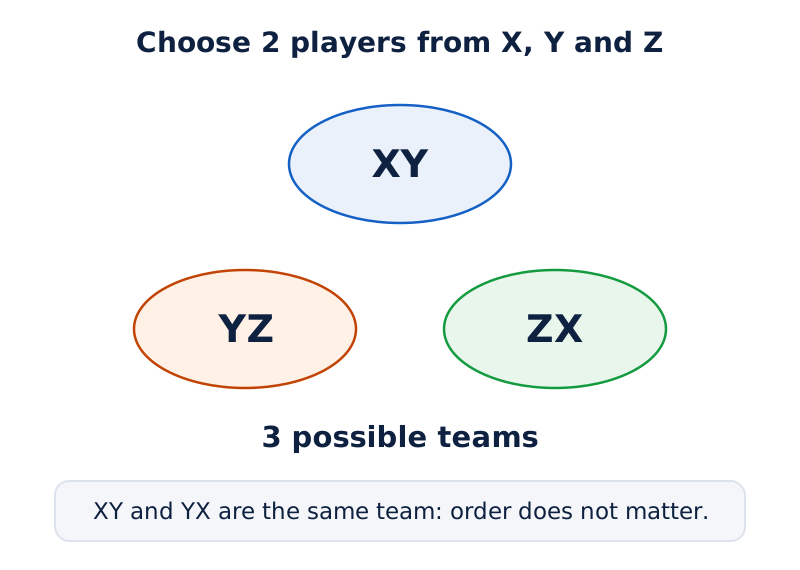
Three separate shaded ovals contain the labels , and . Each label names one possible pair selected from the three players.
Drawn by One Young India. See Fig. 6.3 in your NCERT textbook
How can the two kinds of counting be compared?
| Feature | Permutation | Combination |
|---|---|---|
| What is counted? | An ordered arrangement | A selection |
| Effect of changing order | Can produce a different arrangement | Does not change the selection |
| Typical situation | Choosing a chairman and vice-chairman | Choosing committee members |
| Count for distinct objects |
Derivation: Why is the permutation count divided by a factorial?
- Select objects from distinct objects in ways, where .
- Each selected group can be arranged in different orders.
- Count all ordered arrangements:
- Divide out the arrangements within each selection:
- Include selecting nothing and selecting everything:
Result: The formula applies to integers satisfying . Selecting nothing has one outcome, just as selecting the whole collection has one outcome.
The division removes overcounting within each group. For example, a handshake between two people is unchanged when their names are reversed. Similarly, a chord joining two chosen points is determined by the pair of endpoints, not by which endpoint is named first.
Decide whether order matters before calculating. The wording “choose” alone is insufficient: choosing people for different offices still assigns different roles. A committee without assigned offices, however, is specified by its membership and therefore calls for combinations.
Which combination identities simplify calculations?
Combination identities express relationships between selections of different sizes. They are useful for simplifying expressions and solving equations involving an unknown total. Keep the permissible integer values in view: the number selected cannot be negative or exceed the number available.
Identity: Complementary selections
Selecting objects from a collection of determines exactly which objects are left behind. Conversely, specifying the rejected objects determines the selected ones. The two counts therefore agree.
- Write the factorial expression for choosing the rejected objects:
- Simplify the remaining argument:
- Recognise the original selection count:
Identity: Addition of adjacent combination counts
For integers satisfying , the identity is . Convert both terms to factorial form and use a common denominator. The numerator then simplifies to the next factorial.
- Expand both terms:
- Use a common denominator:
- Combine the numerator factors:
- Recognise the factorial formula:
How are equal combination counts used?
Let and denote two valid selection sizes from the same total . If , then either or . When the lower indices differ, their sum gives the total.
Worked example 9. If , find .
Answer:
- The lower indices are unequal, so they must be complementary.
- Find the total:
- Substitute into the requested expression:
The last step counts the selection of every available object. It does not count their arrangements. Distinguishing these interpretations helps prevent replacing the answer by a factorial merely because the number selected equals the total number available.
How are committees, teams and card selections counted?
Membership problems usually require combinations because the order of names does not change the group. If members must come from separate categories, count the required selection from each category and multiply. Add different permitted compositions when those cases are separate.
How are fixed category requirements handled?
Worked example 10. A group contains two men and three women. Count all three-person committees, then those containing one man and two women.
Answer:
- There are five people altogether. Select any three:
- Select one of the two men:
- Select two of the three women:
- Combine those selections: Six committees have the required composition.
How does “at least” change the cases?
For a team of five chosen from four girls and seven boys, at least three girls permits three girls with two boys or four girls with one boy. Five girls are unavailable. Count the two permitted compositions separately, then add them.
- Three girls and two boys give
- Four girls and one boy give
- Add the counts:
How are card conditions translated into selections?
A pack of 52 playing cards has four suits of thirteen cards each, twelve face cards, and twenty-six cards of each colour. A hand is a selection, so rearranging its cards does not produce another hand. Translate each condition into the relevant categories.
| Four-card requirement | Counting expression | Reason |
|---|---|---|
| Any four cards | Select four from the complete pack | |
| All from one suit | Select a suit, then four cards within it | |
| One from each suit | Make one selection from each suit | |
| All face cards | Select from the twelve face cards | |
| Two red and two black | Both colour requirements must be met | |
| All of one colour | Add the red-only and black-only cases |
The structure of the condition determines the operation. “One from each suit” requires all four selections together, whereas “all red or all black” describes two alternatives. Choose the operation from that structure before substituting factorials.
How can selection, arrangement and dictionary order be combined?
Some problems require two different counting stages: first choose the objects, then arrange the chosen objects. Using a combination alone would count the groups but omit their orders. Using unrestricted permutations immediately could ignore a requirement about the composition of each group.
How are letters selected and then arranged?
Worked example 11. How many words, with or without meaning, containing three vowels and two consonants can be formed from INVOLUTE, using each chosen letter once?
Answer:
- The four vowels are I, O, U and E; the four consonants are N, V, L and T.
- Choose three vowels:
- Choose two consonants:
- Combine the choices of letters:
- Arrange the five distinct chosen letters:
- Count all words:
How does dictionary order organise arrangements?
For dictionary order, group words by their initial letter. Count how many words belong to each initial group before moving to the next letter. After fixing a prefix, recalculate the multiplicities of the letters still available.
Worked example 12. Count the distinct words formed from all letters of AGAIN and find the fiftieth word in dictionary order.
Answer:
- There are five letters with two identical As. The total is
- Fix A first. The remaining four letters are distinct, giving words starting with A.
- Fix G first. The remaining letters include two As, giving words starting with G.
- The same repeated-letter count gives twelve words starting with I. The cumulative count is
- The next group starts with N. Its first two words are NAAGI and NAAIG, so the fiftieth word is NAAIG.
The calculation counts whole groups instead of listing every word. The final ordering still needs attention: after the prefix NAA, the remaining letters G and I occur first in alphabetical order and then in the reversed order. This identifies the required word within the final group.
Glossary
- Fundamental principle of counting — The rule that multiplies the numbers of available choices at successive stages of a completed outcome.
- Permutation — An arrangement of some or all objects in which their definite order is part of the outcome.
- Combination — A selection of objects whose identity depends on membership, without distinguishing different orders of those members.
- Factorial — The product of all natural numbers up to a specified natural number, with zero factorial separately defined as one.
- Distinct objects — Objects distinguishable from one another, such as the different letters in the word ROSE.
- Indistinguishable objects — Objects treated as identical, so exchanging their positions does not produce a visibly different arrangement.
- Repetition allowed — Permission to use an available choice again when filling another position in an ordered arrangement.
- Multiplicity — The number of times a particular kind of identical object occurs in the collection being arranged.
- Block method — Treating objects required together as one object, then accounting for their permitted arrangements within that block.
- Gap method — Placing objects in separate spaces around an existing arrangement to prevent those objects from being adjacent.
- Complementary selection — The unselected group that is determined once a selection from the complete collection has been made.
- Dictionary order — Alphabetical ordering of words, determined by comparing letters successively from the beginning of each word.
Common errors and misconceptions
- Misconception: Every problem that says “choose” requires combinations. Correct: Choosing a chairman and vice-chairman assigns different roles, so reversing the people changes the result and requires permutations.
- Misconception: Repetition allowed and repeated letters mean the same thing. Correct: The first permits reuse of a choice; the second describes identical copies already present in a fixed collection.
- Misconception: Zero factorial equals zero. Correct: , so formulas remain valid when every object is selected or arranged.
- Misconception: Any arrangement of three supplied digits is a three-digit number. Correct: A leading zero is invalid for that length and must be excluded.
- Misconception: A block of vowels has only one internal order. Correct: Distinct vowels can be rearranged inside the block; multiply by their internal arrangement count.
- Misconception: Vowels not all together means no two vowels are adjacent. Correct: Subtracting the all-together case excludes a complete vowel block, while allowing some adjacent vowels.
- Misconception: Selecting the letters completes a word-counting problem. Correct: When order matters, arrange each selected group as a further stage and multiply the counts.
- Misconception: Factorials can be added by adding their arguments. Correct: Evaluate each factorial separately; the exclamation mark does not distribute across addition.
Exam-style questions with model answers
Q1. What is a permutation, and how does it differ from a combination? [2 marks]
- A permutation arranges some or all objects in a definite order, so the positions of the selected objects matter.
- A combination selects objects without considering their order; reversing the names of the same team members does not create another team.
Q2. From the letters of NUMBER, form three-letter words, with or without meaning, without repeating a letter. Find the number of words. [3 marks]
- The word contains six distinct letters. Three ordered positions must be filled, so this is a permutation problem rather than a selection problem.
- There are six choices for the first position, five for the second after one letter is used, and four for the third.
- Multiply these successive choices: Thus, 120 different three-letter words can be formed under the restriction.
Q3. Find the number of distinct arrangements using all the letters of ALLAHABAD. [3 marks]
- There are nine letters altogether. A occurs four times and L occurs twice; H, B and D occur once each.
- Counting all copies as different would overcount each visible word. Divide the factorial count by the factorials of the repeated frequencies:
- Cancel and evaluate the remaining factors: Therefore, there are 7560 distinct arrangements.
Q4. How many numbers between and can be formed from without repeating any digit? [3 marks]
- Initially count all ordered arrangements of three different digits from the six supplied digits:
- Some arrangements begin with zero and are not three-digit numbers. Fixing zero first leaves five choices and then four choices, producing invalid arrangements.
- Subtract precisely those invalid arrangements: The remaining 100 numbers have three digits, use only the supplied digits and contain no repeated digit.
Q5. Using all eight distinct letters of DAUGHTER, find how many arrangements have all three vowels together and how many have the vowels not all together. [5 marks]
- The vowels are A, U and E. Treat these three letters as one block. Alongside the five consonants, the block gives six objects whose order must be counted.
- Arrange the block and consonants in ways. The vowels inside the block can independently be arranged in ways.
- Multiply these counts for the all-together condition: This accounts for both the block's position and its internal order.
- Without the restriction, all eight distinct letters can be arranged in ways.
- Subtract the complete vowel-block arrangements: These have vowels not all together; the condition still permits a pair of adjacent vowels.
Q6. From four girls and seven boys, select a team of five containing at least three girls. Find the number of possible teams. [4 marks]
- The permitted compositions are three girls and two boys, or four girls and one boy. Five girls cannot be chosen because only four are available.
- The first composition gives Multiply because both the girls and boys must be selected.
- The second composition gives
- Add the two separate cases: There are 91 teams, and no further arrangement factor is needed because team membership is unordered.
Q7. A pack of 52 distinct playing cards contains 26 red and 26 black cards. How many selections of four cards contain exactly two red and two black cards? [3 marks]
- Select two red cards from the twenty-six available red cards. Their order does not matter:
- Select two black cards from the twenty-six available black cards. This gives the same number of choices:
- Each red pair can accompany each black pair, so multiply the two counts: Thus, 105625 different four-card selections meet the stated colour requirement.
Q8. Using letters from INVOLUTE without repeating a letter, form words containing three vowels and two consonants. Words need not have meaning. Find the total number. [5 marks]
- Separate the available letters into the four vowels I, O, U and E and the four consonants N, V, L and T. All eight letters are distinct.
- Select three vowels from the four available: This stage chooses their membership without yet choosing their positions in the word.
- Select two consonants: Combining the choices gives sets of five letters.
- Each chosen set contains five distinct letters, which can be placed in different orders in ways.
- Multiply the selection count by the arrangement count: Therefore, 2880 words satisfy both the vowel and consonant requirements.
Key takeaways
- Count successive choices by multiplication, and add separate permitted cases when each outcome belongs to exactly one case.
- Decide whether order matters before selecting a formula: arrangements use permutations, while unordered selections use combinations.
- Expand factorials only far enough to expose common factors, and remember that zero factorial is defined as one.
- Without repetition, the available choices decrease after each position; with repetition allowed, every position retains all original choices.
- For arrangements containing identical copies, divide the factorial count by the factorial of each repeated frequency.
- Handle togetherness with a block, prevent adjacency with separate gaps, and distinguish “not all together” from “none adjacent”.
- A combination specifies which objects are selected; multiply by the arrangement count when the selected objects must also be ordered.
- In digit problems, check leading zero and restricted ending digits before applying an unrestricted permutation formula.
Test yourself
Why does selecting a chairman and vice-chairman involve permutations?
The positions are different. Swapping the two people changes who holds each office, producing a different assignment.
What does equal, and why does it matter here?
. This value allows the factorial formulas to handle arranging or selecting all the available objects.
Why is the count for arranging ROOT divided by ?
The two Os are identical. Exchanging labelled copies would count the same visible word twice, so that duplication must be removed.
Why should the units digit be considered first when forming even numbers?
The units position has a restricted set of permitted digits. Handling that restriction first makes the remaining choices easier to count.
What does express?
Choosing objects from determines the rejected objects, so the two selection counts agree.
Does “the vowels are not all together” forbid every adjacent pair of vowels?
No. It excludes the case where all vowels form one block, but can still allow two vowels to be adjacent.
Why is choosing the letters insufficient when counting words formed from INVOLUTE?
After selecting the required vowels and consonants, their positions still matter. Each selected group must therefore also be arranged.
How does dictionary order reduce the work of finding a particular arrangement?
Count complete groups with the same initial letter, then examine the required position within the remaining group.
Write about it
Turn a question from this chapter into a paper.
The Writing Studio has a structure guide, a rubric and citation tools for 15 formats, from essays to research papers. Drafting is free with an account. Learnacy Essential adds feedback from an AI writing coach and submission to The OYI Review.
Learnacy Essential is ₹1,499 for the year. Publication depends on review and is not guaranteed.