
Plant Life | ICSE Class 7 Biology Notes
On this page

This note covers photosynthesis, the process of making food using light; respiration, the release of energy from food; leaf structures, conditions for food production, experiments, types of respiration, gas exchange, and the importance of plants.
Why do plants need both food and energy?
A life process is an activity needed to keep an organism alive. An organism is a living thing. Plants grow, remove wastes, reproduce and respond to changes around them. These activities require materials and energy, even though a plant does not walk about.
A cell is the smallest structural and functional unit of an organism. Plant cells need energy for their activities. Making food and releasing energy from that food are different processes, so a green plant needs both photosynthesis and respiration.
What does food provide?
Nutrients are components of food needed by living organisms. Food supplies materials for growth and repair, as well as stored energy. Nutrition means taking in food and using it in the body. Green plants prepare food from simple substances in their surroundings.
Autotrophic nutrition is the mode of nutrition in which organisms make their own food from simple substances. Organisms with this mode of nutrition are called autotrophs. Green plants use light energy to make food, but they must still break down food to release usable energy.
Why does a root also need food?
Not every cell in a green plant makes food. Non-green parts also require a food supply for respiration. Food made in photosynthesising parts must therefore reach other parts of the plant. A root needs energy for its activities even though it is underground.
Note: A plant's ability to prepare food does not remove its need for respiration. Food production supplies stored energy; respiration releases energy from food for life processes.
How does photosynthesis make food?
Definition: Photosynthesis is the process in which green plants use light energy, captured by chlorophyll, to prepare carbohydrates from carbon dioxide and water, releasing oxygen.
Chlorophyll is the green pigment that captures light energy. A pigment is a coloured substance that absorbs light. Carbohydrates are food substances such as sugars and starch. Glucose is a simple sugar, while starch is a carbohydrate used for food storage.
Carbon dioxide is a gas in air used in photosynthesis. Oxygen is the gas released during photosynthesis and used in aerobic respiration, the breakdown of food using oxygen. Water is another raw material, meaning a substance used to make the products of a process.
What does the word equation show?
Carbon dioxide and water produce carbohydrate and oxygen, in the presence of sunlight and chlorophyll.
This word equation separates the raw materials from the products, which are the substances formed. Sunlight supplies energy. Chlorophyll captures that energy. Neither sunlight nor chlorophyll should be described as food absorbed from the soil.
Roots absorb water from the soil. Vessels, the conducting passages running through roots, stems and leaves, carry water to the leaves. Carbon dioxide enters leaves through small surface pores. Light energy enables chlorophyll-containing cells to prepare carbohydrates from these materials.
Where does the energy go?
Energy from sunlight becomes stored in food. Glucose is usually stored as starch. A starch test provides evidence of food formation in leaves.
What the figure shows
Photosynthesis in a plant
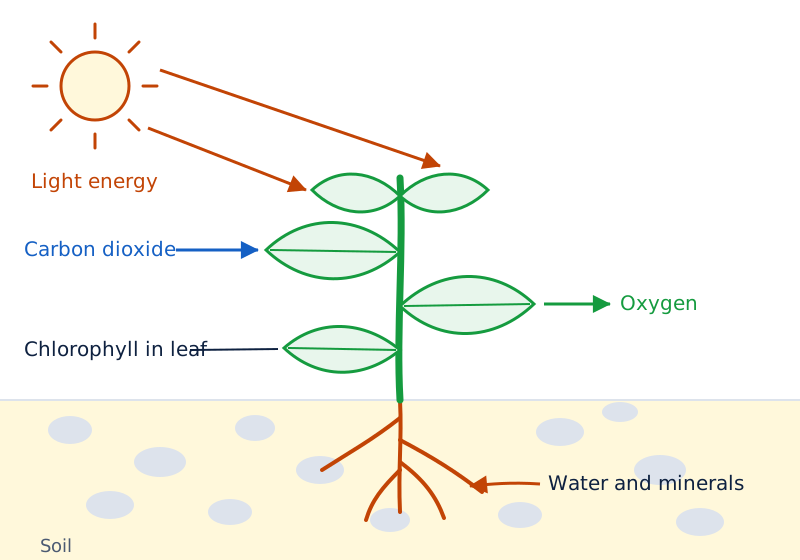
The drawing shows light reaching a leafy plant, carbon dioxide entering a leaf and oxygen leaving it. Labels identify chlorophyll in the leaf and water and minerals near the roots.
Drawn by One Young India.
How do stomata and chloroplasts help leaves?
Stomata are tiny pores on the surface of leaves; one pore is a stoma. Guard cells are the cells surrounding a stomatal pore and controlling its opening and closing. Carbon dioxide and oxygen pass through these openings during gas exchange.
How is the pore controlled?
When water enters guard cells, they swell and the pore opens. When guard cells shrink, the pore closes. The opening is a passage for gases. It should not be confused with the surrounding guard cells, which are living parts of the leaf.
What the figure shows
Leaf and stoma
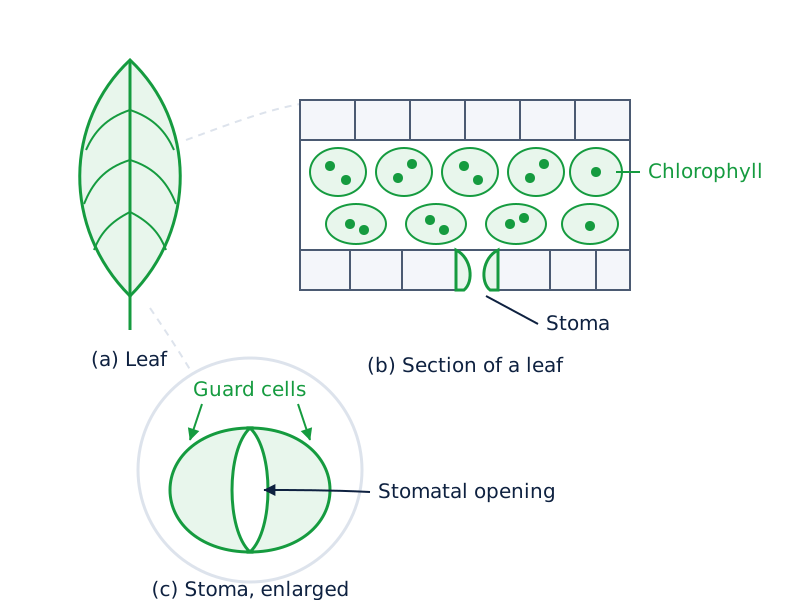
The drawing includes a leaf, a section through a leaf and an enlarged stoma. The enlargement labels the guard cells on either side of the central stomatal opening.
Drawn by One Young India.
Where is chlorophyll found?
A chloroplast is a structure within a plant cell that contains chlorophyll and carries out photosynthesis. Chloroplasts and chlorophyll are different: the chloroplast is the structure, while chlorophyll is the light-absorbing pigment inside it. Chloroplasts can be observed in suitable leaf preparations using a microscope.
For a simple labelled chloroplast drawing, recognise its outer and inner membranes, the thin boundaries enclosing it. Inside are flattened membrane sacs called thylakoids. Stacks of these sacs are called grana; one stack is a granum. Chlorophyll occurs in the thylakoids.
The stroma is the internal matrix surrounding the membrane system. Sugar formation occurs in this region. These basic labels connect structure with function: the membrane system helps capture light energy, and the chloroplast also contains the region where sugar is formed.
What the figure shows
Section of a chloroplast
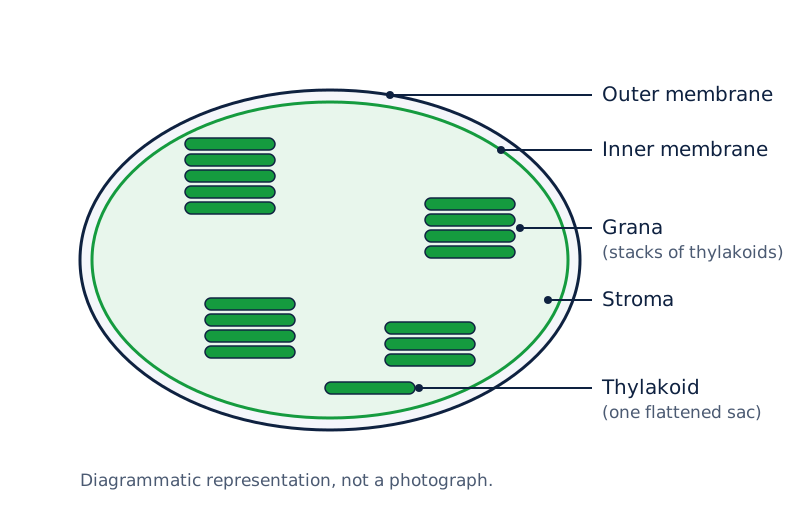
The drawing has an oval outline with outer and inner membranes. Inside, stacks labelled grana lie in the region labelled stroma. It is a diagrammatic representation, rather than a photograph.
Drawn by One Young India.
A leaf pore and a chloroplast have complementary roles. The pore allows gases to pass between the leaf and its surroundings. The chloroplast provides the site for photosynthesis. Having a gas opening alone does not mean that a structure makes food.
Which conditions affect photosynthesis?
Light, carbon dioxide, water and chlorophyll are necessary for photosynthesis. Each has a distinct role. Light provides energy, carbon dioxide and water supply raw materials, and chlorophyll captures light. A photosynthesising plant needs the combination, rather than just one of these requirements.
| Requirement | Role in photosynthesis |
|---|---|
| Light | Provides the energy used to prepare food. |
| Carbon dioxide | Supplies a raw material taken from the surroundings. |
| Water | Supplies a raw material absorbed by roots in land plants. |
| Chlorophyll | Captures the light energy needed for food production. |
How can these factors change the rate?
The rate of photosynthesis describes how quickly the process occurs. At low light levels, increasing light increases the rate. At higher light levels, the rate gradually stops increasing as other requirements limit it. Extra light therefore does not produce an unlimited increase.
A shortage of water causes stomata to close, reducing carbon dioxide availability. Thus, water affects photosynthesis both as a raw material and through its effects on the plant. The amount of chlorophyll also influences photosynthesis, together with the availability of light and raw materials.
Does every photosynthesising leaf look green?
Leaves that appear deep red, violet or brown also contain chlorophyll. Large amounts of other pigments mask its green colour, and photosynthesis occurs in these leaves too. A leaf's visible colour alone is therefore insufficient evidence that it lacks chlorophyll.
A variegated leaf has differently coloured areas, including green and non-green patches. Comparing these areas in a starch test can show the importance of chlorophyll. Record the green patches before removing the leaf's colour, so that the result can be matched to the original pattern.
Is photosynthesis restricted to leaves?
Photosynthesis also occurs in other green parts, including green stems and branches. Leaves are important food-making organs, but the capacity depends on the presence of the required structures and conditions. “Leaves make food” should not become “no other plant part can make food”.
When investigating a condition, compare cases that differ in that condition as far as possible. For example, a light experiment must compare light exposure. A chlorophyll experiment compares green and non-green areas. A carbon dioxide experiment changes the availability of that gas.
How can a starch test demonstrate photosynthesis?
The iodine test detects starch by a blue-black colour. Iodine solution is the test liquid added to the leaf. The test detects starch, not light itself, so the experimental conditions must establish why the starch appeared in a particular part of the leaf.
How is a variegated leaf tested?
Destarching means allowing stored starch to be used up before testing for newly formed starch. A plant is kept in darkness for this purpose. In a variegated-leaf investigation, money plant or croton can provide the differently coloured leaf areas.
- Keep the potted plant in a dark room for three days so that its stored starch is used up.
- Place the plant in sunlight for about six hours. Pluck a leaf, mark its green areas and trace their positions on paper.
- Dip the leaf in boiling water for a few minutes. Then immerse it in alcohol in a beaker.
- Heat the beaker in a water bath until the alcohol begins to boil. A water bath heats the beaker indirectly through surrounding hot water; the alcohol removes the green colour.
- Dip the leaf in dilute iodine solution for a few minutes. Remove the leaf and rinse off the iodine solution.
- Compare the final colour pattern with the tracing of the original green areas. The green areas give the positive starch result after exposure to light.
Observation means what is seen: the previously green regions turn blue-black. A conclusion is what the result supports: chlorophyll is necessary for photosynthesis. The colour pattern matters more than the statement that “the leaf changed colour”.
Note: Carry out heating and chemical handling with adult supervision. Alcohol is flammable, so heat it in a water bath, away from a naked flame.
How can light be investigated?
Partly cover a destarched leaf with black paper and expose the plant to sunlight. After the starch test, compare the covered and uncovered parts. Starch is found in the illuminated green area. The result supports the requirement for light in photosynthesis.
The purpose of destarching is to reduce confusion between old stored starch and starch formed during the investigation. The uncovered part provides a comparison on the same leaf. Both parts are then tested using the same procedure, so their different results can be related to light exposure.
How can carbon dioxide and oxygen be investigated?
Experiments can investigate a raw material used in photosynthesis and a gas released by it. A carbon dioxide investigation tests the requirement for an input. A water-plant investigation demonstrates oxygen production. These experiments answer different questions and should have different conclusions.
How is carbon dioxide shown to be necessary?
Potassium hydroxide is a chemical that absorbs carbon dioxide. A bell jar is a glass cover placed over an experimental setup. The comparison setup, or control, helps show the effect of the condition being investigated.
- Choose two healthy potted plants of nearly the same size and keep them in darkness for three days.
- Put each plant on a separate glass plate. Place a small dish containing potassium hydroxide beside one plant.
- Cover the plants with separate bell jars. Seal the bases to the plates with petroleum jelly so that the setups are airtight.
- Keep both setups in sunlight for about two hours. The jar without potassium hydroxide provides the comparison.
- Pluck a leaf from each plant and test it for starch. Compare the result from the jar with carbon dioxide available with that from the jar where it was absorbed.
The leaf with carbon dioxide available gives a positive starch test. The leaf deprived of carbon dioxide does not. Light alone is insufficient: carbon dioxide is also required. Airtight seals help prevent outside air from replacing the carbon dioxide removed by potassium hydroxide.
What does the Hydrilla experiment show?
Hydrilla is a water plant used to demonstrate oxygen release during photosynthesis. Green aquatic plants produce small bubbles in bright sunlight. In a demonstration, the gas is collected so that its identity can be checked, rather than guessed from the bubbles alone.
- Place Hydrilla beneath an inverted funnel in a beaker of water.
- Fill a test tube with water and invert it over the funnel stem, keeping its mouth under water.
- Expose the setup to sunlight. Gas bubbles rise into the tube and collect as they displace water.
- An adult tests the collected gas with a glowing splint, a wooden strip that is glowing without a flame. Oxygen relights it.
The conclusion is that oxygen is released during photosynthesis. The starch test demonstrates food formation, whereas this gas test demonstrates oxygen production. A visible bubble alone does not establish which gas it contains.
How does respiration release energy in plants?
Definition: Cellular respiration is the breakdown of food within cells with the release of energy. Plants, like other living organisms, need this energy for their life processes.
The word cellular means occurring in cells. Respiration is not merely the movement of gases through a leaf pore. Gas exchange supplies oxygen and removes carbon dioxide, while the energy-releasing breakdown of food occurs inside living cells.
What is aerobic respiration?
Aerobic respiration breaks down glucose using oxygen. Glucose is completely broken down into carbon dioxide and water, releasing energy. Plant cells, including root cells, use this process when oxygen is available. The word equation identifies both the materials used and the products formed.
Glucose and oxygen produce carbon dioxide and water, releasing energy.
Glucose supplies stored chemical energy, meaning energy held in the chemical substances of food. Oxygen enables its complete breakdown. Carbon dioxide and water are products. Energy is released from the food; it is not another gas that escapes through a stoma.
When do plants respire?
Plants respire during the day and at night. In daylight, a green leaf may photosynthesise and respire at the same time. Darkness stops photosynthesis dependent on light, but it does not remove a living cell's need to obtain energy from food.
Plants use energy for activities such as absorption, transport, growth and reproduction. Their need for energy continues even when no obvious movement is visible. A root cell and a leaf cell both carry out activities necessary for the survival of the plant.
Remember the direction of the energy change. Photosynthesis stores light energy in food. Respiration releases energy from food. Calling respiration “food making” confuses the two roles and makes it difficult to explain why a plant needs both processes.
How do roots, stems and leaves exchange gases?
Plants have no specialised breathing organs like animal lungs. Each plant part can take in oxygen and give out carbon dioxide. There is very little transport of gases from one plant part to another, so gas exchange should not be pictured as a lung-like system.
Which openings are used?
Leaves exchange gases through stomata. Woody stems have small openings called lenticels that also allow gas exchange. Inside a plant, air spaces help gases reach living cells. Gas movement and cellular respiration are related, but they are not the same event.
Diffusion is movement from a region of higher concentration to one of lower concentration. Concentration describes how much of a substance is present in a given space. Oxygen and carbon dioxide can move by diffusion between plant tissues and their surroundings.
Where do underground roots obtain oxygen?
Soil contains particles with air spaces between them. Roots take up air from these spaces. A root hair is a fine extension of a root surface cell. Root cells require oxygen to release energy from food, just as other living plant cells do.
What the figure shows
Roots and soil air
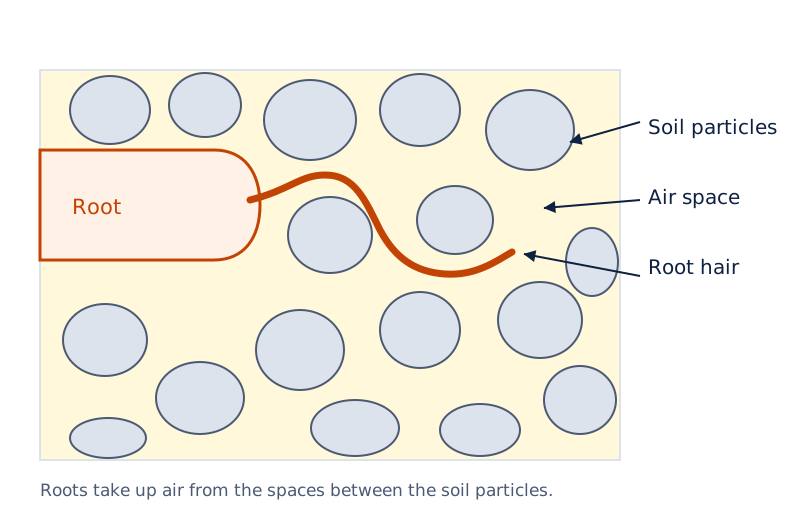
The drawing shows a root hair extending between soil particles. Labels identify the root hair, soil particles and an air space. The spaces help explain how roots obtain air below the ground.
Drawn by One Young India.
Excessive watering can fill soil air spaces and reduce the oxygen available to roots. A plant's need for water therefore does not mean that permanently water-filled soil spaces are harmless. Roots need access to air as well as a supply of water.
When explaining root respiration, keep the locations clear. The soil provides air; the root takes in oxygen; food is broken down in living root cells. The energy released supports cell activities. Roots do not obtain their required energy simply by taking up water.
How does anaerobic respiration differ from aerobic respiration?
Anaerobic respiration releases energy from food without using oxygen. The breakdown is incomplete and releases less energy from glucose than aerobic respiration. “Anaerobic” does not mean “without energy”: energy release is still the purpose of the process.
What happens in yeast?
Yeast is a single-celled fungus. A fungus is an organism that obtains prepared food rather than making food by photosynthesis. In the absence of oxygen, yeast breaks down glucose to alcohol and carbon dioxide, releasing energy. This process is called alcoholic fermentation.
Glucose produces alcohol and carbon dioxide, releasing energy, in the absence of oxygen.
The alcohol here is ethanol, the alcohol formed by yeast fermentation. Yeast is an example used to study anaerobic respiration, but it should not be called a green plant. Fermentation can also occur under anaerobic conditions in germinating seeds, which are seeds beginning to grow.
| Feature | Aerobic respiration | Anaerobic respiration in yeast |
|---|---|---|
| Oxygen | Used during the process. | Not used during the process. |
| Food | Glucose is broken down. | Glucose is broken down. |
| Extent of breakdown | Complete breakdown of glucose. | Incomplete breakdown of glucose. |
| Products | Carbon dioxide and water. | Alcohol and carbon dioxide. |
| Energy released | A greater amount from glucose. | A smaller amount from glucose. |
How can a product of fermentation be detected?
Lime water is a clear solution of calcium hydroxide used to test for carbon dioxide. Carbon dioxide turns it milky. In a supervised demonstration, add yeast to sugar solution or fruit juice in a test tube and fit a cork carrying a bent glass tube.
Dip the free end of the glass tube into fresh lime water. Gas from the yeast mixture passes into it. Milkiness provides evidence of carbon dioxide production. This test detects carbon dioxide; it does not itself detect alcohol or measure the energy released.
Products of anaerobic respiration vary with the organism or cell. In human muscle cells, temporary oxygen shortage can lead to lactic acid formation. Lactic acid is the product of this incomplete breakdown. The yeast equation should therefore not be used for every anaerobic process.
How do photosynthesis and respiration support life together?
Photosynthesis and aerobic respiration involve some of the same substances but perform different functions. Photosynthesis builds food using light energy. Aerobic respiration breaks down food using oxygen and releases energy. A green plant carries out both, so neither process belongs exclusively to animals.
| Feature | Photosynthesis | Aerobic respiration in plants |
|---|---|---|
| Role of food | Carbohydrate is made. | Glucose is broken down. |
| Energy change | Light energy is stored in food. | Energy is released from food. |
| Carbon dioxide | Used as a raw material. | Released as a product. |
| Oxygen | Released as a product. | Used to break down glucose. |
| Light | Requires light. | Occurs in daylight and darkness. |
| Location | Occurs in chlorophyll-containing structures. | Occurs in living cells, including non-green cells. |
How are gases linked between the processes?
Photosynthesis uses carbon dioxide and releases oxygen. Aerobic respiration uses oxygen and releases carbon dioxide. Together, these processes help maintain the balance of these gases in the atmosphere, the layer of gases surrounding Earth. This relationship connects plant activities with the survival of other organisms.
The gases exchanged by a whole leaf can reflect both processes operating together. Oxygen release in sunlight does not prove that respiration has stopped. A green leaf can produce oxygen through photosynthesis while its living cells continue to use oxygen for respiration.
Why should more plants be grown?
The survival of almost all living organisms directly or indirectly depends on food made by plants. Some animals eat plants; others obtain food by eating plant-eating animals.
Growing and protecting plants supports food production and oxygen release. Their photosynthesis draws carbon dioxide from their surroundings and stores energy in food. These are connected reasons for valuing plant life, rather than treating plants as useful merely because they look green.
Plants also use some of the food they produce in their own respiration. Their ecological importance and their personal need for energy fit together: photosynthesis supplies food, and respiration allows living cells to use the energy stored in that food.
Glossary
- Photosynthesis — The process in which green plants use light energy to make carbohydrates from carbon dioxide and water.
- Chlorophyll — The green pigment that captures light energy used in the preparation of food.
- Chloroplast — A structure within plant cells containing chlorophyll and providing the site for photosynthesis.
- Stoma — A tiny pore on a leaf surface through which gases can pass.
- Guard cells — Cells around a stomatal pore that control its opening and closing.
- Starch — A carbohydrate used for food storage and detected by the iodine test.
- Destarching — Allowing stored starch to be used up before testing for newly formed starch.
- Cellular respiration — The breakdown of food inside living cells with the release of energy.
- Aerobic respiration — The complete breakdown of glucose using oxygen, producing carbon dioxide, water and released energy.
- Anaerobic respiration — The breakdown of food without using oxygen, with the release of energy.
- Alcoholic fermentation — The incomplete breakdown of glucose without oxygen, producing alcohol and carbon dioxide.
- Lenticels — Small openings in woody stems that allow gases to pass between the plant and its surroundings.
- Diffusion — The movement of a substance from a region of higher concentration to lower concentration.
- Variegated leaf — A leaf with differently coloured areas, including green and non-green patches.
Common errors and misconceptions
- Misconception: Plants need photosynthesis but do not need respiration. Correct: Plants must release energy from food through respiration to support the activities of their living cells.
- Misconception: Respiration takes place only at night. Correct: Plants respire during the day and at night; a green leaf may also photosynthesise in daylight.
- Misconception: Roots absorb a plant's food from soil. Correct: Roots absorb water and minerals, while green parts prepare food using light energy, carbon dioxide and water.
- Misconception: Every red or brown leaf lacks chlorophyll. Correct: Other pigments can mask chlorophyll, so such leaves can still carry out photosynthesis.
- Misconception: Chlorophyll and chloroplast mean the same thing. Correct: Chlorophyll is a pigment; a chloroplast is a cell structure containing that pigment.
- Misconception: Bubbles alone prove that oxygen was produced. Correct: Collected gas must be tested to establish its identity; oxygen relights a glowing splint.
- Misconception: Anaerobic respiration releases no energy. Correct: It releases energy without oxygen, but less from glucose than aerobic respiration.
- Misconception: Alcohol is a product of every anaerobic process. Correct: Yeast produces alcohol, whereas muscle cells under temporary oxygen shortage form lactic acid.
Exam-style questions with model answers
Q1. Define photosynthesis and cellular respiration. [2 marks]
- Photosynthesis uses light energy captured by chlorophyll to make carbohydrates from carbon dioxide and water, releasing oxygen.
- Cellular respiration is the breakdown of food inside living cells with the release of energy for life processes.
Q2. State the roles of light, carbon dioxide, water and chlorophyll in photosynthesis. Give one point for each. [4 marks]
- Light supplies the energy needed to prepare food; it is an energy source rather than a food absorbed by roots.
- Carbon dioxide supplies a raw material used by photosynthesising cells to make carbohydrates.
- Water is another raw material used in photosynthesis; roots of land plants absorb it from the soil.
- Chlorophyll is the green pigment that captures light energy for the process of food formation.
Q3. A leaf appears red but contains chlorophyll masked by other pigments. Explain whether it can photosynthesise, name the energy source and state the role of chlorophyll. Assume water and carbon dioxide are available. [3 marks]
- The leaf can photosynthesise under suitable light because its red appearance does not mean that chlorophyll is absent.
- Sunlight supplies the energy required for food preparation. The leaf must receive light as well as the available raw materials.
- Chlorophyll captures light energy, which is used to prepare carbohydrates from carbon dioxide and water in the leaf.
Q4. A variegated plant is destarched for three days and exposed to sunlight for about six hours. Its green areas are traced before the leaf is heated in water, decolourised in alcohol using a water bath and tested with iodine. Only previously green areas turn blue-black; blue-black indicates starch. Explain the purpose of destarching, tracing and decolourising, then state the observation and conclusion. [5 marks]
- Destarching allows stored starch to be used up. It helps distinguish starch formed during the light exposure from starch that was already present before the investigation.
- Tracing records where the leaf was green before the colour was removed, allowing the final starch-test pattern to be compared with the original green areas.
- Decolourising removes the green pigment so that the colour produced by the iodine test can be seen more clearly.
- The previously green areas turn blue-black, indicating starch there. The other areas do not show this positive starch result.
- The matching patterns support the conclusion that chlorophyll is necessary for photosynthesis, since starch formation occurred in the illuminated green parts.
Q5. Compare aerobic respiration with anaerobic respiration in yeast in terms of oxygen, completeness of glucose breakdown, products and energy released from glucose. [4 marks]
- Aerobic respiration uses oxygen, whereas anaerobic respiration in yeast breaks down glucose without using oxygen.
- Aerobic respiration completely breaks down glucose, whereas the breakdown of glucose in yeast fermentation is incomplete.
- Aerobic respiration produces carbon dioxide and water; anaerobic respiration in yeast produces alcohol and carbon dioxide.
- Aerobic respiration releases more energy from glucose than yeast fermentation, although both processes release energy from food.
Q6. Two similar healthy plants are destarched, enclosed in separate airtight bell jars and given the same sunlight. One jar contains potassium hydroxide, which absorbs carbon dioxide; the other does not. The first plant's leaf tests negative for starch and the second tests positive. Identify the changed condition, the purpose of the comparison jar, the role of the seals, the observed contrast and the conclusion. [5 marks]
- The changed condition is carbon dioxide availability: potassium hydroxide removes this gas from one jar, while it remains available in the comparison jar.
- The jar without potassium hydroxide provides a control, showing that a similar destarched plant forms starch in the stated light conditions when carbon dioxide remains available.
- The airtight seals prevent surrounding air from entering the jars, helping prevent replacement of the carbon dioxide absorbed in the first setup.
- The observed contrast is absence of a positive starch result in the carbon dioxide-deprived leaf and a positive result in the comparison leaf.
- The result supports the conclusion that carbon dioxide is necessary for photosynthesis. Sunlight alone did not enable starch formation in the first setup.
Q7. Excess water fills air spaces between soil particles around a potted plant's roots. Explain where roots normally get oxygen, how the excess water changes its availability and why root cells need it. [3 marks]
- Roots normally obtain air from spaces between soil particles, providing oxygen to their living cells below the ground.
- When excessive water fills these spaces, less air is available around the roots and their oxygen supply can be reduced.
- Root cells use oxygen for aerobic respiration, breaking down food to release energy needed for their life-sustaining activities.
Q8. Distinguish photosynthesis from aerobic respiration in plants under six headings: food, energy, carbon dioxide, oxygen, light requirement and location. [6 marks]
- Food: photosynthesis produces carbohydrates from simple raw materials, whereas aerobic respiration breaks down glucose that supplies stored energy to living cells.
- Energy: photosynthesis captures light energy and stores it in food, whereas aerobic respiration releases energy from food for activities of the organism.
- Carbon dioxide: photosynthesis uses carbon dioxide as a raw material, whereas aerobic respiration produces carbon dioxide during the breakdown of glucose.
- Oxygen: photosynthesis releases oxygen, whereas aerobic respiration uses oxygen to complete the breakdown of glucose into carbon dioxide and water.
- Light: photosynthesis requires light, whereas aerobic respiration continues during both daylight and darkness because living cells need energy in both conditions.
- Location: photosynthesis occurs in chlorophyll-containing structures, whereas respiration occurs in living cells, including non-green root cells that do not make food by photosynthesis.
Key takeaways
- Photosynthesis uses light energy captured by chlorophyll to make carbohydrates from carbon dioxide and water, releasing oxygen.
- Stomata allow gas exchange, while chloroplasts contain the chlorophyll and structures needed for photosynthesis.
- A positive iodine test indicates starch; comparisons between leaf areas or experimental conditions help explain where starch formed.
- Plants respire during the day and at night to release energy needed by their living cells.
- Aerobic respiration uses oxygen and completely breaks down glucose into carbon dioxide and water, releasing energy.
- Anaerobic respiration in yeast produces alcohol and carbon dioxide and releases less energy from glucose than aerobic respiration.
- Roots obtain air from spaces between soil particles, so excessive watering can reduce their oxygen supply.
- Photosynthesis and respiration connect food production, energy use and the balance of carbon dioxide and oxygen in the atmosphere.
Test yourself
Why does a green plant still need respiration?
Photosynthesis stores energy in food. Respiration releases energy from that food for the activities of living cells.
What is the difference between chlorophyll and a chloroplast?
Chlorophyll is the green pigment that captures light energy; a chloroplast is the cell structure containing it.
Why are leaf patterns traced before a variegated leaf is decolourised?
The tracing records the original green areas so they can be compared with the later starch-test pattern.
What does potassium hydroxide do in the bell-jar experiment?
It absorbs carbon dioxide, allowing the requirement for this gas in photosynthesis to be investigated.
What test identifies the gas collected from photosynthesising Hydrilla as oxygen?
The collected gas relights a glowing splint, identifying it as oxygen.
Where do underground roots obtain air?
Roots take up air from the spaces present between soil particles.
Does the production of oxygen by a leaf mean respiration has stopped?
No. A leaf may photosynthesise and respire at the same time in daylight.
What are the products of anaerobic respiration in yeast?
Yeast breaks down glucose into alcohol and carbon dioxide, releasing energy.
Write about it
Turn a question from this chapter into a paper.
The Writing Studio has a structure guide, a rubric and citation tools for 15 formats, from essays to research papers. Drafting is free with an account. Learnacy Essential adds feedback from an AI writing coach and submission to The OYI Review.
Learnacy Essential is ₹1,499 for the year. Publication depends on review and is not guaranteed.