
Poverty in India - An Overview
On this page
Watch & explore
Start with a few high-quality watches, then dive into the notes below.
Try an idea before you read. Test your understanding of India's poverty landscape and the tools used to measure and combat it. Explore →
Introduction
Poverty is defined as the inability to satisfy basic needs. It is often seen as an economic problem, but a closer examination reveals that it also has a social, cultural, and political component. With generation after generation of impoverished families, it has now become a societal shackle that is impossible to break free from. People who are poor are unable to afford goods and services that might otherwise have assisted them in breaking free, which is why it is often assumed that poverty begets poverty. Poverty is the result of inequality that exists within a society. Poor people are viewed as a burden and are strongly prejudiced against them. However this should not be the case, it is imperative that government and civil society assume responsibility and make collective efforts towards poverty eradication.
“Poverty is the worst form of violence” ~ Mahatma Gandhi
“Poverty is the parent of revolution and crime.” ― Aristotle
Absolute Poverty
Absolute Poverty is defined as a state in which a person or family lacks the financial resources necessary to maintain a subsistence level of life. When a person falls below this level, his or her survival is jeopardised. On an international level, the UN defines this figure at $1.90 per day. This figure is exceptionally low since the UN must account for places with extraordinarily high levels of poverty, such as Sub-Saharan Africa. This figure is not region-specific. It is a globally recognised standard.
Relative Poverty
It is defined from the social perspective that is living standard compared to the economic standards of the population living in surroundings. As a result, it is a measure of income inequality. Typically, relative poverty is defined as the percentage of the population earning less than a certain percentage of median income.
Causes of Poverty
It is critical to remember that poverty breeds poverty; it is both a cause and a consequence of escalating poverty. One gets trapped in the vicious cycle of being poor. Being poor hampers oone's capacity and renders them helpless. Lack of education and healthcare leaves them unfit for seeking employment opportunities. Nothing is impossible, but breaking free from the chains of poverty has a bleak probability.
Population explosion
Inequality and marginalisation
lack of opportunities
caste system
lack of healthcare and basic facilities for all
Unemployment
limited access to credit
Consequences of Poverty
Inequality
widening gap and injustice
Hatred and Disharmony
crime
Poor living Conditions
Mental stress
Alcoholism and drug abuse
How is Poverty Measured?
However, the definition of poverty varies throughout time and across countries. Traditionally, poverty is quantified by defining a minimum expenditure (or income) needed to acquire a basket of goods and services essential to meet basic human needs. This is referred to as the poverty line. The Poverty Line Basket is a collection of commodities and services essential to meet basic human needs (PLB). Head count ratio (HCR) or poverty ratio - the number of impoverished persons to the total population expressed as a percentage - may be used to assess poverty in the United States and other countries.
Based on National Sample Survey (NSS) data, VM Dandekar and N Rath (1971) conducted the first systematic estimate of poverty in India. Unlike earlier researchers who regarded subsistence living or basic minimal requirements criterion to be the measure of poverty line, VM Dandekar and N Rath believed that the poverty line should be calculated from spending sufficient to supply 2250 calories per day in both rural and urban settings.
Alagh Committee (1979),A task force established by the Planning Commission, chaired by YK Alagh, devised a poverty line for rural and urban regions based on nutritional requirements and linked consumer expenditure. Poverty estimates for later years were to be derived by adjusting for inflation in the price level.
Lakdawala Committee (1993), Task Force chaired by DT Lakdawala, based on the assumption that the basket of goods and services used to calculate Consumer Price Index-Industrial Workers (CPI-IW) and Consumer Price Index- Agricultural Labourers (CPI-AL) reflect the consumption patterns of the poor, made the following suggestions:
As previously stated, consumption expenditure should be estimated using calorie consumption.
State-specific poverty lines should be developed and updated using the CPI-IW in urban areas and the CPI-AL in rural regions.
The scaling of poverty estimates based on National Accounts Statistics has been discontinued.
The Planning Commission formed an expert panel, led by Suresh Tendulkar, to review poverty estimation methodology.
Recommendations
It based its calculations on the consumption of items such as cereal, pulses, milk, edible oil, non vegetarian items, vegetables, fresh fruits, dry fruits, sugar, salt & spices, other food, intoxicants, fuel, clothing, footwear, education, medical (non-institutional and institutional), entertainment, personal & toilet goods.
Unlike the Alagh Committee, which relied on separate poverty lines for rural and urban areas, the Tendulkar Committee computed new poverty lines for rural and urban areas of each state based on the uniform poverty line basket.
It also recommended adjustments for inflation.
Rangarjan Committee, The poverty line should be based on certain normative levels of adequate nourishment, clothing, house rent, conveyance and education, and a behaviorally determined level of other non-food expenses.The Expert Group (Rangarajan) computed the average requirements of calories, proteins and fats based on ICMR norms differentiated by age, gender and activity for all-India rural and urban regions to derive the normative levels of nourishment.
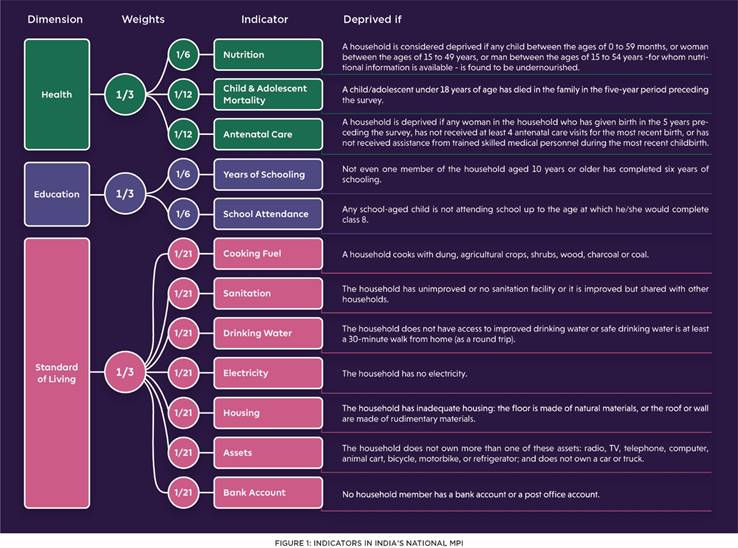
NITI AAYOG -The national MPI measure uses the globally accepted and robust methodology developed by the Oxford Poverty and Human Development Initiative (OPHI) and the UNDP. This baseline report of the national MPI measure is based on the reference period of 2015-16 of the National Family Health Survey (NFHS-4).
Conclusion
Though poverty alleviation strategy has progressed gradually over the previous decades, there has been no fundamental transformation. Changes in nomenclature, integration, or mutations of programmes are all possible. None, however, resulted in a significant shift in asset ownership, manufacturing processes, or the provision of necessities to the poor. While evaluating these programmes, scholars identify three significant areas of concern that limit their effective implementation.
Due to the uneven distribution of land and other assets, the non-poor have usurped the advantages of direct poverty reduction programmes. In comparison to the scale of poverty, the resources provided to these programmes are insufficient.
In addition, government programmes have failed to address the bulk of vulnerable individuals who live on or near the poverty line. It also demonstrates that rapid development is insufficient to alleviate poverty. Without the active engagement of the impoverished, no programme can be implemented successfully.
Poverty can be successfully erased only when the poor begin to contribute to progress via active participation in the growth process. This is achieved via a process of social mobilisation that encourages and empowers disadvantaged people to engage. This will also aid in the creation of job opportunities, which may lead to an increase in income, skill development, health, and literacy.
Furthermore, it is vital to identify impoverished regions and offer infrastructure such as schools, roads, electricity, telecom, IT services, training facilities, and so on. Poverty alleviation has always been recognised by policymakers as one of India's major issues, regardless of which government was in power. The absolute number of poor people in the country has decreased, and certain states have a lower percentage of poor people than the national average. Yet, critics point out that even though vast resources have been allocated and spent, we are still far from reaching the goal.
Today various schemes are being operated which include- skill development, rozgar yojana, antayodya Yojana, MGNREGA, ration scheme for subsidised food, PM-JAY and Jan Dhan Dhan Yojana to name a few. The schemes are well planned but the problem lies in implementation, plan must be charted out to reduce inclusion and exclusion errors, target beneficiaries must be paid attention to as resources are limited. coordination between state and centre governments must be enhanced.
Key takeaways
- Poverty is now widely measured multidimensionally, looking beyond just income to include health, education, and living standards.
- India's historical colonial exploitation and early post-independence economic policies heavily influenced its initial high poverty rates.
- The 1991 economic liberalization spurred rapid GDP growth, which became a primary engine for large-scale poverty reduction.
- Structural vulnerabilities, such as over-reliance on agriculture, informal labor, and social stratification, continue to perpetuate poverty.
- Large-scale welfare programs (like MGNREGA) and digital Direct Benefit Transfers (DBT) are central to India's modern poverty alleviation strategy.
Test yourself
What is the difference between absolute poverty and multidimensional poverty?
Absolute poverty is based strictly on an income threshold, while multidimensional poverty accounts for deprivations in health, education, and living standards.
Why has India historically used consumption expenditure rather than income to measure poverty?
Consumption is considered a more stable and accurate indicator of long-term welfare, especially in agrarian economies where incomes can fluctuate wildly with the seasons.
What is the "JAM Trinity" and how does it help alleviate poverty?
It stands for Jan Dhan (bank accounts), Aadhaar (biometric ID), and Mobile. It enables Direct Benefit Transfers, reducing corruption and ensuring subsidies reach the intended recipients directly.
Frequently asked questions
What is the difference between absolute poverty and relative poverty?
Absolute poverty refers to a lack of financial resources needed to maintain a subsistence level of life, where survival itself is at risk. Relative poverty, on the other hand, measures a person's living standard in comparison to the economic standards of their surrounding population, reflecting income inequality rather than survival needs.
Why is poverty described as both a cause and a consequence?
Poverty creates conditions that make it difficult to escape—such as lack of education, healthcare, and opportunities—which trap individuals in a cycle where poverty reproduces itself. Thus, poverty both results from and contributes to broader social and economic inequalities.
How is poverty typically measured in economic terms?
Poverty is often measured by defining a minimum expenditure or income required to acquire a basket of essential goods and services, known as the poverty line. This line helps quantify how many people fall below a subsistence threshold.
What role do social attitudes play in perpetuating poverty?
The note highlights that poor people are often viewed as a burden and face strong prejudice, which reinforces exclusion and limits their access to opportunities, thereby deepening poverty's societal grip.
Try it
Poverty in India - An Overview
Test your understanding of India's poverty landscape and the tools used to measure and combat it.
1According to the text, how does the Multidimensional Poverty Index (MPI) differ from traditional poverty measurement approaches?
This describes absolute poverty, which the text identifies as the older, narrower approach. The MPI was developed specifically to move beyond this limitation.
Correct. The text states the MPI 'evaluates poverty across three broad dimensions: health, education, and living standards,' allowing policymakers to identify systemic deprivations beyond just income.
This describes the methodology used by committees like Tendulkar (2009) and Rangarajan (2014), which measured consumption expenditure for caloric needs—not the MPI approach.
2Why does the informal economy pose a significant challenge to poverty alleviation in India?
Exactly. The text explicitly states that 'over 80% of India's workforce is employed in the informal sector' and these jobs 'lack social security, health benefits, and legal protections, leaving workers susceptible to sudden loss of livelihood.'
While agriculture is mentioned as a separate vulnerability factor, the informal sector encompasses many industries beyond agriculture—街 vendors, domestic workers, construction labor, etc.
The text provides the specific statistic that 'over 80% of India's workforce is employed in the informal sector,' indicating this is tracked. The issue is not lack of data, but the structural lack of protections these workers face.
You've explored the multidimensional nature of poverty in India and the structural challenges that make alleviation complex. Understanding these nuances is key to evaluating policy effectiveness.