
Reflection of Light | ICSE Class 9 Physics Notes
On this page

This note covers reflection and its laws, plane-mirror images, multiple reflection between parallel mirrors, spherical-mirror terminology, principal rays, image formation, mirror uses, Cartesian signs, the mirror formula and magnification.
What is reflection of light, and how are its rays described?
Reflection is the return of light from a surface into the medium from which it arrived. Light reflected by an object enables us to see it when that light reaches our eyes. A highly polished surface, such as a mirror, reflects most of the light falling on it.
In ordinary observations, light seems to travel in straight lines. A small light source producing a sharp shadow supports this description. A ray represents a path of light; a narrow beam contains several rays. Arrows on ray lines show the direction of travel.
Which terms describe a reflection?
A plane mirror has a flat reflecting surface. The incident ray approaches that surface. The point of incidence is where it strikes. The reflected ray leaves the surface after reflection.
The normal is a line perpendicular to the reflecting surface at the point of incidence. Perpendicular means meeting at a right angle, or 90°, where ° denotes degrees. The normal provides the reference line for measuring both reflection angles.
| Quantity | Symbol | Meaning |
|---|---|---|
| Angle of incidence | i | Angle between the incident ray and the normal |
| Angle of reflection | r | Angle between the reflected ray and the normal |
Regular reflection occurs at a smooth surface such as a mirror. Diffused reflection occurs when parallel rays falling on a rough surface are reflected in different directions. Parallel rays travel alongside one another without meeting.
Diffused reflection does not mean that the reflection laws have failed. Irregularities in the surface change the direction of the normal from point to point. Each individual ray still obeys the laws at its own point of incidence.
What are the laws of reflection, and how can they be verified?
Definition: The laws of reflection state that the angle of incidence equals the angle of reflection, and that the incident ray, the normal at the point of incidence and the reflected ray lie in the same plane.
The angle relationship is . Here a plane means a flat geometrical surface containing the three lines. Both laws apply to plane mirrors and spherical reflecting surfaces. A curved mirror changes the local normal, not the laws.
How is the equality of angles tested?
- Fix a white sheet on a drawing board. Hold a comb perpendicular to the sheet, with all but one opening covered by black paper.
- Send torchlight through the remaining opening. Adjust the torch and comb until a narrow beam travels along the paper.
- Place a plane-mirror strip in its path. Mark the mirror position and the paths of the incident and reflected beams.
- Remove the mirror and draw the normal where the incident path meets the mirror line. Measure both angles from this normal.
- Repeat with different incident directions and compare the measured angles. Carefully obtained readings show that the two angles are equal.
Experimental readings may be approximately equal. The geometrical law states exact equality; the activity tests that relationship through measurements. Keep the mirror upright and the ray paths on the same sheet while recording them.
How is the common plane tested?
Allow stiff paper to project beyond the table, with the reflected beam falling on the projecting part. Bend that part away. The reflected beam is no longer visible on it. Restore the paper to its original position and the beam becomes visible again.
This shows why the incident ray, normal and reflected ray must be considered in one plane. Comparing angles alone checks one law; observing the plane containing the ray paths checks the other.
How does a plane mirror form an image?
An image is the optical reproduction of an object formed by light rays. A real image forms where reflected rays actually meet and can be obtained on a screen. A virtual image forms where reflected rays appear to meet when extended backwards.
A plane mirror forms a virtual image. The reflected light reaches the observer from in front of the mirror, but its backward extensions meet behind the mirror. Those extensions indicate an apparent origin; they are not paths travelled by reflected light behind the mirror.
What are the image characteristics?
| Characteristic | Plane-mirror image |
|---|---|
| Nature | Virtual; cannot be obtained on a screen |
| Orientation | Erect, meaning upright relative to the object |
| Size | Equal to the size of the object |
| Position | As far behind the mirror as the object is in front |
| Sideways appearance | Laterally inverted |
Lateral inversion means that the left of the object appears on the right of the image and the right appears on the left. It differs from an inverted image, which is upside down. A plane-mirror image is erect despite its lateral inversion.
What the figure shows
Image behind a plane mirror
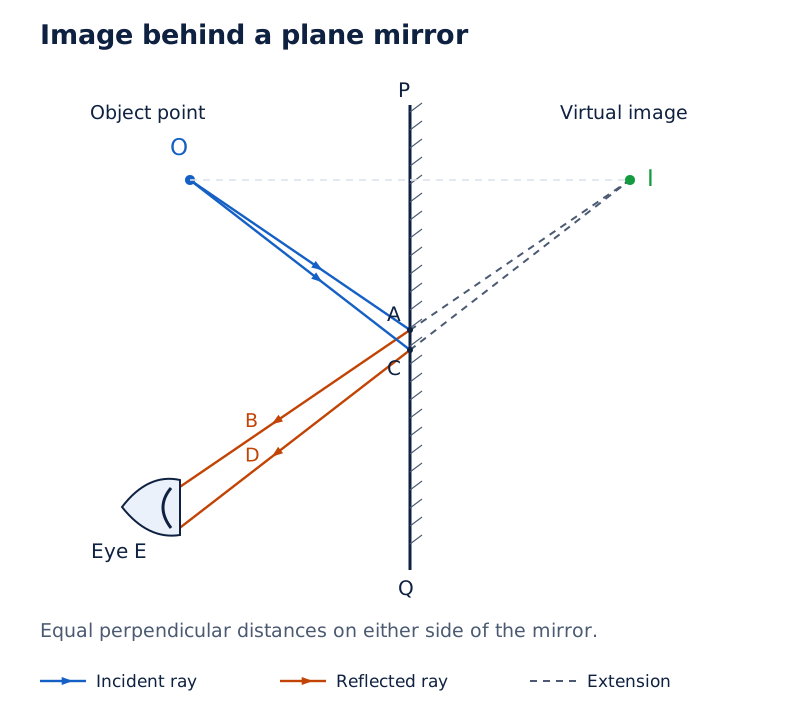
The object point O sends rays to two points A and C on the mirror PQ. Reflected paths AB and CD travel towards an eye E. Dashed backward extensions meet at the image point I behind the mirror.
Drawn by One Young India.
In this diagram, O names the object point; PQ names the mirror line; A and C are the two points of incidence; B and D mark the outgoing paths; E names the eye; and I names the image point.
To check image distance experimentally, place object pins at different distances from an upright plane mirror. Trace reflected paths and extend them backwards using dashed lines. Compare each object's perpendicular distance from the mirror with its image's perpendicular distance behind it.
Why do parallel plane mirrors produce multiple images?
Multiple reflection means that light undergoes reflection more than once. A ray reflected by one mirror can become an incident ray at another. Each reflection follows the same two laws, even though the complete light path contains several changes of direction.
Place a candle between two plane mirrors with their reflecting surfaces facing one another and parallel. Each mirror forms an image of the candle. It also reflects light already reflected by the other mirror, so further images appear behind the mirrors.
What are the characteristics of these images?
In the ideal arrangement of unlimited, perfectly reflecting parallel mirrors, the repeated process has no final reflection. It gives infinitely many images. Real mirrors show a finite visible sequence because they have limited size and do not reflect all the incident light.
The images are virtual, erect and the same size as the object in the ideal plane-mirror construction. Successive reflections reverse the sideways appearance again: an odd number of reflections gives lateral inversion, while an even number restores the original sideways orientation.
Images formed after more reflections appear farther behind the mirrors. Their reduced brightness in practice should not be confused with the reduction in image size produced by a convex mirror. Plane-mirror reflection preserves image size.
Photograph: Image in plane mirror parallel to each other. The photograph shows facing mirrors and a repeated sequence of bright candle images. The label “mirrors” has lines pointing to the reflecting arrangement.
Where is repeated reflection useful?
At a hairdresser's shop, a mirror held behind the head and a mirror in front let a person see the back of the head. A periscope is an instrument using mirrors to see objects that cannot be viewed directly.
A simple periscope uses two plane mirrors. Light reflected from one reaches the other and then the observer. Such instruments are used in submarines, tanks and bunkers. A single plane mirror is also useful for viewing an erect, same-sized image of oneself.
How are concave and convex spherical mirrors described?
A spherical mirror has a reflecting surface forming part of a sphere. A concave mirror reflects from the surface curved inwards, towards the sphere's centre. A convex mirror reflects from the surface bulging outwards.
The inward-curved side of a shining spoon can be approximated to a concave mirror. Its outward-bulging side can be approximated to a convex mirror. This comparison helps identify the reflecting side; the spoon is an approximation, not necessarily an exact spherical surface.
Which points and distances identify a spherical mirror?
| Term | Symbol | Meaning |
|---|---|---|
| Pole | P | Centre of the mirror's reflecting surface |
| Centre of curvature | C | Centre of the sphere of which the mirror forms a part |
| Radius of curvature | R | Radius of that sphere, equal to the distance from P to C |
| Principal axis | Line through P and C | Straight line through the pole and centre of curvature |
| Aperture | Diameter of reflecting surface | Diameter of the circular outline of the reflecting surface |
The centre of curvature lies in front of a concave mirror and behind a convex mirror. It is not a point on the mirror's reflecting surface. The pole, by contrast, lies on that surface.
The principal axis is normal to the mirror at its pole. Away from the pole, the normal to a spherical surface passes through its centre of curvature. This geometry explains why rays directed along a radius retrace their paths after reflection.
The spherical-mirror treatment here concerns mirrors whose aperture is much smaller than the radius of curvature. Keep this restriction with the focus relationships. A broad statement about a spherical surface should not silently remove the small-aperture condition used for the ray construction.
What are principal focus, focal length and focal plane?
For a concave mirror, rays parallel to the principal axis meet after reflection at the principal focus, denoted by F. For a convex mirror, the reflected rays appear to come from F behind the mirror. The actual reflected rays do not meet there.
The focal length, denoted by f, is the distance between the pole and principal focus. The principal focus lies midway between the pole and centre of curvature, provided the spherical mirror has a small aperture. Therefore, , or equivalently .
What the figure shows
Principal foci of spherical mirrors
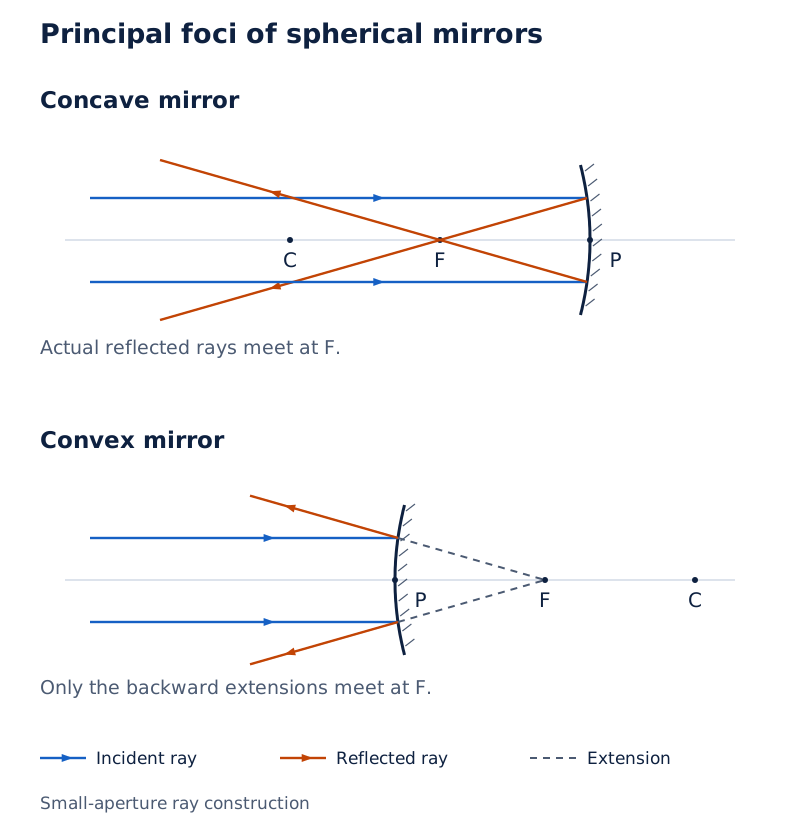
Parallel incident rays meet at F in front of the concave mirror. For the convex mirror, the reflected rays spread apart and their dashed extensions meet at F behind it. P and C mark the pole and centre of curvature.
Drawn by One Young India.
What happens to parallel rays inclined to the axis?
The focal plane is the plane through the principal focus perpendicular to the principal axis. For a narrow bundle of rays close to the axis and making small angles with it, mutually parallel rays inclined to the axis focus at a point on this plane.
With a concave mirror, the reflected rays meet at that off-axis point. With a convex mirror, their backward extensions meet at a corresponding point on its focal plane. Such an off-axis point is a secondary focus, rather than the principal focus.
Conversely, rays from one point on the focal plane of a concave mirror emerge parallel after reflection. For a convex mirror, incident rays directed towards one point on its focal plane emerge parallel. The bundle need not be parallel to the principal axis.
How can focal length be found approximately?
Use a concave mirror to obtain a sharp image of a distant object on a screen. The screen's distance from the mirror gives an approximate focal length. A distant object supplies rays that are nearly parallel over the small mirror aperture.
Note: Do not look directly at the Sun or into a mirror reflecting sunlight. Reflected sunlight can damage the eyes.
Which rays are useful for constructing mirror images?
A ray diagram represents the incident and reflected paths used to locate an image. Many rays leave each point of an object. Two suitably chosen rays from the same point are sufficient to locate that point's image.
For a small upright object, draw rays from its top. The point where the reflected rays meet gives the top of a real image. If they spread apart, extend them backwards; their apparent meeting point gives the top of a virtual image.
What are the principal construction rules?
| Incident path | Concave mirror | Convex mirror |
|---|---|---|
| Parallel to the principal axis | Reflected through F | Reflected as if coming from F |
| Through F, or directed towards F | Reflected parallel to the principal axis | Reflected parallel to the principal axis |
| Through C, or directed towards C | Returns along its original path | Returns along its original path |
| Incident at P | Makes equal incident and reflected angles with the principal axis | Makes equal incident and reflected angles with the principal axis |
The centre-of-curvature ray travels along the normal at the point where it meets the mirror. It therefore returns along the same line. At the pole, the principal axis itself acts as the normal.
What the figure shows
Focus-directed rays
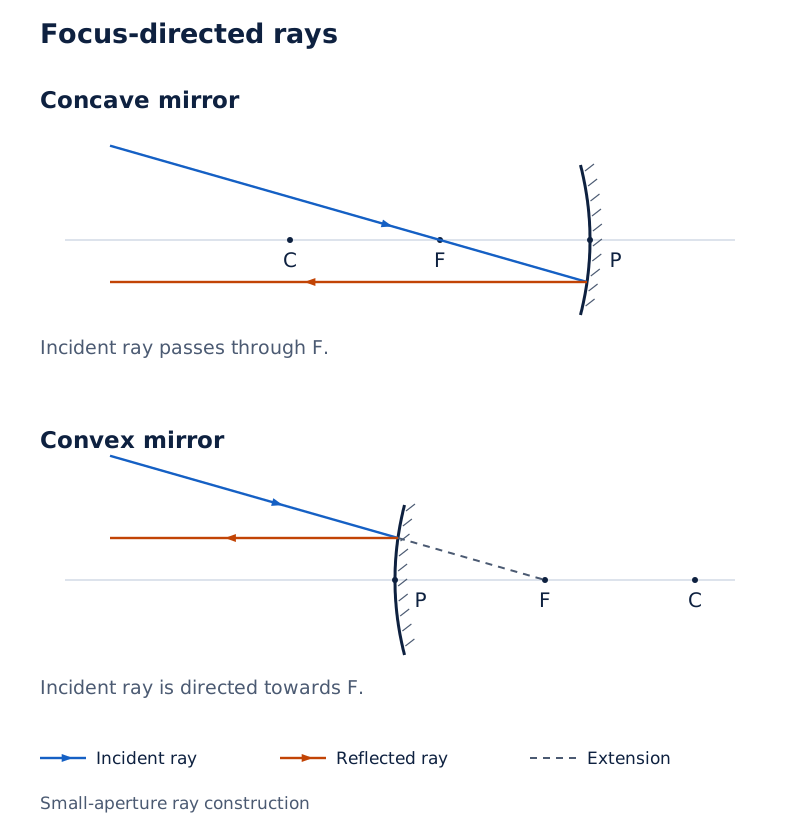
In the concave-mirror drawing, the incident ray passes through F and leaves parallel to the principal axis. In the convex-mirror drawing, a dashed continuation aims towards F behind the mirror, while the reflected ray leaves parallel to the axis.
Drawn by One Young India.
Keep actual rays and backward extensions distinct. Use solid lines with direction arrows for light paths and dashed lines for extensions. A convex mirror's focus-directed incident ray is directed towards a point behind the mirror; it does not first pass through that point.
State the resulting image's position, size and nature together. A diagram showing where lines meet is incomplete as an explanation unless it also distinguishes actual convergence from the apparent convergence of backward extensions.
How does object position change a concave-mirror image?
A concave mirror can give different images as the object moves relative to its pole, focus and centre of curvature. Diminished means smaller than the object; enlarged means larger. The phrase at infinity describes the limiting case of incident rays arriving parallel from a very distant object.
What are the image positions and characteristics?
| Position of the object | Position of the image | Size of the image | Nature of the image |
|---|---|---|---|
| At infinity | At the focus F | Highly diminished, point-sized | Real and inverted |
| Beyond C | Between F and C | Diminished | Real and inverted |
| At C | At C | Same size | Real and inverted |
| Between C and F | Beyond C | Enlarged | Real and inverted |
| At F | At infinity | Image would not be formed | |
| Between P and F | Behind the mirror | Enlarged | Virtual and erect |
For the object at F, reflected rays from a point emerge parallel. They do not meet at a finite distance, so no sharp image can be obtained on a screen at a finite position. “At infinity” describes that limiting ray arrangement.
What the figure shows
Concave-mirror image positions
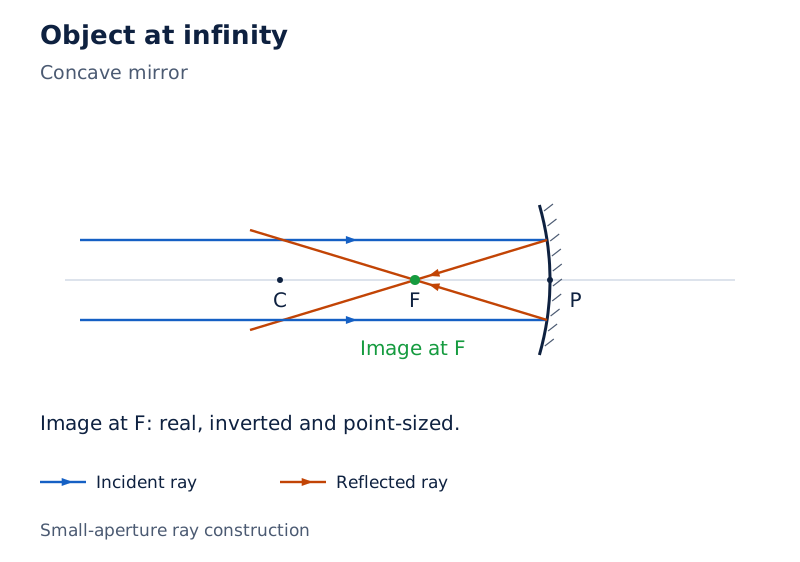
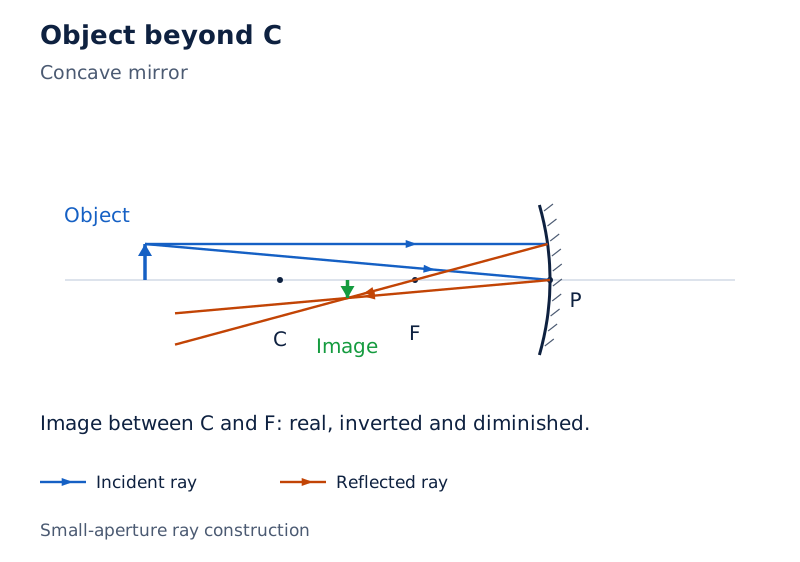
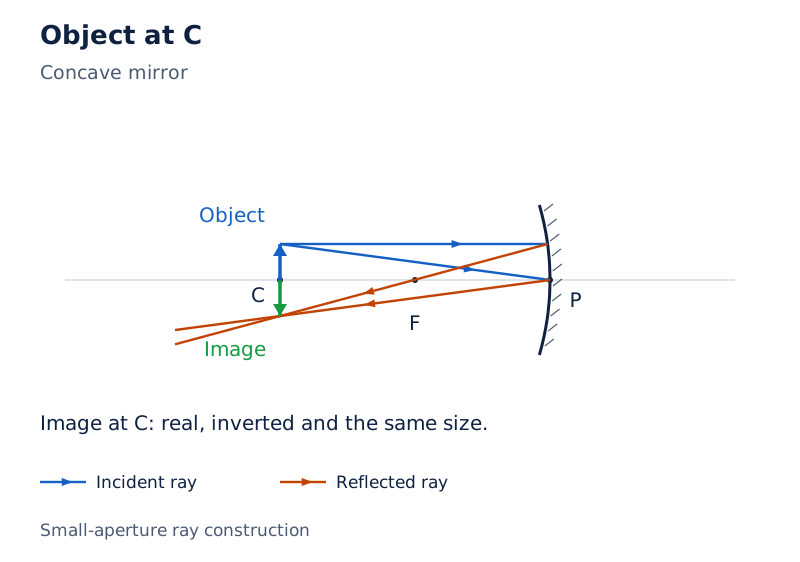
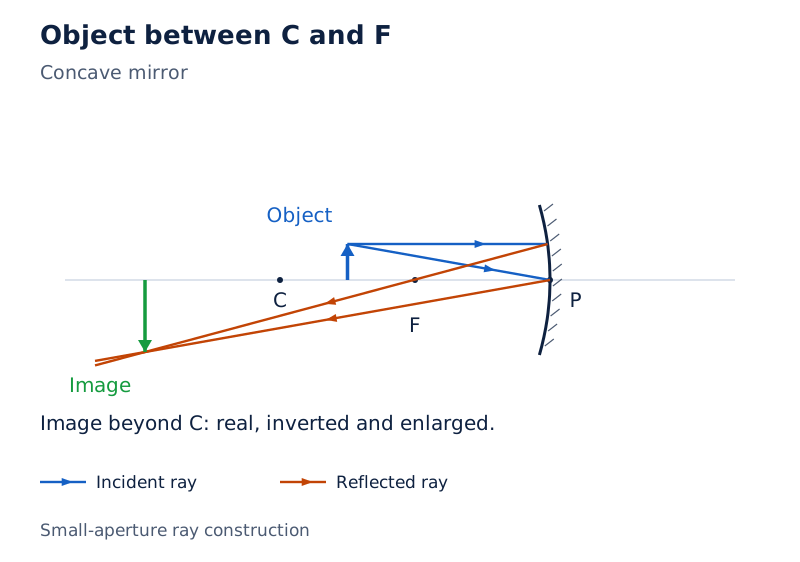
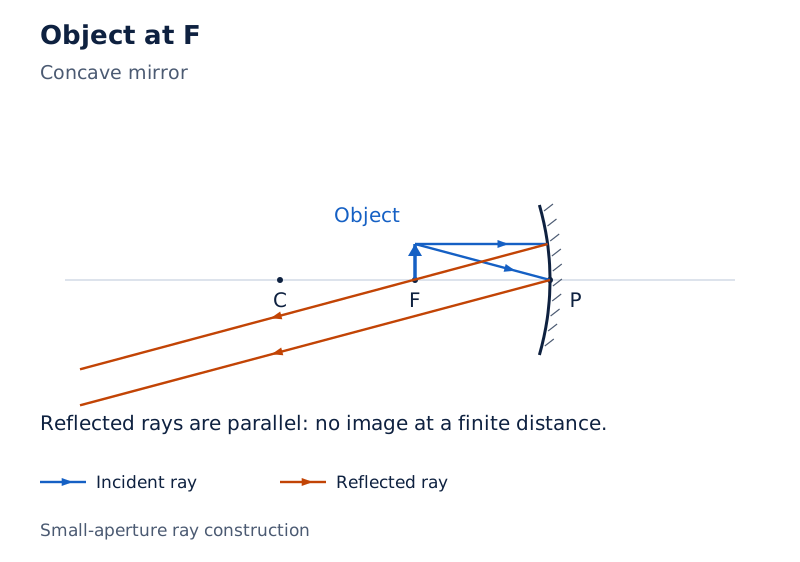
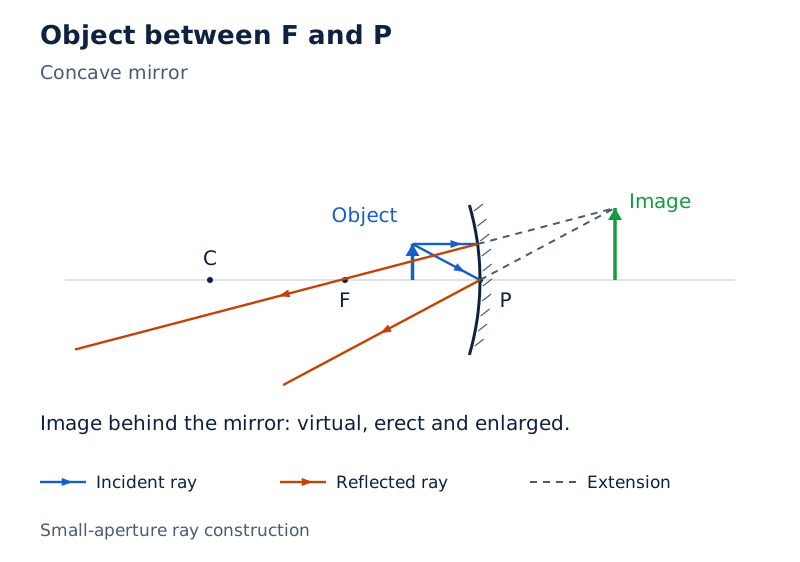
Six drawings show the object at infinity, beyond C, at C, between C and F, at F, and between F and P. The final drawing extends reflected rays behind the mirror to locate an upright enlarged image.
Drawn by One Young India.
How can the cases be investigated?
- Find the approximate focal length using a distant object and a screen.
- Mark the positions corresponding to the pole, focus and centre of curvature along the principal axis.
- Place a candle successively beyond C, at C and between C and F. Move the screen to locate each sharp image.
- Record image position, orientation and relative size. Repeat with the candle at F and between F and P.
- For the object between F and P, look into the mirror for the virtual image; it cannot be caught on the screen.
The important change occurs when the object is brought inside the focal length. Outside the focus, finite real images are inverted. Between focus and pole, the image becomes virtual and erect. “Concave” alone therefore does not determine the image's nature.
How do convex-mirror images and mirror uses compare?
A convex mirror spreads reflected rays apart. For an object in front of it, their backward extensions meet behind the mirror. Its image is virtual and erect, with a size smaller than the object for a finite object distance.
| Position of the object | Position of the image | Size of the image | Nature of the image |
|---|---|---|---|
| At infinity | At the focus F, behind the mirror | Highly diminished, point-sized | Virtual and erect |
| Between infinity and the pole P of the mirror | Between P and F, behind the mirror | Diminished | Virtual and erect |
What the figure shows
Convex-mirror images
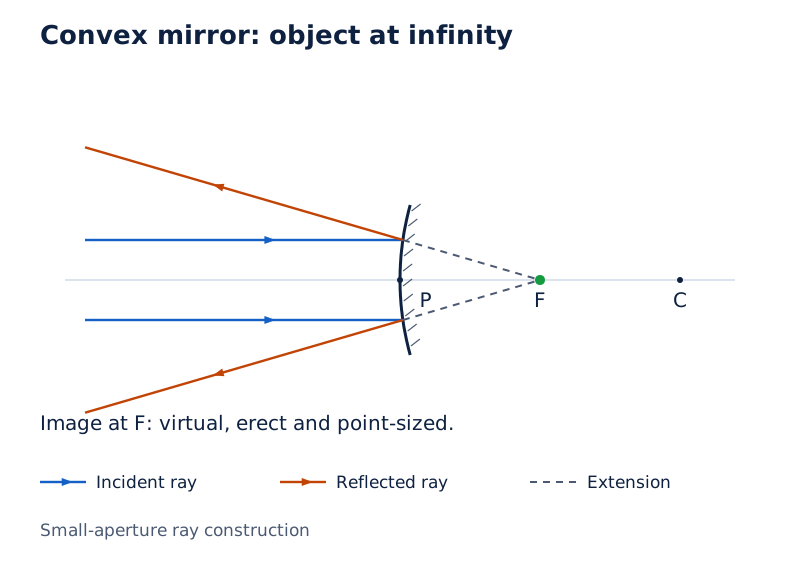
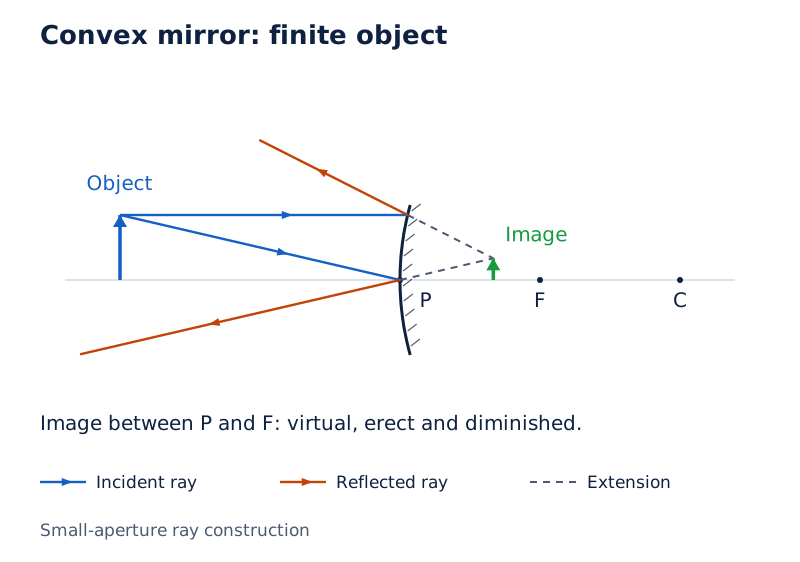
The first drawing shows parallel rays with backward extensions meeting at F. The second shows a finite upright object and a smaller upright image between P and F behind the mirror, located by dashed extensions.
Drawn by One Young India.
Why are different mirrors chosen for different purposes?
Convex mirrors are commonly used as rear-view mirrors on vehicles. Their field of view, the extent of the scene visible in the mirror, is wider than that of a plane mirror. They give an erect, though diminished, view of traffic behind.
Concave mirrors are commonly used in torches, searchlights and vehicle headlights to obtain powerful parallel beams. They are often used as shaving mirrors for an enlarged view of the face. Dentists use them to see enlarged images of teeth.
Large concave mirrors concentrate sunlight to produce heat in solar furnaces, devices that use concentrated sunlight for heating. These applications depend on bringing parallel incident light together, whereas a convex rear-view mirror is selected for its wider view.
For an erect enlarged view in a concave mirror, the object lies between its pole and focus. Moving the object outside the focus changes the image to a real inverted one. Mirror selection therefore depends on both the reflecting shape and the required object position.
How does the Cartesian sign convention work?
The Cartesian sign convention assigns positive and negative signs to distances and heights using a fixed reference. Take the pole as the origin, the point from which coordinates are measured. The principal axis forms the horizontal reference line.
Place the object to the left of the mirror, so incident light arrives from the left. Measure distances parallel to the principal axis from the pole. Rightward distances are positive and leftward distances are negative.
Which symbols and signs are used?
Object distance u is measured from the pole to the object. Image distance v is measured from the pole to the image. Object height is h, and image height is h′, read “h prime”. Heights above the principal axis are positive; those below it are negative.
| Quantity or position | Sign in this arrangement |
|---|---|
| Object distance u for the object on the left | Negative |
| Concave-mirror focal length f and radius R | Negative |
| Convex-mirror focal length f and radius R | Positive |
| Real image in front of the mirror | Negative v |
| Virtual image behind the mirror | Positive v |
| Height above or below the axis | Positive above; negative below |
The object is usually placed above the principal axis, giving positive h. An inverted real image then has negative h′; an erect virtual image has positive h′. A negative distance identifies a direction, not a physically negative amount of space.
What the figure shows
Signed distances and heights
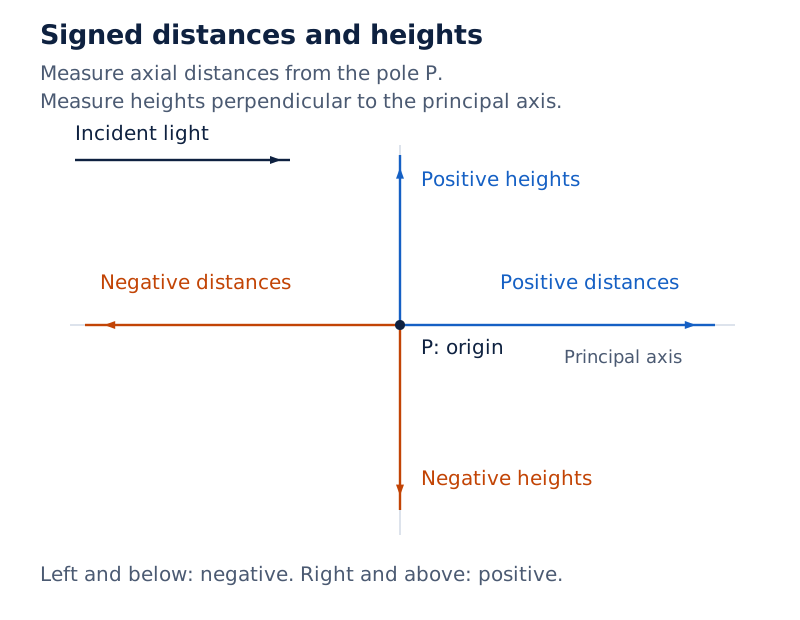
The pole marks the origin. Arrows show positive distances to the right and negative distances to the left. Upward heights are positive and downward heights negative; incident light travels from left to right.
Drawn by One Young India.
The SI unit of length is the metre, symbol m when written after a numerical distance. A centimetre, symbol cm, is one-hundredth of a metre. Use the same length unit for distances substituted into one mirror calculation.
How are the mirror formula and magnification applied?
The mirror formula connects object distance, image distance and focal length. Use signed values throughout: . It applies to concave and convex mirrors within the small-aperture spherical-mirror treatment.
Magnification, symbol m in an equation, gives image height relative to object height: . This m is a ratio, not the metre unit written after a distance. The same units in numerator and denominator cancel, so magnification has no unit.
A positive magnification describes an erect virtual image; a negative magnification describes an inverted real image for the upright real objects considered here. Its size, ignoring the sign, tells whether the image is enlarged, diminished or equal in height to the object.
How should a calculation be organised?
- Identify the mirror type and assign the correct sign to its focal length or radius.
- Write each given distance with its symbol, sign and unit. Assign positive height to an upright object above the axis.
- Use the mirror formula to find the missing distance. Retain the signs during subtraction and division.
- Use magnification to find relative size or image height, when enough information is supplied.
- Interpret the result as a position, nature, orientation and size, rather than leaving a signed number unexplained.
What do radius and magnification tell us directly?
Worked example 1. Find the focal length of a convex mirror with radius of curvature 32 cm.
Answer: Given R = +32 cm. Formula: f = R/2. Substitute: f = (+32 cm)/2 = +16 cm. Its focus lies behind the mirror. This is +0.16 m in metres.
Worked example 2. A concave mirror forms a real image three times the size of an object placed 10 cm in front of it. Find the image position.
Answer: u = −10 cm and m = −3 because the image is real and inverted. Formula: m = −v/u; v = −mu. Substitute: v = −(−3)(−10 cm) = −30 cm. The image is 30 cm in front of the mirror, or 0.30 m.
Image height cannot be calculated as an absolute length unless object height or equivalent information is supplied. Magnification alone gives a ratio. A question without the object's height can still ask for relative image size.
How are complete concave and convex mirror problems solved?
Start with signs before substituting numbers. The same formula handles both types of spherical mirror, but its interpretation must agree with the ray diagram. A screen catches a real image in front of a concave mirror; a virtual image behind a mirror cannot be caught there.
How is a rear-view mirror calculation completed?
Worked example 3. A convex rear-view mirror has radius of curvature 3.00 m. A bus is 5.00 m in front of it. Find image position, nature and size relative to the bus.
Answer: and . Formula: ; ; .
Substitute: f = +1.50 m; 1/v = 1/1.50 − 1/(−5.00). Thus v = +1.15 m, rounded. Then m = −1.15/(−5.00) = +0.23. The image is 1.15 m behind the mirror, virtual, erect and 0.23 times the bus's height.
How is a screen position calculated?
Worked example 4. An object 4.0 cm high stands 25.0 cm in front of a concave mirror of focal length 15.0 cm. Find the screen position and image height.
Answer: , and . Formula: ; .
Substitute: 1/v = −1/15.0 + 1/25.0 = −2/75.0, so v = −37.5 cm. Then h′ = −(−37.5)(4.0)/(−25.0) = −6.0 cm. Place the screen 37.5 cm in front. The real image is inverted and enlarged. These lengths are 0.375 m and 0.060 m respectively.
How can further answers be checked?
Worked example 5. An object is 10 cm in front of a convex mirror of focal length 15 cm. Find image position and nature.
Answer: u = −10 cm and f = +15 cm. Formula: 1/v = 1/f − 1/u; m = −v/u. Substitute: 1/v = 1/15 + 1/10 = 1/6. Thus v = +6 cm and m = +0.6. The image is 6 cm, or 0.06 m, behind the mirror, virtual, erect and diminished.
Worked example 6. An object 7.0 cm high is 27 cm in front of a concave mirror of focal length 18 cm. Find the screen position, image size and nature.
Answer: h = +7.0 cm, u = −27 cm and f = −18 cm. Formula: 1/v = 1/f − 1/u; h′ = −vh/u.
Substitute: 1/v = −1/18 + 1/27 = −1/54, giving v = −54 cm. Then h′ = −(−54)(7.0)/(−27) = −14 cm. The screen is 54 cm in front; the real inverted image is 14 cm high and enlarged. These lengths are 0.54 m and 0.14 m.
The sign of image height and the physical image size answer different questions. In the final example, negative height indicates inversion, while the image's physical height is 14 cm. Reporting both prevents a correct calculation from becoming an unclear conclusion.
Glossary
- Reflection — Return of light from a surface into the medium from which it arrived.
- Incident ray — Ray travelling towards a reflecting surface before striking it at the point of incidence.
- Normal — Line perpendicular to the reflecting surface at the point where a ray strikes.
- Angle of incidence — Angle between the incident ray and the normal at the point of incidence.
- Angle of reflection — Angle between the reflected ray and the normal at the point of incidence.
- Virtual image — Image formed where reflected rays appear to meet, which cannot be obtained on a screen.
- Real image — Image formed where reflected rays actually meet and which can be obtained on a screen.
- Lateral inversion — Appearance in which the object's left and right sides are interchanged in its image.
- Pole — Centre point of the reflecting surface of a spherical mirror.
- Centre of curvature — Centre of the sphere of which a spherical mirror's reflecting surface forms a part.
- Principal axis — Straight line passing through the pole and centre of curvature of a spherical mirror.
- Principal focus — Point where axis-parallel rays meet, or appear to originate, after reflection from a spherical mirror.
- Focal length — Distance between the pole and principal focus of a spherical mirror.
- Focal plane — Plane through the principal focus and perpendicular to the principal axis.
- Magnification — Ratio of signed image height to signed object height, describing relative size and orientation.
Common errors and misconceptions
- Misconception: Reflection angles are measured from the mirror surface. Correct: Measure both angles from the normal at the point of incidence.
- Misconception: Rough surfaces disobey the laws of reflection. Correct: Each ray obeys the laws; changing surface normals produce different reflected directions.
- Misconception: A virtual image is invisible. Correct: It is visible when reflected light enters the eye, but cannot be caught on a screen.
- Misconception: An erect plane-mirror image has no inversion of any kind. Correct: It is erect and laterally inverted; lateral inversion differs from being upside down.
- Misconception: A concave mirror always gives an enlarged virtual image. Correct: That happens when the object is between pole and focus; other positions produce different images.
- Misconception: The radius of curvature equals the focal length. Correct: For spherical mirrors of small aperture, the radius is twice the focal length.
- Misconception: All given distances should be substituted as positive. Correct: Assign Cartesian signs first, including negative focal length for a concave mirror.
- Misconception: Magnification supplies an image height even when object height is unknown. Correct: It gives a size ratio; absolute height needs additional height information.
Exam-style questions with model answers
Q1. State the two laws of reflection of light. [2 marks]
- The angle of incidence equals the angle of reflection, with both angles measured from the normal.
- The incident ray, normal at the point of incidence and reflected ray lie in the same plane.
Q2. Describe four characteristics of the image of an object formed by a plane mirror. [4 marks]
- The image is virtual: reflected rays only appear to meet behind the mirror, so it cannot be obtained on a screen.
- It is erect, meaning upright, but laterally inverted: the object's left and right appear interchanged.
- The image is the same size as the object; a plane mirror does not enlarge or diminish it.
- Its perpendicular distance behind the mirror equals the object's perpendicular distance in front of the mirror.
Q3. An object is placed between two ideal, unlimited, perfectly reflecting parallel plane mirrors whose reflecting surfaces face each other. Explain multiple-image formation in three points. [3 marks]
- Each plane mirror forms a virtual image of the object, and light reflected by one mirror can fall on the other mirror.
- The second reflection is followed by further reflections between the facing surfaces. Every reflection obeys the usual laws of reflection.
- In the stated ideal arrangement, this process has no final reflection, so infinitely many images are formed. They remain erect and the same size as the object.
Q4. For a small object in front of a concave mirror, describe image position, size and nature when the object is beyond the centre of curvature, at the centre, and between the pole and focus. [3 marks]
- Beyond the centre of curvature, the image forms between the principal focus and centre of curvature. It is diminished, real and inverted.
- At the centre of curvature, the image also forms at the centre of curvature. It is the same size as the object, real and inverted.
- Between pole and focus, the image forms behind the mirror. It is enlarged, virtual and erect, and cannot be obtained on a screen.
Q5. A convex rear-view mirror has radius of curvature 3.00 m. A bus is 5.00 m in front of it. Calculate focal length, image distance and magnification, then state image position and characteristics. [5 marks]
- Take the object on the left. Radius of curvature R = +3.00 m and object distance u = −5.00 m. Focal length f = R/2 = +1.50 m.
- Using the mirror formula, 1/v = 1/f − 1/u, where v is image distance, gives 1/v = 1/1.50 − 1/(−5.00).
- Solving gives v = +1.15 m, rounded. The positive sign places the image 1.15 m behind the reflecting surface of the mirror.
- Magnification m = −v/u = −1.15/(−5.00) = +0.23. This ratio states image height relative to bus height, without requiring the bus's absolute height.
- The image is virtual, erect and diminished. Its height is 0.23 times the bus's height; it cannot be obtained on a screen.
Q6. An upright object 4.0 cm high is 25.0 cm in front of a concave mirror of focal length 15.0 cm. Calculate image distance, screen position, magnification and image height, and state its characteristics. [6 marks]
- Use object height h = +4.0 cm, object distance u = −25.0 cm and focal length f = −15.0 cm. The concave focus lies in front of the mirror.
- The mirror formula gives 1/v = 1/f − 1/u = −1/15.0 + 1/25.0 = −2/75.0, where v is the signed image distance.
- Therefore v = −37.5 cm. Place the screen 37.5 cm, or 0.375 m, in front of the mirror to catch the sharp image.
- Magnification m = −v/u = −(−37.5)/(−25.0) = −1.5. The negative sign indicates inversion for the upright object.
- Image height h′ = mh = (−1.5)(4.0 cm) = −6.0 cm. Its physical height is 6.0 cm, or 0.060 m.
- The image is real, inverted and enlarged. Its height is one and a half times the object's height, consistent with the magnitude of magnification.
Q7. A convex mirror has radius of curvature 32 cm. Calculate its signed focal length and state where its principal focus lies. [2 marks]
- For this convex mirror, radius of curvature R = +32 cm, so focal length f = R/2 = +16 cm.
- The principal focus is 16 cm, or 0.16 m, behind the mirror; this agrees with the positive focal length.
Q8. Explain three reasons why a convex mirror is preferred as a vehicle's rear-view mirror. [3 marks]
- It forms an erect image of traffic behind the vehicle, so the driver sees the scene upright rather than inverted.
- It forms diminished images, allowing large objects behind the vehicle to be represented by smaller images in the mirror.
- Its outward-curved reflecting surface provides a wider field of view than a plane mirror, enabling the driver to see a larger area behind the vehicle.
Key takeaways
- Both reflection angles are measured from the normal, and the incident ray, reflected ray and normal share one plane.
- A plane mirror gives an erect, virtual, same-sized, laterally inverted image at the same distance behind the mirror.
- Facing parallel mirrors repeatedly reflect light, producing multiple images; infinitely many belong to the ideal unlimited, perfectly reflecting arrangement.
- For spherical mirrors of small aperture, the principal focus lies midway between pole and centre of curvature.
- A concave mirror's image depends on object position; an object between pole and focus gives a virtual enlarged image.
- A convex mirror produces erect diminished images and provides the wider field of view useful for viewing traffic behind vehicles.
- Assign Cartesian signs before using the mirror formula, and use magnification to connect image height with object height.
- Report calculated image position, orientation, nature and size in words as well as signed numbers.
Test yourself
From which line are the angles of incidence and reflection measured?
Both are measured from the normal at the point where the incident ray strikes the surface.
Why can a plane-mirror image be seen but not caught on a screen?
Reflected light reaches the eye, but the rays only appear to meet behind the mirror; they do not actually meet there.
What does a concave mirror do to a ray passing through its centre of curvature?
It reflects the ray back along the same path because the ray strikes along the normal.
Where must an object be placed for a concave mirror to give an erect enlarged image?
Place the object between the pole and principal focus. The resulting image is virtual and behind the mirror.
What happens to rays from a point at the focus of a concave mirror?
They emerge parallel after reflection, so they do not form a sharp image at any finite screen position.
Where is a convex-mirror image for an object at a finite distance in front?
It lies behind the mirror between the pole and principal focus, and is virtual, erect and diminished.
What does negative magnification indicate for an upright real object in these mirror problems?
It indicates an inverted real image. The magnitude of magnification gives image size relative to object size.
Why must absolute image height not be supplied when only magnification is known?
Magnification is a ratio. To turn that ratio into an image height, the object height or equivalent information is needed.
Write about it
Turn a question from this chapter into a paper.
The Writing Studio has a structure guide, a rubric and citation tools for 15 formats, from essays to research papers. Drafting is free with an account. Learnacy Essential adds feedback from an AI writing coach and submission to The OYI Review.
Learnacy Essential is ₹1,499 for the year. Publication depends on review and is not guaranteed.