
Relations and Functions | CBSE Class 11 Maths Notes
On this page
Watch & explore
Start with a few high-quality watches, then dive into the notes below.

These CBSE Class 11 Mathematics notes cover ordered pairs, Cartesian products, relations, domain, codomain, range, functions, standard function graphs, restrictions on real functions, and the addition, subtraction, multiplication and division of functions.
What are ordered pairs, and when are they equal?
An ordered pair consists of two elements written in a particular order. In , the symbol denotes the first element and denotes the second element. Their positions are part of the information carried by the pair.
If and denote two sets, a pair selected from them has its first element in and its second element in . The notation means that belongs to . Reversing positions need not preserve the pair.
In the notation used below, means equal and means unequal. The symbols and mean less than and greater than; and include equality. Addition, subtraction and powers retain their usual arithmetic meanings.
Property: Equality of ordered pairs
Let and denote the first and second elements of another ordered pair. Equality requires equality in corresponding positions:
The symbol means “if and only if”. Thus both coordinate conditions are required. Comparing the first element of one pair with the second element of the other would test a different statement.
Worked example 1. If , find the unknown numbers and .
Answer:
- Equate first elements:
- Subtract one from both sides:
- Equate second elements and add two:
- Check the original pair by substitution: Both positions agree, so the answers satisfy the given equality.
Order within a pair differs from the order of listing elements of a set. A set is identified by its elements, whereas the first and second positions distinguish the entries of an ordered pair. Keep that distinction when writing sets of pairs.
For numerical pairs, the same ordering gives coordinates in a plane. The first coordinate and second coordinate have different roles. An ordered triplet extends this idea to three positions and is useful when describing points in three-dimensional space.
How do you form and count Cartesian products?
Definition: The Cartesian product is the set of all ordered pairs whose first element belongs to and whose second element belongs to .
Here denotes the Cartesian product of sets. Using the set-builder notation, in which the colon means “such that”, the definition is:
To construct the product systematically, pair one element of the first set with every element of the second set. Then repeat for each remaining first element. This method includes every permitted pair and helps prevent omissions.
Property: Number of elements in a finite product
The notation denotes the number of elements of the finite set . Let and denote the numbers of elements in and , respectively. Then:
The symbol means “implies”. Each first element contributes one pair for each second element. If either set is empty, there are no possible pairs. Writing for the empty set, .
Worked example 2. Let and , where the letters label set elements. Form both Cartesian products and compare them.
Answer:
- Use each element of first and the sole element of second:
- Reverse the roles of the sets:
- Compare corresponding positions in the listed pairs. The products are different:
- Check their sizes separately: The dot denotes multiplication of numbers; equal sizes do not establish equality of sets.
How do products extend to three positions?
An ordered triplet contains three entries in specified positions. For a set , the product contains all triplets with every entry chosen from . Choices may repeat; there is no requirement that the three entries differ.
For , the product is:
Let denote the set of real numbers. The product represents coordinates of points in two-dimensional space; represents coordinates in three-dimensional space. A product of non-empty sets is infinite if either factor is infinite.
What is a relation, and how are its domain and range found?
A relation, denoted by , from a non-empty set to a non-empty set is a subset of their Cartesian product. It selects ordered pairs according to a stated relationship between their first and second elements.
The notation means that every pair in the relation belongs to the product. The symbol means “is a subset of”, allowing equality. The product supplies all possible pairs; the relation identifies the selected pairs.
| Term | How it is identified |
|---|---|
| Domain | Collect all first elements of the ordered pairs actually present in the relation. |
| Range | Collect all second elements of the ordered pairs actually present in the relation. |
| Codomain | Use the entire specified destination set, including elements that are not reached. |
| Image | The second element of a related pair is an image of its first element. |
A relation can be described by roster form, which lists its pairs, or set-builder form, which states the rule selecting them. An arrow diagram gives a visual representation, with arrows running from first elements to their related second elements.
Worked example 3. Let . Define a relation on by , where and denote its first and second elements. Find its domain, range and codomain.
Answer:
- Apply the rule to the permitted first elements: The next calculation gives , which is outside the destination set.
- List the valid pairs:
- Collect the first elements and second elements separately:
- Retain the whole specified destination set:
What the figure shows
Successor relation
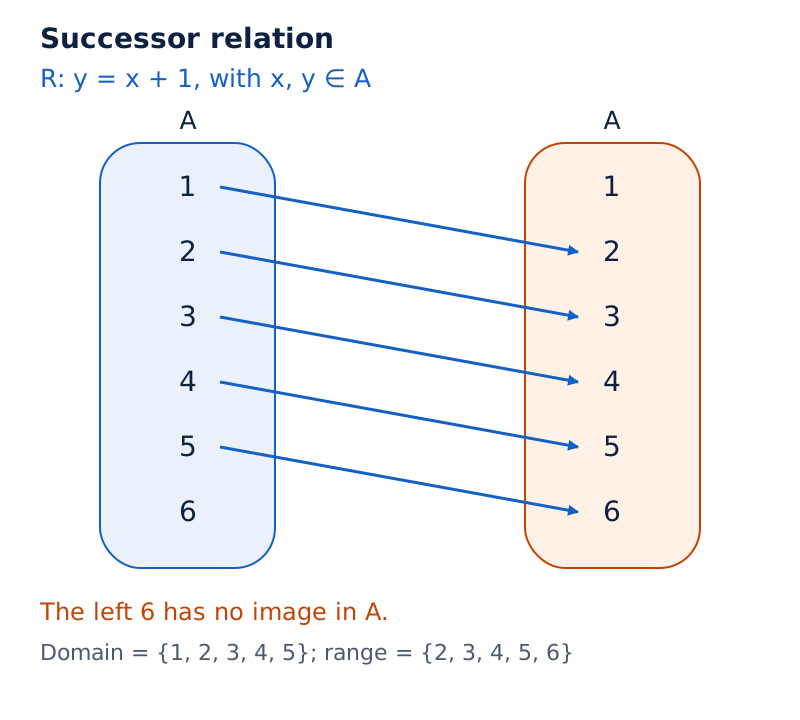
Two ovals each contain the numbers from to . Arrows join to , to , to , to , and to . The left-hand has no outgoing arrow.
Drawn by One Young India. See Fig. 2.5 in your NCERT textbook
A relation on a set means a relation from that set to itself. This does not require all elements to occur as first elements. The domain of a general relation is obtained from its pairs, as the example demonstrates.
How many relations can be defined between two finite sets?
Result: Counting relations by counting subsets
Every subset of a Cartesian product defines a relation. Therefore the number of relations from one finite set to another equals the number of subsets of their product. The empty subset and the complete product are included in this count.
Let and be finite sets, with and elements respectively. Their product has elements. Consequently, the total number of relations from to is .
Derivation: Why does the exponent contain a product?
- Write the sizes of the two sets:
- Count the ordered pairs available for selection:
- Count the subsets of this product:
Check the distinction: the product size counts individual pairs; the relation count counts sets of pairs. A single relation can contain several pairs, one pair, or no pairs. These are different objects being counted.
Worked example 4. Find the number of relations from to .
Answer:
- Form the complete product:
- Count its elements:
- Apply the subset count:
- Evaluate the power: Thus there are sixteen relations, although the product itself has only four elements.
Do not interchange the two stages. First determine how many ordered pairs are available, using the sizes of the source and destination sets. Then count the possible subsets. Listing one particular subset answers a different question from counting all relations.
When does a relation qualify as a function?
Definition: A function from to is a relation in which every element of has one and only one image in .
The notation names the function , its domain , and its codomain . If belongs to this function, write . Here is the image of , and is a preimage of .
There are two requirements: every input in the specified domain must be covered, and its output must be unique. Different inputs may have the same image. The uniqueness requirement concerns the output for each input, rather than the number of inputs reaching an output.
How do you check a list of ordered pairs?
Inspect the first elements. If a first element occurs in distinct pairs with different second elements, the relation fails the function condition. Also compare the listed first elements with any explicitly stated domain to identify missing inputs.
Worked example 5. Decide whether is a function on its set of first elements, and identify its domain and range.
Answer:
- Collect its first elements:
- Read their images: The symbol means “maps to”.
- Each of these inputs has exactly one image, so the relation is a function. The shared image of the first two inputs does not violate the definition.
- Collect the distinct outputs:
By contrast, is not a function because the input has two different images. The successor relation on also fails to be a function on that whole set because its last element has no image.
Let denote the natural numbers. The relation on is a function: every natural-number input has one image. Its domain and codomain are , while its range consists of even natural numbers.
A real-valued function has real numbers as its outputs. If its domain also consists of real numbers, it is a real function. Both the domain and range may be subsets of the real numbers; neither must contain every real number.
How do identity, constant and polynomial functions behave?
Standard functions connect an algebraic rule with a domain, a range and a graph. Let denote the real input and its output. A plotted point records one input together with the output assigned by the function.
What distinguishes identity and constant functions?
The identity function is defined by for every real input. Its domain and range are both . Each input is its own image, and its graph is a straight line through the origin.
A constant function has the rule , where is a fixed real number. Its domain is , but its range is the singleton set . Changing the input leaves the output unchanged.
What the figure shows
Identity and constant graphs
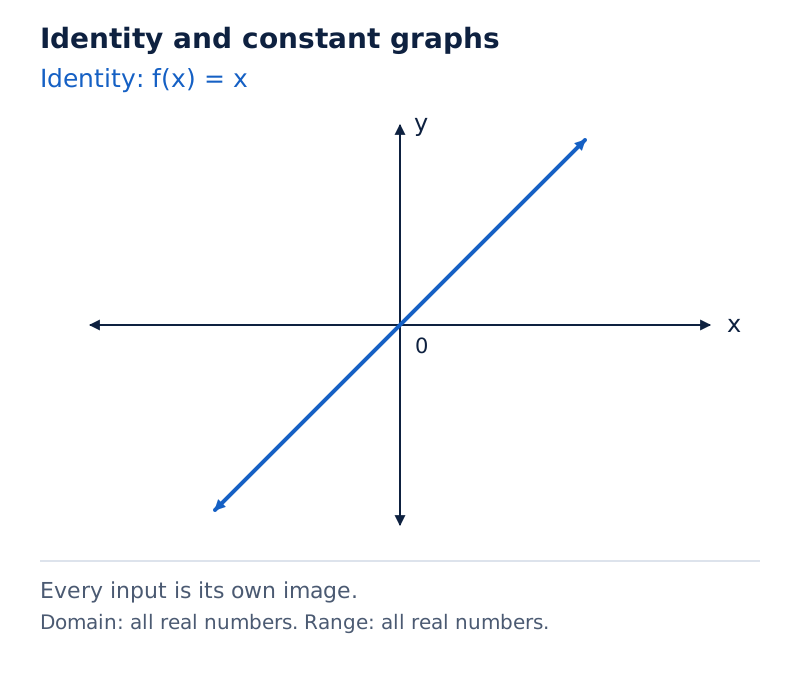
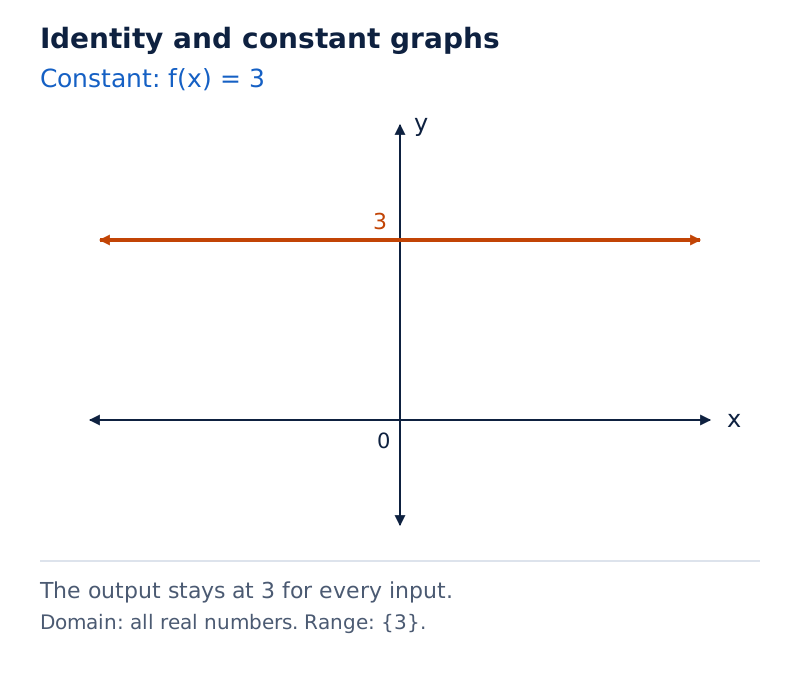
The identity graph is a rising straight line through the origin, labelled . The constant graph is a horizontal line at height , labelled .
Drawn by One Young India. See Figs. 2.8 and 2.9 in your NCERT textbook
What makes a function polynomial?
A polynomial function has the form below. Here is a non-negative integer and are real coefficients, meaning the fixed numbers multiplying the powers of the input:
The powers of the input are non-negative integers. The rule is polynomial. So is , where names another function. The radical sign denotes the non-negative square root. A coefficient need not be rational.
In contrast, the function , where is another function name, is not polynomial because of the fractional power of the input. Distinguish the nature of the coefficient from the exponent attached to the variable.
Worked example 6. For defined by , calculate the values at the integer inputs from to , then state the domain and range.
Answer:
- Square the negative inputs, retaining parentheses:
- Evaluate at zero:
- Square the positive inputs:
- The rule accepts all real inputs. Its outputs are their squares: The interval denotes all non-negative real numbers; indicates that it has no finite upper bound.
What the figure shows
Square function
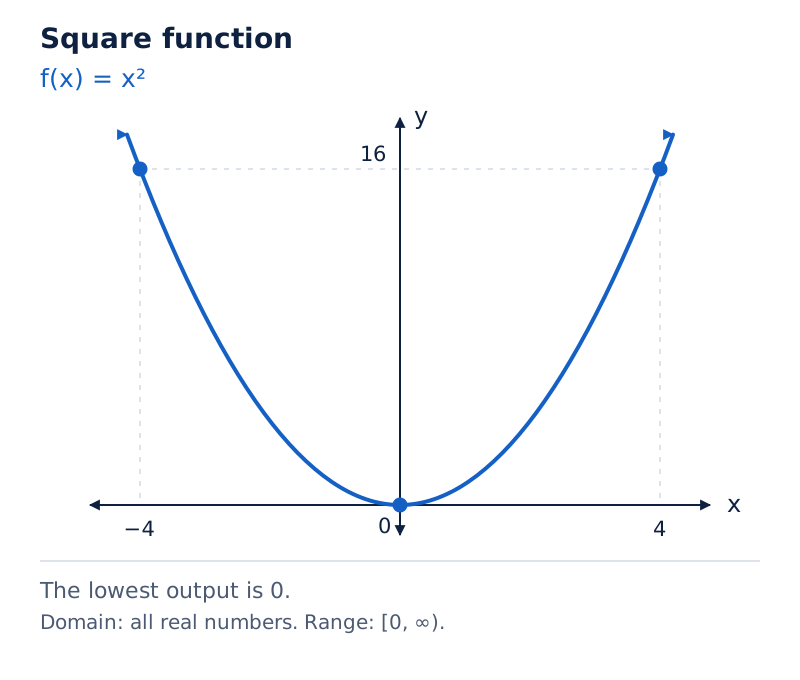
The graph labelled is an upward-opening curve with its lowest point at the origin. Its two arms lie on opposite sides of the vertical axis.
Drawn by One Young India. See Fig. 2.10 in your NCERT textbook
The cubic function is another polynomial example. A finite table helps locate points, but the domain of a polynomial function here is the entire real line. The tabulated inputs are selected plotting values, not a restriction on the function's domain.
How do denominator restrictions determine a real function's domain?
A rational function is a quotient of polynomial functions. If and name those polynomials, the expression is defined only where . The denominator condition is part of specifying the function.
For the reciprocal function , zero is excluded from the domain. No permitted input gives an output of zero either. Therefore its domain and range are both , where means set difference, removing the stated element.
What the figure shows
Reciprocal function
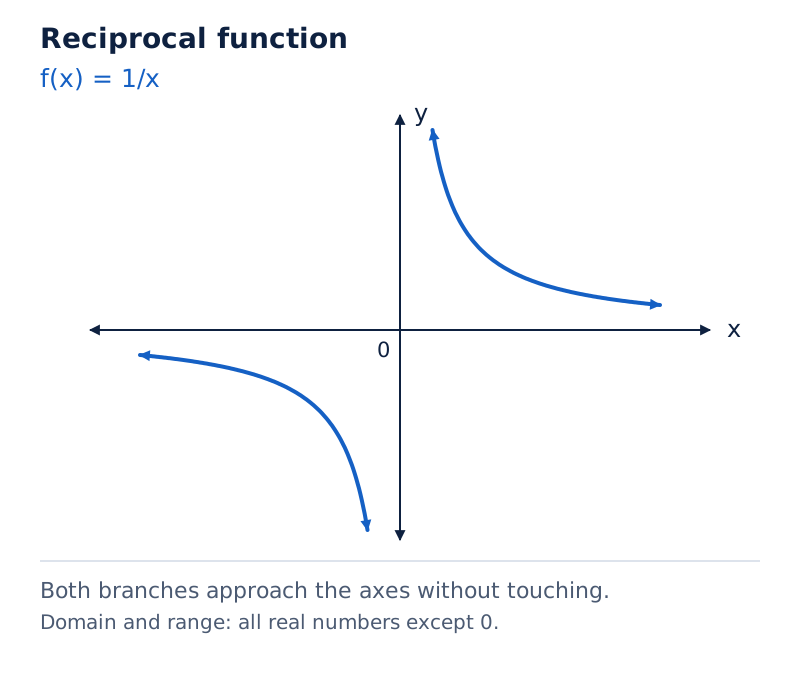
The graph labelled has one branch above the positive horizontal axis and another below the negative horizontal axis. The branches approach the coordinate axes without meeting them in the drawing.
Drawn by One Young India. See Fig. 2.12 in your NCERT textbook
How do you locate excluded inputs?
Find all inputs that make the denominator zero. Factorisation can turn this task into solving simpler equations. The resulting excluded inputs must remain visible in the final domain statement; an algebraic expression alone does not communicate the restriction.
Worked example 7. Find the domain of the real function
Answer:
- Identify the condition imposed by the denominator:
- Factorise it:
- Find the forbidden inputs from the two factors:
- Check these exclusions in the original denominator:
- Remove both inputs from the real numbers:
Domain and range require different questions. For the domain, ask which inputs allow the given rule to be evaluated. For the range, ask which outputs the permitted inputs actually produce. The exclusions in a denominator directly address the first question.
When the rule is supplied with a specified domain, retain that domain as well as the restrictions needed by the expression. In operations involving several functions, the permitted inputs must make every required function value meaningful.
How do modulus, signum and greatest integer functions differ?
These functions describe outputs by conditions on the input. A piecewise rule requires reading both the formula and the condition attached to it. The equality signs at a boundary determine which part supplies the value there.
What does the modulus function return?
The modulus function, written , returns the input for a non-negative real number and its negative for a negative real number. The vertical bars denote modulus. Its rule is:
The output is non-negative in both cases. Negating an already negative input gives its positive magnitude. The two parts therefore fit together at the origin rather than extending as a single straight line through negative output values.
What the figure shows
Modulus function
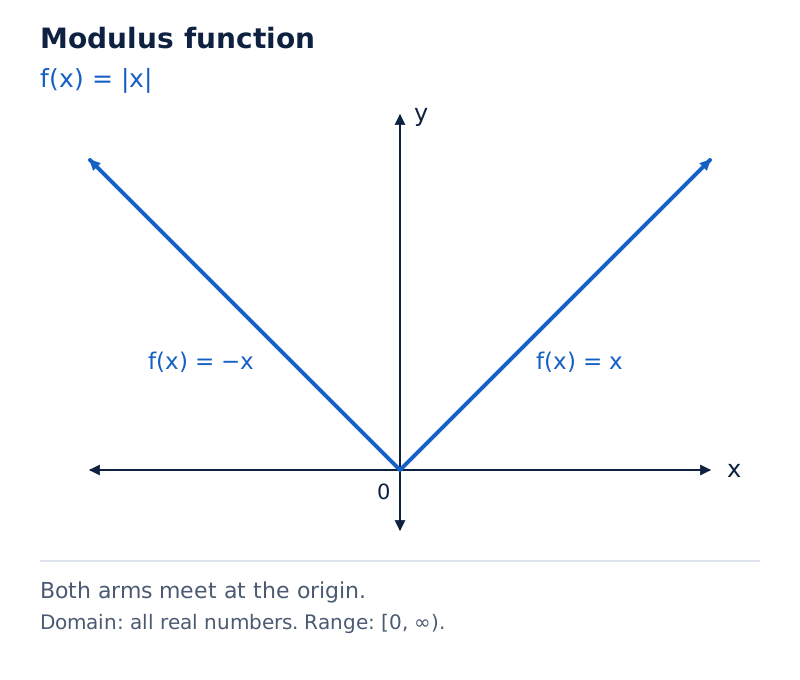
Two straight arms meet at the origin to form a V. The graph is labelled ; both arms rise above the horizontal axis as they move away from the origin.
Drawn by One Young India. See Fig. 2.13 in your NCERT textbook
What information does the signum function retain?
The signum function records whether the input is positive, zero or negative. Its rule and range are:
Its domain is . All positive inputs have the same output, and all negative inputs have the same output. The separate zero case matters: the positive-input and negative-input rules do not include the origin.
How does the greatest integer function handle boundaries?
The greatest integer function is written . Here the square brackets mean the greatest integer less than or equal to the input, rather than an interval. It is a function on the real numbers.
| Input condition | Greatest integer value |
|---|---|
The left endpoint belongs to each listed interval; the right endpoint does not. This explains why the value changes at an integer boundary. For negative inputs, the defining inequality remains essential: selecting an integer merely by removing a fractional part can give the wrong answer.
What the figure shows
Greatest integer graph
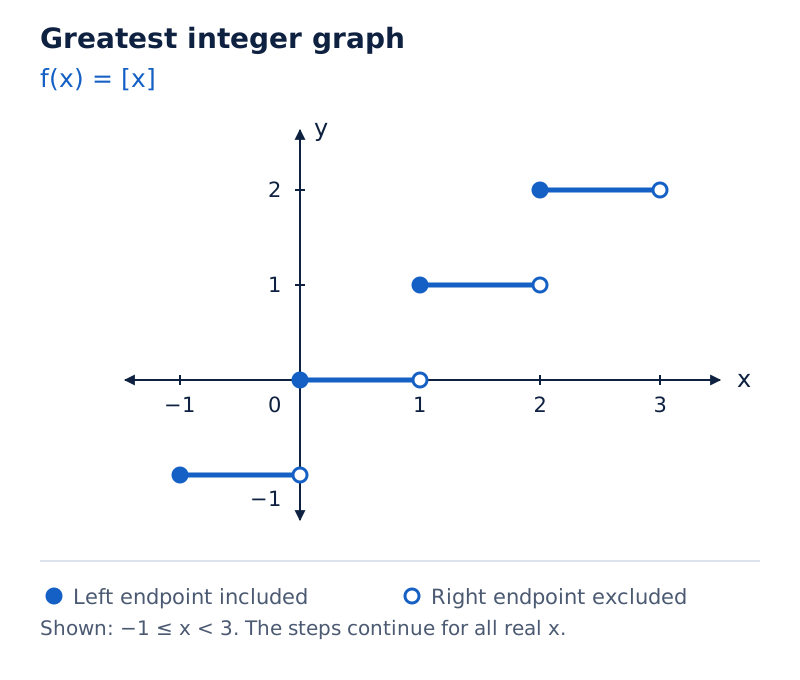
The graph labelled consists of horizontal steps at integer heights, with open circles at their right endpoints. Each step includes its left endpoint and excludes its right endpoint.
Drawn by One Young India. See Fig. 2.15 in your NCERT textbook
How are real functions added, multiplied and divided?
The algebra of functions combines values at the same input. Let denote a common domain contained in , and let and be real functions. Let denote a scalar, meaning a real number.
| Operation | Rule at an input | Condition |
|---|---|---|
| Addition | ||
| Subtraction | ||
| Scalar multiplication | , with real | |
| Pointwise multiplication | ||
| Division | and |
The word pointwise emphasises that both function values use the same input. In subtraction, brackets protect the entire second expression. In division, the common domain must be restricted further wherever the denominator function vanishes.
Worked example 8. For real functions and , find their sum, difference, product and quotient.
Answer:
- Add the values at the same input:
- Subtract the whole second expression:
- Multiply and distribute:
- Form the quotient and solve its denominator condition:
How does a restricted starting domain affect the answer?
A quotient can have fewer permitted inputs than either of its component functions. State the starting domain first, then apply the denominator condition. This is particularly useful when zero is a permitted input for both components but makes their quotient undefined.
Worked example 9. Let and , both defined on the non-negative real numbers. Find the four operations.
Answer:
- Retain the given common domain and add:
- Subtract at the same input:
- Multiply the input powers:
- For division, remove zero from the common domain:
Note: The first three operations in the square-root example retain zero as a permitted input. The quotient does not. A simplified power expression must be accompanied by the restriction obtained from the original quotient.
How can you reconstruct a linear rule and verify a relation?
A linear function has the form , where and are fixed real numbers. Known input-output pairs can determine these constants. After finding a rule, substitute the other supplied inputs to check agreement.
Worked example 10. A linear function agrees with the pairs . Find its rule.
Answer:
- Use the linear form:
- Substitute the pair with zero input:
- Use the pair with input one:
- Write the resulting rule:
- Check the remaining given pairs:
How do integer differences verify related pairs?
Let denote the rational numbers and the integers. Consider the relation on defined by . Here , , and below denote rational elements.
The defining condition is that the difference is an integer. To verify a claim about membership, compute the relevant difference and establish this condition. The following numbered arguments use zero, negatives of integers, and sums of integers.
- For any rational element paired with itself,
- If , reverse the difference:
- If and , add the integer differences:
Use the stated relationship throughout. These arguments follow from the integer-difference rule for this particular relation. They do not follow merely from calling a collection of pairs a relation. Each conclusion has been checked against the condition that defines membership.
Glossary
- Ordered pair — Two elements grouped in a specified order, with distinct first and second positions.
- Cartesian product — The set of all ordered pairs formed by choosing elements from two sets in order.
- Ordered triplet — Three elements grouped in a specified order, preserving the position of each entry.
- Relation — A subset of a Cartesian product describing a relationship between paired elements.
- Domain — The set of all first elements appearing in the ordered pairs of a relation.
- Codomain — The entire specified destination set into which a relation or function is defined.
- Range — The set of all second elements that actually occur in a relation's ordered pairs.
- Function — A relation assigning exactly one image to every element of its specified domain.
- Image — The output element associated with an input through a relation or a function.
- Preimage — An input element whose image under a function is the given output element.
- Real function — A function whose domain and range both consist of real numbers or their subsets.
- Constant function — A function assigning the same fixed output to every input in its domain.
- Rational function — A quotient of polynomial functions, defined only where its denominator is non-zero.
- Greatest integer function — A function returning the greatest integer that is less than or equal to its real input.
Common errors and misconceptions
- Misconception: Reversing a pair preserves it. Correct: Corresponding positions determine equality. Reversing unequal entries changes the ordered pair.
- Misconception: Equal numbers of elements make two Cartesian products equal. Correct: The products must contain the same ordered pairs, not merely the same number of pairs.
- Misconception: Range means the entire destination set. Correct: The codomain is the entire destination set; the range contains outputs actually reached.
- Misconception: Every relation from a set uses every member as an input. Correct: A general relation may omit first elements; a function on that specified domain must cover them all.
- Misconception: Different inputs cannot share an output in a function. Correct: Each input needs a unique output, but several inputs may share that output.
- Misconception: A polynomial cannot have an irrational coefficient. Correct: Real coefficients are permitted; the input powers must be non-negative integers.
- Misconception: The greatest integer function rounds to the nearest integer. Correct: It selects the greatest integer less than or equal to the input.
- Misconception: Dividing functions preserves their whole common domain. Correct: Inputs where the denominator function is zero must also be excluded.
Exam-style questions with model answers
Q1. If , find and . [2 marks]
- Equality of first elements gives , so subtracting one gives .
- Equality of second elements gives , so adding two gives . Substitution returns the required pair .
Q2. Let and . Find their Cartesian product and the number of relations from to . [3 marks]
- Pair each first-set element with both second-set elements: . This lists every permitted ordered pair.
- The product has elements. Each relation is a subset of this product, so the required count is a subset count.
- Therefore the number of relations is . This includes both the empty relation and the full Cartesian product.
Q3. Let , and let . Write its roster form, domain, range and codomain, and decide whether it is a function from to . [5 marks]
- Adding one to the permitted inputs gives the pairs . The next possible output is , which does not belong to the specified destination set.
- The domain consists of the first elements that actually occur: . The unused element is omitted from this set.
- The range consists of the second elements reached by these pairs: .
- The codomain remains the entire destination set: . It includes an element that no arrow reaches.
- The relation is not a function from to . The element of the required input set has no image, violating the requirement that every input have exactly one image.
Q4. Is a function on its set of first elements? Give its domain and range. [3 marks]
- Its first elements are , , and , so its domain is . Each occurs with a single second element in the listed relation.
- The respective images are , , and . Every domain element has exactly one image, so the relation is a function.
- The range is , obtained by collecting distinct second elements. The shared output of two inputs does not violate the definition of a function.
Q5. Find the domain of the real function . [3 marks]
- The expression is a quotient of polynomials, so its denominator must not be zero. Thus the input must satisfy .
- Factorising gives . The factors vanish at and , respectively, so both values are excluded.
- No other real input makes this denominator zero. Hence the domain is , meaning all real numbers except those two values.
Q6. For and , both defined for real inputs, find their sum, difference, product and quotient, and state the quotient restriction. [5 marks]
- Add the function values at the same input: . Both polynomial components are defined for every real input.
- Subtract the entire second expression, changing both its signs: . The brackets ensure that the constant is subtracted too.
- Multiply the expressions and distribute the first factor: . This is pointwise multiplication of the two function values.
- Divide the first function value by the second to obtain . This operation requires an additional denominator condition.
- Solve that condition: , hence . The quotient domain excludes this input because the denominator vanishes there; the other three operations retain all real inputs.
Key takeaways
- Ordered pairs preserve position: equality requires matching first elements and matching second elements separately.
- A Cartesian product includes every permitted pairing, taking the first entry from the first set.
- A relation selects a subset of a Cartesian product; its domain and range come from its actual pairs.
- The codomain is the specified destination set, while the range records outputs that are actually reached.
- A function assigns exactly one image to every input, while allowing different inputs to share an image.
- Standard function rules should be connected with their domains, ranges, graphs and any conditions at boundaries.
- Operations on functions combine values at the same input; subtraction applies to the whole second expression.
- A quotient of functions requires a non-zero denominator, so its domain may exclude otherwise permitted inputs.
Test yourself
What must be true for two ordered pairs to be equal?
Their first elements must be equal, and their second elements must also be equal.
What happens to a Cartesian product if either factor is empty?
The product is empty because no ordered pair can select an element from the empty factor.
How does the domain of a relation differ from its codomain?
The domain contains first elements actually used; the codomain is the entire specified destination set.
Can two inputs of a function have the same image?
Yes. Each input must have exactly one image, but different inputs may share that image.
What are the domain and range of the identity function on the real numbers?
Both are , because every real input is mapped to itself.
What is the range of the signum function?
Its range is , recording negative inputs, zero, and positive inputs respectively.
How is the greatest integer function defined?
It returns the greatest integer less than or equal to the given real input.
What extra restriction is needed when dividing two functions?
Exclude every input where the denominator function is zero, while retaining the original common-domain requirements.
Write about it
Turn a question from this chapter into a paper.
The Writing Studio has a structure guide, a rubric and citation tools for 15 formats, from essays to research papers. Drafting is free with an account. Learnacy Essential adds feedback from an AI writing coach and submission to The OYI Review.
Learnacy Essential is ₹1,499 for the year. Publication depends on review and is not guaranteed.