
Reproduction: How Life Continues | CBSE Class 9 Science Notes
On this page
Watch & explore
Start with a few high-quality watches, then dive into the notes below.
This note covers asexual and sexual reproduction, vegetative propagation, budding, spore formation, cell division and variation, flower structure, pollination, fertilisation, seeds and fruits, reproduction in animals, human reproductive organs, the menstrual cycle, pregnancy, childbirth, reproductive health and contraception.
Why is reproduction necessary for the continuity of life?
Definition: Reproduction is the biological process through which living organisms produce new individuals of their own kind.
An individual has a definite life span: it is born, grows, matures and eventually dies. Reproduction allows life to continue beyond an individual's lifetime. A mango tree may grow old and die, while its seeds grow into new mango plants.
The new individuals are called offspring. Cows produce calves, dogs produce puppies, cats produce kittens and humans produce children. These examples show how reproduction maintains continuity between parents and the next generation.
How do the two main modes differ?
In asexual reproduction, a single parent produces offspring that are almost exact copies of itself. In sexual reproduction, offspring inherit a mixture of characteristics from two individuals. This mixing may produce small differences between parents and offspring.
Variation means differences among individuals. Differences accumulated over many generations help organisms adapt to changing environments and sometimes give rise to new species, or kinds of organisms. Reproduction therefore involves both continuity and the possibility of change.
Asexual reproduction occurs in many unicellular organisms, which consist of one cell, including bacteria, amoeba and yeast. It also occurs in simple multicellular organisms, which have many cells, such as hydra and sponges, and in many plants.
The methods differ in how a new individual begins. A growing plant part, a bud on a parent's body or a fungal spore can produce a new individual asexually. Sexual reproduction involves reproductive cells from the two parents combining their genetic information, the information passed from parents to offspring.
How does vegetative propagation help plants reproduce?
Vegetative propagation is asexual reproduction in which new plants arise from growing, or vegetative, parts of a plant. New shoots and roots develop from existing plant parts. The process involves one parent and produces genetically identical individuals, meaning individuals with the same genetic information.
Potato and ginger have fleshy underground stems that sprout new plants without producing seeds. Money plant and sugarcane stem cuttings grow into new plants. Bryophyllum leaves produce tiny plantlets, or young plants, which eventually develop into new plants.
| Plant | Part involved | Reproductive outcome |
|---|---|---|
| Potato | Fleshy underground stem | Sprouts a new plant without seeds |
| Ginger | Fleshy underground stem | Sprouts a new plant without seeds |
| Money plant | Stem cutting | Grows into a new plant |
| Sugarcane | Stem cutting | Grows into a new plant |
| Bryophyllum | Leaf | Produces tiny plantlets that grow into new plants |
How are cutting and grafting carried out?
A cutting is a plant piece prepared for growing a new plant. Shoot cuttings are collected in the morning, leaves are removed from their lower halves, and approximately half their length is inserted into soil mixed with compost. They are watered regularly.
Grafting joins a stem piece from one plant to a rooted plant. A healthy wild rose can provide the rooted plant, while a yellow or pink rose provides a stem piece of another variety.
- Choose a healthy rooted plant and a healthy stem piece from the other variety.
- Make a wound or slit on a twig of the rooted plant.
- Insert and fit the other plant's stem piece into this slit.
- Protect the join with cotton cloth or wrapping film to keep pests out until it heals, and cut the rooted plant's other branches.
- Water regularly and observe the growth of the joined plants.
What the figure shows
Steps of grafting
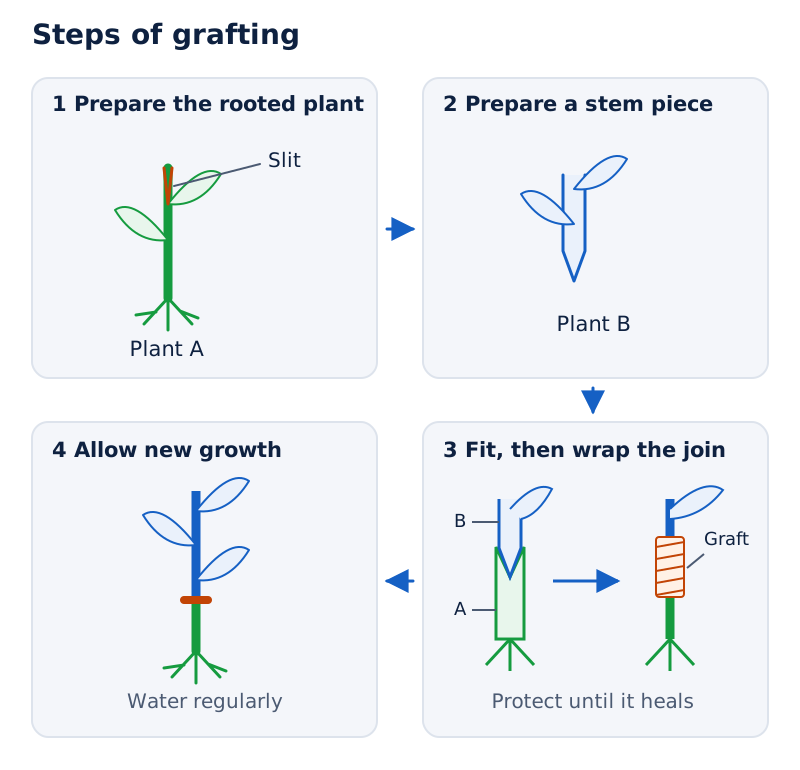
The drawings show rooted Plant A, the preparation of a slit, stem pieces from Plant B, insertion into the slit and a wrapped join labelled Graft. The final drawing shows growth above the joined stem.
Drawn by One Young India. See Fig. 11.3 in your NCERT textbook
How do layering and tissue culture work?
In layering, a twig forms roots while still attached to its parent. Lemon provides an example of a plant with a suitable flexible twig.
- Select a flexible, thin twig and bury its middle part below the soil surface.
- Water regularly and observe the growth of new leaves on the twig.
- Roots develop from the buried region after 10 to 15 days.
- Once roots develop, cut the twig from the parent so that it can grow as a new plant.
Tissue culture propagates plants using plant tissue. In banana farming, healthy plantlets are mass-produced from the shoot tip, called the apical meristem. This helps eliminate virus-infected plants and ensures high yields. These propagation methods allow desirable crops to be cultivated on a large scale.
How do budding and spore formation produce new individuals?
Budding produces a new individual through an outgrowth called a bud on the parent. Yeast cells show small, rounded buds. In hydra, repeated cell division at a particular site on the parent's body produces a bud.
The hydra bud enlarges and separates from the parent to live independently. Many buds can often be seen growing on a hydra's body at the same time. The formation and growth of the outgrowth connect cell division with the production of a new organism.
How does mould grow on bread?
Spores are lightweight reproductive structures that are usually single-celled. Fungi produce them in huge numbers, with millions coming from one mould colony. Air currents carry spores to new places, where moisture and nutrients allow them to germinate, or begin growing into new individuals.
Bread mould grows from spores already present in the air. When they settle on moist bread, they grow and reproduce rapidly. Moisture and warmth support this growth; lower temperatures slow or stop reproduction. Refrigeration therefore helps prevent the spoilage of perishable food.
Hyphae are the thread-like structures of a fungus. Spores form in a sac-like structure or on a swollen structure called a vesicle on a long fungal thread. These structures can be examined under a microscope.
What the figure shows
Fungi
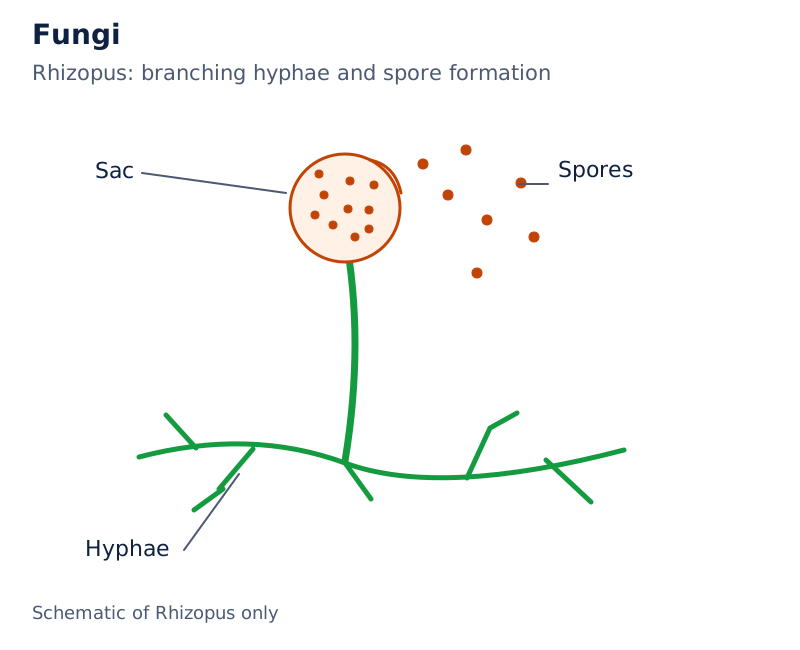
The Rhizopus drawing shows branching threads labelled Hyphae, an upright stalk ending in a Sac, and scattered Spores. Beside it, a microscope photograph labelled Aspergillus shows dark rounded heads on stalk-like threads.
Drawn by One Young India. See Fig. 11.8 in your NCERT textbook
What cell division supports asexual reproduction?
Chromosomes are thread-like structures in the cell's nucleus that carry genetic information. The nucleus is the cell part containing these structures. Mitosis is cell division producing two daughter cells with the same chromosome number and chromosomes identical to those of the parent cell.
Mitosis underlies the asexual methods described here. The genetically identical offspring are called clones. Asexual reproduction is fast and can increase populations quickly, especially when environmental conditions are favourable.
How does meiosis maintain chromosome number and create variation?
Sexual reproduction involves genetic contributions from two parents. If each parent contributed a full chromosome set to every offspring, the chromosome number would double in each generation. A special type of cell division prevents this repeated doubling.
Meiosis reduces the chromosome number to half when reproductive cells are formed. A cell with the full paired chromosome set is diploid; a cell with half that number is haploid. The resulting reproductive cells are called gametes.
What happens to chromosome pairs?
Humans have 23 pairs of chromosomes, making 46 chromosomes in a cell with the full set. During meiosis, the chromosomes of each pair separate. Each gamete receives one chromosome from each pair and therefore has 23 chromosomes.
In animals, male gametes are sperm and female gametes are eggs. The fusion, or joining, of a sperm and an egg restores the full chromosome number. This joining is called fertilisation, and the fertilised egg is called a zygote.
Why are siblings genetically different?
The separation and random mixing of chromosomes provide many combinations of genetic information. A model with three pairs of beads illustrates this: choosing one bead from each pair gives eight possible combinations. Each selection contains a member of every pair but can differ from the previous selection.
With 23 chromosome pairs, each carrying information for many characters, numerous combinations are possible. Children receive unique combinations and differ genetically from their parents and siblings. This genetic variation helps some individuals adapt better to changing environments.
Over time, this process contributes to evolution, changes across generations that can produce new kinds of organisms. Examples of variation include some people's ability to tolerate low oxygen levels at high altitudes or to digest milk in adulthood.
Which parts of a flower take part in reproduction?
Angiosperms are flowering plants, whose reproductive organs are flowers. Non-flowering plants such as pines also reproduce sexually. A complete flower has four main parts: sepals, petals, stamens and a pistil.
Sepals form the outer green covering around the flower bud. The coloured projections are petals, which are often covered by sepals in the bud stage. In some flowers, sepals and petals are fused.
How do the male and female parts compare?
The stamen, the male part, consists of a filament and an anther. The filament is the stalk shown below the anther, the part that produces pollen grains. Pollen grains contain male gametes and deliver them towards the female gamete.
The pistil, the female part, consists of the stigma, style and ovary. The stigma is the tip that receives pollen and may be flat and/or sticky. The style is the thin, long tube connecting the stigma to the ovary, the swollen base.
The ovary contains ovules, structures each containing an egg cell, or female gamete. Pollen must reach the stigma before the male gamete can travel to an ovule.
| Structure | Position or identity | Reproductive role or connection |
|---|---|---|
| Stamen | Male flower part | Includes the filament and anther |
| Anther | Part of the stamen | Produces pollen grains containing male gametes |
| Stigma | Tip of the pistil | Receives transferred pollen |
| Style | Thin, long tube in the pistil | Connects the stigma to the ovary |
| Ovary | Swollen base of the pistil | Contains ovules |
| Ovule | Structure inside the ovary | Contains an egg cell |
What the figure shows
Longitudinal section of a flower
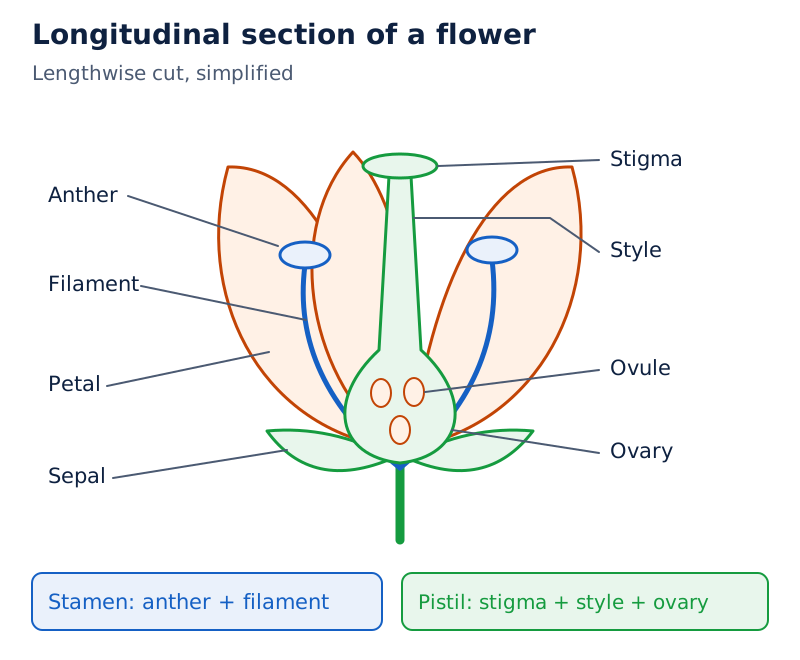
This lengthwise cut shows petals and sepals around stamens and a central pistil. Labels identify anther and filament as parts of a stamen, and stigma, style and ovary as parts of the pistil.
Drawn by One Young India. See Fig. 11.10 in your NCERT textbook
How does pollination occur through different agents?
Pollination is the transfer of pollen grains from an anther to a stigma. In self-pollination, pollen reaches the stigma of the same flower or another flower on the same plant. In cross-pollination, it reaches a flower on another plant of the same type.
In a pea-plant investigation, buds and opened flowers are covered with muslin bags, with stamens removed from selected specimens. Fruit forms in every treatment except the covered bud whose stamens were removed. This links pollen transfer with fruit formation.
Which flower features support pollen transfer?
External agents that carry pollen include wind, water, insects and birds. Wind pollination occurs in wheat, maize and rice. Their pollen grains are light, small and produced in large numbers. A long, feathery stigma helps trap them.
Water pollination occurs in aquatic plants such as Vallisneria and Hydrilla. Water currents carry pollen from one flower to another. Here, movement through water provides the connection between the pollen-producing and pollen-receiving parts.
Sunflower, hibiscus and marigold are pollinated by insects such as bees and butterflies. Their flowers are often brightly coloured, produce nectar, a flower product attracting pollinators, and give off fragrance. Large, sticky or spiny pollen attaches to insects; a sticky stigma receives it.
Birds such as Indian white-eye and sunbirds pollinate flowers including coral tree and hibiscus. These examples show that pollination depends on interactions between flower structures and the agents transporting pollen.
What do approximate pollen and seed counts show?
| Strategy and examples | Approximate pollen grains released per flower | Estimated average seeds formed |
|---|---|---|
| Wind-pollinated grasses, such as maize and wheat | 5,00,000 to 10,00,000 | 50 to 200 |
| Insect-pollinated plants, such as sunflower | 20,000 to 40,000 | 800 to 1,000 |
These are approximate trends and estimated averages. In the listed examples, insect-pollinated plants release fewer pollen grains while forming more seeds. Wind-pollinated grasses release very large numbers of pollen grains. The figures should not be treated as fixed counts for every flower.
How do fertilisation, fruit formation and seed formation follow pollination?
Pollination places a pollen grain on a stigma, but the male gamete still needs to reach the egg. Once pollen reaches a compatible stigma, one on which it can begin the reproductive process, it produces a pollen tube.
The pollen tube grows through the style into the ovary and provides a route for the male gamete. Fertilisation then occurs in an ovule. The zygote later develops into an embryo, the developing new organism.
What is the order of the main events?
- Pollen reaches a compatible stigma and begins to grow a pollen tube.
- The tube grows down through the style and enters the ovary.
- The male gamete travels through the tube to the ovule and fuses with its egg cell.
- The resulting zygote develops into an embryo.
- The ovary enlarges into a fruit, while ovules develop into seeds inside it.
- After dispersal, a seed germinates when water, air and temperature are favourable, and grows into a new plant.
What the figure shows
Germination of pollen on stigma
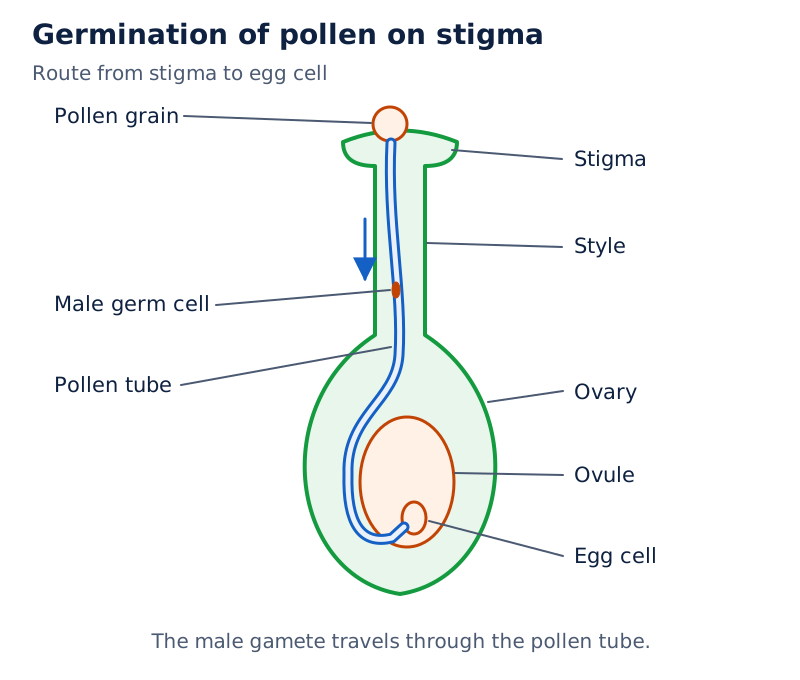
The drawing labels a pollen grain on the stigma, a pollen tube extending down towards an ovule inside the ovary, a male germ cell and an egg cell. The ovule and ovary are labelled separately.
Drawn by One Young India. See Fig. 11.14 in your NCERT textbook
Seed dispersal is the movement of seeds away from their place of formation. Wind, water and animals disperse seeds. Dispersal is distinct from pollination: the transported objects are seeds after their formation, rather than pollen grains travelling to stigmas.
How is sexual reproduction used in crop improvement?
In selective breeding, farmers choose plants with desirable characters for reproduction. Artificial hybridisation involves removing stamens, covering flowers with bags to prevent self-pollination, and manually transferring pollen carrying desired characters.
These approaches help develop new crop varieties, including high-yielding and disease-resistant varieties. Sexual reproduction also creates variation, helping plant species survive and adapt to their environment.
How do fertilisation and development vary among animals?
In external fertilisation, sperm and eggs meet outside the body. This occurs in many aquatic animals, such as frogs and most fish. Females release eggs into water, and males release sperm over them.
Although many eggs are laid, water currents destroy many and other animals eat many. Producing numerous eggs is associated with low survival of young ones in the fish and frog examples.
In internal fertilisation, sperm and eggs meet inside the female body, as in reptiles, birds and mammals. The fertilised egg or embryo receives more protection, and the chances of survival of young ones are generally higher.
| Animal example | Fertilisation | Eggs produced at a time | Estimated survival of young ones |
|---|---|---|---|
| Fish | External | Hundreds to thousands | Low |
| Frog | External | 5,000 to 50,000 | Low |
| Lizard | Internal | 2 to 20 | Moderate |
| Bird | Internal | 1 to 15 | Moderate to high |
How do young animals obtain nourishment?
Yolk contains nutritive substances that nourish the developing embryo. A larva is an intermediate developmental stage that feeds and grows before the adult body forms. Larval development occurs in organisms such as butterflies and frogs.
Reptiles and birds lay eggs containing enough yolk to nourish the embryo until hatching. In mammals, the zygote grows and develops inside the female body. Mammals typically feed their young through breast milk for some duration after birth.
In some species, newly born young can find their own food; in others, prolonged feeding and care are necessary. This broadly depends on how long the embryo develops inside an egg or the mother's body. The common challenge is both successful fertilisation and survival of offspring.
What are the functions of human reproductive organs?
At puberty, reproductive organs mature and begin producing gametes, alongside physical and emotional changes. Hormones are chemicals regulating different body functions. The human reproductive systems produce gametes and enable them to meet so that a new individual can develop.
How does the male reproductive system work?
The testes, singular testis, are two oval organs producing sperm. They lie in the scrotum, a pouch of skin that keeps them slightly cooler than normal body temperature. This lower temperature is necessary for sperm formation.
The testes also produce a hormone controlling sperm production and physical changes during puberty. Sperm leave the testes through the vas deferens, a long tube that ultimately opens into the urethra, a common passage for urine and sperm.
The seminal vesicles and prostate are glands adding fluids that nourish sperm and help them remain active and move. Each sperm has a head containing genetic material and a long tail that helps it swim towards the egg.
What the figure shows
Male reproductive system
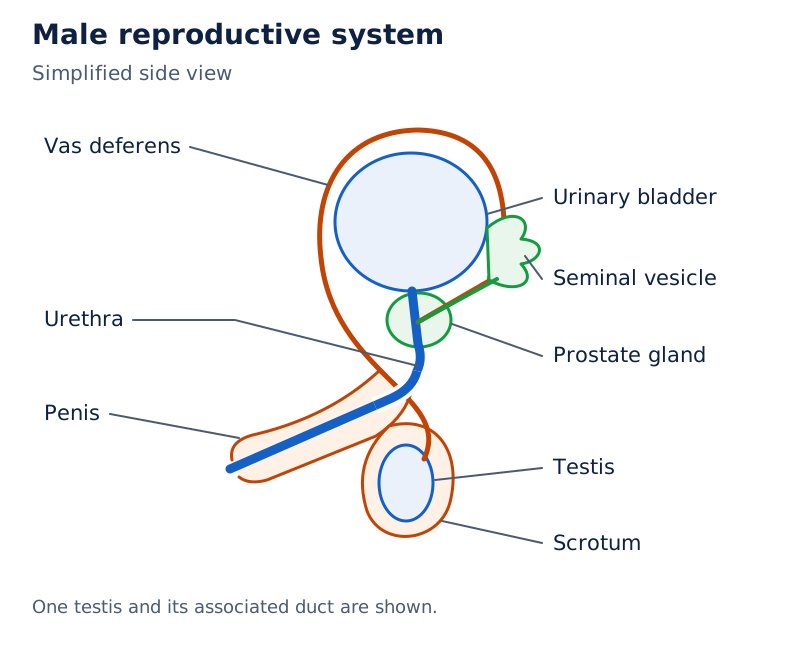
The side-view drawing labels a testis within the scrotum, the vas deferens, seminal vesicle, prostate gland and urethra. It also labels the urinary bladder and penis, with the urethra shown passing through the penis.
Drawn by One Young India. See Fig. 11.18 in your NCERT textbook
How does the female reproductive system work?
The ovaries are a pair of organs producing eggs and releasing hormones responsible for changes during puberty. The oviducts, also called fallopian tubes, connect the ovaries to the uterus, a bag-like organ where the developing baby grows.
The uterus opens into the vagina, the passage through which sperm enter during sexual intercourse, through a narrow passage called the cervix. A developing embryo is called a foetus from about the ninth week of pregnancy.
What the figure shows
Female reproductive system
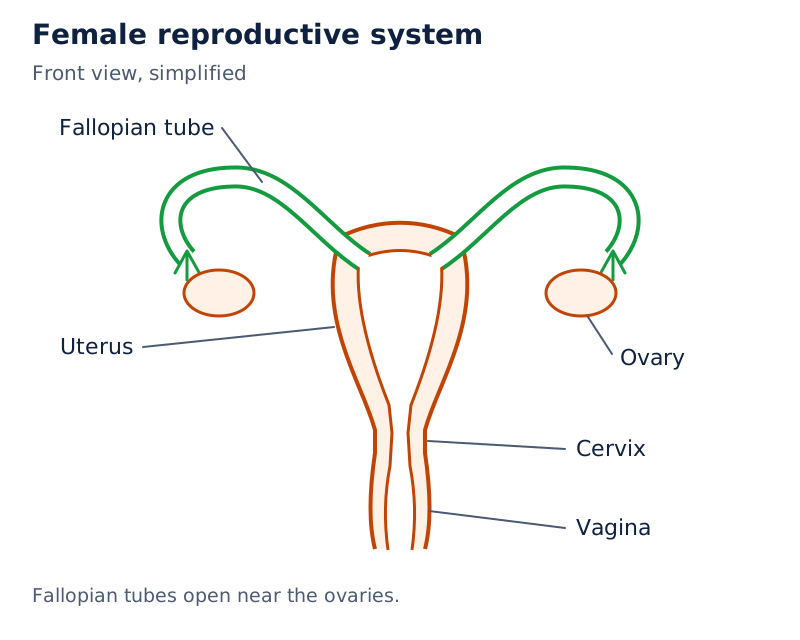
The drawing shows the uterus centrally, with fallopian tubes extending towards the ovaries on either side. The narrowed cervix and the vagina beneath it are labelled, distinguishing them from the body of the uterus.
Drawn by One Young India. See Fig. 11.19 in your NCERT textbook
How do sperm and eggs compare?
Gametogenesis is the formation of gametes in the testes and ovaries. It involves meiosis. Sperm are tiny, active and produced in large numbers; eggs are larger and contain stored nutrients. These differences occur across most animals.
| Feature | Sperm | Egg |
|---|---|---|
| Size | Very small | Large |
| Number produced | Millions | Few |
| Stored nutrients | Absent | Present |
| Motility, meaning ability to move | Actively motile | Non-motile |
How do human fertilisation and implantation occur?
At birth, a girl's ovaries already contain millions of immature eggs. From puberty onwards, usually one mature egg is released every month from one ovary. This release is called ovulation.
Before ovulation, the uterus begins preparing for development of a new individual by thickening its inner lining. The released egg enters the oviduct. During sexual intercourse, millions of sperm enter through the vagina and may reach the egg in the oviduct.
What sequence leads to pregnancy?
- An ovary releases a mature egg, which travels into the oviduct.
- Sperm entering the vagina swim through the female reproductive tract and may reach the egg.
- If a sperm encounters the egg and succeeds in fusing with it, fertilisation forms a zygote.
- The zygote undergoes a series of mitotic divisions while travelling towards the uterus.
- The developing structure attaches within the thickened, blood-rich uterine lining to receive nourishment. This attachment, called implantation, marks the beginning of pregnancy.
Implantation follows the divisions occurring during travel to the uterus. Fertilisation and implantation therefore refer to different events and different locations. The oviduct is where gametes can meet; the uterus supports later development.
How is chromosome number restored?
The sperm contributes 23 chromosomes and the egg contributes 23, giving the human zygote 46. Reduction during meiosis and restoration during fertilisation maintain the chromosome number between generations while combining information from the two parents.
Sex chromosomes are the chromosome pair involved in biological sex. The symbols X and Y identify these chromosomes: females have XX and males XY. The mother always contributes X; the father contributes either X or Y. Thus, the sperm contribution determines whether the combination is XX, female, or XY, male.
In-vitro fertilisation means combining an egg and sperm outside the female body, usually in a laboratory dish. The resulting fertilised egg is then implanted in the uterus to begin a possible pregnancy. The familiar expression “test tube baby” does not describe the dish where fertilisation actually occurs.
What happens during the menstrual cycle when fertilisation does not occur?
An unfertilised egg remains viable, or capable of being fertilised, for about a day and then degenerates. The uterine lining prepared to nourish a developing zygote is no longer needed. It sheds and leaves through the vagina with some blood.
This shedding is menstruation, also called a period, and usually lasts 3 to 7 days. The menstrual cycle includes ovulation, preparation of the uterus and menstruation. It typically repeats every 21 to 35 days, often around 28 days.
Menstrual cycles usually begin at puberty, between ages 10 and 14, and continue until menopause, when they stop, around age 50. These ages and cycle lengths describe typical patterns rather than a fixed timetable for every person.
How should a typical 28-day cycle be read?
What the figure shows
Typical menstrual cycle
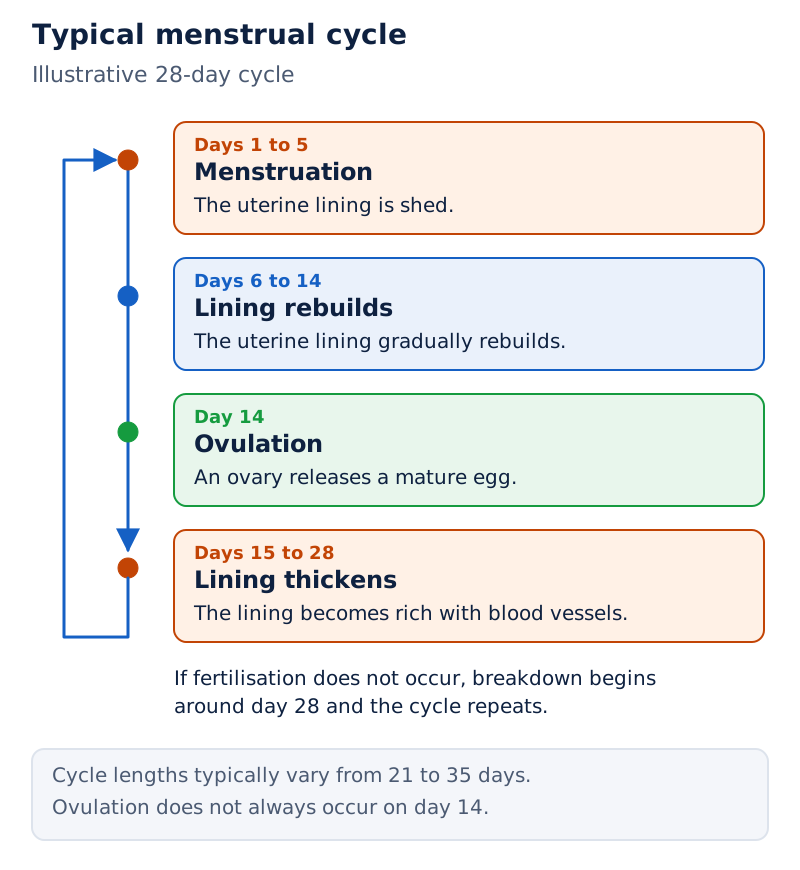
Four boxes on a timeline show days 1 to 5 for menstruation, days 6 to 14 for rebuilding the uterine lining, day 14 for ovulation, and days 15 to 28 for a thicker, blood-rich lining. The last box describes breakdown at approximately day 28 if fertilisation does not occur.
Drawn by One Young India. See Fig. 11.21 in your NCERT textbook
Note: Day 14 belongs to a typical 28-day illustration. Ovulation does not have to occur on day 14 in every cycle, because cycle lengths typically vary between 21 and 35 days.
Which hygiene practices support menstrual health?
Clean menstrual products include sanitary pads, tampons and menstrual cups. Hands should be washed with soap and water before and after changing a pad. Used pads should be wrapped and placed in a bin, rather than flushed down a toilet.
Reusable pads need cleaning according to the manufacturer's instructions and complete drying before reuse. Pads should be changed every 4 to 6 hours, or more often with heavy flow. Menstruation is a sign of a healthy reproductive system and is not something to be ashamed of.
How do pregnancy, childbirth and care support a developing baby?
Human pregnancy lasts about nine months and is divided into three stages called trimesters. The uterus protects and nourishes the developing baby throughout this period. Development changes from early organ formation to growth and preparation for life outside the womb, another name for the uterus.
What happens in the three trimesters?
During the first trimester, the fertilised egg develops into an embryo in the first two months and major organs begin forming. From about the ninth week, the developing embryo is called a foetus and continues to grow and develop.
In the second trimester, the foetus grows bigger and stronger, and the mother can usually feel its movements. In the third trimester, the baby grows rapidly and prepares for life outside the uterus.
What the figure shows
Stages of pregnancy
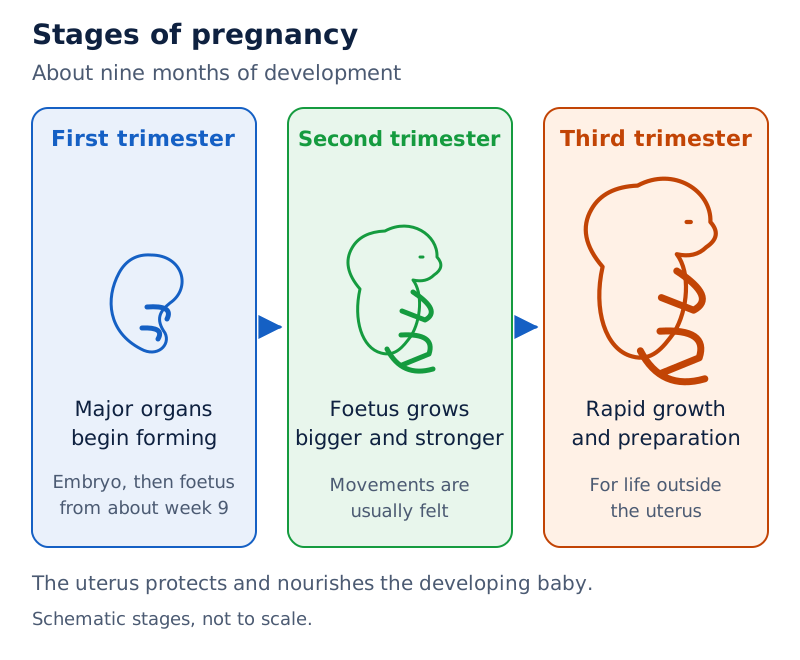
A sequence of drawings shows development from small early forms to progressively larger foetal forms. A band beneath the sequence divides it into the first, second and third trimesters.
Drawn by One Young India. See Fig. 11.22 in your NCERT textbook
What happens during and after childbirth?
During childbirth, strong contractions, or tightening, of uterine muscles help push the foetus through the birth canal. In some cases, when vaginal birth is not possible or safe, doctors may use medical or surgical procedures to deliver the baby.
Breastfeeding supplies complete nutrition and protects an infant from many diseases. Newborn babies need warmth, timely vaccination and gentle handling. The mother's nutrition, rest and well-being are equally important.
During pregnancy, a balanced diet rich in proteins, vitamins and minerals, regular medical check-ups, and medical advice about light exercise and rest support health. Family support also matters. Avoiding smoking, alcohol and medicines taken without medical advice helps protect mother and baby.
How do reproductive maturity and contraception relate to health?
Sexual maturity means that the body is becoming capable of reproduction. It develops gradually alongside overall growth. Physical reproductive capacity does not itself mean readiness for adult responsibilities, because emotional and social maturity take longer to develop.
Emotional maturity includes managing feelings, communicating clearly and making thoughtful decisions. Responsible decisions help prevent unplanned pregnancies and infections and support healthy relationships.
What are sexually transmitted infections?
Sexually transmitted infections, abbreviated STIs, can pass from an infected person to an uninfected person during close physical contact associated with sexual activity. Examples include gonorrhoea, herpes, syphilis and genital warts. Some STIs are not curable yet.
Condoms are barriers that stop sperm from reaching the egg. Using them can prevent transmission of STIs and also help prevent pregnancy. Preventing pregnancy and preventing infection are distinct purposes that must both be considered.
How do contraceptive methods differ?
Contraception means prevention of pregnancy. Different methods interfere with different parts of the reproductive process. Some stop sperm reaching the egg; others alter egg release or prevent gametes from meeting by blocking their passage.
| Method | How it acts or is used | Relevant feature |
|---|---|---|
| Condoms or vaginal covers | Form barriers stopping sperm reaching the egg | Condoms can also prevent STI transmission |
| Oral contraceptive pills | Alter hormones to change the release of eggs | May have some side effects |
| Intra-Uterine Devices, or IUDs, such as copper-T | Devices placed inside the uterus to avoid pregnancy | May sometimes irritate the uterus |
| Surgical blocking of the vas deferens | Blocks the sperm-carrying passage in males | Prevents sperm and egg from meeting |
| Surgical blocking of the fallopian tubes | Blocks the egg-carrying passages in females | Prevents sperm and egg from meeting |
Oral pills alter egg release, while condoms form a barrier during sexual contact. Pregnancy prevention through pills does not provide the barrier against STI transmission supplied by condoms. Physical changes, reproductive knowledge and thoughtful decisions all contribute to reproductive health.
Glossary
- Reproduction — The biological process by which living organisms produce new individuals of their own kind.
- Vegetative propagation — Asexual reproduction in which new plants develop from the growing parts of a parent plant.
- Budding — Formation of a new individual through an outgrowth that enlarges and separates from its parent.
- Spore — A lightweight, usually single-celled reproductive structure that can grow into a new individual under suitable conditions.
- Mitosis — Cell division producing two daughter cells with the same chromosome number and chromosomes identical to the parent cell.
- Meiosis — A special type of cell division that reduces chromosome number to half during gamete formation.
- Gamete — A reproductive cell containing half the chromosome number of a diploid parent cell.
- Variation — Differences among individuals that can help some survive better when environmental conditions change.
- Pollination — The transfer of pollen grains from an anther to the stigma of a flower.
- Fertilisation — The fusion of a male gamete with a female gamete to form a zygote.
- Zygote — The fertilised egg formed by gamete fusion, which later develops into an embryo.
- Ovulation — The release of a mature egg from an ovary, usually occurring once every month from puberty.
- Implantation — Attachment of the developing structure within the uterine lining after divisions during travel to the uterus.
- Menstruation — Shedding of the uterine lining, which leaves the body through the vagina with some blood.
- Contraception — Prevention of pregnancy through methods such as barriers, hormone-altering pills, intra-uterine devices or surgical blocking.
Common errors and misconceptions
- Misconception: Every new plant begins as a seed. Correct: Vegetative propagation produces new plants from growing parts such as potato stems and Bryophyllum leaves.
- Misconception: Pollen transfer is fertilisation. Correct: Pollination transfers pollen from anther to stigma; fertilisation joins male and female gametes.
- Misconception: Pollen travelling between two flowers must be cross-pollination. Correct: Transfer between flowers on the same plant is self-pollination.
- Misconception: The ovary becomes a seed and the ovule becomes a fruit. Correct: The ovary becomes the fruit and ovules become seeds.
- Misconception: Human gametes each contain 46 chromosomes. Correct: Each contains 23; their fusion restores 46 in the zygote.
- Misconception: Ovulation always occurs on day 14. Correct: This is a typical 28-day illustration; cycles typically range from 21 to 35 days.
- Misconception: The human zygote immediately attaches to the uterus at fertilisation. Correct: It undergoes mitotic divisions while travelling to the uterus before implantation.
- Misconception: All contraceptives provide the same protection from infection. Correct: Condoms can prevent STI transmission; hormone-altering pills prevent pregnancy through effects on egg release.
Exam-style questions with model answers
Q1. Define vegetative propagation and give one example involving a leaf. [2 marks]
- Vegetative propagation is asexual reproduction in which new plants develop from growing parts of a parent plant.
- In Bryophyllum, leaves sprout tiny plantlets that eventually grow into new plants.
Q2. A human parent cell has 46 chromosomes. Meiosis halves this number when forming each gamete, and fertilisation joins one sperm with one egg. State the chromosome number in a sperm, an egg and the resulting zygote, explaining each answer. [3 marks]
- The sperm contains 23 chromosomes, because meiosis reduces the 46 chromosomes of its diploid parent cell to half that number.
- The egg also contains 23 chromosomes. The same reduction during gamete formation gives the female gamete a haploid chromosome set.
- The zygote contains 46 chromosomes, formed by combining the sperm's 23 with the egg's 23. Fertilisation therefore restores the full number.
Q3. Compare sperm and eggs using four features: size, number produced, stored nutrients and motility. Motility means the ability to move. [4 marks]
- Sperm are very small, whereas eggs are large. Their size is therefore one clear structural difference between the two gametes.
- Sperm are produced in millions, whereas eggs are produced in much smaller numbers, described as few.
- Sperm lack stored nutrients, whereas eggs contain stored nutrients. The two gametes therefore differ in their nutrient reserves.
- Sperm are actively motile, meaning they move, whereas eggs are non-motile. The sperm's long tail helps it swim towards an egg.
Q4. A pollen grain has reached a compatible stigma. Explain five successive events leading to the formation of an embryo, fruit and seeds, beginning with pollen-tube growth. [5 marks]
- The pollen grain produces a pollen tube, which grows down through the style and into the ovary, providing a route towards the ovule.
- The male gamete travels through this pollen tube and reaches the ovule, the structure inside the ovary containing the female gamete.
- The male gamete fuses with the egg cell in the ovule. This fusion is fertilisation and produces a fertilised egg called a zygote.
- The zygote subsequently develops into an embryo. The embryo is the developing new organism produced following the fusion of the two gametes.
- The ovary enlarges and develops into a fruit, while the ovules inside it develop into seeds. Ovary and ovule thus have different outcomes.
Q5. Approximate data show that wind-pollinated grasses release 5,00,000 to 10,00,000 pollen grains per flower and form an estimated average of 50 to 200 seeds. Insect-pollinated plants release 20,000 to 40,000 pollen grains and form 800 to 1,000 seeds. Compare pollen production and seed formation, then give a qualified conclusion about efficiency. [3 marks]
- The listed wind-pollinated grasses release more pollen per flower: 5,00,000 to 10,00,000 grains, compared with 20,000 to 40,000 for insect-pollinated plants.
- The insect-pollinated examples form more seeds: an estimated average of 800 to 1,000, compared with 50 to 200 for wind-pollinated grasses.
- These approximate trends suggest greater seed formation relative to pollen production in the insect-pollinated examples. They do not establish fixed counts for every flower.
Q6. A diagram places ovulation on day 14 of a typical 28-day menstrual cycle. The cycle typically lasts 21 to 35 days, often around 28 days. Is the claim “Ovulation always occurs on day 14” justified? Give two reasons. [2 marks]
- No. Day 14 belongs to a diagram of a typical 28-day cycle, rather than a timetable applying to every cycle.
- Cycle lengths typically vary from 21 to 35 days, so a fixed day-14 rule ignores the stated variation.
Q7. Explain human reproduction from ovulation to implantation in five ordered points. Include the route followed by sperm, the place of fertilisation, and the divisions before implantation. [5 marks]
- Usually one mature egg is released from an ovary every month from puberty onwards. This release is ovulation, and the egg moves into the oviduct.
- During sexual intercourse, millions of sperm enter through the vagina. They swim through the cervix and uterus into an oviduct, where they may reach the egg.
- If a sperm encounters the egg and succeeds in fusing with it, fertilisation produces a zygote. The fusion takes place before travel to the uterus.
- The zygote undergoes a series of mitotic divisions while travelling towards the uterus. Meanwhile, the uterine lining becomes thicker and richer in blood vessels.
- The developing structure implants within the prepared uterine lining and receives nourishment for development. This implantation, following travel and divisions, marks the beginning of pregnancy.
Q8. Oral contraceptive pills alter hormones affecting egg release. Condoms form barriers stopping sperm reaching the egg and can prevent transmission of sexually transmitted infections. Explain why using pills without condoms does not address both pregnancy and infection risks in the same way. [3 marks]
- Oral contraceptive pills are used to prevent pregnancy by altering hormones and changing egg release. Their stated action concerns a reproductive process.
- Condoms form a physical barrier that stops sperm from reaching the egg. They can also prevent transmission of sexually transmitted infections during sexual contact.
- Using pills without condoms therefore leaves infection risk unaddressed by the barrier method described. Preventing pregnancy is different from preventing transmission of an infection.
Key takeaways
- Reproduction produces new individuals and maintains continuity of life, while sexual reproduction creates combinations that contribute to variation.
- Vegetative propagation, budding and spore formation are asexual methods; mitosis produces daughter cells with unchanged chromosome number.
- Meiosis halves chromosome number during gamete formation, and fertilisation restores the full number in the zygote.
- Pollination transfers pollen from anther to stigma; fertilisation joins gametes after the male gamete reaches the ovule.
- Following fertilisation in flowering plants, the zygote develops into an embryo, the ovary becomes fruit and ovules become seeds.
- Human sperm and eggs each contain 23 chromosomes; their fusion produces a zygote containing 46 chromosomes.
- The menstrual cycle typically lasts 21 to 35 days, so day 14 is not a universal ovulation date.
- Implantation begins pregnancy; maternal care, menstrual hygiene, thoughtful decisions and suitable contraceptive methods support reproductive health.
Test yourself
Why are offspring produced through the asexual methods discussed called clones?
Mitosis produces daughter cells with the same chromosome number and chromosomes identical to the parent cell, resulting in genetically identical offspring.
How does layering differ from preparing a stem cutting?
In layering, the twig remains attached while its buried part develops roots. It is separated after rooting; a stem cutting is detached before planting.
Is pollen transfer between two flowers on the same plant self-pollination or cross-pollination?
It is self-pollination because both flowers belong to the same plant.
Which flower structure becomes a fruit, and which becomes a seed?
The ovary develops into the fruit, while each ovule develops into a seed after fertilisation.
Why does the scrotum keep the testes slightly cooler than normal body temperature?
The slightly lower temperature is necessary for sperm formation in the testes.
What distinguishes fertilisation from implantation in humans?
Fertilisation joins sperm and egg in the oviduct. Implantation is attachment within the uterine lining after divisions during travel to the uterus.
When is the developing human embryo called a foetus?
From about the ninth week, the developing embryo is called a foetus.
Why does sexual maturity not necessarily mean readiness for adult responsibilities?
Physical reproductive capacity develops gradually, while emotional and social maturity take longer and involve thoughtful decisions, communication and management of feelings.
Write about it
Turn a question from this chapter into a paper.
The Writing Studio has a structure guide, a rubric and citation tools for 15 formats, from essays to research papers. Drafting is free with an account. Learnacy Essential adds feedback from an AI writing coach and submission to The OYI Review.
Publication depends on review and is not guaranteed.