
Sutlej Yamuna link Project
On this page
Watch & explore
Start with a few high-quality watches, then dive into the notes below.
Try an idea before you read. Answer the following scenario questions to test your understanding of the Sutlej Yamuna Link (SYL) canal dispute. Explore →
Introduction
Sutlej Yamuna Link Canal or SYL, is an under-construction 214-kilometer long canal in India to connect the Sutlej and Yamuna rivers. The canal is being built with aim to share the waters of the rivers Ravi and Beas between the states of Haryana and Punjab.
Background
The Indus basin was divided after the partition of India and Pakistan in 1947, with Pakistan having lower reaches of the Indus River and its tributaries and India gaining the upper reaches of Ravi, Beas and Sutlej. This resulted in a situation where the use and growth of water resources in one country would hinder those in another. In 1954, while the dispute was being resolved through negotiations, India had already begun to take similar steps in preparation for a treaty.
The Bhakra Nangal project was able to fix the Sutlej river water issue, but the surplus water issues with the Ravi and Beas rivers that do not include the pre-Partition use still exist.
The allocation of water from the rivers was agreed upon by the states of Punjab, PEPSU (Patiala and East Punjab States Union), Rajasthan, and Jammu and Kashmir in January 1955. When Punjab and PEPSU merged in 1956, Punjab's part of the anticipated 15.85 MAF of water decreased to 7.2 MAF (metric acre-feet), while Rajasthan's share increased to 8 MAF, and Jammu and Kashmir's share increased to the remaining amount.
The 1960 Indus Water Treaty gave India free access to water from the Sutlej, Ravi, and Beas rivers.
After the reorganisation of Punjab in 1966 and the creation of the state of Haryana, a disagreement over the sharing of river water arose. Punjab claimed ownership of the whole amount of water from the rivers, while Haryana requested 4.8 MAF of Punjab's total 7.2 MAF share.
Punjab refused to share water with Haryana, claiming that doing so would violate the riparian principle, which states that a river's water is only the property of the State or States through which it flows. As no agreement could be reached, Haryana requested the intervention of the central government.
The Union government issued an executive order in 1976, during a time of domestic emergency, allocating 3.5 MAF of water to each state while giving Delhi the remainder. A Sutlej-Yamuna Link Canal was suggested in order to utilise all of the water that was allotted.
Shromani Akali Dal, a political party in Punjab, opposed the decision. The Shiromani Akali Dal sought that the water sharing between Punjab, Haryana, and Rajasthan be decided by the Supreme Court after assuming power in 1977 and launched a lawsuit in opposition to the Union government's decision.
A deal between Punjab, Haryana, and Rajasthan-all of which were under the control of the Indian National Congress (INC)-was made on December 31, 1981, after the INC had taken control of Punjab in 1980. The deal upped Punjab's share to 4.22 MAF and Rajasthan's to 8.6 MAF, while leaving Haryana's portion from the revised 17.17 MAF of water unchanged.
Indira Gandhi formally began work on the canal's construction at Punjab's Kapoori hamlet on April 8, 1982. The Punjabi government published a white paper on April 23 applauding the accord. In September 1985, the Akali Dal retook control of Punjab, and a few months later, the newly elected Punjab Legislative Assembly rejected the 1981 pact. The canal was first built by the Akali Dal administration of Punjab, led by Surjit Singh Barnala. But it persisted in taking its time to finish. By June 1980, all work on the canal's section in Haryana had been finished.
The Eradi Tribunal headed by Supreme Court Judge V Balakrishna Eradi was set up to reassess availability and sharing of water. In 1987, the tribunal recommended an increase in the shares of Punjab and Haryana to 5 MAF and 3.83 MAF, respectively.
After a Chief Engineer involved in its development was shot by Khalistani activist Balwinder Singh Jattana in July 1990, the construction was halted. Due to the disagreement over the problem, the canal remained unfinished.
Haryana filed a lawsuit at the Supreme Court in 1999 to have the canal built. Punjab was given a year to build the SYL canal by the Supreme Court in 2002. Punjab refused to comply with the court's order and submitted a petition for its review, which was denied. In 2004, the Supreme Court ordered the Union government to use a centralised organisation to complete the canal. In 2004, the Punjab government appointed the Central Public Works Department to take over the canal construction. The Punjab Termination of Agreements Act, 2004, which was adopted by the Punjab Legislative Assembly, revoked all of the state's river water agreements with its neighboring states.
In order to determine the validity of the 2004 Act, the SC began proceedings in 2016 on a presidential reference (Article 143) and concluded that Punjab had broken its pledge to share river waters.
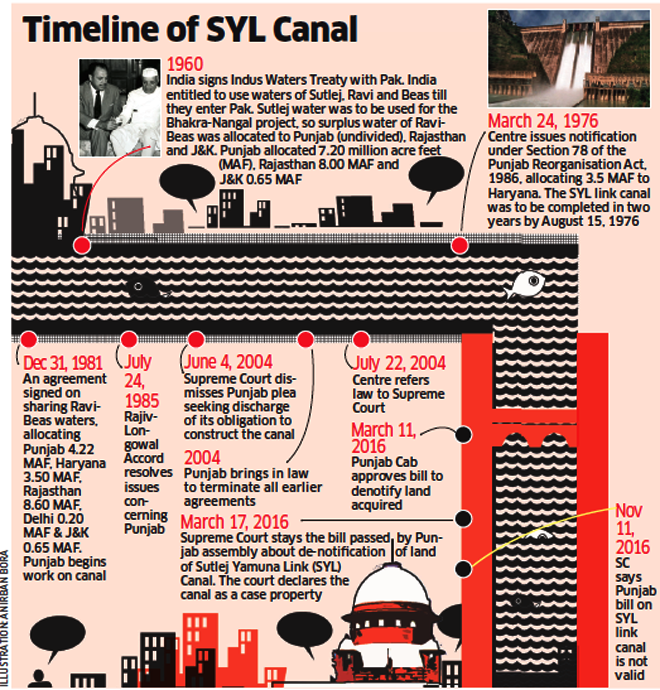
Image Source: The Economic Times, November 2016
The Punjab Satluj Yamuna Link Canal Property (Transfer of Proprietary Rights) Bill, 2016, which proposed returning the land that had been taken from owners for the construction of the SYL canal, was passed by the Punjab Legislative Assembly by a unanimous vote in March 2016. The following day, the Legislative Assembly of Punjab passed a motion requesting royalties for river water delivered to its non-riparian neighbours Delhi, Haryana, and Rajasthan.
Since then, the Punjab government has been mandated by the Supreme Court to keep things as they are on the land intended for the canal's construction.
Arguments
By Punjab
After 2029, several areas in Punjab may become dry, and the state has already overused its groundwater for irrigation, filling the Central Granaries with wheat and paddy worth Rs 70,000 crore annually.
The government claims it is difficult to share water with any other state since water is overused in 79 percent of the state's land area.
Out of 138 blocks, 109 blocks are “over-exploited”, two blocks are “critical” five blocks are “semi-critical” and only 22 blocks are in “safe” category.
By Haryana
It claims that delivering irrigation is difficult for the state and that there was a drinking water shortage in southern Haryana because groundwater levels had dropped below 1,700 feet.
Haryana has been making the case that it is not receiving its fair share of the water as determined by a tribunal by highlighting its contribution to the central distribution pool.
Conclusion
To tackle the problem before it grows enormous, the central government has its work cut out for it. The impending election in one of the contending states gives the already complicated scenario a political undertone.
The problem requires a political resolution because even the Supreme Court seems to be caught in a pickle. It is time for the leaders to act wisely and impartially, giving appropriate consideration to the claims of all interested disputing parties.
Key takeaways
- The SYL Project is a proposed 214-km canal designed to share the waters of the Ravi and Beas rivers between the Indian states of Punjab and Haryana.
- The dispute originated from the 1966 reorganization of Punjab, which created the state of Haryana and necessitated the division of shared resources.
- Punjab bases its refusal to share water on the 'Riparian Principle' and its own severe groundwater depletion.
- Haryana demands the water based on the principle of 'Equitable Apportionment' and legally binding interstate agreements from 1981.
- Despite multiple Supreme Court rulings directing the completion of the canal, the project remains stalled due to political resistance and growing environmental concerns.
Test yourself
What is the total proposed length of the Sutlej-Yamuna Link canal?
214 kilometers (122 km in Punjab and 92 km in Haryana).
Which legal doctrine does Punjab use to argue that Haryana has no right to the river waters?
The Riparian Principle, which grants water rights to those whose land is adjacent to the water body.
What was the purpose of the Punjab Termination of Agreements Act of 2004?
It was a legislative attempt by Punjab to unilaterally cancel its water-sharing agreements with neighboring states.
Try it
Sutlej Yamuna Link Project
Answer the following scenario questions to test your understanding of the Sutlej Yamuna Link (SYL) canal dispute.
1It is 1966. Haryana, newly carved out of Punjab, asks for 4.8 MAF of Punjab's 7.2 MAF share of Ravi and Beas waters. Punjab refuses, citing the 'riparian principle.' In plain terms, what is Punjab's argument?
Correct. The text says Punjab refused to share water with Haryana, claiming that doing so would violate the riparian principle, which states that a river's water is only the property of the State or States through which it flows.
The 1960 Indus Water Treaty gave India — not Punjab alone — free access to the Sutlej, Ravi, and Beas waters. Punjab's refusal was based on the riparian principle, not on the treaty.
The 1955 agreement was made before Haryana existed (it involved Punjab, PEPSU, Rajasthan, and Jammu and Kashmir). The text does not say Punjab used this argument; its stated reason was the riparian principle.
2Decades later, after the Supreme Court ordered Punjab to build the canal and Punjab refused, the Punjab Legislative Assembly passed the Punjab Termination of Agreements Act, 2004, revoking all of the state's river-water agreements with its neighbours. Based on the text, what happened when the validity of this Act was examined?
Correct. The text states that in 2016 the Supreme Court began proceedings on a presidential reference (Article 143) to determine the validity of the 2004 Act and concluded that Punjab had broken its pledge to share river waters.
The text records the opposite outcome: the Supreme Court concluded that Punjab had broken its pledge to share river waters. It does not say the Act was upheld.
The text does not say the Act was void for this reason. The 1981 pact's signatories are not given as the basis for judging the 2004 Act; instead, the Supreme Court examined the Act and found Punjab had broken its pledge.
The SYL canal dispute shows how water sharing between states can become a long-running legal and political conflict: Punjab invoked the riparian principle to refuse sharing, agreements and tribunal awards shifted the shares over time, and even Supreme Court orders and a 2004 termination Act could not settle the matter — the Court ultimately found that Punjab had broken its pledge to share river waters.