
Systems of Particles and Rotational Motion | CBSE Class 11 Physics Notes
On this page
Watch & explore
Start with a few high-quality watches, then dive into the notes below.
This note covers rigid bodies, translation and rotation, centre of mass, linear momentum, vector products, angular velocity, torque, angular momentum, equilibrium, centre of gravity, moment of inertia, rotational kinematics, rotational dynamics and conservation of angular momentum.
What kinds of motion can a rigid body have?
Definition: A rigid body is an ideal body whose shape remains unchanged and whose distances between all pairs of particles remain constant.
A real body has finite size and contains many particles. Its motion cannot always be described adequately by replacing it with a single point mass. Rotation makes the positions of different parts of the body important.
No real body is perfectly rigid because forces can deform it. The rigid-body approximation is useful when bending, twisting and vibration are negligible. Wheels, steel beams and planets can be treated this way in suitable situations.
How does translation differ from rotation?
| Motion | Behaviour of particles | Example |
|---|---|---|
| Pure translation | All particles have the same velocity at a given instant. | A rectangular block sliding down an incline without sidewise movement. |
| Rotation about a fixed axis | Particles outside the axis describe circles centred on the axis, in planes perpendicular to it. | A ceiling fan rotating about its axis. |
| Translation with rotation | The body changes position while its orientation also changes. | A cylinder rolling down an inclined plane. |
For fixed-axis rotation, particles on the axis remain stationary. Other particles can describe circles of different radii in different parallel planes. They share an angular velocity, but their linear velocities need not be the same.
An axis need not remain fixed in every rotational motion. A spinning top can have a fixed point of contact while its axis moves around the vertical. This movement of the axis is called precession. An oscillating table fan also has a moving rotation axis.
What the figure shows
Sliding and rolling on an incline
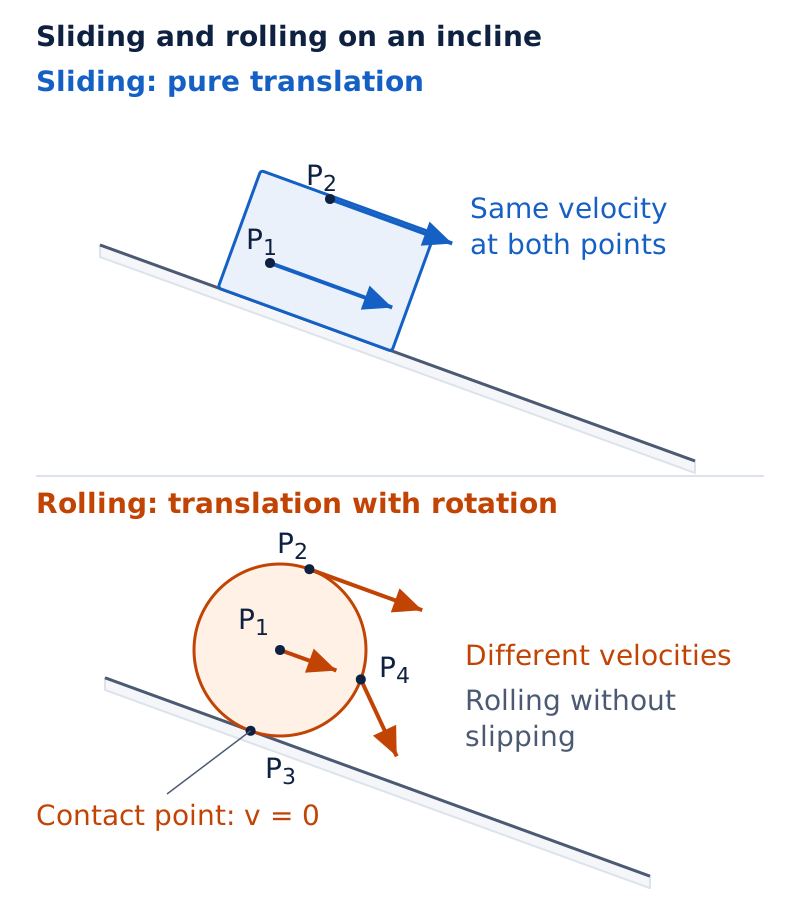
The block has two marked points with parallel velocity arrows down the slope. The cylinder has four marked points with differing velocities; its contact point has zero instantaneous velocity when rolling without slipping.
Drawn by One Young India. See Figs. 6.1 and 6.2 in your NCERT textbook
How is the centre of mass located?
The centre of mass is located by taking a mass-weighted mean of particle positions. Larger masses contribute more strongly to this mean. All coordinates used in one calculation must refer to the same origin and axes.
Let and be two particle masses, and their coordinates along a line, and the centre-of-mass coordinate. Then
For equal masses, , so the centre lies midway between them. Three equal masses at a triangle's vertices have their centre of mass at its centroid. Unequal masses need not have this geometric centre as their centre of mass.
How does the definition extend to many particles?
Let be the number of particles, the particle index, each mass, and its position vector. Write for total mass and for the centre-of-mass position vector. The symbol means addition over all particles; denotes a zero vector.
For particle coordinates , the centre-of-mass coordinates are
For a continuous body, denotes a small mass element at position . Replace the sum by an integral over the body: . At an origin placed at the centre of mass, .
Symmetry places the centre of mass of a homogeneous rod, ring, disc or sphere at its geometric centre. Equal mass elements at opposite positions cancel in the weighted sum. The centre of mass need not lie in the material, as a ring illustrates.
Worked example 1. Three particles of masses , and occupy an equilateral triangle of side . Put the first at the origin, the second at , and the third at . Find the centre of mass.
Formula: ; .
Substitute:
- Total mass: .
- Horizontal coordinate:
- Vertical coordinate:
Answer: approximately horizontally and vertically from the chosen origin. Unequal masses explain why this is not the triangle's centroid.
Worked example 2. A uniform L-shaped lamina of mass consists of three squares of side . Their centres are at , and . Locate the combined centre of mass.
Formula: ; .
Substitute:
- Each square has mass , because their areas and mass distribution are equal.
- Calculate
- Similarly,
Answer: both coordinates are approximately . Treating each square as concentrated at its own centre gives the mass-weighted position of the whole lamina.
What the figure shows
L-shaped lamina
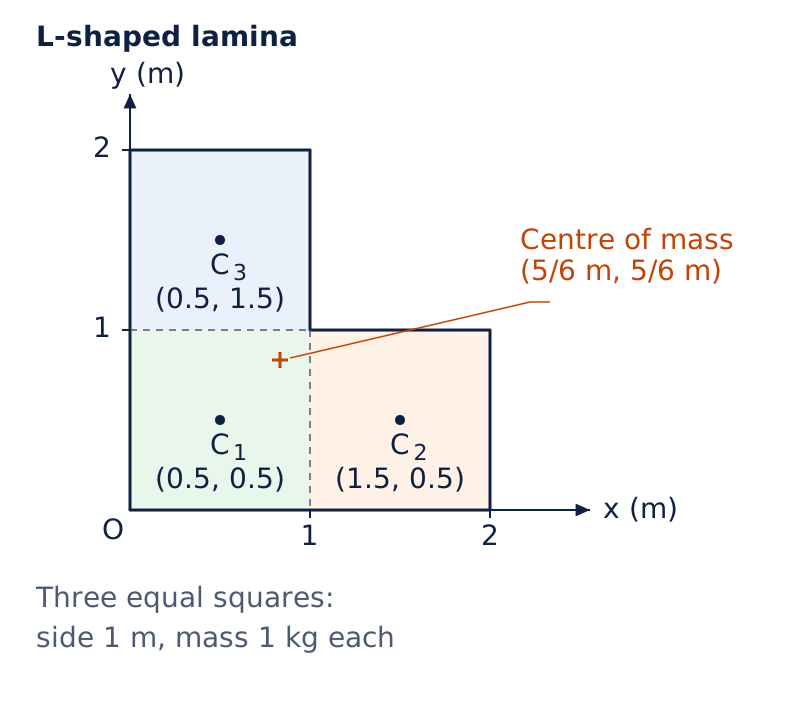
The axes start at the lower left corner. The outline spans two square widths horizontally and vertically, with the upper right square absent. Three interior points mark the centres of the remaining squares.
Drawn by One Young India. See Fig. 6.11 in your NCERT textbook
How do external forces govern centre-of-mass motion?
Let denote time, centre-of-mass velocity and centre-of-mass acceleration. For particle , let and denote velocity and acceleration. The masses are assumed constant throughout the following derivation.
Derivation: Equation of motion of the centre of mass
- Start with the defining mass-weighted position:
- Differentiate with respect to time, holding masses constant:
- Differentiate again:
- Let be the total force on particle . Newton's second law gives
- Internal forces cancel in equal and opposite pairs. If is the total external force,
Result: The centre of mass moves as if the total mass were concentrated there and all external forces acted there. Internal motion can be complicated without changing this equation.
When is total linear momentum conserved?
Let be the momentum of particle and the total momentum. Then
The law of conservation of linear momentum applies when the total external force is zero. Total momentum and centre-of-mass velocity then remain constant. Individual particles can still accelerate through internal interactions.
A projectile exploding in flight illustrates the distinction. Explosion forces are internal. With gravity as the external force, the fragments' centre of mass follows the same parabolic path the unexploded projectile would have followed.
This method separates the motion of the system as a whole from the motion of its parts relative to the centre of mass. It applies to a rigid body and also to particles with internal motion.
How is the vector product used in rotational motion?
The vector product, or cross product, gives a vector perpendicular to the plane of two non-parallel vectors. It is used to define torque and angular momentum, where both magnitude and direction matter.
Let and be vectors of magnitudes and , and let be their smaller included angle. Their vector product satisfies
Use the right-hand rule: curl the right-hand fingers from the first vector towards the second through the smaller angle. The extended thumb indicates the product's direction. Reversing the order reverses that direction.
Which cross-product rules are needed?
Let be unit vectors along the positive Cartesian axes. Let and be the corresponding components of the two vectors.
| Rule | Mathematical statement |
|---|---|
| Order matters | |
| Parallel vectors give zero | |
| Cyclic unit vectors | , , |
| Distributive rule |
In the distributive rule, can be any third vector. For components, use
The cross product of two perpendicular vectors has magnitude equal to the product of their magnitudes. Parallel or antiparallel vectors have zero cross product. These facts explain why a force directed along a position vector produces no torque about that origin.
How are angular velocity and linear velocity related?
For rotation about a fixed axis, let now denote angular displacement from a chosen fixed direction. Angular velocity, denoted by in the scalar description, is its time rate of change.
The SI unit of angular velocity is the radian per second, . All particles of a rotating rigid body share the same angular velocity at any instant, although their distances from the axis may differ.
Let be the perpendicular distance of a particle from the rotation axis and its linear speed. The speed relation is , with angular speed used for . A particle farther from the axis therefore moves faster.
What are the vector relation and angular acceleration?
The angular velocity vector lies along the rotation axis, with its sense given by the right-hand rule. For a particle at position measured from an origin on that axis, its velocity is
Here is tangent to the circular path. Using the full position-vector length in the scalar speed relation is incorrect unless that vector is perpendicular to the axis.
Angular acceleration is the rate of change of angular velocity: . For a fixed-axis scalar description, . The SI unit of angular acceleration is the radian per second squared, .
What the figure shows
Angular and linear velocity
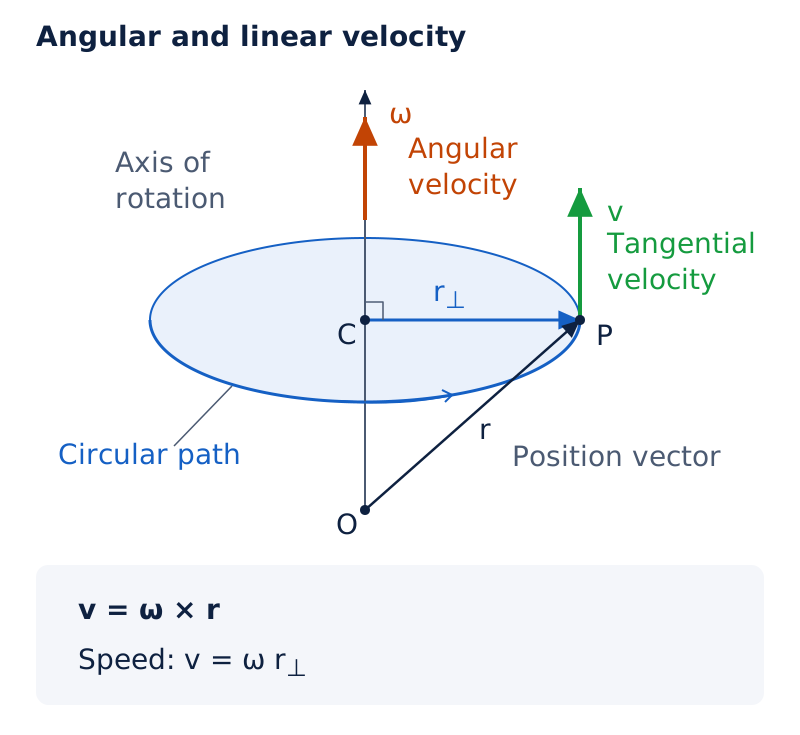
A vertical axis passes through the origin and the centre of a horizontal circular path. The radius runs from the circle's centre to a particle on its edge. The velocity arrow is tangential; the angular velocity arrow follows the vertical axis.
Drawn by One Young India. See Fig. 6.17(b) in your NCERT textbook
What are torque and angular momentum?
Torque describes the turning effect of a force about a specified origin. Let be the force and the position vector of its point of application. The torque vector is
Here are the magnitudes of the respective vectors, and is their included angle. If is the perpendicular distance from the origin to the force's line of action, then .
The SI unit of torque is the newton metre, . Torque and work have the same dimensions, but torque is a vector and work is a scalar. A force whose line of action passes through the origin has zero torque about that origin.
This explains why a door turns most effectively when pushed perpendicular to its surface near the outer edge. Both the force and its perpendicular distance from the hinge axis matter.
How does torque change angular momentum?
For a particle of mass , velocity and momentum , its angular momentum about the origin is . Its magnitude is , where is momentum magnitude and is the angle between position and momentum.
Derivation: Torque as the rate of change of angular momentum
- Differentiate the definition:
- Use the product rule, preserving vector order:
- The first term vanishes because momentum is parallel to velocity:
- Use Newton's second law and the definition of torque:
Result: Torque about an origin equals the time rate of change of angular momentum about that same origin.
For a system, let denote total angular momentum and total external torque. Then and .
Note: Cancellation of internal torques requires internal forces to be equal and opposite and to act along the line joining each pair of particles. Equal and opposite forces alone do not guarantee cancellation of their torques.
When is a rigid body in mechanical equilibrium?
Mechanical equilibrium requires both translational and rotational equilibrium. Total linear momentum and total angular momentum then do not change with time. The two conditions are independent. Here and denote the external force and torque contributions:
For coplanar forces, resolve forces along two perpendicular axes in their plane and take moments about an axis perpendicular to that plane. This gives three scalar conditions. When the net force is zero, the net torque is independent of the chosen origin.
How do couples, levers and centre of gravity enter equilibrium?
A couple consists of equal and opposite forces with different lines of action. Its resultant force is zero, but its torques add. Turning a bottle lid illustrates rotation produced by a couple.
An ideal lever is a light rod supported at a fulcrum. Let be the load, the effort, and their respective perpendicular moment arms. The principle of moments gives . Its mechanical advantage is .
The centre of gravity is the point about which total gravitational torque is zero. It coincides with the centre of mass in a uniform gravitational field. Centre of mass depends on mass distribution; centre of gravity involves gravitational forces.
For a small irregular cardboard, suspend it from different points and mark each vertical through the suspension point. The verticals meet at the centre of gravity. Alternatively, the cardboard can be balanced horizontally on a narrow support at that point.
Worked example 3. A uniform bar of length and mass rests on knife edges from each end. A load hangs from the left end. Find the upward reactions at the left support and at the right. Use gravitational acceleration .
Formula: , where is bar weight; , where is the suspended weight and its mass. Apply force and moment balance.
Substitute:
- Weights are and .
- Vertical balance gives .
- The centre is from the left end. Taking moments there gives .
- Rearrange: . Hence .
- Then .
Answer: left reaction , right reaction . Their sum supports both weights, and their unequal values balance the off-centre load.
Worked example 4. A uniform ladder of length and mass rests with its foot from a frictionless wall. Find the wall reaction and resultant floor reaction in equilibrium. Use .
Formula: . Let be the height of contact, the horizontal wall reaction, the floor's normal reaction, floor friction and the resultant floor reaction. Then , , and .
Substitute:
- Geometry gives . The weight is .
- The midpoint's horizontal distance from the foot is . Moment balance about the foot gives .
- Thus . Force balance gives and .
- The resultant is .
Answer: wall reaction approximately ; floor reaction approximately . Floor friction acts towards the wall and prevents the foot from sliding away.
What does moment of inertia measure?
Moment of inertia, denoted by , measures rotational inertia about a specified axis. Let now denote the perpendicular distance of particle from that axis. Then .
The SI unit of moment of inertia is the kilogram metre squared, . It depends on mass, shape, size, mass distribution and the position and orientation of the axis. Unlike mass, it cannot be specified completely without identifying an axis.
Derivation: Kinetic energy of a rotating rigid body
Let denote total rotational kinetic energy and the kinetic energy of particle . All particles have the same angular speed .
- The linear speed of each particle is
- Its kinetic energy is
- Add the energies and take the common angular speed outside the sum:
- Identify the moment of inertia to obtain
Result: Moment of inertia plays the role that mass plays in translational kinetic energy. The SI unit of kinetic energy is the joule, .
Which standard moments of inertia should be distinguished?
In the table, denotes body mass, its radius and rod length. These expressions use the homogeneous regular bodies and axes specified.
| Body | Axis | Moment of inertia |
|---|---|---|
| Thin ring | Through centre, perpendicular to ring plane | |
| Thin ring | A diameter | |
| Thin rod | Through midpoint, perpendicular to rod | |
| Circular disc | Through centre, perpendicular to disc plane | |
| Circular disc | A diameter | |
| Hollow cylinder | Cylinder's symmetry axis | |
| Solid cylinder | Cylinder's symmetry axis | |
| Solid sphere | A diameter |
The radius of gyration is defined by , so . It is the distance at which the entire mass could be concentrated while preserving the moment of inertia about that axis.
A thin ring has all its mass at the same distance from its central perpendicular axis. A disc distributes some mass nearer that axis, giving a smaller moment of inertia for the same mass and radius.
A flywheel uses a large moment of inertia to resist sudden increases or decreases in rotational speed. This allows a more gradual change in speed and reduces jerky motion.
Which equations describe rotation with constant angular acceleration?
Fixed-axis rotation can be described using a single angular coordinate. Let be initial angular position and initial angular velocity at time . The following equations apply when angular acceleration remains constant:
These are the rotational counterparts of uniformly accelerated linear motion. Choose a positive rotational sense before using signed angular quantities. Angular position and angular displacement differ unless the initial angular position is zero.
Derivation: Angular velocity under uniform angular acceleration
- Begin with the definition and the constant-acceleration condition:
- Integrate, with denoting a constant of integration:
- Use the initial condition:
- Substitute the constant:
Result: Angular velocity changes linearly with time only under constant angular acceleration. The condition must be checked before choosing this equation.
Worked example 5. A motor wheel speeds up uniformly from to in . Find its angular acceleration and number of revolutions. Here is the circle circumference-to-diameter ratio, and rev denotes a revolution.
Formula: . Let be angular displacement and the number of revolutions. Then and .
Substitute:
- Convert the initial speed: .
- Convert the final speed: .
- Find the acceleration: .
- Find displacement: .
- Count complete turns: .
Answer: angular acceleration , with 576 revolutions during the interval. The conversion from minutes to seconds is required before substitution.
How do torque, work and power govern fixed-axis rotation?
For a body constrained to rotate about a fixed axis, the relevant torque is its component along that axis. Constraint forces maintain the axis against the effect of perpendicular torque components.
Let denote work, the signed torque component along the fixed axis and a small angular displacement. Rotational work is . If torque remains constant, .
Let denote instantaneous power, to distinguish it from total linear momentum. Then . Torque changes rotational motion just as force changes translational motion.
How does rotational dynamics compare with translation?
| Role | Translation | Fixed-axis rotation |
|---|---|---|
| Inertia | Mass | Moment of inertia |
| Equation of motion | , where is linear acceleration | , for constant moment of inertia |
| Kinetic energy | ||
| Power for parallel force and velocity |
The rotational equation of motion assumes that mass, shape and the axis's position relative to the body remain unchanged. Greater moment of inertia means smaller angular acceleration for the same torque.
Worked example 6. A flywheel modelled as a uniform disc has mass and radius . A light cord wound around its rim is pulled tangentially with constant force . Bearings are frictionless. Starting from rest, find angular acceleration, work and kinetic energy after of cord unwinds without slipping.
Formula: ; , where is unwound cord length. Also , , , and .
Substitute:
- Convert radius: . Calculate .
- Torque is . Hence .
- Work is .
- Angular displacement is . Thus .
- Kinetic energy is , using the dimensionless nature of the radian in mechanical units.
Answer: angular acceleration ; work and kinetic energy each . With no frictional energy loss, the work becomes rotational kinetic energy.
The disc model specifies the mass distribution needed to calculate moment of inertia. Mass and radius alone would not determine the inertia of an arbitrarily shaped wheel.
When is angular momentum conserved during rotation?
The law of conservation of angular momentum states that total angular momentum remains constant when total external torque is zero. This statement preserves the vector's magnitude and direction, not merely its magnitude.
For fixed-axis rotation, let denote the component of total angular momentum along the chosen rotation axis. Then . Consequently, zero external torque about that axis gives .
Why does drawing the arms inward increase spin?
For two configurations, let be the initial and final moments of inertia and the corresponding angular speeds. Conservation gives
On a swivel chair, stretching the arms outward increases moment of inertia and reduces angular speed. Bringing them inward reduces moment of inertia and increases angular speed, provided frictional torque about the axis is negligible.
Acrobats, divers, skaters and dancers use this principle by changing their mass distribution relative to the rotation axis. The condition concerns external torque; changes within the system can still alter its shape and angular speed.
Note: Angular momentum and angular velocity are not necessarily parallel. For the symmetric bodies considered here, rotating about a symmetry axis, the vector relation holds. For general fixed-axis rotation, retain the component relation .
Linear-momentum conservation and angular-momentum conservation have different conditions. Zero total force conserves linear momentum, while zero total torque conserves angular momentum. A couple demonstrates why satisfying the first condition does not automatically satisfy the second.
Glossary
- Rigid body — An ideal body in which the distances between all pairs of particles remain unchanged.
- Pure translation — Motion in which every particle of a body has the same velocity at a given instant.
- Axis of rotation — The line about which the particles of a rotating body describe their circular paths.
- Centre of mass — The point whose position is the mass-weighted average of the positions of all particles.
- Vector product — A product of two vectors whose magnitude depends on the sine of their included angle.
- Angular velocity — The time rate of change of angular displacement, directed along the rotation axis.
- Angular acceleration — The time rate of change of angular velocity of a rotating body.
- Torque — The vector product of a force's position vector and the force, measured about a specified origin.
- Angular momentum — The vector product of a particle's position vector and its linear momentum about a specified origin.
- Couple — Two equal and opposite forces acting along different lines and producing a turning effect.
- Centre of gravity — The point about which the total torque due to gravitational forces on a body is zero.
- Moment of inertia — The sum of particle masses multiplied by their squared perpendicular distances from a specified rotation axis.
- Radius of gyration — The equivalent distance from an axis at which the total mass gives the body's moment of inertia.
Common errors and misconceptions
- Misconception: The centre of mass must lie within a body's material. Correct: A uniform ring has its centre of mass at its geometric centre, where the ring has no material.
- Misconception: All particles of a rotating rigid body have the same linear velocity. Correct: They share angular velocity; linear speed depends on perpendicular distance from the axis and velocity direction is tangential.
- Misconception: Zero resultant force guarantees mechanical equilibrium. Correct: The total torque must also vanish. A couple has zero resultant force but a non-zero turning effect.
- Misconception: Centre of gravity and centre of mass are identical concepts. Correct: The former concerns gravitational torque and the latter mass distribution. Their positions coincide in a uniform gravitational field.
- Misconception: Moment of inertia depends on mass alone. Correct: It also depends on mass distribution and the axis. The same disc has different inertias about a diameter and its central perpendicular axis.
- Misconception: Rotational kinematic equations apply for any angular acceleration. Correct: The three standard equations presented here require constant angular acceleration and rotation about a fixed axis.
- Misconception: Angular momentum must point along angular velocity. Correct: This holds for the symmetric bodies rotating about a symmetry axis considered here, but it is not a general vector identity.
Exam-style questions with model answers
Q1. Define a rigid body and state the velocity condition for pure translation. [2 marks]
- A rigid body is an ideal body whose distances between every pair of particles remain unchanged, so its shape is fixed.
- In pure translation, every particle of the body has the same velocity at a given instant.
Q2. For vectors and , define their vector product using its magnitude and direction, and state what happens when their order is reversed. [3 marks]
- If are their magnitudes and is the smaller included angle, then . The product is itself a vector.
- It is perpendicular to their plane. Curl the right-hand fingers from towards ; the stretched thumb gives the product's direction.
- Reversing the order preserves magnitude but reverses direction: .
Q3. For particles of constant masses , position vectors , total mass and centre-of-mass position , derive the centre-of-mass equation of motion. Assume internal forces obey Newton's third law. [5 marks]
- Start with the definition , where the sum includes every particle of the system and all positions use a common origin.
- Differentiate once: . Here is centre-of-mass velocity and is each particle's velocity. Masses remain constant.
- Differentiate again: , where and are the corresponding accelerations.
- Newton's second law gives , with the total force on particle . This includes internal and external contributions.
- Internal forces cancel in equal and opposite pairs, leaving . The centre of mass therefore responds to the total external force as if it contained the entire mass.
Q4. A uniform bar of mass rests on knife edges from each end. A load hangs from the left end. Find the reactions, using . [4 marks]
- The bar's weight acts at its midpoint: . The suspended weight is .
- Let be the left and right upward reactions. Vertical balance requires .
- Take moments about the midpoint: . Thus .
- Solving gives and , both upward.
Q5. A rigid body rotates about a fixed axis with angular speed . Its particles have masses and perpendicular distances from the axis. Derive its rotational kinetic energy and identify the quantity measuring rotational inertia. [5 marks]
- All particles share the angular speed , but their linear speeds depend on their distance from the axis: .
- The kinetic energy of particle is . This uses the ordinary kinetic-energy expression for each particle.
- Add the energies of every particle to obtain the total energy : .
- Since angular speed is common, take it outside the sum: . Define the moment of inertia about the specified axis by .
- Consequently, . Moment of inertia measures rotational inertia and plays the role of mass in the analogous translational kinetic-energy expression. Its value depends on the chosen axis.
Q6. A person rotates on a swivel chair with feet clear of the ground. Neglect frictional torque about its vertical axis. Explain what happens to angular speed when the arms are stretched out and then brought inward. [3 marks]
- There is no external torque about the rotation axis, so angular momentum about that axis is conserved: , with moment of inertia and angular speed.
- Stretching the arms outward increases the moment of inertia. Angular speed decreases so that the product remains unchanged.
- Bringing the arms inward decreases the moment of inertia. Angular speed increases, again preserving angular momentum under the stated negligible-friction condition.
Key takeaways
- The rigid-body approximation neglects deformation, allowing motion to be described through translation and rotation.
- Centre of mass is a mass-weighted position, and its acceleration depends on the total external force.
- Zero external force conserves total linear momentum, even when internal forces change individual particle motions.
- Torque and angular momentum are vector products defined about an origin, with directions determined by the right-hand rule.
- Mechanical equilibrium requires both zero resultant force and zero resultant torque; neither condition replaces the other.
- Moment of inertia depends on mass distribution and the chosen axis, and determines rotational kinetic energy.
- The standard rotational kinematic equations require constant angular acceleration and a fixed rotation axis.
- Angular momentum is conserved when external torque vanishes; changing moment of inertia can then change angular speed.
Test yourself
Where is the centre of mass of a uniform ring?
It is at the geometric centre, even though that point lies outside the ring's material.
Can particles accelerate while their system's centre of mass moves uniformly?
Yes. Internal forces can accelerate individual particles while zero total external force keeps centre-of-mass velocity constant.
Why does a force through the chosen origin produce no torque about it?
Its line of action has zero perpendicular distance from the origin, so the force has no moment arm.
What distinguishes a couple from a single force?
A couple has two equal and opposite forces along different lines, giving zero resultant force but non-zero torque.
When do centre of mass and centre of gravity coincide?
They coincide when the gravitational field is uniform throughout the body, although they represent different concepts.
Why must an axis be specified when giving moment of inertia?
The perpendicular distances of mass elements depend on the axis, so changing its position or orientation changes moment of inertia.
What condition is needed for the standard rotational kinematic equations?
The body must rotate about a fixed axis with angular acceleration remaining constant over the interval considered.
Why does stretching the arms reduce speed on a freely rotating chair?
It increases moment of inertia. With negligible external torque about the axis, conservation of angular momentum reduces angular speed.