
The Decline of Liberalism: Are Democracies in Retreat?
On this page
Watch & explore
Start with a few high-quality watches, then dive into the notes below.
Try an idea before you read. You are a political analyst observing a fictional nation. Based on the text, evaluate the actions of its newly elected leader to determine if the country's democracy is in retreat. Explore →
Introduction: A World at a Crossroads
For much of the twentieth century, liberal democracy was seen as the inevitable end point of human political development. After World War II, Western Europe rebuilt itself with democratic institutions and market economies under the security umbrella of the United States. The collapse of the Soviet Union in 1991 further reinforced this belief, leading political scientist Francis Fukuyama to famously declare the “end of history,” suggesting that liberal democracy had triumphed over all other ideologies.
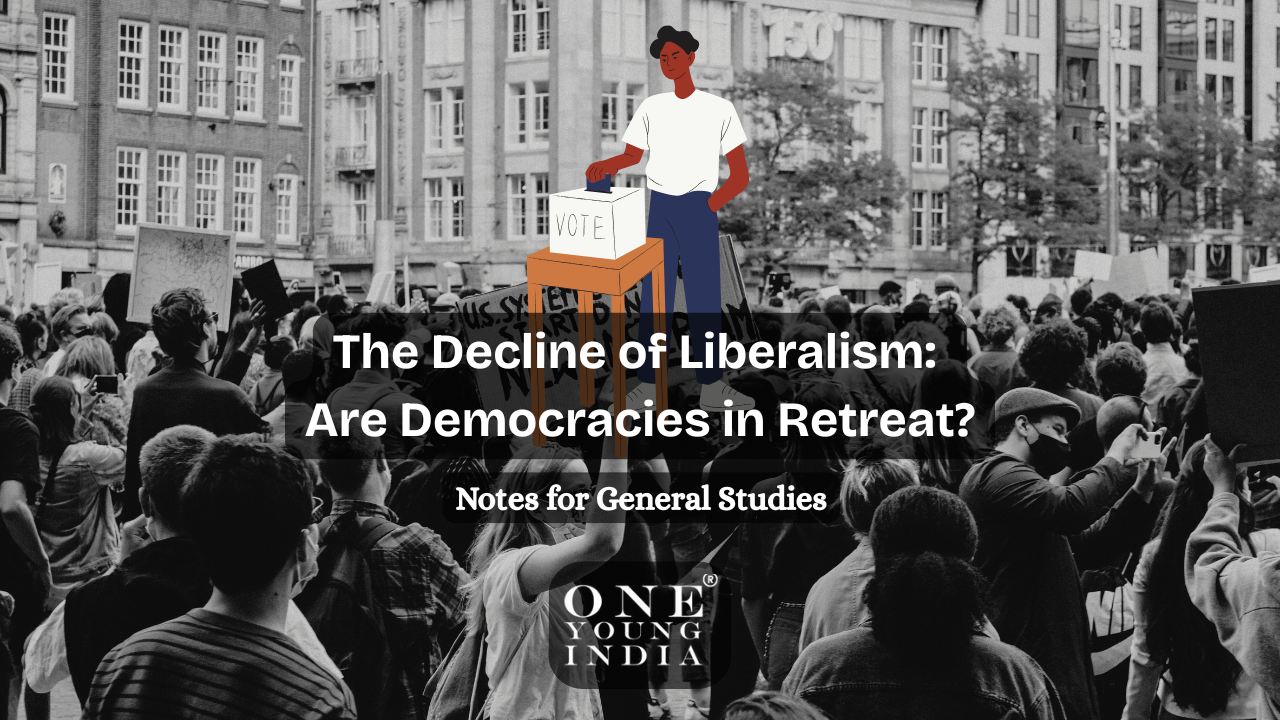
But three decades later, that optimism looks misplaced. Across the globe, liberal values are under strain. Authoritarian regimes are consolidating power, populism is destabilizing democracies, and trust in institutions is declining. From Washington to Warsaw, from Delhi to Brasília, nations that once proudly stood as democracies are experiencing political polarization, erosion of freedoms, and rising nationalist sentiment.
This raises the central question: is liberalism truly in decline, and if so, what comes next?
1. What Do We Mean by “Liberalism”?
Before analyzing its decline, it is important to define what “liberalism” actually means in political and historical terms.
1.1 Classical Liberalism
Classical liberalism emerged in the Enlightenment era, shaped by thinkers like John Locke, Adam Smith, and John Stuart Mill. It emphasized individual rights, limited government, free markets, and the rule of law. The idea was that governments existed to protect natural rights, life, liberty, and property, rather than to control every aspect of human life.
1.2 Liberal Democracy in Practice
In the twentieth century, liberalism evolved into liberal democracy, which combined free-market economies with representative institutions, constitutional protections, and civil liberties such as freedom of speech, religion, and the press. It became the dominant model in the West, and after the Cold War, it seemed destined to spread across the globe.
1.3 Liberalism Today
Today, liberalism has become synonymous with democracy itself, even though democracies exist in different forms. When people speak of liberalism being in decline, they usually refer to the weakening of democratic institutions, the undermining of rule of law, and the shrinking space for civil liberties.
2. Historical Highs and Lows of Liberalism
To understand the current decline, it helps to place liberalism within its historical trajectory.
2.1 Liberalism’s Early Victories
The 19th century witnessed the expansion of constitutional governance across Europe and the Americas. Revolutions in France and the United States established models of government based on liberal ideals, and the Industrial Revolution created economic dynamism that spread liberal values further.
2.2 Liberalism Under Siege
The early 20th century saw liberalism tested by fascism, communism, and global conflict. The rise of Mussolini in Italy, Hitler in Germany, and Stalin in the Soviet Union represented profound challenges to liberal values. World War II became, in part, a struggle to defend liberal democracy against totalitarianism.
2.3 The Cold War Era
After 1945, liberalism rose again. Western Europe adopted democratic constitutions and built welfare states under U.S. protection. The creation of institutions such as NATO, the UN, and the European Union reflected a global liberal order. The Cold War polarized the world, but it also made liberal democracy appear resilient.
2.4 The Post-Cold War Triumph
The fall of the Berlin Wall in 1989 and the collapse of the Soviet Union in 1991 gave rise to the idea of democratic inevitability. Eastern Europe transitioned to democracy, Latin America moved away from dictatorships, and even parts of Africa began experimenting with multiparty systems.
But this moment of triumph sowed the seeds of complacency. Many believed liberal democracy was permanent, but history suggests that political systems are always in flux.
3. Why Is Liberalism Declining Today?
3.1 Erosion of Trust in Institutions
One of the most visible signs of liberal decline is the weakening of trust in institutions. Parliaments, courts, and the media are increasingly viewed with suspicion. In the U.S., approval ratings for Congress have hovered below 20% for years. Similar trends are visible in Europe, Latin America, and Asia, where citizens often feel that democratic institutions serve elites rather than ordinary people.
3.2 The Rise of Populism
Populist leaders, from Donald Trump in the U.S. to Viktor Orbán in Hungary, Narendra Modi in India, and Jair Bolsonaro in Brazil, have challenged liberal norms. Populism often thrives on the claim that elites and intellectuals are out of touch with “the real people.” By bypassing institutions and weakening checks and balances, populists have eroded liberal norms while claiming to restore national pride.
3.3 Economic Inequality and Neoliberal Discontent
Globalization and neoliberal economics widened wealth gaps, particularly after the 2008 financial crisis. While liberal democracies promised prosperity, many citizens instead experienced job losses, wage stagnation, and rising costs of living. This created fertile ground for populism and nationalism, as people blamed open borders, immigrants, or international institutions for their struggles.
3.4 The Digital Revolution and Polarization
Social media has transformed public discourse, often amplifying extremism and disinformation. Liberal democracy relies on informed citizens and compromise, but digital platforms encourage echo chambers and outrage. Elections are increasingly influenced by misinformation campaigns, foreign interference, and algorithmic radicalization.
3.5 Authoritarian Resurgence
Authoritarian states such as China and Russia have promoted alternative models of governance that challenge liberalism’s universality. China’s “authoritarian capitalism” has delivered rapid growth without political freedoms, while Russia has openly sought to destabilize liberal democracies through cyberwarfare and propaganda.
4. Case Studies: Democracies Under Pressure
4.1 The United States
The U.S. once presented itself as the “arsenal of democracy.” Today, it is struggling with deep polarization, partisan gridlock, and challenges to the legitimacy of elections. The storming of the Capitol on January 6, 2021, symbolized the fragility of democratic norms in the very heart of liberal democracy.
4.2 Europe
In Hungary and Poland, governments have undermined judicial independence, restricted media, and used nationalist rhetoric to consolidate power. Even in established democracies like the UK, Brexit revealed profound divisions and mistrust in institutions.
4.3 India
The world’s largest democracy has increasingly leaned toward Hindu nationalism, with critics accusing the government of eroding secularism and press freedoms. While elections remain free, the liberal foundations of pluralism and tolerance are under strain.
4.4 Latin America
Countries such as Brazil and Venezuela illustrate how fragile democratic systems can be when faced with corruption, economic crisis, and populist strongmen.
5. The Global Impact of Liberalism’s Decline
The weakening of liberal democracies has ripple effects worldwide.
Geopolitical Shifts: China and Russia are filling the void left by declining Western influence, offering authoritarian alternatives.
Erosion of Human Rights: International norms on human rights, once championed by liberal democracies, are being disregarded.
Weakening of Global Institutions: Bodies such as the UN and WTO are paralyzed by nationalist competition, making global cooperation on issues like climate change harder.
Crisis of Legitimacy: If democracies cannot deliver stability and prosperity, other countries may see authoritarianism as a more effective model.
6. Is Liberalism Finished? Or Just Transforming?
Despite its struggles, it may be premature to declare the death of liberalism.
Resilience of Democracy: Citizens in many countries still mobilize to defend democratic values, as seen in protests in Hong Kong, Belarus, and Myanmar.
Institutional Adaptation: Democracies have historically weathered crises and reformed themselves, whether through civil rights movements, anti-corruption drives, or institutional reforms.
The Power of Liberal Ideas: Even in authoritarian states, demands for freedom, dignity, and justice persist. Liberalism may retreat, but its values have not disappeared.
7. The Road Ahead: Can Liberalism Reinvent Itself?
The future of liberal democracy depends on whether it can adapt to the challenges of the 21st century.
Economic Renewal: Democracies must address inequality and deliver shared prosperity.
Rebuilding Trust: Strengthening institutions, improving transparency, and curbing corruption are essential to restoring faith in democracy.
Managing Technology: Regulating social media and using technology to promote civic engagement will be crucial.
Defending Liberal Values Abroad: Democracies must stand up for human rights and resist authoritarian influence without falling into hypocrisy.
Conclusion: Retreat or Renewal?
The decline of liberalism is undeniable, but its death is not predetermined. History shows that liberal democracy has survived past crises, reinventing itself in response to new challenges. Today, the forces of populism, inequality, and authoritarianism are real threats, but they are not insurmountable.
Ultimately, liberalism’s survival depends on whether democracies can once again prove that they deliver not just freedom, but also fairness, prosperity, and stability. The question is not whether liberalism is retreating, it is whether it can regroup and reemerge stronger for the future.
Key takeaways
- Liberal democracy requires both the mechanism of voting and the protection of individual rights/rule of law.
- Modern democratic decline is usually a gradual process of erosion rather than a sudden collapse.
- Economic inequality and the fragmentation of the digital information space are primary drivers of current populism.
- The concept of 'illiberal democracy' describes regimes that hold elections but lack the checks and balances of a true liberal state.
- Democratic resilience is maintained through active civil society and institutional independence.
Test yourself
What is the difference between majoritarianism and liberal democracy?
Majoritarianism focuses solely on the rule of the majority, whereas liberal democracy constrains that rule with constitutional protections for minority rights and the rule of law.
What is 'democratic backsliding'?
It is the incremental erosion of democratic institutions, such as the judiciary and free press, often by elected leaders who use legal means to consolidate power.
How does the digital information ecosystem contribute to democratic decline?
Algorithms often amplify outrage and misinformation, creating echo chambers that make it difficult for citizens to agree on a shared set of facts, thereby hindering consensus.
Try it
Analyzing Democratic Backsliding
You are a political analyst observing a fictional nation. Based on the text, evaluate the actions of its newly elected leader to determine if the country's democracy is in retreat.
1The country's leader remains highly popular and continues to hold regular elections. However, they recently passed a law allowing them to bypass the constitutional court and directly appoint loyalists to the national election commission. How should you classify this development?
Incorrect. The text notes that modern democratic decline is rarely a sudden collapse or military coup, but rather a slow, incremental process known as democratic backsliding.
Incorrect. According to the text, a healthy liberal democracy balances majority rule with constitutional protections and an independent judiciary, which this leader is bypassing.
Correct. The text explains that when leaders hold elections but dismantle checks and balances (like 'capturing the referees' by packing election commissions), it creates an 'illiberal democracy'.
2To further consolidate power, the leader's administration begins ordering extensive tax audits on the country's leading independent newspapers and publicly frames opposition party members as 'existential enemies of the state.' What tactics is the regime employing?
Correct. The text explicitly identifies using tax audits against journalists as 'lawfare' to silence dissent, and framing opponents as enemies as a polarization tactic.
Incorrect. The text specifies that regimes often use 'lawfare'—such as tax audits—instead of outright censorship to harass journalists.
Incorrect. The text explicitly identifies the use of tax audits against journalists as a form of 'lawfare' meant to harass and silence dissent, not as a genuine economic policy.
Great job! You successfully identified the subtle mechanisms of democratic backsliding. As the text notes, countering these trends requires an active civil society and independent journalism to maintain democratic resilience.