
The Vedic Civilization | ICSE Class 6 History & Civics Notes
On this page
This note covers the Vedic civilisation, its geographical setting, early and later Vedic life, the Vedas and other literature, government, occupations, social groups, women, religious ideas, education, the four stages of life and cultural heritage.
What was the geographical background of Vedic civilisation?
Vedic means related to the Vedas, ancient collections of sacred knowledge. The word Veda comes from the Sanskrit root vid, meaning knowledge. Sanskrit is the language in which the Vedic hymns were composed. A hymn is a prayer expressed as a poem or song.
Sapta Sindhu, also called Sapta Sindhava, means the land of the seven rivers. It refers to the northwestern region of the Indian subcontinent. Sindhu means the Indus River, or at times a river in general. The Gangetic valley is the valley of the River Ganga.
The term Aryans is used here for the people associated with Vedic language and culture. Early Vedic life is associated with the northwest; later Vedic settlement extended towards the Gangetic valley. This geographical change provides a setting for changes in farming, government and society.
How do the two broad periods fit into a timeline?
BCE means Before Common Era. Dates in BCE become smaller as time moves forward. A millennium is a period of one thousand years. The abbreviation c. means approximately. Early and later Vedic periods are broad historical divisions, rather than changes that happened everywhere on a single day.
| Broad phase | Approximate period | Main focus |
|---|---|---|
| Early Vedic traditions | c. 1500-1000 BCE | The Rig Veda and early Vedic communities |
| Later Vedic traditions | c. 1000-500 BCE | Changing society, more elaborate rituals and new questions |
Brahmavarta is the regional name associated here with the early Vedic age; Aryavarta is associated with the later Vedic age. These regional terms should not be treated as names of two single kingdoms with fixed borders.
Note: The Rig Veda's exact date of composition is difficult to establish. The approximate periods above organise early and later traditions; they do not provide an exact year when every hymn was composed.
What the figure shows
Rivers of the Indian subcontinent
The physical map labels the Indus and its northwestern river system, the Himalayas, the Ganga and the Yamuna. Locate the northwest first, then follow the plains towards the Ganga.
What timeline connects Vedic traditions with later literature?
This timeline connects the broad Vedic periods with changes in agriculture, political organisation and religious literature. Its periods overlap because these developments were gradual. The later entries trace the continuing development of the epics and Puranas.
| Approximate date or period | Development |
|---|---|
| c. 1500 to 1000 BCE | Early Vedic traditions, associated with the Rig Veda and its hymns. |
| Late second millennium BCE | Iron tools became widespread, helping agriculture develop on a bigger scale. |
| Towards the end of the second millennium BCE | Regional cultures in north India reorganised; clans became associated with territories or janapadas under rulers. |
| c. 1000 to 500 BCE | Later Vedic traditions, including increasingly elaborate sacrificial rituals. |
| By the eighth or seventh centuries BCE | Some early states merged into larger units called mahajanapadas. |
| c. sixth century BCE onwards | The early Upanishads explored questions about life and existence. |
| From the fifth century BCE | Brahmanas began committing the orally transmitted Mahabharata story to writing. |
| c. 200 BCE to 200 CE | A further phase of Mahabharata composition accompanied the growing identification of Krishna with Vishnu. |
| c. 200 to 400 CE | Large instructional sections were added to the Mahabharata. |
| By about the middle of the first millennium CE | Brahmanas compiled Puranas containing stories that had circulated for centuries. |
Which literary sources help us understand Vedic life?
Literary sources are texts used to learn about the past. Vedic hymns preserve prayers, ideas and references to human activities. These hymns help us understand beliefs and occupations, but they do not describe every household or explain every institution in equal detail.
A ritual is a prescribed religious act or sequence of acts; a sacrifice is a ritual involving offerings.
What are the four Vedas?
| Veda | Principal character |
|---|---|
| Rig Veda | A collection of hymns praising deities, meaning gods or goddesses |
| Sama Veda | Chants and melodies associated with the singing of hymns |
| Yajur Veda | Prayers and formulae used in performing sacrificial rituals |
| Atharva Veda | Hymns and prayers including concerns of everyday life, health and wellbeing |
The Rig Veda is the most ancient of the four. Vedic hymns were composed by rishis, male sages or seers, and rishikas, female sages or seers. A sage is a person respected for wisdom. The hymns were recited orally rather than originally written down.
Oral transmission means passing knowledge on through speech, listening and memory. Rigorous training preserved the Vedas for many generations with hardly any alterations. Learning involved careful attention to the words and sounds of the hymns, not simply remembering their general subject.
Why must a source be placed in its period?
The early Vedic traditions are broadly placed around 1500 to 1000 BCE, and later Vedic traditions around 1000 to 500 BCE. These approximate divisions help distinguish earlier hymns from later developments. A later text cannot automatically describe conditions throughout the earlier period.
Historians ask who composed a text, whom it addressed, when it developed and what kind of writing it contains. A prayer reveals what people valued or desired. A rule describes expected conduct. Neither automatically proves that everyone lived in precisely the same way.
The Upanishads are texts that develop questions about life, the self and ultimate reality. They build upon Vedic ideas and introduce new ones. Reading hymns alongside such discussions reveals change within a continuing tradition of learning and reflection.
What do the epics and Puranas tell us?
An epic is a long poem generally narrating the adventures of heroes and other great figures of the past. The Ramayana and Mahabharata are Sanskrit epics. Their stories explore family relationships, rulership, conflict and dharma, meaning right conduct and duty in this discussion.
What are the central stories?
In the Ramayana, Rama defeats Ravana, who has kidnapped Rama's wife, Sita. Rama receives help from his brother Lakshmana and from Hanuman. The story raises questions about loyalty, relationships and the struggle to act rightly.
In the Mahabharata, the Pandavas fight their cousins, the Kauravas, to recover their kingdom, with Krishna's help. These are the two related groups at the centre of the conflict. The epic contains many shorter stories that explore difficult choices about right and wrong.
The Bhagavad Gita is a teaching section within the Mahabharata. It contains Krishna's advice to Arjuna, one of the Pandavas. It is therefore part of an epic, not a fifth Veda. Its discussion of action and duty belongs within the larger world of the story.
From the fifth century BCE, Brahmanas began committing the orally transmitted Mahabharata story to writing. Another phase of composition occurred between c. 200 BCE and 200 CE, when Krishna was increasingly identified with Vishnu.
Between c. 200 and 400 CE, large instructional sections were added to the Mahabharata. These stages of composition help explain why its surviving form cannot be treated as a text produced entirely in the early Vedic period.
How do the Puranas differ from the epics?
The Puranas are collections of traditional religious narratives, including stories about gods and goddesses. Much of their material circulated for centuries before compilation. Generally written in simple Sanskrit verse, they were intended to be read aloud to a wide audience.
The epics and Puranas developed over long periods. Their surviving forms should not all be assigned to the early Vedic age. They help us study ideas, beliefs and social expectations, but a story is not automatically proof that every narrated event happened exactly as described.
For more than two millenniums, the epics have been translated or adapted into regional literatures in India and beyond. Many communities also preserve oral versions. Shared characters and themes can therefore appear in different forms while continuing to raise questions about human conduct.
How did political organisation change over time?
Political organisation means the arrangements through which a community is led and its common affairs are managed. Early Vedic society consisted of janas, or clans, meaning larger groups of people. Each clan was associated with a particular region in the northwest.
The Rig Veda names over thirty janas. Examples include the Bharatas, Purus, Kurus and Yadus. These names show that early Vedic society contained several communities. It should not be imagined as one unified kingdom covering the whole subcontinent.
What were the raja, sabha and samiti?
A raja was a king or ruler. Sabha and samiti both refer to a collective gathering or assembly. These terms offer clues about leadership and discussion, but not much is known about precisely how the early janas governed their society.
As communities became associated with settled territories, janapadas developed. A janapada was a territory where a group of people had settled, led by a raja. The term combines jana, meaning people, and pada, meaning foot, suggesting land where people had set foot.
Towards the end of the second millennium BCE, regional cultures gradually reorganised in north India. People formed clans or groups, probably sharing a common language and common customs. Their association with particular territories helps explain the movement towards territorial states.
How did assemblies relate to rulers?
In the janapadas, assemblies discussed matters concerning the clan. We may assume that most members were elders. A good ruler was supposed to take advice from assemblies, as well as ministers and administrators, rather than act independently or arbitrarily.
Note: Some texts mention the removal of an incompetent ruler by an assembly. This does not mean that removal was an established law everywhere. Evidence for these remote periods is incomplete.
The broad comparison is between leadership within early clans and the growth of states tied to territories. It does not justify assigning an identical system of government to every community or treating an ancient assembly as a modern elected parliament.
Why did farming and occupations matter to economic life?
Economic life concerns how people produce goods, obtain food and earn their livelihood. Pastoralism means rearing animals for a living, while agriculture means cultivating crops. Cattle rearing was important in early Vedic life, alongside cultivation and other occupations.
Cattle appear among the things people prayed for in Vedic sacrifices. People also prayed for sons, good health and long life. Such prayers reveal their concerns and desires; they are not a numerical account of how much wealth every family possessed.
Which occupations are mentioned?
Vedic texts mention agriculturists, weavers, potters, builders, carpenters, healers, dancers, barbers and priests. A healer used traditional practices to relieve or heal disease. A priest performed religious duties. These references show a range of activities beyond animal rearing alone.
| Activity | Meaning of the occupation |
|---|---|
| Agriculture | Growing crops |
| Weaving | Making cloth by interlacing threads |
| Pottery | Making objects such as vessels from clay |
| Carpentry | Working with wood |
How did the scale of agriculture change?
By the late second millennium BCE, iron tools had become widespread, facilitating agriculture on a bigger scale. Iron metallurgy means the techniques of extracting and working iron. The spread of useful tools forms part of the explanation for growing agricultural activity.
The fertile Ganga plains offered conditions favourable to agriculture. Fertile land can support crop growth. Agricultural development, iron resources and new trade networks are possible reasons for the later concentration of states in this region. They should be considered together, rather than reduced to one cause.
A trade network links places through the exchange of goods. Janapadas grew as such networks expanded and connected them. Farming, craft production and exchange were related parts of economic life; the development of one did not mean that every other occupation disappeared.
How did different social groups participate in society?
Social organisation means the way people are grouped and related within society. Two useful ideas must be kept separate: a jana was a clan or larger community, while varna referred to one of four broad social categories associated with particular responsibilities.
What roles were associated with the four varnas?
- Brahmins: They were engaged in preserving and spreading knowledge and performing rituals. They are also called Brahmanas.
- Kshatriyas: They were expected to defend society and its land and engage in warfare if necessary.
- Vaishyas: They were supposed to increase society's wealth through trade, business or agriculture.
- Shudras: They included artisans, craftspeople, workers or servants. An artisan is a person skilled in making things.
These descriptions explain an arrangement of social roles. They do not establish that some people possess greater human worth than others. Studying a historical classification means understanding how it operated, including the inequalities associated with it.
Were occupations completely fixed?
In early Vedic society, there appears to have been flexibility and mobility in occupational roles. One Rigvedic hymn describes a speaker who is a poet, whose father is a physician and whose mother grinds grain. A physician is a person who treats illness.
This example shows different occupations within one family. It supports a careful statement about flexibility, rather than a claim that every family followed one occupation. It also does not prove that all people enjoyed the same wealth, influence or opportunities.
How did social distinctions develop?
A jati was a group or community closely connected with a particular occupation and livelihood. Skills were generally transmitted from generation to generation. Varna and jati are related ideas in social history, but the four broad varnas are not identical to the many jatis.
Over time, the system became more rigid and led to inequalities and discrimination against lower jatis and some excluded communities. Discrimination means unfair treatment of people because of the group to which they belong. This development was a process, not one identical change everywhere.
How did the position of women change?
The position of women refers to their opportunities, responsibilities and standing in family and society. The presence of rishikas among the composers of Vedic hymns shows that women participated in religious and intellectual life. Intellectual life includes learning, questioning and discussing ideas.
The broad contrast is between women's participation in early Vedic learning and increasing restrictions on their access to education and religious privileges in later traditions. This is a general trend, not proof that every woman had the same experience in either period.
What does Gargi's story show?
Gargi was a learned woman who took part in a philosophical debate with the sage Yajnavalkya. A philosophical debate is a reasoned discussion about fundamental questions concerning life and the world. Their exchange is preserved in an Upanishad.
In the story, King Janaka announces a prize for a debate. Gargi questions Yajnavalkya about the nature of the world and its ultimate reality. Although he asks her to stop at one point, she later resumes her questions and he continues his explanation.
The example prevents an over-simple claim that women had no place in later intellectual traditions. At the same time, a learned woman's participation does not prove that education was equally accessible to all women. Individual examples and broader social conditions must be distinguished.
How should the comparison be expressed?
Say that opportunities became more restricted over time, while remembering examples of women who continued to learn and debate. Do not replace this measured comparison with either “all women were fully equal” or “no woman could study”. Both statements erase differences within society.
Later Puranic storytelling reached audiences including women and Shudras who did not have access to Vedic learning. Participation in hearing religious narratives and access to specialised Vedic education were therefore different things. One form of participation did not automatically provide the other.
How did Vedic worship and religious thought develop?
Vedic hymns addressed many deities, or gods and goddesses. These included Indra, Agni, Varuna, Mitra, Sarasvati and Ushas. Agni was associated with fire. The hymns express prayers, praise and reflection on human life and the world.
Early Vedic traditions are broadly dated to c. 1500 to 1000 BCE. Sacrifices were initially collective. During the later phase, c. 1000 to 500 BCE onwards, some sacrifices were performed by household heads for their families' wellbeing.
What was a yajna?
A yajna was a religious ritual involving offerings, often called a sacrifice. A ritual is a prescribed religious act or sequence of acts. Vedic rituals were directed towards deities for individual or collective wellbeing. Daily rituals were generally prayers and offerings to Agni.
Rituals became more and more complex over time. Some later sacrifices were performed by household heads for their families. Chiefs and kings performed more elaborate ceremonies with the help of Brahmana priests. This development linked religious activity with household life and political authority.
The early rishis and rishikas saw the gods and goddesses as one, not as separate beings. Their understanding stressed an underlying unity behind different divine names. Ritam meant truth and order in human life and the universe.
What questions did the Upanishads explore?
The Upanishads developed ideas about rebirth, meaning taking birth again, and karma, meaning actions or their results. They asked about the nature of life, the self and the ultimate reality underlying the world. Such questions extended reflection beyond the performance of ceremonies.
In Vedanta, a school of thought growing from these texts, brahman is the single divine essence underlying everything. Atman means the self or divine essence within a being, ultimately one with brahman in this teaching. These are philosophical beliefs, not descriptions of physical objects.
Note: Brahman, the divine essence in this teaching, is not Brahma, the name of a god. It is also different from Brahmin, a social category associated with knowledge and rituals.
The connection between beings supports the wish that all creatures should be happy and free from suffering. Vedic thought thus includes prayer, ritual, questions about existence and reflection on how people should live together.
How did the gurukul system organise learning?
A gurukul, also called a gurukula, was a place of learning associated with a guru, meaning teacher. In the traditional system, pupils lived with or near their teacher. Learning formed part of a disciplined way of life, rather than being confined to written lessons.
How was knowledge passed on?
The preservation of Vedic hymns depended on careful listening, memorising and reciting. Because the texts were transmitted orally, accurate repetition mattered. The teacher's guidance helped learners preserve the wording and sounds, allowing the tradition to continue across generations with hardly any alterations.
Learning was also connected with conduct. Respect for the teacher, self-discipline and participation in everyday duties were features of the traditional gurukul ideal. An ideal is a model of how people are expected to behave; it does not prove that every learner followed it perfectly.
What does Shvetaketu's story teach about learning?
In an Upanishadic story, the sage Uddalaka Aruni sends his son Shvetaketu to a gurukula to learn the Vedas. The son returns after twelve years, proud of his learning. His father then asks questions about brahman that he cannot answer.
Uddalaka explains the invisible essence of reality through familiar comparisons. A banyan seed appears empty when opened, yet contains the possibility of a future tree. Different pots can be made from the same clay. These comparisons help Shvetaketu think beyond the surface of things.
The story distinguishes possessing information from understanding its meaning. It also presents questioning as part of education. The twelve years belong to this particular story; they should not be turned into a compulsory length of study for every gurukul student.
Other Upanishadic stories include questions from men, women and children. Together, such narratives value inquiry as well as memory. Remembering a hymn accurately and asking what an idea means are related aspects of learning, but they are not identical activities.
What were the four ashramas or stages of life?
An ashrama, in this context, means a stage in an ideal scheme of human life. The four ashramas describe changing responsibilities, from education and family life towards withdrawal and spiritual reflection. Spiritual reflection means thinking deeply about the self and the meaning of existence.
What responsibility belonged to each stage?
| Stage | Meaning | Principal responsibility in the ideal scheme |
|---|---|---|
| Brahmacharya | Student life | Learning under a teacher and practising discipline |
| Grihastha | Householder life | Raising a family, earning a livelihood and fulfilling household duties |
| Vanaprastha | Withdrawal from household responsibilities | Reducing attachment to worldly duties and giving more attention to reflection |
| Sannyasa | Renunciation | Giving up worldly attachments and concentrating on spiritual pursuits |
Renunciation means giving up possessions, attachments or ordinary worldly concerns for spiritual purposes. The sequence does not present family life and learning as enemies. Instead, it arranges different kinds of responsibility within an ideal account of a person's life.
Brahmacharya connects with the gurukul system because it emphasises study and discipline. Grihastha places attention on household duties and livelihood. Vanaprastha describes a gradual turning away from those duties, while sannyasa gives central importance to spiritual pursuit.
Was the scheme a description of everybody's life?
The four ashramas form a prescribed ideal, not a record showing that every person passed through every stage. Distinguish what a tradition recommended from what all individuals actually did. The names explain stages of life; they do not refer to four social groups.
Diagram
Four ashramas
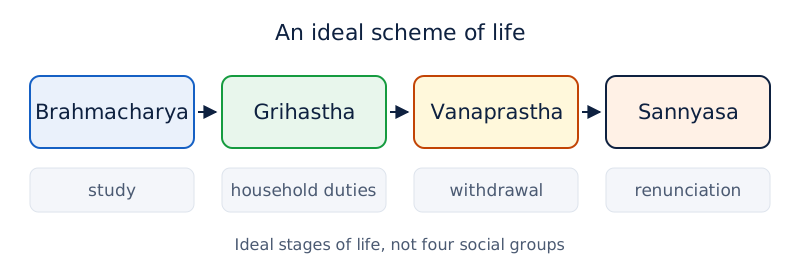
Draw four boxes in sequence: Brahmacharya, Grihastha, Vanaprastha and Sannyasa. Under them write study, household duties, withdrawal and renunciation. Label the whole diagram “An ideal scheme of life”.
Drawn by One Young India.
How did early and later Vedic life compare?
A comparison should match the same aspect of life in both periods. Continuity means something that persists through change. Vedic learning and religious reflection continued, even as settlement, political organisation, occupations and social relationships developed in new directions.
What are the main differences and continuities?
| Aspect | Early Vedic life | Later Vedic developments |
|---|---|---|
| Geographical setting | Associated with the northwestern Sapta Sindhu region | Settlement extended towards the Gangetic valley |
| Political organisation | Janas and rulers, with references to assemblies | Growing association of communities with territories and janapadas |
| Economic life | Cattle rearing, cultivation and several occupations | Agriculture on a larger scale and expanding connections through trade |
| Religious activity | Hymns, prayers and collective sacrifices | More elaborate rituals alongside questions explored in the Upanishads |
| Occupational roles | There appears to have been flexibility and mobility | Social distinctions became more rigid over time, rather than in one sudden change |
| Women's learning | Women participated as composers of hymns | Opportunities became more restricted, while learned women such as Gargi remained important |
The comparison describes broad patterns. It does not mean that farming began only in the later period, that oral learning stopped, or that all assemblies disappeared. A useful contrast identifies a change without inventing a complete break between the two phases.
The growth of agriculture and trade provided a setting for larger settlements and states. More complex rituals involved priests and rulers, while philosophical inquiry explored questions beyond material wealth. These developments show that economic, political and religious changes can be studied together.
At the same time, the evidence does not support one simple explanation for everything. Social life included different communities, occupations and experiences. The terms “early” and “later” help organise the comparison; they do not remove differences within each period.
What was the legacy of Vedic literature and thought?
A legacy is something passed down from the past. Vedic literature preserved hymns, ways of learning and questions about existence. Its oral transmission is an example of knowledge maintained across many generations through disciplined practice.
Which ideas had a continuing significance?
The Upanishads encouraged reflection on the self, ultimate reality, karma and rebirth. Vedanta and Yoga, a school developing methods intended to realise the divine essence within consciousness, grew from Vedic traditions. Consciousness means the state of being aware.
Together, these schools helped form the foundations of Hinduism. Their importance includes philosophical inquiry and ways of understanding life, as well as religious practice. The tradition contains both ceremonies and questioning, so reducing it to either one alone gives an incomplete picture.
The closing verses of the Rig Veda call for unity in thought, purpose and action. This offers a social ideal of people speaking and working together. An ideal expresses what is valued; it does not mean that disagreements or inequalities never existed.
How did stories keep ideas alive?
The epics carried questions about right conduct into stories that could be heard, retold and adapted. Their regional and oral versions show how a shared narrative can become part of many communities' lives. Cultural continuity can therefore include variety and reinterpretation.
Understanding this heritage also requires attention to change. The participation of women in learning, restrictions on access to education and growing social inequalities belong within the same historical enquiry. Appreciating literature and thought is compatible with examining the society in which they developed.
Glossary
- Vedic — Related to the Vedas and the traditions associated with their learning and practice.
- Veda — An ancient collection of sacred knowledge preserved through careful oral recitation across generations.
- Hymn — A prayer expressed in the form of a poem or song.
- Sapta Sindhu — The land of the seven rivers in the northwestern Indian subcontinent.
- Jana — A clan or larger group of people associated with a particular region.
- Janapada — A territory where a group of people had settled under a ruler.
- Varna — One of four broad social categories associated with particular roles and responsibilities.
- Yajna — A religious ritual involving offerings to deities for individual or collective wellbeing.
- Upanishads — Texts exploring questions about life, the self and ultimate reality through Vedic ideas.
- Karma — Actions or their results, discussed in connection with life and rebirth.
- Brahman — The single divine essence underlying everything in the Vedantic school of thought.
- Epic — A long poem generally narrating the adventures of heroes and other great figures.
- Gurukul — A traditional place of learning where pupils lived with or near their teacher.
- Ashrama — A stage in an ideal scheme of life with particular responsibilities.
- Oral transmission — Passing knowledge between generations through speech, listening, memorisation and careful recitation.
Common errors and misconceptions
- Misconception: The Vedas were originally written books. Correct: The hymns were first recited and passed on orally through rigorous training.
- Misconception: Early Vedic society formed one kingdom across India. Correct: It contained different janas associated with particular northwestern regions.
- Misconception: Agriculture began only in the later Vedic age. Correct: Cultivation existed earlier; agriculture later developed on a bigger scale.
- Misconception: No women participated in Vedic learning. Correct: Rishikas composed hymns, and Gargi appears in an Upanishadic philosophical debate.
- Misconception: Brahman, Brahma and Brahmin mean the same thing. Correct: They refer respectively to divine essence, a god and a social category.
- Misconception: The four ashramas were four social groups. Correct: They were ideal stages of life; the four varnas were social categories.
- Misconception: Every epic episode is a verified historical event. Correct: Epics preserve narratives and teachings that require careful historical interpretation.
- Misconception: Approximate period dates give an exact composition date for every hymn. Correct: They organise broad phases; the Rig Veda's exact composition date is difficult to establish.
Exam-style questions with model answers
Q1. A Veda is a collection of sacred knowledge. Its name comes from the Sanskrit root vid, meaning knowledge; Vedic means related to the Vedas. Using this information, explain the two terms. [2 marks]
- A Veda is associated with sacred knowledge; its name comes from the Sanskrit root vid, which means knowledge.
- Vedic means related to the Vedas, including their learning, ideas and traditions.
Q2. Evidence: Vedic hymns were first recited orally rather than written, learners received rigorous memory training, and the texts passed through generations with hardly any alterations. Explain three features of their preservation. [3 marks]
- Preservation depended on oral recitation, so knowledge passed through speaking and listening rather than beginning as a collection of written books.
- Rigorous training of memory helped learners retain the hymns and continue the practice of reciting them accurately.
- Transmission across generations preserved the texts with hardly any alterations; this means remarkable continuity, rather than a claim of absolutely no change.
Q3. Evidence: early Vedic society contained janas, or clans; a raja was a ruler; sabha and samiti meant assemblies; little is known about exactly how these communities governed themselves. Draw four conclusions about political organisation and the limits of the evidence. [4 marks]
- Janas were clans or larger communities, so the evidence describes political life within groups rather than automatically proving one unified kingdom.
- The word raja indicates the presence of rulers, although the information supplied does not establish their precise powers.
- Sabha and samiti indicate collective gatherings or assemblies, showing that political vocabulary included more than the ruler alone.
- Because detailed knowledge of government is limited, we cannot turn these terms into a complete account of how every community was governed.
Q4. Compare five aspects using these paired facts: early settlement was northwestern, later settlement extended towards the Ganga; early communities were janas, later territories included janapadas; cattle rearing and cultivation existed early, agriculture later expanded; sacrifices were initially collective, later ceremonies became more elaborate; early hymns expressed prayers, Upanishads developed questions about the self. Give five paired comparisons. [5 marks]
- Geographically, early settlement was associated with the northwest, while later settlement extended towards the Ganga. The comparison identifies a change in the area of settlement.
- Politically, the early pattern included janas or communities, while later developments included janapadas, which connected communities with settled territories.
- Economically, cattle rearing and cultivation were already present early on. Later agriculture expanded, so the contrast concerns growth rather than farming suddenly beginning.
- In religious practice, collective sacrifices belonged to the earlier pattern, while later ceremonies became more elaborate, indicating change in the organisation of worship.
- In religious thought, early hymns expressed prayers, while the Upanishads developed questions about the self. This shows a widening of inquiry within the tradition.
Q5. A source account contains six facts: rishikas composed hymns; Gargi questioned Yajnavalkya; she resumed questioning after being asked to stop; later women's learning opportunities became more restricted; individual women continued to debate; Puranic narratives reached women without access to Vedic education. Use all six facts to explain women's participation and its limits. [6 marks]
- The presence of rishikas among hymn composers shows women's participation in religious learning. It does not support a claim that women were entirely absent.
- Gargi's questions to Yajnavalkya provide an example of a learned woman taking part in a philosophical discussion and challenging another thinker.
- Her return to questioning after being asked to stop shows continued participation within this particular account, rather than her permanent exclusion from the debate.
- The later restriction of learning opportunities indicates a broad change in women's access. It should not be confused with an identical experience for everyone.
- The continued participation of individual women shows why a general trend towards restriction must not become the absolute statement that no woman could debate.
- Women could hear Puranic narratives without having access to Vedic education. Hearing religious stories and receiving specialised Vedic learning were different opportunities.
Q6. Arrange and explain these stages in the supplied order: Brahmacharya involves study; Grihastha involves household duties; Vanaprastha involves withdrawal from household responsibilities; Sannyasa involves renunciation for spiritual pursuits. Explain one responsibility for each stage. [4 marks]
- Brahmacharya is the student stage, centred on study. Its principal responsibility is learning, placed at the beginning of the supplied sequence.
- Grihastha is the householder stage, centred on fulfilling the responsibilities of household life rather than continuing only with student duties.
- Vanaprastha involves withdrawal from household responsibilities, marking a shift away from the duties that occupied the preceding householder stage.
- Sannyasa involves renunciation for spiritual pursuits, placing spiritual concerns at the centre of the final stage in this ideal sequence.
Q7. Evidence: cattle occur in Vedic prayers; texts mention farmers and craftspeople; widespread iron tools facilitated larger-scale agriculture; growing trade networks connected janapadas. Explain four aspects of economic life shown by this evidence. [4 marks]
- Prayers mentioning cattle show that cattle mattered to people's concerns, although the prayers do not measure every household's wealth.
- References to farmers and craftspeople show a variety of occupations, including crop cultivation and the production of crafted goods.
- The spread of iron tools helped agriculture develop on a bigger scale, connecting changes in technology with changes in production.
- Growing trade networks connected janapadas, showing that economic activity involved links between territories as well as work within individual communities.
Q8. Evidence: the Ramayana and Mahabharata contain heroic stories and questions about right conduct; the Bhagavad Gita is Krishna's advice to Arjuna within the Mahabharata; Puranas contain traditional religious narratives, including stories of deities. Distinguish these three literary forms. [3 marks]
- The Ramayana and Mahabharata are epics, combining stories of heroes with questions about right conduct rather than serving simply as lists of rules.
- The Bhagavad Gita is a teaching section within the Mahabharata, containing Krishna's advice to Arjuna within the larger epic narrative.
- The Puranas contain traditional religious narratives, including stories about deities, so their character differs from both the larger heroic epics and the Gita's specific teaching setting.
Key takeaways
- Vedic means related to the Vedas, whose hymns were preserved through careful oral transmission across generations.
- Early Vedic life is associated with the northwestern Sapta Sindhu region; later settlement extended towards the Gangetic valley.
- Janas were communities, while janapadas connected groups with territories; the details of early government remain incompletely known.
- Cattle rearing, cultivation and several crafts existed, while iron tools later helped agriculture develop on a bigger scale.
- Women composed Vedic hymns and participated in debate, even though access to learning became more restricted over time.
- The Upanishads explored the self, ultimate reality, karma and rebirth, extending inquiry beyond the performance of rituals.
- The four ashramas describe ideal stages of life; they must not be confused with the four varnas.
- Epics and Puranas preserve stories, values and social expectations, but their narratives require careful historical interpretation.
Test yourself
What does Sapta Sindhu mean, and where was it?
It means the land of the seven rivers in the northwestern Indian subcontinent.
Name the four Vedas.
The four Vedas are the Rig Veda, Sama Veda, Yajur Veda and Atharva Veda.
How does a jana differ from a janapada?
A jana was a clan or larger community; a janapada was a territory where a group had settled.
What do sabha and samiti mean?
Both terms refer to a collective gathering or assembly associated with community affairs.
Why is Gargi important in studying women's learning?
Gargi appears in an Upanishadic debate questioning Yajnavalkya about the world and ultimate reality.
How is brahman different from Brahmin?
Brahman is the divine essence in Vedantic thought; Brahmin names a social category associated with learning and rituals.
What is the order of the four ashramas?
The ideal sequence is Brahmacharya, Grihastha, Vanaprastha and Sannyasa: study, household duties, withdrawal and renunciation.
Why should a story about one learner not become a rule for every learner?
A particular story describes that learner's experience; it does not prove that every pupil followed an identical course.
Write about it
Turn a question from this chapter into a paper.
The Writing Studio has a structure guide, a rubric and citation tools for 15 formats, from essays to research papers. Drafting is free with an account. Learnacy Essential adds feedback from an AI writing coach and submission to The OYI Review.
Learnacy Essential is ₹1,499 for the year. Publication depends on review and is not guaranteed.