
Transportation | ICSE Class 10 Commercial Studies Notes
On this page
This note covers the meaning and importance of transportation, land transport by road and rail, water and air transport, the merits and limitations of each mode, and the factors governing the choice of transport.
What is transportation, and how does it support trade?
Definition: Transportation is the service of carrying people and goods from one place to another, using people, animals or vehicles. It connects places where goods are produced with places where they are needed.
Trade means the buying and selling of goods and services. Production and consumption often occur in different places. Transport provides the routes and carriers through which goods reach their users, making it an essential support to trade.
How does movement connect production with consumption?
Raw materials are the basic materials used to produce other goods. They must reach the places where production occurs. Finished goods must then reach markets, where buyers obtain them. Transport connects these stages of economic activity.
Natural resources, economic activities and markets are rarely found together in one place. A region can produce goods for which it is well suited and exchange them with other regions. These exchanges depend on the physical movement of goods.
Transport therefore helps businesses reach buyers beyond their immediate surroundings. Producing goods is not enough to make them available to consumers. The goods also need a means of travelling from their supply location to the place of demand.
What does a transport service include?
A transport service involves more than a moving vehicle. It includes routes, vehicles, maintenance and arrangements for loading, unloading and delivery. Loading puts goods onto a vehicle; unloading removes them at a stopping or delivery point.
A transport network consists of places joined by routes. The connected places are called nodes, and the routes connecting them are called links. A network helps explain how separate producing and consuming centres can exchange goods.
Efficient transportation supports the development of industry, agriculture and trade. It also carries passengers. Its commercial importance lies in connecting economic activities and making movement possible, rather than merely increasing the number of vehicles on a route.
How are the main modes of transportation classified?
A mode of transport is a method of carrying people or goods. The main groups considered here are land, water and air. Land transport includes roadways and railways, which must be studied separately because their operating features differ.
What belongs to each group?
| Group | Mode | Meaning |
|---|---|---|
| Land | Road | Movement using vehicles travelling on roads. |
| Land | Rail | Movement using trains travelling on railway tracks. |
| Water | Inland waterways and sea routes | Movement using boats, steamers and ships on suitable water routes. |
| Air | Airways | Movement using aircraft through the air. |
Freight means goods carried by a transport service. Cargo also means the goods being carried, particularly in discussions of ships and aircraft. Passengers are the people being transported. A mode may serve both goods and passenger movement.
Water transport includes inland waterways, such as navigable rivers, canals and lakes, and sea routes across seas and oceans. Navigable means suitable for vessels to pass through. A river's existence alone does not establish its suitability for transport.
Why are several modes needed?
The importance of a mode depends on the goods to be carried, transport costs and the modes available. Roadways serve short journeys and direct delivery; railways suit large volumes of bulky material over long distances within a country.
Bulky goods occupy considerable space. Water transport is well suited to heavy and bulky loads. Airways are best suited to high-value, light and perishable goods. Perishable goods are goods liable to spoil or deteriorate if they are not handled and delivered appropriately.
These strengths do not make the modes mutually exclusive. In a well-managed transport system, they complement one another. The usefulness of a mode must be related to the particular movement, including the goods, the distance and access to the route.
Diagram
Classification of transportation
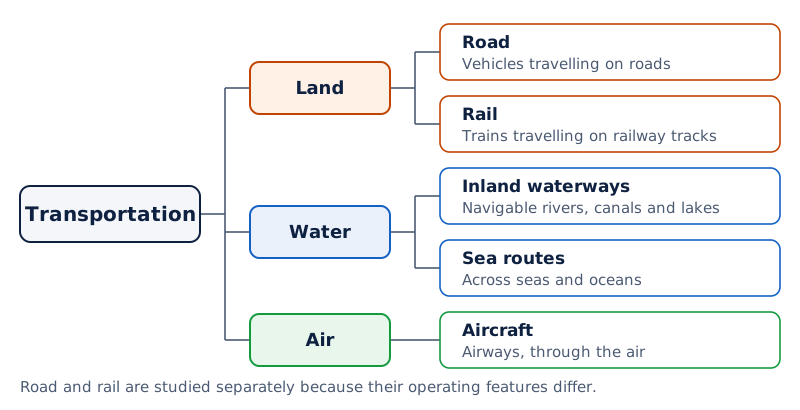
Draw a box labelled Transportation. Branch it into Land, Water and Air. Divide Land into Road and Rail, and Water into Inland waterways and Sea routes. Place Aircraft under Air.
Drawn by One Young India.
What are the merits of road transport?
Road transport carries people and goods in vehicles travelling on roads. Its important commercial strengths are short-distance economy, direct delivery and connections with other transport modes. These features make it especially useful for relatively small movements over short distances.
How do cost and access favour roads?
- Economy over short distances: Road transport is economical for a few people or a relatively small quantity of goods travelling a short distance. The distance and size of the load are essential parts of this advantage.
- Door-to-door service: Goods can be carried between the sender's and receiver's premises where suitable roads provide access. This reduces the need for separate handling at intermediate transport points.
- Lower loading and unloading costs: Direct delivery reduces these costs. This is a separate benefit of door-to-door service, rather than a claim that every road journey has the lowest total cost.
- Lower route construction cost: Roads cost much less to construct than railway lines. This comparison concerns the cost of the route, not a promise about the price charged for every individual shipment.
A shipment is a quantity of goods sent together. For a short-distance shipment, direct access and reduced handling can be commercially important. A low charge for the main journey is less useful if additional movements are needed to complete delivery.
How do roads connect difficult terrain and other modes?
Terrain means the physical character of the land. Roads can cross comparatively more uneven and dissected terrain, meaning land broken up by valleys, than railways. They can also negotiate steeper slopes. The Himalayas illustrate the importance of road access in mountainous areas.
A feeder service connects places with a main transport route or facility. Roads provide such links to railway stations, airports and seaports. They can therefore support a rail, air or sea journey as well as provide the entire journey themselves.
The key distinction is between a road vehicle's direct access and another mode's main carrying role. A business may need both. The strength of road transport includes its contribution to the wider transport network, not just its independent carrying service.
Worked example 1. Which mode is suited to carrying a relatively small quantity of goods over a short distance with direct delivery to the receiver's premises?
Answer: Choose road transport. Its short-distance economy and door-to-door service match both requirements; its direct service also reduces loading and unloading costs.
What limitations must be considered when using roads?
Road transport has important limitations even where its direct service is valuable. Road quality, weather and traffic conditions influence its usefulness. A business must consider whether a route can carry the goods effectively, rather than assuming that a road connection guarantees smooth movement.
How do weather and road quality matter?
Metalled roads have a hard surface, such as concrete or bitumen, a dark material used to bind road surfaces. Unmetalled roads lack this hard surfacing. Unmetalled roads are not serviceable in all seasons and become unmotorable during the rainy season, meaning motor vehicles cannot use them.
Even metalled roads are seriously affected by heavy rain and floods. The description of a road as suitable for all seasons should not be confused with immunity from severe weather. Flooding can still interrupt the movement of road vehicles.
Road construction and maintenance require substantial expenditure. Although construction costs are lower than those of railway lines, roads are not costless to build or keep usable. Their quality varies, and poor provision can limit their contribution to trade.
How do traffic and the load affect suitability?
Traffic congestion occurs when the road network cannot cope with the traffic using it. City roads suffer from congestion, including busy periods before and after work. Congestion can interfere with timely movement and reduce the practical benefit of direct access.
The short-distance economy of roads should also be kept within its stated limits. Railways are most suited to large volumes of bulky goods over long distances within a country. Road transport's advantages for smaller, shorter movements do not establish equal suitability for every load.
| Road limitation | Commercial implication |
|---|---|
| Unmetalled roads become unusable in the rainy season | A connection shown on a route plan may not provide year-round motor access. |
| Heavy rain and floods affect metalled roads | A hard road surface does not remove severe weather disruption. |
| Congestion develops where traffic exceeds network capacity | Direct delivery may still face delays along the road. |
| Construction and maintenance require expenditure | Lower construction cost than rail does not remove the costs of building and maintaining roads. |
What are the merits of railway transport?
Rail transport carries passengers and goods in trains running on railway tracks. Its principal commercial strength is the movement of large volumes of bulky goods over long distances within a country. This makes railways an important part of land transport.
Why do railways suit large loads?
Railways provide a means of carrying substantial quantities of freight over long routes. Their suitability must be explained using both load size and distance. Merely describing a load as goods does not explain why rail would be preferred.
Rail transport can connect raw-material producing regions, industrial areas and markets. This supports movement between stages of production and distribution. In India, railway development has helped bind economic activity together and has supported industry and agriculture.
Indian Railways carries both freight and passengers. The movement of people is also commercially significant because it allows journeys for business and other purposes. The transport system therefore serves more than the movement of finished products.
How can railway routes support continuity of movement?
During heavy rain and flooding, raised railway embankments and efficient maintenance can provide an effective transport solution when roads are affected. An embankment is raised ground supporting a route. This advantage depends on the relevant track and its maintenance.
It should not be turned into a claim that trains are immune to weather or physical damage. Railway transport remains dependent on usable tracks. Its strength is the carrying service offered under suitable operating conditions, rather than guaranteed movement in every circumstance.
Railways also work with other modes. Roads link places to railway stations and help complete journeys beyond the rail network. A railway's ability to carry a large load over a long distance can therefore be combined with road access at either end.
Worked example 2. Which land transport mode is most suited to carrying a large volume of bulky material over a long distance within a country?
Answer: Choose railway transport. Both the large volume of bulky material and the long inland journey match its principal carrying strength.
The conclusion concerns suitability, meaning how well a mode matches a transport need. It does not establish a particular fare, a guaranteed delivery time or a universal cost advantage for every possible railway journey.
What are the limitations of railway transport?
Railway transport depends on a built track network. Its usefulness is therefore influenced by the availability of railway lines, access to stations and the physical conditions along the route. A railway connection cannot be assumed wherever goods need to move.
How do cost and terrain restrict railways?
Infrastructure means the basic physical facilities needed for a service, such as tracks, bridges and stations. Railway infrastructure is expensive to construct. Roads have a much lower construction cost, which is one reason road and rail provision differ.
Mountains, steep relief and difficult ground create obstacles to laying tracks. Relief means differences in the height and shape of the land. Railway routes in hilly regions may require gaps or tunnels, while wide rivers require bridges.
The Himalayan region is unfavourable for railway construction because of its high relief, sparse population and limited economic opportunities. Sandy plains, swamps and forested areas have also posed construction difficulties in India. A route must be physically and economically workable.
Railways are not free from physical disruption. Parts of the Konkan railway have faced sinking tracks and landslides. A landslide is the movement of rock or earth down a slope, which can damage or obstruct a route.
How do fixed routes affect delivery?
Trains follow fixed tracks and use designated stations. This limits route flexibility compared with road vehicles. Route flexibility means the ability to vary a journey's path to suit the required collection and delivery points.
Ordinary railway service does not provide the same direct access to individual premises as road transport. Goods may need road movement to a station and onward movement after the rail journey. Such transfers introduce additional handling into the overall delivery.
Railway tracks cannot serve every place, so road feeder services remain important. The same connection that helps railways reach beyond their tracks also shows their dependence on another mode for parts of many journeys.
Note: Keep route construction costs separate from the suitability of an operating service. Railway construction can be expensive while railway transport remains well suited to large quantities of bulky goods over long distances.
What are the types and merits of water transport?
Water transport uses vessels to carry passengers and cargo along inland waterways and sea routes. A vessel is a craft such as a boat or ship used on water. Waterways are especially suitable for moving heavy and bulky goods.
How do inland and sea transport differ?
| Basis | Inland water transport | Sea transport |
|---|---|---|
| Route | Navigable rivers, canals and lakes. | Seas and oceans. |
| Means of carriage | Boats and steamers carry passengers and cargo. | Ships carry cargo and passengers across sea routes. |
| Important suitability | Heavy cargo on usable inland channels. | Bulky cargo over long distances between continents. |
| Essential access condition | The channel must be navigable. | Suitable port facilities are needed at the ends of the journey. |
A port is a place where vessels can load or unload goods and passengers. Port facilities connect the sea journey with land transport and cargo handling. A natural water route does not remove the need for facilities at its ends.
Why is water transport commercially useful?
- Low transport cost: Waterways are the cheapest means of transport. Ocean transport is cheaper than land and air transport for bulky material moved over long distances between continents.
- Heavy and bulky cargo: Waterways are particularly suited to such loads. Coal, cement, timber and metallic ores are examples of very heavy cargo that can move through inland waterways.
- Fuel efficiency: Water transport has a lower energy cost and is fuel-efficient. This is an important advantage when large quantities of material must be moved.
- Natural sea routes: Oceans provide routes without constructing a continuous road or railway track. Port facilities are still required, and inland navigation can require improvements to the channel.
Containers are large standard transport boxes used to hold cargo. Their use has made cargo handling at major ports easier. Specialised ships and refrigerated chambers, which keep goods cold, have also improved the transport of perishable cargo.
Worked example 3. Which mode offers a cheaper means than land or air for carrying bulky material over long distances from one continent to another?
Answer: Choose sea transport. The long distance between continents and the bulky nature of the cargo match its stated cost advantage.
Sea transport's commercial importance is therefore closely linked with international trade, meaning trade between countries. Inland waterways serve a different geographical setting, while sharing water transport's suitability for heavy loads where usable channels are available.
What are the limitations of water transport?
The usefulness of water transport depends on access to a navigable route and suitable facilities. A low carriage cost cannot make an unsuitable river usable or provide direct delivery to every inland business. Its advantages must be considered alongside these restrictions.
What limits inland navigation?
Navigability depends on the width and depth of the channel, continuity of water flow and transport technology. A narrow or shallow section can restrict the vessels using a route. The whole intended journey needs suitable conditions for the vessel concerned.
Diversion of river water for irrigation can reduce the water available for navigation. Irrigation means supplying water to crops. Competition for water can therefore affect inland transport, even where a river has previously carried boats or steamers.
Poor maintenance also reduces usefulness. Some rivers require dredging, the removal of deposited material from the bed to improve channel depth. Strengthening river banks and controlling water flow can also be necessary to improve navigation.
These requirements distinguish a natural water route from a ready-to-use transport service. The absence of a constructed railway track does not mean the waterway needs no attention, investment or operating facilities.
What limits water transport as a delivery choice?
Water transport is generally slow compared with air transport. This makes it less suitable when very rapid delivery is the main requirement. Time matters especially where goods are perishable, although specialised facilities can improve their carriage by ship.
Water routes also have limited geographical reach. An inland destination away from navigable water needs another transport connection. Roads can link seaports with places of production and consumption, so a sea journey may form only part of the delivery.
Bad weather and rough seas can disrupt shipping. Low river water levels restrict inland navigation in a different way. It is useful to distinguish these limitations instead of assuming that every form of water transport faces exactly the same operating conditions.
Note: Natural sea routes avoid continuous route construction, but ports, vessels and cargo handling still have costs. Inland waterways may require dredging and control of water flow. Cheap transport does not mean a service without facilities or maintenance.
The practical judgement combines cost, speed and access. Water transport is attractive for heavy, bulky loads on suitable routes, while urgent delivery or a destination beyond those routes may require a different mode or a combination of modes.
What are the merits and limitations of air transport?
Air transport carries passengers and cargo by aircraft. It is the fastest means of transportation, but it is very costly. Its central advantage is reducing travel time over long distances and improving access where surface routes are difficult.
What are its main merits?
Speed permits valuable cargo to move rapidly over great distances. High-value goods are goods with a high monetary value. High-value, light and perishable goods are best moved by airways, so the nature of the cargo matters as well as distance.
Aircraft can cross difficult terrain, including mountains, deserts and dense forests, and can cover long ocean stretches. Air transport is often the only means of reaching inaccessible areas. Inaccessible describes a place that is difficult to reach by available routes.
In the Himalayan region, surface routes are often obstructed by landslides, avalanches or heavy snowfall. An avalanche is a mass of snow moving rapidly down a slope. At such times, air travel is the only alternative to reach a place.
Air travel has also made access easier in north-eastern India, where difficult terrain, dense forests, large rivers and frequent floods complicate surface movement. This illustrates how speed and access can be valuable together.
What are its main demerits?
Air carriage is very costly. Its speed must therefore be weighed against the expense of moving the goods. The fact that airways best suit high-value, light and perishable cargo does not make them an economical general substitute for bulk transport.
Aircraft manufacture and operation require elaborate infrastructure. This includes landing, fuelling and maintenance facilities, as well as hangars, which are buildings used to house or maintain aircraft. Airport construction is also very expensive.
Air transport depends on suitable weather and operating conditions. Fog, storms and other adverse conditions can delay or cancel flights. Being able to cross a mountain range does not mean aircraft can operate safely in all weather.
Aircraft also face restrictions on the weight and size of loads. These restrictions, together with high cost, limit their suitability for heavy and bulky cargo. Rail and water transport are better matched to the bulk movements already described.
Worked example 4. Which mode is best suited to high-value, light and perishable goods when rapid movement is required?
Answer: Choose air transport. Its speed matches the need for rapid delivery, and the stated cargo characteristics match the goods best moved by airways. Its high cost remains a limitation.
How should a business compare and choose transport modes?
A sound choice relates a mode's merits and limitations to the movement required. No single feature, such as speed or direct access, answers every transport need. The goods, distance, cost and available routes must be considered together.
Which factors guide the choice?
- Identify the goods: Consider their weight, bulk, value and perishability. Large quantities of bulky material point towards rail or water, while high-value, light and perishable goods favour airways.
- Consider the distance: Road transport is economical for smaller loads over short distances. Railways suit large volumes of bulky materials over long inland distances, while ships connect distant places across seas.
- Check access: Establish which modes serve the collection and delivery points. A railway station, airport or seaport may need a road connection to complete the required movement.
- Compare cost with time: Air transport offers speed at high cost. Water offers cheap bulk carriage but is generally slow. The choice depends on the importance of rapid delivery for the goods concerned.
- Check operating conditions: Consider road quality, congestion, railway access, waterway navigability and weather. A mode's general advantage is useful only where the intended service can operate.
These are connected considerations rather than a compulsory sequence followed by every business. A restriction may rule out a mode before any comparison of charges. A requirement for rapid delivery may make time more important than the cheapest carriage.
How do the modes compare?
| Mode | Main strength | Important limitation |
|---|---|---|
| Road | Short-distance economy, direct delivery and feeder links. | Congestion and disruption from poor roads or severe rain. |
| Rail | Large volumes of bulky freight over long inland distances. | Costly track construction and dependence on fixed routes. |
| Water | Cheap carriage of heavy, bulky loads on suitable routes. | Slow movement and dependence on navigable routes and port access. |
| Air | Fast movement of high-value, light and perishable cargo. | Very high cost and demanding infrastructure requirements. |
Complementary modes are modes that support one another in completing transport. Road links to railway stations, airports and seaports demonstrate this relationship. Choosing transport can therefore involve selecting connections between modes as well as selecting the main carrier.
A balanced explanation identifies the mode, links its relevant advantage to the stated need, and recognises a relevant limitation. It keeps the conditions attached to comparisons, especially short distances, large volumes, long inland journeys and high-value light cargo.
Glossary
- Transportation — The service of moving people or goods from one place to another.
- Mode of transport — A method used to carry people or goods, such as road or rail.
- Transport network — A pattern of connected places joined together by transport routes.
- Freight — Goods carried by a transport service, as distinct from its passengers.
- Cargo — Goods being transported, particularly when discussing carriage by ships or aircraft.
- Door-to-door service — Carriage directly between the sender's and receiver's premises where suitable access exists.
- Feeder service — A transport connection linking places with a main route or transport facility.
- Bulky goods — Goods occupying considerable space, whose volume matters when choosing a transport mode.
- Perishable goods — Goods liable to spoil or deteriorate without appropriate handling and timely delivery.
- Inland waterways — Navigable rivers, canals and lakes used to carry passengers and cargo.
- Navigability — The suitability of a water route for the passage of vessels.
- Port — A place where vessels can load or unload goods and passengers.
- Dredging — Removing deposited material from a waterway's bed to improve channel depth.
- Infrastructure — The basic physical facilities needed for transport, including routes and operating facilities.
- Hangar — A building used to house aircraft or provide space for their maintenance.
Common errors and misconceptions
- Misconception: Road transport is cheapest for every load and distance. Correct: Its economy applies to relatively small loads over short distances; rail and water have important strengths for bulky loads over longer routes.
- Misconception: An all-season road cannot be disrupted by rain. Correct: Even metalled roads are seriously affected by heavy rain and floods.
- Misconception: Railway transport gives the same direct access to premises as road transport. Correct: Trains depend on fixed tracks and stations; road links may be needed at either end.
- Misconception: Water transport requires no expenditure because its routes are natural. Correct: Ships and ports need facilities, and inland waterways may need dredging or control of water flow.
- Misconception: Every river can carry commercial vessels. Correct: Navigability depends on channel width, depth, continuity of flow and transport technology.
- Misconception: The fastest mode must be best for every shipment. Correct: Air transport is very costly; speed must be weighed against cargo characteristics, cost and route availability.
- Misconception: Perishable goods can never travel by ship. Correct: Refrigerated chambers and specialised ships have improved their carriage, even though high-value, light and perishable goods are best moved by air.
- Misconception: A delivery must use just one transport mode. Correct: Modes can complement one another, with roads providing feeder links to railways, airports and seaports.
Exam-style questions with model answers
Q1. Define transportation and name the two forms of land transport studied in this chapter. [2 marks]
- Transportation is the service of carrying people or goods from one place to another.
- The two forms of land transport studied here are road transport and railway transport.
Q2. Explain three merits of road transport: short-distance economy, door-to-door service and its feeder role. [3 marks]
- Road transport is economical for a relatively small quantity of goods or a few people travelling over short distances.
- It provides door-to-door service where suitable road access exists, reducing the need for separate handling and lowering loading and unloading costs.
- It acts as a feeder to other modes by providing connections with railway stations, airports and seaports.
Q3. Explain three limitations of road transport, covering unmetalled roads, severe rain on metalled roads and congestion. [3 marks]
- Unmetalled roads are not usable in all seasons and become unmotorable during the rainy season, interrupting motor transport along those routes.
- Even metalled roads are seriously affected by heavy rain and floods, so a hard road surface does not guarantee uninterrupted movement.
- Congestion occurs when a road network cannot cope with traffic, interfering with movement and potentially delaying deliveries.
Q4. Explain two merits of rail transport, relating to bulky freight and economic connections, and three limitations, relating to construction cost, terrain and fixed routes. [5 marks]
- Railways are most suited to carrying large volumes of bulky material over long distances within a country, giving them an important freight role.
- They connect producing regions and markets, supporting the movement of materials and goods and helping the development of industry and agriculture.
- Railway lines require expensive construction. Their construction cost is much higher than that of roads, so establishing the network requires substantial investment.
- Difficult terrain obstructs track construction. Mountains and wide rivers can require tunnels or bridges before trains can use the intended route.
- Trains depend on fixed tracks and stations. Road connections may therefore be required between individual premises and the railway service.
Q5. Explain two merits of water transport, relating to bulk carriage cost and fuel use, and three limitations, relating to speed, navigability and inland delivery access. [5 marks]
- Water transport offers cheap carriage for heavy and bulky goods. Ocean transport is cheaper than land and air for bulky material moved between continents.
- It is fuel-efficient and has a lower energy cost, which is an important advantage when substantial quantities of material must be carried.
- Water transport is generally slow compared with air transport, making it less suitable when very rapid delivery is the main requirement.
- Inland navigation depends on sufficient channel width, depth and continuity of water flow. A river's presence does not guarantee a usable transport route.
- Destinations away from navigable water need another transport connection. Road feeder services may be needed to complete delivery beyond a seaport.
Q6. Explain two merits and two demerits of air transport, using speed, access, carriage cost and infrastructure as your four points. [4 marks]
- Air transport is the fastest mode and enables valuable cargo to move rapidly over long distances.
- It crosses difficult terrain and is often the only means of reaching areas inaccessible by other available routes.
- Air carriage is very costly, so the benefit of speed must be considered alongside the expense of moving the goods.
- Aircraft operation requires elaborate landing, fuelling and maintenance facilities, and the construction of airports is also very expensive.
Q7. Compare road and rail transport on four bases: suitability for load and distance, route construction cost, direct access to premises, and ability to negotiate uneven land and slopes. [4 marks]
- Road suits smaller loads over short distances; rail is most suited to large volumes of bulky material over long inland distances.
- Road construction costs much less than the construction of railway lines, although both require investment and maintenance.
- Road provides door-to-door service where access exists; rail follows fixed tracks and may require road links to individual premises.
- Roads can cross comparatively more uneven terrain and negotiate steeper slopes, while railway construction faces greater difficulties in such conditions.
Q8. Recommend a mode and explain its suitability for each stated requirement: a small load over a short distance with direct delivery; a large volume of bulky goods over a long inland distance; and high-value, light, perishable cargo requiring rapid movement. Assume suitable services and access are available. Give one recommendation and one explanation for each requirement. [6 marks]
- Choose road transport for the relatively small load travelling a short distance and requiring delivery directly to the receiver's premises.
- Road is economical for smaller loads over short distances, while its door-to-door service matches the stated need for direct delivery.
- Choose railway transport for the large volume of bulky goods that needs to travel a long distance within the country.
- Railways are most suited to large volumes of bulky material over long inland distances, matching both the load and journey described.
- Choose air transport for the high-value, light and perishable cargo whose stated requirement is rapid movement to its destination.
- Airways provide the fastest movement and best suit these cargo characteristics. The recommendation follows from the stated urgency and nature of the goods.
Key takeaways
- Transportation moves people and goods between places, connecting production, markets and consumption and supporting trade.
- Land transport includes road and rail; water and air transport provide other important means of movement.
- Road transport offers economy for smaller loads over short distances, direct delivery and feeder connections.
- Railways are most suited to large volumes of bulky goods carried over long distances within a country.
- Water transport provides cheap, fuel-efficient carriage of heavy and bulky goods where navigable routes and facilities exist.
- Air transport is fastest and best suits high-value, light and perishable goods, but is very costly.
- Transport choice depends on the goods, distance, cost, speed, route availability and conditions affecting the service.
- Different transport modes complement one another, with road links helping complete rail, sea and air journeys.
Test yourself
What is the difference between a node and a link in a transport network?
A node is a connected place; a link is a route joining places within the network.
Why is the phrase “over short distances” important when describing road transport's economy?
Road transport's economy relates to smaller loads and short journeys. Railways are most suited to large volumes of bulky material over long inland distances.
How does a road act as a feeder to another transport mode?
It connects places with a railway station, airport or seaport, helping complete the overall movement.
Why does a natural sea route still require transport facilities?
Ships need port facilities for loading and unloading, and cargo may need land connections to complete delivery.
Which physical features influence a river's navigability?
The channel's width and depth and continuity of water flow influence whether vessels can use it.
What is dredging, and why may an inland waterway need it?
Dredging removes deposited material from the waterway's bed to improve depth and help vessels pass.
Which cargo characteristics favour air transport?
High value, light weight and perishability favour air transport, particularly where rapid movement is required.
Why is “air transport reaches inaccessible areas” not a promise of all-weather operation?
Aircraft can cross difficult terrain, but adverse weather can still delay or cancel flights.
Write about it
Turn a question from this chapter into a paper.
The Writing Studio has a structure guide, a rubric and citation tools for 15 formats, from essays to research papers. Drafting is free with an account. Learnacy Essential adds feedback from an AI writing coach and submission to The OYI Review.
Learnacy Essential is ₹1,499 for the year. Publication depends on review and is not guaranteed.