
Water | ICSE Class 8 Biology Notes
On this page
Watch & explore
Start with a few high-quality watches, then dive into the notes below.
Try an idea before you read. Test your understanding of how plants absorb and transport water with these real-world scenarios. Explore →

This note covers the importance of water to living beings, water sources and states, dissolved substances, evaporation, condensation, the water cycle, groundwater, transport in plants, water pollution, separation of impurities and water conservation.
Why is water essential for living beings?
Water supports life in several connected ways. It is needed within organisms, provides places for aquatic organisms to live and helps people grow crops. In animals, water aids digestion, helps regulate body temperature and maintains hydration, meaning an adequate supply of water in the body.
Water also carries mineral nutrients from the soil to the leaves of plants. Mineral nutrients are substances needed for plant growth. Plants take up these nutrients along with water through their roots, so the supply of water connects the soil with the growing plant.
How does water help plants make food?
Photosynthesis is the process by which plants prepare food from water and carbon dioxide in the presence of sunlight and chlorophyll. Carbon dioxide is a gas present in air; chlorophyll is the green pigment, or colouring substance, that helps plants prepare food using sunlight.
Leaves are the primary site of photosynthesis. Other green parts containing chlorophyll also perform it. Oxygen is released during the process. Water therefore supports food production in plants as well as the animals that depend on plants for food.
How do water bodies support life?
Aquatic means living or growing in water. Oceans, lakes and rivers provide environments for aquatic life, from tiny organisms to large animals. Water is more than a resource taken out of these places: the water bodies themselves are homes for living beings.
The hydrosphere includes Earth's water in ponds, lakes, rivers, springs, seas, oceans and underground. Rain replenishes water sources, while the amount of rainfall affects which plants and animals can live in a place. Changes in water availability therefore affect both organisms and their surroundings.
Note: Water has several biological roles. Its importance includes plant food production, transport of mineral nutrients, animal body functions and support for aquatic life. Drinking is one important use, but it is not the whole explanation.
Where is water found, and why is freshwater precious?
Most of Earth's surface is covered by water, but most of that water is in oceans and seas. Saline water means salty water. Ocean water cannot be used directly for many everyday needs, so a large quantity of water on Earth does not mean that usable water is readily available everywhere.
Freshwater is the water resource found in rivers, lakes, ice sheets, snow and underground, in contrast with saline ocean water. Freshwater stored as ice and snow, or underground, is difficult to access. Only a very small fraction in ponds, rivers, lakes and wells is easily accessible.
Which sources and uses should be distinguished?
| Water store or source | Where it occurs | Important distinction |
|---|---|---|
| Oceans and seas | Large water bodies on Earth's surface | Contain most of Earth's water, which is saline |
| Rivers | Flowing surface water | Provide part of the accessible freshwater supply |
| Lakes and ponds | Surface water bodies | Contain part of the small accessible freshwater fraction |
| Ice sheets and snow | Frozen water stores | Contain freshwater that is difficult to access |
| Groundwater | Water stored beneath the ground | Can be obtained through wells and bore wells |
People need water for drinking, cooking, bathing, washing and cleaning. Water is also used for growing crops and industrial purposes. These uses draw on freshwater resources that must also remain available to other living beings.
Water access is unequal. In some places, people walk long distances to fetch drinking water. A nearby river or well is useful only when its water remains available and suitable for use. Pollution and wastage make the problem of limited freshwater more serious.
Definition: Water conservation means using water carefully, reducing wastage and protecting water resources so that they remain available for living beings.
Conservation therefore concerns both the amount of water available and its condition. Saving water while allowing its sources to become polluted does not solve the whole problem. Careful use and protection from pollution need to work together.
How do the three states of water differ?
Water occurs as a solid, a liquid and a gas. These are different states, or physical forms, of the same substance. Ice is solid water, ordinary flowing water is liquid water, and water vapour is water in its gaseous state.
An ice cube retains its shape when moved between differently shaped containers. Liquid water takes the shape of its container and flows when poured. Its volume, meaning the space it occupies, remains constant when it is simply transferred between containers.
| Feature | Ice | Liquid water | Water vapour |
|---|---|---|---|
| Physical state | Solid | Liquid | Gas |
| Shape | Retains its own shape | Takes the container's shape | Has no fixed shape |
| Spreading behaviour | Does not flow or spread | Flows and spreads while retaining its volume | Spreads through the available space |
| Occurrence in nature | Snow and ice sheets | Rivers, lakes and oceans | Present in the surrounding air |
| Observation | Can be seen and held as an ice cube | Can be seen flowing between containers | Is invisible even though present in air |
What happens during changes of state?
Melting is the conversion of a solid into a liquid. An ice cube left in a cup on a table melts into water. Freezing is the conversion of a liquid into a solid, as when water placed in a freezer becomes ice.
Supplying heat changes ice into liquid water and can change water into vapour. Cooling can change water back into ice. These observations show why the different behaviour of ice and water does not make them different substances.
Water vapour exists even at room temperature. The visible mist associated with steam contains tiny liquid droplets; water vapour itself is invisible. This distinction matters when explaining clouds, drying clothes and the appearance of droplets on a cold surface.
What affects evaporation, and how does it produce cooling?
Evaporation is the conversion of liquid water into water vapour. It takes place continuously, even at room temperature. Water left on washed utensils, a mopped floor or wet clothes can disappear into the air through evaporation.
A puddle can lose water both through evaporation and through water entering the ground. A steel plate helps separate these explanations: water placed on it can disappear even though it does not pass through to the other side of the plate.
How can exposed surface area be investigated?
- Put a small amount of water in a bottle cap.
- Put the same amount of water on a plate, where it spreads over a larger area.
- Keep the cap and plate near each other so that the surrounding conditions are comparable.
- Record how long the water takes to evaporate completely in each container.
- Compare the observations: water exposed over the larger area evaporates faster.
The exposed surface area is the area of water open to the air. In this activity, that area changes while the amount of water is kept the same. Comparing unequal amounts of water would introduce an additional difference into the investigation.
| Condition | Effect on evaporation | Example |
|---|---|---|
| Larger exposed area | Faster evaporation | Water spread over a plate |
| Sunlight compared with shade | Faster evaporation in sunlight | Equal water quantities in identical bottle caps |
| Greater air movement | Faster evaporation | Clothes drying on a windy day |
| Higher humidity | Slower evaporation | Clothes drying slowly on a rainy day |
Humidity is the amount of water vapour present in air. When this amount is already high, water evaporates slowly. For a fair sunlight comparison, use identical caps containing equal amounts of water, place one in sunlight and the other in shade, and observe them every 15 minutes.
Why do an earthen pot and a fan help cooling?
Water seeps through an earthen pot's surface and evaporates, producing a cooling effect on the water inside. Moving air also helps sweat evaporate from the body. This is why sitting under a fan can make a person feel cooler.
A pot-in-pot cooler uses a smaller earthen pot inside a larger one, with moist sand between them and a lid or wet jute sack over the smaller pot. Allow 4 to 5 hours for cooling, but this time range can be influenced by many conditions.
Water must be added regularly to keep the sand moist. The cooler provides an example of evaporation being used without electricity. Its performance depends on the conditions affecting evaporation, so its cooling time should not be treated as a fixed result in every situation.
How does condensation explain droplets on a cold glass?
Condensation is the conversion of water vapour into liquid water. When water vapour in air comes into contact with a cold surface, it forms droplets. This explains the appearance of water on the outside of a glass containing cold water and ice.
Initially, small droplets appear. They can join to form larger drops. Similar observations include dew on plants and droplets on the inner side of a steel plate covering a vessel in which water is being boiled.
What evidence helps identify the source of the droplets?
- Half-fill a glass tumbler with water and add a few ice cubes.
- Cover the tumbler with a small steel plate and place it on a digital weighing balance, an instrument for measuring mass.
- Record the reading every five minutes, continuing for 30 minutes.
- Observe droplets on the outer surface and the increase in the balance reading as water collects.
- Repeat with the water level marked on the glass using a permanent marker or visible tape.
- Check that the marked water level does not fall while extra water collects outside the tumbler.
Mass means the amount of matter in an object. The increased balance reading provides evidence that extra water has joined the weighed arrangement. However, that reading alone does not conclusively establish that no water has seeped through the glass.
Note: The balance experiment alone does not conclusively prove that every outside droplet came from condensation. Adding the marked water-level observation helps test the alternative explanation that water escaped through the tumbler.
When the level inside does not go down but water collects outside, the observations support condensation from the surrounding air. The important method is to compare possible explanations with observations, rather than to treat the first visible change as complete proof.
Evaporation and condensation run in opposite directions. During evaporation, liquid water becomes vapour. During condensation, vapour becomes liquid. Water can therefore leave a surface invisibly and later appear as visible droplets on another surface under suitable conditions.
Why does water's ability to dissolve substances matter to life?
A solution is a uniform mixture in which the components are evenly distributed. When salt or sugar dissolves in water, the resulting mixture is uniform. Sand and water form a non-uniform mixture because the components are not evenly distributed.
For a solution made by dissolving a solid in a liquid, the solid is the solute and the liquid is the solvent. In salt solution, salt is the solute and water is the solvent. These words describe the roles of the substances in that solution.
Water is a good solvent. This property matters in plants because mineral nutrients dissolved in water travel from the roots to other parts. Transporting dissolved material is different from moving a mixture of visible sand particles through a plant.
Can water dissolve an unlimited amount of a substance?
An unsaturated solution can dissolve more solute at a given temperature. A saturated solution has reached the point at which no more of that solute dissolves at that temperature. Adding salt repeatedly to a fixed amount of water eventually leaves some undissolved salt at the bottom.
The temperature condition is important. For most substances, the amount that can dissolve increases when temperature increases. This is a general pattern for the solids discussed here, not a rule to apply without qualification to gases.
Why is dissolved oxygen important?
Oxygen dissolves in water only to a small extent. Even in minute quantities, dissolved oxygen, meaning oxygen mixed uniformly into the water, supports aquatic life. The presence of water alone does not explain the survival of organisms that depend on this oxygen.
The solubility of a substance is the maximum amount that dissolves in a fixed quantity of solvent at a particular temperature. Gas solubility generally decreases as temperature increases. More oxygen can dissolve in cold water; its solubility decreases as water becomes warmer.
Note: Do not transfer a conclusion about dissolving a solid directly to a gas. Most solid substances discussed in this context become more soluble on heating, while the solubility of gases generally decreases.
How does floating ice help aquatic animals?
Density is the mass of a substance per unit volume. Water has its highest density at 4 degrees Celsius, a temperature measured on the Celsius scale. When water freezes at 0 degrees Celsius, its structure changes and the same amount occupies more space.
Ice therefore has a lower density than liquid water and floats on its surface. In cold conditions, this floating layer keeps the water underneath warm enough for fish and other aquatic creatures to survive. The position of the ice layer is biologically important.
To explain this properly, compare equal volumes when using the word “lighter”. The useful property is lower density, rather than a claim that every piece of ice has less mass than every amount of liquid water.
How does water circulate through the water cycle?
The water cycle is the continuous movement of water between Earth's surface and the atmosphere, the layer of gases surrounding Earth. Water moves through water bodies, air, soil, rocks and plants. The Sun supplies heat that plays an important role in evaporation.
Water rises as vapour and returns through precipitation, meaning rain, snow or hail falling from clouds. Plants also return water to the air by transpiration, the loss of water as vapour from plants. These processes connect living organisms with the movement of water around them.
- Heat from the Sun causes water in oceans, rivers and lakes to evaporate.
- Transpiration from trees and other plants also contributes water vapour to the air.
- As moist air rises into cooler regions, water vapour condenses into small droplets that form clouds.
- Droplets combine into larger drops; when drops become heavy enough, they fall as rain. Under special conditions, precipitation might occur as hail or snow.
- Water flows into ponds, lakes, rivers and oceans, while some enters the ground.
- Water returns to water bodies and can evaporate again, continuing the cycle.
What should a water-cycle diagram show?
What the figure shows
Water cycle
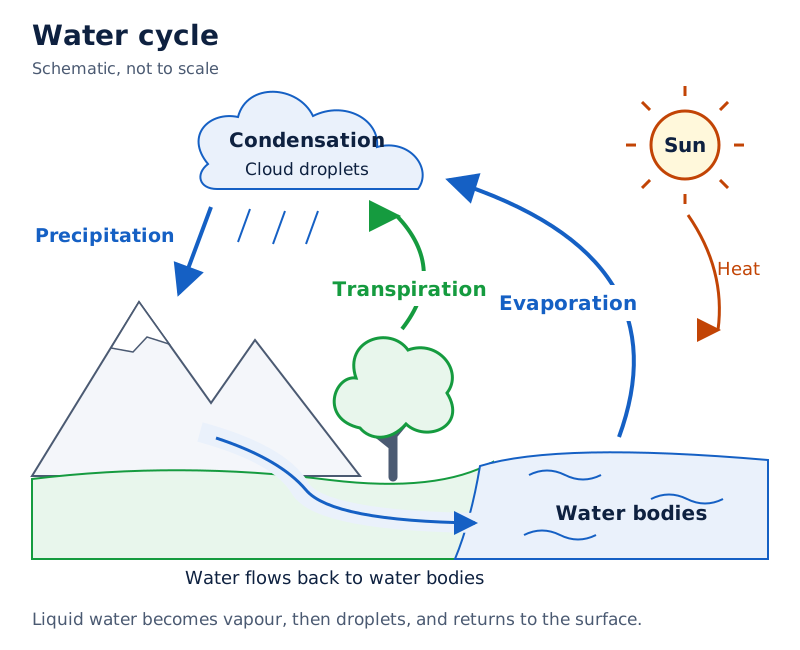
The drawing shows the Sun, clouds, mountains, water bodies and vegetation. An upward arrow from the water is labelled Evaporation; a cloud is labelled Condensation. A downward arrow is labelled Precipitation, and an upward arrow from vegetation is labelled Transpiration.
Drawn by One Young India.
Cloud droplets are generally formed around dust particles. The droplets are liquid water, so a cloud should not simply be identified as invisible water vapour. The change from vapour to tiny droplets is condensation; the subsequent falling of water is precipitation.
The cycle redistributes and replenishes water in rivers, lakes and oceans. During summer, some snow and ice melt and flow down as rivers, ultimately reaching the oceans. Fresh snow during winter replenishes the melted ice. These changes link frozen water stores with flowing water.
How does water enter the ground and replenish groundwater?
Infiltration is the process by which surface water seeps through soil and rocks. Water enters more readily where spaces between soil and rock particles are wider, open and connected. This explains why the material beneath the surface affects how easily rainwater moves downwards.
Groundwater is water stored in the pore spaces of sediments and openings in rocks beneath the surface. Pore spaces are small gaps between particles; sediments are deposited materials such as sand and gravel. The water is stored within these spaces rather than being confined to visible surface water bodies.
Aquifers are underground layers of sediments and rocks that store water in pore spaces. Wells and bore wells reach these layers to obtain water. Depending on location, groundwater may be a few metres to hundreds of metres below the ground.
How can seepage through different materials be compared?
Use three transparent one-litre plastic bottles, cut across the middle, with a small hole in each cap. A litre is a unit of volume; a millilitre is one-thousandth of a litre. Invert the bottle tops, fill them separately with clay, sand and gravel, and place identical beakers below.
Add 200 millilitres of water to each and collect the water flowing through for 10 minutes. You may observe that water seeps fastest through gravel, slower through sand and slowest through clay. The wider spaces between gravel particles help water pass through more easily.
What the figure shows
An aquifer beneath the ground
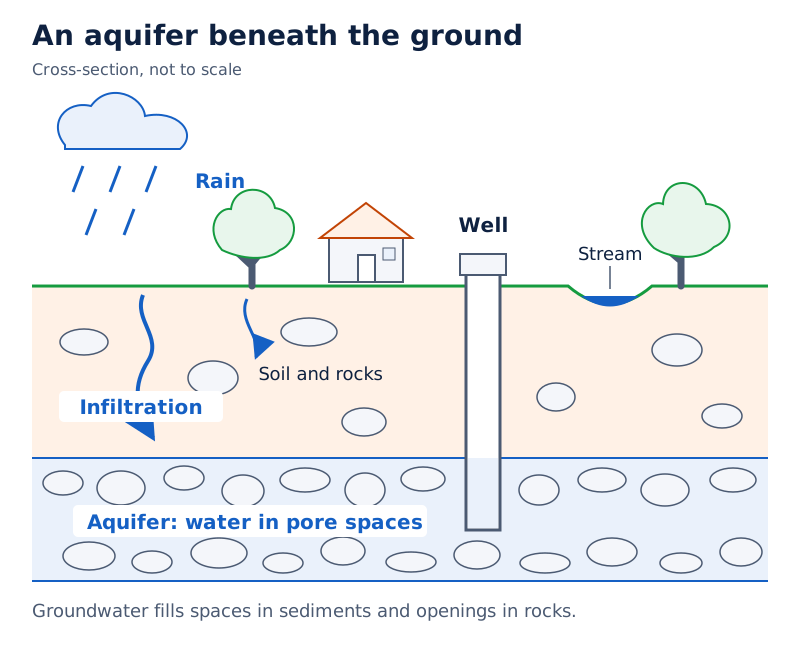
The cross-section shows rain above land, trees, a house and a stream. Below the surface, the drawing labels Infiltration and an Aquifer. A vertical Well reaches the blue water-bearing layer beneath the soil and rocks.
Drawn by One Young India.
Why can groundwater become depleted?
Depletion means a reduction in the stored supply. Groundwater is not unlimited. Increasing demand has led to excessive extraction, while reduced vegetation and increased concrete surfaces in urban areas limit infiltration. Both greater removal and restricted replenishment contribute to depletion.
Rainwater harvesting and recharge pits help replenish groundwater. A recharge pit is a pit used to help water enter the ground and restore underground stores. Groundwater conservation therefore requires attention to both water extraction and opportunities for rainwater to infiltrate.
Who studied rainfall in ancient India?
Varahamihira was an astronomer and mathematician of the sixth century CE in Ujjaini, modern-day Ujjain in Madhya Pradesh. CE means Common Era, the system used here for numbering years. His work Brihatsamhita included methods for predicting seasonal rainfall.
These predictions considered cloud formation, wind patterns, the positions of stars and the moon, and other natural phenomena. This is a historical example of the study of rainfall, distinct from the experimental comparison of seepage through different materials.
How do plants absorb and transport water?
Plants take up water and mineral nutrients from the soil through their roots. Xylem consists of thin tube-like structures that carry water and dissolved minerals through the stem, branches and leaves. This transport makes water available where photosynthesis and other plant functions take place.
Food made in the leaves travels through phloem, another set of tube-like structures. Xylem and phloem therefore have different transport roles. Transported food may also be stored in other plant parts, such as seeds and roots.
What does the coloured-water experiment show?
- Take two similar tender plant twigs, preferably with white flowers, such as white sadabahar or balsam.
- Label two tumblers A and B. Here A identifies the plain-water tumbler and B identifies the coloured-water tumbler.
- Fill each tumbler one-third full with water and add a few drops of red ink to B.
- Cut the stems obliquely, meaning at an angle, at their bases while keeping them under water. Immediately place one twig in each tumbler.
- Observe the twigs the next day. Red colour is visible in the stem, leaves and flowers of the twig kept in coloured water.
- Cut an upper part of that stem which was not immersed in the coloured water and examine it with a magnifying glass to see the stained conducting structures.
The red colour moves upwards with the water through the xylem. Mineral nutrients dissolved in water also move through this pathway. Comparing the coloured-water twig with the plain-water twig helps show the effect of the coloured water on the plant parts.
What the figure shows
Water and food transport in a plant
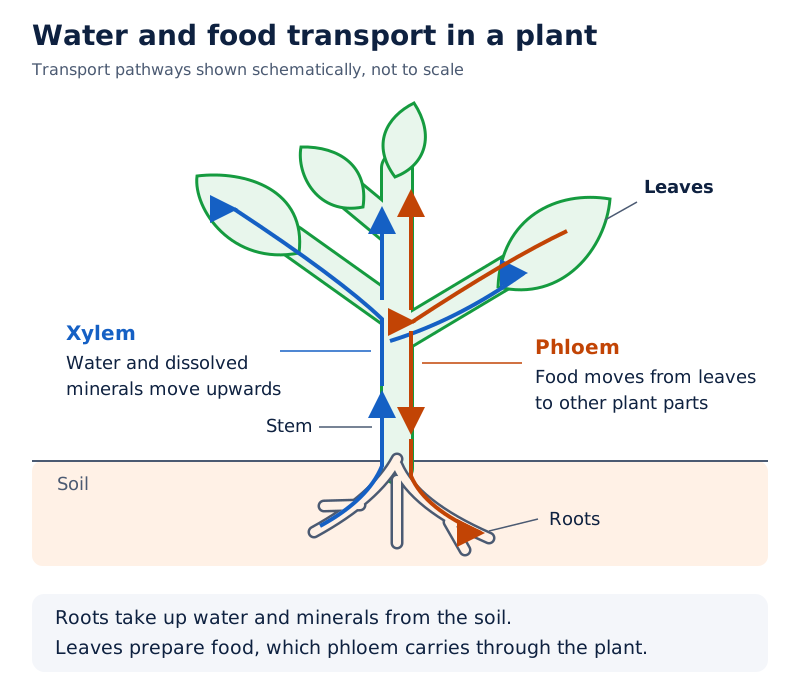
The drawing shows a plant with roots, a stem and green leaves. Blue arrows indicate water transport through xylem from the roots upwards. Red arrows indicate food transport through phloem from the leaf into the plant.
Drawn by One Young India.
Stomata are tiny pores on the surface of leaves that help gas exchange. Plants interact with both the soil and air: their roots obtain water, their leaves exchange gases, and transpiration contributes water vapour to the water cycle. Water transport is therefore part of a larger connection with the surroundings.
How do pollution and separation of impurities affect water use?
Water pollution occurs when waste and harmful substances contaminate water sources. Waste from homes and industries can pollute freshwater when dumped into it. Plastic bags and wrappers floating in water are visible examples of the waste entering these environments.
Factory, farm and plastic waste can harm aquatic life and make water unsafe. Keeping water sources free of pollution is necessary because living beings need suitable water, not merely a large volume of water. Preventing waste from entering a source is part of conserving that source.
How can insoluble particles be separated?
Insoluble describes a substance that does not dissolve in the liquid concerned. Muddy water contains particles that can be separated from the water. Sedimentation is the settling of heavier insoluble material at the bottom of a liquid when the mixture is left undisturbed.
Decantation removes liquid by carefully tilting the vessel and pouring it away from settled material. It can remove most tea leaves after they settle, but it does not completely separate all the leaves. A remaining particle shows why settling and pouring may need another separation step.
Filtration separates insoluble solid components from a liquid using a filter. The solid retained is the residue, while the liquid that passes through is the filtrate. With muddy water and filter paper, mud remains as residue and clear water is collected as filtrate.
| Method | What happens | Example or result |
|---|---|---|
| Sedimentation | Heavier insoluble material settles | Tea leaves collect at the bottom |
| Decantation | Liquid is poured away from settled material | Most settled tea leaves remain in the vessel |
| Filtration | A filter retains insoluble particles | Mud stays on filter paper |
| Evaporation | Liquid becomes vapour, leaving dissolved solid | Salt can be separated from salt solution |
The choice of filter depends on the size of the particles to be removed. Cotton, charcoal and sand can also be used as filter materials. Separating visible mud establishes that those particles were removed; it does not by itself demonstrate removal of every kind of contamination.
How are separation methods combined in Leela's water example?
Leela is working on a farm with her father when she realises that they have left their drinking water at home. She collects muddy pond water, lets it stand, then filters it through muslin cloth, a fabric used here to retain solid particles.
She boils the filtered water for about 10 minutes in a covered pan, allows it to cool and filters it again. The sequence combines settling and filtration with boiling. Removing visible mud alone is not the complete sequence in this example.
How can water be conserved at home and in the community?
Rainwater harvesting means collecting and storing rainwater for later use. Buildings can collect substantial quantities of rainwater instead of allowing all of it to flow away. Harvesting can support water supplies, while arrangements that allow infiltration can help replenish groundwater.
Water conservation also begins with ordinary habits. Turn off taps when they are not being used and repair leaks. Observe water use during washing, bathing, cooking, gardening and brushing teeth to identify where water is being wasted.
What can traditional stepwells teach us?
Stepwells are traditional structures used to collect and store water. They are commonly called Bawadi in Rajasthan and Vav in Gujarat. They were built in response to water scarcity and illustrate the long history of water harvesting in India.
These structures store rainwater as well as water seeping from nearby lakes, ponds and rivers. Their trenches, meaning long deep holes in the ground, have walls lined with stone blocks that allow water to seep in. They therefore combine collection with seepage from surrounding water sources.
How do saving water and preventing pollution work together?
- Reduce wastage: close taps when not needed and repair water leakages.
- Harvest rain: collect and store rainwater for later use.
- Support recharge: use rainwater harvesting and recharge pits to replenish underground stores.
- Protect water sources: prevent household, industrial and plastic waste from being dumped into them.
- Use water thoughtfully: remember that freshwater supplies support other living beings as well as human activities.
Recycling water, meaning processing used water for further use, also helps save water. Together, careful use, protection of sources and replenishment address different parts of the same problem. A water supply must remain available and suitable for the use it is intended to serve.
World Water Day is observed on 22 March every year. It provides an occasion to consider the importance of water and the need to conserve it. Water-saving practices matter throughout the year, including in places where water appears plentiful.
Glossary
- Hydrosphere — Earth's water, including water in oceans, rivers, lakes, springs and underground stores.
- Evaporation — The conversion of liquid water into water vapour, occurring even at room temperature.
- Condensation — The conversion of water vapour into liquid water, such as droplets on a cold surface.
- Humidity — The amount of water vapour present in the air surrounding us.
- Precipitation — Water returning from clouds to Earth's surface as rain, snow or hail.
- Water cycle — The continuous circulation of water between Earth's surface and atmosphere through connected natural processes.
- Infiltration — The process of surface water seeping through soil and rocks into the ground.
- Groundwater — Water stored beneath Earth's surface in sediment pore spaces and openings in rocks.
- Aquifer — An underground layer of sediments and rocks that stores water within pore spaces.
- Xylem — Tube-like structures that transport water and dissolved mineral nutrients through a plant.
- Phloem — Tube-like structures that transport food prepared in leaves to other parts of a plant.
- Transpiration — The loss of water as vapour from plants into the surrounding air.
- Sedimentation — The settling of heavier insoluble material at the bottom of a liquid.
- Filtration — The separation of insoluble solid components from a liquid using a suitable filter.
- Rainwater harvesting — The collection and storage of rainwater so that it can be used later.
Common errors and misconceptions
- Misconception: Earth's large water cover means usable freshwater is abundant everywhere. Correct: Most water is saline, and only a very small fraction of freshwater is easily accessible.
- Misconception: Ice and liquid water are different substances. Correct: They are different physical states of the same substance and can change into each other.
- Misconception: Water must boil before evaporation occurs. Correct: Evaporation takes place continuously, even at room temperature, as wet clothes and mopped floors dry.
- Misconception: Visible clouds consist simply of invisible water vapour. Correct: Water vapour condenses into tiny droplets that form clouds; condensation changes the physical state.
- Misconception: An increased balance reading alone conclusively proves that no water seeped from a cold glass. Correct: The marked water-level observation provides an additional check on that explanation.
- Misconception: Heating makes every substance more soluble in water. Correct: Gas solubility generally decreases as temperature increases, although most solid substances discussed here show the opposite pattern.
- Misconception: Groundwater is unlimited because rain replenishes it. Correct: Excessive extraction and reduced infiltration can deplete groundwater despite the operation of the water cycle.
- Misconception: Xylem and phloem carry the same material. Correct: Xylem carries water and dissolved minerals; phloem carries food prepared in the leaves.
Exam-style questions with model answers
Q1. Define evaporation and condensation, making the direction of each change clear. [2 marks]
- Evaporation is the conversion of liquid water into water vapour. It occurs even at room temperature.
- Condensation is the conversion of water vapour into liquid water, as when droplets collect on a cold surface.
Q2. Equal amounts of water are placed in a bottle cap and on a plate kept beside it. Water on the plate evaporates faster. Identify the changed condition, one condition kept the same and the conclusion. [3 marks]
- The changed condition is the exposed surface area. Water spreads over a larger area on the plate than in the bottle cap.
- The amount of water is kept the same in both containers, so the comparison is not between different starting quantities.
- The result supports the conclusion that a larger exposed surface area makes water evaporate faster under comparable surrounding conditions.
Q3. A covered tumbler containing cold water and ice develops outside droplets, and its balance reading increases. In a repeat investigation, the marked water level inside does not fall while droplets collect outside. Explain the droplets, the increased reading, the limitation of the first investigation and the purpose of marking the level. [4 marks]
- Water vapour in the surrounding air condenses when it contacts the cold outer surface, producing liquid droplets.
- The balance reading increases because extra water from the air collects on the weighed arrangement, adding to its mass.
- The first investigation alone does not conclusively show that no water seeped through the glass or that condensation explains all the outside water.
- Marking the level tests the seepage explanation. The unchanged level, together with extra water outside, supports condensation from the surrounding air.
Q4. Describe five connected stages of the water cycle: evaporation, transpiration, cloud formation, precipitation and the return of water to surface or underground stores. [5 marks]
- The Sun heats water in oceans, rivers and lakes. Some of this liquid water changes into water vapour through evaporation and enters the atmosphere.
- Trees and other plants contribute additional water vapour through transpiration. Living plants therefore participate in the movement of water into the air.
- As moist air rises into cooler regions, water vapour condenses into tiny droplets. These droplets are generally formed around dust particles and form clouds.
- Droplets join into larger drops that fall as rain when heavy enough. Under special conditions, water might return as snow or hail.
- Water flows into rivers, lakes and oceans, while some infiltrates soil and rocks to replenish groundwater. Water can subsequently circulate through these processes again.
Q5. Define infiltration and aquifer. Then explain two reasons why groundwater can become depleted: excessive extraction and increasing concrete surfaces. [4 marks]
- Infiltration is the process in which surface water seeps through soil and rocks and moves beneath the ground.
- An aquifer is an underground layer of sediments and rocks that stores water in pore spaces.
- Excessive extraction removes stored groundwater to meet growing demand. Groundwater is not an unlimited supply, even though rainfall can replenish it.
- Increasing concrete surfaces limits water infiltration. Less opportunity for rainwater to enter the ground restricts replenishment of the underground supply.
Q6. Two similar white-flowered twigs are placed in tumblers A and B. A contains plain water; B contains water with red ink. The next day, B's twig has red colouring in its stem, leaves and flowers. Explain the comparison, the pathway, the role of dissolved minerals, the use of water in food production and the different role of phloem. [5 marks]
- Tumbler A provides the plain-water comparison for tumbler B. The red colour appearing in B's twig shows movement of the coloured water into plant parts.
- The coloured water moves upwards through xylem, the thin tube-like structures present in the stem, branches and leaves of the plant.
- Mineral nutrients dissolved in water also move through xylem. These nutrients are taken up with water through roots and are important for plant growth.
- Water is required for photosynthesis. Plants use water and carbon dioxide to prepare food in the presence of sunlight and chlorophyll.
- Phloem transports food prepared in leaves to other parts of the plant. It has a different transport role from the water-carrying xylem.
Q7. Muddy water is left undisturbed, liquid is gently poured away from settled mud, and the liquid is passed through filter paper. Name and explain the three separation processes in order. [3 marks]
- Sedimentation occurs first: heavier insoluble mud particles settle at the bottom while the water is left undisturbed.
- Decantation follows: the vessel is tilted carefully to pour liquid away from the material that has settled at the bottom.
- Filtration is the final process: filter paper retains remaining insoluble particles as residue, while water passes through and is collected as filtrate.
Q8. Give two ways of conserving water, one that prevents everyday wastage and one that collects water for later use. [2 marks]
- Repair leaking taps or pipes so that water is not continually lost through leakages.
- Practise rainwater harvesting by collecting and storing rainwater for use at a later time.
Key takeaways
- Water supports photosynthesis, mineral transport, animal body functions and aquatic environments, linking organisms with the places in which they live.
- Most water is saline, while only a very small fraction of freshwater is easily accessible for human and other biological needs.
- Evaporation changes liquid water into vapour, and condensation changes vapour into liquid droplets on suitable cold surfaces.
- Evaporation becomes faster with larger exposed area and greater air movement, while higher humidity slows it down.
- The water cycle connects evaporation, transpiration, condensation, precipitation and the return of water to surface and underground stores.
- Groundwater occupies spaces in sediments and rocks; excessive extraction and reduced infiltration can deplete this stored supply.
- Xylem transports water and dissolved minerals, whereas phloem transports food made in leaves to other parts of the plant.
- Conservation combines reducing wastage, collecting rainwater, supporting groundwater replenishment and preventing pollution of water sources.
Test yourself
Why does a large ocean supply not remove the need to conserve freshwater?
Ocean water is saline and cannot be used directly for many needs. Only a very small fraction of freshwater is easily accessible.
What are the solute and solvent in a salt solution?
Salt is the dissolved solid or solute, while water is the liquid solvent in which it dissolves.
Why do clothes commonly dry slowly on rainy days?
Rainy air contains more water vapour and has higher humidity, so water evaporates from wet clothes more slowly.
What is the difference between condensation and precipitation?
Condensation changes water vapour into liquid droplets. Precipitation is water falling from clouds as rain, snow or hail.
Where is groundwater stored beneath Earth's surface?
It is stored in pore spaces of sediments and openings in rocks. Water-bearing underground layers are called aquifers.
Which structures carry water and mineral nutrients upwards through a plant?
Xylem carries water and dissolved minerals through the stem, branches and leaves after roots take them up.
What are residue and filtrate when muddy water passes through filter paper?
Mud retained on the filter paper is the residue. Water passing through and collected below is the filtrate.
What are Bawadi and Vav, and what water do they collect?
They are names for stepwells in Rajasthan and Gujarat. They collect rainwater and water seeping from nearby lakes, ponds and rivers.
Try it
Plant Water Transport Scenarios
Test your understanding of how plants absorb and transport water with these real-world scenarios.
1A gardener notices that their potted plant's stems are drooping and the leaves are no longer fully expanded. Based on the text, what is the primary physical cause of this drooping?
Correct! The text explains that water provides physical support through turgidity. When a plant loses more water than it absorbs, the vacuoles lose water, turgor pressure drops, and the plant wilts or droops.
Incorrect. The text states that water naturally flows into the root hair through osmosis, which requires zero energy from the plant.
Incorrect. The text attributes drooping (wilting) to a drop in turgor pressure when a plant loses more water than it absorbs, not to the collapse of xylem vessels.
2You move a plant from a still, highly humid greenhouse to a breezy outdoor patio. According to the text, how will the plant's transpiration rate change, and why?
Incorrect. Root pressure gives water an initial push, but the text notes that wind speeds up transpiration, not decreases it.
Correct! The text explains that a windy day blows away the humid air surrounding the leaf, maintaining a steep concentration gradient that encourages more water vapor to escape, thus speeding up transpiration.
Incorrect. While cohesion and adhesion are important for the water column, the text explicitly states that environmental factors like wind speed up the rate of evaporation and transpiration.
Great job! You've successfully applied the concepts of turgidity, osmosis, and transpiration to real-world plant scenarios.