


Letter from the chairs
Dear delegates,
We will chair the Agriculture Working Group at the Model G20 Summit 2027. Our group takes on one hard task: keeping food and fertiliser moving during wars and trade disputes.
Read this guide twice. The first time, read for the story of how a war far away or a ban by one seller can empty a market on the other side of the world. The second time, read it as your member’s negotiator and mark every line that helps or hurts your case.
In the room we will look for clauses that name who acts, what they do and by when. We will also look for delegates who bring an exporter and an importer to the same text, and who can show a source for every claim they make.
Bring your white paper, your member’s row from Section 8 and one draft clause. We look forward to meeting you at FLAME University in June.
Warm regards,
Your chairs, Agriculture Working Group
How the G20 and this simulation work
The real G20
The Group of Twenty has 21 members: 19 countries and two regional bodies, the European Union and the African Union6. The African Union became a permanent member at the New Delhi summit in 20236. Together the members account for around 85% of the world’s economic output, over 75% of world trade and about two-thirds of its people6.
The G20 began in 1999, after the Asian financial crisis, as a meeting of finance ministers and central bank governors6. Leaders first met in Washington DC in 2008, and they have met every year since 20116. Each year one member holds the presidency and sets the agenda, helped by the members that held it before and will hold it after. These three are called the troika6. The United States took over the presidency on 1 December 2025 and cut the number of working groups from 16 to four6. The United Kingdom holds the presidency in 2027 and will host the Leaders’ Summit in Manchester on 27 and 28 November 20277,8.
Two tracks
The G20 process is led by the sherpas, each leader’s personal representative. The work runs in two tracks, the Finance Track and the Sherpa Track. Within the two tracks, working groups bring together officials from the members, invited countries and international organisations6.
Agreement by everyone
In 2025 the G20 agriculture ministers issued an Outcome Document and Chair’s Summary9. It records that the majority of members agreed with the text the presidency proposed, but some had challenges agreeing on one of its priorities9. In this simulation a text is agreed only when no member objects; the Rules of Procedure 2027 explain how.
This simulation
The Model G20 Summit 2027 is set in 2027, the year the United Kingdom holds the G20 presidency. The Model G20 secretariat chairs every working group, and the UK delegation is an ordinary member. All 21 members are seated in every group. Each group also has four invited seats for international organisations or guest countries; they take part in the debate but are not members. Model G20 is organised by One Young India and is independent of the G20 and of every G20 government.
Each working group is modelled on a group that has met in the real G20 in recent years, so delegates learn how the forum works. Your group negotiates one short text on its agenda. On Sunday afternoon the working groups’ texts come together in the communiqué, which the Leaders’ Session adopts by consensus at the closing ceremony. The Rules of Procedure 2027 explain how debate, amendments and the final text work.
This working group
The Agriculture Working Group is modelled on the work of the G20’s agriculture ministers. They met in Hyderabad, India, in June 202310, in Mato Grosso, Brazil, in September 202411, and again under South Africa’s presidency in 2025, when their text acknowledged the work of a new Food Security Task Force9. In 2026, under the US presidency, G20 trade ministers reached consensus on a statement against using food as a weapon, the US Trade Representative announced as chair12,13, and finance ministers urged countries to avoid unnecessary export restrictions14.
The issue explained
Why food and fertiliser cross borders
Many countries cannot grow all their own food or make their own fertiliser. FAO expects Egypt to need 12 million tonnes of imported wheat in 2026 to 202715. Japan’s agriculture ministry reported for 2022 that almost all its ammonium phosphate and potassium chloride, and 95% of its urea, were imported from a small number of countries16. South Africa imports more than 80% of the fertiliser it needs17.
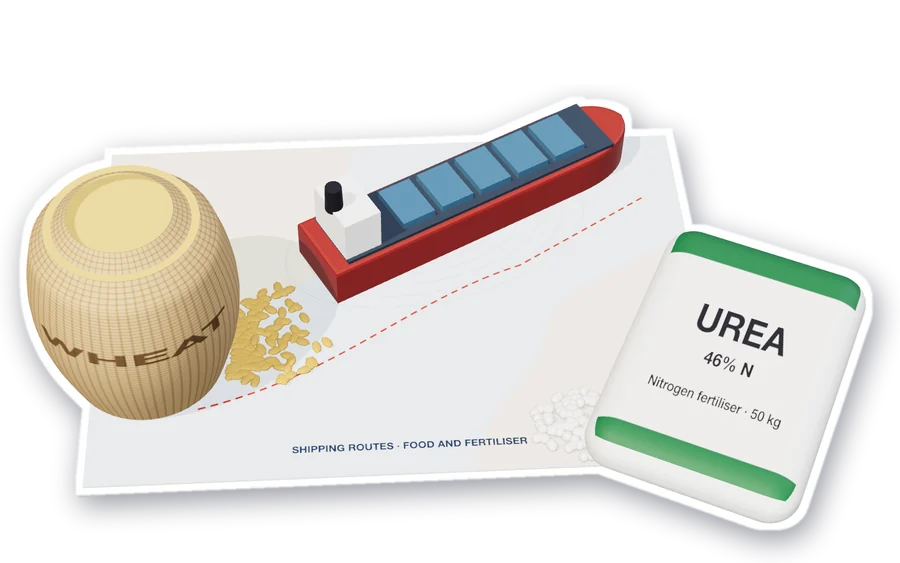
Food, fuel and fertiliser markets are linked18. Nitrogen fertilisers such as urea depend on energy, because making ammonia uses natural gas both as a raw material and as fuel2. Timing matters too: fertiliser must be applied at specific moments in the crop cycle, and if it does not arrive on time, yields are reduced, FAO warned19. Figure 1 shows what stops the flow and what keeps it moving.
Figure 1Section 3
How food and fertiliser move from exporters to importers, what stops them, and four ways to keep them moving.
How a war stops the flow
In 2022 the war in Ukraine18 blocked Ukraine’s sea exports of food until the Black Sea Grain Initiative, from 22 July, let ships leave three Ukrainian ports20. In 2026 a conflict in the Persian Gulf brought fertiliser shipments through the Strait of Hormuz to a standstill2. The strait carries around a quarter of the world’s seaborne oil, as well as large volumes of gas and fertiliser21. In March 2026 the WTO said around one-third of the world’s fertiliser exports normally pass through it22, and Germany’s government puts the share at 17% to 24%23. After the conflict began, traffic through the strait fell from 138 commercial ships a day to almost zero22. In April 2026 the price of urea rose from around US$400 to over US$850 a tonne, before falling back to US$453 in June2. In July the WTO mentioned an agreement to reopen trade in the strait2.
How a ban or a dispute stops the flow
Governments may limit their exports of food for a time to relieve a critical shortage at home. Many food-importing countries worry about what that does to prices and price swings elsewhere, especially in poor countries24. In July 2022 around 25 countries had adopted export restrictions affecting over 8% of global food trade18. In 2026 China, Russia and Türkiye all tightened controls on fertiliser or its inputs2. The WTO counts 47 export measures in force that affect fertilisers, most of them licensing rules from before the conflict2.
Some trade actions go further. G20 trade ministers call it the weaponization of food when governments slow, stop, block or direct the trade of food or farm inputs to put coercive pressure on another country for unrelated political gains5. Their statement does not cover measures that are transparent, respect international rules and serve legitimate domestic policy aims, such as food security5.
Why prices matter as much as supplies
Hunger can rise even when the world grows enough food. South Africa’s 2025 G20 presidency noted that recent rises in hunger came while there was no global shortage of food, and were caused by price shocks that drove up food prices25. In June 2026 the G7 and partner countries said the fertiliser problem was mainly one of affordability and money, not a shortage of supplies26. In 2025, 645 million people faced hunger, and Africa had more hungry people than Asia1.
What has happened so far
- Jun 2011G20 agriculture ministers meet in Paris; the G20 decides to launch AMIS4
- Jan 2021Nearly 80 WTO members pledge not to restrict exports of food bought by WFP for humanitarian aid24
- 5 Mar 2022AMIS holds an emergency session on the conflict in Ukraine, its first10
- 13 May 2022India restricts wheat exports27
- Jun 2022WTO ministers exempt WFP’s humanitarian food purchases from export bans28
- 22 Jul 2022The Black Sea Grain Initiative starts, for 120 days at first20
- 17 Jul 2023The Black Sea Initiative ends after Russia’s decision to terminate it29
- 20 Jul 2023India bans exports of non-basmati white rice30
- Feb 2026Conflict in the Persian Gulf; fertiliser shipments through the Strait of Hormuz stop2
- Apr 2026Urea rises from around US$400 to over US$850 a tonne2
- 21 Jul 2026A UN report projects 510 to 520 million people may still face hunger in 20301
- 1 Sep 2026G20 finance ministers, in a Chair’s Statement, urge countries to avoid unnecessary export restrictions14
- 1 Oct 2026G20 trade ministers reach consensus on a statement against the weaponization of food, says the US Trade Representative as chair12,13
- 28 Oct 2026The World Bank projects food prices up about 10% in 2026 and fertiliser prices up 14%31
What the G20 has already said
G20 agriculture ministers, Declaration agreed under Brazil’s presidency, September 2024, paragraph 20:
“Besides not imposing export prohibitions or restrictions in a manner inconsistent with relevant WTO provisions, concrete steps should be taken to ensure agricultural and food products trade to flow.”11
G20 trade ministers, Statement on the Weaponization of Food through Coercive Trade Actions, Milwaukee, October 2026:
“We condemn food weaponization, as it poses a significant humanitarian and economic threat.”5
Facts that matter
| Figure | Value | Year | Ref. |
|---|---|---|---|
| People facing hunger | about 645 million, 7.8% of the world | 2025 | 1 |
| People facing moderate or severe food insecurity | around 2.1 billion, 25.8% of the world | 2025 | 1 |
| Hungry people in Africa and in Asia | about 309 million and 292 million | 2025 | 1 |
| People in acute food insecurity, WFP count | 318 million; almost 45 million more if the conflict went past mid-2026 with oil above US$100 a barrel | March 2026 | 32 |
| FAO Food Price Index | 133.9 points: 5.9% above a year earlier, 16.4% below the March 2022 peak | October 2026 | 33 |
| Urea price | over US$850 a tonne in April, up 80% since February (World Bank); US$453 in June (WTO) | 2026 | 2,3 |
| Gulf economies’ share of world nitrogen fertiliser exports | 24.8% | WTO, 2024 data | 2 |
| World fertiliser exports that export licences, restrictions and bans could affect | up to 15%; at most 23.3% if all Gulf exports count as blocked by the closed strait | WTO, 2026 | 2 |
| Export measures in force affecting fertilisers | 47 | WTO, 2026 | 2 |
| Ships through the Strait of Hormuz each day | 138, falling to almost zero | WTO, March 2026 | 22 |
| Countries with food export restrictions | around 25, covering over 8% of food trade | July 2022 | 18 |
| Food shipped under the Black Sea Grain Initiative | about 32 million tonnes, to 45 countries | 2022 to 2023 | 20 |
Core tensions
Feed your own people first, or keep exports flowing
For your own people first. A government answers to its own citizens. India said it restricted wheat exports in May 2022 to manage its own food security and to help neighbouring and vulnerable countries that could not get enough wheat27. When it banned exports of one kind of rice in 2023, it said retail rice prices at home had risen 11.5% in a year30.
For keeping exports flowing. Many food-importing countries worry that export limits can push up prices and price swings elsewhere, especially in poor countries24. G20 agriculture ministers said in 2024 that, besides not imposing export bans inconsistent with WTO rules, concrete steps should be taken to keep food trade flowing11.
Condemn coercion, or protect room to act
For condemning coercion. G20 trade ministers in 2026 condemned food weaponization as “a significant humanitarian and economic threat”5. The US Trade Representative said that for decades trade in food and farm inputs has been used to put coercive pressure on countries12.
For room to act. The same statement does not cover transparent measures that respect international rules and serve legitimate domestic policy aims, including food security5. Members will disagree about where a fair emergency measure ends and coercion begins, and the statement names no one to decide.
Rescue now, or resilience later
For rescue now. When a strait closes, farmers need fertiliser this season. The G7’s June 2026 plan starts with an immediate response and financial stabilisation26, and the EU proposed a top-up of €300 million to its agricultural reserve to help farmers facing fertiliser costs34.
For resilience later. Countries that depend on a few suppliers stay exposed. The EU wants to reinforce its own fertiliser production and reduce its dependency on imports35, and Japan’s agriculture ministry, after the 2022 price spike, named a stockpile of fertiliser raw materials and more use of fertiliser from domestic resources16. Canada, the world’s largest potash exporter, promoted open agri-food trade and efficient use of fertiliser in June 202636,37.
Case studies
The Black Sea Grain Initiative
In July 2022 Türkiye and the UN brokered a package: the Black Sea Grain Initiative and a memorandum between Russia and the UN Secretariat10. A Joint Coordination Centre in Istanbul, staffed by Russia, Türkiye, Ukraine and the UN, ran the deal20. About 32 million tonnes of food left three Ukrainian ports for 45 countries20. WFP moved more than 725,000 tonnes of wheat under it to Afghanistan, Ethiopia, Kenya, Somalia, Sudan and Yemen20. The deal was renewed for 120 days, then twice for 60 days, the length Russia agreed to20, and it ended on 17 July 2023 after Russia decided to terminate it29. The UN Secretary-General called the initiative and the memorandum with Russia “a lifeline for global food security and a beacon of hope in a troubled world”29.
What it shows. A corridor can move food through a war, but only while every party keeps agreeing to it. Question for your group. What would a G20 text need to say to make the next corridor last longer?
India’s wheat and rice restrictions
On 13 May 2022 India restricted wheat exports27, saying it needed to manage its own food security and support neighbouring and vulnerable countries27. After a request from Egypt’s government, it let a cargo of 61,500 tonnes of wheat sail to Egypt27. In September 2022 India put a 20% duty on exports of non-basmati white rice, and on 20 July 2023 it banned them30. It said retail rice prices had risen 11.5% over a year, and that this rice made up about 25% of its rice exports30.
What it shows. A large exporter can protect its own consumers and still make exceptions for countries that ask27. Question for your group. Should a G20 text set rules for export limits, such as notice, a time limit or exceptions for the poorest importers?
Fertiliser shocks, 2022 and 2026
In 2021 and 2022 fertiliser prices rose by more than 100% and 55%, amid supply disruptions in Russia and Belarus3. In 2022 urea briefly passed US$900 a tonne2. In 2026 the Gulf conflict closed the Strait of Hormuz to fertiliser shipments2. Several members tightened their own controls: China on urea and sulphuric acid, Russia on fertiliser export quotas, and Türkiye on sulphur2. Some moved the other way, Türkiye among them: the EU suspended fertiliser import tariffs, except on goods from Russia and Belarus, and Türkiye lifted duties on urea and other fertilisers2.
What it shows. In the same crisis, members restricted some exports and opened up some imports, and Türkiye did both. Question for your group. What can the G20 ask of members that export fertiliser when supplies are tight?
Country positions
One row for each of the 21 members. “Stake” and “On the record” come from official sources. “Our reading”, in italics, is what we think that record suggests: test it in your research. Where the record is silent, the row says so. The label under each name shows what the record says about the member’s trade in food or fertiliser: food exporter, palm oil exporter, fertiliser exporter, fertiliser importer, fertiliser exports and imports, regional body, or not clear. Bring this section to the summit and tick each row as members speak.
| Member | Stake | On the record | Our reading | Mark |
|---|---|---|---|---|
 Argentina | In October 2026 FAO linked lower world wheat prices partly to a better production outlook in Argentina33. | Its foreign ministry reports that its then foreign minister, Diana Mondino, told G20 trade ministers in Brasília that such farm subsidies “promueven la ineficiencia y obstaculizan nuestros esfuerzos hacia la seguridad alimentaria” (they promote inefficiency and hinder our efforts towards food security)38. | Pushes for: Fewer farm subsidies. Allies: Australia, Canada. Not clear from the record: red line. Research it. | AllyOpp.Swing |
 Australia | In October 2026 FAO said good crop prospects in Australia put further downward pressure on barley prices33. | In May 2026, with the United States, Paraguay and Ukraine, it argued at the WTO that India’s price support for rice and wheat is well above the levels India has notified39. | Pushes for: Holding members to WTO limits on farm support. Allies: The United States, Argentina. Not clear from the record: red line. Research it. | AllyOpp.Swing |
 Brazil | Its ministries co-chaired the G20 agriculture ministers’ meeting of September 202411. | The 2024 Declaration, agreed under its presidency, encourages “facilitating international trade and access to affordable, safe, and sustainable fertilizers”11. In 2026 it joined the G7’s action plan on fertiliser shocks as a partner country26. | Pushes for: Affordable fertiliser through open trade. Allies: India, Korea. Not clear from the record: red line. Research it. | AllyOpp.Swing |
 Canada | Its government says Canada is the world’s largest producer and exporter of potash, and a net exporter of nitrogen fertilisers, but that it relies largely on imports of phosphorus fertilisers36. | In June 2026 its agriculture minister said he had promoted the efficient use of fertiliser and open agri-food trade37. | Pushes for: Open trade in fertiliser. Allies: Australia, the European Union. Not clear from the record: red line. Research it. | AllyOpp.Swing |
 China | In 2026 it tightened controls on urea and sulphuric acid before allowing limited urea exports under a quota, the WTO reports2. | It objected to four paragraphs of the 2026 finance ministers’ Chair’s Statement, including paragraph 4 on wars and conflicts, shipping through the Strait of Hormuz and value chains such as energy, food, fertiliser and critical minerals; no reason is given14. In 2023 it said the agriculture ministers’ outcome should not refer to the Ukraine crisis10. | Pushes for: Room to control its own exports. Red line: A text that names a conflict. Allies: Russia. | AllyOpp.Swing |
 France | It held the G7 presidency in 202640, and the G7’s June 2026 action plan on fertiliser shocks appeared on its G7 website26. | After the G7 agriculture ministers met in Paris in October 2026, its agriculture minister said the G7 was “determined to support our farmers”40. | Pushes for: Support for farmers facing fertiliser costs. Allies: The European Union, Germany, Italy. Not clear from the record: red line. Research it. | AllyOpp.Swing |
 Germany | Its government told the Bundestag that 17% to 24% of the world’s fertiliser exports usually pass through the Strait of Hormuz23. | The same answer relays WFP’s warning that high transport costs could leave it able to reach up to nine million fewer people in 2026 than planned23. | Pushes for: Humanitarian food reaching those in need. Allies: France, the European Union. Not clear from the record: red line. Research it. | AllyOpp.Swing |
INDIndia food exporter | In May 2022 it restricted wheat exports, and in July 2023 it banned exports of non-basmati white rice27,30. | It said the wheat restriction was to manage its own food security and to support neighbouring and vulnerable countries27. At the WTO in May 2026 it defended its rice and wheat support as necessary for food security39. | Pushes for: Room to restrict exports when prices at home rise. Allies: Brazil, Korea. Not clear from the record: red line. Research it. | AllyOpp.Swing |
 Indonesia | Japan’s agriculture ministry lists Indonesia’s export control on palm oil in April to May 2022 among major developments abroad in 202216. | No public statement found. Research it. | Not clear from the record. Research it. | AllyOpp.Swing |
 Italy | In May 2026 its foreign minister co-chaired a meeting in Rome that launched the “Rome Coalition” on access to fertilisers and food security41, bringing together over 40 countries and organisations19. | Its foreign ministry says the coalition aims at continuity of supply flows, better access to fertilisers and more resilient food systems41. | Pushes for: Steady supply of fertiliser around the Mediterranean. Allies: France, the European Union. Not clear from the record: red line. Research it. | AllyOpp.Swing |
 Japan | Its agriculture ministry’s report for 2022 said almost all its ammonium phosphate and potassium chloride, and 95% of its urea, were imported from a small number of countries16. | In the same report it named a stockpile of fertiliser raw materials and more use of fertiliser from domestic resources as ways to keep supplies stable16. | Pushes for: Stockpiles and more varied suppliers. Allies: South Africa, the European Union. Not clear from the record: red line. Research it. | AllyOpp.Swing |
 Republic of Korea | In June 2026 it joined the G7’s action plan on fertiliser shocks as a partner country26. | No public statement found. Research it. | Allies: Brazil, India. Not clear from the record: pushes for, red line. Research it. | AllyOpp.Swing |
 Mexico | A ministry leaflet says its fertiliser programme will make chemical and organic fertilisers available to small producers of maize, beans and rice42. | After AMIS’s emergency session of 5 March 2022, it issued a joint statement as AMIS’s outgoing chair with the incoming chair, the United States10. | Pushes for: Shared early warning through AMIS. Allies: The United States. Not clear from the record: red line. Research it. | AllyOpp.Swing |
RUSRussia fertiliser exporter | The World Bank calls Russia and Belarus two of the world’s key fertiliser suppliers3. In 2026 Russia extended its fertiliser export quotas and suspended export licences for ammonium nitrate2. | It dissociated itself from three paragraphs of the 2023 G20 agriculture ministers’ Chair’s Summary, including paragraph 5 on the Black Sea Grain Initiative10. | Red line: A text that names a conflict. Allies: China. Not clear from the record: pushes for. Research it. | AllyOpp.Swing |
KSASaudi Arabia fertiliser exporter | The WTO counts it among the Gulf economies that export fertiliser; some Saudi shipments continued through the Red Sea port of Yanbu, at higher cost2. | No public statement found. Research it. | Not clear from the record. Research it. | AllyOpp.Swing |
 South Africa | Its agriculture minister says it imports more than 80% of its fertiliser, and that fertiliser is around 35% to 50% of a farmer’s costs17. | Under its 2025 presidency the G20 set up a Food Security Task Force; the agriculture ministers’ 2025 Outcome Document and Chair’s Summary acknowledges its work9. | Pushes for: Affordable fertiliser for importing countries. Allies: The African Union, the European Union. Not clear from the record: red line. Research it. | AllyOpp.Swing |
 Türkiye | In 2026 it banned sulphur exports for a time and lifted duties on urea and other fertilisers2. | With the UN, it brokered the Black Sea Grain Initiative in July 2022, and the centre that ran it sat in Istanbul10,20. | Pushes for: Negotiated corridors. Not clear from the record: red line, allies. Research it. | AllyOpp.Swing |
 United Kingdom | It holds the G20 presidency in 20277. | In July 2023 it condemned “in the strongest terms” Russia’s decision to withdraw from the Black Sea Grain Initiative, which it said had delivered over 32 million tonnes of food43. | Pushes for: Corridors that last. Allies: Türkiye. Not clear from the record: red line. Research it. | AllyOpp.Swing |
 United States | It held the G20 presidency in 20266; the finance ministers’ Chair’s Statement urged countries to avoid unnecessary export restrictions14. | Its Trade Representative said food and farm inputs have been used for decades to put coercive pressure on countries, and called the G20 statement on the weaponization of food “an important step”12. | Pushes for: A firm line against coercion with food. Allies: Australia, Mexico. Not clear from the record: red line. Research it. | AllyOpp.Swing |
 European Union | In May 2026 the European Commission proposed a Fertiliser Action Plan to reinforce its own production and reduce its dependency on imports35. | It aimed to mobilise €540 million to help farmers facing fertiliser costs34, and it suspended fertiliser import tariffs, except on goods from Russia and Belarus2. | Pushes for: Help for farmers and more varied supply. Allies: France, Germany, Italy. Not clear from the record: red line. Research it. | AllyOpp.Swing |
AUAfrican Union regional body | Africa had about 309 million hungry people in 2025, more than Asia1. | In May 2026 its Commission called an emergency technical meeting on what the Middle East conflict meant for fertiliser supply, prices and trade in Africa44. | Pushes for: Emergency help with fertiliser for Africa. Allies: South Africa. Not clear from the record: red line. Research it. | AllyOpp.Swing |
Invited seats (not members)
- FAO. Its Director-General warned in May 2026 that disruption in the Strait of Hormuz was already tightening fertiliser markets19; in 2011 the G20 decided to house AMIS in FAO4.
- World Food Programme. Ukraine supplied more than half of WFP’s wheat grain in 202220.
- WTO. Its database records 47 export measures in force that affect fertilisers2.
- Egypt (food-importing guest country in this simulation). FAO puts its wheat import needs for 2026 to 2027 at 12 million tonnes15; in 2022 it asked India to let a wheat cargo already loading at Kandla sail despite India’s restriction, and India agreed27.
The camps
Options on the table
Each option is something the G20 can actually do: commit its own members, call on others, or ask international bodies to act and report. Who may back or resist each option is our reading of the record in Section 8, for you to test in your research.
A. Shared early warning
What it is. Members report stocks, prices and planned export measures to one system, and meet at once when markets jump. Who runs it. AMIS, which the G20 decided in 2011 to house in FAO4. Precedent. The 2023 G20 text supports AMIS’s work on fertilisers, and in March 2022 its Rapid Response Forum held an emergency session on the conflict in Ukraine10. For. It already exists, and the 2025 G20 agriculture text calls it “a vital instrument”9. Against. Warning of a shortage does not end it. May back it. Mexico and the United States, AMIS’s outgoing and incoming chairs, which issued a joint statement after its March 2022 emergency session10.
B. Food aid exempt from export bans
What it is. No member blocks food bought by WFP for humanitarian aid, in any crisis. Who runs it. Each member, under WTO rules. Precedent. In June 2022 WTO ministers exempted WFP’s humanitarian food purchases from export bans24, and the 2023 G20 text recalled that decision10. For. It protects the people with the least. Against. It covers only aid, not the trade most importers rely on. May back it. Germany, which relayed WFP’s warning that high logistics costs could leave it reaching up to nine million fewer people in 202623.
C. Condemn coercion, protect open policies
What it is. Members commit never to use food or farm inputs as a weapon, while keeping room for open, rule-based measures. Who runs it. Each member, with peer review in the G20. Precedent. The Milwaukee statement of October 20265. For. The US Trade Representative, as chair, said the entire G20 reached consensus on it13. Against. It names no one to decide when a measure is coercion. May back it. The United States12.
D. A negotiated corridor in wartime
What it is. A safe sea route for food and fertiliser, agreed by the parties to a conflict and watched by a neutral body. Who runs it. The UN, a broker country and the parties to the conflict, as in 202220. Precedent. The Black Sea Grain Initiative, brokered by Türkiye and the UN on 22 July 202210. For. It moved about 32 million tonnes of food out of a war zone20. Against. It lasted only while every party agreed, and ended in July 202329. May back it. Türkiye10.
E. Money to keep fertiliser affordable
What it is. Development banks finance fertiliser production, storage and transport, and help poorer countries buy it in a crisis. Who runs it. The multilateral development banks. Precedent. In 2026 G20 finance ministers welcomed the banks’ plan to develop a roadmap on strengthening fertiliser supply chains14. The G7’s June 2026 plan adds market monitoring through AMIS and local fertiliser production26. For. It answers the problem of cost, which the G7 says is the main one26. Against. New plants and storage can take years to build. May back it. Brazil, India and Korea, which joined the G7 plan26.
What the communiqué must answer
- When may a member limit its food or fertiliser exports, and for how long?
- Is food bought for humanitarian aid always exempt?
- What counts as using food as a weapon, and who decides?
- How do members warn each other early about shortages and price jumps?
- Who pays to keep fertiliser affordable for poorer farmers?
- Who reports progress, to whom, and by when?
Draft paragraph, as amendedWeak, then strong
We recognise the importance of food security and call for open and predictable trade in food and fertiliser. We commit not to restrict exports of food bought by the World Food Programme for humanitarian purposes, and to notify AMIS at least 30 days before any new export restriction on food or fertiliser, with an end date. We call on the multilateral development banks to finance fertiliser supply for low-income food-importing countries, and ask FAO and AMIS to report to our Agriculture Ministers by October 2028.
The weak paragraph names no one and promises nothing. The strong one commits only G20 members and calls on everyone else. It is an example, not the answer: your group may decide on a different course, or on none.
Preparation
Your white paper
Write at most 1,000 words, with numbered sources, and send it to your chairs by Monday 31 May 2027 (Rules of Procedure 9.2). Use five parts:
- Your member’s stake, in three numbers with sources.
- Its position on each question in Section 10.
- Its red lines: what it will not accept.
- One draft paragraph in the style of a communiqué, beginning “We commit” or “We call on”.
- Your sources, numbered, official ones first.
Five questions to research for your member
- Does your member export or import food and fertiliser, and which ones?
- Has it limited its own exports of food or fertiliser since 2022, and why?
- How did the closing of the Strait of Hormuz in 2026 affect it?
- What did its agriculture or trade minister say at the G20 or the WTO in 2026?
- Which members are most likely to agree with it, and which one in the other camp could it win over?
Starter sources
- Hunger in the world: the 2026 UN report, reference 1
- The G20 statement on the weaponization of food, reference 5
- Fertiliser trade after the Strait of Hormuz closed (WTO), reference 2
- The 2024 G20 agriculture declaration, reference 11
- What G20 finance ministers said in 2026, reference 14
- The Black Sea Grain Initiative in facts and figures, reference 20
- The FAO Food Price Index, reference 33
- The WTO’s 2022 decisions on food insecurity, reference 24
 Pocket card
Your first hour as a delegate
- Roll call. Hold up your placard and answer “present” when your member is called.
- Opening speech. Give your member’s stake in one number, its position, and one thing it wants in the text.
- Listen. As members speak, mark their rows in Section 8: ally, opponent or swing.
- First caucus. Find two allies, one in your camp and one in the other.
- By the break. Bring one clause that names who acts, what they do, and by when.
Glossary
- AMIS
- The Agricultural Market Information System, which the G20 decided in 2011 to launch and house in FAO4.
- Corridor
- A safe route for ships, agreed by the parties to a conflict.
- Export restriction
- A government rule that limits or bans selling a good abroad.
- FAO
- The Food and Agriculture Organization of the United Nations.
- Fertiliser
- Nutrients farmers add to soil, such as nitrogen, phosphate and potash.
- Food insecurity
- Not having reliable access to enough safe, nutritious food.
- Food Price Index
- FAO’s monthly measure of world prices for a basket of foods33.
- Potash
- A fertiliser that supplies potassium.
- Strait of Hormuz
- The narrow sea passage between the Persian Gulf and the open ocean.
- Urea
- A nitrogen fertiliser, made from ammonia produced with natural gas2.
- Weaponization of food
- Targeted government actions that slow, stop, block or direct trade in food or farm inputs to extract unrelated geopolitical concessions by coercion5.
- WFP
- The World Food Programme, the UN agency that brings food aid.
- WTO
- The World Trade Organization, which sets the rules of trade between its members.
References
All sources accessed 20 and 21 November 2026. Numbers in the text refer to this list.
- FAO, IFAD, UNICEF, WFP and WHO. “UN report: Global hunger levels ease for third consecutive year as regional disparities persist” (The State of Food Security and Nutrition in the World 2026), FAO news release, Rome, 21 July 2026. https://www.fao.org/newsroom/detail/un-report--global-hunger-levels-ease-for-third-consecutive-year-as-regional-disparities-persist/en
- WTO Secretariat. “Fertilizer trade impacted by Strait of Hormuz conflict”, WTO Data Blog, 10 July 2026. https://www.wto.org/english/blogs_e/data_blog_e/blog_dta_10jul26_451_e.htm
- World Bank. “Fertilizer prices surge as Strait of Hormuz disruptions tighten supplies”, Data Blog, 14 May 2026. https://blogs.worldbank.org/en/opendata/fertilizer-prices-surge-as-strait-of-hormuz-disruptions-tighten-
- FAO Committee on Commodity Problems, 69th session. “Inter-agency food and agricultural price volatility report for the G20” (CCP 12/2), April 2012. https://www.fao.org/docrep/meeting/025/md669e.pdf
- G20 Trade Ministers’ Statement on the Weaponization of Food through Coercive Trade Actions, Milwaukee, 30 September and 1 October 2026, published by the US Trade Representative. https://ustr.gov/sites/default/files/files/Press/Releases/Final%20G20%20Statement%20Weaponization%20of%20Food%20for%20Members.pdf
- Ministry of External Affairs, India. “Group of Twenty - G20” (brief), July 2026. https://www.mea.gov.in/Portal/ForeignRelation/G20_2026.pdf
- Prime Minister’s Office, GOV.UK. “Growth and opportunity set to be at the heart of UK-hosted G20”, 22 November 2025. https://www.gov.uk/government/news/growth-and-opportunity-set-to-be-at-the-heart-of-uk-hosted-g20
- Cabinet Office, GOV.UK. “Manchester to host world leaders at the 2027 G20 Summit”, 23 September 2026. https://www.gov.uk/government/news/manchester-to-host-world-leaders-at-the-2027-g20-summit
- G20 Agriculture Ministers Meeting: Outcome Document and Chair’s Summary, 18 September 2025 (South African presidency), copy hosted by WOAH Regional Representation for Africa. https://rr-africa.woah.org/app/uploads/2025/09/G20-AGRICULTURE-MINISTERS-MEETING-OUTCOMES-DOCUMENT-AND-CHAIRS-SUMMARY.pdf
- G20 Agriculture Ministers’ Meeting, Hyderabad, 16-17 June 2023: Outcome Document and Chair’s Summary, copy hosted by the G20 Research Group, University of Toronto. https://g20.utoronto.ca/2023/230618-agriculture.html
- G20 Agriculture Ministers Declaration, Chapada dos Guimaraes, 12-13 September 2024, copy hosted by the G20 Research Group, University of Toronto. https://www.g20.utoronto.ca/2024/G20_Agriculture_Ministers_Declaration_2024.pdf
- US Trade Representative. “Ambassador Greer Issues a Statement on G20 Trade Ministers Reaching Consensus on Condemning the Weaponization of Food through Coercive Trade Actions”, 2 October 2026. https://ustr.gov/about/policy-offices/press-office/press-releases/2026/october/ambassador-greer-issues-statement-g20-trade-ministers-reaching-consensus-condemning-weaponization
- US Trade Representative. “Chair’s Statement of the G20 Trade Ministerial”, October 2026. https://ustr.gov/about/policy-offices/press-office/press-releases/2026/october/chairs-statement-g20-trade-ministerial
- US Department of the Treasury. “G20 Chair’s Statement”, Second Meeting of G20 Finance Ministers and Central Bank Governors, Asheville, 31 August and 1 September 2026 (press release sb0620). https://home.treasury.gov/news/press-releases/sb0620
- FAO GIEWS. Country Brief on Egypt. https://www.fao.org/giews/countrybrief/country.jsp?code=EGY
- Ministry of Agriculture, Forestry and Fisheries of Japan. “FY2022 Summary of the Annual Report on Food, Agriculture and Rural Areas in Japan”. https://www.maff.go.jp/e/data/publish/attach/pdf/index-224.pdf
- Minister John Steenhuisen, speech at the Grain SA Congress, 11 March 2026, South African Government. https://www.gov.za/news/speeches/minister-john-steenhuisen-grain-sa-congress-11-mar-2026
- FAO, IMF, World Bank Group, WFP and WTO. “Joint Statement by the Heads of the Food and Agriculture Organization, International Monetary Fund, World Bank Group, World Food Programme, and World Trade Organization on the Global Food Security Crisis”, 15 July 2022, published by WFP. https://www.wfp.org/news/joint-statement-heads-food-and-agriculture-organization-international-monetary-fund-world-bank
- FAO. “Strait of Hormuz crisis: Fertilizer scarcity will affect next harvests and food supplies, FAO warns”, news release, Rome, 7 May 2026. https://www.fao.org/newsroom/detail/strait-of-hormuz-crisis--fertilizer-scarcity-will-affect-next-harvests-and-food-supplies--fao-warns/en
- UN News. “One year of the Black Sea Initiative: Key facts and figures”, 10 July 2023. https://news.un.org/en/story/2023/07/1138532
- UNCTAD. “From gas to grain: Fertilizer disruptions raise risks for food security and trade”, 30 March 2026. https://unctad.org/news/gas-grain-fertilizer-disruptions-raise-risks-food-security-and-trade
- WTO. “Middle East conflict weighs further on slowing trade outlook”, news item, 19 March 2026. https://www.wto.org/english/news_e/news26_e/stat_19mar26_329_e.htm
- Deutscher Bundestag. “Auswirkungen der Blockade an der Straße von Hormus” (hib 862/2026, government answer), 28 October 2026. https://www.bundestag.de/1229936
- WTO. MC12 briefing note: Agriculture, 12th Ministerial Conference, Geneva, June 2022. https://www.wto.org/english/thewto_e/minist_e/mc12_e/briefing_notes_e/bfagric_e.htm
- G20 South Africa Presidency. “Concept Note and Calendar” (2025 presidency), copy published by the South African Institute of International Affairs. https://saiia.org.za/wp-content/uploads/2025/02/G20-CONCEPT-NOTE-SOUTH-AFRICA.pdf
- G7 France presidency. “G7 and Partner Countries Action Plan on Fertilizer Shocks and Food Systems Resilience”, Evian G7 website, 7 June 2026. https://www.elysee.fr/en/G7evian/2026/06/07/g7-and-partner-countries-action-plan-on-fertilizer-shocks-and-food-systems-resilience
- Press Information Bureau, Government of India (Ministry of Commerce & Industry). “Government announces some relaxation in wheat export notification; Allows wheat consignment already registered with Customs prior to the order”, 17 May 2022. https://pib.gov.in/PressReleasePage.aspx?PRID=1825991
- WTO. “WTO members secure unprecedented package of trade outcomes at MC12”, news item, 17 June 2022. https://www.wto.org/english/news_e/news22_e/mc12_17jun22_e.htm
- UN News. “UN chief regrets Russia’s decision to withdraw from grain deal”, 17 July 2023. https://news.un.org/en/story/2023/07/1138752
- Press Information Bureau, Government of India (Ministry of Consumer Affairs, Food & Public Distribution). “Centre prohibits export of Non Basmati White Rice”, 20 July 2023. https://www.pib.gov.in/PressReleasePage.aspx?PRID=1941139
- World Bank. “Commodity Prices Set to Increase by 23% in 2026 as Global Shocks Mount” (Commodity Markets Outlook, October 2026), press release, 28 October 2026. https://www.worldbank.org/en/news/press-release/2026/10/28/commodity-markets-outlook-october-2026
- WFP. “WFP projects food insecurity could reach record levels as a result of Middle East escalation”, news release, 17 March 2026. https://www.wfp.org/news/wfp-projects-food-insecurity-could-reach-record-levels-result-middle-east-escalation
- FAO. “FAO Food Price Index” (release of 6 November 2026 for October 2026). https://www.fao.org/worldfoodsituation/foodpricesindex/en/
- European Commission Representation in Malta. “Commission proposes EUR 540 million and financial relief and other supports for farmers facing fertiliser crisis”, 12 June 2026. https://malta.representation.ec.europa.eu/news/commission-proposes-eu540-million-and-financial-relief-and-other-supports-farmers-facing-fertiliser-2026-06-12_en
- European Commission. “Europe’s plan to boost fertiliser supply and food security”, news article, 19 May 2026. https://commission.europa.eu/news-and-media/news/europes-plan-boost-fertiliser-supply-and-food-security-2026-05-19_en
- Government of Canada, Privy Council Office. Question Period Note “Fertilizer impacts from geopolitical disruptions” (PCO-QP-2026-004). https://search.open.canada.ca/qpnotes/record/pco-bcp%2CPCO-QP-2026-004
- Agriculture and Agri-Food Canada. “Minister MacDonald concludes G7 Agriculture Ministers’ Meeting”, news release, Ottawa, 8 June 2026. https://www.canada.ca/en/agriculture-agri-food/news/2026/06/minister-macdonald-concludes-g7-agriculture-ministers-meeting.html
- Ministry of Foreign Affairs, International Trade and Worship of Argentina. “G20: Mondino participó en Brasil de la Reunión de Ministros de Comercio” (in Spanish). https://www.cancilleria.gob.ar/es/destacados/g20-mondino-participo-en-brasil-de-la-reunion-de-ministros-de-comercio
- WTO. “Members discuss agriculture domestic support, impact of El Nino and Middle East conflict”, Committee on Agriculture, 27-28 May 2026, news item. https://www.wto.org/english/news_e/news26_e/agri_27may26_399_e.htm
- French G7 presidency. Press release “Réunion des ministres de l’agriculture du G7 du 19 octobre 2026”, Paris, 19 October 2026 (English text), copy hosted by Japan’s Ministry of Agriculture, Forestry and Fisheries. https://www.maff.go.jp/j/press/y_kokusai/kikou/attach/pdf/261020-1.pdf
- Ministry of Foreign Affairs and International Cooperation of Italy. “Italy launches Rome Coalition for Hormuz with around 40 countries and FAO”, press release, 7 May 2026. https://www.esteri.it/en/sala_stampa/archivionotizie/comunicati/2026/05/italia-lancia-coalizione-di-roma-per-hormuz-con-circa-40-paesi-e-fao-tajani-priorita-e-sicurezza-alimentare-per-africa-e-paesi-vulnerabili/
- Secretaría de Agricultura y Desarrollo Rural, Mexico. “Fertilizantes para el Bienestar” (programme leaflet). https://www.gob.mx/cms/uploads/attachment/file/499386/Fertilizantes_bienestar.pdf
- Foreign, Commonwealth & Development Office, GOV.UK. “Ukraine: UK statement on the Black Sea Grain Initiative”, 17 July 2023. https://www.gov.uk/government/news/ukraine-uk-statement-on-the-black-sea-grain-initiative
- African Union. “Joint Extraordinary STC on Continental Response to Fertilizer Market Disruption and Food System Risk Arising from Geopolitical Conflict in the Middle East” (event notice, 20-22 May 2026). https://au.int/en/newsevents/20260520/joint-extraordinary-stc-continental-response-fertilizer-market-disruption