
Adaptation | ICSE Class 6 Biology Notes
On this page

This note covers habitats, adaptations, floating and submerged water plants, fixed aquatic plants, fish, cactus, camel, mountain trees, mountain goats, flight in birds, aerial plants, and comparisons between the features of organisms living in different surroundings.
What are habitats and how do they meet living things' needs?
An organism is a living thing. Its habitat is the place where it lives. A habitat provides food, water, air, shelter and other conditions needed for survival. Different kinds of plants and animals may share the same habitat.
The word environment refers to an organism's surroundings and the conditions there. Water availability, heat, cold and the surface on which an animal moves help explain why organisms in different environments have different features.
How are land and water habitats grouped?
Terrestrial habitats are habitats on land. Deserts, mountains, forests and grasslands are examples. Aquatic habitats are habitats in water. Ponds, lakes, rivers and oceans are examples. A fish living in a pond therefore occupies an aquatic habitat.
A camel can live in a hot or a cold desert. Both are terrestrial habitats. The word desert does not necessarily mean a hot place. Very little water is available in deserts, while the temperature conditions can differ between them.
Habitat is more than the surface beneath an organism. A fish needs water around its body, while a mountain tree grows under the conditions of its mountain surroundings. Naming a habitat should therefore be followed by describing its relevant conditions.
Definition: A habitat is the place where an organism lives and obtains the conditions and resources needed for survival.
Loss of a habitat can mean loss of food, shelter and other resources. Biodiversity means the variety of living things in a region. Damage to habitats can reduce this variety because the organisms lose the surroundings on which they depend.
How can organisms from different surroundings be compared?
- Prepare a table with columns for deserts, mountains, oceans, forests and any other region being studied.
- List plants and animals observed or already known from each region. Begin with camel for desert, deodar tree for mountains, fish for ocean and lion for forest.
- Compare the organisms listed in the different columns and discuss the observations with classmates.
- Use the comparison to identify how the plants and animals found in one kind of region differ from those found in another.
What is an adaptation and how should it be explained?
An adaptation is a special feature that enables an organism to survive in its particular surroundings. Features suited to an environment also help organisms reproduce, meaning produce young ones or new plants. An adaptation connects an organism's features with the conditions of its habitat.
For example, a cactus has a thick, fleshy stem that stores water. Storage matters because very little water is available in a desert. Naming the stem alone describes a feature; linking it with water storage explains how that feature helps survival.
How can a feature be linked to its function?
A function is the job performed by a part or feature. The useful pattern is organism, habitat, feature and function. For a fish, the habitat is water and the body is streamlined, meaning shaped to reduce resistance, the opposition to movement through water or air. This shape helps it swim.
A streamlined shape makes movement through the surrounding water or air easier. A fish and a flying bird both face resistance, although one moves through water and the other through air.
Different organisms in one habitat need not have identical adaptations. A cactus and a camel both live in deserts, but one is a plant and the other is an animal. Water storage in a plant stem and water conservation in an animal are different features.
Note: An adaptation is not a decision made by an organism because it wants a feature. Differences in animal body structures have developed over long periods of time.
Keep the explanation specific. “Helps it survive” is incomplete unless the useful effect is given. “The fleshy stem stores water when water is scarce” identifies both the feature and the environmental problem it helps the cactus meet.
How do floating, fixed and submerged aquatic plants differ?
Aquatic plants occupy different positions in water. A free-floating plant floats without being rooted in the bottom mud. A fixed aquatic plant is anchored in bottom mud by its roots, plant parts that attach it and take up water and minerals. A submerged plant has its main leafy parts under water.
These descriptions answer different questions. “Fixed” describes attachment to the bottom, while “submerged” describes position below the water surface. A plant can therefore be both rooted in the bottom and submerged. Do not assume that every submerged plant must float freely.
Which examples show these differences?
Water hyacinth is a free-floating plant with roots hanging in the water. Water lily is fixed in the bottom mud, although its leaves float at the surface. Hydrilla is a rooted submerged plant with its shoots, the stems and the leaves they bear, under water.
| Feature compared | Water hyacinth | Water lily | Hydrilla |
|---|---|---|---|
| Main group | Free-floating aquatic plant | Fixed aquatic plant | Submerged aquatic plant |
| Attachment to bottom | Not rooted in bottom mud | Rooted in bottom mud | Rooted in bottom mud |
| Root position | Hanging in water | Growing in bottom mud | Growing in bottom mud |
| Leaf position | Held at or above the surface | Floating at the surface | Under water |
| Useful identifying feature | Buoyant, swollen leaf stalks | Long, flexible stalks reaching the surface | Slender stems with narrow leaves |
A leaf stalk joins a leaf blade to the stem. Buoyant means able to float. The swollen leaf stalks of water hyacinth contain air spaces that help it float. Floating describes the whole plant here, rather than just one leaf.
For water lily, a floating leaf does not make the whole plant free-floating. Its roots remain attached below. When identifying a water plant, examine both its attachment and the position of its leaves instead of relying on a surface view alone.
How do the structures of water plants help them live in water?
Aquatic plants need features suited to their position in water. A water lily holds broad leaves at the surface. These leaves receive light, while long, flexible stalks connect them with the rooted plant below. Flexible means able to bend without readily breaking.
The upper surface of a water lily leaf has a waxy covering that helps shed water. Its stomata, tiny pores involved in gas exchange, are on the upper surface, where the floating leaf is exposed to air.
Why do leaf position and shape matter?
Photosynthesis is the process by which green plants use light to make food from water and carbon dioxide, a gas in air, while releasing oxygen, a gas needed by fish and many other organisms for survival. A broad floating leaf spreads over the water surface and exposes a large area to light.
Hydrilla has narrow leaves and slender, flexible stems beneath the water. These structures bend with moving water. Its submerged surfaces exchange gases with the surrounding water. It does not need to place broad floating leaves at the surface like a water lily.
Water hyacinth illustrates another useful structure: air spaces in swollen leaf stalks help support the floating plant. The water lily illustrates attachment below and leaves above. Hydrilla illustrates a leafy plant body that remains submerged.
How can the three forms be represented?
Diagram
Three positions of aquatic plants
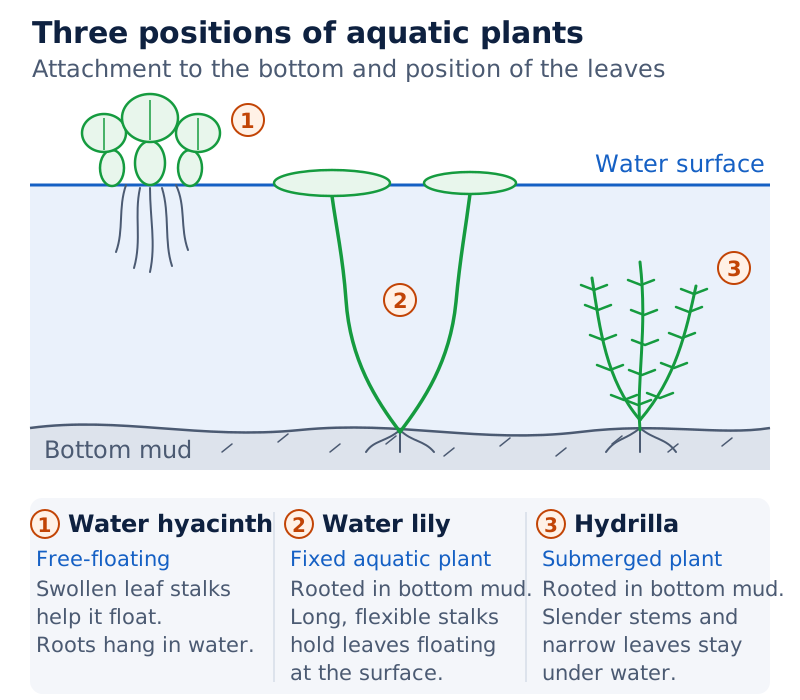
Draw a water surface and a muddy bottom. Show water hyacinth floating with hanging roots, water lily rooted below with leaves at the surface, and Hydrilla rooted below with submerged leafy stems. Label each plant and the water surface.
Drawn by One Young India.
The drawing should make attachment and position clear. It need not show invisible internal structures. Add short annotations beside the plants explaining floating support, flexible stalks or submerged leaves. An annotation is a brief explanatory note attached to part of a drawing.
How is a fish adapted to an aquatic habitat?
A fish has a streamlined body that helps it move through water. Its shape offers less resistance than a broad, blunt shape would. Movement through water also depends on the body and fins, rather than on body shape alone.
Fins are structures projecting from the body that help a fish move and control its position in water. The body and tail move from side to side during swimming. Fins help maintain balance and change direction.
How does a fish obtain oxygen?
Gills are organs that take up oxygen dissolved in water. Dissolved oxygen is oxygen mixed into the water, rather than a visible air bubble. Water passes over the gills, allowing the fish to obtain oxygen from its surroundings.
Keep the functions separate: fins help with movement, while gills help with breathing in water. A fish does not use its fins to absorb the oxygen it needs. Nor do gills split water into oxygen and another substance.
Photographs: Body parts used by animals for movement. The figure contains photographs of a fish and a goat. “Fins” labels parts of the fish, while “Legs” labels the goat's limbs. The photographs compare movement in water with movement on the ground.
Diagram
Fish body and fins
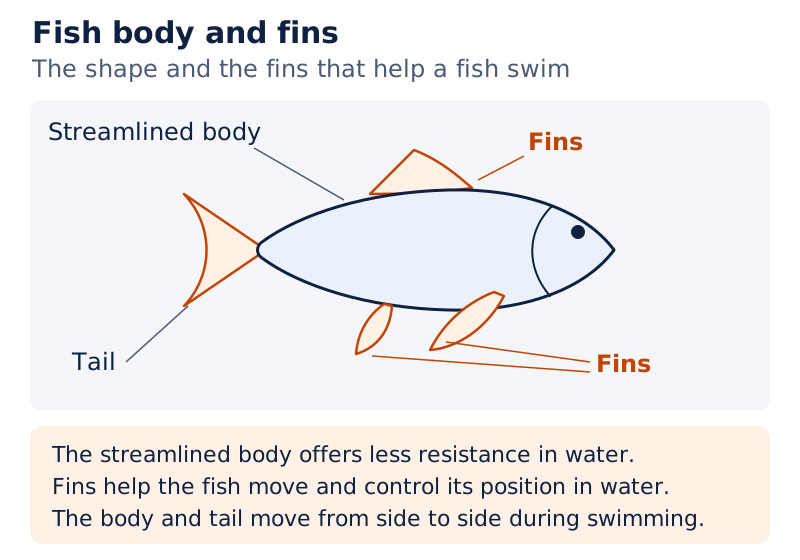
Draw the outline of a fish and its fins. Label the streamlined body and the fins. Add an annotation explaining that these features help the fish move through water.
Drawn by One Young India.
How should fish adaptations be connected?
Combine shape, movement and breathing in an explanation. The streamlined body eases movement through water; fins help the fish control swimming; gills obtain dissolved oxygen. These features perform different jobs within the same aquatic habitat.
The body shape visible in a photograph supports a description of external form. The function of gills needs a written explanation because it cannot be established merely by looking at the outside of the fish. Separate what is visible from what the structure does.
How can movement and body parts be investigated?
- Prepare a poster of animals whose movements have been observed, such as a goat, pigeon, housefly and fish.
- List the animals in a table with columns for type of movement and body parts used.
- Record how each animal moves and the parts it uses. A goat walks and jumps using legs; a pigeon walks and flies using legs and wings; a fish swims using fins.
- Compare the completed entries and group animals according to their types of movement.
How is a cactus adapted to a desert habitat?
Very little water is available in deserts. A hot desert is typically very hot during the day and very cold at night. A cactus has features that help it store water and reduce water loss under dry conditions.
Its fleshy stem is thick and stores water. A green cactus stem also carries out photosynthesis. Thus, the same part can perform more than one function: the stem provides a water store and makes food using light.
What roles do spines and the stem covering play?
In a cactus such as Opuntia, the leaves are modified into spines, narrow, pointed structures. Their small surface area reduces water loss compared with broad leaves. Spines should not be labelled as ordinary broad leaves in a cactus diagram.
Transpiration is the loss of water vapour from the above-ground parts of a plant. A waxy covering on the cactus stem helps reduce water loss. Water vapour is water in its gaseous form, rather than visible liquid droplets.
The combination is important. A fleshy stem stores water, the green stem makes food, spines reduce the leaf surface exposed for water loss, and the waxy covering helps retain water. Storage and conservation support each other in a dry habitat.
Photograph: Cactus with thick and fleshy stems in a desert. The photograph shows upright, branching cactus stems with visible pointed projections. The caption identifies the thick, fleshy stems and the desert setting. Water stored inside the stems is not visible in the photograph.
What should not be assumed about desert plants?
A cactus still needs water. Its adaptations help it cope with scarcity; they do not remove that need. Also, a feature of cactus should not automatically be applied to every desert plant. Babul or kikar is another desert plant example, but it is not a cactus.
When comparing these examples, record the features of the particular plant being studied. “Desert plant” names its habitat association; it does not mean every such plant has the same stem, leaf form or overall appearance.
How do camels survive in desert conditions?
A camel is adapted to desert life, but hot-desert and cold-desert camels differ. The hot-desert camel has long legs and wide hooves, the hard coverings at the ends of its feet. These features help it walk on sand without sinking into it.
Camels of a cold desert have comparatively shorter legs and are shorter in height. Their short legs help them walk in mountainous regions. The comparison matters because a camel is not restricted to one kind of desert environment.
How do food reserves and water conservation help?
A hump is the raised part of a camel's back containing a food reserve stored as fat. Hot-desert camels have one hump each; cold-desert camels have two. The reserve helps when food is scarce. A hump is not a tank of drinking water.
Cold-desert camels grow long hair from the head to the neck, helping them survive cold winters. Their humps shrink in late winters when food is limited and the stored reserve is used. This connects a changing body feature with the use of stored food.
Camels pass small amounts of urine, the liquid waste removed from the body. Their dung, or solid waste, is dry. These features limit water loss and help camels survive for many days without drinking water.
| Feature compared | Hot-desert camel | Cold-desert camel |
|---|---|---|
| Example of habitat | Hot desert of Rajasthan | Cold desert of Ladakh |
| Number of humps | One | Two |
| Legs | Long | Comparatively shorter |
| Leg-related advantage | Help movement on sandy desert ground | Help movement in mountainous regions |
| Use of hump reserve | Supports survival during food scarcity | Used when food is limited in late winters |
Photographs: A camel living in the hot desert of Rajasthan and a camel living in the cold desert of Ladakh. The photographs show a one-humped camel from Rajasthan and a two-humped camel from Ladakh. Both have labels pointing to the hooves. The Ladakh camel has conspicuous long hair around its head and neck.
How are mountain trees such as pine and fir adapted?
Mountains in extremely cold regions experience frequent snowfall. Pine and fir are examples of mountain trees with a cone-like outline and sloping branches. These features help snow slide off instead of remaining spread over a broad, flat crown.
Conical means shaped like a cone, broad below and narrow towards the top. A tree's crown is its upper part formed by branches and leaves. Describing a conical crown explains the tree's overall outline, rather than the shape of a single leaf.
How do shape and leaves contribute?
Pine and fir have narrow, needle-like leaves. Their small exposed surface and waxy covering help reduce water loss. These leaf features perform a different job from sloping branches, which help shed snow. An explanation should link each feature to its particular effect.
Deodar provides another mountain example. It has a conical shape and flexible, sloping branches. Its shape and branch arrangement enable snow to slide off easily. This is a useful comparison with the pine and fir examples.
Do not turn these examples into a claim that every mountain plant has the same form. Some trees have features that allow snow to slide off easily. Mountain conditions vary, and the features of plants can vary between regions.
How can mountain and desert plants be compared?
A cactus stem stores water in a dry habitat. A pine or fir crown helps shed snow in snowy mountain conditions. Both are plant adaptations, but they involve different structures and meet different difficulties. Match the explanation to the conditions named.
Diagram
Deodar tree in the mountains
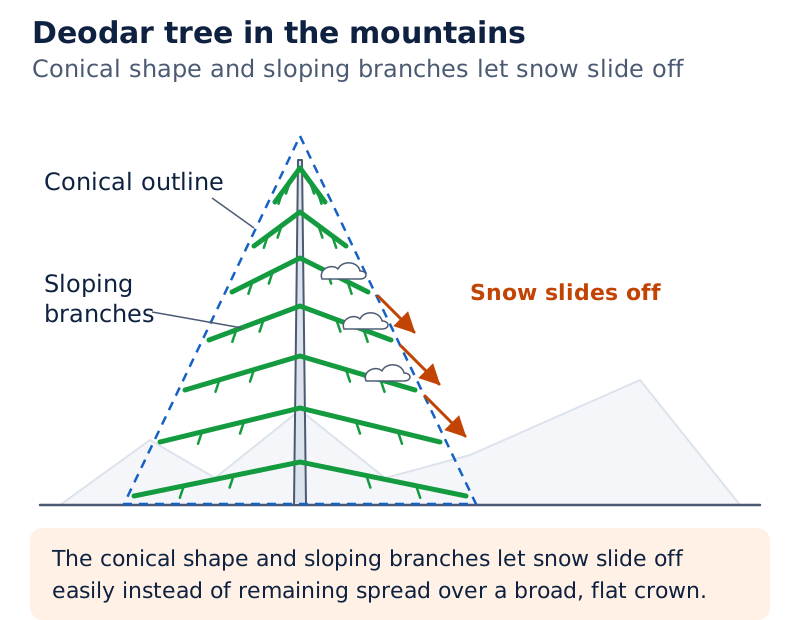
Draw a deodar tree with a conical outline and sloping branches. Label both features. Add an annotation explaining that the shape and branch arrangement allow snow to slide off easily.
Drawn by One Young India.
How is a mountain goat suited to cold, rocky surroundings?
A mountain goat lives in surroundings where cold and rocky slopes present different challenges. Its thick coat helps conserve body heat. Conserving heat means reducing the rate at which heat is lost, rather than producing warmth simply because the coat is present.
Its strong legs help it climb and move over uneven ground. Its divided hooves have gripping surfaces that help it obtain a foothold on rocks. A foothold is a firm place for a foot when standing or climbing.
Why must the functions be kept separate?
The thick coat is related to cold conditions. Legs and hooves are related to movement and grip. Saying only that all three are “for the mountains” leaves out the different jobs they perform. State the function of each feature separately.
A comparison with a goat from the plains helps focus attention on visible differences in the coat. However, a photograph does not directly demonstrate how well a hoof grips a rock. A visible feature and an explanation of its function are different kinds of information.
The same caution applies when comparing the mountain goat with the camel. Both move on land using legs, but the surfaces they move across differ. A mountain goat needs secure footing on rocky slopes; the hot-desert camel moves over sand.
Do not transfer the camel's food-storage adaptation to the mountain goat. Sharing a terrestrial habitat category does not make the animals' adaptations interchangeable. Each feature needs to be associated with the correct animal and the particular conditions it faces.
How are birds adapted for flight?
Flight is movement through the air using structures that support and move the body. A pigeon is an example of a flying bird. It walks using its legs and flies using its wings, so its movements are not confined to one setting.
In birds, the forelimbs, the front pair of limbs, are modified into wings. Feathers cover the body and form broad surfaces on the wings. Wings and their feathers help the bird obtain support and move through the air.
Which features work together during flight?
A flying bird's streamlined shape reduces resistance as it moves through air. Strong chest muscles move the wings. A muscle is body tissue that can contract to produce movement. Contract means shorten while pulling on a body part.
Hollow long bones contain air spaces and help make the skeleton light. The skeleton is the supporting framework inside the body. This lightness is useful in flight, alongside wings, feathers, body shape and the muscles that move the wings.
Do not replace “hollow long bones” with “every bone is hollow”. Similarly, feathers alone are not a complete explanation of flight. The shape, supporting framework and movement of the wings work together.
Can every bird fly?
Most birds can fly, but flightless birds also exist. The ostrich is an example. Having feathers therefore identifies an important bird feature without proving that every bird is capable of flight.
Birds also breathe using lungs. Lungs are organs used for exchanging gases with air. Air sacs, air-filled structures connected to the lungs, supplement breathing. A bird's wings perform movement, while its breathing organs meet a different need.
When explaining flight, begin with the features directly related to it: wings, feathers, streamlined shape, light bones and strong wing-moving muscles. Keep these distinct from other bird features that have different functions.
What are aerial plants and how do they obtain support?
Some plants grow above the ground on other plants. An epiphyte is a plant that grows on another plant for support without taking food from it. An orchid growing on a mango branch is an example of this aerial way of life.
Here, aerial means above ground and exposed to the air. It does not mean that the plant flies or remains suspended without support. The orchid is attached to a branch while growing in a position above the soil.
How do aerial roots help?
Aerial roots are roots exposed above the ground. In epiphytic orchids, roots help attach the plant to its support. Some exposed roots also absorb moisture from rain and humid air through a spongy outer covering. Humid air contains appreciable water vapour.
The orchid makes its own food by photosynthesis. The supporting tree offers a place to grow; it is not supplying prepared food to the orchid. This distinguishes an epiphyte from a parasite, an organism that obtains nourishment from another living organism and harms it.
For an orchid growing as an epiphyte on a mango branch, the orchid benefits, while the mango tree derives no apparent benefit. Keep the distinction between physical support and nourishment clear when describing the relationship.
How do aerial plants differ from flying birds?
A bird moves through air using wings. An epiphytic orchid remains attached to a support above ground. Their connection with air therefore involves different activities. “Aerial” does not imply the same kind of adaptation in a plant and an animal.
For the orchid, describe attachment, exposed roots, moisture uptake and food-making. For the bird, describe the structures used in flight. Avoid using a movement explanation for a rooted plant merely because it grows above ground.
How can observations connect organisms, habitats and adaptations?
Study an organism by recording its name, habitat, visible features and the functions of those features. Observation means information gathered by looking carefully or using other senses. An explanation connects that information with how a feature helps the organism live.
A cactus photograph can show a thick stem. The explanation is that the fleshy stem stores water. A fish photograph can show fins. The explanation connects fins with movement and control in water. Do not confuse a visible feature with its unseen function.
What should a comparison record contain?
| Organism | Habitat or position | Feature | Useful effect |
|---|---|---|---|
| Water lily | Aquatic, fixed below | Long, flexible leaf stalks | Connect rooted plant with floating leaves |
| Fish | Aquatic | Streamlined body | Eases movement through water |
| Cactus | Desert | Thick, fleshy stem | Stores water |
| Pine or fir | Snowy mountain conditions | Conical crown and sloping branches | Help snow slide off |
| Mountain goat | Cold, rocky mountains | Thick coat and gripping hooves | Conserve heat and provide secure footing |
| Pigeon | Air during flight | Wings with feathers | Help movement through air |
| Epiphytic orchid | Above ground on a branch | Aerial roots | Provide attachment and help absorb moisture |
Compare the same kind of feature or function across examples. To compare movement, discuss fins, legs or wings. To compare plant water relations, discuss water storage, reduced water loss or moisture uptake. Keep the basis of the comparison consistent.
During a nature walk, observe living things without disturbing them. Record the conditions as well as the organism. A drawing with clear labels and brief functional explanations can connect what is seen with what has been learnt about the habitat.
A useful final check is whether the account answers both “What feature is present?” and “How does it help here?” A habitat name alone does not explain an adaptation, and a feature without its function leaves the connection unfinished.
How can a nature walk be recorded?
- Plan a visit to a park or nearby forest with a teacher, taking a notebook and pen.
- Observe plants and animals and note weather conditions such as heat, cold or wind. Avoid disturbing living things or plucking leaves and flowers.
- Record plant features, including stems, leaves and flowers. For animals, record where they live, what they eat and how they move.
- Compare the observations for similarities and differences, then sketch the plants and animals and write down the details gathered.
Glossary
- Habitat — The place where an organism lives and obtains resources and conditions needed for survival.
- Adaptation — A special feature that helps an organism survive in the conditions of its particular surroundings.
- Terrestrial habitat — A habitat on land, such as a desert, forest, grassland or mountain.
- Aquatic habitat — A habitat in water, such as a pond, lake, river or ocean.
- Free-floating plant — An aquatic plant that floats without being rooted in the mud at the bottom.
- Fixed aquatic plant — An aquatic plant rooted in bottom mud, with water lily as a familiar example.
- Submerged plant — An aquatic plant whose main leafy parts grow below the surface of the water.
- Streamlined body — A body shape that reduces resistance during movement through water or through air.
- Gills — Organs that enable fish to obtain oxygen dissolved in the water around them.
- Transpiration — Loss of water as water vapour from the above-ground parts of a plant.
- Photosynthesis — The process in which green plants use light to make food from water and carbon dioxide, releasing oxygen.
- Conical crown — A tree's cone-shaped arrangement of branches and leaves, broader below and narrower towards the top.
- Epiphyte — A plant that grows on another plant for support without taking food from it.
- Aerial roots — Roots exposed above the ground that can provide attachment and, in epiphytic orchids, absorb moisture.
- Biodiversity — The variety of living things occurring together in a particular region or area.
Common errors and misconceptions
- Misconception: Habitat and adaptation mean the same thing. Correct: Habitat is the place an organism lives; adaptation is a feature helping it survive there.
- Misconception: A water lily is free-floating because its leaves float. Correct: Its roots are fixed in bottom mud, while its leaves float at the surface.
- Misconception: Every submerged plant is unattached to the bottom. Correct: Hydrilla is rooted below while its main leafy parts remain under water.
- Misconception: Fish use fins to breathe. Correct: Fins help with movement and control; gills obtain dissolved oxygen from water.
- Misconception: A cactus does not need water. Correct: It stores water in its fleshy stem and has features that reduce water loss.
- Misconception: A camel's hump is a water tank. Correct: The hump contains a food reserve stored as fat, which helps during food scarcity.
- Misconception: Every bird flies and every bird bone is hollow. Correct: Most birds fly, with exceptions such as the ostrich; the hollow-bone description concerns long bones.
- Misconception: An epiphytic orchid takes food from its supporting tree. Correct: It uses the tree for support and makes its own food by photosynthesis.
Exam-style questions with model answers
Q1. A fish lives in pond water, and its streamlined body helps it swim. Identify the habitat and the adaptation from this information. [2 marks]
- The habitat is the pond water in which the fish lives. This is an aquatic habitat.
- The adaptation is its streamlined body, which helps it move through the water while swimming.
Q2. Water hyacinth floats without attachment to bottom mud; water lily is rooted in mud with floating leaves; Hydrilla is rooted in mud with submerged leafy shoots. Classify each plant by its position or attachment and explain the choice. [3 marks]
- Water hyacinth is free-floating because the plant floats without being rooted in the mud. The description concerns the attachment of the whole plant.
- Water lily is a fixed aquatic plant because its roots are attached in bottom mud, even though the leaves float at the water surface.
- Hydrilla is a submerged plant because its leafy shoots are under water. It is also rooted below, so submerged does not mean free-floating.
Q3. A fish has a streamlined body that reduces water resistance, fins that help balance and direction, and gills that take up dissolved oxygen. Explain the separate contribution of each feature to aquatic life. [3 marks]
- The streamlined body reduces opposition to movement through water. This helps the fish swim through its aquatic surroundings more easily.
- The fins help the fish balance and control its direction. They contribute to controlled movement rather than taking oxygen from water.
- The gills obtain oxygen dissolved in the surrounding water. This meets the fish's need for oxygen while it lives in an aquatic habitat.
Q4. In a dry habitat, a cactus has a fleshy water-storing stem, a green stem that makes food, leaves reduced to spines with little exposed surface, and a waxy covering that reduces water loss. Explain these four features. [4 marks]
- The fleshy stem stores water. This stored supply helps the cactus cope with the small amount of water available in its dry habitat.
- The green stem carries out photosynthesis and makes food. Food-making therefore takes place in the stem despite the reduction of the leaves.
- The leaves are reduced to spines, leaving little exposed leaf surface. This helps reduce the loss of water from the plant.
- The waxy covering reduces water loss from the stem. It helps conserve the water that the plant stores and needs for survival.
Q5. A hot-desert camel has long legs and wide hooves that help walking on sand, a hump containing a fat reserve used when food is scarce, small urine output and dry dung. Explain five ways these supplied features support desert survival. [5 marks]
- The long legs contribute to movement over sandy desert ground. Together with the feet, they help the camel move in the surroundings described.
- The wide hooves help the camel avoid sinking into sand. This gives the animal useful support when walking across the sandy surface.
- The hump contains a food reserve stored as fat. The camel can use this reserve when food becomes scarce in its desert habitat.
- Passing only small amounts of urine limits the water lost in liquid waste. This helps the camel conserve water under dry conditions.
- Dry dung means little water is lost with the solid waste. This is another way of retaining water where available supplies are limited.
Q6. Pine and fir have conical crowns and sloping branches that shed snow. A mountain goat has a thick coat that reduces heat loss and gripping hooves that provide footholds on rocks. Explain one plant adaptation and two animal adaptations from these observations. [3 marks]
- The conical crown and sloping branches help snow slide off pine and fir. This is useful where mountain conditions include snowfall.
- The mountain goat's thick coat reduces heat loss from its body. This helps it cope with the cold conditions of its surroundings.
- The gripping hooves provide secure footholds on rocks. They help the goat stand and move over the uneven surfaces of rocky slopes.
Q7. A pigeon has wings that move it through air, wing feathers forming broad supporting surfaces, a streamlined body reducing air resistance, hollow long bones making its skeleton light, and strong chest muscles moving the wings. Explain the role of each feature in flight. [5 marks]
- The wings are the structures used for movement through air. Their movement contributes to the pigeon's ability to fly rather than simply walk.
- The wing feathers form broad supporting surfaces. These surfaces help the wings support and move the bird while it travels through the air.
- The streamlined body reduces air resistance. Less opposition to forward movement helps the pigeon pass through the air during its flight.
- The hollow long bones help make the skeleton light. A lighter supporting framework is useful for a bird moving and remaining supported in air.
- The strong chest muscles move the wings. Their contraction produces the wing movements needed to use the wings and feathers during flight.
Q8. An orchid grows on a mango branch for support, makes its own food, and has exposed roots that help attachment and absorb moisture. It does not take food from the tree. Identify its way of life and explain the two root functions. [3 marks]
- The orchid is an epiphyte. It grows on another plant for support while making its own food instead of taking nourishment from that tree.
- The roots help attach the orchid to the supporting branch. This allows the plant to remain in its position above the ground.
- The exposed roots absorb moisture from the surroundings. They therefore help meet the orchid's water needs while it grows away from the soil.
Key takeaways
- A habitat is the place an organism lives; an adaptation is a feature that helps it survive in those surroundings.
- Free-floating water hyacinth, fixed water lily and submerged Hydrilla differ in attachment and the position of their leaves.
- A fish's streamlined body and fins help swimming, while its gills obtain oxygen dissolved in water.
- A cactus stores water in its fleshy stem, makes food in its green stem and reduces water loss through protective features.
- Camels conserve water and use food reserves stored in humps; hot-desert and cold-desert camels have different body features.
- Pine and fir shed snow using conical crowns and sloping branches; mountain goats have features for warmth and secure footing.
- Most birds fly using a combination of wings, feathers, streamlined shape, light bones and strong muscles.
- An epiphytic orchid uses another plant for support, makes its own food and obtains moisture through exposed roots.
Test yourself
How is a habitat different from an adaptation?
A habitat is where an organism lives. An adaptation is a feature helping it survive in that place.
Why is a water lily classified as fixed even though its leaves float?
Its roots are attached to the bottom mud. Floating leaves do not make the whole plant free-floating.
Can a submerged aquatic plant be rooted in the bottom?
Yes. Hydrilla is rooted below while its main leafy parts grow under the water surface.
Which fish structures obtain oxygen, and where does the oxygen come from?
Gills obtain oxygen that is dissolved in the surrounding water as water passes over them.
Which cactus part stores water and can make food?
The thick, fleshy green stem stores water and carries out photosynthesis to make food.
How do a mountain goat's coat and hooves perform different jobs?
The thick coat reduces heat loss, while the gripping hooves help provide secure footholds on rocky ground.
Why should a description say that most birds fly?
Flightless birds exist, including the ostrich, so the ability to fly cannot be applied to every bird.
Does an epiphytic orchid obtain food from its supporting tree?
No. It uses the tree for support and makes its own food through photosynthesis.
Write about it
Turn a question from this chapter into a paper.
The Writing Studio has a structure guide, a rubric and citation tools for 15 formats, from essays to research papers. Drafting is free with an account. Learnacy Essential adds feedback from an AI writing coach and submission to The OYI Review.
Publication depends on review and is not guaranteed.