
Adolescence: A Stage of Growth and Change | CBSE Class 7 Science Notes
On this page
This note covers adolescence, changes in height and body structure, voice and skin changes, reproductive development, emotions and behaviour, nutrition, personal cleanliness, physical activity, respectful relationships, online safety, and avoiding harmful substances.
What are adolescence and puberty?
Adolescence is the period of change between childhood and adulthood. It generally begins around 10 years of age and usually lasts until 19 years. This period brings rapid growth and development as the body prepares for adulthood.
Human life passes through infancy, childhood, adolescence, adulthood and old age. Each person experiences these stages at their own pace. Their duration may vary from one individual to another, so growth should not be treated as an identical timetable for everyone.
How does growing up involve more than becoming taller?
Until around 10 to 12 years of age, most changes concern height and weight. After this, other noticeable changes begin to occur. Some changes can be seen from outside the body, while internal changes may go unnoticed.
Reproduction means producing young ones. Humans, like most other living beings, cannot reproduce immediately after birth. Their bodies need to grow and reach maturity before they become capable of reproduction. Both observable and internal changes contribute to this development.
Definition: Puberty is the stage in which an adolescent's body undergoes external and internal changes to develop into an adult capable of reproduction.
Secondary sexual characteristics are features that help distinguish males from females but are not directly involved in reproduction. Examples include facial and chest hair in boys and breast development in girls. These characteristics are natural signs of preparation for adulthood and mark the onset of puberty.
Adolescence also involves changes in feelings and behaviour. Understanding growth therefore means considering physical development, reproductive capability, emotions and actions together. Guidance and awareness help adolescents manage these changes responsibly.
How do height, body structure and growth differ among individuals?
An increase in height is part of continuous growth from birth. During adolescence, this increase becomes more prominent. Changes in height occur alongside changes in weight, strength and appearance, rather than being the whole meaning of growing up.
What changes may be observed in boys and girls?
As boys grow, it might be seen that they become taller and gain weight. Their shoulders might become a bit broader, and their chests may get wider. Girls also experience changes in height and weight, together with other changes such as breast development.
Individual variation means that changes differ from person to person. The timing, nature and extent of changes in height, voice or facial hair vary among individuals. These variations are completely normal, and the duration of adolescence also differs between people.
Note: A difference in the timing or extent of adolescent changes is not a reason to expect everyone to look or develop alike. Each person experiences adolescence at their own pace.
How can changes be discussed respectfully?
A group activity can help identify changes noticed among students moving from Grades 5 to 8. Observations can concern height, strength, behaviour or appearance. Names should be left out when recording them, so the discussion concerns changes rather than named individuals.
- Take a jar and prepare paper slips for recording observations.
- Write changes noticed while students grow from Grades 5 to 8, without writing their names.
- Fold the slips, place them in the jar and mix them together.
- Unfold the slips one by one, discuss the observations and organise them under suitable headings.
Useful headings include height, weight and strength, and appearance. The observations should come from the discussion itself. Recognising variation is as important as identifying common changes: a shared stage of life does not mean identical experiences.
Why do voices, body hair and facial skin change?
What causes changes in voice?
The voice box is a structure in the throat that helps us speak. In adolescent boys, its growth leads to a voice that sounds hoarse. This growth may be visible as a throat bump called the Adam's apple.
The Adam's apple is not noticeable in every individual. The voice box also grows in adolescent girls, but it is not as big as in boys. This leads to only slight changes in girls' voices. Voice changes therefore occur in both, with differences in their extent.
Where does hair appear?
Both boys and girls develop hair in areas such as the armpits and the pubic region, the area around the external reproductive organs. Boys often develop facial hair, which later grows into a moustache and beard as they move towards adulthood.
Some boys may also develop chest and back hair, though few boys may have no significant hair growth. Variation in the timing and appearance of hair growth is completely normal. Facial hair should not be treated as a change occurring identically in every boy.
How are acne and pimples related?
Acne is a skin condition in which small, reddish pimples appear, commonly on the face. Oily secretions from the skin increase during adolescence. They can clog skin pores, the tiny openings in the skin, and lead to infections.
Acne names the condition, whereas pimples are a visible manifestation of it. This distinction connects what can be observed on the face with the underlying increase in oily secretions. It does not mean that every adolescent has the same skin changes.
| Change | Explanation | Qualification to remember |
|---|---|---|
| Hoarse voice in boys | The voice box grows during adolescence. | The Adam's apple is not noticeable in every individual. |
| Voice changes in girls | The voice box also grows. | The changes in voice are only slight. |
| Facial hair in boys | Hair later grows into a moustache and beard. | Boys often develop facial hair; timing and extent vary. |
| Pimples | Increased oily secretions can clog skin pores and lead to infections. | Pimples are a manifestation of acne, the skin condition. |
What changes indicate reproductive capability?
Some important adolescent changes occur inside the body. Parts involved in reproduction gradually mature in both boys and girls. These changes are natural parts of growing up, although they cannot all be seen from outside.
What are the menstrual cycle and menstruation?
The menstrual cycle is a recurring natural process associated with reproductive development in girls. Its onset is an important change during adolescence. It recurs generally every 28 to 30 days and is commonly known as the period.
Many healthy girls may have longer or shorter cycles, ranging from 21 to 35 days. The menstrual cycle is one of the signs of good reproductive health. A cycle should therefore not be described as having exactly the same duration for everyone.
Menstruation is the phase of the cycle when blood discharge occurs from the body. It may last for three to seven days. Some girls may feel pain or discomfort in the lower abdomen, the lower part of the belly, during these days.
Usually, by the age of 45 to 55, menstruation stops naturally, marking the end of reproductive capability in a woman's life. This age range, like the cycle lengths, needs its qualification: it describes what usually occurs.
| Feature | Time or range | Meaning |
|---|---|---|
| Recurrence of the cycle | Generally every 28 to 30 days | The usual interval described for the menstrual cycle. |
| Variation in cycle length | 21 to 35 days | Many healthy girls may have longer or shorter cycles in this range. |
| Blood-discharge phase | May last three to seven days | This phase is menstruation. |
| Natural stopping of menstruation | Usually by 45 to 55 years | This marks the end of reproductive capability. |
Why should menstrual myths be challenged?
Wrong beliefs about menstruation can create fear, shame or guilt. Physically isolating menstruating girls is one such practice without a scientific basis. A scientific outlook recognises menstruation as natural and supports good reproductive health, dignity and a healthier lifestyle.
How do hormones, emotions and behaviour contribute to adolescence?
Hormones are chemicals produced in the body that help regulate growth, development and proper functioning. Many adolescent changes, including menstruation and other signs of puberty, are mainly due to hormones. Some hormones also influence mood and behaviour.
How does the body release hormones?
Hormones are produced in different parts of the body. They are released at an appropriate time in response to signals from the brain. This explains why changes during adolescence involve internal regulation as well as visible growth.
The wording mainly due to hormones matters. Understanding their role links physical changes with emotional and behavioural changes, without treating every experience as identical or reducing all behaviour to one cause.
What emotional changes may occur?
Mood swings are changes in mood, such as feeling energetic and happy on some days and low on others. Adolescence is often marked by stronger emotions than childhood. These emotions might influence behaviour and the way a person responds to situations.
Increased sensitivity and stronger feelings may accompany this stage. Adolescents may develop deeper interests in new areas or join social initiatives supporting people in need. Emotional changes can therefore be linked with positive involvement as well as experiences that feel confusing.
| Area to understand | Examples and possibilities |
|---|---|
| Changing feelings | Mood swings and strong emotions may affect behaviour. |
| Activities | Music, dance and sports provide varied ways to become involved. |
| Exploring interests | Self-exploration and activities may lead to creativity and innovation. |
| Concern for others | Compassion and involvement in social work support positive growth. |
Compassion means concern for others, including people who need support. Understanding how feelings influence actions can help adolescents make better choices and respond thoughtfully. Seeking support and guidance when needed is part of managing these changes effectively.
Why is a balanced diet important during adolescence?
Adolescence involves growth and development with several changes in the body, so a nutritious diet is especially important. Nutrients are food components that provide energy, support growth and repair, protect the body from diseases, and help maintain its functions.
What do the main nutrients do?
Proteins are body-building nutrients that support growth and repair. Carbohydrates and fats are primary sources of energy. A diet also needs adequate vitamins and minerals, two groups of protective nutrients that help keep the body healthy.
Roughage, or dietary fibre, helps remove undigested food and supports the smooth passage of stools. Water helps the body absorb nutrients and remove wastes. A balanced diet supplies essential nutrients, roughage and water in the right amounts for growth and development.
| Food sources | Nutrients listed | Function listed |
|---|---|---|
| Milk, millets, curd, cheese and paneer | Calcium, proteins and fats | Help optimal bone growth. |
| Spinach, kidney beans and dried fruits like raisins and figs | Iron | Helps in the formation of blood. |
Calcium is a mineral associated with bone growth; iron is a mineral that helps in blood formation. Millets are small-sized grains used as food. Locally available foods can be considered when identifying sources that support growth, strength and energy.
Why should nutrient deficiency be taken seriously?
A deficiency means a shortage of a needed nutrient. Adolescents, especially girls, may sometimes suffer from blood-related health problems because of a deficiency of iron or vitamin B₁₂, a vitamin required for the body's proper functioning.
Like most vitamins, vitamin B₁₂ cannot be made in the human body and has to come from food. Dorothy Hodgkin studied its structure. In 1964, she became the third woman to win the Nobel Prize in chemistry.
Nutritional needs may vary with age, physical activity, health and other circumstances. A balanced diet therefore concerns an appropriate combination of nutrients and other essential food components. It should not be reduced to eating just one nutrient or one food.
How can personal and menstrual hygiene support health?
Personal hygiene means keeping the body clean. Alongside nutrition, it is crucial during adolescence. Maintaining body hygiene, particularly in the armpits and pubic region, may protect against potential infections. This is a possible protective benefit, not a promise that infections cannot occur.
What does menstrual hygiene involve?
Menstrual hygiene means the cleanliness practices used during menstruation. It is essential for comfort and health. Suitable products include sanitary pads, products used to manage menstrual blood discharge, and reusable cloth pads designed for this purpose.
What the figure shows
Sanitary pad
The illustration shows an elongated pad with rounded ends and a narrower middle. Curved lines are drawn within its outline. The figure identifies a product used for menstrual hygiene.
See Fig. 6.1 in your NCERT textbook
Good menstrual hygiene also requires access to necessary facilities in schools and public places. Making these facilities available supports girls and women in managing menstruation. Reducing stigma, meaning the shame attached to a natural process, is part of this shared responsibility.
How should used sanitary pads be disposed of?
- Recognise that a used sanitary pad needs proper disposal.
- Wrap the used pad in newspaper before discarding it.
- Place the wrapped pad inside a dustbin.
- Follow this disposal practice to support community health and environmental cleanliness.
Biodegradable pads, pads whose material can break down naturally, are also available as an environment-friendly option. Proper disposal remains part of menstrual hygiene. Leaving used pads scattered near a bin does not follow the practice of placing them inside it.
Menstrual health should be approached with practical support and respect. Cleanliness, appropriate products, access to facilities and the removal of shame work together. Menstruation is natural; treating menstruating girls as people who need isolation has no scientific basis.
What initiatives help adolescents access menstrual hygiene support?
Access to menstrual hygiene products is part of supporting adolescent health. Government efforts include providing products free of charge or at a low price. Awareness programmes also help girls understand menstrual hygiene and health, alongside improving access to suitable products.
How do the named initiatives differ?
| Initiative | Main support described |
|---|---|
| Menstrual Hygiene Scheme | Provides sanitary pads free or at reduced prices to adolescent girls in rural areas, with awareness programmes on menstrual hygiene and health. |
| Rashtriya Kishor Swasthya Karyakram | Aims to improve overall adolescent health, including menstrual health and hygiene, and encourages peer education. |
| Suvidha Sanitary Napkin Initiative | Provides affordable biodegradable sanitary pads through Jan Aushadhi Kendras to improve access for women and adolescent girls. |
| State-level initiatives | Include Karnataka's Shuchi Scheme and free sanitary napkin schemes in Tamil Nadu and Odisha, aiming to distribute free pads in government schools. |
Peer education here means older students helping younger students learn about adolescent health topics. Jan Aushadhi Kendras are the outlets through which the Suvidha initiative makes its affordable pads available. Each initiative contributes through its own described form of support.
The programmes combine several needs: products that people can obtain, information that helps them use menstrual hygiene practices, and broader attention to adolescent well-being. An overall health programme therefore has a wider purpose than distributing a menstrual hygiene product alone.
Schools and public places also need suitable facilities. Families, students and communities can contribute by reducing shame and supporting menstrual hygiene. Access and understanding belong together: providing a product and encouraging a respectful attitude address connected parts of the same need.
How do physical activity and respectful relationships support well-being?
Regular exercise and physical activities are important during adolescence. Games, sports and other exercises help keep both body and mind fit and healthy. They build stamina, the ability to keep up physical effort, and boost mood.
What activities and attitudes are shown?
What the figure shows
Physical activities for fitness
The drawing shows two children playing with a football, a child skipping with a rope, and two figures exercising on mats. One mat figure bends forwards while seated; the other raises the upper body while lying face down.
See Fig. 6.2 in your NCERT textbook
Physical activity belongs alongside nutritious food and personal hygiene in a healthy lifestyle. Growth during adolescence involves the body and emotions, so activities that support fitness and mood are both relevant. Good habits and thoughtful decisions contribute positively to overall well-being.
Why do everyday interactions matter?
A balanced social life includes thoughtful, responsible interaction with other people. Politeness and respect help create a favourable and safe environment. Adolescence brings new experiences and emotions, making care in dealing with others important.
Adolescents may feel attracted to their peers, people of a similar age or group, and may copy their behaviour. They often interact online as well as in person. Responsible behaviour therefore matters across different kinds of relationships and communication.
What the figure shows
Collaborative learning
The illustration shows students gathered around a table, looking at containers together. Labels above them read “Trust”, “Mutual Respect”, “Respectful Communication” and “Mindful”. The drawing presents learning together with attention and respect.
See Fig. 6.3 in your NCERT textbook
Collaborative learning means learning together. Respecting others during shared activities connects social well-being with everyday actions. Behaving politely and seeking guidance from elders or teachers can help adolescents handle interactions thoughtfully.
How can adolescents use online platforms responsibly?
Online platforms are internet-based spaces used to obtain information, connect, interact and share information. They can support communication, but careless use can affect others. Responsible behaviour should support the collective well-being of people using these spaces.
What habits support responsible sharing?
Privacy concerns keeping personal information from being shared without permission. Before posting, think about what is being shared. Be respectful and kind, protect privacy, and do not share personal photographs with strangers or virtual friends known through online interaction.
| Practice | How to apply it |
|---|---|
| Respect and kindness | Interact politely and consider how communication affects other people. |
| Thoughtful posting | Think before uploading a picture or sharing information. |
| Protection of privacy | Be cautious about sharing personal information with strangers. |
| Guidance | Seek help from elders and teachers to use platforms positively. |
What is cyberbullying?
Cyberbullying means using digital devices or online platforms to harass others. It can involve sending misleading messages, spreading false rumours, or sharing personal information without consent, meaning permission. Phones and computers can be used for such harassment.
What the figure shows
Cyberbullying
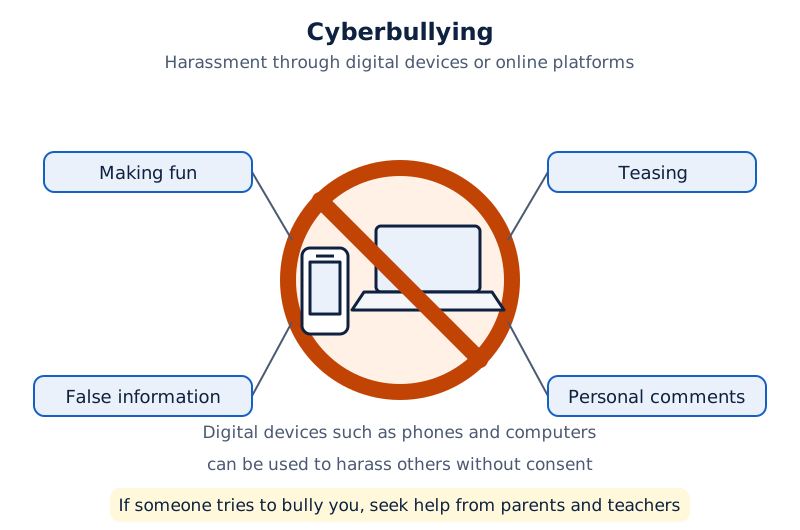
A red prohibition circle and diagonal bar cross a drawing containing a phone and laptop. The surrounding labels include “Making fun”, “False information”, “Personal comments” and “Teasing”. It is an illustration, not a photograph of an incident.
Drawn by One Young India. See Fig. 6.4 in your NCERT textbook
If someone tries to bully an adolescent, the response should include seeking help from parents and teachers. It is important not to feel scared or helpless, but to handle the situation wisely with support. Harmful online behaviour should not be dismissed as ordinary interaction.
Responsible use combines consideration for others with care about personal information. The same need for respect applies in person and online. Guidance helps turn access to information and communication into a positive part of adolescent life.
Why should adolescents refuse harmful and addictive substances?
People, including peers, may tempt, persuade, force or pressure adolescents to consume harmful substances. Tobacco products, alcohol and illegal drugs are examples. Curiosity and excitement during adolescence mean that adolescents might be influenced to try them.
What do addiction and substance abuse mean?
Addiction involves a strong urge to take a substance again and again. Harmful substances can damage physical and mental health and are addictive. Over time, people start using them regularly; this harmful pattern is described as substance abuse.
Someone who is addicted might have started with trying a substance just once. It is therefore wise to say no the first time and every time. Staying firm and confident when refusing is part of making healthy choices.
What harm can these substances cause?
Depending on the substance, use can cause serious health problems such as breathing difficulties, memory loss and damage to the lungs. These are possible effects associated with harmful substance use, not an identical list of effects for every substance.
What the figure shows
Lungs before and after prolonged smoke exposure
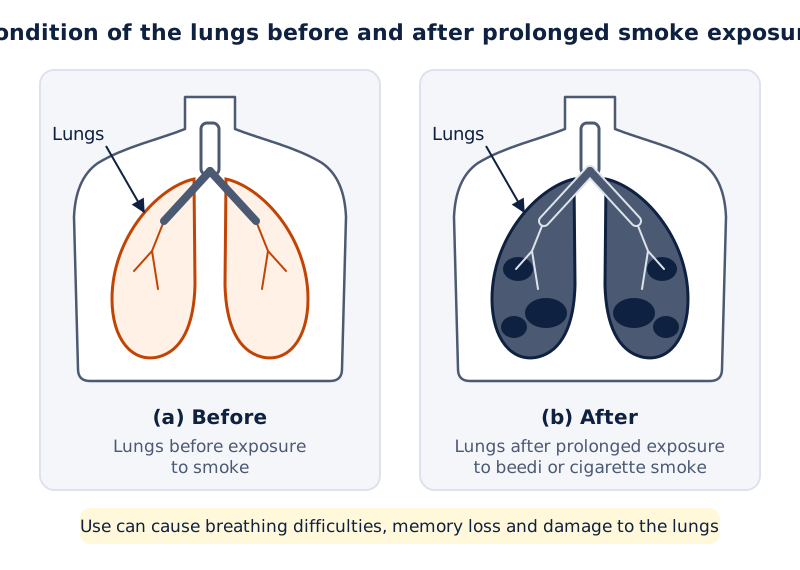
Two illustrated upper bodies are labelled “(a) Before” and “(b) After”. Arrows identify the lungs. The first pair is drawn red; the second is drawn dark, illustrating the comparison associated with prolonged beedi or cigarette smoke exposure.
Drawn by One Young India. See Fig. 6.5 in your NCERT textbook
A beedi and a cigarette are tobacco products smoked by users. The drawing illustrates lung damage; it is not a pair of medical photographs. Completely avoiding harmful substances is the healthy choice promoted alongside nutrition, hygiene, activity and responsible social behaviour.
Where can support come from?
The first step towards overcoming addiction is seeking help and support from family and friends, and talking to trusted people such as parents or teachers. Counselling, discussion with someone who provides guidance and support, and medical advice can also help.
The Nasha Mukt Bharat Abhiyaan is a Government of India awareness initiative against substance abuse. It involves young people, women and the community, with a special focus on preventing substance abuse among children at an early age.
Refusing harmful substances and seeking help are connected decisions. Confidence can support refusal when pressure is applied; trusted people can provide support when a problem has already developed. Healthy choices and timely guidance help adolescents manage this stage responsibly.
Glossary
- Adolescence — The period of growth and development between childhood and adulthood, generally beginning around ten and usually lasting until nineteen.
- Puberty — The stage when external and internal changes develop an adolescent's body towards an adult capable of reproduction.
- Secondary sexual characteristics — Features that help distinguish males from females but are not directly involved in the process of reproduction.
- Voice box — The structure in the throat that helps a person to speak and grows during adolescence.
- Adam's apple — The bump that may be seen in the throat as the voice box grows during adolescence.
- Acne — A skin condition involving small reddish pimples, commonly appearing on the face during the adolescent years.
- Menstrual cycle — A recurring natural process beginning during adolescence in girls, generally recurring every twenty-eight to thirty days.
- Menstruation — The phase of the menstrual cycle during which blood discharge occurs, which may last three to seven days.
- Hormones — Chemicals produced in the body that regulate growth, development and functioning; some also influence mood and behaviour.
- Balanced diet — A diet containing essential nutrients, roughage and water in the right amounts for proper growth and development.
- Menstrual hygiene — Cleanliness practices during menstruation, including using appropriate products and disposing of used sanitary pads properly.
- Cyberbullying — Harassment through digital devices or online platforms, including misleading messages, false rumours and sharing personal information without consent.
- Addiction — A strong urge to consume a harmful substance again and again, which can develop into regular use.
Common errors and misconceptions
- Misconception: All adolescents grow at the same pace and show identical changes. Correct: The timing, nature and extent of changes vary normally among individuals, and the duration of adolescence also differs.
- Misconception: A girl's voice box does not grow. Correct: It grows, but is not as big as in boys, leading to only slight changes in voice.
- Misconception: Every boy develops a clearly visible Adam's apple and the same amount of hair. Correct: The Adam's apple is not noticeable in every individual, and the timing and extent of hair growth vary.
- Misconception: Acne and pimples name exactly the same thing. Correct: Acne is the skin condition; small reddish pimples are a manifestation of that condition.
- Misconception: Every menstrual cycle must last exactly twenty-eight days. Correct: Cycles recur generally every twenty-eight to thirty days; many healthy girls may have cycles ranging from twenty-one to thirty-five days.
- Misconception: Menstruating girls need physical isolation. Correct: Menstruation is natural. Beliefs supporting such isolation have no scientific basis; practical hygiene support and respect are needed.
- Misconception: Trying an addictive substance once guarantees that stopping will be easy. Correct: A person who is addicted might have started just once. Refusing the first time and every time is the healthy choice.
Exam-style questions with model answers
Q1. What is adolescence? State when it generally begins and how long it usually lasts. [2 marks]
- Adolescence is the period of rapid growth and development between childhood and adulthood, when the body prepares for adult life.
- It generally begins around ten years of age and usually lasts until nineteen years, although its duration varies among individuals.
Q2. Ramesh is an eleven-year-old boy who develops a few reddish pimples on his face during adolescence. Explain the possible connection between acne, oily skin secretions and blocked skin pores. [3 marks]
- Acne is a skin condition in which small reddish pimples appear, commonly on the face. The pimples are a manifestation of the condition.
- During adolescence, oily secretions from the skin increase. This increased oil provides a possible explanation for the change in Ramesh's facial skin.
- The oily secretions can clog skin pores and lead to infections. This connects the increased secretions with the development of acne.
Q3. The menstrual cycle recurs generally every 28 to 30 days; many healthy girls may have cycles of 21 to 35 days. Blood discharge may last three to seven days. Explain what each range describes and why an exact twenty-eight-day rule is incorrect. [4 marks]
- The range of twenty-eight to thirty days describes how frequently the menstrual cycle generally recurs, rather than a fixed duration for every person.
- The range of twenty-one to thirty-five days describes longer or shorter cycles that many healthy girls may experience.
- The three-to-seven-day range concerns menstruation, the blood-discharge phase. It does not describe the length of the entire menstrual cycle.
- An exact twenty-eight-day rule ignores the stated variation. A natural cycle can vary in length within the range supplied in the question.
Q4. A food table links milk, millets, curd, cheese and paneer with calcium, proteins and fats, and with optimal bone growth. It links spinach, kidney beans, raisins and figs with iron and blood formation. Explain these two links and why a balanced diet matters during adolescence. [3 marks]
- The first group supplies the listed nutrients, including calcium. The function linked to this group in the question is helping optimal bone growth.
- The second group supplies iron. Iron helps in the formation of blood, making these listed foods relevant to that nutritional need.
- Adolescence involves rapid growth and several body changes. A balanced diet provides essential nutrients, roughage and water in appropriate amounts to support development.
Q5. Explain five practices or provisions that support menstrual hygiene: suitable products, wrapping used pads, bin disposal, access to facilities, and reducing stigma. [5 marks]
- Use suitable menstrual hygiene products, such as sanitary pads or reusable cloth pads designed for the purpose, to support comfort and health.
- Wrap used sanitary pads in newspaper before discarding them. This is part of the proper disposal practice for these products.
- Place wrapped used pads inside a dustbin. Proper disposal supports community health and environmental cleanliness rather than leaving pads scattered nearby.
- Ensure that necessary facilities are available in schools and public places. Such provision helps girls and women maintain menstrual hygiene.
- Reduce shame around menstruation and support those experiencing it. Menstruation is natural, and beliefs requiring physical isolation have no scientific basis.
Q6. Explain five aspects of responsible online behaviour: respectful communication, thoughtful posting, protecting privacy, recognising cyberbullying, and seeking support if bullied. [5 marks]
- Be respectful and kind in online interactions. Polite communication contributes to a favourable, safe environment and supports the well-being of other people.
- Think before posting or uploading pictures. Using online platforms thoughtfully is important because these platforms allow information to be shared with others.
- Protect privacy by being cautious about personal information. Do not share personal photographs with strangers or virtual friends known through online interaction.
- Recognise cyberbullying as digital harassment. It can include misleading messages, false rumours or the sharing of someone else's personal information without consent.
- If someone tries to bully you, seek help from parents or teachers. Handle the situation wisely with support rather than feeling helpless.
Q7. Describe the role and release of hormones during adolescence, and give two ways emotional changes may affect behaviour. [4 marks]
- Hormones are body-produced chemicals that regulate growth, development and functioning. Many changes of adolescence, including signs of puberty, are mainly due to them.
- Different parts of the body produce hormones. They are released at an appropriate time in response to signals from the brain.
- Adolescence is often marked by stronger emotions than childhood. These emotions might lead to joining social initiatives that support people in need.
- Emotional changes might also accompany deeper interests in new areas. Understanding feelings can help adolescents choose their actions and respond thoughtfully.
Q8. Explain why adolescents should refuse tobacco products, alcohol and illegal drugs. Give five points covering social pressure, addiction, health effects, refusal and sources of support. [5 marks]
- Other people, including peers, may create pressure to try harmful substances. Curiosity and excitement during adolescence mean that adolescents might be influenced.
- These substances are addictive: users develop a strong urge to take them repeatedly. Someone who becomes addicted might have started with just one trial.
- Depending on the substance, use can cause breathing difficulties, memory loss or lung damage. Harm affects physical and mental health.
- Adolescents should remain firm and confident in saying no the first time and every time. Completely avoiding these substances supports healthy choices.
- Help can come from family, friends and trusted adults such as parents or teachers. Counselling and medical advice can also support overcoming addiction.
Key takeaways
- Adolescence generally begins around ten and usually lasts until nineteen, with differences in timing, nature and extent of changes among individuals.
- Puberty involves external and internal development towards reproductive capability; secondary sexual characteristics are not directly involved in reproduction.
- The voice box grows in boys and girls, while voice changes in girls are only slight.
- Menstrual cycles recur generally every twenty-eight to thirty days, but many healthy girls may have cycles of twenty-one to thirty-five days.
- Hormones mainly control many adolescent changes, and some influence mood and behaviour as well as physical development.
- A balanced diet, personal hygiene and regular physical activity support adolescent health, growth and well-being.
- Respectful relationships, thoughtful online sharing and help from trusted adults support responsible participation in social life.
- Refuse harmful addictive substances consistently, and seek support from trusted people, counselling or medical advice when help is needed.
Test yourself
Why should differences in the timing of growth not be treated as unusual?
The timing, nature and extent of adolescent changes vary among individuals. These variations are completely normal, and each person develops at their own pace.
What makes a feature a secondary sexual characteristic?
It helps distinguish males from females but is not directly involved in reproduction. Facial and chest hair in boys and breast development in girls are examples.
What is the relationship between acne and pimples?
Acne is the skin condition, while small reddish pimples are a manifestation of it. Increased oily secretions can clog pores and lead to infections.
How does menstruation differ from the whole menstrual cycle?
Menstruation is the blood-discharge phase and may last three to seven days. The cycle recurs generally every twenty-eight to thirty days, with variation among many healthy girls.
How should a used sanitary pad be discarded?
Wrap the used pad in newspaper and place it inside a dustbin. Proper disposal supports community health and environmental cleanliness.
How can stronger emotions contribute to positive action?
They might lead adolescents to join social initiatives supporting people in need or develop deeper interests in new areas. Understanding emotions helps thoughtful decision-making.
What should an adolescent do if someone tries to bully them online?
Seek help from parents or teachers and handle the situation wisely with support. It is important not to feel scared or helpless.
Why is “just once” not a sound reason to try an addictive substance?
Someone who is addicted might have started with just one trial. Addictive substances create an urge to take them repeatedly, so refusing them consistently is important.
Write about it
Turn a question from this chapter into a paper.
The Writing Studio has a structure guide, a rubric and citation tools for 15 formats, from essays to research papers. Drafting is free with an account. Learnacy Essential adds feedback from an AI writing coach and submission to The OYI Review.
Learnacy Essential is ₹1,499 for the year. Publication depends on review and is not guaranteed.