
Chemical Coordination in Plants | ICSE Class 10 Biology Notes
On this page
Watch & explore
Start with a few high-quality watches, then dive into the notes below.

This note covers chemical control of plant growth, the functions of growth regulators, responses to light, gravity, water and chemicals, and plant movements caused by touch.
What is chemical coordination in plants?
Chemical coordination is the control and linking of plant activities through chemical substances. Plants respond to their surroundings even though they have neither a nervous system nor muscles. Their responses include changes in growth, development and the direction in which particular parts grow.
Definition: Plant growth regulators are small, simple molecules that influence plant growth and development. They are also called plant hormones or phytohormones. The abbreviation PGR means plant growth regulator.
Growth, development and responses
Growth is an irreversible, permanent increase in the size of a cell, an organ or its parts. Cell division increases cell number, while cell enlargement increases cell size. These are distinct ways in which a growing plant can increase in size.
Differentiation is the process by which cells mature to perform specific functions. Broadly, development combines growth and differentiation. It includes the changes during a plant's life, from seed germination, when a seed begins growing, to senescence, the ageing stage leading towards death.
A stimulus is a change that brings about a response. Light, gravity and contact with a support can influence plant movements. Some movements involve growth, while others occur through changes in the amount of water inside cells.
Internal and external influences
Plant growth regulators provide one form of internal control. They do not act in isolation from the environment. Light, temperature, water, oxygen and nutrition also influence growth and development, and some environmental influences operate through growth regulators.
Different hormones coordinate different activities. Some promote growth, while others inhibit it, meaning that they restrain or slow it. The same regulator can affect more than one process, and several regulators can influence the same event.
How do the five groups of plant growth regulators compare?
The five major groups are auxins, gibberellins, cytokinins, abscisic acid and ethylene. Auxins influence elongation and other growth responses; gibberellins promote stem growth; cytokinins promote cell division; abscisic acid generally inhibits growth; ethylene is a gaseous regulator with varied effects.
Growth promotion and growth inhibition
Growth promoters participate in activities such as cell division, enlargement, flowering and fruit formation. Auxins, gibberellins and cytokinins belong broadly to this group. Growth inhibitors are associated with restrained growth and responses to unfavourable conditions. Abscisic acid belongs to this second group.
Dormancy is a period of suspended growth or rest. Abscission is the shedding of plant parts, such as leaves, flowers or fruits. Both are among the processes influenced by growth regulators, alongside the ageing process called senescence.
| Regulator | Broad role | Examples of effects |
|---|---|---|
| Auxins | Growth promotion and regulation | Cell elongation in shoots; initiation of roots in stem cuttings |
| Gibberellins | Growth promotion | Stem elongation; delayed senescence |
| Cytokinins | Promotion of cell division | Growth of lateral, or side, shoots; delayed leaf senescence |
| Abscisic acid | General growth inhibition | Inhibition of seed germination; closure of leaf pores |
| Ethylene | Fits either group but is largely a growth inhibitor | Fruit ripening; senescence and abscission; some growth-promoting effects |
Why is the grouping broad?
Ethylene illustrates why a simple classification needs qualification. It promotes senescence and abscission, but also promotes root growth and breaks dormancy. Calling it largely an inhibitor does not mean that every one of its effects inhibits growth.
Note: A regulator does not have just one function. Different regulators may produce similar effects, or they may oppose one another. Their roles can also be complementary, contributing together to a developmental event.
How do auxins affect growth and branching?
Auxins are generally produced at the growing tips, or apices, of stems and roots. They move from these regions to the regions where they act. In a growing shoot, auxin helps cells become longer, a process called cell elongation.
Rooting and the retention of plant parts
Auxins help initiate roots in stem cuttings, pieces of stem used to produce new plants. This effect is used in plant propagation, meaning the production of additional plants. Auxins also promote flowering in pineapples.
The effect on shedding depends on the stage of the plant part. Auxins help prevent fruit and leaf drop at early stages, but promote the abscission of older mature leaves and fruits. These two effects must be considered together.
Apical dominance
The apical bud is the bud at the shoot tip. Lateral buds, also called axillary buds, occur to the sides of the main shoot. In most higher plants, the growing apical bud inhibits the growth of lateral buds.
This influence is called apical dominance. Removing the shoot tip is called decapitation. It usually results in the growth of lateral buds. The words “most” and “usually” matter: the description should not be turned into an unqualified rule for every plant.
What the figure shows
Apical dominance
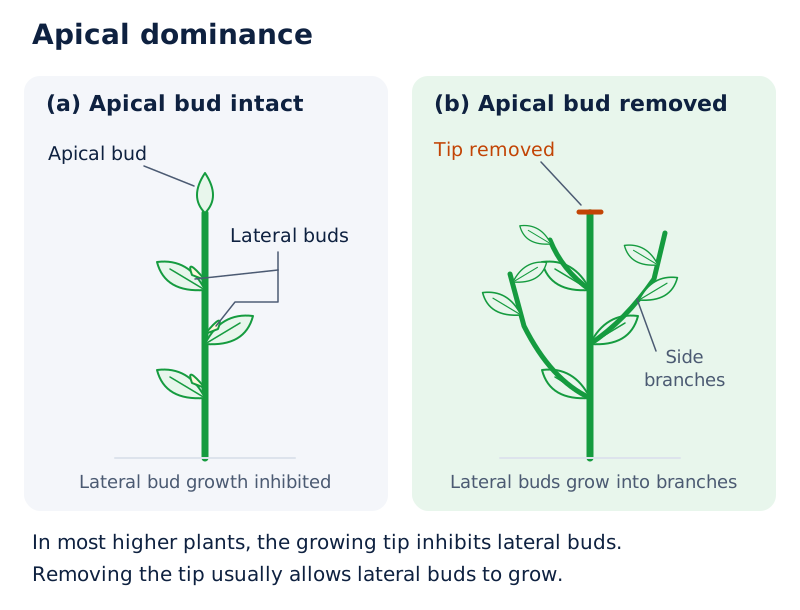
The drawing compares plant (a), with its apical bud intact, and plant (b), with the apical bud removed. The second plant shows lateral buds growing into branches.
Drawn by One Young India.
Removal of shoot tips is widely used in tea plantations and hedge-making. The connection is the growth of lateral buds after the influence of the shoot tip is removed. Branching, rather than continued growth of the main tip alone, is the relevant response.
Auxin also links chemical coordination with responses to light. When light reaches a shoot from one side, auxin moves towards the shaded side. Unequal elongation on the two sides then changes the direction of shoot growth.
Note: Preventing early leaf drop and promoting the shedding of older mature leaves are both auxin effects. The age of the plant part is essential to explaining the apparent difference.
How do gibberellins promote elongation and affect plant development?
Gibberellins are growth-promoting regulators that help stems grow. They can increase the length of the plant axis, meaning the main line of a stem or other elongated plant part. Their effects also include changes in fruit shape and the timing of senescence.
Elongation and its applications
The ability to increase length is used to increase the length of grape stalks. Gibberellins also cause fruits such as apples to elongate and improve their shape. These are specific applications of their effects on growth.
Sugarcane stores sugar in its stems. Spraying the crop with gibberellins increases stem length and thereby increases yield. The connection is between an elongated stem and the plant part in which sugar is stored.
Bolting and delayed senescence
A node is a place on a stem where a leaf arises, and an internode is the region between two nodes. Bolting means internode elongation just before flowering. Gibberellins promote bolting in beet and cabbages.
Bolting concerns the elongation between leaf-bearing points before flowering. Its definition includes both a change in stem structure and its timing. It should therefore be distinguished from a general increase in leaf size or from growth described without reference to flowering.
Gibberellins also delay senescence. Fruits can consequently remain on the tree longer, extending the period during which they can be marketed. This is a different effect from ethylene's promotion of fruit ripening.
The functions of gibberellins should therefore be grouped into related ideas: elongation of stems and stalks, changes in fruit shape, bolting before flowering and delayed ageing. A description restricted to “makes the plant taller” misses several of these effects.
How do cytokinins influence cell division and leaf ageing?
Cytokinins promote cell division. They help increase cell number by promoting the production of new cells through division. Cell division increases the number of cells, while elongation makes existing cells longer.
Sites of production and growth effects
Natural cytokinins are synthesised, or produced, in regions where rapid cell division occurs. Examples include root apices, developing shoot buds and young fruits. Their association with these regions fits their role in promoting cell division.
Cytokinins help produce new leaves and chloroplasts in leaves. Chloroplasts are cell structures containing the green pigment involved in photosynthesis, the process by which plants use light energy to make food. Cytokinins also promote lateral shoot growth.
They help overcome apical dominance. This connects their activity with the balance between the growing shoot tip and the lateral buds. The growth of side shoots is therefore influenced by more than one type of regulator.
Delayed leaf senescence
Cytokinins promote nutrient mobilisation, the movement of nutrients within the plant. This helps delay leaf senescence. Their role is therefore broader than initiating cell division: they also influence how long leaves remain functional before ageing.
Both cytokinins and gibberellins can delay senescence, but their other characteristic effects differ. Cytokinins are especially associated with cell division and lateral shoot growth. Gibberellins are associated with elongation of the axis and bolting.
These overlapping effects illustrate a general principle of chemical coordination. A developmental change need not belong exclusively to one hormone. Leaf ageing and the growth of buds involve interactions among regulators, rather than a separate chemical controller for every single activity.
Why is abscisic acid called the stress hormone?
Abscisic acid, abbreviated ABA, acts as a general plant growth inhibitor. Its effects include inhibition of seed germination and increased tolerance of various stresses.
Stomatal closure and stress tolerance
Stomata are small pores in leaves through which gases are exchanged and water vapour can escape. ABA stimulates their closure. It is called the stress hormone because it increases the tolerance of plants to various kinds of unfavourable conditions.
Growth inhibition is therefore part of useful regulation. Plant responses are not limited to making every organ grow faster. Restricting growth and changing the behaviour of leaf pores can be important components of a response to adverse conditions.
Seed maturation and dormancy
ABA plays an important role in seed development, maturation and dormancy. It inhibits germination. By inducing dormancy, it helps seeds withstand desiccation, meaning drying out, and other factors that are unfavourable for growth.
A dormant seed has suspended growth. This state must be distinguished from active germination. ABA's involvement in dormancy connects the regulation of growth with the persistence of seeds through unsuitable conditions.
In most situations, ABA acts as an antagonist to gibberellins. An antagonist is something that opposes another's action. The qualification “most situations” must be retained; it does not mean that the two regulators oppose each other in every possible response.
Note: “Growth inhibitor” describes an effect on growth, not a substance that is necessarily harmful to the plant. ABA contributes to stress tolerance and helps dormant seeds withstand conditions unfavourable for growth.
How does ethylene regulate ripening, ageing and growth?
Ethylene is a simple gaseous plant growth regulator. It is synthesised in large amounts by ripening fruits and tissues undergoing senescence. A tissue is a group of cells organised to perform a particular function. Its gaseous nature distinguishes it from the other major regulator groups considered here.
Fruit ripening and abscission
Ethylene is highly effective in fruit ripening, the changes by which a fruit becomes ripe. It enhances the rate of respiration during ripening. Respiration is the cellular process that releases energy from food.
It also promotes senescence and abscission of plant organs, especially leaves and flowers. These effects explain why ethylene is largely grouped with growth inhibitors, although that description does not cover every one of its actions.
Effects that promote growth
Ethylene breaks seed and bud dormancy. It initiates germination in peanut seeds and growth from buds in potatoes.
Ethylene also promotes root growth and root hair formation. Root hairs are thin outgrowths of root surface cells. Their formation increases the surface available for absorption, showing that ethylene can promote particular growth activities.
In deep water rice plants, ethylene promotes rapid elongation of internodes and petioles, the stalks attaching leaves to stems. This helps the leaves and upper parts of the shoot remain above water.
Ethylene can therefore fit either the promoting or inhibiting group, but is largely an inhibitor of growth activities. A complete description keeps both parts of this statement: its broad classification and its growth-promoting effects.
Ripening, abscission and dormancy are separate processes. Ethylene can promote the first two while breaking the third. Recognising the process named in a description is more useful than assuming that a single label predicts all of the hormone's effects.
What are tropic movements and how are they classified?
Definition: A tropic movement, or tropism, is a directional growth response to a stimulus. Growth may occur towards the stimulus or away from it, changing the direction of the growing plant part.
Positive tropism means growth towards the stimulus, while negative tropism means growth away from it. Positive and negative describe direction. They do not mean that the response is beneficial or harmful.
Five kinds of tropism
Phototropism is a growth response to light. Geotropism is a growth response to gravity, the Earth's pull. Hydrotropism is a growth response to water. Thigmotropism is a growth response to touch or contact, and chemotropism is a growth response to chemicals.
A tendril is a slender coiling plant structure used for support. A pollen tube is the tube growing from a pollen grain that carries male reproductive cells towards an ovule, the structure containing the female reproductive cell.
| Tropic movement | Stimulus | Suitable example |
|---|---|---|
| Phototropism | Light | A shoot bends towards light; roots bend away from it |
| Geotropism | Gravity | Roots grow downwards; shoots usually grow upwards |
| Hydrotropism | Water | Roots grow towards a source of water |
| Thigmotropism | Touch or contact | A pea tendril grows around a support |
| Chemotropism | Chemicals | A pollen tube grows towards an ovule |
Identifying the response
First identify the stimulus, then identify the plant part and its direction of growth. The stimulus gives the name of the tropism. The direction relative to that stimulus determines whether the response is positive or negative.
A single plant can show contrasting responses in different parts. The shoot and root need not grow in the same direction when responding to light or gravity. The response belongs to the specified plant part, rather than to the entire plant without qualification.
How does auxin cause a shoot to bend towards light?
A growing shoot responds to light from one side by bending towards it. This is positive phototropism. The movement involves unequal growth on the two sides of the shoot, coordinated by auxin produced at the shoot tip.
The sequence of the response
- The growing shoot detects light, and auxin synthesised at its tip helps shoot cells become longer.
- When illumination comes from one side, auxin diffuses towards the shaded side. Diffusion is movement from a region of higher concentration towards a region of lower concentration. Here, concentration means the amount of a substance in a given volume.
- The greater amount of auxin on the shaded side stimulates greater cell elongation there than on the illuminated side.
- This unequal elongation causes the growing shoot to bend towards the light source.
The shaded side grows more, but the shoot bends towards the light. Confusing the side with greater elongation and the direction of bending reverses the explanation. The hormone's distribution links the one-sided stimulus to unequal growth.
Demonstrating the response
- Fill a conical flask with water and cover its neck with wire mesh. Place two or three freshly germinated bean seeds on the mesh.
- Put the flask in a cardboard box open on one side, with the opening facing light from a window.
- After two or three days, observe the shoots bending towards the light and the roots bending away from it.
- Turn the flask so that the shoots face away from the light and the roots face towards it. Leave it undisturbed for a few days and compare old parts with the direction of new growth.
What the figure shows
Response to the direction of light
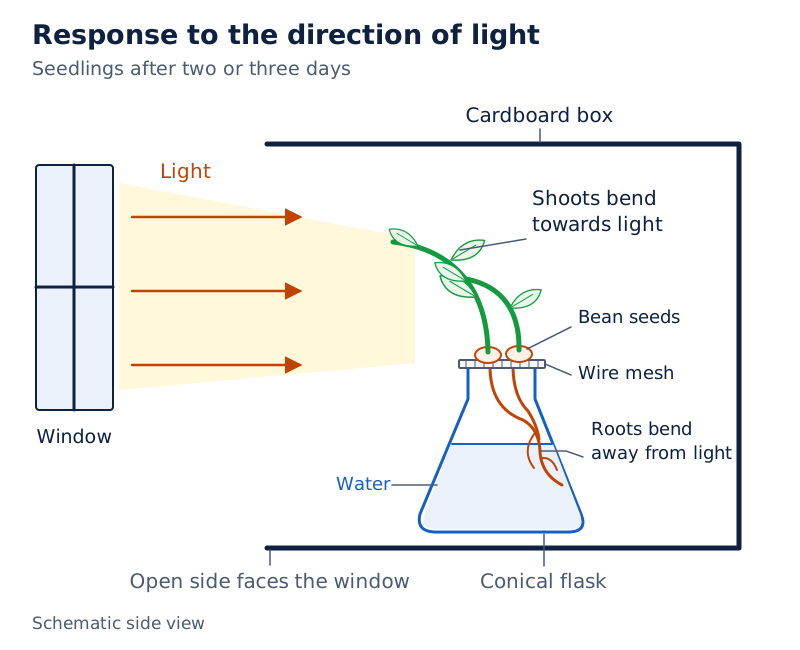
The drawing shows a flask containing seedlings inside an open-sided box beside a window. A yellow beam indicates the incoming light, and the shoots bend towards the illuminated opening.
Drawn by One Young India.
The activity separates the position in which the plant is placed from its growth response. Turning the flask changes the relation between the seedling and the light source. Comparing new growth with older parts focuses attention on movement caused by growth.
Note: This explanation concerns elongation in a shoot. The observation that roots bend away from light should not be explained by copying the shoot's auxin response without qualification.
How do gravity, water and chemicals guide plant growth?
Different environmental signals can influence the direction of growth. Gravity gives a downward reference, water provides the stimulus for hydrotropism, and chemical substances provide the stimulus for chemotropism. The name of a response depends on the stimulus being considered.
Geotropism in roots and shoots
The roots of a plant grow downwards in response to gravity. This is positive geotropism. Shoots usually grow upwards, away from the Earth's pull, and therefore show negative geotropism. The word “usually” qualifies the description of shoot growth.
What the figure shows
A plant showing geotropism
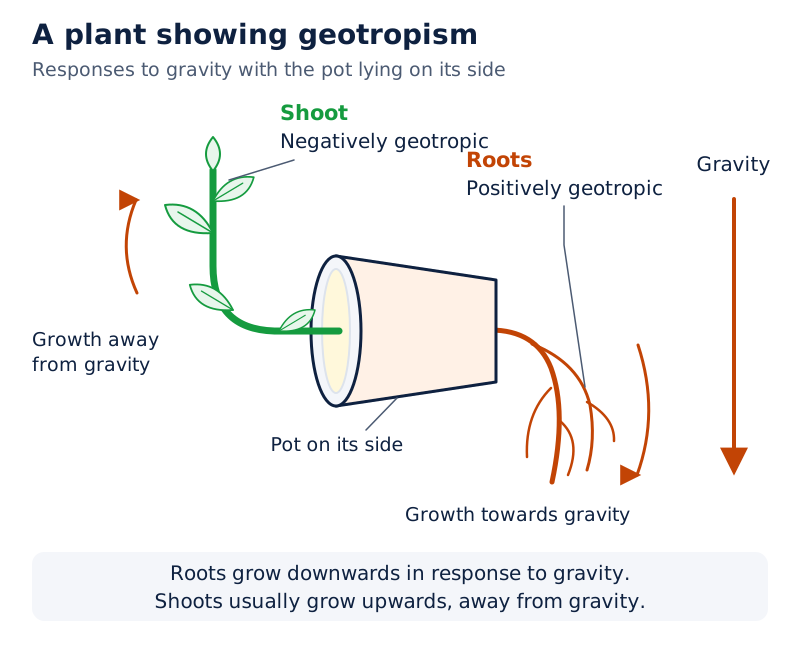
The drawing shows a pot lying on its side. The roots curve downwards and are labelled “Positively geotropic”. The shoot curves upwards and is labelled “Negatively geotropic”.
Drawn by One Young India.
The sideways position makes the contrast visible. Root growth is towards gravity, while the shoot turns upwards. The two responses should be named separately, since the root and shoot have different directions relative to the same stimulus.
Hydrotropism towards water
Positive hydrotropism is illustrated by roots growing towards a source of water. The important feature is directional growth in relation to water. Simply stating that roots absorb water does not describe the direction of their growth.
Hydrotropism and geotropism must therefore be distinguished by their stimuli. A description involving gravity concerns geotropism; one involving growth towards water concerns hydrotropism. The word “root” alone does not identify which response is being described.
Chemotropism towards an ovule
The growth of a pollen tube towards an ovule is an example of chemotropism. It is a directional growth response associated with chemical stimulation. This example concerns a reproductive structure rather than the orientation of a root or leafy shoot.
Across these examples, the common feature is growth in a direction related to a stimulus. The stimulus differs, but the method of describing the response remains consistent: name the stimulus, identify the responding part and state its direction.
How does a tendril coil, and how is this different from rapid leaf folding?
Pea plants can climb other plants or fences using tendrils. These structures are sensitive to touch. Contact with a support changes the relative growth rates on opposite sides of the tendril, causing it to curve around the object.
Coiling by unequal growth
- A tendril comes into contact with a support, such as another plant or a fence.
- The part touching the object does not grow as rapidly as the part away from the object.
- Unequal growth on the two sides causes the tendril to curve and circle around the support.
- The tendril consequently clings to the object, helping the plant climb.
This is thigmotropism, a directional growth response to contact. The contacting side is slower-growing. It should not be described as the side that grows faster and pushes the tendril away from its support.
Movement without growth
The sensitive plant, or touch-me-not plant of the Mimosa family, folds and droops its leaves quickly when touched. This movement does not involve growth. Plant cells change shape through changes in their water content, swelling or shrinking as water amounts change.
Information about touch is communicated from cell to cell by electrical-chemical means. Plants do not have specialised nervous tissue for conducting this information. Their cells can nevertheless communicate and bring about a coordinated response.
The contrast is therefore between unequal growth in a tendril and a change in cell shape during rapid leaf movement. Both begin with touch, but sharing a stimulus does not mean that the movements use the same mechanism.
To recognise a tropic response, establish that the movement involves directional growth. The mere fact that a leaf or tendril moves after contact is insufficient to classify both movements together as thigmotropism.
Glossary
- Plant growth regulator — A small, simple chemical molecule influencing growth, development and responses in plants.
- Auxin — A plant growth regulator involved in shoot cell elongation, rooting and other growth responses.
- Gibberellin — A growth-promoting plant regulator associated with stem elongation, bolting and delayed senescence.
- Cytokinin — A plant growth regulator promoting cell division, lateral shoot growth and delayed leaf senescence.
- Abscisic acid — A growth-inhibiting plant regulator involved in seed dormancy, stomatal closure and stress tolerance.
- Ethylene — A gaseous plant growth regulator involved in ripening, senescence, abscission and certain growth-promoting responses.
- Apical dominance — Inhibition of lateral bud growth by the growing apical bud in most higher plants.
- Dormancy — A period of suspended growth or rest in a plant structure such as a seed.
- Abscission — The shedding of plant parts such as leaves, flowers or fruits.
- Senescence — The ageing stage in plant development that leads towards death.
- Phototropism — Directional growth in response to light, either towards it or away from it.
- Geotropism — Directional growth in response to gravity, with roots and shoots showing contrasting responses.
- Hydrotropism — Directional growth in response to water, illustrated by roots growing towards a water source.
- Thigmotropism — Directional growth in response to contact, as when a tendril coils around a support.
- Chemotropism — Directional growth in response to chemicals, illustrated by pollen tube growth towards an ovule.
Common errors and misconceptions
- Misconception: Every growth regulator promotes growth. Correct: ABA acts as a general growth inhibitor, and ethylene is largely an inhibitor despite having growth-promoting effects.
- Misconception: Auxins prevent all leaf and fruit drop. Correct: They help prevent early drop but promote abscission of older mature leaves and fruits.
- Misconception: Removing a shoot tip always produces side branches. Correct: Tip removal usually results in lateral bud growth; apical dominance occurs in most higher plants.
- Misconception: The illuminated side of a shoot elongates more during bending towards light. Correct: Auxin accumulates on the shaded side and stimulates greater elongation there.
- Misconception: Positive tropism means useful movement. Correct: Positive means growth towards a stimulus, while negative means growth away from it.
- Misconception: All movements caused by touch are thigmotropic. Correct: Tendril coiling involves growth, whereas rapid folding of sensitive-plant leaves does not.
- Misconception: ABA always opposes gibberellins. Correct: ABA acts as an antagonist to gibberellins in most situations, rather than in every possible situation.
Exam-style questions with model answers
Q1. A shoot grows towards light, while a root grows away from light. Name the tropism and its direction in each plant part. [2 marks]
- The shoot shows positive phototropism because its growth is towards the light stimulus.
- The root shows negative phototropism because its growth is away from the light stimulus.
Q2. A pea tendril touches a support. The contacting side grows more slowly than the side away from the support. Name the tropism and explain the resulting shape. [2 marks]
- The response is thigmotropism because contact with a support produces directional growth in the tendril.
- Unequal growth causes the tendril to curve around the support, since the side away from contact grows faster.
Q3. A regulator inhibits seed germination, stimulates stomatal closure and helps dormant seeds withstand drying out. Identify the regulator, explain its “stress hormone” name and explain the value of dormancy here. [3 marks]
- The regulator is abscisic acid, abbreviated ABA. The stated inhibition of germination and stimulation of stomatal closure are characteristic effects of this hormone.
- ABA is called the stress hormone because it increases plant tolerance of various stresses. Stimulation of stomatal closure is one of its physiological effects.
- By inducing dormancy, ABA helps seeds withstand desiccation, or drying out. This suspended growth helps seeds withstand conditions that are unfavourable for growth.
Q4. A shoot receives light from one side. Auxin is produced at its tip, diffuses towards the shaded side and promotes elongation of shoot cells. Explain the bending response in four linked points. [4 marks]
- Auxin is synthesised at the growing shoot tip and helps shoot cells become longer, providing the chemical influence on growth in this response.
- Because light arrives from one side, auxin diffuses towards the shaded side of the shoot, producing an unequal distribution between the two sides.
- The greater amount of auxin stimulates more cell elongation on the shaded side than on the illuminated side, so growth becomes unequal.
- Unequal elongation bends the shoot towards the light source. The resulting directional growth towards light is described as positive phototropism.
Q5. Five plant responses are observed: a shoot bends towards light; a root grows downwards in response to gravity; a root grows towards water; a pea tendril coils after contact with a support; and a pollen tube grows towards an ovule in response to chemicals. Classify and explain each response. [5 marks]
- The shoot shows positive phototropism. Light is the stimulus, and its growth towards that stimulus makes the response positive rather than negative.
- The downward-growing root shows positive geotropism. Its growth follows the direction of the Earth's gravitational pull, which is the stimulus specified here.
- The root growing towards water shows positive hydrotropism. This classification concerns growth direction in relation to water, rather than the absorption of water alone.
- The pea tendril shows thigmotropism. Contact with the support causes a directional growth response, producing coiling that enables the tendril to cling.
- The pollen tube shows chemotropism. Its growth towards the ovule responds to chemical stimulation, so the example concerns a chemically guided growth direction.
Q6. Identify the regulator associated with each observation and explain the link: initiation of roots in stem cuttings; bolting in cabbage; cell division and delayed leaf senescence; inhibited seed germination with stomatal closure; and accelerated fruit ripening with increased respiration. [5 marks]
- Auxins are associated with the initiation of roots in stem cuttings. This effect is used in plant propagation to help produce new plants from cut stems.
- Gibberellins promote bolting in cabbage. Bolting means elongation of the internodes just before flowering, linking the observation with gibberellin-promoted elongation of the axis.
- Cytokinins promote cell division and help delay leaf senescence. They promote nutrient mobilisation, which contributes to the delay in the ageing of leaves.
- Abscisic acid inhibits seed germination and stimulates stomatal closure. These effects fit its role as a general growth inhibitor and a regulator associated with stress tolerance.
- Ethylene is highly effective in fruit ripening and enhances respiration during that process. It is the gaseous growth regulator associated with the final observation.
Q7. In most higher plants, the growing apical bud inhibits lateral bud growth. Removing the tip usually allows lateral buds to grow. Name the phenomenon, explain the expected result of removal and state its use in tea plantations or hedge-making. [3 marks]
- The phenomenon is apical dominance: the growing apical bud inhibits lateral bud growth. The qualification “most higher plants” limits the scope of the statement.
- Removal of the shoot tip, called decapitation, usually results in lateral bud growth. The expected response is therefore the development of side branches.
- Tip removal is used in tea plantations and hedge-making because it usually encourages lateral bud growth and branching after the apical bud is removed.
Q8. A pea tendril coils after contact because its contacting side grows more slowly. Sensitive-plant leaves fold rapidly after touch because cells change water content and shape, without growth. Give four contrasts between these responses. [4 marks]
- Tendril coiling depends on unequal growth, whereas folding of the sensitive-plant leaves does not involve growth. This is the central difference between the mechanisms.
- In the tendril, the side away from the support grows faster. In the leaf response, cells change shape by swelling or shrinking as their water content changes.
- Tendril coiling is a directional growth response called thigmotropism. The leaf-folding response cannot be classified as thigmotropism merely because touch also triggers it.
- The tendril gradually grows around and clings to a support. The sensitive-plant leaves fold rapidly, illustrating a much quicker movement that is independent of growth.
Key takeaways
- Plant growth regulators coordinate growth, development and environmental responses; several regulators can influence the same developmental event.
- Auxins promote shoot cell elongation and rooting, while their effects on leaf and fruit shedding depend on developmental stage.
- Gibberellins promote elongation and bolting; cytokinins promote cell division, lateral shoot growth and delayed leaf senescence.
- Abscisic acid inhibits germination, stimulates stomatal closure and helps dormant seeds withstand drying and other unfavourable conditions.
- Ethylene promotes fruit ripening and abscission, but also has growth-promoting effects despite being largely a growth inhibitor.
- Tropic movements are directional growth responses: the stimulus identifies the type, while growth towards or away identifies the direction.
- In shoot phototropism, auxin accumulates on the shaded side, causing greater elongation there and bending towards light.
- Tendril coiling involves unequal growth, while rapid folding of sensitive-plant leaves involves water-related changes in cell shape.
Test yourself
Why is chemical coordination possible without muscles or a nervous system?
Plant hormones influence growth and responses, and plant cells communicate. Movement can result from unequal growth or from water-related changes in cell shape.
Which side of a shoot elongates more when light comes from one side?
The shaded side elongates more because auxin accumulates there and stimulates shoot cells to grow longer.
What is bolting, and which regulator promotes it?
Bolting is internode elongation just before flowering. Gibberellins promote it in plants such as beet and cabbage.
Why is it inaccurate to call ethylene exclusively a growth inhibitor?
Ethylene is largely an inhibitor, but it also promotes root growth and root hair formation and breaks seed and bud dormancy.
What is apical dominance, and what usually happens after removal of the tip?
In most higher plants, the growing apical bud inhibits lateral buds. Removing the tip usually allows lateral buds to grow.
How does hydrotropism differ from geotropism?
Hydrotropism is directional growth in response to water, whereas geotropism is directional growth in response to gravity.
Which regulator stimulates stomatal closure and inhibits seed germination?
Abscisic acid has both effects and is also associated with seed dormancy and increased stress tolerance.
Why are tendril coiling and sensitive-plant leaf folding different responses?
Tendril coiling depends on unequal growth after contact. Rapid leaf folding depends on water-related changes in cell shape and does not involve growth.
Write about it
Turn a question from this chapter into a paper.
The Writing Studio has a structure guide, a rubric and citation tools for 15 formats, from essays to research papers. Drafting is free with an account. Learnacy Essential adds feedback from an AI writing coach and submission to The OYI Review.
Learnacy Essential is ₹1,499 for the year. Publication depends on review and is not guaranteed.