
Legislature | CBSE Class 11 Political Science Notes
On this page
Watch & explore
Start with a few high-quality watches, then dive into the notes below.

This note covers the need for a legislature, the two Houses of Parliament, their composition and powers, parliamentary functions, types of bills, law making, control over the executive, parliamentary committees, orderly proceedings and the anti-defection law.
Why does a democracy need a legislature?
A legislature is a representative institution that makes laws and performs other democratic functions. Parliament is the national legislature. A State legislature works at the State level. Legislatures elected by the people act on their behalf and help people hold representatives accountable.
Accountability means having to answer for decisions and actions. A legislature provides a public setting for this responsibility. It brings together different interests, examines government policies and allows disagreement to become part of democratic decision making.
Why is law making only part of its work?
A legislature is the centre of democratic political activity. Debate, protest, walkouts, agreement and cooperation all have roles within it. A walkout is a departure from proceedings to register protest. These activities cannot be understood simply by counting laws passed.
A representative, efficient and effective legislature is essential to genuine democracy. Its composition makes it the most representative organ of government. It offers an open forum where the government's actions can be questioned and the concerns of different groups can be expressed.
Does a strong executive make Parliament unnecessary?
The executive is the branch that carries out government policies and administration. The Cabinet, the leading ministerial body, initiates policies and sets the governing agenda. In most democracies, legislatures are losing their central place to the executive.
Even a strong Cabinet must retain a majority in the legislature. A strong leader must face Parliament and answer it satisfactorily. Parliament's power to choose and dismiss the government gives it democratic importance even when ministers dominate policy preparation.
Note: Executive initiative does not remove legislative responsibility. Parliament's democratic potential rests on representation, open debate and the ability to hold the government responsible.
The diversity of members also matters. Representatives bring different regional, religious, caste and social backgrounds into public discussion. Their presence makes the legislature more representative and potentially more responsive to people's expectations. Bitter disagreement does not by itself erase this representative function.
Why are there two Houses, and how does bicameralism work?
Definition: A bicameral legislature has two Houses. A unicameral legislature has one House. India's Parliament has the Rajya Sabha, or Council of States, and the Lok Sabha, or House of the People.
Countries with a large size and much diversity usually prefer two national legislative Houses. This helps provide representation to different sections of society and geographical regions. A second House also makes reconsideration possible when the first House has acted in haste.
The two-House arrangement provides a double check through discussion in both Houses. However, the Houses do not have identical powers in every matter. The special procedure for money bills limits the role of the Rajya Sabha, as explained below.
Which States have two Houses?
The Constitution gives States the option of a unicameral or bicameral legislature. The six States with bicameral legislatures are Andhra Pradesh, Bihar, Karnataka, Maharashtra, Telangana and Uttar Pradesh. The State Legislative Assembly is the directly elected legislative body at State level.
Purnima Banerji, speaking in the Constituent Assembly on 30 July 1949, supported the useful revising role of an Upper House. She also saw value in advice from people unable to participate in the rough and tumble of active politics.
How does Germany provide a comparison?
A coalition is an alliance of parties. Germany illustrates how two Houses can connect national law making with its constituent states, including situations where coalition partners at state level disagree over their voting instructions.
| Feature | German arrangement |
|---|---|
| Federal Assembly | The Bundestag is elected for four years through a complex combination of direct and proportional representation, combining direct choice with representation in proportion to electoral support. |
| Federal Council | The Bundesrat represents Germany's 16 federal states. Its 69 seats are divided according to population ranges. |
| Membership | Members are generally state ministers appointed by the governments of the federal states, rather than elected to this Council. |
| Voting | Members from one state vote as a bloc, meaning together, under their state government's instructions. Coalition disagreement may cause abstention, or not voting. |
| Legislative role | It does not vote on every legislative initiative. It must approve, and can veto or block, legislation in the specified policy areas where states share powers and responsibility for federal regulations. |
How are the Rajya Sabha and Lok Sabha constituted?
What is the basis of Rajya Sabha representation?
The Rajya Sabha represents States and is indirectly elected. People elect members of the State Legislative Assembly. The elected Assembly members, also called MLAs, then elect Rajya Sabha members. The two steps distinguish this arrangement from direct election by citizens.
Symmetrical representation gives every constituent part equal representation irrespective of size or population. In the United States of America, every state has equal representation in the Senate, its second legislative chamber. India follows a different approach for the Rajya Sabha.
The Fourth Schedule, a part of the Constitution listing State seat allocations, fixes the number elected from each State. More populous States receive more representatives. The comparison of Uttar Pradesh's population of 1998.12 lakhs with Sikkim's 6.10 lakhs illustrates the difference; a lakh means 100,000.
Uttar Pradesh sends 31 members to the Rajya Sabha, while Sikkim has one seat. Giving both equal seats would disregard the large population difference. This illustrates why the framers chose population-based differences instead of the American principle of equal State representation.
How do membership and duration differ?
| Feature | Rajya Sabha | Lok Sabha |
|---|---|---|
| Election | State representatives are elected indirectly by elected Assembly members. | Representatives are directly elected by the people. |
| Term | Members serve six years and can be re-elected. | Elected for five years, with the possibility of earlier dissolution. |
| Continuity | One third complete their terms every two years; the House is never fully dissolved. | The House can be dissolved before completing five years. |
| Additional membership feature | The President nominates twelve people distinguished in literature, science, art or social service. | One representative is elected from each of 543 territorial constituencies. |
Dissolution ends the life of a House before a new election. The Rajya Sabha is a permanent House, so it can meet for urgent business even when the Lok Sabha has been dissolved and elections have not yet occurred.
A constituency is a territorial area electing a representative. Lok Sabha constituencies have roughly equal populations. Universal adult suffrage gives adults the vote, with each individual's vote carrying equal value. The number of constituencies has not changed since the 1971 census.
The Lok Sabha may be dissolved early if no party or coalition can form a government, or if the Prime Minister advises the President to dissolve it and hold fresh elections. Five years is therefore not a guaranteed term.
What functions does Parliament perform beyond making laws?
Parliament combines law making with representation, discussion, financial scrutiny and control of government. Its functions also include constitutional change, elections and consideration of removal from certain high offices. Treating it solely as a law-making body overlooks much of its democratic work.
How are laws, money and responsibility connected?
A special majority is the particular majority required for constitutional amendments. A budget sets out government finances, including the resources needed for programmes.
| Function | What Parliament does |
|---|---|
| Legislative | Enacts laws, although the bureaucracy, or administrative officials, drafts bills under the responsible minister and the Cabinet decides their substance and timing. |
| Executive accountability | Checks that the executive does not exceed its authority and remains responsible to the people. |
| Financial | Controls taxation, grants resources and examines government spending through the budget and annual financial statements. |
| Representative | Expresses divergent regional, social, economic and religious views from different parts of the country. |
| Debating | Provides the highest forum for discussion of matters facing the nation, allowing members to speak without fear. |
| Constituent | Discusses and enacts constitutional amendments, meaning changes to the Constitution, requiring a special majority in both Houses. |
| Electoral | Performs electoral functions in the election of the President and Vice President. |
| Judicial | Considers proposals to remove the President, Vice President and judges of the High Courts and Supreme Court. |
New taxation proposed by the Government of India requires Lok Sabha approval. The government must account for money spent and explain the resources it wishes to raise.
The constituent powers of the Houses are similar. Both Houses must approve such amendments. Legislative approval and constitutional amendment are therefore distinct functions even though both involve parliamentary decisions.
Why does debate matter?
Discussion allows members to analyse national issues and express competing viewpoints. These discussions are central to democratic decision making. Financial examination likewise concerns both the proper use of money and the policies for which money is requested.
What the figure shows
Parliament's financial authority
Cartoon: Shankar's cartoon dated 3 April 1955 shows ministers standing deferentially before a seated figure beneath a Parliament sign. Caption: “The Parliament is the boss and the ministers are looking very humble here. That is the effect of the Parliament’s power to sanction money to different ministries.”
Reference: NCERT Class 11, page 108, unnumbered
How do the powers of the Lok Sabha and Rajya Sabha differ?
The Houses share important powers, but direct election gives the Lok Sabha a stronger position in government survival and finance. The Rajya Sabha represents States and provides reconsideration. These different foundations explain why equality between the Houses is not complete.
Which powers are shared, and which are distinct?
A motion is a proposal placed before the House for consideration; a resolution expresses a decision or position of the House. A no-confidence motion tests whether the government retains the Lok Sabha's support. The Council of Ministers, the ministerial executive, is responsible to the Lok Sabha.
| Matter | Lok Sabha | Rajya Sabha |
|---|---|---|
| Non-money bills | Considers and passes them. | Considers and passes them with co-equal powers. |
| Constitutional amendment | Must approve through the required special majority. | Must also approve through the required special majority. |
| Money bills | Introduces and passes them; may accept or reject suggested changes. | May suggest changes but cannot initiate, reject or amend them. |
| Executive scrutiny | Uses questions, supplementary questions, resolutions and motions. | Uses questions, motions and resolutions to scrutinise government. |
| Government survival | Can remove the government through a no-confidence motion. | Can criticise the government but cannot remove it. |
| Removal of Vice President | Participates in removal. | Alone can initiate the removal procedure. |
What special role protects States?
The State List covers matters assigned to State law making. The Union List covers Union legislative matters; the Concurrent List covers matters on which Union and State legislatures share law-making power. The Rajya Sabha can authorise Parliament to legislate on State List matters.
This consent protects State powers when national interests require Union action in this field. However, experience shows that Rajya Sabha members represent their parties more than their States. Formal State representation does not automatically overcome party loyalty.
The Lok Sabha also approves emergency proclamations, establishes committees and commissions, and considers their reports. Both Houses participate in presidential impeachment, the constitutional removal process, and in removing the Vice President. Their non-money legislative and constituent powers are co-equal.
The stronger Lok Sabha role in finance and dismissal follows the principle that people are the final authority. Their directly elected representatives receive the crucial powers to control money and remove the government.
How is a bill prepared before it reaches Parliament?
Definition: A bill is a draft of a proposed law. A Government Bill is introduced by a minister; a private member's bill is proposed by a member who is not a minister.
The distinction between government and private member's bills concerns who proposes them. A money bill concerns specified financial matters and follows a special procedure; a non-money bill follows the other legislative route. A Constitution Amendment Bill proposes a constitutional change.
What political discussion precedes drafting?
Discussion may begin well before formal introduction. A political party may press for legislation to fulfil election promises or improve its prospects in forthcoming elections. Interest groups, the media and citizens' forums may also persuade the government to legislate.
The Cabinet considers the resources required, likely support and opposition, and the effects on electoral prospects. In coalition politics especially, a government bill has to be acceptable to all coalition partners. Law making is therefore a political course of action as well as a legal procedure.
Who prepares the draft?
- Identify the need: Public demands, party commitments and political discussion may create pressure for a proposed law.
- Consider the policy: The Cabinet assesses practical and political considerations before approving the policy behind legislation.
- Prepare the draft: The concerned ministry drafts the bill; administrative officials work under ministerial supervision.
- Introduce the proposal: A member presents the bill in Parliament, often the minister responsible for its subject.
For example, a proposal to raise girls' marriageable age from 18 to 21 would be prepared by the law ministry, with the ministry of women and child welfare possibly involved.
No major bill is introduced without Cabinet approval. Although non-ministers may introduce bills, these have no chance of passing without government support. Parliament often approves legislation whose detailed preparation has already occurred within the executive.
How does a proposed bill become law?
Law making follows a definite procedure, partly laid down in the Constitution and partly developed through conventions, or established practices. A non-money bill may begin in either House. A money bill may be introduced only in the Lok Sabha.
What are the main stages for a non-money bill?
- Introduction: A member introduces the bill in either House, beginning its formal parliamentary consideration.
- Examination: The House may discuss the bill itself or refer it to a committee for detailed consideration.
- Report and discussion: A committee sends its recommendations to the House, which may or may not accept them. Detailed discussion examines the proposal.
- Voting: The bill's clauses are considered and voted upon, and the House accepts or rejects the bill.
- Other House: A passed non-money bill goes to the other House and through the same procedure. Disagreement may require a joint session.
- Presidential assent: After parliamentary passage, the bill goes to the President. Assent, meaning approval, turns the bill into law; the President may instead return the bill for reconsideration.
A joint session brings both Houses together to try to resolve a legislative deadlock, or disagreement preventing passage. In the few instances in which joint sessions have resolved deadlocks, decisions have always favoured the Lok Sabha. This observation describes experience, not a guarantee about every future decision.
What the figure shows
Passage of a bill
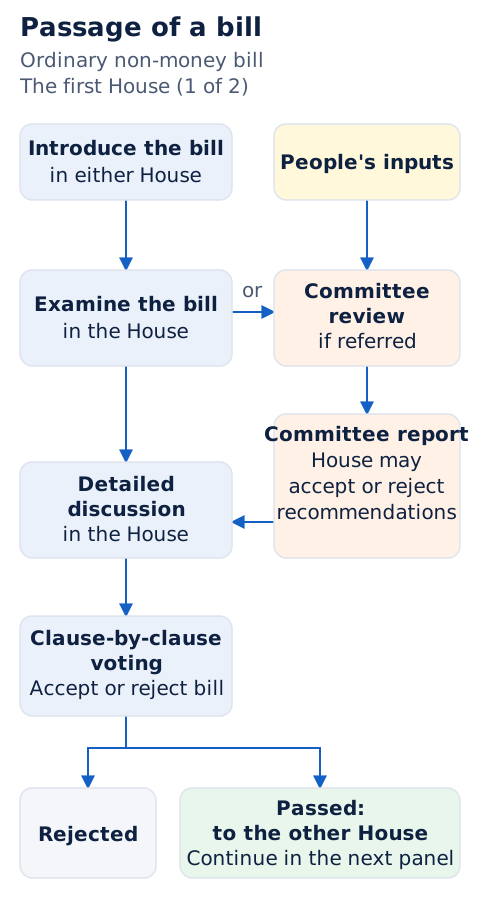
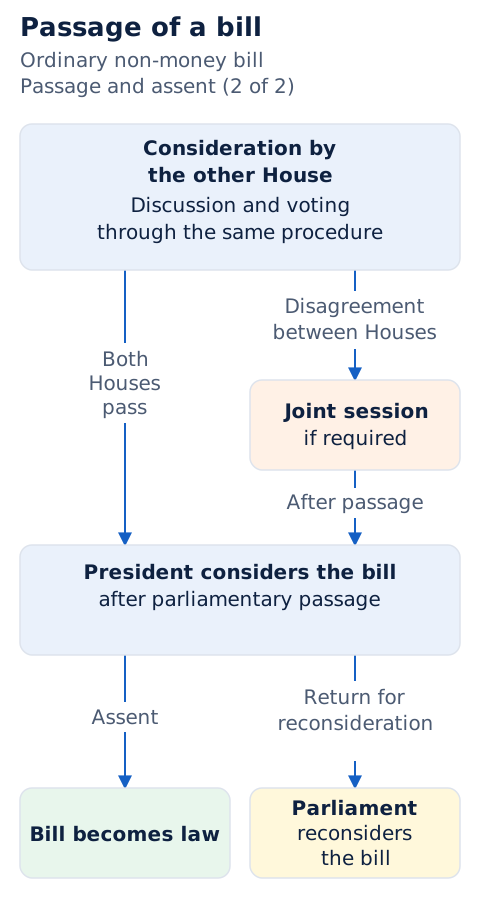
The flowchart links a bill with introduction, House or committee discussion, voting, the other House and presidential approval. It also shows people's inputs, the committee report, a joint session if required, and a return for reconsideration.
Drawn by One Young India. Reference: NCERT Class 11, page 111, unnumbered
What changes for a money bill?
Article 109(1), the constitutional provision for this special procedure, prohibits introduction of a money bill in the Council of States. After Lok Sabha passage, the Rajya Sabha may approve it or suggest changes, but cannot reject it.
If the Rajya Sabha takes no action within 14 days, the bill is deemed passed. The Lok Sabha may or may not accept its suggested changes. This distinguishes suggestions from a binding power to amend and prevents the second House from blocking a money bill.
How do discussion and legislative approval control the executive?
The executive comes from the party or coalition with a Lok Sabha majority. That majority may permit excessive executive power. Cabinet dictatorship describes the danger that the Cabinet leads while the House merely follows. Active and vigilant parliamentary scrutiny is needed to prevent this.
Why must members be free to speak?
Parliamentary privilege protects members in performing their representative work. No action can be taken against a member for what the member says in the legislature. The presiding officer, who chairs and regulates proceedings, has final powers over decisions concerning breach of privilege.
This freedom enables members to represent people and question executive conduct fearlessly. It concerns speech in the legislature; it is not a general claim that members may say anything anywhere without consequences.
| Instrument | How it supports scrutiny |
|---|---|
| Question Hour | Held every day during parliamentary sessions; ministers answer searching questions from members. |
| Zero Hour | Members raise matters they regard as important, though ministers are not bound to reply. |
| Other discussion | General debates, half-an-hour discussions on public matters and adjournment motions, proposals to interrupt normal business, provide further opportunities. |
| Approval or refusal of laws | The government needs parliamentary approval for legislation and may have to negotiate concessions. |
Perhaps Question Hour is the most effective way to watch the executive and administrative agencies. It attracts great interest and maximum attendance. Most questions seek information on public concerns such as price rises, food-grain availability, riots, black-marketing and atrocities against weaker sections.
Why cannot approval simply be assumed?
A disciplined government majority may make passage easier, but approval cannot be taken for granted: it results from intense bargaining within the ruling party, among coalition partners and between government and opposition. If the government has a majority in the Lok Sabha but not in the Rajya Sabha, it will be forced to make substantial concessions to gain approval in both Houses.
The Janata Party government in 1977 and the National Democratic Alliance government in 2000 illustrate a Lok Sabha majority without a Rajya Sabha majority. Earlier Lok Pal Bill proposals concerning a body to investigate corruption failed enactment; the Rajya Sabha rejected the Prevention of Terrorism bill in 2002.
Heated questions may lead members to raise their voices, approach the central area of the House or walk out. These actions consume legislative time, but many also serve as political techniques to gain concessions and enforce executive accountability.
How do financial control and parliamentary protests influence government?
Financial control links permission to raise and spend money with scrutiny of government policy. Preparing and presenting a budget for legislative approval is a constitutional obligation. Before granting funds, the Lok Sabha can examine why the government needs them.
The legislature may refuse resources, though this seldom happens because the government ordinarily enjoys majority support. It can investigate misuse through reports of the Comptroller and Auditor General, the public audit authority, and Public Accounts committees, parliamentary bodies examining public expenditure.
This examination concerns financial propriety, meaning proper use of public money, and the policies expressed in the budget. Controlling resources therefore gives the legislature a way to influence the government's programme, rather than simply check arithmetic.
What do the dated parliamentary examples show?
In these figures, Rs. denotes rupees, kg means kilogram, and paisa is a subdivision of the rupee. Urea is a fertiliser.
| Date | Event and significance |
|---|---|
| 28 February and 11 March 2002 | A budget proposal raised a 50 kg bag of urea by Rs. 12, with smaller increases for two other fertilisers, amounting to about 5 per cent. Intense opposition pressure led to rollback on 11 March. |
| 4 and 5 June 1998 | Opposition members staged walkouts over urea and petroleum price rises. Finance Minister Yashwant Sinha withdrew the proposed urea increase of 50 paisa per kilogram. |
| 22 February 1983 | The Lok Sabha unanimously suspended official business to give priority to Assam. Home Minister P. C. Sethi appealed for cooperation and harmony among communities. |
| 3 March 1985 | Congress members protested atrocities against Dalits in Andhra Pradesh, illustrating representatives raising social grievances. |
In February 2002, urea cost Rs. 4,830 per tonne and carried a subsidy, government financial support, of as much as 80 per cent.
When can the government lose office?
The no-confidence motion is the most powerful instrument of executive accountability. While a government retains the support of its party or coalition majority in the Lok Sabha, the House's power to dismiss it is fictional rather than real. After 1989, several governments had to resign after losing coalition partners' support and thus the confidence of the Lok Sabha.
Effective control requires time, interested participation and willingness to compromise. Fewer sittings, reduced debating time, boycotts and absence of quorum, the minimum attendance needed to conduct business, weaken scrutiny. Disruption can press a demand while also reducing opportunities for sustained discussion.
What do parliamentary committees contribute to legislative work?
Parliamentary committees are smaller groups assigned detailed legislative and scrutiny work. Parliament meets during sessions and has limited time. Preparing laws, examining departmental spending and investigating corruption require attention that full-House debate alone cannot always supply.
What work do standing and joint committees perform?
Standing committees supervise continuing areas of departmental work. The system developed since 1983 includes over twenty departmentally related committees. They examine departmental budgets, expenditure and bills relating to the departments under their supervision.
Joint Parliamentary Committees, abbreviated as JPCs, contain members selected from both Houses. They may be established to discuss a particular bill or investigate financial irregularities. Their joint membership distinguishes them from a group drawn from only one House.
- Study proposals: Detailed consideration examines the issues involved in a proposed law before the House makes its decision.
- Examine demands: Committees study demands for grants, the ministries' requests for funds needed for their work.
- Scrutinise expenditure: They examine spending already incurred by departments and may investigate corruption or financial irregularities.
- Report findings: Their recommendations return to Parliament for consideration, reducing the burden on the full House.
Do committees replace Parliament?
Committees are called miniature legislatures because much discussion of bills occurs within them. Their work makes parliamentary scrutiny more manageable, especially where an issue needs detailed study and sustained attention.
Parliament rarely rejects committee suggestions and has often approved their work with a few occasional alterations. Nevertheless, legal authority remains with Parliament: a bill cannot become law and a budget cannot be sanctioned without parliamentary approval.
Thus, committee influence and formal decision-making power must be distinguished. Detailed examination is delegated, but recommendations do not themselves enact legislation. Committees strengthen Parliament by doing preparatory and supervisory work that its limited session time makes difficult to complete in full meetings.
How does Parliament regulate itself and deal with defection?
Debate must be meaningful and orderly if Parliament is to perform its functions while maintaining its dignity. The Constitution provides for smooth conduct of business. The presiding officer is the final authority for regulating the legislature's proceedings.
In the Constituent Assembly on 18 November 1949, N. V. Gadgil distinguished procedural restrictions on the legislature from the broad scope of its substantive deliberation. Rules of procedure allow discussion to take place and support the institution's representative responsibilities.
What is the anti-defection law?
Defection concerns a legislator's departure from the party membership or directions under which the member serves. Most legislators are elected on a political party's ticket. Parties agreed that an elected member should be restricted from changing parties after election.
The 52nd Amendment Act, 1985 introduced the anti-defection amendment. The 91st Amendment subsequently modified it. The presiding officer makes the final decision on cases of defection.
The conduct treated as defection includes remaining absent when the party leadership requires attendance, voting against party instructions, and voluntarily leaving party membership. This is wider than simply announcing a move from one party to another.
What follows, and what are its limits?
If defection is proved, the member loses membership of the House and is disqualified from holding political office such as ministership. Disqualification means loss of eligibility to hold the relevant membership or office.
The experience assessed over twenty years shows that the anti-defection amendment has not been able to curb defections. It has, however, increased the powers of party leaders and presiding officers over members. Party discipline and a member's freedom therefore remain important questions.
What the figure shows
Ordered out
Cartoon: Irfan draws MPs leaving a doorway while another person faces them. The Hindi speech bubble says, in translation, “Not a walkout; we have been sent out!” Caption: “We are not walking out, we have been ordered out,” said the MPs. Why do you think such situations occur? The cartoon distinguishes voluntary protest from removal under instructions regulating proceedings.
Reference: NCERT Class 11, page 120, unnumbered
Parliament's democratic potential depends on both representation and effective work. Members from diverse backgrounds can express social interests and control the executive, but these opportunities need meaningful discussion, responsible participation and functioning procedures to produce an accountable government.
Glossary
- Legislature — A representative institution that makes laws, debates public affairs and holds government accountable.
- Bicameral legislature — A legislature with two Houses, allowing representation through different bases and reconsideration of decisions.
- Symmetrical representation — Equal representation for constituent parts of a country irrespective of their size or population.
- Universal adult suffrage — Voting by the adult population with equal value attached to each individual's vote.
- Bill — A draft of a proposed law submitted for legislative consideration and approval.
- Private member's bill — A proposed law introduced by a member of the legislature who is not a minister.
- Government Bill — A proposed law introduced in the legislature by a minister.
- Parliamentary privilege — Protection enabling legislators to represent people fearlessly, including protection for speech within the legislature.
- Question Hour — The daily parliamentary session period when ministers respond to members' searching questions.
- Zero Hour — An opportunity to raise important matters, during which ministers are not bound to reply.
- No-confidence motion — A motion testing the government's support in the Lok Sabha and potentially leading to its removal.
- Standing committees — Parliamentary groups supervising departments through scrutiny of their budgets, expenditure and related bills.
- Joint Parliamentary Committee — A committee with members from both Houses, formed for particular legislative or investigative purposes.
- Defection — Conduct including leaving party membership, disobeying voting instructions or ignoring required attendance in the House.
- Presiding officer — The authority responsible for regulating legislative business and deciding cases of defection.
Common errors and misconceptions
- Misconception: Parliament exists only to pass laws. Correct: Its work also includes debate, representation, financial control, executive accountability and constitutional, electoral and judicial functions.
- Misconception: Every State receives equal Rajya Sabha representation. Correct: Seat allocation differs with population; Uttar Pradesh sends 31 representatives while Sikkim sends one.
- Misconception: The permanent Rajya Sabha gives every member a permanent seat. Correct: Members serve six-year terms; one third complete their terms every two years.
- Misconception: The Lok Sabha necessarily lasts five years. Correct: It may be dissolved earlier, including when no party or coalition can form a government.
- Misconception: The Rajya Sabha can reject a money bill. Correct: It can suggest changes, which the Lok Sabha may accept or reject; inaction for 14 days results in deemed passage.
- Misconception: Ministers must answer during Zero Hour just as in Question Hour. Correct: Ministers are not bound to reply during Zero Hour.
- Misconception: Committee approval automatically makes a bill law. Correct: Committees recommend; parliamentary approval remains necessary, followed by presidential assent in the legislative process.
- Misconception: Defection means only joining another party. Correct: It also includes voluntarily leaving membership, disobeying voting instructions and absence despite party directions to attend.
Exam-style questions with model answers
Q1. Two Houses can represent different regions and social groups, and review one another's decisions. Explain two advantages of this arrangement. [2 marks]
- It provides a basis for representing different regions and sections of society in the national legislature.
- It allows reconsideration, so a decision taken hastily in one House can receive further discussion in the other.
Q2. Rajya Sabha members serve six years, and one third complete their terms every two years. Explain in two points why it is called a permanent House and why that matters. [2 marks]
- Staggered retirement means that only part of its membership changes at a time, so the Rajya Sabha is never fully dissolved.
- Its continuing existence allows it to meet for urgent business even when the Lok Sabha is dissolved and elections are pending.
Q3. A money bill has passed the Lok Sabha. The Rajya Sabha may suggest changes, cannot reject it, and has 14 days to act; the Lok Sabha need not accept suggestions. Explain three consequences of these rules. [3 marks]
- The Rajya Sabha can scrutinise the financial proposal and recommend changes, but it cannot use rejection to prevent the money bill from proceeding.
- The Lok Sabha retains the decisive role because it may accept or decline changes suggested by the Rajya Sabha.
- If the Rajya Sabha takes no action within 14 days, the bill is deemed passed; its inaction cannot delay the proposal indefinitely.
Q4. Ministers answer questions during Question Hour; Zero Hour allows important matters without compulsory ministerial replies; laws need parliamentary approval; and spending needs budget approval. Explain four methods of executive scrutiny illustrated here. [4 marks]
- Question Hour allows members to obtain information directly from ministers, question administrative conduct and bring constituents' concerns before the government.
- Zero Hour makes room for matters members consider important, extending public discussion even though ministers are not bound to respond.
- Legislative approval requires government proposals to face parliamentary consideration, creating opportunities for debate, negotiation and concessions before a bill becomes law.
- Budget approval allows Parliament to examine the purposes of expenditure and the policies represented by requests for financial resources.
Q5. Follow an ordinary non-money bill through these supplied stages: introduction in either House; committee or House examination; report and detailed discussion; clause-by-clause voting and a decision on the bill; consideration by the other House, with a possible joint session for disagreement; presidential assent. Explain the six stages in order. [6 marks]
- A member introduces the proposed law in either the Lok Sabha or the Rajya Sabha, beginning formal consideration of the bill.
- The House discusses the proposal itself or sends it to a committee, where detailed examination can receive additional time and attention.
- The committee reports its recommendations to the House. The House may accept or reject them while discussing the bill in detail.
- The House considers and votes on the bill's clauses and then decides whether to accept or reject the proposed legislation.
- A passed bill goes to the other House for consideration. Disagreement between the Houses may lead to a joint session to resolve the deadlock.
- After parliamentary passage, the bill is sent to the President. Presidential assent completes its enactment into a law.
Q6. Parliament has limited session time. Its committees study bills, departmental funding requests, expenditure and financial irregularities; they report recommendations, while parliamentary approval remains necessary. Explain five contributions or limits of the committee system. [5 marks]
- Committees reduce pressure on limited parliamentary time by moving detailed examination into smaller groups able to devote attention to particular issues.
- Study of proposed bills improves legislative examination before the full House considers the recommendations and takes its decision on the legislation.
- Examination of departmental funding requests enables closer scrutiny of the resources ministries seek for carrying out their work and programmes.
- Scrutiny of expenditure and financial irregularities supports oversight of how public money has been used, including investigation where necessary.
- Recommendations assist Parliament but do not replace its authority. Bills and budgets still require parliamentary approval, so committee conclusions are not automatically final.
Q7. The anti-defection rules cover absence despite party attendance instructions, voting against party directions and voluntarily leaving party membership. The presiding officer decides cases, and proved defection causes loss of membership and disqualification from political office such as ministership. Explain four features of this system. [4 marks]
- Required attendance is part of party discipline: remaining absent when instructed to attend can be treated as defection under the stated rules.
- Voting against party instructions and voluntarily leaving party membership are further forms of defection, so the concept extends beyond merely joining another party.
- The presiding officer decides defection cases, giving that office an important role in regulating members' conduct and status.
- Proved defection leads to loss of House membership and disqualification from political office such as ministership, linking discipline to significant consequences.
Q8. A government retains office while it has Lok Sabha majority support. Coalition withdrawal can remove that support. Effective parliamentary scrutiny also needs time, participation and compromise. Using these facts, explain three reasons why formal control powers may vary in effectiveness. [3 marks]
- A secure majority protects the government from dismissal, so a formal power to remove it may have little immediate effect while support remains intact.
- Coalition withdrawal can change the majority position, making parliamentary confidence decisive for whether the government can remain in office.
- Scrutiny requires workable proceedings: without time, participating members and willingness to compromise, opportunities to question and influence the executive become weaker.
Key takeaways
- Parliament combines representation, debate, law making and accountability; its democratic importance cannot be measured only by the number of laws passed.
- The Rajya Sabha represents States indirectly and continues permanently through staggered retirement, while the Lok Sabha is directly elected.
- The Lok Sabha has decisive powers over government survival and money bills, while the Houses share important non-money and constitutional powers.
- Making a law involves political preparation, parliamentary discussion, possible committee examination, voting, consideration by the other House and presidential assent.
- Questions, legislative approval, financial scrutiny and no-confidence motions allow Parliament to check the executive at different stages.
- Committees provide detailed study and reduce Parliament's workload, but their recommendations do not replace the requirement of parliamentary approval.
- The anti-defection provisions strengthen party discipline and presiding officers, yet have not been able to curb defections.
- Effective scrutiny depends on active participation, adequate debating time and compromise, alongside the formal powers granted to Parliament.
Test yourself
What makes Rajya Sabha elections indirect?
People elect State Assembly members, and the elected Assembly members elect the State's Rajya Sabha representatives.
Which fields provide the twelve nominated Rajya Sabha members?
The President nominates distinguished people from literature, science, art and social service.
What distinguishes a government bill from a private member's bill?
A minister introduces a government bill; a member who is not a minister introduces a private member's bill.
Why is the Rajya Sabha unable to dismiss the government?
The Council of Ministers is responsible to the Lok Sabha, whose members are directly elected by the people.
What happens after Rajya Sabha inaction on a money bill for 14 days?
The bill is deemed to have been passed after that period of inaction.
Why are committees described as miniature legislatures?
Much detailed discussion of bills occurs in committees before recommendations return to the full House.
What is the difference between a walkout and being ordered out?
A walkout registers protest through voluntary departure; being ordered out follows an instruction regulating proceedings.
Which amendments are associated with the anti-defection law?
The 52nd Amendment introduced it in 1985; the 91st Amendment subsequently modified it.