
Heat | ICSE Class 7 Physics Notes
On this page
This note covers heat and its units, temperature scales, thermometer readings, changes caused by heating, conduction, convection, radiation, conductors and insulators, sea and land breezes, clothing, and the construction and working of a thermos flask.
What is heat, and how is it different from temperature?
Heat is a form of energy transferred between objects because their temperatures differ. Temperature measures how hot or cold an object is. A hotter object has a higher temperature than a colder one.
Heat moves from an object at a higher temperature to one at a lower temperature. For example, a cup of hot tea cools as heat passes to its surroundings. Ice-cold water in a glass gains heat from warmer surroundings and becomes warmer.
How do we describe the direction of transfer?
The surroundings are the things around the object being considered. In the tea example, the tea loses heat to them. In the cold-water example, the water receives heat from them. The direction depends on the temperature difference.
Heat transfer continues until the object and its surroundings reach the same temperature. Temperature therefore helps us predict the direction of heat transfer. It does not mean the same thing as the energy being transferred.
Which units express heat?
The International System of Units, abbreviated SI, provides standard units for physical quantities. The SI unit of heat is the joule, written J. Another unit of heat is the calorie, written cal.
Definition: One calorie is the heat required to raise the temperature of one gram of water from 14.5 degrees Celsius to 15.5 degrees Celsius. A gram, written g, is a unit of mass, the quantity of matter in an object.
The symbol °C means degree Celsius, a unit of temperature. The heat-unit conversion is . This relates two energy units; it does not convert energy into temperature.
| Quantity | Meaning | Units used here |
|---|---|---|
| Heat | Energy transferred because temperatures differ | Joule and calorie |
| Temperature | Measure of hotness or coldness | Degree Celsius, degree Fahrenheit and kelvin |
A thermometer is an instrument that measures temperature. Its reading tells us how hot or cold something is, rather than directly measuring the heat transferred to it. Keep the quantity and its unit together when recording a measurement.
How do Celsius, Fahrenheit and Kelvin scales compare?
A temperature scale assigns numbers to temperatures. The Celsius, Fahrenheit and Kelvin scales describe temperature using different numerical readings. Degree Fahrenheit is written °F; kelvin is written K. The SI unit of temperature is kelvin, which takes no degree sign.
What are the reference temperatures?
The ice point and steam point are the temperatures at which pure water freezes and boils under standard pressure. Atmospheric pressure is the pressure exerted by surrounding air; standard pressure is the agreed reference used for this comparison. Freezing changes liquid into solid; boiling changes liquid into gas.
On the traditional Celsius scale, these points are 0 °C and 100 °C. On the Fahrenheit scale, they are 32 °F and 212 °F. The interval between them has 100 equal Celsius steps or 180 equal Fahrenheit steps.
| Scale | Unit symbol | Useful reference |
|---|---|---|
| Celsius | °C | Traditional ice point: 0 °C |
| Fahrenheit | °F | Traditional ice point: 32 °F |
| Kelvin | K | 0 K corresponds to −273.15 °C |
How can a reading be converted?
Let C be the numerical temperature reading in degrees Celsius, F the numerical reading in degrees Fahrenheit, and T the numerical reading in kelvin. The following relations connect readings for the same temperature.
The fraction bar means division. Celsius and Kelvin have equal-sized temperature intervals, but different zero points. Fahrenheit uses a different-sized interval as well as a different zero point.
Worked example 1. Convert 37.0 °C to degrees Fahrenheit using .
Answer: . Therefore, the temperature is 98.6 °F.
The normal temperature of a healthy human body is taken to be 37.0 °C, equivalent to 98.6 °F. A healthy person's temperature may be slightly higher or lower. Normal temperature represents an average for many healthy people, rather than an identical reading for everyone.
Note: A temperature statement needs its scale. Writing just “37 degrees” leaves out information. For example, 37 °C and 37 °F do not represent the same temperature.
How should temperature be measured reliably?
Our sense of touch cannot always tell us correctly how hot or cold an object is. One hand first placed in warm water and the other in ice-cold water can give different impressions when both are moved into the same tap water.
The hand from the warm water feels the tap water as cool, while the hand from the ice-cold water feels it as warm. The water being tested is the same. A thermometer gives a more reliable measure than these different sensations.
Which thermometer should be used?
A clinical thermometer measures human body temperature. A laboratory thermometer measures temperatures for other purposes, including water in a beaker, which is a laboratory container. Laboratory thermometers typically have a range from −10 °C to 110 °C.
The range extends from the lowest to the highest temperature an instrument can measure. Individual instruments can have different ranges and divisions. Check the actual scale before using it, rather than assuming that every laboratory thermometer is identical.
What does one small division represent?
A scale division is the interval between neighbouring marks. To find its value, divide the temperature difference between two labelled marks by the number of equal intervals separating them. Count intervals, rather than counting both end marks as additional spaces.
Worked example 2. A thermometer has ten equal divisions between 0 °C and 10 °C. What temperature interval does one division represent?
Let and be the lower and upper Celsius readings, the number of equal intervals, their total temperature difference, and the value of one division.
Formula: ; .
Substitute: , so the total interval is 10 °C. Then .
Answer: One division represents 1 °C.
Worked example 3. A laboratory thermometer has 50 equal divisions between 0 °C and 100 °C. Find the value of each division.
Let and be the lower and upper Celsius readings, the number of equal intervals, their total temperature difference, and the value of one division.
Formula: ; .
Substitute: , so the total interval is 100 °C. Then .
Answer: One division represents 2 °C.
How can temperature readings and scales be checked?
Worked example 4. Draw the portion of a thermometer scale from 10 °C to 20 °C with a smallest division of 0.5 °C. How should the marks be spaced?
The temperature interval is degrees Celsius. The number of equal spaces is .
Answer: Draw 20 equal spaces from 10 °C to 20 °C. Each space represents 0.5 °C. Include both end marks, giving 21 marks altogether.
Worked example 5. Vaishnavi's highest temperature readings on days one, two and three are 40.0 °C, 39.0 °C and 37.6 °C. On day one, the 40.0 °C reading occurs at 7 pm. Identify the highest recorded temperature and when it occurs.
Compare the three daily maxima. Since , the highest reading is the maximum for day one.
Answer: Her highest recorded temperature is 40.0 °C, on day one at 7 pm.
Worked example 6. Komal says she has a fever of 101 degrees. Does she mean Celsius or Fahrenheit?
A normal human body temperature is about 37.0 °C or 98.6 °F. A reading of 101 °F is a little above 98.6 °F; 101 °C would be above the usual boiling point of water.
Answer: She means 101 °F. To check, rearrange the conversion formula: . Substitution gives , so this is about 38.3 °C.
How is a laboratory reading taken?
- Keep the thermometer upright and handle it carefully. Do not hold it by the bulb, the enlarged end containing the measuring liquid.
- Immerse the bulb in the water without letting it touch the bottom or sides of the container.
- Wait for the liquid column, the narrow thread of liquid inside the thermometer, to stop rising.
- Read with the eye directly in line with the top of the liquid column, while the bulb remains immersed.
Taking the thermometer out of warm water makes the liquid level begin to fall. Record the reading with its unit while the instrument is still in the water. This links the recorded value to the temperature actually being measured.
What changes can heating and cooling produce?
Heating can produce a change in temperature, a change in size, or a change in state. State means the solid, liquid or gaseous form of a substance. The effects need not all appear in the same way during every heating process.
How can temperature and size change?
Water becomes hotter when heating raises its temperature. Thermal expansion means an increase in an object's dimensions as its temperature increases. Dimensions describe its size. Contraction is a decrease in size. Most substances expand on heating and contract on cooling.
A tightly fitted metal bottle lid can be loosened by putting the lid in hot water. Heating allows the metal lid to expand. In a liquid-in-glass thermometer, expansion of the measuring liquid makes the column rise as it becomes warmer.
Air can also expand. A partially inflated balloon placed in sunlight becomes larger as its air warms and occupies more space. Conversely, a fully inflated balloon placed in cold water starts shrinking as the air inside contracts.
Note: Keep the word “most” in the rule about expansion. “Most substances expand on heating” does not mean that every substance expands whenever it is heated.
What is a change of state?
Melting is the change from solid to liquid, as when ice becomes water. Freezing is the reverse change from liquid to solid. Condensation changes a gas into a liquid, as when water vapour cools to form liquid water.
Water vapour is water in its gaseous state. Water can change into vapour by boiling or by evaporation, the change of liquid water into vapour. Heating helps explain many changes between the states of water.
| Effect | What changes? | Example |
|---|---|---|
| Temperature change | Hotness or coldness | Water becomes warmer on heating |
| Expansion | Size increases | Air in a balloon expands on warming |
| State change | Solid, liquid or gaseous form | Ice melts to form liquid water |
Supplying heat does not necessarily raise temperature throughout the process. While ice melts, its temperature remains constant. The supplied heat changes the ice into water. Similarly, the temperature of water remains constant while it is boiling under unchanged pressure.
Specific heat capacity describes the heat needed per unit mass for a unit rise in temperature without a change of state. The SI unit of specific heat capacity is , meaning joules per kilogram per kelvin.
Latent heat describes the heat needed per unit mass for a change of state at constant temperature. The SI unit of latent heat is , meaning joules per kilogram.
How does conduction transfer heat through a solid?
Conduction transfers heat from a hotter part of an object to a colder part. In this process, a heated particle passes energy to neighbouring particles. A particle is a tiny constituent of matter. The particles do not travel from the hot end to the cold end.
In solids, heat transfer takes place mainly through conduction. This explains why heating one part of a metal utensil can make another part hot. The heated material passes energy along even though the utensil itself stays in place.
What does the metal-strip activity show?
A metal strip with pins attached by wax makes the progress of heating visible. Wax melts when it becomes sufficiently warm, so the falling pins show which parts of the strip have heated first. Carry out heating activities under adult supervision.
- Attach four pins to an aluminium or iron strip with wax, spacing them at nearly equal distances.
- Support the strip on a stand and heat the end away from the stand with a candle.
- Label the pins I, II, III and IV in order from the heated end. These labels mean first, second, third and fourth.
- Observe the pins fall in that order as heat reaches them and melts the wax holding them.
What the figure shows
Heat transfer along a metal strip
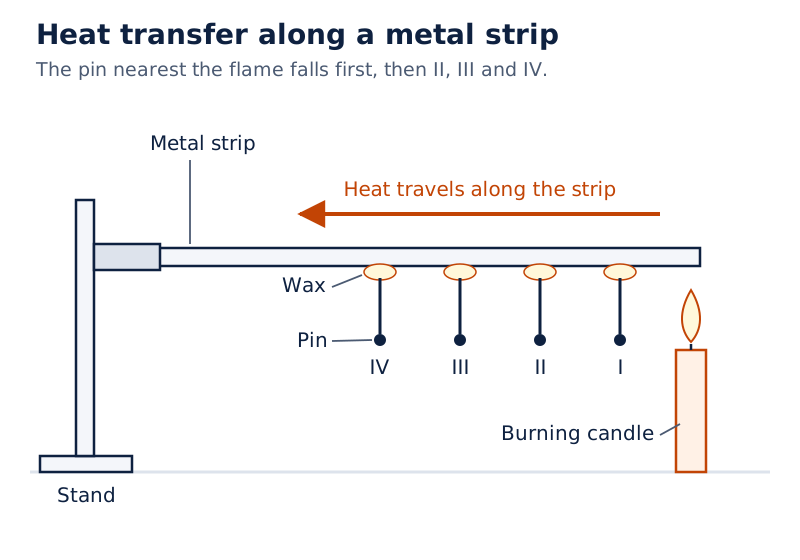
A stand holds a horizontal metal strip. Four pins hang below it. A burning candle heats the right-hand end. Pin I is nearest the candle; pins II, III and IV lie successively towards the stand.
Drawn by One Young India.
The nearest pin falls first because its wax is heated first. The later falling of the other pins shows that heat travels along the metal. It does not mean the metal particles themselves move along the strip with the heat.
This activity connects an observation to an explanation: the order of falling is observed, while conduction explains that order. Merely saying “the strip becomes hot” misses the evidence that transfer proceeds from the hotter part towards the colder parts.
Why are conductors and insulators chosen for different uses?
A good conductor of heat allows heat to pass through it easily. A poor conductor does not allow heat to pass through easily. Poor conductors are also called insulators. These descriptions concern how readily heat travels through a material.
Metals are good conductors. Wood and glass are poor conductors. This difference makes the choice of material important: some objects need to pass heat to their contents, while others need to reduce heat transfer to a hand or to the surroundings.
Why are cooking utensils and handles different?
A metal cooking utensil conducts heat to the food being heated. A wooden handle is useful because it is a poor conductor and reduces heat transfer towards the hand. The pan and its handle therefore serve different thermal purposes.
| Material | Heat-conducting behaviour | Related use |
|---|---|---|
| Metal | Good conductor | Cooking utensils that transfer heat to food |
| Wood | Poor conductor | Handles that reduce heat transfer to the hand |
| Clay and porcelain | Poor conductors | Cups that keep tea or coffee hot longer |
| Trapped air | Poor conductor | Insulation between clothing layers |
How does trapped air help?
Woollen fabric traps air in its small spaces or pores. Air is a poor conductor, so it reduces heat flow from the body to colder surroundings. Air between layers of clothing also helps to keep the body warm.
Two thin blankets can keep us warm because air is trapped between them. This is an insulation effect: the air layer reduces the escape of body heat. The blankets do not have to supply heat themselves for the body to feel warmer.
Hollow bricks use the same property. Air trapped inside them is a poor conductor, helping houses remain warmer in winter and cooler in summer. The important feature is the trapped air, rather than air being a source of heat.
“Poor conductor” does not mean an absolute barrier to heat transfer. It means heat does not pass through the material easily. Use this wording when explaining insulation instead of claiming that an insulating material stops every transfer of heat.
How does convection transfer heat in water and air?
Convection is heat transfer by the actual movement of particles in liquids or gases. A liquid or gas can move from one place to another, carrying heat with it. This movement distinguishes convection from conduction through a stationary metal strip.
What happens when water is heated from below?
Water near the heat source becomes hot and expands. Its density, or mass per unit volume, decreases. Volume is the space occupied by matter. A given volume of the warmed water therefore contains less mass than the same volume of cooler surrounding water. It rises, while comparatively cooler water at the sides moves down to take its place.
A convection current is the circulating movement formed by this rising warm water and descending cooler water. The water that moves down is then heated and rises in turn. The cycle continues until the whole volume of water gets heated.
- Place water in a beaker and gently put a grain of potassium permanganate at the centre of its base, using a straw.
- Potassium permanganate is a substance that colours the water, making the movement easier to observe.
- Heat below the centre of the base with a candle, under adult supervision.
- Watch the coloured streak move upwards and then down at the sides as the water circulates.
What the figure shows
Convection in heated water
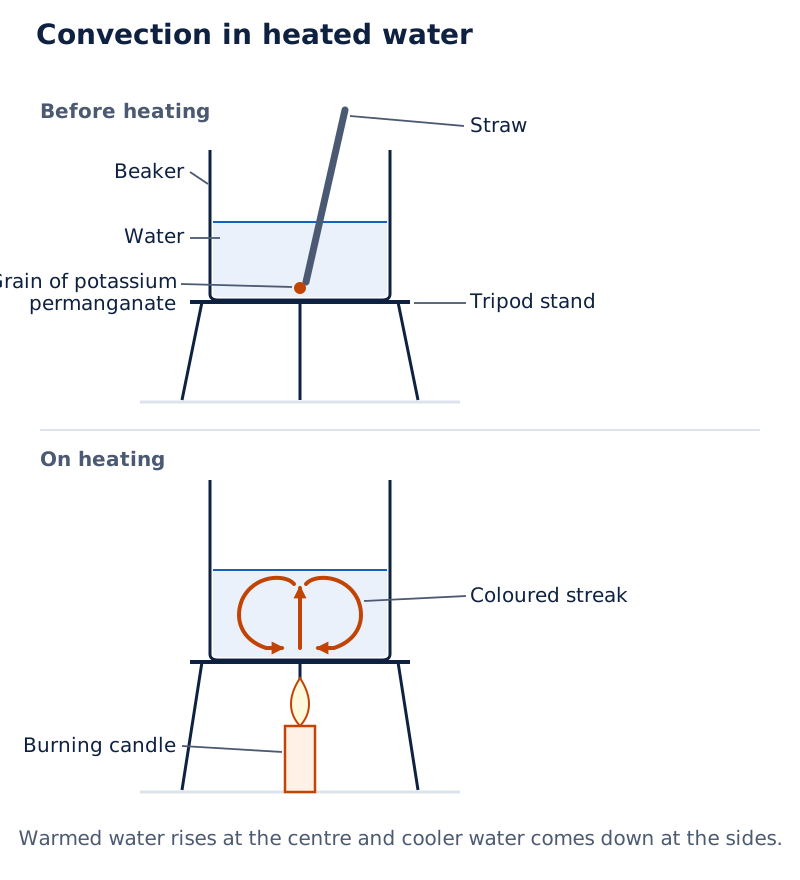
The first drawing shows a straw reaching into water in a beaker on a tripod stand. The second shows a candle burning below the beaker and a coloured streak rising through the water and curving towards the side.
Drawn by One Young India.
How does the explanation apply to air?
Air around a candle flame heats up, expands and rises. Cooler surrounding air moves in to replace it. The rising air can carry smoke upwards. Smoke is a mixture of hot gases and tiny solid particles released during burning.
Convection needs material that can move and carry heat. Conduction also needs a medium, meaning matter through which transfer occurs. In convection the material moves from place to place; in conduction through a solid, energy is passed between neighbouring particles.
Why do sea breezes and land breezes change direction?
A breeze is a gentle wind. Along a coast, land and sea heat and cool at different rates. Land heats faster than water during the day and cools faster at night. These differences set up convection in the air.
How does a sea breeze develop?
During the day, the land becomes warmer than the sea. Air above the land heats up and rises. Cooler air moves from the sea towards the land to replace it. This movement is called a sea breeze.
The name tells us where the incoming cooler air comes from. Windows facing the sea allow coastal houses to receive this cooler air. The higher movement of warm air completes the circulation, while the sea breeze describes the flow towards land near the surface.
What the figure shows
Sea breeze
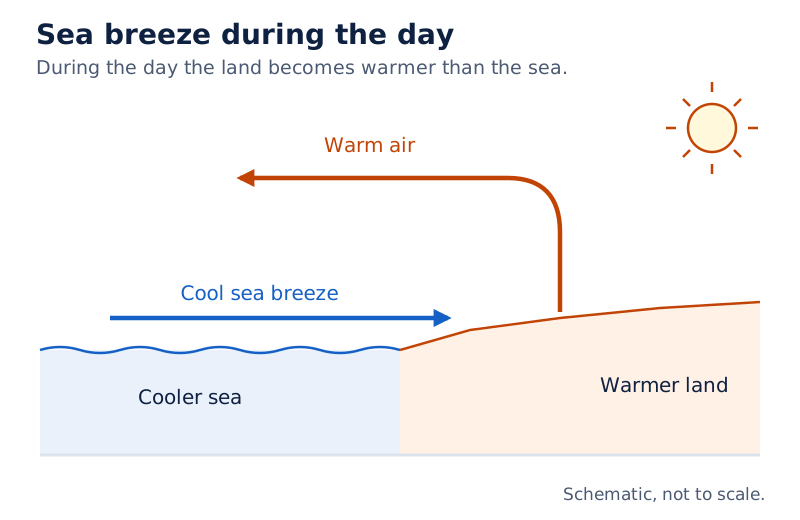
The drawing labels the sea as cooler and the land as warmer. A lower arrow points from sea to land and is labelled “Cool sea breeze”. An upper arrow labelled “Warm air” points back towards the sea.
Drawn by One Young India.
How does a land breeze develop?
At night, the land cools faster than the sea. The air above the warmer sea rises. Cooler air then moves from the land towards the sea. This movement is called a land breeze.
| Feature | Sea breeze | Land breeze |
|---|---|---|
| Time | Day | Night |
| Relatively warmer surface | Land | Sea |
| Direction of cooler air | Sea to land | Land to sea |
For either breeze, connect three ideas: which surface is warmer, where warm air rises, and where cooler replacement air comes from. Simply memorising “day” and “night” leaves out the heat-transfer process responsible for the change in wind direction.
How does radiation transfer heat without a material medium?
Radiation is a mode of heat transfer that does not require a material medium. Heat from the Sun reaches Earth by radiation. Unlike conduction and convection, this transfer can occur through empty space.
All objects radiate heat. A hot utensil removed from a flame transfers heat to its surroundings by radiation as it cools. The warmth felt near a fire is another familiar example. Radiation can also occur when matter is present between objects.
What happens when radiation reaches a surface?
Some radiation is reflected, meaning sent back from the surface, and some is absorbed, meaning taken in by the object. Absorbed heat can increase the object's temperature. Surface colour affects the amount absorbed.
Dark surfaces absorb more heat than light-coloured surfaces. Light-coloured clothes reflect most of the heat falling on them, helping us feel more comfortable in summer. Dark-coloured clothes absorb more heat and help us feel comfortable in winter.
Colour and insulation explain different aspects of clothing. A light surface reduces absorption of incoming radiation. Air trapped in woollen fabric reduces heat flow from the body. Keep these explanations distinct when identifying the property responsible for a particular effect.
Can several modes occur together?
When water is heated in a metal pan, heat travels through the metal by conduction. Water circulates and becomes heated by convection. Radiation from the hot pan and flame contributes to the warmth felt nearby. One situation can involve several transfer processes.
| Mode | Key feature | Example |
|---|---|---|
| Conduction | Heat passes through neighbouring particles | Heat travels along a metal strip |
| Convection | Liquid or gas moves and carries heat | Heated water circulates in a beaker |
| Radiation | No material medium is required | Heat travels from the Sun to Earth |
Identify the particular part of the situation being explained. Heat travelling through the pan, circulating within the water, and reaching a nearby person describe different paths, so they need not receive the same answer.
How does a thermos flask reduce heat transfer?
A thermos flask, also called a Dewar flask, is a container designed to minimise heat transfer between its contents and its surroundings. It can keep hot contents, such as milk, from cooling quickly, and cold contents, such as ice, from warming quickly.
What are its main parts?
A glass thermos flask contains a double-walled vessel, meaning a container with two walls. The walls are coated with silver, and air is removed from the space between them. Removing air is called evacuation; the resulting nearly empty space is a vacuum.
The vessel rests on an insulating support such as cork. A close-fitting insulating stopper closes its mouth. Each feature reduces a route by which heat could enter or leave, so the construction needs to be connected to the corresponding heat-transfer process.
| Feature | How it helps |
|---|---|
| Evacuated gap between walls | Reduces conduction and convection across the gap |
| Silvered wall surfaces | Reflect radiation and reduce transfer by radiation |
| Insulating support | Reduces conduction through the support |
| Insulating stopper | Reduces conduction and air exchange through the mouth |
Why do vacuum and silvering have different jobs?
Conduction and convection require matter to carry heat. Removing air from between the walls reduces these routes across the gap. Radiation requires no material medium, so removing the air cannot by itself stop radiative transfer.
The silvered surfaces reflect radiation. Radiation from the inner wall is reflected back towards the contents. The outer wall reflects incoming radiation back towards the surroundings. Silvering therefore addresses a route that the evacuated gap does not remove.
Why can the same flask keep things hot or cold?
If the contents are hotter than the surroundings, the flask reduces outward heat transfer. If they are colder, it reduces inward heat transfer. The purpose is to slow transfer in either direction, rather than to create heat or cold.
A flask minimises heat transfer; it does not guarantee an unchanged temperature indefinitely. A complete explanation names the evacuated gap, reflective surfaces and insulating parts, and connects each one to the transfer route it reduces.
Glossary
- Heat — Energy transferred between objects or between an object and its surroundings because their temperatures differ.
- Temperature — A measure of how hot or cold an object is compared with another object.
- Joule — The SI unit used to express heat and other forms of energy.
- Calorie — Heat needed to warm one gram of water from 14.5 °C to 15.5 °C.
- Thermometer — An instrument used to measure temperature on a specified temperature scale.
- Thermal expansion — An increase in the dimensions of an object when its temperature increases.
- Contraction — A decrease in size, such as the shrinking of air when it cools.
- Conduction — Transfer of heat from a hotter part towards colder parts through neighbouring particles.
- Convection — Transfer of heat by the actual movement of particles of liquids or gases.
- Radiation — A mode of heat transfer that can occur without a material medium.
- Conductor — A material that allows heat to pass through it easily.
- Insulator — A poor conductor that does not allow heat to pass through it easily.
- Sea breeze — Movement of cooler air from the sea towards warmer land during the day.
- Land breeze — Movement of cooler air from the land towards the warmer sea at night.
- Vacuum — A space from which air has been removed, used between the walls of a thermos flask.
Common errors and misconceptions
- Misconception: Heat and temperature are the same quantity. Correct: Heat is transferred energy; temperature measures hotness or coldness. Joules express heat, while degrees Celsius express temperature.
- Misconception: Touch always measures hotness reliably. Correct: Hands previously placed in different water temperatures can give different impressions of the same water. Use a thermometer for a reliable measurement.
- Misconception: Heating must increase temperature throughout a process. Correct: During melting, supplied heat changes solid into liquid while the temperature remains constant.
- Misconception: Every substance expands whenever heated. Correct: Most substances expand on heating and contract on cooling. The qualification matters.
- Misconception: Metal particles travel along the strip during conduction. Correct: Energy passes between neighbouring particles; they do not travel from the heated end to the colder end.
- Misconception: Radiation needs air to carry it. Correct: Radiation needs no material medium. This is how heat from the Sun reaches Earth.
- Misconception: Light-coloured clothes reflect all incident heat. Correct: They reflect most of the heat falling on them. “Most” must not become “all”.
- Misconception: A thermos flask works by its vacuum alone. Correct: The evacuated gap reduces conduction and convection; silvered surfaces reduce radiative transfer, and insulating parts reduce other transfer routes.
Exam-style questions with model answers
Q1. Distinguish heat from temperature by stating what each means. [2 marks]
- Heat is energy transferred between objects because their temperatures differ.
- Temperature measures how hot or cold an object is; a hotter object has a higher temperature.
Q2. A laboratory thermometer has 50 equal divisions between 0 °C and 100 °C. Find the value of one division, showing your calculation. [2 marks]
- The total temperature interval between the labelled marks is 100 − 0 = 100 °C.
- Dividing by the 50 equal intervals gives 100 / 50 = 2 °C for each division.
Q3. Four pins, labelled I, II, III and IV in order away from a heated end, are fixed with wax to a metal strip. Explain why they fall in that order and name the heat-transfer process. [3 marks]
- The end beside pin I becomes hot first, and heat moves along the metal strip towards its colder parts by conduction.
- The wax holding pin I melts first, so pin I falls before pins farther from the flame.
- As heat reaches the remaining positions, their wax melts in sequence and pins II, III and IV fall. Energy passes between neighbouring particles of the metal.
Q4. Describe four precautions needed when measuring warm water with a liquid-in-glass laboratory thermometer. [4 marks]
- Hold the thermometer upright and handle it carefully, without holding the bulb, so the instrument is correctly positioned for the measurement.
- Immerse the bulb in the water, keeping it away from the bottom and sides of the container.
- Wait until the liquid column stops rising, then read while the bulb is still immersed in the water.
- Keep the eye directly in line with the top of the liquid column when reading, and record the temperature with its unit.
Q5. Land heats faster than sea water during the day. Explain in three stages how this produces a sea breeze. [3 marks]
- The land becomes warmer than the sea, and the air immediately above the land becomes warm as well.
- This warmer air rises, so cooler air from above the sea moves towards the land to take its place.
- The movement of cooler air from sea to land is the sea breeze. It forms part of a convection circulation caused by unequal heating.
Q6. Explain convection in water heated from below. Include the motion of warm and cool water and explain why a coloured streak can reveal this motion. [5 marks]
- Water near the heat source at the bottom of the container receives heat first and becomes warmer than water farther from the source.
- The warmed water expands and becomes less dense than the cooler surrounding water, so it rises through the container.
- The comparatively cooler water at the sides moves down to replace the rising water and then receives heat near the bottom.
- Repeated rising and downward replacement create a circulating current. Heat is transferred through the actual movement of water particles, which is convection.
- A coloured streak moves with the water, making its upward and downward paths visible. The circulation continues until the whole volume of water becomes heated.
Q7. A glass thermos flask has a double wall with an evacuated gap, silvered surfaces, a cork support and an insulating stopper. Explain how these features help it keep hot contents hot and cold contents cold. [5 marks]
- The evacuated gap contains very little matter to carry heat between the walls, so it reduces transfer across the gap by conduction and convection.
- The silvered surfaces reflect radiation. They return radiation towards the contents on the inside and reflect incoming radiation towards the surroundings on the outside.
- The cork support is an insulator, so it reduces heat conduction through the place where the vessel is supported.
- The insulating stopper reduces conduction through the mouth and limits air exchange there, reducing another route for heat transfer.
- Together these features slow outward heat transfer from hot contents and inward heat transfer to cold contents. The flask minimises transfer rather than producing heat or cold.
Q8. Convert 37.0 °C into degrees Fahrenheit. Use F = (9 × C / 5) + 32, where C and F are the numerical Celsius and Fahrenheit readings. Show the calculation and give the unit. [2 marks]
- Substituting the Celsius reading gives F = (9 × 37.0 / 5) + 32 = 66.6 + 32.
- The result is 98.6, so the temperature expressed on the Fahrenheit scale is 98.6 °F.
Key takeaways
- Heat is transferred energy, while temperature measures hotness or coldness and helps determine the direction of heat transfer.
- Celsius, Fahrenheit and Kelvin use different numerical readings; always state the temperature with the correct unit.
- Heating can change temperature, size or state; supplying heat does not necessarily keep raising the temperature.
- Most substances expand on heating and contract on cooling, but the word “most” is essential to this rule.
- Conduction passes heat through neighbouring particles, while convection transfers heat through the movement of liquids or gases.
- Radiation needs no material medium; light-coloured clothes reflect most of the heat that falls on them.
- Sea breezes move towards land by day; land breezes move towards the sea at night.
- A thermos flask combines an evacuated gap, reflective surfaces and insulating parts to minimise heat transfer.
Test yourself
Which quantity does a thermometer measure?
A thermometer measures temperature, which tells us how hot or cold an object is.
What do J and cal stand for?
J stands for joule and cal stands for calorie; both are units of energy.
Why must a laboratory thermometer remain in water while it is read?
Its liquid level begins to fall after removal from warm water, so the reading must be taken while the bulb remains immersed.
What happens to the heat supplied while ice is melting?
The supplied heat changes solid ice into liquid water while its temperature remains constant.
Why does woollen clothing keep the body warm?
Woollen fabric traps air, which is a poor conductor and reduces heat flow from the body to colder surroundings.
Why does the warmer water rise during convection?
It expands and becomes less dense than the cooler surrounding water, so it rises.
Which way does a land breeze blow?
It blows from the cooler land towards the warmer sea at night.
Why are silvered surfaces needed in addition to a vacuum in a thermos flask?
A vacuum reduces conduction and convection across the gap, but radiation can cross it. Silvered surfaces reflect radiation and reduce that transfer.
Write about it
Turn a question from this chapter into a paper.
The Writing Studio has a structure guide, a rubric and citation tools for 15 formats, from essays to research papers. Drafting is free with an account. Learnacy Essential adds feedback from an AI writing coach and submission to The OYI Review.
Publication depends on review and is not guaranteed.