
Sound | ICSE Class 7 Physics Notes
On this page

This note covers sources of sound, vibrating objects, the human voice, the need for a material medium, longitudinal sound waves, amplitude and loudness, frequency, relative speed in different materials, reflection, absorption and the design of a sound-proof box.
How do vibrating objects produce sound?
Sound is a form of energy. A source of sound is an object that produces sound. Sources include a ringing bell, a plucked rubber band, musical instruments and the human voice. Their common feature is vibration.
Definition: Vibration is the repeated to-and-fro motion of an object. This back-and-forth movement is also called oscillation. A vibrating object produces sound.
What does a rubber band show?
Stretch a rubber band around the longer side of a pencil box. Insert two pencils between the box and the band, then pluck the band in the middle. Plucking means pulling it aside and releasing it. The band moves back and forth and produces sound.
Watch the band while listening. When it stops vibrating, it stops producing sound. This connects the sound with the movement of the source. The band does not need to travel across the room to make a sound.
What the figure shows
Plucking a rubber band
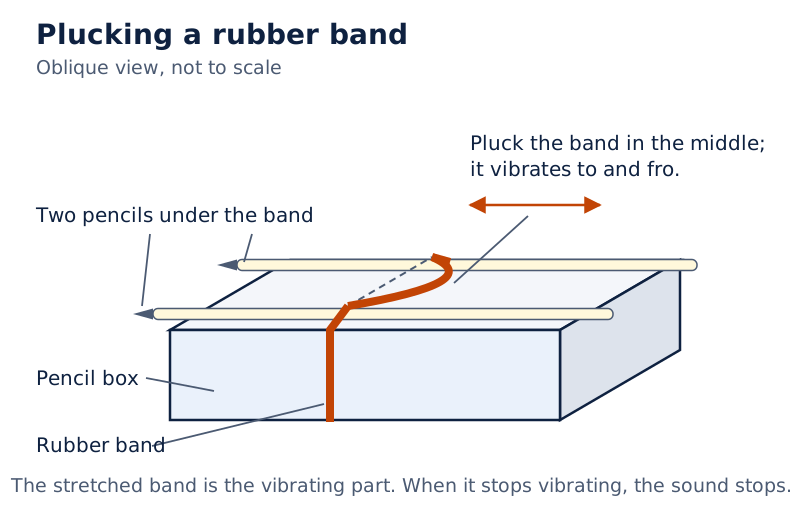
The photograph shows hands plucking a rubber band stretched around a pencil box, with two pencils placed beneath the band. Identify the band as the vibrating part.
Drawn by One Young India.
How can vibrations be detected?
Strike a freely hanging metal pan with a stick and touch the pan gently. Its vibrations can be felt. Holding it firmly stops the vibrations and the sound. The mean position is the position about which an object vibrates. Its amplitude is the maximum distance moved from that position. In most cases, the amplitude is so small that the vibrations cannot be seen, although they can be felt.
| Sound source | Part that vibrates |
|---|---|
| Plucked rubber band | The stretched band |
| Veena | A stretched string |
| Tabla | A stretched membrane, meaning a thin sheet |
| Flute | The air inside its hollow pipe |
Identifying a vibrating part does not mean that the rest of an instrument has no role. In most musical instruments, more than one vibrating part is involved in producing sound. For example, a plucked sitar string also makes the body of the instrument vibrate.
How is sound produced in the human voice?
In humans, sound is produced by the voice box, also called the larynx. It lies at the upper end of the windpipe, the passage carrying air towards and away from the lungs. The voice box contains two vocal cords, stretched muscular flaps that vibrate to produce sound.
What makes the vocal cords vibrate?
The vocal cords leave a narrow slit between them through which air passes. Air forced from the lungs through this opening sets the cords vibrating. The vibrating cords produce sound, just as vibration produces sound in other sources.
- Air is forced out from the lungs.
- The air passes through the narrow opening between the vocal cords.
- The vocal cords vibrate as air passes through the opening.
- The vibrations produce the sound of the human voice.
Muscles attached to the vocal cords can tighten or loosen them. The tongue, lips, mouth and nasal cavity, the space inside the nose, help shape the sound into speech or music. Producing the initial sound and shaping it into spoken words are connected processes.
How can you feel voice vibrations?
Place your hand gently on your throat while speaking or singing. You can feel vibrations. This activity connects a familiar action with the vibrating-source explanation of sound. It does not require seeing the vocal cords themselves.
What the figure shows
Voice box in humans
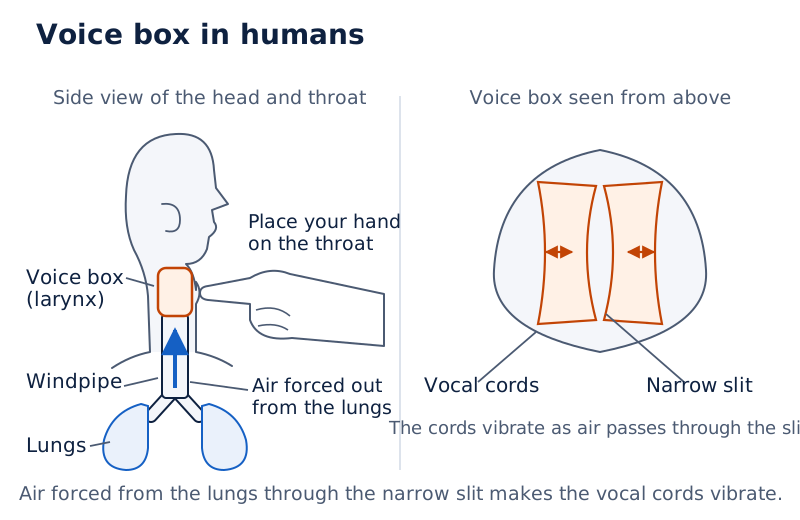
The drawing shows a side view of the head and throat with a finger at the voice-box region. Beside it is a separate view of the voice box and the opening between the vocal cords.
Drawn by One Young India.
A complete explanation of the human voice therefore names both the vibrating structure and the moving air that sets it vibrating. Saying merely that sound comes from the mouth leaves out the role of the vocal cords.
Why does sound need a medium to travel?
Propagation means the travel of sound from one place to another. A medium is the material through which sound travels. Air, water, wood and metal can act as media. The plural of medium is media.
A vacuum is a space without matter. Sound cannot travel through a vacuum because there is no material medium to carry it. Transmission means passage through a medium. Producing sound at a source and transmitting it to a listener are therefore different parts of the explanation.
What happens in a bell-jar experiment?
A bell jar is a transparent enclosure used in this experiment. An electric bell is placed inside it and connected to a power supply. A vacuum pump, a device that removes air, is connected to the jar.
- Switch on the electric bell while the jar contains air and listen to its sound.
- Use the pump to remove air from the jar while the bell continues ringing.
- Notice that the sound becomes fainter as air is removed.
- At a near vacuum, almost no sound can be heard, although the bell can still be seen ringing.
- Allow air back into the jar. The sound returns and gradually becomes as loud as before.
What the figure shows
Vacuum bell jar
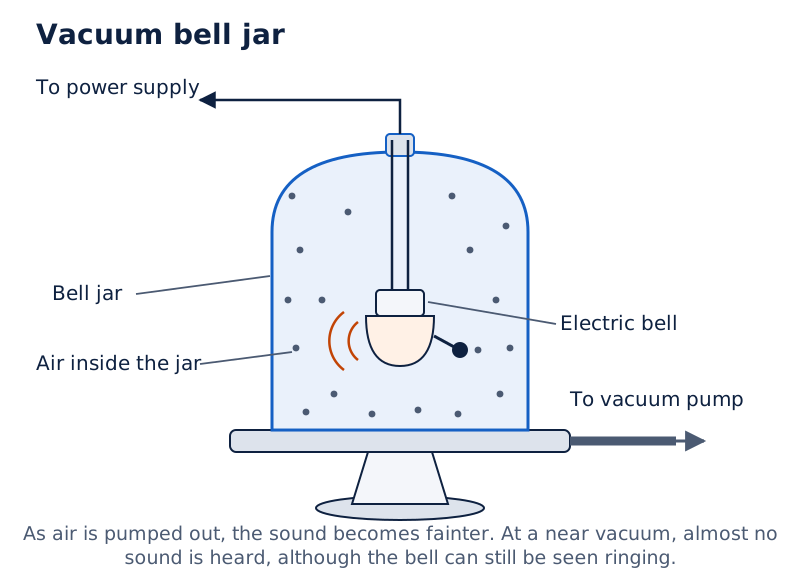
The illustration shows an electric bell inside a transparent bell jar. Labels identify the bell jar, electric bell, connection to the power supply and connection to the vacuum pump.
Drawn by One Young India.
The continuing movement of the bell is essential evidence: the source is still operating while the sound becomes fainter. The changing factor is the amount of air available to transmit sound. Letting air back in restores that transmission.
Note: A near vacuum is not a complete vacuum. Describe the observation as “almost no sound” at a near vacuum. The general conclusion is that sound cannot propagate through a vacuum.
Air is a gas, but this experiment does not show that air is the only possible medium. To examine that separate question, sound transmission through liquids and solids must also be considered.
How can sound travel through solids and liquids?
Sound can travel through a solid, a liquid or a gas. A solid has a definite shape; a liquid flows and takes the shape of its container; a gas spreads to fill the space available. Each contains matter that can transmit sound.
What evidence comes from a desk?
Ask a partner to gently scratch or knock one end of a desk. First listen with your ear in the air. Then place your ear against the desk and listen again. Hearing the sound through the desk shows that a solid can transmit it.
A similar activity uses a long metal rod or metre scale. A metre scale is a ruler one metre long. Gently scratching or tapping one end produces a sound that can be heard with an ear at the other end.
What evidence comes from water?
Tap two metal spoons together under water in a tub. Keep the spoons away from the sides and bottom. The sound can be heard outside the tub after travelling through water and air. This shows that a liquid can form part of the transmission path.
Keeping the spoons clear of the tub matters when interpreting the activity. The intended observation concerns sound passing through the water, rather than a spoon directly striking the solid container. Record what was done as well as what was heard.
| Material | State | Transmission example |
|---|---|---|
| Air | Gas | A voice reaches a listener across a room. |
| Water | Liquid | Underwater tapping of spoons is heard outside the tub. |
| Wood | Solid | Scratching is heard through a desk. |
| Metal | Solid | Tapping is heard through a long rod. |
These activities establish whether sound can travel through a material. They do not by themselves measure its speed. Transmission, meaning passage through a medium, must be distinguished from a comparison of how quickly sound covers a distance.
What makes a sound wave longitudinal?
A wave is a travelling disturbance that transfers energy. The tiny constituents of a medium are called its particles. As sound passes, particles vibrate about their mean positions, the positions about which their back-and-forth movements occur.
Definition: A longitudinal wave is a wave in which particles vibrate parallel to the direction in which the disturbance travels. Parallel here means along the same direction, rather than across it.
What are compressions and rarefactions?
As a source moves forwards, it pushes nearby air particles closer together. This produces a compression, a region where particles are more closely packed than usual. As it moves backwards, it produces a rarefaction, a region where particles are more spread out than usual.
The disturbance passes between neighbouring particles. Repeated forward and backward movements produce alternating compressions and rarefactions that move through the medium. The sound wave travels away from the source while the particles vibrate about their own mean positions.
| Feature | Compression | Rarefaction |
|---|---|---|
| Particle spacing | Closer together than usual | More spread out than usual |
| Density, meaning mass per unit volume | Higher than the average density | Lower than the average density |
How does a spring model help?
A slinky is a long, flexible spring toy. Stretch it horizontally and push and pull one end along its length while the other end is held fixed. Regions of closely packed and widely spaced turns move along the spring.
Mark one turn of the spring and watch it. The marked turn moves back and forth about its position; it does not travel along the whole spring with the disturbance. This distinguishes the motion of the medium from the motion of the wave.
What the figure shows
A longitudinal wave
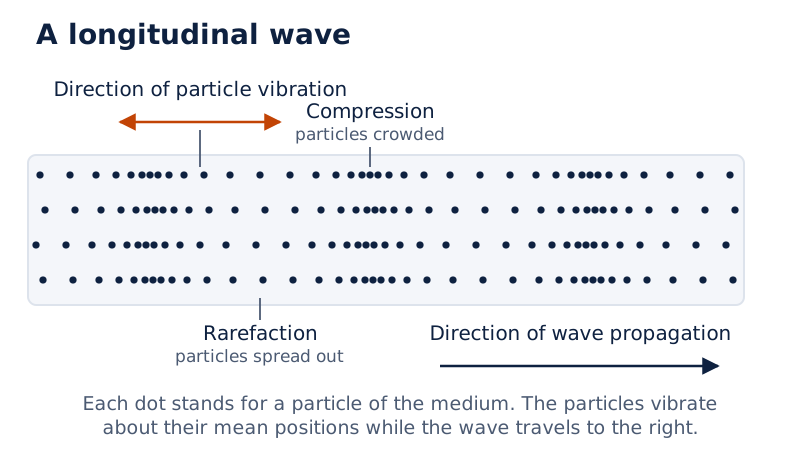
The drawing shows alternating crowded and spread-out regions of dots. A double-headed horizontal arrow indicates particle vibration. A horizontal arrow pointing to the right indicates wave propagation.
Drawn by One Young India.
Sound is also called a mechanical wave, meaning a wave that requires a material medium. “Longitudinal” describes the direction of particle vibration; “mechanical” describes the need for a medium. These terms answer different questions about the same wave.
How does amplitude affect loudness?
For a vibrating object, amplitude is its maximum displacement from the mean position. Displacement here means how far, and in which direction, the object has moved from that position. Amplitude describes the size of the vibration, rather than how often it happens.
Loudness describes how loud or soft a sound is perceived to be. A larger amplitude of vibration produces a louder sound. A smaller amplitude produces a softer or feebler sound. The word feeble means weak in this context.
How can the difference be observed?
Strike the rim of a metal tumbler gently with a spoon and listen. Then strike it a little harder. Compare the sounds. The harder strike produces a larger vibration and a louder sound.
Suspend a small thermocol ball so that it touches the rim. Thermocol is a lightweight plastic foam. When the tumbler vibrates, the ball moves away. Its movement provides a visible indication of the size of the tumbler's otherwise small vibration.
- Place the suspended ball against the tumbler's rim.
- Strike the tumbler gently and observe the ball's movement.
- Strike it a little harder and observe the movement again.
- Compare the ball's movement with the loudness heard in each case.
What conclusion should be drawn?
The larger movement of the ball indicates a larger amplitude of vibration of the tumbler. Link the observations carefully: a larger vibration accompanies a louder sound. The ball acts as an indicator; it is not the original sound source being investigated.
A sound wave with a larger amplitude carries more energy than one with a smaller amplitude. Loudness also decreases as a listener moves farther from a source. When comparing gentle and harder strikes, listen from the same position so that distance does not change the comparison.
Amplitude is not frequency. A larger back-and-forth movement and a greater number of movements in a second describe different features. Counting vibrations is the way to investigate frequency.
What is frequency, and how is it calculated?
Frequency is the number of complete oscillations or vibrations made in one second. A complete oscillation is one full back-and-forth cycle. Frequency describes how often a vibration repeats, rather than how far the object moves.
The SI unit, meaning the unit used in the International System of Units, of frequency is the hertz. Its symbol is Hz. A frequency of 1 Hz means one complete oscillation per second. The symbol s stands for second, the unit of time.
How do counting and timing give frequency?
, where is frequency, is the number of complete oscillations and is the time taken. Use time in seconds to obtain frequency in hertz. Count full cycles, rather than counting each outward and return movement as separate oscillations.
The time period, , is the time taken for one complete oscillation, measured in seconds: . Frequency and time period are reciprocals: .
Worked example 1. An object oscillates 20 times in one second. Find its frequency.
Formula: .
Substitute: .
Answer: The frequency is 20 Hz. The answer means that 20 complete oscillations occur in each second.
Worked example 2. A pendulum, an object suspended so that it can swing to and fro, makes 40 oscillations in 4 seconds. Find its frequency and time period.
Formula: and .
Substitute: . Then .
Answer: The frequency is 10 Hz and the time period is 0.1 s. Ten complete oscillations occur per second, and each takes one tenth of a second.
Worked example 3. At a fixed position in a sound wave, there are 10 complete density oscillations in 2 seconds. Find the frequency and time period.
Formula: and .
Substitute: . Then .
Answer: The frequency is 5 Hz and the time period is 0.2 s. A density oscillation is a change from maximum density to minimum density and back to maximum density.
Worked example 4. A mosquito produces sound by vibrating its wings at an average rate of 500 vibrations per second. Find the time period of the vibration.
Formula: .
Substitute: .
Answer: The time period is 0.002 s, the time taken for one complete wing vibration.
How does frequency differ from amplitude?
Amplitude describes the size of vibration; frequency describes the repetition rate. Pitch is how high or low a sound seems. In general, higher-pitched sounds have higher frequencies and lower-pitched sounds have lower frequencies. This differs from the amplitude and loudness relationship.
A frequency answer therefore needs both a numerical value and its unit. Writing a total count of vibrations without considering the elapsed time does not establish frequency. The same count spread over a longer time represents fewer vibrations per second.
How does the speed of sound differ between media?
The speed of sound describes how quickly a sound disturbance travels through a medium. It is the distance travelled by the disturbance per unit time. It does not describe how quickly an individual particle travels from the source to the listener.
Sound travels fastest in solids, slower in liquids and slowest in gases in the comparison considered here. The medium matters: sound does not have one speed that applies to every substance and condition.
What do representative values show?
The following approximate speeds are for the stated media at 15 °C and atmospheric pressure. The symbol °C means degrees Celsius, a unit of temperature. Atmospheric pressure means the pressure exerted by the surrounding air.
The unit m/s means metres per second; m is the symbol for metre. A speed expressed in this unit gives the distance, in metres, travelled in one second.
| State | Substance or medium | Approximate speed at 15 °C |
|---|---|---|
| Solid | Steel | 5000 m/s |
| Liquid | Water | 1500 m/s |
| Gas | Air | 340 m/s |
The values place steel first, water second and air third in order of speed. These are values for named materials under stated conditions, not exact constants for every solid, liquid or gas.
What affects a fair comparison?
For the same distance, the faster sound takes less time. Sound therefore covers an equal distance in steel sooner than in water or air when using these values. Comparing travel times over different distances would require taking those distances into account.
The speed of sound in air also depends on temperature and humidity. Humidity is the amount of water vapour in air. Increasing temperature or humidity increases the speed of sound in air. Keep the conditions attached to any numerical value used.
Note: The absence of sound transmission in a vacuum is not another entry in a speed ranking. A vacuum has no material medium through which a sound wave can propagate.
What happens when sound is reflected?
Reflection of sound is the bouncing back of sound from an obstacle. Sound can be reflected from solid or liquid surfaces. A reflected sound has travelled from its source to a surface and then travelled away from that surface.
How does an echo form?
An echo is a reflected sound heard separately after the original sound. A voice shouted near a mountain, cliff or along a long corridor may be heard again after a delay. The returning sound comes from reflection, not from the source speaking again.
Trace the path in order: source, reflecting surface, listener. If the speaker is also the listener, the sound travels outwards towards the surface and then back. Both parts of this journey contribute to the delay before the echo is heard.
For an echo heard back at its source, let be the sound speed, the total return time, the total distance travelled and the distance to the reflecting surface. Then and .
Worked example 5. You clap in an empty corridor and hear an echo after 0.5 s. If the speed of sound in air is 340 m/s, calculate your distance from the wall.
Formula: and .
Substitute: . Then .
Answer: The wall is 85 m away. The sound travels 170 m in total because it reaches the wall and returns.
Worked example 6. Two sounds can be heard separately when they arrive at least 0.1 s apart. Taking the speed of sound as 340 m/s, find the minimum distance of a reflecting surface for a separate echo.
Formula: and .
Substitute: . Then .
Answer: The minimum distance is 17 m. The 34 m path includes both the outward and return journeys.
Reflection does not produce a distinct echo in every setting. In a small room, reflections from walls arrive too quickly for the listener to separate them clearly from the original sound. Reflection can occur even when no separate repeat is recognised.
Which surfaces give stronger echoes?
Hard, smooth surfaces give stronger echoes. Soft surfaces such as curtains tend to absorb sound, meaning they take in sound energy and reduce reflected sound. Rough surfaces scatter it, meaning they send it in different directions. These differences affect how clearly reflected sound is heard.
Reverberation is the persistence of sound after its source stops, caused by multiple reflections. In a large hall, reflected sounds can arrive from several surfaces. This differs from identifying one clearly separated echo.
| Term | Meaning |
|---|---|
| Reflection | Sound bounces back from an obstacle. |
| Echo | Reflected sound is heard as a separate repeat. |
| Reverberation | Multiple reflections make sound persist after the source stops. |
For a reflection explanation, identify the surface and the returning path. For an echo explanation, also explain that the reflected sound is heard separately. For reverberation, identify repeated reflections and the resulting persistence of sound.
How does absorption of sound help in theatres?
Absorption of sound occurs when a material takes in sound energy, reducing the sound reflected from it. Reflection and absorption therefore describe different responses when a sound wave reaches a material.
The walls of a theatre are lined with layers of sound-absorbing materials. These reduce unwanted reflected sound and help the audience hear more clearly. The aim is to manage sound within the space while allowing speech or music to be heard.
Which materials help?
Curtains, sound-absorbing panels, upholstered chairs and other soft, porous surfaces reduce reverberation. Upholstered means covered with padding and fabric. Porous means containing small spaces or pores. These materials are useful where repeated reflections would otherwise make sound unclear.
| Feature | Reflection | Absorption |
|---|---|---|
| What happens | Sound returns from a surface. | A material takes in sound energy. |
| Useful example | A hard, smooth surface gives a stronger echo. | Curtains tend to absorb sound. |
| Effect in a hall | Repeated reflections can prolong sound. | Absorbing materials reduce reverberation. |
Why is reduced reflection useful?
When a source stops, previously produced sound can still be travelling and reflecting inside the hall. If repeated reflections persist excessively, successive sounds become difficult to hear clearly. Absorbing surfaces reduce these unwanted reflections.
A theatre therefore connects several ideas in one practical setting. A source produces vibrations, air transmits the sound, surfaces reflect or absorb it, and the audience hears the resulting sound. No single one of these steps explains the entire situation.
Do not treat an absorbing lining as proof that no sound can pass through a structure. Reducing reverberation inside a space and preventing sound from reaching the outside are different aims. A proposed sound-proof box needs a separate test of the sound heard outside it.
How can you design and test a sound-proof box?
A sound-proof box is an enclosure intended to reduce sound reaching the outside. A useful classroom design applies the idea of sound absorption and checks the result by comparison. The word sound-proof should not be treated as a guarantee of complete silence.
What design can be investigated?
As a proposed investigation, place a ringing mobile phone inside a box that can be closed. Compare the sound heard outside before and after lining the inside with soft fabric. The fabric is chosen because soft surfaces such as curtains tend to absorb sound.
The proposed arrangement applies the absorption principle; its effectiveness must be observed. Do not write down a made-up reduction in loudness or claim that the lining creates a vacuum. Air is still present inside the box.
How can the comparison be kept fair?
- Use the same phone, ringtone and volume setting for both trials.
- Listen from the same position with the phone at the same position inside the box.
- Close the unlined box and record how loud the sound seems outside.
- Add the soft lining, close the box again and repeat the observation.
- Compare the two observations and report whether the outside sound was reduced.
A fair comparison keeps the relevant conditions unchanged while changing the feature under investigation. Here that feature is the lining. Changing the phone volume or listening distance at the same time would make the reason for a difference less clear.
Record an observation before giving an explanation. If the sound is fainter with the lining, that is evidence that the complete arrangement reduced the sound reaching the listener. It does not establish that the box blocks every sound or that absorption is its only effect.
This design task connects an identified source, a transmission path, a choice of material and a testable result. Improvement should follow the observations, rather than an assumption that any closed box is completely sound-proof.
Glossary
- Vibration — Repeated to-and-fro movement of an object about its mean position.
- Source of sound — An object whose vibrations produce the sound being considered.
- Larynx — The voice box containing the vocal cords that vibrate to produce human sound.
- Medium — Material through which sound travels, such as air, water or wood.
- Vacuum — A space without matter, through which sound cannot propagate.
- Longitudinal wave — A wave whose particles vibrate parallel to the direction of wave travel.
- Compression — A region of a sound wave where particles are more closely packed than usual.
- Rarefaction — A region of a sound wave where particles are more spread out than usual.
- Amplitude — The maximum displacement of a vibrating object from its mean position.
- Frequency — The number of complete oscillations made in one second, expressed in hertz.
- Hertz — The unit of frequency; one hertz means one complete oscillation per second.
- Reflection — The bouncing back of sound after it reaches an obstacle.
- Echo — A reflected sound heard separately after the original sound reaches the listener.
- Reverberation — Persistence of sound after its source stops, caused by multiple reflections.
- Absorption — The taking in of sound energy by a material, reducing reflected sound.
Common errors and misconceptions
- Misconception: Only objects with visible movements can produce sound. Correct: In most cases, the amplitude of vibration is too small to see, although the vibrations can be felt.
- Misconception: Sound travels through air but not solids or liquids. Correct: Sound can travel through all three states; a desk and water provide examples of other media.
- Misconception: The bell stops producing sound when air is removed from the bell jar. Correct: It can still be seen ringing, while the reduced amount of air weakens sound transmission.
- Misconception: Air particles travel all the way from the speaker to the listener with the sound. Correct: Particles vibrate about their mean positions while the disturbance travels.
- Misconception: A larger amplitude means a greater frequency. Correct: Amplitude measures the size of vibration; frequency counts complete vibrations per second.
- Misconception: Every reflection is heard as a separate echo. Correct: Reflections can arrive too quickly to be heard separately from the original sound.
- Misconception: A soft lining guarantees a completely silent box. Correct: The lining may reduce sound, but the finished box must be tested before claiming how effective it is.
Exam-style questions with model answers
Q1. Define vibration and state its connection with sound production. [2 marks]
- Vibration is the repeated to-and-fro movement of an object about its mean position.
- A vibrating object produces sound; when its vibration stops, it stops producing sound.
Q2. Name the human voice-producing organ, identify its vibrating parts and explain what makes them vibrate. [3 marks]
- The voice-producing organ is the larynx, or voice box, located at the upper end of the windpipe.
- Two vocal cords are stretched across the voice box, leaving a narrow opening for air to pass between them.
- Air forced from the lungs through this opening makes the vocal cords vibrate, producing sound.
Q3. An electric bell rings inside a transparent bell jar. Its sound becomes fainter as air is pumped out. At a near vacuum, almost no sound is heard although the bell is still seen ringing. Air is then let back in and the sound gradually returns to its original loudness. Explain these observations and give the conclusion. [5 marks]
- At the start, the jar contains air, which acts as a material medium through which sound from the vibrating bell can travel.
- Pumping air out reduces the amount of this medium, so the sound heard outside the jar becomes progressively fainter.
- The visible ringing shows that the source is still operating; the fading sound is not evidence that the bell has stopped vibrating.
- At a near vacuum, almost no sound is heard. Letting air back in restores the medium and the sound becomes as loud as before.
- The experiment supports the conclusion that sound needs a material medium for propagation and cannot travel through a complete vacuum.
Q4. Explain a longitudinal sound wave using the terms particle vibration, compression, rarefaction and travelling disturbance. [4 marks]
- Particles vibrate back and forth about their mean positions, parallel to the direction in which the wave travels.
- A compression is a region in which the particles are more closely packed than they normally are.
- A rarefaction is a region in which the particles are more spread out than they normally are.
- The alternating compressions and rarefactions travel through the medium as a disturbance; the particles do not travel along with the wave.
Q5. A pendulum makes 40 complete oscillations in 4 seconds. Define frequency, calculate its value and explain the result with its unit. [3 marks]
- Frequency is the number of complete oscillations made in one second. It is calculated by dividing the number of oscillations by the time taken.
- Frequency = 40 ÷ 4 seconds = 10 hertz, using the count and time supplied in the question.
- The symbol for hertz is Hz, so the answer is 10 Hz. This means ten complete oscillations occur per second.
Q6. A suspended thermocol ball touches a metal tumbler. A gentle strike gives a small ball movement and a soft sound; a harder strike gives a larger ball movement and a louder sound. Define amplitude and explain the observations. [3 marks]
- Amplitude is the maximum displacement of a vibrating object from its mean position. It describes the size of the vibration.
- The ball's movement indicates the tumbler's vibration: its larger movement after the harder strike indicates a larger amplitude.
- A larger amplitude produces a louder sound. This explains why the harder strike is heard more loudly than the gentle strike.
Q7. At 15 °C and atmospheric pressure, approximate sound speeds are steel: 5000 m/s, water: 1500 m/s and air: 340 m/s. Here °C means degrees Celsius and m/s means metres per second. Rank the media by speed, identify their states, state which transmits sound across an equal distance first and explain why a vacuum is excluded. [4 marks]
- The descending order of speed is steel, then water, then air, using the three approximate values supplied.
- Steel is a solid, water is a liquid and air is a gas, so the values compare three different states of matter.
- Sound covers an equal distance first in steel because steel has the highest sound speed in the given data.
- A vacuum is excluded because it contains no material medium. Sound cannot propagate through it, so it is not a slower transmitting material.
Q8. In a theatre, sound persists after the speaker stops because of repeated reflections. Curtains and upholstered chairs are added. Upholstered chairs have padding and fabric coverings. Define the observed effect, explain why it can cause difficulty, name the principle used by the added materials, explain their benefit and distinguish this from guaranteeing a sound-proof building. [5 marks]
- The persistence of sound after the source stops, caused by multiple reflections, is called reverberation. That is the effect described in the theatre.
- Repeated reflections can prolong earlier sounds and make subsequent speech difficult to hear clearly, so excessive persistence is undesirable.
- The added curtains and padded, fabric-covered chairs apply sound absorption. Their soft surfaces take in sound energy and reduce reflected sound.
- Reducing unwanted reflections reduces reverberation, helping the audience hear speech more clearly rather than hearing excessive persistence of earlier sounds.
- Improved clarity inside does not guarantee a sound-proof building. Reducing internal reflection and preventing sound reaching outside are different aims requiring different observations.
Key takeaways
- Sound is produced by vibrating objects, including stretched bands, strings, membranes, air in pipes and human vocal cords.
- The larynx contains vocal cords that vibrate when air from the lungs passes through the opening between them.
- Sound needs a material medium and can travel through solids, liquids and gases, but cannot propagate through a vacuum.
- In longitudinal sound waves, particles vibrate parallel to wave travel while compressions and rarefactions move through the medium.
- Amplitude describes the size of vibration and is related to loudness; frequency counts complete vibrations in each second.
- Frequency is measured in hertz and calculated by dividing the number of complete oscillations by time in seconds.
- The given speeds place steel above water and air; numerical sound speeds belong to stated materials and conditions.
- Reflection can produce echoes and reverberation, while soft absorbing materials help reduce unwanted reflections inside theatres.
- A proposed sound-proof box needs a fair comparison before and after lining, followed by conclusions based on observed results.
Test yourself
Why does holding a ringing pan firmly stop its sound?
Holding it firmly stops its vibrations. When the vibrations stop, the pan stops producing sound.
What structure vibrates to produce the human voice?
The vocal cords inside the larynx vibrate when air from the lungs passes between them.
Why is visible bell movement important in the bell-jar experiment?
It shows that the sound source is still operating while removing air weakens the transmission of sound.
What does “longitudinal” tell you about a sound wave?
The particles vibrate parallel to the direction in which the sound disturbance travels.
How does a compression differ from a rarefaction?
A compression has particles more closely packed than usual; a rarefaction has particles more spread out than usual.
An object makes 20 complete oscillations in one second. What is its frequency?
Its frequency is 20 Hz, meaning twenty complete oscillations in each second.
Why does no separate echo in a room not prove that reflection is absent?
Reflected sound may return too quickly to be heard separately from the original sound.
Why keep the phone volume and listening distance unchanged when testing a box lining?
Changing either would affect the loudness comparison, making it harder to identify the effect of adding the lining.
Write about it
Turn a question from this chapter into a paper.
The Writing Studio has a structure guide, a rubric and citation tools for 15 formats, from essays to research papers. Drafting is free with an account. Learnacy Essential adds feedback from an AI writing coach and submission to The OYI Review.
Learnacy Essential is ₹1,499 for the year. Publication depends on review and is not guaranteed.