
International Trade (World) | CBSE Class 12 Geography Notes
On this page
Watch & explore
Start with a few high-quality watches, then dive into the notes below.
This note covers trade and barter, the history and basis of international trade, balance of trade, bilateral and multilateral trade, trade liberalisation and dumping, the World Trade Organisation, regional trade blocs, benefits and concerns, and ports classified by cargo, location and specialised functions.
What is international trade, and how did barter work?
Trade means the voluntary exchange of goods and services. It requires two parties: one sells and the other purchases. Trade takes place at national and international levels. International trade is the exchange of goods and services among countries across national boundaries.
Countries trade to obtain commodities, meaning goods, that they cannot produce themselves or can purchase elsewhere at a lower price. The reason for exchange therefore concerns both the availability of a product and the price at which it can be obtained.
How does direct exchange differ from exchange using money?
The barter system was the initial form of trade in primitive societies. It involved direct exchange. A potter needing plumbing services had to find a plumber who needed pots. The potter could then exchange pots for the plumber's service.
The difficulty was finding someone whose needs matched the proposed exchange. The introduction of money, a means of payment, overcame the difficulties of barter. Before paper and coin currency, rare objects possessing high intrinsic value, meaning value in themselves, served as money.
Examples included cowrie shells, skins, furs, cattle, rice, peppercorns, salt, small tools, copper, silver and gold. Exchange was therefore possible before the development of paper and coin currency. Barter and exchange using money differ in the way payment takes place.
Case study: What happens at Jon Beel Mela?
Jon Beel Mela takes place every January after the harvest season at Jagiroad, 35 kilometres from Guwahati. A big market brings together people from various tribes and communities who exchange their products. It is possibly the only fair in India where the barter system is still alive.
What the figure shows
Barter at Jon Beel Mela
This photograph shows two women seated beside goods spread before them. The photograph illustrates barter, with goods laid out for direct exchange at the fair.
See Fig. 8.1 in your NCERT textbook
How did international trade develop over time?
In ancient times, transporting goods over long distances was risky, so trade was restricted to local markets. People spent most of their resources on basic necessities such as food and clothes. Only rich people bought jewellery and costly dresses, creating trade in luxury items.
Case study: Why was the Silk Route important?
The Silk Route was an early example of long-distance trade. Its 6,000-kilometre route connected Rome with China. Traders carried Chinese silk, Roman wool, precious metals and other high-value commodities from intermediate points in India, Persia and Central Asia.
This route illustrates the importance of high-value goods in early long-distance trade. Gems, silk and spices could be traded over long distances even when inadequate transport restricted much trade to local areas. Transport conditions influenced both the reach of trade and the goods carried.
How did colonialism and industry change trade?
From the fifteenth century, European colonialism, the control of other territories by European powers, was accompanied by the slave trade, the forced transportation and sale of people. Portuguese, Dutch, Spanish and British traders captured African people and forcibly transported them to the Americas for plantation labour.
This trade remained lucrative for more than two hundred years. Slave auctions often separated family members, many of whom never saw their loved ones again. The history of trade therefore includes coercion and exploitation as well as voluntary exchange.
| Country | Year of abolition of the slave trade |
|---|---|
| Denmark | 1792 |
| Great Britain | 1807 |
| United States | 1808 |
What the figure shows
Advertisement for a slave auction, 1829
This reproduced advertisement prominently displays the word “SLAVES” and announces a public auction. It is a historical advertisement, with printed sale information, rather than a photograph of an auction.
See Fig. 8.2 in your NCERT textbook
After the Industrial Revolution, the expansion of machine-based industrial production, demand for raw materials such as grains, meat and wool increased. Their monetary value, however, declined relative to manufactured goods. Imports are goods and services bought from other countries; exports are those sold to other countries. Industrialised nations imported primary products as raw materials and exported finished products to non-industrialised nations.
In the later half of the nineteenth century, industrial nations became each other's principal customers. During the First and Second World Wars, countries imposed trade taxes and quantitative restrictions, meaning limits on quantities traded. Post-war trade organisations helped reduce tariffs, which are taxes on trade.
Why do resources and population create a basis for trade?
International trade results from specialisation, or concentrating production on particular goods or services. Division of labour means distributing different productive tasks. The world economy benefits if countries practise specialisation and division of labour in producing commodities or providing services.
Trade rests on comparative advantage, the ability to produce at a lower opportunity cost than another country; complementarity, the matching of one country's supplies with another's needs; and transferability, the ability to move goods and services between places. Opportunity cost means the alternative production forgone. In principle, trade should be mutually beneficial to the trading partners.
How do physical differences affect production?
National resources are unevenly distributed because countries differ in geology, relief, soil and climate. Geology concerns rocks and geological structure; relief concerns the shape and height of land. These physical differences help explain why countries produce different goods.
| Physical factor | Connection with production and trade |
|---|---|
| Geological structure | Determines the mineral resource base; differences in landforms ensure diversity in crops and animals raised. |
| Lowlands and mountains | Lowlands have greater agricultural potential; mountains attract tourists and promote tourism. |
| Mineral resources | Uneven availability provides a basis for industrial development. |
| Climate | Influences plants and animals; wool production can occur in cold regions, while bananas, rubber and cocoa can grow in tropical regions. |
How do culture, population size and living standards matter?
The size, distribution and diversity of people affect the type and volume of goods traded. Distinctive arts and crafts develop in particular cultures and gain value elsewhere. China produces the finest porcelains, fine pottery, and brocades, fabrics with woven patterns. Iranian carpets, North African leather work and Indonesian batik, cloth patterned using wax-resist dyeing, are prized products.
Densely populated countries have large internal trade but little external trade because most agricultural and industrial production is consumed in local markets. Internal trade takes place within a country; external trade crosses its borders. Population size influences how much production remains available for exchange abroad.
The population's standard of living, its level of material well-being, determines demand for better-quality imported products. Where living standards are low, only a few people can afford costly imported goods. Both productive differences and consumer demand therefore contribute to international trade.
How do development, investment and transport influence trade?
The stage of economic development affects the nature of goods traded. Agriculturally important countries exchange agricultural products for manufactured goods. Industrialised nations export machinery and finished products and import food grains and other raw materials. Differences in production create different patterns of exchange.
How can foreign investment increase trade?
Foreign investment means investment from another country. It can boost trade in developing countries lacking the capital, or funds, required for mining, oil drilling, heavy engineering, lumbering and plantation agriculture. These are capital-intensive activities, meaning activities requiring substantial investment.
- Developing countries lack the capital needed to develop these activities.
- Foreign investment can help develop the capital-intensive industries.
- Industrial nations thereby ensure imports of foodstuffs and minerals.
- They also create markets for their finished products, increasing the volume of trade between nations.
The link involves production and markets together. Investment develops activities supplying foodstuffs and minerals, while the investing industrial nations also find markets for manufactured products. The resulting cycle steps up international exchange rather than affecting just one direction of trade.
How has transport expanded the area of trade?
Inadequate and inefficient transport once confined trade to local areas. Only high-value items such as gems, silk and spices travelled over long distances. Expansion of rail, ocean and air transport, together with better refrigeration, keeping goods cold, and preservation, protecting goods from deterioration, extended the geographical reach of trade.
Refrigeration and preservation work alongside transport to make wider exchange possible. Developed transport and communication systems allow goods and services to travel faster and farther, linking production and consumption across national boundaries.
What does a country's balance of trade show?
Imports are goods and services a country buys from other countries; exports are those it sells to other countries. Balance of trade records the goods and services imported and exported. Its favourable or unfavourable character depends on comparing their values.
| Comparison of values | Balance of trade | Meaning |
|---|---|---|
| Import value exceeds export value | Negative or unfavourable | The country spends more buying from abroad than it earns through exports. |
| Export value exceeds import value | Positive or favourable | The country earns more through exports than it spends on imports. |
Why is a negative balance a concern?
A negative balance means expenditure on buying goods exceeds earnings from selling goods. This would ultimately exhaust the country's financial reserves, the funds it holds in reserve. The concern relates to the relationship between earnings and expenditure, rather than the existence of imports alone.
Note: Compare the value of imports with the value of exports. The number of products traded does not establish whether the balance is favourable or unfavourable. Keep “imports exceed exports” associated with a negative balance.
How do bilateral and multilateral trade differ?
International trade may be categorised as bilateral trade or multilateral trade. The distinction concerns the number of trading countries involved. It differs from the distinction between a favourable and an unfavourable balance, which concerns the relative values of imports and exports.
What characterises bilateral trade?
Bilateral trade takes place between two countries. They enter an agreement to trade specified commodities with each other. One country may agree to supply a raw material and purchase another specified item from its partner. The arrangement concerns the agreed exchange between that pair of countries.
What characterises multilateral trade?
Multilateral trade involves many trading countries. A country can trade with a number of other countries. It may also grant Most Favoured Nation status, abbreviated as MFN, to some trading partners. This status concerns treatment no less favourable than that given to other trading partners. The relationship still involves a country trading with a number of countries, rather than a single bilateral pair.
| Basis | Bilateral trade | Multilateral trade |
|---|---|---|
| Partners | Two countries trading with each other | A country trading with many countries |
| Arrangement | An agreement covering specified commodities | Trading relationships with a number of other countries |
What are free trade and dumping?
Definition: Free trade, also called trade liberalisation, is the opening up of economies for trading by reducing trade barriers such as tariffs. It allows goods and services from everywhere to compete with domestic products and services.
Domestic products and services are those produced within the country. When trade barriers fall, they face competition from goods and services originating elsewhere. Transport and communication improvements reinforce these connections by allowing trade to extend faster and farther.
Why can liberalisation be unequal?
Globalisation, the growing interconnection of economies, along with free trade can adversely affect developing countries when conditions imposed on them are unfavourable. An unequal playing field prevents countries from competing on equal terms. Opening markets therefore does not by itself settle concerns about fairness.
Access to markets is central to this concern. Many developed countries have not fully opened their markets to products from developing countries. The benefits of wider exchange must therefore be considered alongside the conditions under which countries enter and compete in international markets.
What makes dumping a concern?
Dumping is the practice of selling a commodity in two countries at prices that differ for reasons unrelated to costs. The connection between price differences and costs is essential to the definition. A difference in price alone does not supply the complete explanation.
Countries need to be cautious because dumped goods sold at cheaper prices can harm domestic producers. The concern links the terms of international competition to producers within the importing country. Trade liberalisation and the risks from dumped goods therefore need to be considered together.
What does the World Trade Organisation do?
The General Agreement for Tariffs and Trade, abbreviated as GATT, was formed in 1948 by some countries to reduce high customs tariffs and other restrictions. Customs tariffs are taxes charged on goods crossing national borders. The agreement formed part of post-war efforts to reduce trade barriers.
How did a permanent trade institution emerge?
In 1994, member countries decided to establish a permanent institution to promote free and fair trade among nations. GATT was transformed into the World Trade Organisation, abbreviated as WTO, from 1 January 1995. Its headquarters are in Geneva, Switzerland.
| Date | Development or membership figure |
|---|---|
| 1948 | Formation of GATT |
| 1994 | Decision to establish a permanent trade institution |
| 1 January 1995 | Transformation of GATT into the WTO |
| December 2024 | WTO membership stood at 166 countries |
The WTO is the only international organisation dealing with global rules of trade between nations. It sets rules for the global trading system and resolves disputes between member nations. India is one of its founder members.
Its work also covers trade in services, including telecommunication and banking, and issues such as intellectual rights, rights associated with intellectual creations. Its scope therefore extends beyond the physical goods passing through ports and across national boundaries.
Why has the WTO faced criticism?
Critics argue that free trade does not make ordinary people more prosperous and widens the gulf between rich and poor. They contend that influential nations focus on their own commercial interests. Many developed countries have not fully opened their markets to developing-country products.
It is also argued that health, workers' rights, child labour and environmental issues are ignored. These are criticisms of the effects and priorities of the trading system. They should be distinguished from the WTO's stated functions of setting rules and resolving disputes.
Why do countries form regional trade blocs?
Regional trade blocs are groups of countries that encourage trade among members. They arise among countries with geographical proximity, similarities and complementary trading items. Proximity means nearness; complementary items connect the products available in one country with the needs of another.
These groups also aim to curb restrictions on trade in the developing world. They developed in response to the failure of global organisations to speed up intra-regional trade, meaning trade within a region. Regional cooperation thus addresses trading relationships among nearby or economically complementary countries.
What benefits and possible limitations do blocs have?
Regional blocs remove trade tariffs within member nations and encourage free trade. The removal of these barriers promotes exchange among members. Their basis combines geographical relationships with the kinds of goods that countries can offer one another.
The figures for regional blocs are 120 blocs generating 52 per cent of world trade. These figures refer to the scale of regional trading arrangements. Their removal of tariffs concerns member nations, rather than automatically extending the same arrangements to every other country.
In the future, free trade between different trading blocs could get increasingly difficult. This is a possible limitation, not a claim that exchange between blocs has stopped. Freer trade within a group and difficulties between groups can be considered separately.
When is international trade beneficial, and what concerns arise?
International trade is mutually beneficial if it produces favourable economic and social outcomes. The condition matters: participation by itself does not guarantee every benefit. The gains concern production, living standards, access to goods, prices, wages and the movement of knowledge and culture.
What benefits can nations receive?
- Regional specialisation: regions concentrate on particular productive activities.
- Higher production: exchange supports a higher level of output.
- Better living standards: people gain improved material conditions.
- Worldwide availability: goods and services become available across countries.
- Equalisation of prices and wages: prices and wages become more equal.
- Diffusion of knowledge and culture: knowledge and cultural influences spread between places.
How can trade harm economies and environments?
Trade can prove detrimental if it leads to dependence on other countries, uneven development, exploitation or commercial rivalry leading to wars. Detrimental means harmful. These concerns show why the terms and consequences of trade matter alongside its total volume.
As countries compete to trade more, production and use of natural resources rise. Resources get used up faster than they can be replenished, meaning replaced or restored. Marine life is depleting, forests are cut down and river basins are sold to private drinking-water companies.
Multinational corporations, companies operating in more than one country, expand operations in oil, gas, mining, pharmaceuticals and agricultural business. Expansion at all costs creates more pollution. Such a mode of operation does not follow sustainable development, which keeps development consistent with protecting resources and future well-being.
Note: If organisations are geared only towards profit and neglect environmental and health concerns, there could be serious future implications. Keep this conditional relationship clear when explaining the possible consequences of international trade.
Why are ports gateways of international trade?
Harbours, sheltered places where ships can stay, and ports, places providing facilities for ships and trade, are the chief gateways of international trade. Cargoes, meaning goods carried for transport, and travellers pass through ports as they move between parts of the world.
What facilities and services do ports provide?
Ports provide docking, loading, unloading and storage facilities. Docking brings a ship into a position where it can be handled at the port. Loading puts cargo aboard, unloading removes it, and storage holds cargo at the port.
- Port authorities maintain navigable channels, waterways that ships can use.
- They arrange tugs, boats used to assist ships, and barges, vessels used to carry loads.
- They provide labour for port activities.
- They provide managerial services to organise the work.
A port's importance is judged by the size of cargo and number of ships it handles. Cargo quantity is also an indicator of development in its hinterland, the inland area served by the port. Port activity therefore connects international movement with the area supplying and receiving goods.
What the figure shows
San Francisco, the largest land-locked harbour in the world
The photograph shows a broad water area, surrounding built-up land, waterfront structures and a bridge. It presents the harbour within its surrounding landscape.
See Fig. 8.3 in your NCERT textbook
What the figure shows
Leningrad Commercial Port
The photograph shows a dockside with cranes, a ship and large aircraft components. It illustrates a port handling manufactured cargo.
See Fig. 8.4 in your NCERT textbook
How are ports classified by cargo, location and specialised function?
Ports are generally classified by the traffic they handle. They can also be classified by location and specialised function. Keep the basis of classification clear: a description of where a port lies answers a different question from a description of the cargo or services it handles.
What are the three cargo-based types?
Bulk cargo consists of large quantities of materials such as grain or ore. General cargo includes packaged products and manufactured goods. These terms distinguish what ports handle, while the categories below connect that cargo with the port type.
| Type | Cargo and traffic handled |
|---|---|
| Industrial ports | Bulk cargo such as grain, sugar, ore, oil, chemicals and similar materials |
| Commercial ports | General cargo such as packaged products and manufactured goods, together with passengers |
| Comprehensive ports | Both bulk and general cargo in large volumes |
Most of the world's great ports are comprehensive ports. Their defining feature is the combination of bulk and general cargo handled in large volumes.
How do inland ports differ from out ports?
Inland ports lie away from the sea coast and connect to the sea through a river or canal. Flat-bottomed ships or barges can reach them. Manchester has a canal link; Memphis lies on the Mississippi; Mannheim and Duisburg are on the Rhine.
Kolkata lies on the Hoogli, a branch of the Ganga. These examples connect an inland location with a waterway providing access to the sea. An inland port is therefore not defined by the absence of a sea connection, but by its location away from the coast.
Diagram
Inland ports and their waterways
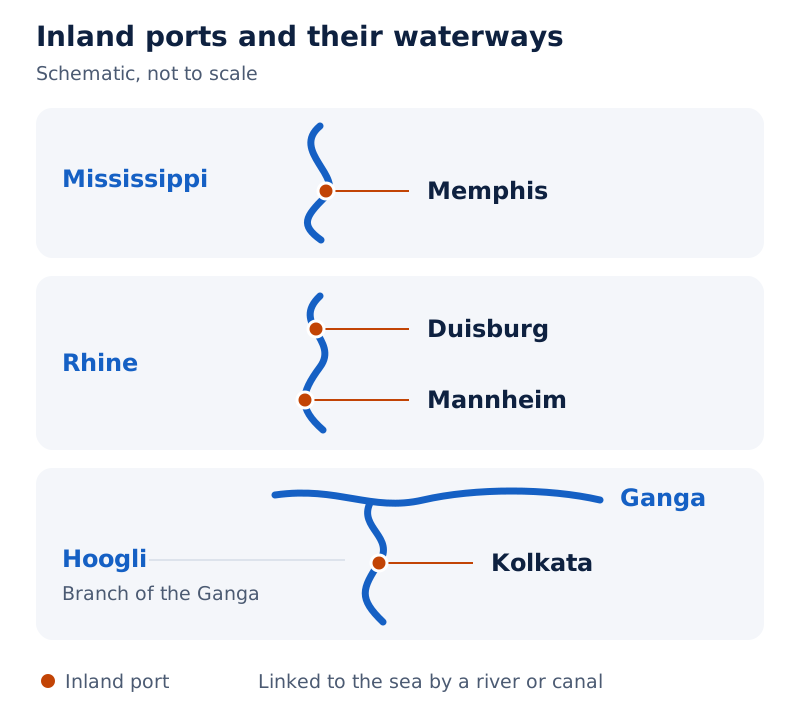
On a sketch map, label Memphis beside the Mississippi, Mannheim and Duisburg beside the Rhine, and Kolkata beside the Hoogli. Annotate Kolkata's waterway as a branch of the Ganga. Use the labels to associate each inland port with its named river.
Drawn by One Young India.
Out ports are deep-water ports built away from actual ports. They serve parent ports by receiving ships too large to approach them. Athens and its out port Piraeus in Greece form a classic combination. The key relationship is the out port's service to the parent port.
Which specialised functions distinguish ports?
A tanker carries oil, while a refinery processes it. A port of call developed as a stopping point for supplies. An entrepot is a collection centre for goods destined for export. These functions distinguish specialised port categories.
| Specialised type | Function | Examples |
|---|---|---|
| Oil ports | Process and ship oil; include tanker and refinery ports | Tanker ports: Maracaibo in Venezuela, Esskhira in Tunisia and Tripoli in Lebanon; refinery port: Abadan on the Gulf of Persia |
| Ports of call | Originally supplied fuel, water and food to ships on main sea routes; later became commercial ports | Aden, Honolulu and Singapore |
| Packet stations or ferry ports | Exclusively transport passengers and mail across water bodies over short distances | Dover in England and Calais in France |
| Entrepot ports | Collect goods brought from different countries for export | Singapore for Asia, Rotterdam for Europe and Copenhagen for the Baltic region |
| Naval ports | Have only strategic importance; serve warships and provide repair workshops | Kochi and Karwar in India |
Diagram
Paired ferry ports across the English Channel
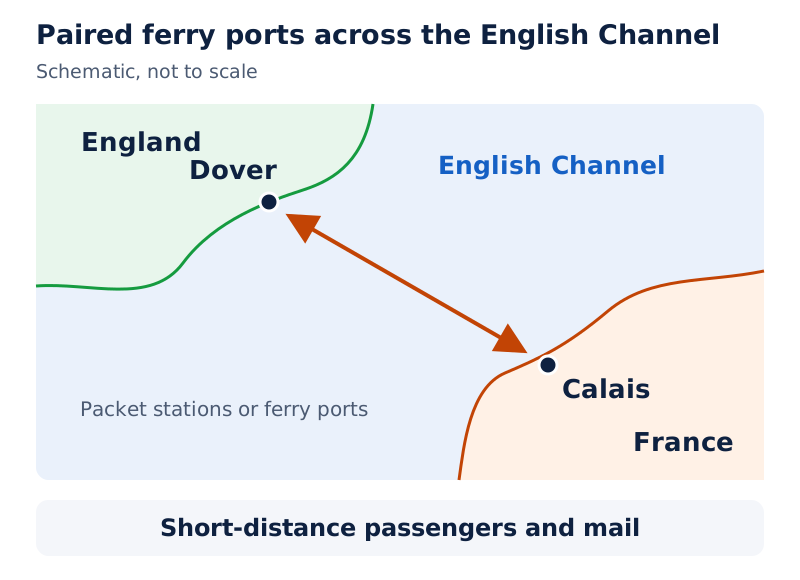
Draw a sketch map labelling England, France and the English Channel. Mark Dover and Calais facing each other across the water. Annotate the pair with “short-distance passengers and mail” to show the packet-station function.
Drawn by One Young India.
Packet stations occur in pairs facing each other across a water body. Naval ports serve a strategic purpose connected with warships. Singapore appears as both a port of call and an entrepot, illustrating how a named port can be associated with different specialised functions.
Glossary
- International trade — The exchange of goods and services among countries across their national boundaries.
- Barter — Direct exchange of goods or services between parties without using money for payment.
- Specialisation — Concentration on particular goods or services within the wider division of productive activity.
- Balance of trade — A record of goods and services imported and exported, assessed by comparing their values.
- Bilateral trade — Trade between two countries that agree to exchange specified commodities with each other.
- Multilateral trade — Trade in which a country exchanges goods and services with many trading countries.
- Trade liberalisation — Opening economies to trade by reducing barriers and allowing competition with domestic goods and services.
- Dumping — Selling a commodity in two countries at different prices for reasons unrelated to costs.
- World Trade Organisation — The international organisation that sets global trading rules and resolves disputes between member nations.
- Regional trade bloc — A grouping that encourages trade and removes trade tariffs among its member countries.
- Comprehensive port — A port that handles both bulk and general cargo in large volumes.
- Inland port — A port away from the sea coast, linked to the sea through a river or canal.
- Out port — A deep-water port serving a parent port by receiving ships too large to approach it.
- Packet station — A ferry port exclusively transporting passengers and mail across water over short distances.
- Entrepot port — A collection centre receiving goods from different countries for their subsequent export.
Common errors and misconceptions
- Misconception: A high value of imports gives a favourable balance. Correct: The balance is unfavourable when import value exceeds export value; it is favourable when export value exceeds import value.
- Misconception: Bilateral trade involves many countries. Correct: Bilateral trade involves two countries; multilateral trade involves many trading countries.
- Misconception: Every price difference between countries is dumping. Correct: Dumping involves prices differing for reasons unrelated to costs. The reason for the difference belongs in the definition.
- Misconception: Jon Beel Mela is definitely India's only surviving barter fair. Correct: It is possibly the only such fair. Retain that qualification.
- Misconception: All great ports are comprehensive ports. Correct: Most of the world's great ports are comprehensive ports, handling bulk and general cargo in large volumes.
- Misconception: Inland ports have no connection with the sea. Correct: They lie away from the coast but connect with the sea through a river or canal.
- Misconception: Free trade guarantees equal benefits to every nation. Correct: Benefits depend on outcomes; unfavourable conditions can harm developing economies, and cheaper dumped goods can harm domestic producers.
- Misconception: The WTO membership figure is undated. Correct: The figure of 166 countries applies to December 2024.
Exam-style questions with model answers
Q1. A potter needs plumbing services, and a plumber needs pots. They exchange pots for the service without money. Identify the system and explain what makes this exchange possible. [2 marks]
- The system is barter, involving direct exchange of goods or services without money.
- The exchange works because the potter needs the plumber's service and the plumber needs the potter's pots.
Q2. A country's import value exceeds its export value. It spends more on goods bought abroad than it earns from goods sold abroad, drawing on its financial reserves. Identify the balance, explain the comparison and state the eventual financial concern. [3 marks]
- The country has a negative or unfavourable balance of trade because the value of its imports is greater than the value of its exports.
- Its spending on goods purchased from other countries exceeds the earnings obtained from selling its goods to other countries.
- The negative balance would ultimately exhaust its financial reserves, since it is spending more on purchases than it earns through sales.
Q3. Use these facts to explain four bases of international trade: minerals are unevenly distributed; distinctive crafts develop in different cultures and are valued elsewhere; agriculturally important countries exchange agricultural products for manufactured goods; rail, ocean and air transport and preservation have improved. [4 marks]
- National resources: Uneven mineral distribution creates differences in the resource base available for industrial development, contributing to exchange between countries with different resources.
- Population and culture: Distinctive crafts produced by different cultures become valued elsewhere and influence the types of goods that countries trade.
- Economic development: Agriculturally important countries exchange agricultural products for manufactured goods, reflecting differences in the nature of national production.
- Transport: Improved rail, ocean and air transport, together with preservation, expands the geographical reach over which trade can take place.
Q4. Developing countries may lack capital for mining, oil drilling, heavy engineering, lumbering and plantation agriculture. Foreign investment can develop these industries. Industrial nations then obtain foodstuffs and minerals and create markets for finished products. Explain this investment-trade relationship in five points. [5 marks]
- Developing countries may lack the capital needed for mining, oil drilling, heavy engineering, lumbering and plantation agriculture, limiting the development of these activities.
- Foreign investment can supply investment from other countries and help develop these capital-intensive activities, which require substantial funds for their development.
- By developing these industries in developing countries, industrial nations ensure imports of foodstuffs and minerals, connecting investment with supplies obtained through trade.
- Industrial nations also create markets for their finished products, so the relationship includes sales of manufactured goods as well as imports of resources.
- This cycle steps up the volume of trade between nations, linking investment, production, resource supplies and markets rather than affecting just one exchange.
Q5. Ports provide docking, loading, unloading and storage. Authorities maintain navigable channels, arrange tugs and barges, and provide labour and management. Inland ports lie away from the sea coast and connect to it by rivers or canals. Out ports are deep-water ports built away from parent ports, receiving ships too large to approach them. Explain three port services and distinguish the two location-based types. [5 marks]
- Ports provide docking, loading, unloading and storage facilities, enabling cargo to be handled and held while ships and goods pass through the port.
- Port authorities maintain navigable channels and arrange tugs and barges, providing the water access and supporting vessels needed for the port's activities.
- Authorities also provide labour and managerial services, linking the workers needed for handling activities with the organisation of work within the port.
- Inland ports lie away from the sea coast but are connected to the sea by a river or canal, providing water access from an inland location.
- Out ports are deep-water ports built away from parent ports; they receive large ships that cannot approach those parent ports because of their size.
Q6. Regional trade blocs encourage exchange among nearby countries with similar and complementary trading items. They remove tariffs within their membership, but free trade between different blocs could become increasingly difficult. Explain their basis, benefit and possible limitation. [3 marks]
- Their basis combines geographical proximity with similarities and complementary trading items, connecting nearby countries whose production and trading needs support exchange.
- They remove trade tariffs within member nations and encourage free trade, reducing barriers to exchange among the countries belonging to the bloc.
- Free trade between different blocs could become increasingly difficult in the future. This possible limitation concerns relationships between groups, rather than trade within one bloc.
Q7. The World Trade Organisation (WTO) sets global trading rules, resolves member disputes and covers services such as telecommunication and banking. Critics argue that influential nations pursue commercial interests and that health, workers' rights, child labour and the environment are ignored. Explain three functions and two criticisms. [5 marks]
- The WTO sets rules for the global trading system, providing rules for trade between nations rather than leaving its role confined to individual commodities.
- It resolves disputes between its member nations, making the settlement of disagreements part of its work alongside the setting of global trading rules.
- It covers trade in services, including telecommunication and banking, so its activities extend beyond the exchange of physical goods moving between countries.
- Critics argue that influential member nations focus on their own commercial interests, raising concerns about whose interests the trading system gives priority to.
- It is also argued that health, workers' rights, child labour and environmental concerns are ignored, questioning the wider social and environmental priorities of trade.
Q8. A commodity is sold in two countries at different prices for reasons unrelated to costs. The cheaper goods compete with domestic producers. Identify the practice and state its possible effect on those producers. [2 marks]
- This is dumping: the international price difference arises for reasons unrelated to costs.
- Dumped goods sold at cheaper prices can harm domestic producers competing with them.
Key takeaways
- International trade crosses national boundaries and helps countries obtain goods they cannot produce or can buy elsewhere at lower prices.
- Resources, population, economic development, foreign investment and transport provide the main bases for international trade.
- A negative balance means import value exceeds export value; a positive balance means export value exceeds import value.
- Bilateral trade involves two countries, while multilateral trade involves a country trading with many partners.
- Trade liberalisation reduces barriers, but unfavourable conditions and cheaper dumped goods can harm developing economies and domestic producers.
- The WTO sets global trading rules and resolves member disputes; regional blocs encourage freer trade among their members.
- Trade is beneficial if it improves production and living standards, but dependence, exploitation and environmental damage remain concerns.
- Ports are trade gateways classified by cargo, location and specialised functions; most great ports handle bulk and general cargo.
Test yourself
What makes the potter and plumber example an example of barter?
The potter exchanges pots directly for the plumber's service, with each party receiving something needed and no money used.
What qualification must accompany the description of Jon Beel Mela?
It is possibly the only fair in India where the barter system is still alive.
Which comparison establishes a favourable balance of trade?
A favourable balance exists when the value of exports exceeds the value of imports.
What distinguishes dumping from an unspecified price difference?
Dumping requires the commodity's prices in two countries to differ for reasons unrelated to costs.
What date belongs with the WTO membership figure of 166 countries?
The membership figure of 166 countries applies to December 2024.
How does an out port serve its parent port?
It receives ships that are too large to approach the parent port, using deep-water facilities built away from it.
Which ports exemplify packet stations across the English Channel?
Dover in England and Calais in France face each other across the English Channel and transport passengers and mail.
How does an entrepot port differ from a naval port?
An entrepot collects goods from different countries for export. A naval port has strategic importance, serving warships and providing repair workshops.
Write about it
Turn a question from this chapter into a paper.
The Writing Studio has a structure guide, a rubric and citation tools for 15 formats, from essays to research papers. Drafting is free with an account. Learnacy Essential adds feedback from an AI writing coach and submission to The OYI Review.
Publication depends on review and is not guaranteed.