
Mineral and Energy Resources | CBSE Class 12 Geography Notes
On this page
This note covers mineral classification and characteristics, India’s mineral belts, the distribution and uses of iron ore, manganese, bauxite, copper and mica, conventional energy resources, nuclear energy, renewable energy sources and the conservation of mineral resources.
What are minerals, and how are they classified?
Definition: A mineral is a natural substance of organic or inorganic origin with definite chemical and physical properties. Organic origin here refers to material derived from animal and plant life; inorganic minerals include mica, limestone and graphite.
Mineral resources provide a base for industrial development. India has a rich variety because of its varied geological structure, meaning the nature and arrangement of its rocks. Minerals can be grouped by their chemical and physical properties.
How do metallic and non-metallic minerals differ?
Metallic minerals are sources of metals. Iron ore, copper and gold belong to this category. An ore is mineral material from which a metal is obtained. Metallic minerals are divided into ferrous and non-ferrous groups.
Ferrous refers to iron; minerals with iron content belong to the ferrous group. Non-ferrous minerals do not have iron content in this classification. Copper and bauxite are examples. Iron ore and manganese are grouped as ferrous mineral resources.
Non-metallic minerals include mineral fuels and other non-metallic substances. Fossil fuels, also called mineral fuels, come from buried animal and plant life. Coal and petroleum are examples. Mica, limestone and graphite are inorganic non-metallic minerals.
| Group | Basis of distinction | Examples |
|---|---|---|
| Ferrous metallic minerals | Iron-related mineral resources | Iron ore and manganese |
| Non-ferrous metallic minerals | No iron content in this classification | Copper and bauxite |
| Organic non-metallic minerals | Derived from buried animal and plant life | Coal and petroleum |
| Inorganic non-metallic minerals | Inorganic origin | Mica, limestone and graphite |
What the figure shows
Classification of minerals
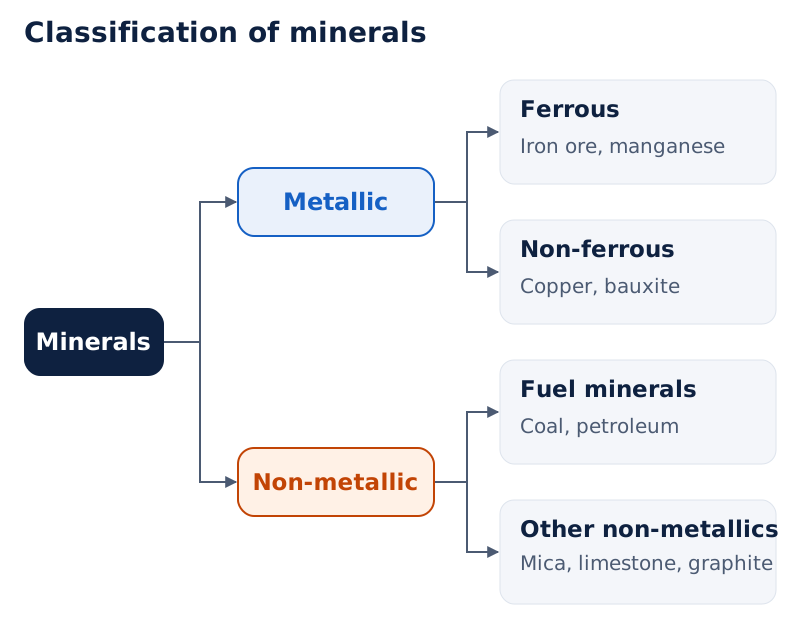
A branching chart divides minerals into metallic and non-metallic groups. Metallic minerals divide into ferrous and non-ferrous groups. Non-metallic minerals divide into fuel minerals and other non-metallics, with examples below each branch.
Drawn by One Young India. See Fig. 5.1 in your NCERT textbook
Why are mineral resources unevenly distributed and exhaustible?
Minerals have three central characteristics: uneven distribution, an inverse relationship between quality and quantity, and exhaustibility. An inverse relationship here means that good-quality minerals occur in smaller quantities than low-quality minerals. Mineral wealth is therefore unequal in both location and quality.
Exhaustible resources can be depleted over time. Minerals take a long geological time to develop and cannot be replenished immediately when needed. Their use therefore requires conservation, meaning protection and careful use so that resources remain available for future generations.
What is the broad spatial pattern in India?
Most metallic minerals occur in the old crystalline rocks of the peninsular plateau. Crystalline rocks have interlocking mineral crystals. Most major mineral resources occur east of a line linking Mangaluru and Kanpur. This is a broad concentration, not a claim that resources occur nowhere else.
Petroleum reserves, or known accumulations of petroleum, occur in the sedimentary basins of Assam, Gujarat and Mumbai High. Sedimentary basins are areas where layers of sediment accumulate. New reserves have been located in the Krishna-Godavari and Kaveri basins.
| Resource pattern | Quantity stated | Associated locations |
|---|---|---|
| Coal reserves | Over 97 per cent | Damodar, Sone, Mahanadi and Godavari valleys |
| Total iron ore reserves | About 95 per cent | Odisha, Jharkhand, Chhattisgarh, Karnataka, Goa, Telangana, Andhra Pradesh and Tamil Nadu |
| Coal deposits of bituminous type and non-coking grade | About 80 per cent | India |
Bituminous names a type of coal; non-coking grade means coal unsuitable for making metallurgical coke, the fuel used in metal extraction. Reserves and deposits describe resources present, whereas production describes material extracted. The percentages above are not annual production shares.
Where are India’s major mineral belts located?
Minerals are generally concentrated in three broad belts. There may also be sporadic occurrences, meaning scattered occurrences in isolated pockets. The Himalayan belt is another mineral belt, so the three broad concentrations should not be treated as an exhaustive boundary around all mineral occurrences.
How do the three broad belts compare?
| Belt | Extent | Important resources and features |
|---|---|---|
| North-Eastern Plateau | Chhotanagpur in Jharkhand, Odisha Plateau, West Bengal and parts of Chhattisgarh | Iron ore, coal, manganese, bauxite and mica |
| South-Western Plateau | Karnataka, Goa, adjoining Tamil Nadu uplands and Kerala | Ferrous metals, bauxite, high-grade iron ore, manganese and limestone |
| North-Western Region | Along the Aravali in Rajasthan and part of Gujarat | Copper, zinc, building stones, gypsum, limestone, petroleum and salt |
The South-Western Plateau belt lacks coal deposits except Neyveli lignite, a brown coal. Its mineral deposits are less diversified than those of the north-eastern belt. Kerala has monazite and thorium deposits, which are associated with nuclear energy, energy obtained from the nuclei or central parts of atoms. Goa has iron ore deposits.
In the North-Western Region, minerals are associated with the Dharwar system, a geological rock system. Rajasthan supplies building stones such as sandstone, granite and marble. Gypsum and Fuller’s earth deposits are extensive. Dolomite and limestone supply raw materials for cement.
Gujarat is known for petroleum deposits, while Gujarat and Rajasthan both have rich salt resources. These examples show that a mineral belt can contain fuels, metallic minerals and non-metallic minerals, rather than a single resource category.
What occurs beyond these three belts?
In the Himalayan belt, copper, lead, zinc, cobalt and tungsten are known to occur in both eastern and western parts. The Assam valley has mineral oil deposits. Offshore oil resources, located beneath the sea away from the coast, also occur near Mumbai at Mumbai High.
Where are iron ore and manganese found, and why are they important?
Iron ore, manganese and chromite support metallurgical industries, the industries concerned with obtaining and working metals. India is well placed in ferrous mineral reserves and production. Its iron ore resources are fairly abundant, and it has the largest iron ore reserve in Asia.
What is the distribution of iron ore?
Haematite and magnetite are the two main iron ore types found in India. Indian iron ore has great international demand because of its superior quality. In the north-eastern plateau, iron ore mines lie close to coalfields, which adds to their advantage.
| State or region | Iron ore locations |
|---|---|
| Odisha | Gurumahisani, Sulaipet, Badampahar, Kiruburu and Bonai |
| Jharkhand | Noamundi and Gua in the Singhbhum districts |
| Chhattisgarh | Durg, Dantewara and Bailadila; Dalli and Rajhara in Durg |
| Karnataka | Sandur-Hospet in Ballari; Baba Budan hills and Kudremukh in Chikkamagaluru |
| Other mining regions | Chandrapur, Bhandara and Ratnagiri in Maharashtra; Karimnagar and Warangal in Telangana; Salem and Nilgiris in Tamil Nadu |
Other deposits occur in parts of Shivamogga, Chitradurg and Tumakuru in Karnataka. Kurnool, Cuddapah and Anantapur in Andhra Pradesh are iron mining regions. Goa has also emerged as an important iron ore producer.
How does manganese support industry?
Manganese is used in smelting iron ore, meaning extracting metal from ore by heating, and in making ferro alloys, which are iron-based alloys. An alloy is a mixture containing a metal and other elements. Manganese occurs in almost all geological formations but is mainly associated with the Dharwar system.
Madhya Pradesh and Odisha are leading producers. Madhya Pradesh’s manganese belt includes Balaghat, Chhindwara, Nimar, Mandla and Jhabua. Odisha’s major mines include Bonai, Kendujhar, Sundergarh, Gangpur, Koraput, Kalahandi and Bolangir.
Karnataka is another major producer. Maharashtra produces manganese in Nagpur, Bhandara and Ratnagiri, but these mines have the disadvantage of being far from steel plants. Telangana, Goa and Jharkhand are minor producers.
What the figure shows
India’s ferrous metallic minerals
The legend distinguishes iron ore fields, iron ore mines, iron ore exporting ports and manganese. Labels include Mayurbhanj, Bailadila, Ratnagiri, Ballari, Balaghat and Shivamogga. Read each place together with its mineral symbol.
See Fig. 5.2 in your NCERT textbook
How do bauxite and copper differ in use and distribution?
India is poorly endowed with non-ferrous metallic minerals except bauxite. Bauxite supplies aluminium, while copper is indispensable to the electrical industry. Their uses and producing regions differ, although both belong to the non-ferrous category.
Where does bauxite occur?
Bauxite is the ore used to manufacture aluminium. It is found mainly in tertiary deposits, deposits of a named geological period, and is associated with laterite rocks. These weathered rocks occur extensively on peninsular plateaus and hill ranges, and in coastal tracts.
Odisha is the largest bauxite producer. Kalahandi and Sambalpur lead, while Bolangir and Koraput have been increasing production. The patlands, or plateau areas, of Lohardaga in Jharkhand have rich deposits.
Other major producers are Gujarat, Chhattisgarh, Madhya Pradesh and Maharashtra. Important deposits include Bhavanagar and Jamnagar in Gujarat, the Amarkantak plateau in Chhattisgarh, and Katni-Jabalpur and Balaghat in Madhya Pradesh.
In Maharashtra, Kolaba, Thane, Ratnagiri, Satara, Pune and Kolhapur are important producers. Tamil Nadu, Karnataka and Goa are minor producers of bauxite. This distinction separates the leading and major producing areas from smaller producers.
Why is copper valuable?
Copper is used in wires, electric motors, transformers and generators. It is alloyable, meaning it can form alloys; malleable, meaning it can be shaped into sheets; and ductile, meaning it can be drawn into wires. Mixing copper with gold strengthens jewellery.
Copper deposits mainly occur in Singhbhum in Jharkhand, Balaghat in Madhya Pradesh, and Jhunjhunu and Alwar in Rajasthan. Minor producers include Agnigundala in Andhra Pradesh, Chitradurg and Hasan in Karnataka, and South Arcot in Tamil Nadu.
What the figure shows
India’s non-ferrous minerals
Stars represent copper and squares represent bauxite. Copper labels include Khetri, Alwar, Hazaribagh and Singhbhum. Bauxite labels include Katni, Bilaspur and Koraput. Use the legend to distinguish the two resources.
See Fig. 5.3 in your NCERT textbook
What makes mica useful, and where is it produced?
Mica is an important non-metallic mineral, mainly used in electrical and electronic industries. It can be split into very thin sheets that are tough and flexible. Its sheet-forming property is a useful distinction from the metal-producing ores discussed earlier.
Mica is produced in Jharkhand, Andhra Pradesh, Telangana and Rajasthan, followed by Tamil Nadu, West Bengal and Madhya Pradesh. The distribution includes both broad belts and individual producing districts.
Which mica belts and districts are important?
| Area | Extent or characteristic | Location detail |
|---|---|---|
| Jharkhand | About 150 kilometres long and about 22 kilometres wide | Lower Hazaribagh plateau; high-quality mica |
| Rajasthan | About 320 kilometres | Jaipur to Bhilwara and around Udaipur |
| Andhra Pradesh | Best-quality mica | Nellore district |
Additional mica deposits occur in Mysuru and Hasan in Karnataka; Coimbatore, Tiruchirapalli, Madurai and Kanniyakumari in Tamil Nadu; Alleppey in Kerala; Ratnagiri in Maharashtra; and Purulia and Bankura in West Bengal.
Limestone, dolomite and phosphate are other non-metallic minerals extracted for local consumption. Mica’s industrial use should not lead to its classification as a metallic mineral: a mineral’s use in electrical equipment does not itself make it a source of metal.
Note: Keep the qualifying word “about” with the mica-belt measurements. The Jharkhand figures describe length and width, while the Rajasthan figure describes the belt’s extent. They are not figures for output or mineral reserves.
Why is coal important, and where are its major deposits?
Energy resources supply power for agriculture, industry, transport and other economic activities. Coal, petroleum and natural gas are fossil fuels. Together with nuclear energy minerals, they use exhaustible resources. Their availability connects mineral geography with the demand for energy.
Coal is mainly used to generate thermal power, power produced using heat, and to smelt iron ore. It occurs mainly in rock sequences of two geological ages: Gondwana and tertiary. These names identify the geological groups associated with the deposits.
Where are the Gondwana coalfields?
The most important Gondwana coalfields lie in the Damodar Valley, within the Jharkhand-Bengal coal belt. Important fields are Raniganj, Jharia, Bokaro, Giridih and Karanpura. Jharia is the largest coalfield, followed by Raniganj.
Other river valleys associated with coal are the Godavari, Mahanadi and Sone. Major mining centres include Singrauli in Madhya Pradesh, part of whose coalfield lies in Uttar Pradesh, and Korba in Chhattisgarh.
Other important centres are Talcher and Rampur in Odisha; Chanda-Wardha, Kamptee and Bander in Maharashtra; Singareni in Telangana; and Pandur in Andhra Pradesh. Remember the river-valley pattern together with the individual mining centres.
Where are tertiary coal and lignite found?
Tertiary coal occurs in Assam, Arunachal Pradesh, Meghalaya and Nagaland. Extraction locations include Darangiri, Cherrapunji, Mewlong and Langrin in Meghalaya; Makum, Jaipur and Nazira in upper Assam; Namchik-Namphuk in Arunachal Pradesh; and Kalakot in Jammu and Kashmir.
Lignite, or brown coal, occurs in the coastal areas of Tamil Nadu, Puducherry and Gujarat, and in Jammu and Kashmir. Neyveli lignite is the exception to the lack of coal deposits in the south-western mineral belt.
What the figure shows
India’s conventional energy resources
Separate legend symbols identify coalfields, coal mines, oilfields and major natural gas reserves. Jharia, Bokaro, Raniganj, Singrauli, Korba, Talcher, Singareni and Neyveli are labelled. Mumbai High is marked offshore on the western side.
See Fig. 5.4 in your NCERT textbook
How are petroleum resources distributed and processed?
Crude petroleum is oil as extracted from wells, before refining. It consists of hydrocarbons, compounds of hydrogen and carbon, in liquid and gaseous states. Its composition, colour and specific gravity, a measure of relative density, vary.
Petroleum provides energy for internal combustion engines, engines in which fuel burns inside, in automobiles, railways and aircraft. Its numerous by-products are processed in petrochemical industries, industries that make chemical products from petroleum.
Products include fertiliser, synthetic rubber, synthetic fibre, medicines, vaseline, lubricants, wax, soap and cosmetics. Petroleum is called liquid gold because of its scarcity and diversified uses. This expression combines its economic value with its wide range of applications.
Where does petroleum occur?
Crude petroleum occurs in sedimentary rocks of the tertiary period. Systematic exploration and production followed the establishment of the Oil and Natural Gas Commission in 1956. Until then, Digboi in Assam was the only oil-producing region.
Important producing areas in Assam are Digboi, Naharkatiya and Moran. Gujarat’s major oilfields are Ankaleshwar, Kalol, Mehsana, Nawagam, Kosamba and Lunej. Exploratory wells have found oil and natural gas in the Krishna-Godavari and Kaveri basins on the east coast.
Case study: How did Mumbai High develop?
Mumbai High lies 160 kilometres offshore from Mumbai. It was discovered in 1973, and production commenced in 1976. Its location illustrates the importance of offshore petroleum resources alongside the producing areas of Assam and Gujarat.
Why must crude oil be refined?
Refining means processing crude oil to obtain usable petroleum products. Crude oil contains many impurities and cannot be used directly. The sequence from the well to useful products connects extraction with refining and further industrial processing.
- Oil is extracted from wells as crude oil.
- The extracted crude contains many impurities and is unsuitable for direct use.
- It must therefore pass through refining before it can be used.
- Numerous petroleum by-products are processed in petrochemical industries into products such as fertiliser, synthetic fibre and lubricants.
India has field-based refineries, associated with oil-producing fields, and market-based refineries, associated with markets for petroleum products. Digboi illustrates the first type, and Barauni the second.
What the figure shows
India’s oil refineries
Dots mark refinery locations. Labels include Mathura, Jamnagar, Barauni and Digboi. The dots identify refineries, so they should not be read as a map of oil-producing fields.
See Fig. 5.5 in your NCERT textbook
How do natural gas and nuclear minerals supply energy?
Natural gas occurs with petroleum deposits and is released when crude oil reaches the surface. It is used as a domestic and industrial fuel, including electricity generation in the power sector and heating in industries.
It also serves as a raw material for chemical, petrochemical and fertiliser industries. With expanding infrastructure and local gas distribution networks, it is emerging as a preferred transport and household cooking fuel.
Where are the major gas reserves?
India’s major natural gas reserves occur in Mumbai High and allied fields along the west coast, supplemented by finds in the Cambay basin. New reserves have been discovered in the Krishna-Godavari basin along the east coast.
Which minerals support nuclear energy?
Nuclear energy is energy obtained from the nuclei, or central parts, of atoms. Uranium and thorium are important minerals used for its generation. Their raw materials are exhaustible, so nuclear energy should not be equated with renewable sources such as wind and sunlight.
Uranium deposits occur in Dharwar rocks. Uranium ores are known along the Singhbhum Copper belt, and in Udaipur, Alwar and Jhunjhunu in Rajasthan; Durg in Chhattisgarh; Bhandara in Maharashtra; and Kullu in Himachal Pradesh.
Thorium is mainly obtained from monazite and ilmenite, minerals in beach sands along Kerala and Tamil Nadu. The world’s richest monazite deposits occur in Palakkad and Kollam in Kerala, near Vishakhapatnam in Andhra Pradesh, and in Odisha’s Mahanadi delta.
How did nuclear energy institutions develop?
| Year | Development |
|---|---|
| 1948 | Atomic Energy Commission established |
| 1954 | Atomic Energy Institute established at Trombay |
| 1967 | The institute renamed Bhabha Atomic Research Centre |
Progress could be made only after the institute was established in 1954. Important nuclear power projects are Tarapur in Maharashtra, Rawatbhata near Kota in Rajasthan, Kalpakkam in Tamil Nadu, Narora in Uttar Pradesh, Kaiga in Karnataka and Kakarapara in Gujarat.
How do solar and wind energy offer alternatives to exhaustible fuels?
Renewable energy sources are sources renewed by natural processes. Sustainable energy resources are renewable sources such as solar, wind, geothermal and biomass energy. Biomass means biological material used as an energy source. These sources are more equitably distributed and environment-friendly.
Non-conventional energy sources offer alternatives to established energy supplies. They will provide more sustained, eco-friendly and cheaper energy after the initial cost is taken care of. Retain that cost condition when considering their economic advantages.
How is solar energy tapped?
Solar energy comes from sun rays. Photovoltaic cells, devices that convert sunlight into electrical energy, can tap these rays. Photovoltaics and solar thermal technology, which uses the sun’s heat, are two effective ways to obtain solar energy.
Solar thermal technology has some relative advantages over other non-renewable energy sources: it is cost competitive, environment-friendly and easy to construct. Solar energy is generally used more in appliances such as heaters, crop dryers and cookers.
The western part of India, particularly Gujarat and Rajasthan, has greater potential for solar energy development. This regional potential should be associated with solar energy, while wind has its own set of favourable locations.
How does wind become electrical energy?
Wind energy uses the kinetic energy, or energy of motion, of blowing air. Through turbines, rotating machines that receive energy from moving air, this energy is converted into electrical energy. Wind is an inexhaustible source of energy.
Permanent wind systems such as the trade winds and westerlies, as well as seasonal winds such as the monsoon, have been used as energy sources. Local winds, including land and sea breezes, can also produce electricity.
India has started generating wind energy. Rajasthan, Gujarat, Maharashtra and Karnataka have favourable conditions for its development. Solar and wind therefore provide different ways of using naturally available energy while reducing reliance on exhaustible raw materials.
What energy can be obtained from the sea, underground heat and biological waste?
Tidal and wave energy uses the energy associated with sea movements. Ocean currents are a storehouse of energy. Large tidal waves are known to occur along India’s west coast, giving the country great potential for tidal energy development along its coasts.
This coastal potential has not yet been utilised. The existence of a potential energy resource and its actual use are separate ideas: favourable natural conditions do not by themselves mean that energy production has begun.
How is geothermal energy obtained?
Geothermal energy is energy from heat within the Earth. Magma, hot molten material inside the Earth, releases tremendous heat when it comes to the surface. This heat can be tapped and converted into electrical energy.
Hot water emerging through geyser wells, wells through which heated underground water gushes out, can also generate thermal energy. Hot springs and geysers have been used since the medieval period. A geothermal energy plant has been commissioned at Manikaran in Himachal Pradesh.
The first successful attempt to tap underground heat was made in Boise, Idaho, in 1890. A hot-water pipe network heated surrounding buildings. This illustrates the direct use of underground heat, alongside the possibility of converting heat into electricity.
Case study: What does Okhla illustrate about bio-energy?
Bio-energy is energy derived from biological products, including agricultural residues and municipal, industrial and other wastes. Agricultural residues are material left from farming, while municipal waste is waste handled by towns and cities.
Bio-energy can be converted into electricity, heat or gas for cooking. It processes waste and garbage while producing energy. Okhla in Delhi is an example of a project converting municipal waste into energy.
Bio-energy will improve rural economic life in developing countries, reduce environmental pollution, enhance self-reliance and reduce pressure on fuel wood. These are benefits of bio-energy generally; the Okhla example establishes the conversion of municipal waste into energy.
How can mineral resources be conserved for sustainable development?
Sustainable development brings economic development together with environmental concerns and protects resources for future generations. Traditional methods of resource use generate enormous quantities of waste and create other environmental problems. Conservation therefore concerns both resource availability and the effects of resource use.
Minerals take a long time to form and cannot be immediately replaced. The need for conservation follows from this exhaustibility as well as the unequal distribution of mineral wealth. Using a scarce mineral carelessly can shorten the period for which its reserves remain available.
Which measures reduce pressure on mineral reserves?
- Develop alternative energy: solar, wind, wave and geothermal energy are inexhaustible resources that should be developed to replace exhaustible resources.
- Recycle scrap metals: scrap, meaning discarded metal available for reuse, enables metals to be recycled. Recycling means recovering and using material again.
- Prioritise scarce metal reserves: using scrap is especially significant for copper, lead and zinc because India’s reserves of these metals are meagre.
- Use substitutes: alternative materials for scarce metals may reduce the consumption of those metals.
- Reduce exports: exports of strategic and scarce minerals must be reduced so that existing reserves can be used for longer. Strategic minerals are those important to essential national needs.
These measures address different parts of resource use. Alternative energy changes the source of power; recycling reuses material already extracted; substitutes reduce demand for scarce metals; and reduced exports help extend the life of existing reserves.
Note: Conservation does not mean that new mineral deposits can immediately replace exhausted ones. The long time needed for mineral formation makes careful use, recycling and alternatives necessary even where resources appear abundant.
Glossary
- Mineral — A natural substance of organic or inorganic origin with definite chemical and physical properties.
- Metallic minerals — Minerals that supply metals, including iron ore, copper and gold.
- Ferrous minerals — Iron-related mineral resources, including iron ore and manganese in the mineral classification.
- Non-ferrous minerals — Metallic minerals without iron content in this classification, including copper and bauxite.
- Fossil fuels — Mineral fuels derived from buried animal and plant life, such as coal and petroleum.
- Exhaustible resources — Resources that can be depleted over time and cannot be immediately replenished when needed.
- Bauxite — The ore used to manufacture aluminium, mainly associated with tertiary deposits and laterite rocks.
- Lignite — Brown coal occurring in areas including Tamil Nadu, Puducherry, Gujarat and Jammu and Kashmir.
- Crude petroleum — Oil extracted from wells that contains impurities and requires refining before use.
- Solar energy — Energy obtained from sun rays through photovoltaics or solar thermal technology.
- Geothermal energy — Energy obtained from the Earth’s internal heat, including heat associated with magma and hot water.
- Bio-energy — Energy derived from biological products, including agricultural residues and municipal, industrial and other wastes.
- Conservation — Protection and careful use of resources so that they remain available for future generations.
Common errors and misconceptions
- Misconception: Every mineral is a source of metal. Correct: Minerals include metallic and non-metallic groups. Coal, petroleum, mica and limestone belong to non-metallic groups.
- Misconception: Better-quality minerals are more abundant. Correct: Quality and quantity have an inverse relationship: good-quality minerals are less abundant than low-quality minerals.
- Misconception: India’s minerals occur exclusively within three belts. Correct: Minerals are generally concentrated in three broad belts, but isolated pockets may occur and the Himalayan belt is another mineral belt.
- Misconception: The south-western mineral belt has no coal of any kind. Correct: It lacks coal deposits except Neyveli lignite. That exception must be retained.
- Misconception: Crude oil can be used directly after extraction. Correct: It contains many impurities and needs refining. Digboi and Barauni illustrate different refinery types.
- Misconception: Nuclear energy uses inexhaustible raw materials. Correct: Uranium and thorium are mineral resources, and nuclear energy uses exhaustible raw materials.
- Misconception: All bio-energy benefits have been individually demonstrated by the Okhla example. Correct: Okhla illustrates municipal waste conversion. Rural development and reduced pressure on fuel wood are general benefits of bio-energy.
Exam-style questions with model answers
Q1. Given that metallic minerals supply metals, iron ore is ferrous, copper and bauxite are non-ferrous, and mica and limestone are inorganic non-metallic minerals, distinguish metallic from non-metallic minerals with examples. Give two points. [2 marks]
- Metallic minerals supply metals. Iron ore is a ferrous example, while copper and bauxite belong to the non-ferrous group.
- Non-metallic minerals form a separate category from metal-supplying minerals. Mica and limestone are examples of inorganic non-metallic minerals.
Q2. Minerals are unevenly distributed; good-quality minerals are less abundant than low-quality minerals; and minerals take a long geological time to form and cannot be replenished immediately. Using these facts, explain three reasons for careful resource use. [3 marks]
- Uneven distribution means that mineral resources are not equally available everywhere. Their concentration in particular places makes careful use of available resources necessary.
- Good-quality minerals occur in smaller quantities than low-quality minerals. Their quality does not mean that they are abundant, so these valuable resources need care.
- Minerals take a long geological time to develop and cannot be immediately replenished. Depletion therefore cannot be quickly reversed when more material is needed.
Q3. The North-Eastern Plateau belt includes Chhotanagpur, Odisha Plateau, West Bengal and parts of Chhattisgarh, with iron ore, coal, manganese, bauxite and mica. The South-Western Plateau belt includes Karnataka, Goa, adjoining Tamil Nadu uplands and Kerala; it has ferrous metals and bauxite, lacks coal except Neyveli lignite, and is less diversified. Compare the belts in four points using these facts. [4 marks]
- The north-eastern belt covers Chhotanagpur, Odisha Plateau, West Bengal and parts of Chhattisgarh. The south-western belt covers Karnataka, Goa, adjoining Tamil Nadu uplands and Kerala.
- The north-eastern belt contains iron ore, coal, manganese, bauxite and mica. Ferrous metals and bauxite are important resources in the south-western belt.
- Coal is part of the north-eastern belt’s resource base. The south-western belt lacks coal deposits except for Neyveli lignite, an exception that must be retained.
- The south-western belt has less diversified mineral deposits than the north-eastern belt. Both contain mineral resources, but their resource combinations differ.
Q4. Use these facts to explain petroleum development, location and processing in five points: systematic exploration followed the Oil and Natural Gas Commission’s establishment in 1956; Assam has Digboi, Naharkatiya and Moran; Gujarat has Ankaleshwar and Kalol; Mumbai High lies 160 kilometres offshore, was discovered in 1973 and began production in 1976; crude oil contains impurities and needs refining; Digboi is field-based and Barauni market-based. [5 marks]
- Systematic petroleum exploration and production followed the establishment of the Oil and Natural Gas Commission in 1956. This institutional development supported the search for and production of oil.
- Important producing locations include Digboi, Naharkatiya and Moran in Assam, together with Ankaleshwar and Kalol in Gujarat. The supplied locations show producing areas in both states.
- Mumbai High illustrates offshore production, lying 160 kilometres from Mumbai. It was discovered in 1973, while production began in 1976, so discovery and production have different dates.
- Oil extracted from wells is crude oil containing impurities. Refining is necessary before use, so extraction alone does not make the oil directly usable.
- Refineries differ by their locational association: Digboi is field-based and Barauni is market-based. These examples distinguish association with an oilfield from association with a market.
Q5. Uranium and thorium are important nuclear energy minerals and are exhaustible. Uranium ores occur along the Singhbhum Copper belt. Thorium is mainly obtained from monazite and ilmenite in Kerala and Tamil Nadu beach sands. Using these facts, give three points linking nuclear energy with its mineral resources. [3 marks]
- Nuclear energy depends on minerals such as uranium and thorium. These resources are exhaustible, so the energy source should not be treated as using an unlimited supply of raw materials.
- The Singhbhum Copper belt is a location where uranium ores occur. It provides a geographical association for one of the important nuclear energy minerals.
- Thorium is mainly obtained from monazite and ilmenite in beach sands along Kerala and Tamil Nadu.
Q6. Compare five alternative energy sources using this fact set: solar energy is tapped through photovoltaics and solar thermal technology, with greater potential in Gujarat and Rajasthan; wind’s kinetic energy becomes electricity through turbines, with favourable conditions in Rajasthan, Gujarat, Maharashtra and Karnataka; west-coast tidal potential has not yet been utilised; geothermal heat can generate electricity and a plant has been commissioned at Manikaran; bio-energy uses biological products and wastes, with municipal waste conversion at Okhla in Delhi. [5 marks]
- Solar energy taps sunlight through photovoltaics and solar thermal technology. Gujarat and Rajasthan have greater potential, linking the source with opportunities in western India.
- Wind energy converts the kinetic energy of moving air into electricity through turbines. Rajasthan, Gujarat, Maharashtra and Karnataka have favourable conditions for its development.
- Tidal energy has potential along the west coast. This potential has not yet been utilised, so resource potential must be distinguished from actual energy production.
- Geothermal energy uses underground heat that can be converted into electricity. Manikaran is the given example of a place where a geothermal plant has been commissioned.
- Bio-energy uses biological products and wastes as energy inputs. Okhla in Delhi illustrates a specific application in which municipal waste is converted into energy.
Q7. Minerals are exhaustible and cannot be immediately replenished. Solar, wind, wave and geothermal energy can replace exhaustible resources; scrap metal enables recycling, especially for India’s meagre copper, lead and zinc reserves; substitutes may reduce scarce-metal consumption; reducing exports of strategic and scarce minerals extends reserve use. Explain four conservation measures using these facts. [4 marks]
- Develop solar, wind, wave and geothermal energy to replace exhaustible resources. These alternatives reduce reliance on resources that cannot be immediately replenished after use.
- Use scrap metal for recycling. This is especially significant for copper, lead and zinc because India’s meagre reserves make reuse of extracted material valuable.
- Use substitutes for scarce metals. Alternative materials may reduce consumption of those metals, helping to limit demand for resources whose reserves are restricted.
- Reduce exports of strategic and scarce minerals. This allows existing reserves to be used for a longer period and supports their conservation for future needs.
Q8. Mica splits into very thin, tough and flexible sheets and is mainly used in electrical and electronic industries. High-quality mica occurs in the lower Hazaribagh plateau in a belt about 150 kilometres long and about 22 kilometres wide. State one property-use point and one distribution point. [2 marks]
- Mica forms very thin sheets that are tough and flexible. It is mainly used in electrical and electronic industries.
- High-quality mica occurs in the lower Hazaribagh plateau, in a belt about 150 kilometres long and about 22 kilometres wide.
Key takeaways
- Minerals are unevenly distributed, better-quality minerals are less abundant, and geological formation takes too long for immediate replacement.
- Most metallic minerals occur in peninsular India, while petroleum reserves occur in sedimentary basins and offshore areas.
- The three broad mineral belts have different resource combinations, with the Himalayan belt and possible isolated pockets adding to the distribution.
- Iron ore and manganese support metallurgical industries; bauxite supplies aluminium; copper and mica have important electrical uses.
- Coal is mainly used for thermal power and iron ore smelting, while crude petroleum requires refining before use.
- Uranium and thorium support nuclear energy, but their exhaustible raw materials distinguish them from renewable energy sources.
- Solar, wind, tidal, geothermal and bio-energy use different natural resources, with distinct regional opportunities and examples of application.
- Conservation combines alternative energy development, metal recycling, substitutes for scarce metals and reduced exports of strategic and scarce minerals.
Test yourself
Why does a high-quality mineral still need conservation?
Good-quality minerals are less abundant than low-quality minerals, and minerals cannot be replenished immediately after use.
Which exception must accompany the statement that the south-western mineral belt lacks coal?
Neyveli lignite is the exception to the belt’s lack of coal deposits.
Which two iron ore types are the main ones found in India?
Haematite and magnetite are the two main types of iron ore found in India.
Why must the location of a refinery be distinguished from an oilfield?
Refineries process crude oil and may be field-based or market-based. Digboi illustrates the first type and Barauni the second.
What are Mumbai High’s discovery and production-start dates?
Mumbai High was discovered in 1973, and its oil production commenced in 1976.
Which minerals are important for nuclear energy, and are their supplies inexhaustible?
Uranium and thorium are important nuclear energy minerals. Nuclear energy uses exhaustible raw materials.
What energy examples are associated with Manikaran and Okhla?
Manikaran in Himachal Pradesh has a commissioned geothermal plant; Okhla in Delhi illustrates municipal waste conversion into energy.
Why is metal recycling especially significant for copper, lead and zinc in India?
India’s reserves of these metals are meagre, making the use of scrap for recycling especially significant.
Write about it
Turn a question from this chapter into a paper.
The Writing Studio has a structure guide, a rubric and citation tools for 15 formats, from essays to research papers. Drafting is free with an account. Learnacy Essential adds feedback from an AI writing coach and submission to The OYI Review.
Learnacy Essential is ₹1,499 for the year. Publication depends on review and is not guaranteed.