
Geographical Perspective on Selected Issues and Problems | CBSE Class 12 Geography Notes
On this page

This note covers environmental pollution, water and river pollution, air and noise pollution, urban waste disposal, ecological restoration in Daurala, rural-urban migration, problems of slums, land degradation and community participation in watershed management in Jhabua.
What is environmental pollution and how are its types distinguished?
Definition: Environmental pollution results from the release of substances and energy from the waste products of human activities. Pollutants are the substances or forms of energy responsible for this pollution.
The classification depends on the medium, or surroundings, through which pollutants are transported and spread. The four types are air pollution, water pollution, land pollution and noise pollution. Each type connects a source of waste or disturbance with the environment affected.
How do sources and pollutants differ?
A source of pollution is the activity or place from which pollution originates. A pollutant is what causes the contamination or disturbance. For example, burning petrol is a source, while the harmful gases released are pollutants associated with air pollution.
Pesticides control pests; fertilisers supply plant nutrients. Residues are materials left behind after use. Heavy metals are metallic elements of relatively high density, including lead and mercury.
Runoff is water flowing over the ground surface; it can carry waste into water bodies. Sewage means wastewater containing human and domestic waste. These terms help distinguish the waste itself from the route by which it reaches a river or lake.
| Type | Pollutants or disturbance | Sources |
|---|---|---|
| Air pollution | Dust, smoke and poisonous gases | Burning coal, petrol and diesel; industrial processes; solid waste and sewage disposal |
| Water pollution | Oil, grease, agricultural chemical residues and heavy metals such as lead and mercury | Sewage disposal, urban runoff, industrial discharge and runoff over cultivated land |
| Land pollution | Human and animal excreta, or bodily wastes; garbage; bacteria; agricultural chemical residues | Improper human activities, untreated industrial waste, pesticides and fertilisers |
| Noise pollution | Noise above the level people can tolerate | Aircraft, automobiles, trains, industrial processing and advertising media |
The categories do not make the activities independent of one another. Industrial activity, for instance, produces polluted wastewater, gases, dust and solid waste. Studying its geographical effects therefore involves examining the different surroundings into which these wastes are released.
How does water become polluted and affect human health?
Water pollution develops when the concentration of unwanted substances increases enough to make water unfit for use. Indiscriminate water use by an increasing population and industrial expansion have considerably degraded water quality. Rivers, canals and lakes contain small quantities of suspended particles, carried in water rather than dissolved, and organic and inorganic substances, relating respectively to living matter and materials such as minerals.
When the concentration of these substances increases, water becomes unfit for use. Its self-purifying capacity, the capacity to clean itself, is then unable to purify it.
Which activities contribute to contamination?
Natural sources include erosion, the removal of soil and rock; landslides, downhill movement of earth and rock; and the decay and decomposition of plants and animals. However, pollutants from human activities are the real causes of concern. Industrial, agricultural and cultural activities pollute water; industry is the most significant contributor among these activities.
Industries generate wastewater, poisonous gases, chemical residues, heavy metals, dust and smoke. Most industrial wastes are disposed of in running water or lakes. Poisonous elements reach reservoirs, rivers and other water bodies, destroying their biological systems. Leather, pulp and paper, textiles and chemicals are major water-polluting industries.
- Modern agriculture uses inorganic fertilisers, pesticides and herbicides, chemicals used to control unwanted plants.
- Water washes these chemicals into rivers, lakes and tanks.
- The chemicals also infiltrate, or pass into, the soil and reach groundwater, which is water beneath the ground surface.
- Fertilisers increase nitrate, a nitrogen-containing chemical form, in surface waters, adding to the deterioration of water quality.
Pilgrimage, religious fairs and tourism also cause water pollution. In India, almost all surface water sources are contaminated and unfit for human consumption. The qualification matters: contamination is widespread, but the statement is not that every individual surface water source is affected.
What are the health consequences?
Water-borne diseases are diseases spread through contaminated water. Common examples are diarrhoea, intestinal worms and hepatitis. The World Health Organization's estimate places about one-fourth of communicable diseases in India in this category. Communicable diseases are illnesses that can spread between people, directly or indirectly.
What the figure shows
Foam on the Yamuna, photograph
Two people occupy a narrow boat surrounded by a pale layer of foam. The photograph shows rowing through the heavily polluted Yamuna on the outskirts of New Delhi.
See Fig. 9.1 in your NCERT textbook
What do the Ganga and Yamuna examples reveal about river pollution?
The Ganga flows through one of India's most populous regions, making its pollution a matter of great concern. Industrial waste, domestic waste and the dumping of animal carcasses affect the river. A carcass is the dead body of an animal.
The Yamuna example combines waste discharge with the extraction of water for irrigation. Water extraction by Haryana and Uttar Pradesh, agricultural runoff, and domestic and industrial waste from Delhi are listed among its pollution-related problems. Agricultural runoff produces high levels of micro-pollutants, meaning pollutants present in very small quantities.
Downstream means in the direction in which a river flows. A confluence is the meeting point of rivers.
| River | Polluted stretches | Waste sources and associated pressures |
|---|---|---|
| Ganga | Downstream of Kanpur; downstream of Varanasi; Farrakka Barrage | Industrial pollution from towns such as Kanpur; urban domestic wastes; carcass dumping |
| Yamuna | Delhi to its confluence with the Chambal; Mathura and Agra | Irrigation withdrawals; agricultural runoff; domestic and industrial wastes from Delhi |
Kanpur, Prayagraj, Varanasi, Patna and Kolkata release domestic waste into the Ganga. Delhi is a major source of domestic waste entering the Yamuna.
Diagram
River pollution locations
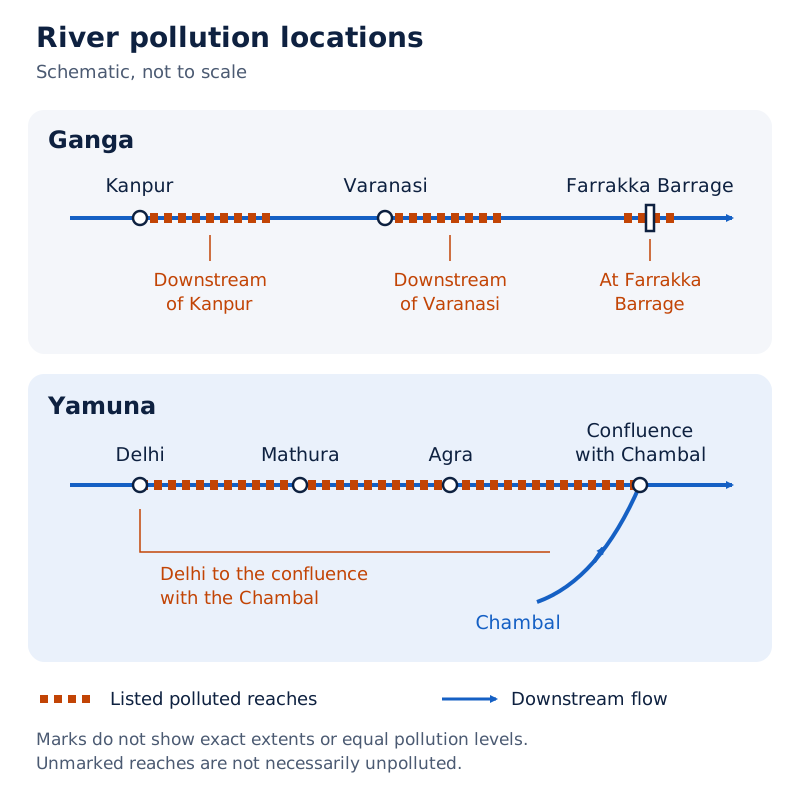
On a sketch map, label the Ganga and Yamuna. Mark Kanpur, Varanasi and Farrakka Barrage for the Ganga, and Delhi, Mathura and Agra for the Yamuna. Annotate the polluted stretches given in the table; do not imply that the whole river has identical pollution.
Drawn by One Young India.
What are the objectives of Namami Gange?
The National Mission for Clean Ganga was initiated to improve the river's condition. The Union Government launched the Namami Gange Programme to clean the river through effective pollution control. Its objectives address waste treatment, ecological improvement and public behaviour.
- Develop sewerage treatment systems in towns to treat wastewater.
- Monitor industrial effluents, meaning liquid waste discharged by industries.
- Develop the river front.
- Undertake afforestation, or tree planting, along the bank to increase biodiversity, the variety of living organisms.
- Clean the river surface.
- Develop Ganga Grams, villages covered by the programme's village-development objective, in Uttarakhand, Uttar Pradesh, Bihar, Jharkhand and West Bengal.
- Create public awareness to avoid adding pollutants to the river, even through rituals.
River cleaning includes both controlling incoming pollutants and improving conditions along the river. The seven objectives should be understood together, rather than reducing the programme to surface cleaning alone.
How do air pollution and noise pollution affect people and places?
Definition: Air pollution is the addition of dust, fumes, gases, fog, odour, smoke or vapour to air in substantial proportion and for a duration that may harm plants, animals and property.
Increasing fuel use has brought a marked rise in emissions of toxic gases. Burning fossil fuels, such as coal and petroleum fuels, mining and industries are the main sources. Emissions include oxides of sulphur and nitrogen, compounds containing oxygen; hydrocarbons, compounds of hydrogen and carbon; carbon dioxide and carbon monoxide, gases containing carbon and oxygen; lead, a metal; and asbestos, a fibrous mineral material.
What are the effects of polluted air?
Air pollution causes diseases affecting the respiratory, or breathing, system; the nervous system, which carries messages around the body; and the circulatory system, which moves blood through the body. Urban smog means smoky fog over cities caused by atmospheric pollution. It is very harmful to human health.
Air pollution can also cause acid rain, rain made more acidic by air pollution. The pH value indicates acidity or alkalinity; a lower value indicates greater acidity. Analysis of urban rainwater indicates that the first rain after summer always has a lower pH than subsequent rains.
Why is noise pollution location specific?
Noise pollution is noise that creates unbearable and uncomfortable conditions for people. Its sources include factories, mechanised construction and demolition, automobiles and aircraft. Sirens and loudspeakers at festivals and community programmes may add periodical noise. Steady noise is measured as a sound level in decibels, abbreviated as dB.
Traffic produces the biggest nuisance among these sources. Its noise varies with the type of aircraft, vehicle or train. For automobiles, both road condition and vehicle condition matter. Industrial noise varies in intensity according to the type of industry.
In sea traffic, noise pollution is confined to the harbour because of loading and unloading. Noise intensity declines as distance from industrial areas, transport routes or airports increases. This makes noise pollution location specific; it is hazardous in many metropolitan and big Indian cities.
What the figure shows
Noise monitoring at a mine, photograph
People stand near large mining machinery on exposed ground. The activity is noise monitoring at Panchpatmalai Bauxite Mine.
See Fig. 9.2 in your NCERT textbook
Why is urban waste disposal a serious geographical problem?
Urban areas are generally marked by overcrowding, congestion and inadequate facilities for their rapidly growing populations. Poor sanitation and foul air follow. Solid waste pollution has become significant because the amount of waste produced by different sources has grown enormously.
Solid waste consists of discarded old and used articles, also called refuse, garbage or rubbish. Examples include metal pieces, broken glassware, plastic containers, polythene bags and ash. The two main sources are household or domestic establishments and industrial or commercial establishments.
How is waste disposed of?
Household waste is disposed of on public land or at private contractors' sites. Industrial solid waste is collected and disposed of through municipal facilities at low-lying public grounds called landfill areas. Ash and debris from industries, thermal power houses, construction and demolition create serious disposal problems.
| Urban category | Reported proportion | What the figure measures |
|---|---|---|
| Metropolitan cities such as Mumbai, Kolkata, Chennai and Bengaluru | About 90 per cent | Solid waste collected and disposed of |
| Most other cities and towns | About 30 to 50 per cent | Generated waste left uncollected |
Note: The two percentages measure different things. About 90 per cent refers to collected waste in the metropolitan examples; about 30 to 50 per cent refers to uncollected waste in most other cities and towns.
What damage does poorly managed waste cause?
Uncollected waste accumulates on streets, between houses and on wasteland. It produces offensive smells and harbours flies and rodents that carry diseases, including typhoid, diphtheria, diarrhoea, malaria and cholera. Wind and rainwater spread carelessly handled waste and increase the nuisance.
Industrial waste dumped into rivers causes water pollution. City-based industries and untreated sewage create serious health problems downstream. Untreated wastes also ferment slowly and release toxic biogas, including methane, a gas consisting of carbon and hydrogen. Biogas is gas produced during the breakdown of organic waste.
Waste should be treated as a resource and used to generate energy and compost, the material produced by decomposition for use in soil. The problem therefore includes collection, disposal and useful treatment, rather than merely moving rubbish out of sight.
What the figure shows
Urban waste at Mahim, photograph
A person stands beside waste scattered along a narrow space between buildings. The scene illustrates urban waste in Mahim, Mumbai.
See Fig. 9.3 in your NCERT textbook
How did the Daurala case study combine safe water and ecological restoration?
Daurala, near Meerut, provides an example of restoring ecology and protecting health through people's participation. Ecology concerns relationships between living organisms and their environment. In 2003, the village's poor condition drew civil society's attention. Its groundwater contained heavy metals because untreated industrial wastewater was leaching, moving down through the ground with water, into it.
A Meerut-based non-governmental organisation, an organisation outside government commonly abbreviated to NGO, surveyed residents' health from door to door and prepared a report. The village community, organisation and people's representatives then sought sustainable solutions.
Which groups participated in the response?
Meetings brought together Daurala Industries officials, NGOs, government officials and other stakeholders, meaning people or groups concerned with the problem. Authentic studies, arguments and public pressure supported the response. Industrialists showed keen interest in checking ecological deterioration.
The effort followed the polluter pays principle, which places responsibility for pollution costs on the polluter. The restoration model began bearing fruit after three years. The case concerns the health and environment of twelve thousand residents, rather than an isolated improvement to a single water source.
| Recorded detail | Number | Meaning in the case |
|---|---|---|
| Public attention | 2003 | The condition of Daurala drew civil society's attention |
| Residents | 12,000 | Village population whose living conditions were affected |
| Additional pipeline | 900 metres | Extra pipeline laid to supply potable water, meaning water fit for drinking |
| Tree planting | 1,000 trees | Planting that improved the environment |
What practical measures were taken?
- The capacity of the overhead water tank was increased and the extra pipeline supplied potable water, meaning water fit for drinking.
- The village pond was desilted, meaning accumulated silt was removed, to increase the amount of water it could hold.
- The restored pond helped recharge aquifers, underground formations that store and transmit water.
- Rainwater harvesting, the collection of rainwater for use or recharge, helped dilute groundwater contaminants after the monsoons.
- Tree planting improved the village environment.
The measures addressed immediate drinking-water needs and the condition of local water and land resources. Community participation connected the health survey with action by officials and industrialists. Diluting contamination should be distinguished from claiming that every contaminant was completely removed.
Why do people migrate from rural areas, and what does Ramesh's case study show?
Rural-urban migration is the movement of people from rural areas to towns and cities. High demand for urban labour, low rural employment opportunities and unbalanced development between rural and urban areas encourage this movement. India's city populations are increasing rapidly.
Because opportunities are limited in smaller and medium-sized cities, poor migrants generally bypass them and go directly to mega cities for livelihoods. This is a general tendency, not a rule that every migrant follows. Both conditions at home and perceived opportunities elsewhere influence migration.
What pushed Ramesh to leave his village?
Ramesh's family faced severe poverty and debt. Three of his brothers and their families depended on three acres of land. He discontinued education after the ninth standard and faced additional pressure after marriage. Successful migrants working in Ludhiana also influenced him through the money and goods they sent home.
Family poverty acted as a push factor, a condition encouraging departure. Perceived job promises in Ludhiana acted as a pull factor, an attraction at the destination. Ramesh moved to Punjab with a friend and worked in a woollen factory for six months in 1988.
| Stage or activity | Recorded figure | Significance |
|---|---|---|
| Woollen factory employment in Ludhiana | 20 rupees per day in 1988 | Meagre wages made personal expenses difficult to manage |
| Duration of that employment | Six months | He subsequently changed his place of work |
| Money sent to his father | 20,000 rupees per year | Supported family consumption and other household needs |
What changed after he learnt welding?
Difficulty adapting to the new culture and environment added to his financial problems. Guided by a friend, he moved from Ludhiana to Surat, learnt welding and began moving between places with the same contractor. His work included a construction site in Talcher, a coal region of Odisha.
Remittances, money migrants send home, supported daily consumption, healthcare and children's schooling. Some money also went into agriculture, land purchases and house building. His family's standard of living improved significantly, but his temporary and transferable job prevented him from bringing the family to live with him.
In developing countries, poor, semi-illiterate and unskilled migrants frequently obtain low-paid menial work in the informal sector, work outside organised employment arrangements. Wages are too low to support families at destinations. Spouses remain in villages caring for children and older people, and the migration stream is male dominated.
Note: Improved household income and painful separation can occur together. Ramesh's experience shows that migration's economic gains do not remove the insecurity associated with temporary, transferable employment.
How do slums reveal inequalities within urban areas?
Rural and urban settlements differ in functions and sometimes complement one another. They also show cultural, social, political, economic and technological divisions. Within cities, however, residents do not share uniform conditions. Urban centres contain marked differences in income, infrastructure and living environments.
High-income localities have wide roads, streetlights, water, sanitation, lawns, parks, playgrounds and provisions for security and privacy. At the other extreme are slums, residential areas of least choice with deteriorated housing, poor hygiene, inadequate ventilation and a lack of basic amenities.
Why do people live in such conditions?
People forced to leave rural areas for livelihoods may be unable to afford proper urban housing because rents and land prices are high. Slums, jhuggi-jhopari clusters and shanty structures occupy degraded and environmentally incompatible areas. Jhuggi-jhopari and shanty settlements are clusters of makeshift dwellings.
Overcrowded narrow streets, open defecation and unregulated drainage create health and social-environmental hazards. Many dwellings lack drinking water, light and toilets. These are linked problems of housing, essential services and the conditions in which residents must earn their livelihoods.
Most slum residents work in low-paid, high-risk, unorganised urban sectors. They are undernourished, prone to illness and unable to afford proper education for children. Poverty makes them vulnerable to substance abuse and other social problems, ultimately including social exclusion, being shut out of participation in wider society.
What does the Dharavi example add?
Dharavi illustrates crowded living conditions: narrow passages, crowded rooms, temporary buildings, uncollected garbage and stagnant foul water. Some lanes are too narrow for a bicycle. At the same time, the settlement produces valuable goods, including pottery, embroidery, leather goods, garments, metalwork, jewellery settings, wood carvings and furniture.
Dharavi therefore illustrates the coexistence of poor living conditions and productive work. Its contribution to wealth does not guarantee adequate living conditions for those producing the goods. The example helps connect housing deprivation with the wider urban economy.
The Swachh Bharat Mission, abbreviated to SBM, is part of the urban renewal mission launched by the Government of India to improve quality of life in urban slums. Urban renewal concerns improving urban living conditions and facilities.
Note: Vulnerability does not mean that every slum resident engages in crime or substance abuse. The problem is the insecurity produced by poverty, hazardous work and inadequate housing and services.
What causes land degradation, and how does it differ from wasteland?
Definition: Land degradation is generally understood as a temporary or permanent decline in the productive capacity of land. Pressure on agricultural land rises both because land is limited and because its quality deteriorates.
Soil erosion is the removal of soil; waterlogging is excessive water accumulation in the ground. Salinisation means increasing salt content, while alkalinisation means increasing alkalinity. These processes degrade land. Consistent use without managing fertility also reduces productivity.
Is every degraded area already wasteland?
All degraded land may not be wasteland. Unchecked degradation may lead to its conversion into wasteland. A decline in productive capacity and the eventual conversion into wasteland are therefore related but different conditions. The decline can also be temporary rather than permanent.
The National Remote Sensing Centre, abbreviated to NRSC, classifies wastelands using remote sensing, the collection of information about the Earth's surface from a distance. The categories can be grouped according to the natural and human processes responsible for them.
Ravinous land contains deep channels cut by erosion; scrub means low, bushy vegetation. Shifting cultivation involves cultivation that moves between plots. These terms describe different land conditions or uses, rather than a single process shared by all wastelands.
| Dominant explanation | Examples | Qualification |
|---|---|---|
| Natural agents | Gullied or ravinous land, desertic or coastal sands, barren rocky areas, steep slopes and glacial areas | Primarily caused by natural agents |
| Natural and human factors | Waterlogged and marshy areas, salt-affected and alkaline land, land with or without scrub | Largely caused by both natural and human factors |
| Human action | Degraded shifting cultivation areas, plantation land, forests and pastures; mining and industrial wastelands | Caused by human action |
The words primarily and largely preserve the distinction between a dominant explanation and an exclusive one. Waterlogging and salt-affected land should not simply be assigned to natural causes alone. Effective management needs to consider how land use, water and vegetation interact.
How does the Jhabua case study demonstrate community-based land restoration?
Jhabua district lies in the westernmost agro-climatic zone of Madhya Pradesh. An agro-climatic zone is an area grouped by climate and agricultural conditions. It has a high concentration of tribal population, mostly Bhils. Poverty has been worsened by rapid degradation of forest and land resources.
Watershed management means managing land, water and vegetation together within a drainage area. Programmes funded by the Union ministries of Rural Development and Agriculture have been successfully implemented in Jhabua, helping prevent land degradation and improve soil quality.
What role did programme support play?
Watershed programmes recognise the links between land, water and vegetation and seek better livelihoods through natural-resource management and community participation. Over a five-year period, programmes funded by the Ministry of Rural Development alone treated 20 per cent of the district's total area.
These programmes were implemented by the Rajiv Gandhi Mission for Watershed Management. Petlawad block illustrates cooperation between government, non-governmental organisations and the community.
Draw and label
Jhabua and Petlawad location sketch
Mark Jhabua in the westernmost agro-climatic zone of Madhya Pradesh. In an enlarged district sketch, place Petlawad in the northernmost part of Jhabua. Label Sat Rundi hamlet of Karravat village as the community example within Petlawad block.
How did the Bhils restore common land?
Common property resources, abbreviated to CPR, are resources shared by a community. In Sat Rundi hamlet of Karravat village, Bhils revitalised large parts of their common resources through their own efforts. The actions linked planting with collective decisions about future use.
- Each household planted and maintained one tree on common property.
- The community planted fodder grass on pasture land, land used to feed grazing animals.
- It adopted social fencing, community-agreed protection of land from use, for at least two years.
- It planned no open grazing even afterwards, choosing stall feeding, supplying fodder to cattle kept in stalls, instead.
Before this management began, a villager from an adjoining village had encroached on the common land, occupying it without the community's accepted rights. Residents called the tehsildar, a local revenue official, to establish those rights. They addressed the conflict by offering the encroacher membership of their user group and shared benefits.
The villagers were confident that the restored pastures would sustain their cattle in future. That confidence is an expectation, not proof of unlimited future supply. Community membership, shared benefits and agreed restrictions were part of the restoration process alongside tree and grass planting.
What the figure shows
Common-land restoration, photographs
Figure 9.4 shows planted vegetation on open, uneven land in Jhabua. Figure 9.5 shows people working across a grassy slope during community land levelling on common property resources in Jhabua.
See Figs. 9.4 and 9.5 in your NCERT textbook
Glossary
- Environmental pollution — Environmental harm resulting from substances and energy released through waste products of human activities.
- Water pollution — Increased concentration of unwanted substances in water that makes it unfit for use.
- Industrial effluents — Liquid wastes discharged by industrial establishments into the surrounding environment or water bodies.
- Water-borne diseases — Diseases spread through contaminated water, including diarrhoea, intestinal worms and hepatitis.
- Air pollution — Addition of contaminants to air in substantial proportion and duration that may harm living organisms and property.
- Urban smog — Smoky fog over cities caused by atmospheric pollution and harmful to human health.
- Noise pollution — Noise from different sources that creates unbearable and uncomfortable conditions for human beings.
- Solid waste — Discarded old and used articles from domestic, industrial or commercial establishments.
- Rural-urban migration — Movement of people from rural areas to towns and cities for livelihoods and other opportunities.
- Remittances — Money sent home by migrants to support families and meet household needs.
- Slums — Residential areas of least choice, marked by deteriorated housing, poor hygiene and inadequate basic amenities.
- Land degradation — A temporary or permanent decline in the productive capacity of land.
- Watershed management — Joint management of land, water and vegetation to improve resources and livelihoods through community participation.
- Common property resources — Resources shared by a community, including common lands and pastures managed through collective action.
Common errors and misconceptions
- Misconception: Water pollution comes entirely from natural processes. Correct: Natural sources exist, but human activities are the real concern; industry is the most significant contributor among industrial, agricultural and cultural activities.
- Misconception: Every surface water source in India is contaminated. Correct: The description is almost all surface water sources. Removing that qualification changes the extent of the claim.
- Misconception: Noise has the same intensity at every distance from its source. Correct: Noise pollution is location specific, and its intensity declines as distance from the source increases.
- Misconception: The urban waste figures both measure collection. Correct: About 90 per cent measures collection and disposal in the metropolitan examples; about 30 to 50 per cent measures uncollected waste in most other cities and towns.
- Misconception: Migration automatically allows a worker's family to live together in the city. Correct: Ramesh's family income improved, but his temporary and transferable work prevented family relocation and caused painful separation.
- Misconception: All degraded land is already wasteland, and all degradation is permanent. Correct: Degradation may be temporary or permanent; unchecked degradation may convert land into wasteland.
- Misconception: Slum residents do not contribute to the urban economy. Correct: Dharavi produces valuable goods despite poor living conditions. Poverty-related vulnerability should not be treated as a description of every resident's behaviour.
- Misconception: Jhabua's restoration involved planting alone. Correct: Households maintained trees, planted fodder grass, protected pastures, planned stall feeding and resolved a conflict over common land through shared membership and benefits.
Exam-style questions with model answers
Q1. Environmental pollution arises from substances and energy released in human waste products. Burning fuel releases harmful gases into air. Using this information, distinguish pollution from a pollutant in two points. [2 marks]
- Pollution is the environmental condition produced when harmful substances or energy are released through human activities.
- A pollutant is the harmful substance or energy involved, such as the gases released by burning fuel.
Q2. Agricultural chemicals are washed into rivers, lakes and tanks; they also infiltrate soil and reach groundwater. Fertilisers increase surface-water nitrate content. Explain three ways in which these facts connect agriculture with water pollution. [3 marks]
- Water carries agricultural chemicals from cultivated land into rivers, lakes and tanks, linking activities on farmland with contamination of surface water bodies.
- Chemicals infiltrate the soil and reach groundwater, so their effects extend beneath the land surface as well as into visible water bodies.
- Fertilisers increase nitrate content in surface water, providing a specific example of how agricultural inputs change water quality.
Q3. About 90 per cent of solid waste is collected and disposed of in metropolitan examples such as Mumbai. In most other cities and towns, about 30 to 50 per cent remains uncollected. Such waste accumulates in streets and open spaces and harbours disease-carrying flies and rodents. Explain this contrast and its consequences in four points. [4 marks]
- The metropolitan figure describes collected and disposed waste, indicating that about 90 per cent receives those services in the examples given.
- The figure for most other cities and towns describes the opposite category: about 30 to 50 per cent of generated waste remains uncollected.
- Uncollected waste accumulates in streets and open spaces, making the places where people live and move repositories for discarded material.
- Flies and rodents sheltered by the waste carry disease, connecting inadequate waste collection with hazards to human health.
Q4. Namami Gange objectives include town sewerage treatment, industrial-effluent monitoring, river-front development, tree planting for biodiversity, surface cleaning, Ganga Grams in Uttarakhand, Uttar Pradesh, Bihar, Jharkhand and West Bengal, and public awareness about pollution including rituals. Explain any five objectives, giving one point for each. [5 marks]
- Town sewerage treatment aims to develop systems that treat wastewater. It addresses the waste reaching the river from settlements along its course.
- Industrial-effluent monitoring focuses attention on liquid waste discharged by industries. It forms part of the programme's effort to control river pollution effectively.
- Afforestation along riverbanks means planting trees to increase biodiversity. This objective connects river improvement with the variety of living organisms along the banks.
- Cleaning the river surface directly addresses waste at the water surface. It is one objective within the wider group of pollution-control activities.
- Public awareness encourages people to avoid adding pollutants to the river. This includes pollution associated with rituals as well as other activities.
Q5. In Daurala, untreated industrial wastewater contaminated groundwater with heavy metals. A health survey and meetings supported action: water-tank capacity increased and 900 metres of pipeline were added for drinking-water supply, the pond was desilted to recharge aquifers, rainwater harvesting diluted contaminants after monsoons, and 1,000 trees improved the environment. Explain five responses to the problem using these facts. [5 marks]
- The health survey and meetings connected evidence about residents' health with collective action. They helped participants organise a response to industrial contamination of groundwater.
- Increasing overhead tank capacity and adding 900 metres of pipeline improved the arrangements for supplying drinking water to the affected community.
- Desilting the pond removed accumulated material and allowed more water to collect. This supported the recharge of underground aquifers in the village.
- Rainwater harvesting structures helped dilute groundwater contaminants after the monsoons. This describes reduced concentration through dilution, without claiming that all pollution disappeared.
- Planting 1,000 trees improved the environment. Tree planting accompanied water-supply and recharge measures as part of the broader effort at ecological restoration.
Q6. Ramesh left a poor, indebted household after hearing of jobs in Ludhiana. He earned 20 rupees daily in a woollen factory in 1988, later learnt welding in Surat and sent 20,000 rupees annually to his father. Remittances supported household needs, but temporary, transferable work prevented family relocation. Explain four aspects of his migration experience. [4 marks]
- Poverty and debt pushed Ramesh away from his village, while perceived employment opportunities in Ludhiana attracted him towards an urban destination.
- His woollen-factory wage of 20 rupees per day in 1988 shows the low-paid employment associated with the earlier stage of his migration.
- After learning welding, annual remittances of 20,000 rupees supported household needs, showing how migration could improve the family's economic circumstances.
- Temporary and transferable work prevented family relocation, so financial support for the household coexisted with separation from the people at home.
Q7. Slums contain deteriorated, crowded housing, inadequate ventilation, limited drinking water and toilets, and unregulated drainage. Most residents work in low-paid, high-risk occupations; poor families cannot afford proper education for children. Explain five connected problems using this information. [5 marks]
- Deteriorated and crowded housing provides an inadequate residential environment. Overcrowding is therefore part of the housing problem, rather than simply a description of settlement size.
- Poor ventilation limits the quality of indoor living conditions. It accompanies the other deficiencies of housing in the crowded residential areas described in the question.
- Limited drinking water and toilet facilities show the shortage of basic amenities. Unregulated drainage adds to the unhealthy conditions surrounding people's homes.
- Most residents' low-paid and high-risk occupations combine limited earnings with hazardous working conditions. These employment problems accompany the difficulties of the residential environment.
- Families unable to afford proper education cannot meet their children's schooling needs adequately. Low household resources thus connect livelihood insecurity with educational deprivation.
Q8. In Jhabua's Petlawad example, each household maintained one planted tree, villagers grew fodder grass, protected pastures through social fencing for at least two years and planned stall feeding instead of open grazing. An encroacher was offered user-group membership and shared benefits. Explain these five elements of community resource management. [5 marks]
- Planting and maintaining one tree per household gave families a direct role in restoring common land. Responsibility included care after planting, not planting alone.
- Growing fodder grass developed the pasture resource used to support cattle. This connected land restoration with an everyday livelihood requirement of the community.
- Social fencing protected the land through community agreement for at least two years. Collective restrictions were part of managing the restored pasture.
- Planned stall feeding replaced open grazing in the community's future arrangements. The decision linked cattle feeding with continued protection of the developed pastures.
- Offering membership and shared benefits to the encroacher addressed the dispute through inclusion. Management therefore involved resolving resource-use conflicts as well as improving vegetation.
Key takeaways
- Environmental pollution includes air, water, land and noise pollution, distinguished by the medium through which pollutants travel and spread.
- Industry is the most significant contributor among industrial, agricultural and cultural activities polluting water; natural sources also exist.
- Namami Gange combines wastewater treatment, monitoring, river-front improvement, tree planting, surface cleaning, village development and public awareness.
- Noise pollution is location specific, while air pollution harms health and can produce urban smog and acid rain.
- Urban waste creates health hazards, but treatment can turn discarded materials into resources for energy and compost.
- Daurala links community participation with improved water supply, pond restoration, rainwater harvesting and tree planting to protect health and ecology.
- Ramesh's migration improved family income through remittances, while insecure and transferable work maintained painful separation from his family.
- Slums combine inadequate housing and services with livelihood insecurity; Dharavi also demonstrates residents' productive contribution to the urban economy.
- Land degradation may be temporary or permanent; Jhabua illustrates restoration through linked resource management and community participation.
Test yourself
Which four broad types of environmental pollution are distinguished?
The four types are air pollution, water pollution, land pollution and noise pollution.
Which industries are major contributors to water pollution?
Leather, pulp and paper, textiles and chemicals are major water-polluting industries.
What does the abbreviation dB mean in noise measurement?
It means decibels, the units used to express the sound level of steady noise.
Why should the two urban waste percentages not be read as equivalent measures?
About 90 per cent measures collection and disposal in metropolitan examples. About 30 to 50 per cent measures waste left uncollected in most other cities and towns.
How did industrial activity contaminate Daurala's groundwater?
Untreated wastewater from Daurala industries leached into groundwater, contaminating it with heavy metals.
Why could Ramesh not bring his family to live with him?
His job was temporary and transferable, preventing family relocation despite improved household income.
How are land degradation and wasteland related?
All degraded land may not be wasteland, but unchecked degradation may convert land into wasteland.
How did Jhabua villagers deal with the common-land encroacher?
They offered him membership of their user group and a share in the benefits of restoring common lands and pastures.
Write about it
Turn a question from this chapter into a paper.
The Writing Studio has a structure guide, a rubric and citation tools for 15 formats, from essays to research papers. Drafting is free with an account. Learnacy Essential adds feedback from an AI writing coach and submission to The OYI Review.
Learnacy Essential is ₹1,499 for the year. Publication depends on review and is not guaranteed.