
Morphology of Flowering Plants | ISC Class 11 Biology Notes
On this page
This note covers root systems and root regions, modifications of roots and stems, leaf structure and arrangement, leaf modifications, inflorescences, flower structure and symmetry, floral whorls, aestivation, stamen relationships, ovary position and placentation.
What are root systems, and how does a root grow?
Morphology concerns the external form and structure of organisms. In flowering plants, or angiosperms, the root system and shoot system form the basic plant body. The shoot system includes the stem, leaves, flowers and fruits.
The radicle is the embryonic root, while the plumule is the embryonic shoot. An embryo is the young plant within a seed. Its seed leaves are called cotyledons: dicotyledonous plants have two, while monocotyledonous plants have one.
How do the three root types differ?
In the majority of dicotyledonous plants, direct elongation of the radicle produces the primary root. Its lateral branches are secondary roots, which can branch further. The primary root and its branches constitute a tap root system, as in mustard.
In monocotyledonous plants, the primary root is short lived. Numerous roots arising from the stem base replace it, forming a fibrous root system, as in wheat. Adventitious roots arise from parts other than the radicle, as in grass, Monstera and banyan.
Roots absorb water and minerals, anchor the plant, store reserve food and synthesise plant growth regulators, substances that regulate plant growth. Root type is identified by origin and branching, rather than simply by whether the organ lies underground.
What is the sequence of root regions?
- The root cap, a thimble-like covering at the tip, protects the tender apex as it moves through soil.
- A few millimetres above it lies the region of meristematic activity, where small, thin-walled cells with dense living contents divide repeatedly.
- Farther from the tip, cells in the region of elongation enlarge rapidly, increasing root length.
- Cells then differentiate and mature in the region of maturation. Some outer surface cells form fine, delicate, thread-like outgrowths called root hairs that absorb water and minerals.
What the figure shows
Regions of the root-tip
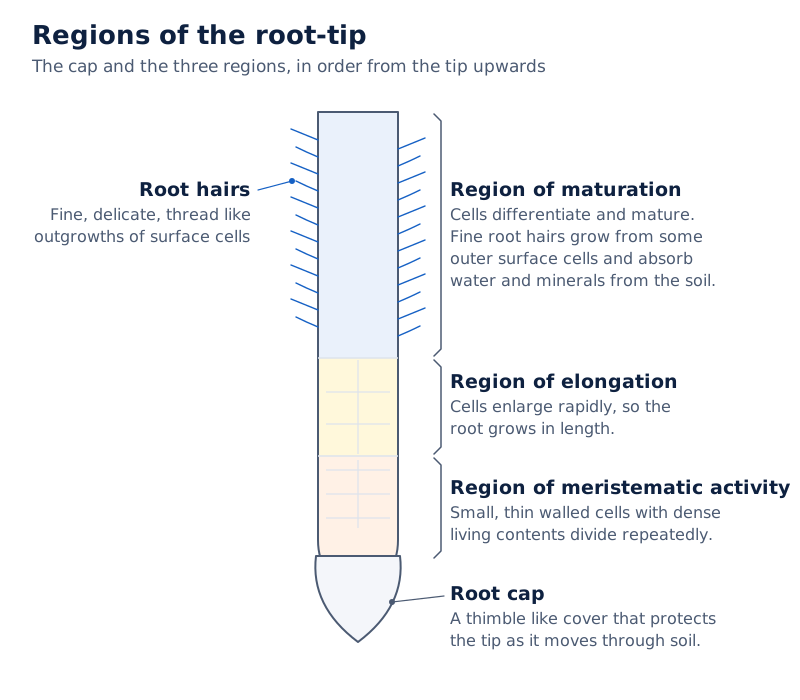
The root cap is drawn at the bottom. Above it are the labelled regions of meristematic activity, elongation and maturation. Numerous fine root hairs project from the maturation region.
Drawn by One Young India.
How are roots modified for storage, respiration and support?
A modification is a change in an organ's form associated with a particular function. Roots may become enlarged for food storage, project into the air for respiration, or provide additional mechanical support. Their modified appearance does not change their identity as roots.
Which shapes occur in storage roots?
| Storage form | Identifying shape | Example |
|---|---|---|
| Tuberous | Swollen without a definite regular shape | Mirabilis and sweet potato |
| Fusiform | Spindle-shaped, swollen in the middle and tapering towards both ends | Radish |
| Conical | Broad towards the upper end and gradually tapering downwards | Carrot |
| Napiform | Rounded, greatly swollen upper portion that narrows abruptly below | Turnip |
Storage roots retain reserve food. Shape terms describe the swollen organ: fusiform does not mean the same as conical, and napiform does not mean uniformly tapering. Sweet potato is a root modification, whereas the potato tuber is a stem modification.
How do breathing roots and supporting roots differ?
Pneumatophores are specialised roots that grow upwards from waterlogged soil and assist gaseous exchange. Gaseous exchange means the movement of gases between the plant and its surroundings. These roots help obtain oxygen for respiration, the cellular release of energy from food.
Prop roots descend from branches towards the soil and provide pillar-like support, as in banyan. Stilt roots arise from the lower part of the stem and grow obliquely into the soil, supporting the plant, as in maize.
The distinction is functional and positional: pneumatophores assist breathing, prop roots support from branches, and stilt roots support from the lower stem. An aerial position, meaning above ground, does not by itself establish that a structure is a stem.
What identifies a stem, and how are underground stems modified?
The stem develops from the plumule and bears branches, leaves, flowers and fruits. A node is a region where leaves arise; an internode is the portion between two nodes. These features help distinguish a stem from a root.
A bud is an undeveloped shoot. A terminal bud lies at the shoot tip; an axillary bud occurs in the axil, the angle between a leaf and the stem. The stem is generally green when young and later often becomes woody and dark brown.
What functions does the stem perform?
The stem spreads out branches bearing leaves, flowers and fruits. It also conducts water, minerals and photosynthates, the products of photosynthesis. Photosynthesis is the manufacture of food using light. Some stems additionally store food, provide support or protection, or enable vegetative propagation.
Vegetative propagation is the formation of new plants from vegetative parts such as roots, stems or leaves. Underground stems can store reserves and bear buds capable of producing new shoots. Their position beneath the soil does not make them roots.
| Underground modification | Structure | Example |
|---|---|---|
| Tuber | Swollen stem portion with buds; potato eyes bear buds | Potato |
| Rhizome | Horizontal underground stem with nodes, internodes, reduced leaves and buds | Ginger |
| Corm | Short, upright, solid, swollen underground stem | Colocasia |
In identifying a tuber, look for stem features rather than relying on its rounded outline. Compare potato with sweet potato: both store food, but the former is a stem tuber and the latter a swollen root. Shared function does not establish shared organ identity.
How do aerial and sub-aerial stem modifications differ?
Aerial stem modifications occur above ground. They may help a plant climb, protect it or carry out photosynthesis. Sub-aerial stems grow partly along or close to the ground and help vegetative propagation. Distinguish these categories from underground storage stems.
Which aerial modifications perform special functions?
| Modification | Defining feature and function | Example |
|---|---|---|
| Stem tendril | Slender, coiling stem structure that attaches to support and assists climbing | Grapevine |
| Thorn | Hard, pointed modified stem that provides protection | Citrus |
| Phylloclade | Green modified stem with several nodes and internodes that performs photosynthesis | Opuntia |
| Cladode | Green photosynthetic stem branch restricted to one or a few internodes | Asparagus |
A tendril is a slender structure that coils around support. Its organ of origin matters: the tendril in grapevine is a stem modification, while the tendril in pea is a leaf modification. Likewise, a stem thorn differs in origin from a leaf spine, a hard, pointed modified leaf.
How do sub-aerial stems spread?
| Modification | Growth pattern | Example |
|---|---|---|
| Runner | Slender stem creeps over the ground and forms roots and shoots at nodes | Grass |
| Sucker | Branch grows from the underground basal stem and emerges upwards as a leafy shoot | Mint |
| Stolon | Lateral branch grows outwards, arches down and roots where it contacts the soil | Jasmine |
| Offset | Short lateral branch with one internode connects a daughter shoot with the parent | Pistia |
For each modification, connect its structure to its function. Coiling provides support; a pointed thorn provides protection; a green modified stem makes food; spreading branches can establish new plants. Do not group all of them merely as unusual stems without describing their distinguishing features.
What are the parts of a leaf, and what is venation?
A leaf is a lateral, generally flattened structure borne on the stem. It develops at a node and bears an axillary bud. Leaves originate from the shoot apical meristem, the dividing tissue at the shoot tip.
Leaves are arranged in acropetal order, with older leaves towards the base and younger ones towards the apex. They are the most important vegetative organs for photosynthesis. A typical leaf has a leaf base, petiole and lamina.
How do the leaf parts contribute to its function?
The leaf base attaches the leaf to the stem and may bear two small lateral leaf-like structures called stipules. In monocotyledons, the leaf base expands into a sheath covering the stem partially or wholly.
In some leguminous plants, members of the pea family, the leaf base may become swollen, forming a pulvinus. The petiole is the leaf stalk and holds the blade towards light. Long, thin, flexible petioles allow fluttering, cooling the leaf and bringing fresh air to its surface.
The lamina, or leaf blade, is the green expanded part. It contains veins and smaller veinlets. A prominent middle vein, the midrib, is usually present. Veins stiffen the blade and provide transport channels for water, minerals and food.
How do reticulate and parallel venation differ?
Venation is the arrangement of veins and veinlets in the lamina. In reticulate venation, veinlets form a network. In parallel venation, veins run parallel within the lamina. These terms concern vein arrangement, rather than the arrangement of leaves on a stem.
Dicotyledonous leaves generally possess reticulate venation. Parallel venation is characteristic of most monocotyledons. Retain these qualifications: neither statement makes venation an exceptionless rule for identifying the two groups.
What the figure shows
Structure of a leaf
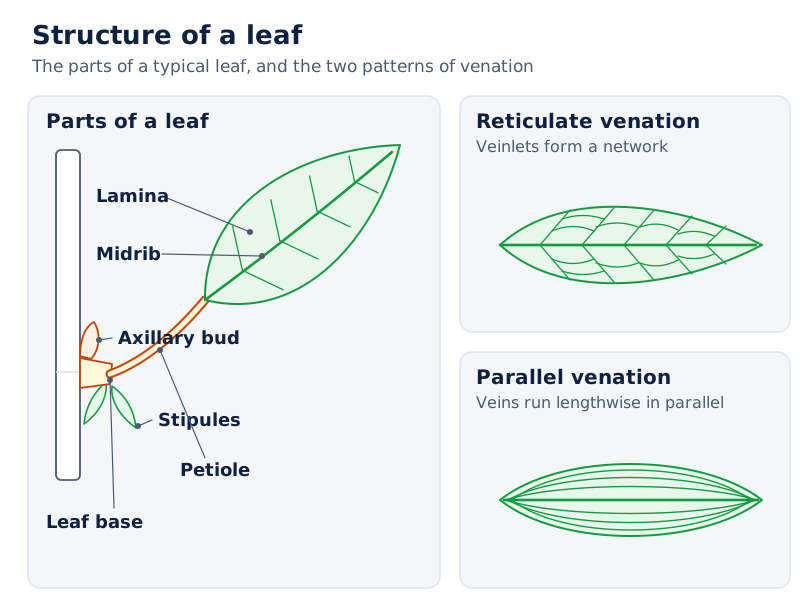
The first drawing labels the lamina, petiole, stipule, leaf base and axillary bud. The next two drawings contrast a branching network of veins with veins running lengthwise in parallel.
Drawn by One Young India.
How can leaf types and phyllotaxy be identified?
A simple leaf has an entire lamina, or incisions that do not reach the midrib. In a compound leaf, incisions reach the midrib and divide the blade into separate leaflets, the smaller blade units of the compound leaf.
Both simple and compound leaves have a bud in the axil of the petiole. A leaflet lacks an axillary bud. This distinction helps separate a compound leaf from a branch bearing several simple leaves, even when the two arrangements look similar.
How do pinnate and palmate compound leaves differ?
In a pinnately compound leaf, leaflets occur along a common axis called the rachis, which represents the midrib. Neem is an example. In a palmately compound leaf, the leaflets attach at one point at the petiole tip, as in silk cotton.
Phyllotaxy is the arrangement of leaves on a stem or branch. It is usually of three types. Do not confuse it with venation, which concerns veins, or with the arrangement of leaflets within a single compound leaf.
| Phyllotaxy | Arrangement at a node | Examples |
|---|---|---|
| Alternate | A single leaf at each node in an alternate manner | China rose, mustard, sunflower |
| Opposite | A pair of leaves at each node, lying opposite one another | Calotropis, guava |
| Whorled | More than two leaves arise at a node and form a ring | Alstonia |
What sequence helps describe a leafy specimen?
- Locate the node and axillary bud to identify the whole leaf.
- Examine the lamina and its incisions to distinguish a simple leaf from a compound leaf.
- If compound, examine whether leaflets lie along a rachis or meet at the petiole tip.
- Count whole leaves at each node to describe phyllotaxy, and examine veins separately to describe venation.
How are leaves modified for specialised functions?
Leaves can perform functions in addition to photosynthesis. Their modifications may provide climbing support, protection, food storage, vegetative reproduction or insect capture. Identify both the modified structure and its role; shape alone can be misleading when different organs perform similar functions.
Which modifications help support, protection and storage?
In pea, leaves are modified into leaf tendrils that coil around support. In Opuntia, leaves form spines, hard, pointed structures that provide protection. The green stem performs photosynthesis, so a spine need not resemble a flat green leaf.
A bulb, as in onion, includes a short stem surrounded by fleshy storage leaves or leaf bases. The fleshy parts store food. Calling the entire bulb a single leaf would overlook the short stem that bears those leaves.
How do modified leaves produce new plants or capture insects?
In Bryophyllum, buds develop along the leaf margins and can produce new plants. This is vegetative reproduction because new plants arise from a vegetative organ. It differs from reproduction involving flowers and seeds.
Insectivorous plants capture and digest insects to supplement their mineral nutrition. Their green parts also carry out photosynthesis. In a pitcher plant, the leaf forms a pitcher-like trap; insects entering it can be trapped and digested.
In the Venus-fly-trap, the leaf blade forms two lobes that can close when stimulated, trapping an insect. The pitcher and the closing trap represent different leaf modifications serving insect capture. They should not be confused with tendrils, whose role is mechanical support.
Note: Organ origin distinguishes look-alike structures. A thorn is a modified stem, a spine can be a modified leaf, and a tendril may arise from a stem or a leaf.
How do flowers develop, and how do inflorescences differ?
A flower is a modified shoot and the reproductive unit of an angiosperm. Its development involves changes in the shoot tip and the structures produced there. Inflorescence means the arrangement of flowers on the floral axis, the stem axis bearing them.
What changes convert a shoot into a flower?
- The shoot apical meristem changes into a floral meristem, dividing tissue that produces the flower.
- The internodes do not elongate, and the axis becomes condensed.
- The apex produces different floral appendages, the parts of a flower, laterally at successive nodes instead of leaves.
- When the shoot tip transforms into a flower, that tip bears a solitary flower.
What distinguishes racemose from cymose inflorescence?
Basipetal order means progression towards the base: younger flowers are towards the base relative to older ones. Acropetal succession has the reverse age sequence.
| Feature | Racemose | Cymose |
|---|---|---|
| Main axis | Continues to grow | Terminates in a flower |
| Growth | Not limited by a terminal flower | Limited by the terminal flower |
| Flower sequence | Acropetal succession | Basipetal order |
| Relative ages | Older flowers towards the base; younger towards the apex | Older flower towards the apex; younger flowers towards the base |
| Example | Mustard | Jasmine |
Determine inflorescence type from the fate of the main axis and flower sequence together.
The distinction does not depend simply on the number of visible flowers. A description of a cymose inflorescence should mention the terminal flower and limited growth; a description of racemose inflorescence should mention continued axis growth and lateral flowers in acropetal succession.
How is a typical flower organised and classified?
A typical flower has four kinds of whorls, successive groups of floral parts arranged around the axis. They occur on the swollen end of the flower stalk. The stalk is the pedicel; its swollen end is the thalamus, or receptacle.
What are the four whorls?
From outside inwards, the whorls are calyx, made of sepals; corolla, made of petals; androecium, made of stamens, the male reproductive organs; and gynoecium, made of carpels, the female reproductive units. Sepals protect the bud; petals are usually brightly coloured.
Calyx and corolla are accessory or non-essential whorls; androecium and gynoecium are the essential whorls directly concerned with sexual reproduction. Non-essential does not mean functionless. A complete flower has all four whorls; an incomplete flower lacks one or more.
A bisexual flower has both androecium and gynoecium. A unisexual flower has only stamens or only carpels. These terms describe the reproductive organs, whereas complete and incomplete describe the presence of all four whorls.
How are symmetry, part numbers and bracts described?
An actinomorphic flower has radial symmetry: any radial plane through its centre divides it into two equal halves, as in mustard, datura and chilli. A zygomorphic flower has bilateral symmetry: only one particular vertical plane gives two similar halves, as in pea, bean and Cassia.
The terms trimerous, tetramerous and pentamerous mean that floral appendages occur in multiples of three, four and five respectively. These numbers describe the arrangement of floral members, not the number of flowers in an inflorescence.
A bract is a reduced leaf at the base of the pedicel. A flower with a bract is bracteate; one without a bract is ebracteate. Bracts are distinct from the sepals that constitute the calyx.
How do the calyx, corolla and aestivation vary?
The calyx is the outermost floral whorl. Its sepals are generally green and leaf-like and protect the flower in the bud stage. A gamosepalous calyx has united sepals; a polysepalous calyx has free sepals.
The corolla consists of petals, which are usually brightly coloured to attract insects for pollination, the transfer of pollen grains from an anther to a stigma. Pollen grains are the grains produced in the anther, the pollen-producing part of a stamen. A stigma is the pollen-receptive part of a carpel.
A gamopetalous corolla has united petals; a polypetalous corolla has free petals.
When calyx and corolla are not distinct, as in lily, the floral envelope is called the perianth. Fusion of petals and their arrangement in a bud are different features: one concerns union, while the other concerns the relationships between their margins.
What are the four types of aestivation?
Definition: Aestivation is the arrangement of sepals or petals in a floral bud relative to other members of the same whorl.
In vexillary, or papilionaceous, aestivation, the standard is the largest petal, the wings are the two lateral petals, and the keel consists of the two smallest anterior petals. Anterior means towards the front. There are five petals in this arrangement.
| Type | Relationship of margins | Examples |
|---|---|---|
| Valvate | Members touch at their margins without overlapping | Calotropis |
| Twisted | One margin overlaps the next member, continuing in the same direction | China rose, lady's finger, cotton |
| Imbricate | Margins overlap without a particular direction | Cassia, gulmohur |
| Vexillary | The large standard overlaps two wings, which overlap the two keel petals | Pea, bean |
What the figure shows
Types of aestivation in corolla
Four paired drawings show valvate, twisted, imbricate and vexillary arrangements. The upper outlines show petal margins in the bud; the coloured drawings below show the corresponding corollas.
How are stamens structured, united and attached?
The androecium is composed of stamens. Each stamen has a stalk, the filament, and a pollen-producing anther. The anther is usually bilobed, with two pollen sacs, or pollen-producing chambers, in each lobe. Pollen grains develop within these sacs.
A sterile stamen, one that does not produce functional pollen, is a staminode. For anther description, monothecous means one anther lobe and dithecous means two anther lobes. Do not equate lobe number with the number of pollen sacs.
What is cohesion between stamens?
Cohesion is union between members of the same floral whorl. Stamens may remain free, a condition called polyandrous, or their filaments or anthers may unite. State which parts unite rather than saying only that the stamens are joined.
| Condition | Nature of union |
|---|---|
| Monadelphous | Filaments unite into one bundle; anthers remain free, as in china rose |
| Diadelphous | Filaments unite into two bundles; anthers remain free, as in pea |
| Polyadelphous | Filaments unite into more than two bundles; anthers remain free, as in citrus |
| Syngenesious | Anthers unite while filaments remain free |
| Synandrous | Both filaments and anthers unite |
What is adhesion to another whorl?
Adhesion is union between members of different floral whorls. Stamens attached to petals are epipetalous, as in brinjal. Stamens attached to the perianth are epiphyllous, as in lily. These conditions concern attachment to another whorl, rather than bundles of stamens.
Filaments can also vary in length within a flower, as in Salvia and mustard. This feature is distinct from cohesion and adhesion. A full description keeps anther structure, filament relationships and attachment to other floral parts separate.
How are carpels organised, and how is ovary position described?
The gynoecium comprises one or more carpels. Each carpel has an enlarged basal ovary, a style connecting it to the stigma, and the pollen-receptive stigma, usually at the style tip. The ovary contains ovules, structures that develop into seeds after fertilisation. Fertilisation is the fusion of male and female gametes, or reproductive cells.
Ovules attach to a placenta, the ovule-bearing tissue inside the ovary. With more than one carpel, separate carpels form an apocarpous gynoecium, as in lotus and rose; fused carpels form a syncarpous gynoecium, as in mustard and tomato.
What does locule number mean?
A locule is an ovary chamber. Unilocular, bilocular and multilocular mean one-chambered, two-chambered and many-chambered respectively. These terms describe internal chambers, while apocarpous and syncarpous describe carpel union. A septum is a partition between chambers; its plural is septa.
How do hypogynous, perigynous and epigynous flowers differ?
| Flower type | Position of the other floral parts | Ovary description | Examples |
|---|---|---|---|
| Hypogynous | Calyx, corolla and androecium lie below the gynoecium | Superior | Mustard, china rose, brinjal |
| Perigynous | Other parts arise on the thalamus rim almost at the same level as the central gynoecium | Half inferior | Plum, rose, peach |
| Epigynous | The thalamus encloses and fuses with the ovary; other floral parts arise above it | Inferior | Guava, cucumber |
Superior and inferior describe the ovary's position relative to the insertion of the other floral parts. They do not describe the flower's height on the plant. For perigynous flowers, retain both the rim arrangement and the qualification “almost at the same level”.
What the figure shows
Position of floral parts on thalamus
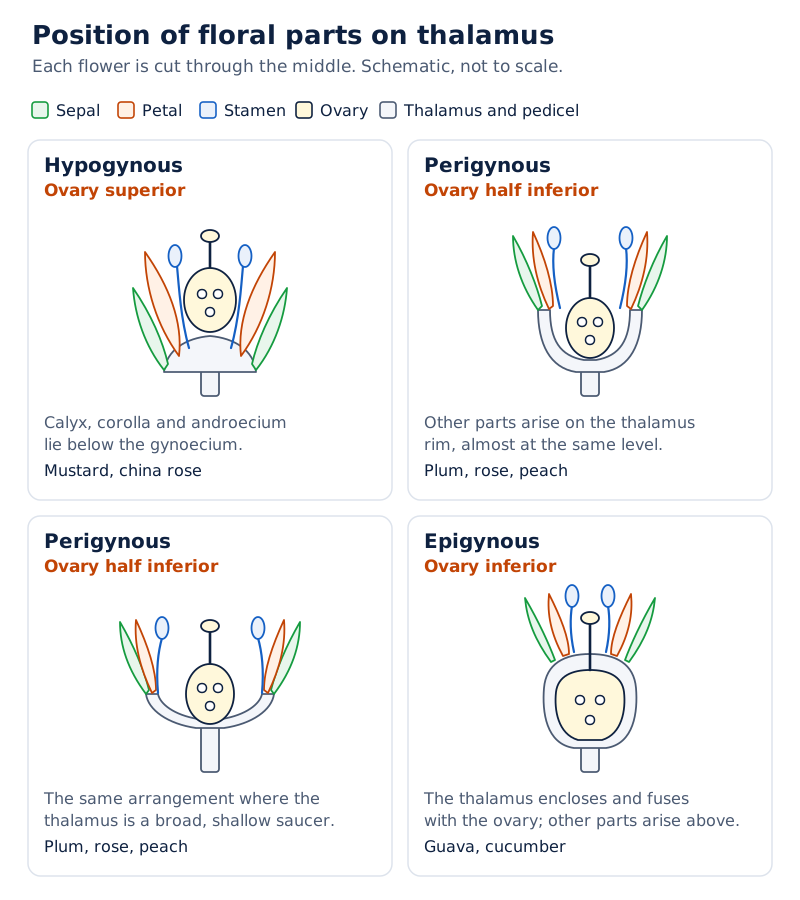
Four drawings show one hypogynous arrangement, two perigynous arrangements and one epigynous arrangement. Compare the central ovary with the attachment of the surrounding sepals, petals and stamens.
Drawn by One Young India.
How are the five types of placentation distinguished?
Placentation is the arrangement of ovules within the ovary. Describe where the placenta occurs, where the ovules attach and whether partitions are present. Ovary position concerns the relationship with other floral whorls; placentation concerns structures inside the ovary.
Where do ovules attach in each type?
The ventral suture is the line where the margins of a carpel meet. In marginal placentation, the placenta follows that line.
| Type | Arrangement | Examples |
|---|---|---|
| Marginal | A placental ridge along the ventral suture bears ovules in two rows | Pea |
| Axile | Ovules attach to a central placenta in a multilocular ovary | China rose, tomato, lemon |
| Parietal | Ovules develop on the inner ovary wall or peripheral part | Mustard, Argemone |
| Free central | Ovules attach to a central axis and septa are absent | Dianthus, Primrose |
| Basal | The placenta develops at the ovary base and bears a single ovule | Sunflower, marigold |
In parietal placentation, the ovary is one-chambered but becomes two-chambered through formation of a false septum, an additional partition, as in mustard and Argemone.
Why must axile and free central placentation be separated?
Both arrangements involve a central ovule-bearing region. However, axile placentation has a multilocular ovary, whereas free central placentation lacks septa. Identifying only a central axis is therefore insufficient; the presence or absence of partitions supplies the decisive distinction.
What the figure shows
Types of placentation
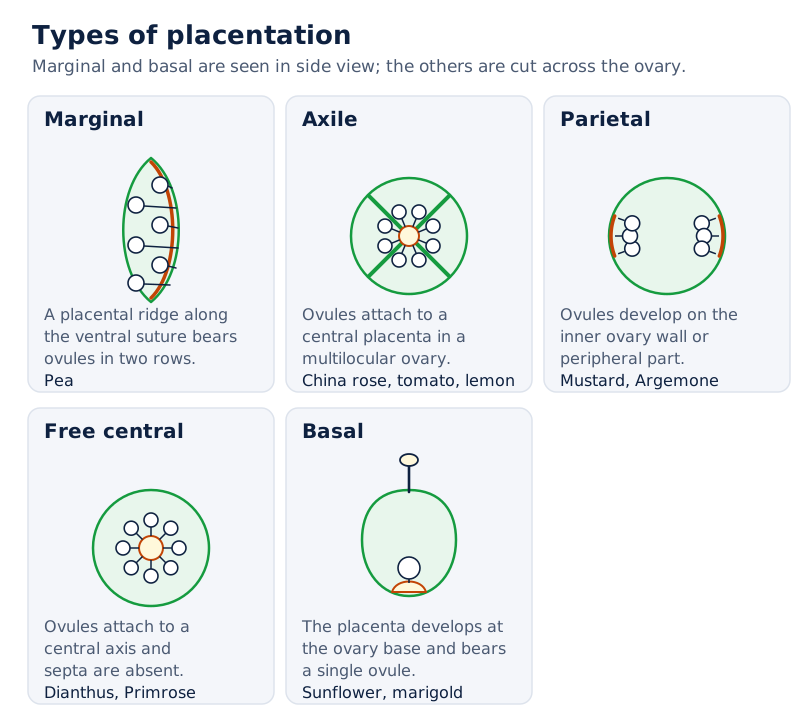
The drawings show marginal, axile, parietal, free central and basal arrangements. The axile drawing has partitions extending to the centre; the free central drawing shows a central group of ovules without those partitions.
Drawn by One Young India.
After fertilisation, ovules develop into seeds and the ovary matures into a fruit. Keep the two developmental relationships distinct: ovule to seed, and ovary to fruit.
Glossary
- Morphology — Study of the external form and structure of organisms and their parts.
- Adventitious root — A root arising from a plant part other than the radicle.
- Pneumatophore — A specialised root projecting upwards from waterlogged soil to assist gaseous exchange.
- Node — The region of a stem at which a leaf arises.
- Rachis — The common axis bearing leaflets in a pinnately compound leaf.
- Phyllotaxy — The pattern in which leaves are arranged on a stem or branch.
- Inflorescence — The arrangement of flowers on the floral axis of a plant.
- Actinomorphic — Describing a flower divisible into equal halves in any radial plane through its centre.
- Aestivation — Arrangement of sepals or petals in a floral bud relative to members of the same whorl.
- Cohesion — Union between floral members belonging to the same floral whorl.
- Adhesion — Union between floral members that belong to different floral whorls.
- Syncarpous — Describing a gynoecium in which the constituent carpels are fused together.
- Placentation — The arrangement of ovules and their attachment within the ovary.
- Locule — An internal chamber of an ovary used in describing its structure.
Common errors and misconceptions
- Misconception: Every underground storage organ is a root. Correct: Potato is a stem tuber with buds, whereas sweet potato is a storage root.
- Misconception: Root hairs grow from the root cap. Correct: They arise from outer surface cells in the region of maturation.
- Misconception: Each leaflet has an axillary bud. Correct: The whole compound leaf has an axillary bud, but its leaflets do not.
- Misconception: All monocotyledons have parallel venation without exception. Correct: Parallel venation is characteristic of most monocotyledons.
- Misconception: A bisexual flower must be complete. Correct: Bisexual describes the presence of both reproductive whorls; complete requires all four whorls.
- Misconception: Epipetalous stamens illustrate cohesion. Correct: Attachment of stamens to petals is adhesion between different whorls.
- Misconception: Axile and free central placentation are identical. Correct: Axile placentation occurs in a multilocular ovary; free central placentation lacks septa.
- Misconception: The ovary develops into the seed. Correct: The ovule develops into a seed after fertilisation; the ovary matures into a fruit.
Exam-style questions with model answers
Q1. A root arises from the stem rather than the radicle. Classify it by origin and explain the classification. [2 marks]
- It is an adventitious root, because this category is defined by origin from a plant part other than the radicle.
- The stated stem origin satisfies that definition; it does not represent direct elongation of the embryonic root.
Q2. Starting at the root tip, describe the protective covering and the next three regions, giving one role of each. [4 marks]
- The root cap covers the tender apex and protects it as the root moves through the soil.
- The region of meristematic activity contains small cells that divide repeatedly, supplying cells for root growth.
- In the region of elongation, cells enlarge rapidly and contribute to an increase in root length.
- In the region of maturation, cells differentiate and some outer surface cells form root hairs for absorption of water and minerals.
Q3. A leaf has leaflets along a common axis. A bud is present at the base of its petiole but absent at leaflet bases. The stem bears one whole leaf at each node in an alternate manner. Identify the leaf type, explain the bud evidence and name the phyllotaxy. [3 marks]
- The leaf is pinnately compound because its leaflets are arranged along a common axis, the rachis, rather than arising together at the petiole tip.
- The axillary bud at the whole leaf base, with no buds at leaflet bases, supports the distinction between a compound leaf and a leafy branch.
- The phyllotaxy is alternate because a single whole leaf arises at each node in the stated alternate arrangement.
Q4. Contrast racemose and cymose inflorescences in terms of main-axis growth, terminal flower and relative ages of flowers. [3 marks]
- In racemose inflorescence, the main axis continues to grow; in cymose inflorescence, growth of the main axis is limited.
- The racemose axis bears flowers laterally, whereas the cymose main axis ends in a flower, which limits its further growth.
- Racemose flowers occur in acropetal succession, with younger flowers towards the apex; cymose flowers occur in basipetal order, with younger flowers towards the base.
Q5. Describe valvate, twisted, imbricate and vexillary aestivation, giving one example of each. [4 marks]
- Valvate aestivation has sepals or petals that touch at their margins without overlap, as in Calotropis.
- Twisted aestivation has one margin overlapping the next member, continuing in the same direction, as in china rose.
- Imbricate aestivation has overlapping margins without a particular direction of overlap, as in Cassia.
- Vexillary aestivation has a large standard overlapping two wings, which overlap the two keel petals, as in pea.
Q6. Define cohesion and adhesion in a flower. Distinguish monadelphous, syngenesious and synandrous stamens, then explain epipetalous attachment. [6 marks]
- Cohesion is union between members of the same floral whorl, such as union between stamens within the androecium.
- Adhesion is union between members of different whorls, so the two attached structures belong to different floral groups.
- Monadelphous stamens have their filaments united into one bundle while their anthers remain free; china rose illustrates this condition.
- Syngenesious stamens have united anthers but free filaments. The part showing union is therefore different from that in monadelphous stamens.
- Synandrous stamens have both anthers and filaments united, distinguishing them from conditions in which only one of those parts unites.
- Epipetalous attachment means that stamens are attached to petals, as in brinjal. It is adhesion because stamens and petals belong to different whorls.
Q7. In one flower, the other floral whorls arise below the gynoecium. In another, the thalamus encloses and fuses with the ovary and the other whorls arise above it. Identify both flower types and state each ovary position. [4 marks]
- The first flower is hypogynous because its other floral whorls are inserted below the gynoecium, which occupies the highest position.
- Its ovary is superior, describing its position relative to the insertion of the surrounding floral parts.
- The second flower is epigynous because the thalamus encloses and fuses with its ovary, with the other whorls arising above.
- Its ovary is inferior, again referring to its relationship with the surrounding floral whorls rather than its height on the plant.
Q8. Describe marginal, axile, parietal, free central and basal placentation, giving one example of each. [5 marks]
- Marginal placentation has a placental ridge along the ventral suture of the ovary, with ovules arranged in two rows, as in pea.
- Axile placentation has a central placenta bearing ovules in a multilocular ovary. The presence of chambers distinguishes it from free central placentation; tomato is an example.
- Parietal placentation has ovules attached to the inner ovary wall or peripheral part. Mustard is an example in which a false septum creates two chambers.
- Free central placentation has ovules borne on a central axis without septa, leaving the central structure free from partitions, as in Dianthus.
- Basal placentation has the placenta at the base of the ovary and a single ovule attached to it, as in marigold.
Key takeaways
- Identify a root or stem by its origin and structural features, rather than by its position above or below ground.
- The root cap protects the apex; division, elongation and maturation occur in successive regions behind it.
- Root, stem and leaf modifications connect organ structure with storage, support, protection, reproduction or nutrition.
- Venation describes veins, phyllotaxy describes whole leaves, and compound-leaf type describes the arrangement of leaflets.
- Racemose inflorescences retain a growing main axis; cymose inflorescences have a main axis terminating in a flower.
- Floral description separates whorl presence, sex, symmetry, part numbers, union and the position of the ovary.
- Cohesion joins members of one whorl; adhesion joins different whorls, such as stamens attached to petals.
- Placentation depends on ovule attachment and partitions; axile and free central arrangements differ in the presence of septa.
Test yourself
Why is potato a stem modification while sweet potato is a root modification?
Potato is a stem tuber with eyes bearing buds. Sweet potato is a swollen storage root; storage function alone does not determine organ identity.
How do prop roots differ from stilt roots?
Prop roots descend from branches and provide pillar-like support. Stilt roots arise from the lower stem and grow obliquely into the soil.
How can a leaflet be distinguished from a whole leaf?
A whole leaf has a bud in the axil of its petiole; a leaflet of a compound leaf lacks an axillary bud.
What do trimerous, tetramerous and pentamerous mean?
They describe floral appendages occurring in multiples of three, four and five respectively.
How do epipetalous and epiphyllous stamens differ?
Epipetalous stamens attach to petals, as in brinjal. Epiphyllous stamens attach to the perianth, as in lily.
What is the difference between apocarpous and syncarpous?
Apocarpous describes separate carpels, as in lotus and rose. Syncarpous describes fused carpels, as in mustard and tomato.
What distinguishes axile from free central placentation?
Axile placentation occurs in a multilocular ovary with partitions. Free central placentation bears ovules on a central axis without septa.
What becomes the fruit, and what becomes the seed?
After fertilisation, the ovary matures into a fruit and the ovules develop into seeds.
Write about it
Turn a question from this chapter into a paper.
The Writing Studio has a structure guide, a rubric and citation tools for 15 formats, from essays to research papers. Drafting is free with an account. Learnacy Essential adds feedback from an AI writing coach and submission to The OYI Review.
Learnacy Essential is ₹1,499 for the year. Publication depends on review and is not guaranteed.