
Rural Development | CBSE Class 12 Economics Notes
On this page
Watch & explore
Start with a few high-quality watches, then dive into the notes below.
Try an idea before you read. You're a rural development officer visiting a village in India. Use what you've learned to help these farmers. Explore →
This note covers rural development, rural credit and banking, self-help groups, agricultural marketing, cooperatives, alternative marketing channels, diversification, animal husbandry, fisheries, horticulture, information technology and organic farming.
What does rural development mean, and why is it important?
Definition: Rural development involves action to improve the areas of the village economy that lag behind in overall development. It includes productive activities, infrastructure, human resources and the living conditions of disadvantaged people.
Agriculture is a major source of rural livelihood. Yet growth in towns and industrial centres does not automatically improve life in villages. Rural progress requires people to have better opportunities for earning income and better access to basic services.
Which areas need attention?
| Area | Development priorities |
|---|---|
| Human resources | Literacy, especially female literacy, education, skills, sanitation and public health |
| Land and local resources | Land reforms and development of the productive resources of each locality |
| Infrastructure | Electricity, irrigation, credit, marketing, transport and village roads |
| Agricultural knowledge | Research, extension facilities and dissemination of information |
| Poverty alleviation | Better living conditions and access to productive employment for weaker sections |
Improvement in productivity matters in both farm and non-farm activities. Rural workers also need opportunities to enter activities such as food processing. Affordable healthcare, sanitation at home and work, and education support these changes.
Why does the rural economy face difficulties?
Agriculture's declining contribution to GDP has not been accompanied by a comparable decline in the population depending on it. This makes the creation of alternative employment particularly important. Inadequate infrastructure and increasing casualisation of employment further obstruct development.
Agricultural growth slowed to about 3 per cent annually during 1991 to 2012. In 2023-24, agriculture and allied activities recorded GVA growth of about 2 per cent. Declining public investment since 1991 has been identified as a major explanation for agricultural difficulties.
Rural development therefore connects economic opportunities with social services. Raising farm output is one part of a wider effort involving credit, marketing, skills, infrastructure and sustainable livelihoods.
Why do farmers need credit, and which institutions provide it?
Rural credit supplies funds needed for productive activity and household requirements. Agriculture involves a considerable interval between sowing a crop and receiving income from its sale. Farmers must meet expenses during this interval even though the harvest has not yet generated income.
Borrowing helps pay for seeds, fertilisers and implements. Farmers may also borrow for family expenses connected with marriage, death and religious ceremonies. Credit is therefore used for both production and consumption needs.
How did the credit system change?
At independence, moneylenders and traders exploited small and marginal farmers and landless labourers through high interest rates and manipulated accounts. These practices could keep borrowers in a debt trap.
After 1969, social banking and a multi-agency approach expanded the effort to meet rural credit needs. The Green Revolution also encouraged a shift towards production-oriented rural lending.
The National Bank for Agriculture and Rural Development (NABARD) was established in 1982 as the apex body coordinating institutions involved in rural finance. Its coordinating role should be distinguished from the different institutions through which rural banking operates.
| Institutional component | Place in rural finance |
|---|---|
| Commercial banks | Part of the multi-agency institutional rural banking system |
| Regional rural banks | Part of the network expected to supply adequate rural credit |
| Cooperatives | Institutional participants in providing rural finance |
| Land development banks | Another component of the institutional rural banking structure |
| NABARD | Apex body coordinating institutions involved in rural financing |
These institutions are expected to provide adequate credit at cheaper rates. However, institutional expansion does not by itself ensure that every poor household can borrow. Requirements such as collateral can exclude households that lack acceptable security.
The central development issue is whether finance enables rural people to improve productivity and livelihoods. The amount of credit, its accessibility and its use all matter alongside the presence of a banking institution.
How do self-help groups improve access to rural credit?
Self-help groups (SHGs) help fill gaps in the formal credit system. Poor households can remain outside institutional lending because they cannot provide collateral. Formal credit has also not been fully integrated with rural social and community development.
How does a group's saving and lending arrangement work?
- Members make small minimum contributions, encouraging regular saving or thrift.
- The contributions are pooled into a fund belonging to the group.
- Credit from the pooled money is made available to members who need it.
- Borrowers repay in small instalments at reasonable interest rates.
Such small-scale credit arrangements are called micro-credit programmes. Their importance lies in connecting the savings of members with the borrowing needs of people who may have difficulty using formal banking channels.
Diagram
SHG saving and lending
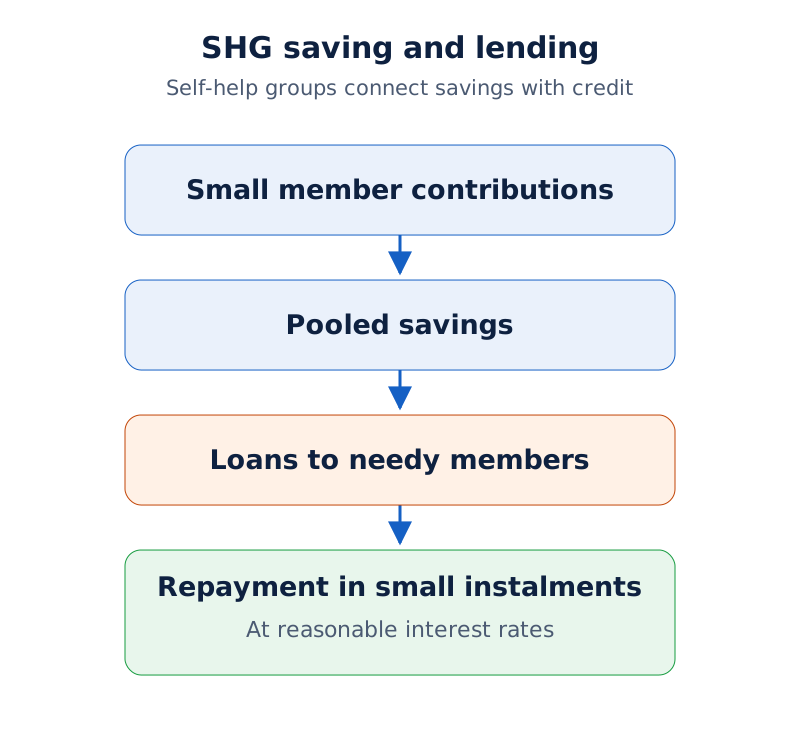
Draw connected boxes labelled small member contributions, pooled savings, loans to needy members, and repayment in small instalments. These boxes summarise the group's saving and credit arrangement.
Drawn by One Young India.
What do women's groups demonstrate?
By May 2019, nearly 6 crore women belonged to 54 lakh women's SHGs in India. Such groups have supported women's empowerment. However, access to credit should not be treated as proof that all borrowing finances production; consumption needs also absorb loans.
Kudumbashree is a women-oriented community poverty-reduction programme in Kerala. A thrift and credit society started in 1995 encouraged savings among poor women and mobilised Rs 1 crore in thrift savings.
This example highlights the importance of small savings and community participation in rural finance. SHGs supplement formal credit arrangements by reaching people whose needs are not adequately met. Their contribution includes both access to funds and greater participation by women.
When evaluating micro-credit, distinguish the availability of a loan from the opportunity to use it productively. Better access is valuable, but sustainable income generation remains an important development objective.
What has rural banking achieved, and what problems remain?
The expansion of rural banking helped increase farm and non-farm output, income and employment, especially after the Green Revolution. Farmers gained access to banking services and different loans for production needs.
Improved access to finance formed part of the progress towards food security, reflected in substantial buffer stocks of foodgrains. Nevertheless, rural banking has continuing weaknesses and requires a balanced appraisal.
What limits the effectiveness of banking?
Many formal institutions, with commercial banks as a possible exception, have not developed effective practices for mobilising deposits, lending to suitable borrowers and recovering loans. Agricultural loan defaults have remained high.
Borrowers may face crop failure, insufficient income and inadequate employment opportunities. These difficulties must be considered when discussing repayment problems. A loan default should not automatically be described as deliberate refusal to repay.
The expansion and promotion of rural banking received less emphasis after economic reforms. Improving the system involves attention to both the availability of credit and the institutional practices that keep finance functioning effectively.
How does Jan-Dhan Yojana support inclusion?
Jan-Dhan Yojana encourages adults to open bank accounts without a minimum-balance requirement. Accounts provide access to facilities such as accidental insurance and overdrafts, while also enabling the transfer of government payments.
Wages from government-related work, old-age pensions and other social security payments can reach beneficiaries through bank accounts. This connects households with formal financial services and encourages thrift.
Financial inclusion also allows banks to mobilise savings and supports better allocation of financial resources. However, account ownership and the effective supply of productive rural credit are connected but distinct aspects of development.
A complete appraisal therefore recognises the gains in access, production and savings while also considering exclusion, repayment difficulties and weaknesses in deposit mobilisation and loan recovery.
What is agricultural marketing, and why does it need improvement?
Definition: Agricultural marketing covers assembling, storing, processing, transporting, packaging, grading and distributing agricultural commodities. It connects production on farms with the places where agricultural goods are consumed.
Marketing involves much more than a final sale. A farmer's ability to earn a reasonable return depends partly on access to storage, transport, reliable price information and fair trading conditions.
Which obstacles have farmers faced?
Before independence, farmers suffered from faulty weighing and manipulation of accounts by traders. A lack of information about market prices often forced them to sell cheaply. Inadequate storage also prevented them from holding produce for a later sale at a better price.
| Marketing obstacle | Effect on farmers or produce |
|---|---|
| Faulty weighing | Unfair treatment when quantities are assessed for sale |
| Manipulated accounts | Exploitation in dealings with traders |
| Inadequate price information | Pressure to accept low prices |
| Lack of storage | Difficulty retaining produce for sale later at a better price |
| Inadequate physical infrastructure | Weaknesses in handling, transporting and processing agricultural commodities |
Storage facilities have an important place in marketing reform because the absence of storage also leads to wastage. Roads, railways, warehouses, godowns, cold storage and processing units are needed to improve the marketing system.
What the figure shows
Regulated market yard
The photograph shows an open market yard containing separate heaps of produce, stacks of sacks and people moving among them. It illustrates a physical setting in which agricultural produce is assembled and traded.
See Fig. 5.1 in your NCERT textbook
Government intervention became necessary to regulate private traders and improve market conditions. This includes making transactions more orderly and transparent as well as providing the physical facilities on which effective marketing depends.
Increasing production without improving marketing leaves important rural problems unresolved. Produce must be handled and distributed through arrangements that support farmers' incomes and the supply of food to consumers.
How do government measures and cooperatives improve marketing?
Government action to improve agricultural marketing has four main components: market regulation, infrastructure, cooperative marketing and policy instruments. These measures address different weaknesses and should be explained separately.
What are the four components?
- Regulated markets: Create orderly and transparent marketing conditions that can benefit both producers and consumers.
- Physical infrastructure: Develop roads, railways, warehouses, godowns, cold storage and processing facilities.
- Cooperative marketing: Help farmers obtain fair prices through cooperative arrangements for marketing their products.
- Policy instruments: Use minimum support prices, buffer stocks and the public distribution system to protect farm incomes and provide subsidised food to poor consumers.
Minimum support prices (MSP) provide price assurance for agricultural products. The Food Corporation of India maintains buffer stocks of wheat and rice. The public distribution system (PDS) distributes foodgrains and sugar at subsidised rates.
These instruments have related but distinct functions. Price assurance concerns producers' incomes, stocks support the food system, and subsidised distribution assists poor consumers. They should not be treated as interchangeable names for the same measure.
Why are cooperatives important, and where do they fall short?
Milk cooperatives have helped transform the social and economic conditions of Gujarat and other areas. They show how cooperative marketing can support fair returns for producers.
However, cooperatives face limited farmer membership, weak connections between marketing and processing cooperatives, and inefficient financial management. These shortcomings restrict their effectiveness and coverage.
Physical infrastructure also remains inadequate. Despite government intervention, private trade continues to dominate agricultural markets, including trade conducted by moneylenders, large merchants, rich farmers and rural political elites.
A balanced assessment recognises progress while identifying unfinished work. Marketing reforms require wider coverage, better facilities and more effective institutions if their full potential is to be realised.
How can alternative marketing channels help farmers?
Direct marketing enables farmers to sell produce to consumers. Such channels can increase farmers' incomes and provide an alternative to existing marketing arrangements.
Which examples illustrate direct sales?
| Marketing channel | Location |
|---|---|
| Apni Mandi | Punjab, Haryana and Rajasthan |
| Hadaspar Mandi | Pune |
| Rythu Bazars | Andhra Pradesh and Telangana |
| Uzhavar Sandies | Tamil Nadu |
These examples represent opportunities for farmers to reach consumers directly. Rythu Bazars are markets for vegetables and fruits, while Uzhavar Sandies are farmers' markets.
How do contracts and alliances work?
National and multinational fast-food chains have entered agreements with farmers to grow products of specified quality. These arrangements can include seeds and other inputs, together with assured procurement at prices decided in advance.
Such arrangements may reduce price risk and expand markets for agricultural products. Their possible benefits should be distinguished from a guarantee that every small farmer will earn a higher income.
The key features are the desired quality of produce, provision of inputs and a pre-decided procurement price. These features explain how an agreement differs from simply bringing produce to a market and selling it there.
In 2016, the Union Government launched the e-National Agriculture Market (e-NAM) portal to connect mandis and regulated market yards through an online platform. It adds an information-technology dimension to agricultural marketing.
Alternative channels form part of the wider effort to improve farmers' access to markets. They operate alongside regulated markets, cooperatives and other public measures, rather than making the need for infrastructure disappear.
Why is diversification essential for sustainable rural livelihoods?
Diversification has two aspects. One is a change in cropping patterns. The other is a shift of workers from agriculture towards allied activities, such as livestock, poultry and fisheries, and towards non-agricultural employment.
How does diversification address risk and seasonality?
Dependence exclusively on farming exposes households to substantial risk. Other productive activities can provide supplementary employment and income, helping rural people develop more sustainable livelihoods.
Much agricultural employment is concentrated in the Kharif season. During the Rabi season, areas with inadequate irrigation may offer little gainful agricultural work. This is a reason to expand opportunities outside crop production.
Agriculture is already overcrowded, so a major share of the growing labour force needs alternative jobs. Diversification can help rural households raise incomes and overcome poverty through a wider range of productive activities.
Which non-farm activities have potential?
Agro-processing, food processing, leather industries and tourism are dynamic non-farm activities with growth linkages. Pottery, crafts and handlooms also have potential, but often lack infrastructure and other support.
What the figure shows
Jaggery making
The photograph shows people working beside processing equipment with stalks piled in the foreground. It presents jaggery making as an activity allied to farming.
See Fig. 5.2 in your NCERT textbook
Tamil Nadu Women in Agriculture (TANWA), initiated in the late 1980s, trained women in agricultural techniques and organic farming. It encouraged their participation in improving productivity and family incomes.
A Farm Women's Group in Thiruchirapalli produced and sold vermicompost. Other groups used accumulated savings to support mushroom cultivation, soap manufacture, doll making and related income-generating activities.
These experiences link training, savings and work opportunities. Rural diversification is therefore broader than changing the crop grown on a field: it also concerns the range of occupations available to rural workers.
How do livestock and dairying support rural development?
Animal husbandry is an important source of supplementary livelihood. Mixed crop-livestock farming combines cultivation with animals such as cattle, goats and fowl. Livestock can provide more stable income, food security, nutrition, transport and fuel without disrupting other food-producing activities.
What does the livestock distribution show?
What the figure shows
Distribution of poultry and livestock in India, 2019
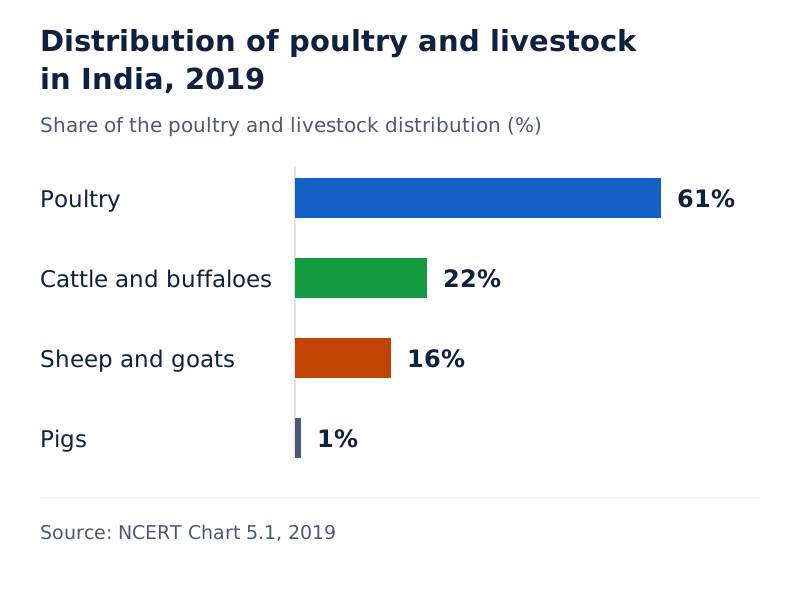
The pie chart labels poultry at 61 per cent, cattle and buffaloes at 22 per cent, sheep and goats at 16 per cent, and pigs at 1 per cent. Poultry occupies the largest sector.
Drawn by One Young India. Reference: NCERT Chart 5.1
Worked example 1. In the 2019 distribution, poultry has a 61 per cent share and cattle and buffaloes together have 22 per cent. How much larger is poultry's share?
Answer: 61 − 22 = 39 percentage points. This compares shares in the poultry and livestock distribution; it does not measure shares of income or agricultural output.
How do milk cooperatives work?
Operation Flood supported a system in which farmers pooled milk, graded it by quality, and arranged processing and marketing to urban centres through cooperatives. Farmers received a fair price and income from supplying urban markets.
Gujarat provides a successful example of milk cooperatives, followed by other states. India's milk production increased about twelvefold between 1951 and 2021, mainly associated with the successful implementation of Operation Flood.
Worked example 2. Milk production in 2021 was approximately twelve times its 1951 level. Calculate the percentage increase relative to 1951.
Answer: The increase was approximately twelve times minus one original level, or eleven times the original. The percentage increase was approximately (12 − 1) × 100 = 1,100 per cent. A twelvefold final level is different from a twelve per cent increase.
Livestock numbers alone do not ensure high productivity. Better breeds, improved technology, veterinary care and credit for small and marginal farmers and landless labourers are needed. Meat, eggs, wool and other livestock products also offer opportunities for diversification.
How do fisheries, horticulture and information technology create opportunities?
Fisheries draw on marine and inland water bodies. Budgetary support and new technologies in fishing and aquaculture have helped the sector develop. However, fishing communities continue to face serious livelihood problems.
Diagram
Sources of fish production value
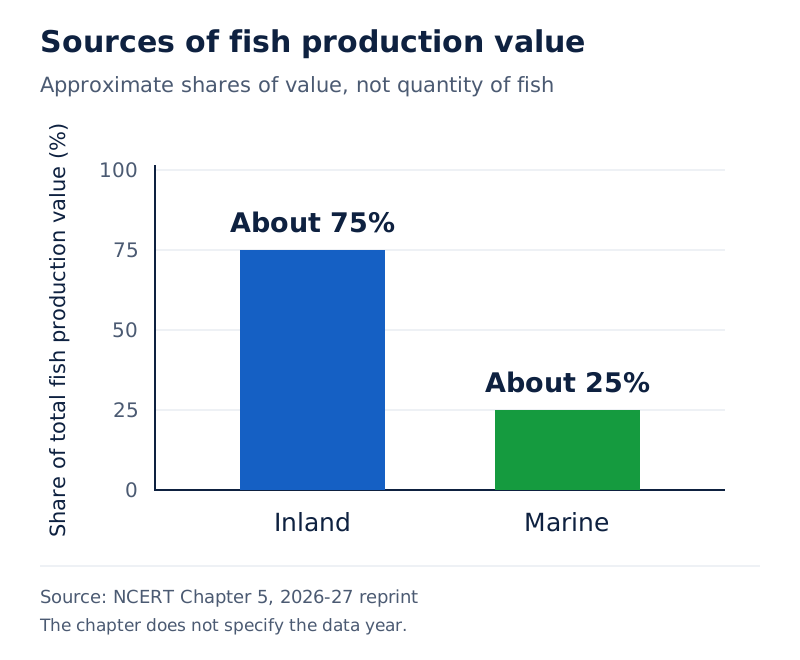
Draw two bars labelled inland and marine, with heights of about 75 per cent and 25 per cent respectively. Label the vertical axis share of total fish production value, not quantity of fish.
Drawn by One Young India.
Worked example 3. Inland sources contribute about 75 per cent of total fish production value and marine sources about 25 per cent. Find their ratio.
Answer: Inland to marine value is approximately 75:25, or 3:1. The comparison concerns production value and does not establish that inland fish weigh three times as much as marine fish.
What support do fisheries require?
Fishing families face underemployment, low earnings, illiteracy and indebtedness, with limited movement into other occupations. Cooperatives and SHGs can improve working-capital access for fisherwomen engaged in marketing. Overfishing and pollution also need control, alongside welfare measures offering lasting livelihood gains.
Why is horticulture important?
Horticulture includes fruits, vegetables, tuber crops, flowers, medicinal and aromatic plants, spices and plantation crops. Varied climate and soils allow India to grow a wide range of these crops, supporting nutrition, employment and income.
Flower harvesting, nursery maintenance, hybrid seed production, tissue culture, propagation and food processing provide employment opportunities for rural women. Electricity, cold storage, marketing connections, small processing units and improved technology are needed to strengthen horticulture.
What can information technology contribute?
Information technology can communicate prices, weather and soil conditions, and information about new agricultural technologies. Software and information can help governments identify areas vulnerable to food insecurity and act before emergencies develop.
IT also offers employment potential. It is a tool for using society's knowledge and creativity, but cannot bring rural transformation by itself. Its contribution belongs within the wider development of productive activities and supporting services.
What are the benefits and limitations of organic farming?
Definition: Organic farming is a whole farming system that restores, maintains and improves ecological balance. It offers an environmentally sustainable alternative to production heavily dependent on chemical fertilisers and pesticides.
Chemical-intensive farming can contaminate food and water, damage soil, harm livestock and disturb ecosystems. Organic agriculture seeks to support production while protecting the ecological conditions on which farming depends.
Which advantages can organic farming offer?
Locally produced organic inputs can replace costlier purchased inputs. This can reduce input costs and improve returns. Growing demand for organic produce also creates export opportunities.
Organic farming uses more labour than conventional farming, making it relevant to employment in India. It provides produce grown without the chemical pesticides associated with conventional cultivation and supports environmental sustainability.
What difficulties occur during adoption?
| Potential benefit | Limitation or supporting requirement |
|---|---|
| Cheaper locally produced organic inputs | Farmers need awareness and willingness to adopt different methods |
| Improved long-term environmental sustainability | Yields may initially be below those of modern agricultural farming |
| Export opportunities | Marketing problems and inadequate infrastructure require attention |
| Greater labour use | Small and marginal farmers may find large-scale adoption difficult |
| Produce grown without chemical pesticide spraying | Produce may have more blemishes and a shorter shelf life than sprayed produce |
Off-season production choices are also limited. Appropriate agricultural policy, infrastructure and marketing support are needed to popularise organic farming. Its advantages do not mean that transition is costless or that yields immediately rise.
What does the Maharashtra cotton example illustrate?
An account published in 2005 described 130 farmers committing 1,200 hectares to organic cotton. The produce was tested by AGRECO and found to be of high quality. This was a specific example of adopting organic methods, rather than a measure of all Indian organic farming.
Worked example 4. In this organic-cotton example, 130 farmers committed a total of 1,200 hectares. Calculate the mean committed area per farmer.
Answer: 1,200 ÷ 130 ≈ 9.23 hectares per farmer. This is an arithmetic mean for the group; it does not mean that every participating farmer committed the same area.
Rural development and environmental protection are closely connected. Sustainable livelihoods require suitable technologies, access to credit and markets, and continuing dialogue between farmers' groups and agricultural departments. Communities can learn from successful practices used under comparable conditions.
Glossary
- Rural development — Action to improve lagging areas of village economies, including productive resources, human capabilities, infrastructure and living conditions.
- Rural credit — Funds borrowed to meet agricultural, non-agricultural and household needs within the rural economy.
- NABARD — National Bank for Agriculture and Rural Development, the apex institution coordinating organisations involved in rural finance.
- Self-help group — A group pooling small member savings and lending to needy members at reasonable interest rates.
- Micro-credit — Small-scale credit provision, including lending through groups that mobilise savings from their members.
- Agricultural marketing — The assembling, storage, processing, transport, packaging, grading and distribution of agricultural commodities.
- Cooperative marketing — Marketing through cooperative arrangements intended to secure fair prices for farmers' products.
- Minimum support price — An assured minimum price for agricultural products used as an instrument to protect farmers' incomes.
- Diversification — Changes in cropping patterns and shifts of workers towards allied agricultural or non-agricultural activities.
- Animal husbandry — Rearing livestock as a productive activity providing income, food and other household livelihood benefits.
- Operation Flood — A cooperative dairy system involving pooling, quality grading, processing and marketing milk to urban centres.
- Horticulture — Cultivation of fruits, vegetables, tubers, flowers, medicinal and aromatic plants, spices and plantation crops.
- Organic farming — A whole farming system that restores, maintains and enhances ecological balance through environmentally sustainable methods.
- Thrift — Saving small amounts regularly, including contributions that build the pooled funds of self-help groups.
Common errors and misconceptions
- Misconception: Rural development means increasing crop output alone. Correct: It also covers human resources, land reforms, infrastructure, poverty alleviation and non-farm livelihoods.
- Misconception: All rural borrowing finances production. Correct: Borrowing also meets household and consumption needs; access to a loan does not establish its productive use.
- Misconception: Expansion of banking has removed rural credit problems. Correct: Collateral barriers, repayment difficulties and weaknesses in deposit mobilisation and recovery remain.
- Misconception: Agricultural marketing is simply selling the harvest. Correct: It also includes assembling, storing, processing, transporting, packaging, grading and distributing produce.
- Misconception: Diversification means leaving farming altogether. Correct: It includes changes in cropping patterns as well as allied activities and non-agricultural employment.
- Misconception: Organic farming immediately increases yields and has no marketing difficulties. Correct: Initial yields can be lower, while infrastructure, marketing and shelf-life problems require attention.
- Misconception: The inland and marine fish percentages measure physical quantities. Correct: The 75 per cent and 25 per cent figures concern shares of total fish production value.
Exam-style questions with model answers
Q1. State the two aspects of rural diversification. [2 marks]
- Diversification includes changing the cropping pattern within agriculture.
- It also includes shifting workers from agriculture towards allied activities, such as livestock and fisheries, and towards non-agricultural occupations.
Q2. Explain three reasons why farmers need access to credit. [3 marks]
- There is a substantial interval between sowing crops and receiving income after production. Credit helps farmers meet expenses during this period.
- Farmers need funds for productive inputs such as seeds, fertilisers and implements, which support agricultural production.
- Households also face expenses connected with marriage, death and religious ceremonies. Borrowing may therefore meet family needs as well as investment requirements.
Q3. Explain how self-help groups provide micro-credit and identify one limitation in the use of such loans. [4 marks]
- Members make small contributions that promote thrift and create a pooled savings fund.
- The group lends from this fund to needy members, who repay in small instalments at reasonable interest rates.
- This arrangement helps meet credit needs that formal institutions have not adequately served, particularly where collateral requirements exclude poor households.
- Some borrowing finances consumption rather than productive activity. Consequently, the availability of micro-credit does not necessarily establish that a new income-generating activity has begun.
Q4. Explain the four main government measures for improving agricultural marketing and state two continuing limitations. [6 marks]
- Regulated markets aim to establish orderly and transparent marketing conditions, benefiting farmers and consumers.
- Physical infrastructure includes roads, railways, warehouses, godowns, cold storage and processing units to support the movement and handling of produce.
- Cooperative marketing helps farmers obtain fair prices. Milk cooperatives illustrate its contribution to rural incomes and social conditions.
- Policy instruments include minimum support prices, buffer stocks of wheat and rice maintained by the Food Corporation of India, and subsidised distribution through the public distribution system.
- Infrastructure remains inadequate for the needs of agricultural marketing.
- Cooperatives face limited farmer coverage, weak marketing-processing links and inefficient financial management. These problems restrict the effectiveness of measures intended to improve returns to farmers.
Q5. Explain why diversification is necessary for rural livelihoods and describe the role of non-farm employment. [5 marks]
- Exclusive dependence on farming involves risk. Diversification provides additional productive opportunities and more sustainable sources of livelihood.
- Agricultural work is concentrated in the Kharif season. In areas lacking adequate irrigation, gainful employment can be difficult to obtain during Rabi.
- Agriculture is already overcrowded, so much of the growing labour force needs employment in other activities.
- Agro-processing, food processing, leather industries and tourism have dynamic growth linkages. Pottery, crafts and handlooms also have potential but need infrastructure and support.
- Non-farm employment can supplement household income and help reduce poverty. Diversification also includes changes in cropping patterns and expansion into allied activities, rather than requiring all workers to abandon farming.
Q6. Define organic farming. Explain three benefits and three limitations. [6 marks]
- Organic farming is a whole farming system that restores, maintains and enhances ecological balance.
- Locally produced organic inputs can replace costlier purchased inputs and improve returns.
- Growing demand for organic produce creates opportunities to earn export income.
- Greater labour requirements can support employment, while environmentally sustainable methods reduce dependence on chemical pesticides.
- Yields may initially be lower than under modern agricultural farming, making large-scale adoption difficult for small and marginal farmers.
- Inadequate infrastructure and marketing problems restrict the spread of organic farming.
- Organic produce may have more blemishes and a shorter shelf life than sprayed produce. These limitations mean that adoption requires supporting policy, awareness and suitable facilities.
Q7. Inland sources contribute about 75 per cent of total fish production value and marine sources about 25 per cent. Calculate the ratio of inland to marine value and the gap in percentage points. [2 marks]
- The ratio is approximately 75:25 = 3:1.
- The gap is approximately 75 − 25 = 50 percentage points. Both results compare production value, not the physical weight of fish.
Q8. Assess three ways in which information technology can support rural development, and state one limitation. [4 marks]
- Information and software tools can help governments identify areas vulnerable to food insecurity, supporting action to prevent or reduce emergencies.
- IT can disseminate information about agricultural technologies, prices, weather and soil conditions, helping rural producers access relevant knowledge.
- It also has potential to generate employment in rural areas.
- IT cannot produce transformation by itself. It functions as a tool for releasing existing knowledge and creativity within society, so its contribution must be understood within the wider development process.
Key takeaways
- Rural development links productivity and employment with education, health, sanitation, land reforms and supporting infrastructure.
- Credit bridges the interval between sowing and income, while institutional barriers still limit access for poor households.
- Self-help groups pool small savings, provide micro-credit and encourage women's participation in rural financial activity.
- Agricultural marketing includes storage, processing, transport and distribution, requiring fair trading arrangements and adequate physical facilities.
- Government marketing measures combine regulation, infrastructure, cooperatives and policy instruments, but important gaps remain in coverage and effectiveness.
- Diversification reduces exclusive reliance on farming through cropping changes, allied activities and wider opportunities for non-farm work.
- Livestock, fisheries and horticulture support rural livelihoods but require credit, technology, infrastructure and attention to environmental problems.
- Organic farming supports ecological balance, although initial yield losses, marketing difficulties and limited shelf life can complicate adoption.
Test yourself
Why is rural development broader than agricultural growth?
It also includes human resources, land reforms, infrastructure, poverty alleviation and opportunities for non-farm employment.
What role does NABARD perform?
NABARD is the apex body coordinating the activities of institutions involved in rural finance.
How can collateral requirements exclude poor rural households?
Households without acceptable collateral may be unable to obtain formal credit despite needing funds.
Why are storage facilities important to farmers?
Storage helps farmers retain produce for later sale at better prices and reduces losses associated with inadequate storage.
What are the four main areas of government intervention in agricultural marketing?
They are regulated markets, physical infrastructure, cooperative marketing and policy instruments such as support prices, buffer stocks and subsidised distribution.
Why does inadequate irrigation strengthen the case for diversification?
It can limit gainful agricultural employment during Rabi, making supplementary work in other activities necessary.
How do milk cooperatives connect farmers with urban markets?
They pool milk, grade it by quality, and arrange processing and marketing to urban centres.
What difficulties may farmers face when adopting organic methods?
Initial yields may be lower, infrastructure and marketing may be inadequate, and produce may have a shorter shelf life.
Try it
Rural Development | Class 12 Indian Economic Development Notes
You're a rural development officer visiting a village in India. Use what you've learned to help these farmers.
1A farmer named Ramesh is preparing for the kharif season. He needs to buy seeds, fertilizer, and equipment, but his family won't earn any income until after the harvest months later. What is the MAIN economic reason Ramesh needs to borrow money?
While farmers do borrow for family expenses like weddings, the text specifically explains the main reason: there's a long gap between sowing a crop and earning income from it, so farmers borrow to meet early costs on seeds, fertilizers, and implements.
The text states: 'Because the gap in time between sowing a crop and earning income from it is quite long, farmers borrow from various sources to meet their early costs on seeds, fertilisers and implements.' This is the fundamental economic reason for rural credit.
This describes the exploitation that happened before independence, not the reason farmers need credit. The text says moneylenders 'exploited small and marginal farmers'—but that's about unfair lending practices, not why borrowing exists.
2A farming family in a drought-prone area depends only on rain-fed agriculture. In bad years, they have no income. A development worker suggests 'diversification.' What does this concept primarily help the family avoid, based on the text?
The text explains: 'The need for diversification arises because there is a greater risk in depending only on farming for a livelihood.' Diversification helps reduce this risk by shifting to allied activities (like animal husbandry) and non-farm employment.
This describes a marketing problem, not the purpose of diversification. The text says farmers 'lacked information about prices' and 'lacked proper storage'—that's about market access, not about diversifying income sources.
While debt is a real issue, diversification isn't primarily about avoiding land loss. The text connects diversification to 'giv[ing] rural people productive, sustainable livelihood options' and reducing risk from depending solely on agriculture.