
Shadow Economies: How Informal Markets Run the World
On this page
Watch & explore
Start with a few high-quality watches, then dive into the notes below.
Try an idea before you read. Let's test your understanding of how informal markets work. You'll face two real-world scenarios. Choose the best answer. Explore →
When most of us think about “the economy,” we picture official statistics, government reports, stock market indices, and formal jobs with contracts. But beneath this visible world lies another economic system-one that is often overlooked, underestimated, or outright ignored. This is the shadow economy, also called the informal, underground, or black economy. It’s the vast network of unregistered businesses, street vendors, unlicensed labor, cash-only trades, and even illicit activities that never make it into GDP calculations.
Far from being marginal, shadow economies are massive. In many countries, especially across Asia, Africa, and Latin America, the informal sector accounts for more than half of all employment and a significant share of national income. Even in advanced economies, where regulations are stricter and enforcement stronger, informal labor-from cash-in-hand domestic workers to undocumented farmhands-continues to exist in surprising abundance.

The question is not whether shadow economies exist. It’s about how deeply they shape the world we live in. To understand globalization, development, and the future of work, we must look beyond the official figures and into this hidden marketplace that millions depend on for survival.
1. What Exactly Is a Shadow Economy?
At its core, a shadow economy includes any economic activity that escapes official regulation, taxation, or observation. This doesn’t automatically make it criminal. While black markets for drugs, weapons, or smuggling certainly fall under the umbrella, so do far more benign activities: a neighborhood mechanic fixing bikes in his backyard, a farmer selling vegetables directly without invoices, or a migrant nanny who gets paid in cash without paperwork.
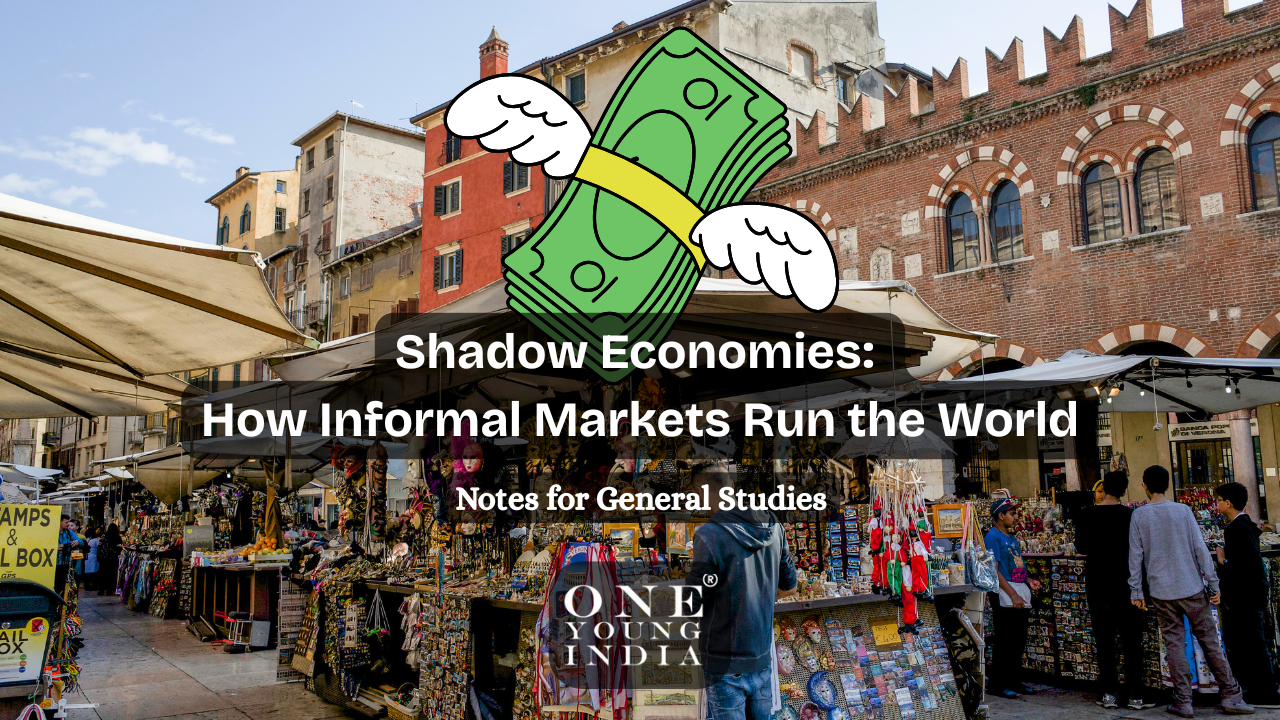
The common thread is invisibility. These transactions happen “off the books,” meaning governments can’t collect taxes on them, economists can’t track them, and policymakers can’t regulate them. Yet for participants, this invisibility is often the point. Shadow economies provide a level of flexibility and survival that the formal economy, with all its paperwork, taxes, and compliance costs, cannot.
This duality-illicit vs. survivalist-is what makes shadow economies both controversial and essential. They are neither wholly criminal nor wholly legitimate. Instead, they occupy a gray zone that blurs the lines between necessity, opportunity, and exploitation.
2. Why Do Shadow Economies Exist?
The persistence of shadow economies across time and geography shows they are not anomalies but structural features of human societies. Several interlocking reasons explain why people retreat to the informal sector.
Excessive Regulation and Bureaucracy
For many small entrepreneurs, the cost of entering the formal economy is simply too high. Governments often require multiple licenses, inspections, and fees just to start a small shop or workshop. In places like Sub-Saharan Africa or South Asia, opening a legal business can take months and involve dozens of bureaucratic steps. For someone living on the margins, these hurdles are impossible. So they sidestep the system entirely. A street food vendor, for instance, may never bother with business registration or health licenses, not out of malice but because compliance could cost more than their entire earnings.
Weak Enforcement and Corruption
Another reason shadow economies thrive is the selective nature of enforcement. In many countries, local authorities turn a blind eye to informal businesses in exchange for small bribes or simply because cracking down would harm livelihoods. Street vendors who pay “informal taxes” to municipal officers are not seen as rebels against the state but as participants in a parallel system of governance. In this way, corruption doesn’t eliminate informal markets-it integrates them into a shadow version of the state.
Poverty and Survival
Perhaps the most powerful driver of informality is necessity. In regions where formal job opportunities are scarce, the informal economy becomes the only way to survive. Migrants unable to secure legal employment, farmers facing unstable markets, or youth with limited education often find informal work to be their only option. A woman sewing clothes at home and selling them in her neighborhood may technically be operating outside the law, but she is also putting food on the table. The shadow economy, in this sense, is not just a choice-it is often the difference between survival and destitution.
3. The Scale of the Shadow Economy
It is tempting to think of informal economies as minor sidelines to the “real” economy, but data suggests otherwise. According to the International Labour Organization (ILO), nearly 2 billion people worldwide-about 60% of the global workforce-are employed in the informal sector. In some developing nations, this figure can reach 80 to 90%.
In Sub-Saharan Africa, informal employment accounts for around 89% of all jobs. In South Asia, it is about 85%. Even in Latin America, where urbanization and industrialization are advanced, informal work constitutes nearly half of total employment.
What’s more striking is that informality is not limited to the developing world. In Europe, informal labor contributes anywhere between 10 to 20% of GDP, depending on the country. In the United States, millions of workers in agriculture, domestic work, and small services are technically “off the books.” From New York nannies to Los Angeles day laborers, informality exists in places one would least expect.
This scale makes shadow economies not just parallel markets but integral parts of the global economy. To ignore them is to ignore reality.
4. The Benefits of Shadow Economies
Though often framed negatively, shadow economies also provide crucial benefits. For individuals, they represent opportunity and flexibility; for societies, they can absorb labor that the formal sector cannot.
Employment Creation
One of the most obvious benefits is jobs. In many developing nations, formal sectors are too small to employ everyone. Shadow economies fill the gap by providing income opportunities for millions who would otherwise remain unemployed. A city’s informal transport system-rickshaws, minibuses, motorcycle taxis-may not be regulated, but it keeps urban populations moving while employing thousands.
Flexibility and Innovation
Informal markets are nimble in ways formal businesses cannot be. Without the weight of regulation, they can adapt quickly to demand. During crises, they often respond faster than governments. During the COVID-19 pandemic, informal tailors in parts of Africa and South Asia began producing cloth masks long before formal supply chains could catch up. Similarly, informal food vendors ensured urban populations continued to eat when formal supply chains faltered.
Cultural and Social Value
Shadow economies are not just economic-they are cultural. Traditional crafts, street food, neighborhood markets, and local services are often rooted in informality. These activities preserve traditions, create community, and foster local identity. In some ways, the vibrancy of cities from Delhi to Lagos to Rio de Janeiro owes much to their informal economies.
5. The Dark Side: Exploitation and Risk
Yet shadow economies are not without their dangers. For all their benefits, they can perpetuate exploitation, instability, and inequality.
Lack of Worker Protections
Informal workers have no contracts, health benefits, or job security. A domestic worker paid in cash can be fired without notice. A construction worker without insurance may receive no compensation if injured. This lack of protection makes informal labor inherently precarious, trapping millions in cycles of vulnerability.
Tax Loss and Public Services
Because shadow economies are untaxed, governments lose massive revenue. These tax shortfalls mean less funding for healthcare, education, and infrastructure. Ironically, while informal workers benefit from public services, they cannot contribute to sustaining them, creating a vicious cycle where both state and citizen remain trapped.
Criminal Overlap
Finally, while not all informal economies are illegal, the overlap with outright criminal enterprises is real. Smuggling, drug trafficking, and counterfeit markets operate within the same invisible channels as survivalist vendors. This overlap makes governance complex: cracking down on one often harms the other.
6. Shadow Economies and Globalization
Globalization has reshaped informal markets in profound ways. On one hand, freer trade and digital tools have expanded opportunities for informal entrepreneurs. On the other, global supply chains have absorbed informal labor in exploitative ways.
For instance, garment industries in South Asia often subcontract to informal workshops, where workers are paid in cash and labor protections are nonexistent. At the same time, e-commerce platforms and mobile payment systems have given street vendors access to wider markets than ever before. Globalization, then, has not erased informality-it has integrated it into the global system.
7. The Future of Shadow Economies
As technology and politics evolve, shadow economies are also transforming.
Digital Informality
Mobile banking, cryptocurrencies, and social media platforms are enabling a new kind of shadow economy. From Instagram sellers to freelancers paid in Bitcoin, informality has moved online. This digital shift allows for greater reach but also raises new challenges for regulation.
Climate and Migration
Climate change is likely to expand shadow economies further. As rural populations are displaced by droughts or floods, they will migrate to cities, where informal work is often their first point of entry. Similarly, refugee crises will continue to fuel informal labor markets across borders.
Rethinking Regulation
Governments face a choice: crackdown or integration. Cracking down too hard can devastate livelihoods, while ignoring shadow economies creates governance blind spots. The smarter path may be partial integration-simplifying registration, offering micro-insurance, and creating hybrid spaces where informal workers can operate legally without prohibitive costs.
Conclusion: The World We Don’t See
Shadow economies are not accidents or anomalies; they are structural realities of the modern world. They provide jobs, preserve cultures, and fuel survival. At the same time, they exploit workers, drain tax revenues, and blur into criminal networks.
To view them as purely negative is to misunderstand their role. Shadow economies exist because formal economies fail to serve everyone. Until that changes, the hidden half of the economy will continue to hum beneath the surface-feeding, moving, and clothing billions.
If we want a fuller understanding of globalization, inequality, and development, we must stop treating the informal economy as a shadow and start recognizing it as an essential, if complicated, partner in shaping our world.
Key takeaways
- The shadow economy includes both legal-but-unregistered work and illegal criminal activity.
- It is a global phenomenon, not limited to developing nations; it exists in every country.
- High taxes and excessive bureaucracy are primary drivers for the growth of informal markets.
- Economists estimate the size of the shadow economy using proxy data like electricity usage and cash demand.
- Digitalization is a double-edged sword, simultaneously enabling new forms of evasion and offering tools to formalize the workforce.
Test yourself
What is the primary difference between the informal sector and the black market?
The informal sector consists of legal activities that are unregistered, whereas the black market consists of inherently illegal activities.
Why do economists use electricity consumption to measure the shadow economy?
It acts as a proxy; if a business consumes electricity but reports no official output, it suggests hidden economic activity.
What is one major benefit of 'formalizing' the shadow economy?
It allows workers to access social safety nets, credit, and legal protections that are unavailable in the informal sector.
Frequently asked questions
What is the shadow economy, and how does it differ from the formal economy?
The shadow economy includes any economic activity that escapes official regulation, taxation, or observation, ranging from unregistered businesses to cash-only trades. Unlike the formal economy, these transactions are 'off the books,' making them invisible to governments, economists, and policymakers.
Why do people participate in the shadow economy even when it’s not criminal?
For many, participation in the shadow economy is driven by necessity or survival, as the cost of entering the formal economy—such as licenses, fees, and bureaucratic hurdles—can outweigh the benefits. It provides flexibility and survival opportunities that the formal economy cannot.
How does weak enforcement contribute to the growth of shadow economies?
Weak enforcement and selective application of regulations allow informal businesses to operate without penalties. This creates an environment where bypassing formal requirements becomes a viable, low-risk strategy for survival or profit.
Can shadow economies provide any benefits to society?
Shadow economies can create employment, offer flexibility and innovation, and preserve cultural or social value by enabling small-scale, community-based economic activities that the formal sector might overlook or exclude.
Try it
Spot the Shadow Economy
Let's test your understanding of how informal markets work. You'll face two real-world scenarios. Choose the best answer.
1You are a researcher in a developing nation. You meet a woman who sells handmade crafts on the street. She earns money to feed her family, but she has never registered her business or paid taxes on these sales. How should economists classify this activity?
Correct. The text defines the informal sector as legal activities that are simply not registered, and specifically lists street vending and small-scale farming as examples. Because her work is legal but unrecorded, it belongs in the informal sector, not the black market.
Not quite. The black market is for activities inherently prohibited by law, such as drug trafficking. Her craft sales are legal, just unregistered, so this is part of the informal sector.
Actually, this is a textbook example of the informal sector: legal activity that is hidden from official observation because it is unrecorded.
2You are analyzing a country's official GDP data. You notice that electricity consumption is high, but official economic output is low. A factory in the country uses large amounts of power yet reports almost no production. What does this discrepancy most likely indicate?
Correct. The text says researchers use electricity consumption as a proxy indicator: if a factory is consuming power but reporting zero production, it is likely operating in the shadow.
Not according to the text. High electricity use with low reported output is treated as evidence of missing economic activity, not efficiency.
The text explains that such discrepancies are exactly why economists suspect hidden, unrecorded activity; official data may miss shadow transactions.
You've completed the scenario. Remember: the shadow economy spans legal-but-unregistered work and illegal markets, and economists use indirect clues like electricity use to reveal it.