
Suggestions for Project Work | CBSE Class 12 Sociology Notes
On this page
This note covers practical sociological research, research questions, choice of methods, surveys, interviews, observation, combining methods, and projects on transport, communication, domestic work, public space, aspirations and commodities.
Note: Suggestions for Project Work is a non-evaluative theory unit in CBSE Class 12 Sociology for 2026-27. Project work is separately assessed for 20 marks. Use this chapter to develop research skills and prepare your project, following the applicable project guidelines.
What does practical project work help us learn?
Practical research involves trying to answer a question by systematically collecting evidence. Reading about research and actually doing it are different experiences. Small projects offer an opportunity to encounter both the excitement and the difficulties of investigating social life.
Such experience will hopefully introduce learners to sociological research. A small school project gives a feel for research; a full research project would involve much more time, effort and elaboration. The scale of the task therefore matters when deciding what to investigate.
How does a topic become a research question?
A research topic is a broad area of interest. A research question specifies what the investigator wants to find out within that area. Public transport, for example, is a topic; asking how different groups depend on it narrows the inquiry.
Suggested topics are starting points rather than a compulsory list. Other ideas can be developed in consultation with teachers. The topics have no particular order, and a topic does not by itself determine a single compulsory method.
A research method is the way chosen to investigate the question and collect relevant evidence. Most methods can be used with most of the suggested topics, but the specific question must suit the selected method.
Definition: A research question states the particular issue an investigation seeks to answer. Choosing it carefully comes before selecting an appropriate research method.
For most research questions, there is a choice of possible methods, but this choice is usually limited. A method that helps answer one question is not necessarily appropriate for every other question about the same topic.
How can a school comparison guide the choice of method?
Comparing co-educational schools, where boys and girls study together, with single-sex schools, attended by boys only or girls only, is a broad topic. The investigation first needs a specific question about studies, sports or happiness at school.
One possible question is whether children in single-sex schools are happier than those in co-educational schools. This is a question to investigate, rather than an established difference between the schools. Different methods could approach it in different ways.
What could each method contribute?
| Method | Application to the school-happiness question | What the work requires |
|---|---|---|
| Interview, an in-person questioning method | Ask students directly how they feel about their school. | Analyse their answers to see whether feelings differ between school types. |
| Observation, systematic watching and recording | Spend time watching students' behaviour in different types of school. | Decide on criteria for recognising greater or lesser happiness and observe for sufficient time. |
| Survey, a fixed set of questions usually asked of relatively many people | Use a questionnaire, a fixed set of questions, about students' feelings towards school. | Distribute it to equal numbers in each school type, collect completed forms and analyse them. |
Technical suitability means the compatibility between the question and the method. Practical considerations concern the time, people, materials and circumstances available for carrying out the investigation. Both kinds of consideration belong in the decision.
- Choose the broad comparison that interests you, such as different types of school.
- Specify the question, such as whether students differ in their feelings about school.
- Select a method that can provide evidence relevant to that particular question.
- Consider the time, people, materials and circumstances needed to use the method.
This sequence connects the purpose of the inquiry with its practical organisation. Choosing observation, for instance, involves more than deciding to visit schools: it also requires criteria for happiness and sufficient time to watch what happens.
How does a survey work, and what are its limitations?
A survey usually asks a relatively large number of people the same fixed questions. Numbers such as 30, 100 or 2000 illustrate possible sizes; what counts as large depends on the context and the topic.
A questionnaire is the fixed set of questions used to obtain answers. A respondent is the person answering them. The investigator may read the questions aloud and record the answers, or respondents may complete and return the questionnaire themselves.
What are the advantages and disadvantages?
The main advantage is that a survey can cover many people, allowing results to represent the relevant group or population, meaning the group being studied. Its fixed format, however, limits what can be explored during questioning.
No on-the-spot adjustments are possible in this fixed questionnaire format. Misunderstood questions can produce misleading or wrong results. An interesting reply cannot be pursued with further questions because the investigator must keep to the questionnaire.
A questionnaire also provides a snapshot: information about one particular moment. Conditions may have been different earlier or may change later. That questionnaire would not capture those other situations.
What practical difficulties need attention?
Making enough copies takes time, effort and money. Distributing forms in classrooms may require teachers' permission. Permission may not be obtained on the first attempt, or the investigator may be asked to return later.
Some people may not return their forms, and others may leave questions unanswered. These problems require decisions about how to proceed. Possible responses include returning to respondents, considering only complete questionnaires, or considering only the answers that have been completed.
Note: The suggested responses to incomplete questionnaires are alternatives. They are not a rule that every incomplete form must be discarded or that every respondent must be approached again.
In the school comparison, distributing forms is therefore only part of the task. Collecting usable answers and deciding how to deal with incomplete responses are also practical parts of carrying out the inquiry.
How do interviews differ from surveys?
An interview is always conducted in person and usually involves far fewer people than a survey. Possible numbers include 5, 20 or 40, usually not much more. These examples describe the small scale of interviews rather than a compulsory number of participants.
What do structured and unstructured interviews mean?
A structured interview follows a predetermined pattern of questions. An unstructured interview starts with topics decided beforehand, while the actual questions develop through conversation. Unstructured therefore does not mean that there is no prior preparation.
Interviews may be more or less intensive, meaning detailed and sustained. A person may be interviewed for 2 to 3 hours or visited repeatedly to obtain a detailed account of their story.
| Feature | Survey | Interview |
|---|---|---|
| Reach | Usually a relatively large number of people. | Usually many fewer people. |
| Questioning | The same fixed questions are used. | Questions may follow a structure or emerge through conversation. |
| Flexibility | The fixed format does not allow on-the-spot adjustments. | Questions may be refined, modified or clarified. |
| Main strength | Coverage of many people can represent the relevant group. | Promising topics can be pursued in greater detail. |
| Limitation | Misunderstandings and the snapshot character can limit the results. | The views presented are limited to a select group of individuals. |
The flexibility of interviews allows further exploration of a promising topic and clarification of an unclear answer. Their limitation is that they cannot cover a large number of people. Detailed individual accounts therefore come with restricted coverage.
For the school-happiness question, interviews could ask students directly about their feelings and compare their replies. The choice depends on what the investigator wants to know and whether the practical circumstances permit this form of questioning.
How do observation and combined methods deepen an inquiry?
Observation requires systematically watching and recording what happens in a chosen setting. It may sound simple, but may not always be easy in practice. Careful attention is needed without deciding in advance what is relevant and what is not.
Sometimes an absence is as significant as an event. In a study of how different social classes use an open space, it matters if poor people or middle-class people never enter it or are never seen there.
Why notice both actions and absences?
Recording only visible activities could leave out this important feature of the space's use. The question concerns different groups, so attention must extend to which groups appear and which do not. Sometimes what does not happen is as important or interesting as what does happen.
Combining methods means approaching the same research question from different angles. This is often highly recommended. It does not remove the need to match each method to the question being investigated.
How can present and past evidence be combined?
A project on the changing place of newspapers and television could combine a survey with archival methods, which examine material from the past. The survey will tell us about the present; archival methods might show what earlier media were like.
Old magazines, newspapers or television programmes may help investigate earlier forms of communication. The distinction matters because a present-day survey supplies a snapshot, while a question about change also concerns a past situation.
Diagram
Studying media change
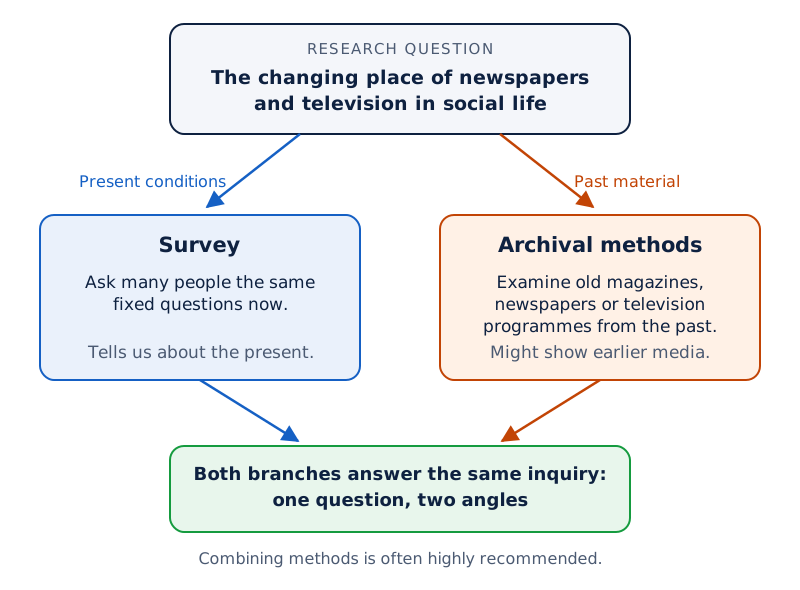
Put the research question about changing media at the centre. Connect it to a survey branch labelled present conditions and an archival branch labelled past material. Bring both branches back to the same inquiry.
Drawn by One Young India.
The diagram expresses a combination of approaches, rather than a claim that every project must use two methods. The method or combination chosen still depends on the question, available material and practical circumstances.
What questions can a project on public transport investigate?
Public transport can be investigated through its place in people's lives. Questions may concern who needs it, why they need it, and how strongly different groups depend on it. These questions direct attention to users and their different circumstances.
Other questions concern problems associated with transport, changes over time and whether unequal access causes social problems. Groups who do not need public transport can also be studied through their attitudes towards it.
How can a particular mode be studied?
A mode of transport is a particular form of travel, such as a tonga, rickshaw or train. A project could trace its history within a town or city, identify its rivals and investigate why it gains or loses ground.
The inquiry could also ask about its likely future and whether people would miss it. These are research questions, not evidence that any particular mode is disappearing or that a rival has already replaced it.
| Approach | Possible focus |
|---|---|
| Observation | Behaviour, expected etiquette (ways of behaving) and sharing space at a local railway or bus station. |
| Survey | Experiences, difficulties and opinions about changes over time. |
| Archival work | Newspapers and other sources concerning the history of change. |
| Interviews | Views of regular and occasional users, or of men and women. |
Etiquette means the expected ways of behaving in these shared settings. Observing it is different from asking people what they think about transport: the former attends to behaviour, while the latter collects views and experiences.
What role can reasoned imagination play?
A project in Delhi could imagine the future of the Delhi Metro. Such an account needs reasons for what it imagines and a coherent connection with present conditions, relationships and the wider development of public transport.
The question of whether the transport topic is suitable only for bigger cities remains a question. It should not be converted into a firm rule excluding other places.
How can communication media be studied in social life?
Communication media are means through which information is conveyed or people communicate. They include mass media, which reach large numbers, such as newspapers, television, films and the internet. They also include letters, telephones, mobile phones and email.
A project could investigate the changing place of media or shifts between print, radio and television. It could ask about preferences for films or books among different classes, age groups or genders, and about perceptions of mobile phones or the internet.
What can observation add to people's accounts?
Observation can reveal a divergence, meaning a difference, if any, between stated views and actual behaviour. For example, actual television viewing may be compared with the time people feel they watch or believe it is appropriate to watch.
The qualification if any matters. The project should investigate whether such a difference exists. It should not begin by treating people's accounts and behaviour as necessarily inconsistent.
Similarly, whether television has reduced the importance of radio and newspapers is a question. Each format may retain a special place. An inquiry can ask why people prefer particular formats rather than announce the outcome before collecting evidence.
What does content analysis examine?
Content analysis here means studying how media treat particular subjects. Possible subjects include schools, education, the environment, caste, religious conflicts and sports, or the treatment of local, national and regional news.
Other approaches include watching mobile-phone use in public, surveying television viewing and programme preferences, or analysing coverage of a current issue. Interviews could explore feelings about the decline of letter writing after the arrival of phones.
Note: Ask about people's views without telling them what they should feel. Treating declining letter writing as necessarily sad would prejudge the issue before hearing their responses.
For a question about change, historical material and present-day inquiry can contribute different evidence. For a question about behaviour, observation can complement what people report about their own media use.
What can household appliances reveal about domestic work?
Household appliances are devices used for work in the home. Examples include gas or kerosene stoves, mixies, grinders, food processors, irons, washing machines, ovens, toasters and pressure cookers. A project connects these devices with the people who use them.
Domestic work means work done within the household. The intra-household division of labour means how that work is distributed among people in the home. Research can ask whether appliances have changed either the work itself or its distribution.
Which questions keep the inquiry focused on people?
- Who uses particular appliances: men or women, younger or older people, paid or unpaid workers?
- How do users feel about the appliances, and have the devices really made work easier?
- Do younger and older people now carry out different jobs compared with earlier arrangements?
- How are domestic tasks distributed, and have there been recent changes in who does what?
These questions do not assume that an appliance automatically makes every task easier or redistributes work. They identify changes and experiences that the project could investigate. A project may also concentrate simply on the distribution of household tasks.
Which methods could be used?
Observation can examine patterns of use, the domestic division of labour and gender aspects. A survey can collect attitudes and memories concerning different appliances. Interviews can explore how different kinds of people respond to a particular device.
Archival research can examine advertising patterns for different appliances. Boys should be encouraged to undertake this project; it should not become a topic assigned only to girls. The organisation of the project should reflect that suggestion.
Keeping the appliance and its users together in the question allows the investigation to remain about social life. The central concern is how work is organised and experienced, alongside whether and how it changes over time.
How can the use of public space become a research project?
Public space in this inquiry includes open fields, roadsides, footpaths, empty plots in housing colonies and areas outside public offices. The project investigates the different uses of such spaces rather than assuming they have one purpose.
Some spaces support small commercial activities, such as roadside vending, temporary shops or parking. Others seem empty but are used for marriages, religious functions, public meetings or dumping materials. Many become homes for poor homeless people who occupy them.
What can be compared?
The inquiry could ask what poor, middle-class and affluent people feel about a space and what resource it represents for them. Affluent means well-off. It could also investigate changes in the use of a particular neighbourhood space.
Possible questions concern whether those changes have generated conflict or friction and, if so, why. Conflict is a possibility to investigate, not an outcome to assume for every shared space.
| Method | Question or activity |
|---|---|
| Observation | Compare the use of similar open spaces in different localities. |
| Survey | Ask a range of people about different uses of a specific space. |
| Archival inquiry | Investigate the uses of a particular space over the years. |
| Interview | Explore whether different social classes and groups have different views about its use. |
It is best to choose familiar, specific places that people know about and relate to. This connects responses with an identifiable setting. Observation should also attend to groups who never enter or are never seen in the space.
The methods address related but distinct parts of the topic: uses, opinions, past changes and differences between groups. A suitable question can bring those strands together while keeping attention on the particular space being investigated.
How can changing aspirations be investigated?
Aspirations are ambitions or goals people hope to achieve. Most people change their goals, specially at young ages. A project can investigate what these changes are and whether patterns appear across different groups.
Possible groups include pupils in Classes 5, 8 and 11 in different kinds of school, different genders and different parental backgrounds. The aim is to see whether patterns emerge, rather than presume that every group follows the same path.
How can adults contribute?
Adults can be asked what they remember about changes in their ambitions. This allows inquiry into whether changes after school show a different pattern from changes during school-going years. Their contribution is based on memory.
Interviews can follow one group's account of its own development or compare different age groups. For this project, interviewees should not come from the investigator's own school. That suggestion applies specifically to the aspirations investigation.
Which methods suit this topic?
| Method | Suitability or focus |
|---|---|
| Observation | Not suitable. |
| Survey | Boys and girls, and adults of different generations speaking from memory. |
| Archival work | Depends on the availability of past material, such as school essays about aspirations. |
| Interview | One group's own development or the accounts of different age groups. |
Availability of material is a practical condition for archival work. Earlier school essays are a possible source, not a guarantee that such records exist. The method depends on whether usable past material can be found.
The contrast with other topics is useful: observing behaviour is suggested for transport, appliances and public space, but observation is not suitable here. A broad interest in social life therefore does not make every method suitable for every question.
What is the biography of a commodity?
A commodity here is a consumption item, such as a television set, motor cycle, carpet or piece of furniture. Its biography is an account of its life history, tracing how it came to its present place in a household.
The project can be written as an autobiography, an account told in the item's own imagined voice. This creative form asks the investigator to consider the social relationships through which the object was produced, traded and purchased.
What relationships should the account explore?
Circuits of exchange are the routes of transactions through which the item has passed. Tracing them connects an object in the home with its earlier production and movement. The question is how it reached its present owner.
Symbolic significance means the meaning an object has for its owners, family or community. The project therefore asks not just where the item moved, but also what it means to the people among whom it now exists.
- Select a household consumption item, such as a television set, carpet or piece of furniture.
- Imagine its life history and the route by which it reached the home.
- Trace the social relationships involved in producing, trading and purchasing it.
- Consider its meaning for its owners, their family and the community.
The imagined speaking object can also describe the people it meets or sees. A television set, sofa set or motor cycle could be given a voice that comments on a family or on other imagined households.
This form brings attention to familiar possessions through an unfamiliar viewpoint. Its central questions remain about exchange, social relationships and meaning. The object's imagined voice is a way of organising the account of those connections.
Glossary
- Research question — A specific question that an investigation seeks to answer through suitable evidence and methods.
- Research method — A way of investigating a question, selected for its suitability and practical feasibility.
- Survey — A method usually asking relatively many people the same fixed set of questions.
- Questionnaire — A fixed set of questions that respondents answer themselves or through an investigator.
- Respondent — A person who provides answers to questions asked during a research inquiry.
- Structured interview — An in-person interview that follows a pattern of questions decided in advance.
- Unstructured interview — An interview with predetermined topics whose actual questions develop through the conversation.
- Observation — Systematic watching and recording of what happens in a chosen research setting.
- Archival methods — Approaches using material from the past to investigate earlier conditions or changes.
- Content analysis — Examination of how media coverage treats selected themes, subjects or current issues.
- Division of labour — The distribution of work among people, including the allocation of tasks within households.
- Aspirations — Ambitions or goals whose changes can be investigated across ages and social groups.
- Commodity biography — An item's life history, tracing production, exchange, purchase and its meaning for people.
- Symbolic significance — The meaning an object carries for its owners, their family or their community.
Common errors and misconceptions
- Misconception: Choosing a broad topic completes the research design. Correct: A topic must be narrowed into a specific question before a suitable method is selected.
- Misconception: Any method can answer every question. Correct: For most questions the choice is usually limited, and both technical suitability and practical circumstances matter.
- Misconception: Survey questions can be changed whenever a reply is interesting. Correct: The fixed questionnaire format does not permit on-the-spot adjustments or follow-up questions.
- Misconception: Unstructured interviews have no preparation. Correct: Topics are decided in advance, although the questions themselves emerge through conversation.
- Misconception: Observation records only events that occur. Correct: Sometimes what does not occur, such as a group's absence from a space, is equally significant.
- Misconception: Appliances must have made everyone's household work easier. Correct: Whether they have made work easier, and for whom, are questions requiring investigation.
- Misconception: Research on media should begin by condemning the decline of letters. Correct: Ask people about their views without prejudging the issue or telling them what to think.
- Misconception: Observation is suitable for studying changing aspirations. Correct: It is not suitable for this topic; surveys, interviews and available past material are suggested approaches.
Exam-style questions with model answers
Q1. Distinguish a research topic from a research question, using public transport and dependence on it as your example. [2 marks]
- A research topic identifies a broad area, such as public transport, within which an investigation could be developed.
- A research question specifies what is to be found out, such as how strongly different groups depend on public transport.
Q2. Explain three considerations involved in selecting a research method after specifying the research question. [3 marks]
- Consider technical suitability: the method must fit the particular research question and be capable of obtaining evidence relevant to answering it.
- Consider the time and resources available, including people and materials. A method's practical demands must be considered alongside its suitability.
- Consider the circumstances in which the investigation must be conducted. For most questions there is a choice of possible methods, but that choice is usually limited.
Q3. Explain four limitations of a survey using a fixed questionnaire. [4 marks]
- Questions are decided beforehand, so the investigator cannot make on-the-spot adjustments while following the fixed questionnaire format.
- If respondents misunderstand a question, the answers obtained can produce wrong or misleading results about the group being studied.
- An interesting response cannot be followed with additional questions about that subject because the investigator must keep to the questionnaire.
- The questionnaire gives a snapshot of one moment. It would not capture circumstances that were different earlier or changed afterwards.
Q4. A project asks whether pupils in single-sex schools are happier than those in co-educational schools. It will use a questionnaire about feelings towards school. Explain five steps in carrying out this proposed survey, including how to address incomplete responses. No survey results have yet been collected. [5 marks]
- Prepare a questionnaire designed to obtain information about how pupils feel towards their schools, keeping it connected to the stated happiness question.
- Make enough copies for the planned distribution, recognising that preparing the forms involves time, effort and money before responses can be collected.
- Seek any necessary permission to distribute questionnaires in classrooms. Permission may not be obtained at the first attempt, and another visit may be needed.
- Distribute the questionnaire to equal numbers of pupils in each school type, collect the completed forms and analyse the answers for possible differences.
- Decide how to deal with incomplete responses: return to respondents, consider complete questionnaires only, or use only completed answers. These are alternative responses to a practical problem.
Q5. Explain four features of interviews, covering their structure, intensity, advantage and limitation. [4 marks]
- Interviews may be structured around predetermined questions or unstructured, with topics decided beforehand and questions emerging during conversation.
- They may be more or less intensive. A long interview lasting 2 to 3 hours or repeated visits can produce a detailed account.
- Their flexibility allows promising topics to be pursued, questions to be refined or modified, and clarification to be sought.
- They cannot cover a large number of people, so the accounts obtained are limited to the views of a select group.
Q6. A project investigates the changing place of newspapers and television. It proposes a present-day survey and examination of older magazines, newspapers or television programmes. Explain the contribution of each approach. [2 marks]
- The survey will provide information about what is happening today, contributing evidence about the present place of these media.
- The archival approach might show what earlier media were like, allowing the same question to be approached from a historical angle.
Q7. A project on changing aspirations proposes to compare pupils in Classes 5, 8 and 11, consult adults' memories and look for earlier school essays. Explain five relevant methodological choices or cautions. [5 marks]
- The project can compare the aspirations of the stated age groups and investigate whether patterns emerge, rather than assuming that every group follows the same pattern.
- Adults can contribute memories of changing ambitions. Their accounts can help investigate whether changes after school differ from changes during school-going years.
- Interviews may explore one group's own development or compare different age groups. For this aspirations project, interviewees should not be from the investigator's own school.
- Archival work depends on whether relevant past material is available. Earlier school essays are a possible resource, so their availability must be checked.
- Observation is not suitable for this topic. Surveys and interviews are suggested approaches, while the proposed essays may support archival inquiry if available.
Q8. Explain three social questions that could organise the imagined autobiography of a household commodity, such as a television set, carpet or piece of furniture. [3 marks]
- Ask which circuits of exchange the item passed through before reaching the household. This traces the route of transactions in its life history.
- Ask about the social relationships through which it was produced, traded and purchased. These connect the present possession with the people involved earlier.
- Ask about its symbolic significance for its owners, family and community. This investigates what the item means to people as well as how it reached them.
Key takeaways
- Practical projects offer experience of asking a question and collecting evidence systematically, including the excitement and difficulties of sociological research.
- A broad topic needs a specific research question, followed by a method selected for technical suitability and practical circumstances.
- Surveys usually reach relatively many people, but fixed questions prevent immediate adjustments and capture only a particular moment.
- Interviews offer flexibility and depth, while their limited coverage presents the views of a select group of individuals.
- Observation requires systematic watching and recording without prejudging relevance; sometimes a group's absence is as significant as visible activity.
- Combining methods is often highly recommended; present surveys and past material can approach the same question from different angles.
- Suggested topics include transport, communication, household work, public space, changing aspirations and the social life history of a commodity.
- Questions about change, preferences or conflict must remain open inquiries; avoid telling respondents what they should think or feel.
Test yourself
What should come before selecting a research method?
Carefully specify the research question, then choose a method suited to answering it.
Does a survey have one compulsory number of respondents?
No. What counts as a relatively large number depends on the research context and topic.
What is decided in advance in an unstructured interview?
The topics are decided beforehand, while actual questions develop through the conversation.
Why can absence matter in observation of an open space?
A social group that never enters or is never seen there may be significant to understanding the space's use.
What does archival work contribute to research on media change?
Past material might reveal what newspapers, magazines or television programmes were like earlier.
What does the intra-household division of labour mean?
It means the distribution of work among people within the household: who does which tasks.
What condition affects archival research on changing aspirations?
It depends on the availability of past material, such as school essays about aspirations.
What makes a commodity biography a social inquiry?
It traces production, trade, purchase and the object's meaning for its owners, family and community.
Write about it
Turn a question from this chapter into a paper.
The Writing Studio has a structure guide, a rubric and citation tools for 15 formats, from essays to research papers. Drafting is free with an account. Learnacy Essential adds feedback from an AI writing coach and submission to The OYI Review.
Learnacy Essential is ₹1,499 for the year. Publication depends on review and is not guaranteed.