
The First World War | ICSE Class 10 History & Civics Notes
On this page
Watch & explore
Start with a few high-quality watches, then dive into the notes below.
This note covers the First World War, its long-term causes and immediate trigger, the rival European powers, the peace settlement, and the organisation created to preserve peace after the fighting.
What was the background to the First World War?
The First World War was the conflict of 1914 to 1918, fought mainly in Europe but with effects around the world. Its origins lay in rival national ambitions, competition for overseas possessions, military preparations and the division of European powers into opposing groups.
Nationalism means identification with a nation and the desire to advance its interests or secure its independence. Imperialism means extending a state's power over other peoples and territories. In Europe, these forces became closely connected with competition between powerful states.
How did national ambitions become international tensions?
Germany became a unified empire in 1871. By the last quarter of the nineteenth century, nationalism in Europe had become increasingly narrow and intolerant. Major powers manipulated the national aspirations of subject peoples, meaning peoples governed by another power, to advance their own imperial ambitions.
The Balkans, a region in south-eastern Europe containing several peoples and states, became a major centre of tension after 1871. A large part of the region had been controlled by the Ottoman Empire, the empire ruled by the Ottoman dynasty.
As Ottoman control weakened, subject nationalities sought independence. However, newly independent states also competed for territory. Their struggles became linked to the ambitions of larger European powers. Local disputes therefore developed within a wider setting of international rivalry.
Why should the causes be studied together?
The outbreak in 1914 cannot be explained simply by naming one assassination. Long-term rivalries made the political atmosphere dangerous; military preparations increased the capacity for war; agreements between states helped widen the conflict once the immediate crisis began.
Note: A long-term cause creates underlying tension. An immediate cause triggers the crisis that leads to fighting. The assassination at Sarajevo was the immediate trigger, but it operated within an already divided Europe.
How did nationalism and imperialism contribute to war?
Aggressive nationalism placed national power and prestige above accommodation with other states. It encouraged hostility towards rivals and made territorial disputes more difficult to resolve. National pride became linked to the strength of armies, navies and overseas empires.
Why were the Balkans particularly unstable?
Balkan peoples used their histories to support claims to independence. They viewed resistance to foreign rule as the recovery of freedom previously lost. Yet the Balkan states were also fiercely jealous of one another, and each hoped to enlarge its territory at the expense of its neighbours.
This was more than a struggle between one ruler and one subject people. Several national groups were asserting competing claims. The weakening of Ottoman authority did not automatically produce agreement about borders or about which state should control a disputed area.
The ambitions of Russia, Germany, Britain and Austria-Hungary complicated these conflicts. Austria-Hungary was a multinational empire, meaning an empire containing several national communities. Each major power wanted to limit the influence of rivals and extend its own influence in the Balkans.
How did imperial competition reinforce nationalism?
European powers competed over trade, colonies, meaning territories governed by an outside power, and naval and military strength. Competition for political influence and economic advantage reinforced distrust. Expansion by one power could be interpreted by another as a threat to its own position.
Nationalism and imperialism therefore interacted. National pride could justify expansion, while possession of an empire could become a source of national pride. In the Balkans, the search for independence became entangled with attempts by powerful states to extend their control.
Diagram
Linked causes of tension
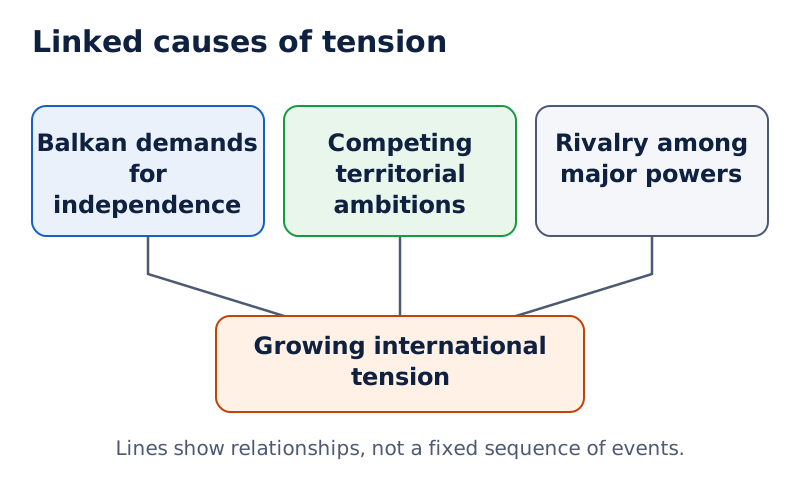
Draw three labelled boxes: “Balkan demands for independence”, “Competing territorial ambitions” and “Rivalry among major powers”. Connect all three to a fourth box labelled “Growing international tension”. The connecting lines show relationships, not a fixed sequence of events.
Drawn by One Young India.
Why did the armament race make Europe more dangerous?
Armaments are weapons and military equipment. An armament race occurs when rival states compete to increase their military strength. Before the First World War, competition over naval and military power accompanied rivalry over trade, territory and colonies.
How were preparation and suspicion connected?
Each power could present its military preparations as necessary for defence. Other powers could interpret the same preparations as evidence of an aggressive intention. Efforts to increase security could therefore intensify mutual suspicion and encourage further preparation by rivals.
Militarism means placing great importance on military strength and readiness to use force. In this atmosphere, armed strength became a measure of national prestige. Negotiation had to operate alongside the belief that military superiority could protect a state's interests.
The armament race did not itself identify the place or date at which war would begin. Its significance was that it increased the resources available for fighting and strengthened the atmosphere of competition in which governments responded to international crises.
How did industry affect the scale of war?
The conflict became the first modern industrial war, meaning a war in which large-scale industry supplied destructive equipment and supported mass warfare. Machine guns, tanks, aircraft and chemical weapons were used on a massive scale during the fighting.
Millions of soldiers were recruited around the world and moved to the fighting areas by ships and trains. Industry and transport therefore helped sustain a conflict far larger than a local dispute. Military preparation before the war and industrial production during it were related but distinct processes.
Do not treat every weapon used during the war as a weapon already deployed when the crisis began. The central relationship is between competition in armed strength before the war and the industrial capacity that sustained destruction once fighting was under way.
How did different groups of powers participate in Europe's division?
An alliance is an agreement between states to cooperate, often for mutual protection. Before 1914, European powers formed rival groupings. These arrangements offered support against opponents but also connected the security of individual states with the interests of their partners.
Which powers formed the Triple Alliance?
The Triple Alliance, formed in 1882, linked Germany, Austria-Hungary and Italy. Its membership describes a pre-war arrangement. It must not be copied unchanged as the list of states that fought together throughout the First World War.
Italy did not enter the war alongside Germany and Austria-Hungary in 1914. It joined the opposing side in 1915. An alliance map before the war and a list of participants during the war therefore answer different historical questions.
Which powers formed the Triple Entente?
The Triple Entente was the understanding linking Britain, France and Russia, completed in 1907. An entente is an understanding between states. These powers formed the core of the Allies, the wartime grouping opposed to Germany and its partners.
The United States later joined the Allied side. The list of participants consequently changed during the conflict. Naming a grouping without identifying whether it belongs to the pre-war or wartime situation can conceal an important change.
Which powers formed the Central Powers?
The Central Powers were the wartime grouping that included Germany, Austria-Hungary and Ottoman Turkey; Bulgaria also joined them. Ottoman Turkey refers here to the Ottoman Empire in its wartime role. This grouping was different from the Triple Alliance.
| Grouping | Period or character | Members relevant here |
|---|---|---|
| Triple Alliance | Pre-war alliance formed in 1882 | Germany, Austria-Hungary and Italy |
| Triple Entente | Pre-war understanding completed in 1907 | Britain, France and Russia |
| Central Powers | Wartime grouping | Germany, Austria-Hungary, Ottoman Turkey and Bulgaria |
| Allies | Wartime grouping whose membership expanded | Britain, France and Russia; later joined by Italy and the United States |
The danger of Europe's division lay in the possibility that a dispute involving one power would draw in its partners. Nevertheless, the existence of alliances did not remove decisions by governments. The spread of war must be explained through both these connections and the decisions taken during the crisis.
How did the Sarajevo crisis trigger the war?
The Sarajevo crisis was the international crisis following the assassination of Archduke Franz Ferdinand at Sarajevo on 28 June 1914. An archduke was a title used by princes of Austria's ruling family. Franz Ferdinand was the heir to the Austro-Hungarian throne.
He was killed by Gavrilo Princip, a Bosnian Serb nationalist. Sarajevo was in Bosnia-Herzegovina, which Austria-Hungary had annexed in 1908. Annexation means the formal incorporation of a territory into another state's possessions.
How did the crisis move from assassination to war?
Austria-Hungary held Serbia responsible and sent it an ultimatum, a final demand backed by a threat of action. Serbia accepted many demands but did not accept them all. Austria-Hungary declared war on Serbia on 28 July 1914.
Russia supported Serbia and began military mobilisation. Mobilisation means preparing and assembling armed forces for war. Germany supported Austria-Hungary. The dispute now involved the interests and military preparations of powers beyond the original confrontation.
- The assassination at Sarajevo produced a crisis between Austria-Hungary and Serbia.
- Austria-Hungary's ultimatum and subsequent declaration of war turned the crisis into armed conflict.
- Russian support for Serbia and German support for Austria-Hungary widened the confrontation.
- Germany declared war on Russia on 1 August and France on 3 August 1914.
- Germany's invasion of Belgium was followed by Britain's entry into the war on 4 August 1914.
What should be distinguished in this account?
Princip's identity does not by itself establish that the Serbian government ordered the assassination. Austria-Hungary's accusation and the assassin's action must be kept distinct. The immediate trigger explains the timing of the crisis; earlier rivalries help explain why the crisis spread.
The dates also distinguish the beginning of the Austro-Serbian war in July from the wider European war in August. They describe successive stages in an expanding conflict rather than two contradictory starting points.
How do the long-term causes compare with the immediate cause?
A useful explanation separates the conditions that made conflict more likely from the event that set the final crisis in motion. It then reconnects them. A list of causes becomes an explanation when each cause is linked to the way it increased tension or widened the conflict.
| Cause | What it involved | Contribution to war |
|---|---|---|
| Nationalism | Rival national ambitions and competing territorial claims | Increased hostility and sharpened Balkan disputes |
| Imperialism | Competition for colonies, trade and political influence | Extended rivalry between major powers |
| Armament race | Competition to strengthen armies and navies | Increased suspicion and military preparedness |
| Division of Europe | Rival alliances and understandings | Connected local disputes with the interests of other powers |
| Sarajevo crisis | Assassination followed by demands, mobilisation and declarations of war | Triggered the immediate sequence leading to general war |
Why is a single-cause explanation incomplete?
Nationalism alone does not describe military preparations. The armament race alone does not explain the particular dispute between Austria-Hungary and Serbia. The assassination alone does not explain why Britain, France, Russia and Germany became involved in the widening crisis.
These causes worked at different levels. Some concerned ideas and ambitions, others concerned military resources or relationships between states. The immediate crisis brought those pressures together. Explaining their interaction is more accurate than treating each cause as a separate event without connections.
Definition: A cause helps explain why an event occurred; a consequence is an effect that followed it. The peace settlement following the First World War was a consequence of the fighting, not a cause of its outbreak.
What does the timeline show about the war and peace settlement?
A timeline arranges events in chronological order, meaning the order in which they occurred. For the First World War, it helps distinguish pre-war alliances, the immediate crisis, the end of fighting and the later arrangements for peace.
An armistice is an agreement to stop fighting. The armistice of 11 November 1918 ended fighting on the Western Front, the principal fighting zone in western Europe. It was not the same event as the signing of the peace treaty.
A peace treaty is a formal agreement establishing peace and its terms. The Treaty of Versailles, the peace treaty with Germany, was signed in 1919. The League of Nations, an international organisation intended to preserve peace through cooperation, began in 1920.
| Date | Event | Place in the sequence |
|---|---|---|
| 1789 | The French Revolution transferred sovereignty from the monarchy to French citizens | Early expression of nationalism in Europe |
| 1815 | The European powers met at Vienna after defeating Napoleon | A conservative settlement sought to restore monarchies |
| 1821 | The Greek struggle for independence began | Nationalist resistance to Ottoman rule |
| 1832 | The Treaty of Constantinople recognised Greek independence | Emergence of an independent nation from Ottoman rule |
| 1848 | The Frankfurt parliament attempted German unification under a constitution | A liberal initiative opposed by the monarchy and military |
| 1859 | Sardinia-Piedmont defeated Austrian forces with French support | War and diplomacy advanced Italian unification |
| 1861 | Victor Emmanuel II was proclaimed king of united Italy | Formation of a new European nation-state |
| 1871 | William I was proclaimed German Emperor at Versailles | Prussian leadership completed German unification |
| 1882 | Formation of the Triple Alliance | Pre-war division of Europe |
| 1885 | The major European powers met in Berlin to complete the division of Africa | Overseas expansion formed part of the imperial background |
| 1907 | Completion of the Triple Entente | Development of the rival grouping |
| 1908 | Austria-Hungary annexed Bosnia-Herzegovina | Background to tension in the Balkans |
| 28 June 1914 | Assassination of Franz Ferdinand at Sarajevo | Immediate trigger of the crisis |
| 28 July 1914 | Austria-Hungary declared war on Serbia | Beginning of the Austro-Serbian war |
| 1 August 1914 | Germany declared war on Russia | Expansion of the conflict |
| 3 August 1914 | Germany declared war on France | Further expansion of the conflict |
| 4 August 1914 | Britain entered the war after Germany invaded Belgium | Britain joined the widening war |
| 11 November 1918 | Armistice with Germany | End of fighting on the Western Front |
| 28 June 1919 | Treaty of Versailles signed | Peace settlement with Germany |
| 10 January 1920 | League of Nations came into existence | Establishment of the new international organisation |
| 1921 | One in every five British workers was out of work | Post-war contraction and reduced government expenditure brought job losses |
Why are the armistice, the Treaty of Versailles and the League’s formation dated differently?
The sequence therefore moves from stopping the fighting to specifying the peace terms and establishing an organisation for future peace. Confusing these stages gives the wrong date to the wrong event, even when the general order of war and peace is understood.
What were the human and economic consequences of the war?
The First World War lasted from 1914 to 1918. Many governments initially expected a short conflict, but it lasted more than four years. Industrial production, military recruitment and the movement of supplies sustained destruction on an enormous scale.
How did the war affect people and work?
Most of the killed and maimed were men of working age. “Maimed” means seriously injured with lasting bodily damage. Deaths and injuries reduced Europe's able-bodied workforce. With fewer family members able to earn, household incomes declined after the war.
Industries were reorganised to manufacture war-related goods. As men went to battle, women stepped into jobs that earlier only men were expected to do. The war consequently affected the organisation of work as well as the lives of soldiers.
This does not mean that women had never worked before the war. The change concerned their entry into jobs previously expected to be performed by men. Nor does “most” mean that every person killed or seriously injured belonged to the same age or sex group.
How did war finance create lasting problems?
Britain borrowed heavily from the United States, abbreviated hereafter as US. The US changed from an international debtor, owing money abroad, to an international creditor, to which others owed money. Britain's external debts complicated its recovery.
A wartime economic boom, an expansion in demand, production and employment, was followed by contraction when war demand ended. Reduced production and lower government war expenditure contributed to unemployment. Post-war recovery was therefore difficult even for a victorious power.
These consequences help explain the importance attached to a new peace settlement. Stopping the fighting did not immediately restore household earnings, reverse debts or return economies to their earlier condition. The political arrangements for peace were made against this background of disruption.
What were the main terms and effects of the Treaty of Versailles?
The Treaty of Versailles was the peace treaty signed with Germany on 28 June 1919. The armistice had stopped fighting in November 1918; the treaty set out Germany's obligations in the peace settlement. Its terms concerned territory, military strength and responsibility for war damage.
What territorial and military restrictions were imposed?
Germany returned Alsace-Lorraine, a territory on its border with France, to France. It lost its overseas colonies. These changes reduced Germany's territorial possessions in Europe and overseas, rather than merely changing the size of its armed forces.
The German army was limited to 100,000 men, and conscription, compulsory military service, was prohibited. Germany was forbidden an air force and submarines, meaning naval vessels capable of operating underwater. Such restrictions were intended to limit its ability to wage war.
The Rhineland, the region adjoining the Rhine River, was demilitarised. Demilitarisation means prohibiting military forces or military installations in a specified area. This restriction must be distinguished from annexation: a restriction on military activity is not the same as transfer of political control.
What were the financial and responsibility clauses?
The treaty's war guilt clause placed responsibility on Germany and its allies for loss and damage caused by the war. It provided the basis for requiring Germany to pay reparations, compensation for war damage. A treaty's assignment of responsibility is distinct from a complete historical explanation of all causes.
| Category | Term | Effect on Germany |
|---|---|---|
| Territorial | Return of Alsace-Lorraine to France | Loss of territory in Europe |
| Colonial | Loss of overseas colonies | Reduction of overseas possessions |
| Military | Army limited to 100,000 men; conscription prohibited | Restriction on armed manpower |
| Strategic | Demilitarisation of the Rhineland | Restriction on military activity in that region |
| Financial | Reparations for war damage | Obligation to provide compensation |
Why did the settlement leave resentment?
Territorial losses, military restrictions and the responsibility and reparations provisions caused resentment in Germany. The treaty established peace terms, but signing a treaty did not ensure that those affected regarded the settlement as fair or that future international relations would remain peaceful.
The settlement also included the Covenant of the League of Nations, the agreement setting out the League's purposes and rules. Versailles therefore combined restrictions on a defeated state with an attempt to create machinery for international cooperation.
Why was the League of Nations formed and what were its objectives?
The League of Nations arose from the effort to prevent another destructive international war. Its Covenant formed part of the 1919 peace settlement, and the organisation came into existence on 10 January 1920. Its headquarters were in Geneva, Switzerland.
Woodrow Wilson, the president of the United States during the peace negotiations, was a major advocate of the League. However, the United States did not become a member. Proposing an organisation and joining it are separate actions.
How was the League intended to preserve peace?
The League aimed to maintain international peace and security. Collective security means states acting together to protect peace against aggression. Aggression means an attack by one state on another. The League sought to replace reliance on individual force with organised international cooperation.
- Prevent war: Maintain peace and security through cooperation between member states.
- Settle disputes peacefully: Encourage discussion, arbitration and judicial settlement rather than resort to war. Arbitration means submitting a dispute to an agreed third party for a decision; judicial settlement means referring it to a court.
- Reduce armaments: Seek a reduction in weapons and military forces to lessen the danger of competitive military preparation.
- Protect member states: Respect and preserve their territorial integrity and political independence against external aggression. Territorial integrity means the preservation of a state's territory; political independence means freedom from outside political control.
- Promote international cooperation: Encourage cooperation over economic and social problems, including efforts concerning health and working conditions.
How did these aims relate to the causes of war?
Peaceful settlement addressed the danger that a dispute would escalate into fighting. Reduction of armaments addressed competitive military preparation. Collective security sought a common response to threats to peace. Cooperation provided a means of discussing problems shared across national boundaries.
These were objectives, meaning intended goals. They should not be confused with achievements. Establishing an organisation devoted to peace did not by itself guarantee that governments would cooperate or that another war would be prevented.
Versailles and the League were thus related but different results of the war. The treaty dealt with the terms imposed on Germany, while the League was intended to provide an ongoing framework for cooperation and the prevention of future conflicts.
What do historical sources reveal about European nationalism?
How did writers link national unity with economic interests and consent?
In 1834, the economist Friedrich List argued that the Zollverein should unite Germans economically, protect their external interests and stimulate internal production. He hoped that combining individual and provincial interests would strengthen national feeling.
List's argument reveals the political aims attached to economic integration. His description of what the customs union ought to achieve is evidence of an aspiration; it does not by itself demonstrate that every German shared that aspiration.
In his 1882 lecture, Ernst Renan grounded nationhood in shared memories, past sacrifices and a continuing wish to live together. He rejected common language, race, religion or territory as sufficient explanations and opposed holding a country against its inhabitants' will.
Whose liberty did nationalist politics include?
Louise Otto-Peters, writing in her newspaper's editorial of 21 April 1849, challenged men who demanded liberty while seeking its benefits only for men. She argued that freedom could not be divided in this way.
Her criticism exposes a tension within liberal politics: demands for freedom could coexist with women's exclusion. Read alongside List and Renan, it shows that economic unity, consent and equal political rights raised different questions about the nation.
These sources provide evidence of particular writers' arguments. Their hopes and criticisms should be distinguished from the policies governments followed and from claims about what everyone believed. This distinction matters when explaining how nationalism later became connected with imperial rivalry.
Glossary
- Nationalism — Identification with a nation and the desire to advance its interests or secure its independence.
- Imperialism — The extension of a state's power over other peoples and territories through domination or control.
- Armament race — Competition between rival states to increase their weapons, military equipment and armed strength.
- Militarism — The belief in the importance of military strength and readiness to use armed force.
- Alliance — An agreement between states to cooperate, often to support one another against common threats.
- Annexation — The formal incorporation of a territory into the possessions of another state.
- Ultimatum — A final demand backed by a threat of action if its terms are rejected.
- Mobilisation — The preparation and assembly of armed forces so that they are ready for war.
- Armistice — An agreement to stop fighting, distinct from a treaty establishing the terms of peace.
- Reparations — Compensation required from a defeated state for damage caused during a war.
- Demilitarisation — The prohibition of military forces or military installations within a specified geographical area.
- Conscription — Compulsory military service through which a state requires people to serve in its armed forces.
- Collective security — An arrangement in which states act together to protect international peace against aggression.
- Covenant — The agreement that set out the purposes and rules of the League of Nations.
Common errors and misconceptions
- Misconception: The assassination at Sarajevo was the entire explanation for the war. Correct: It triggered the immediate crisis, but nationalism, imperialism, armaments and rival groupings formed its wider background.
- Misconception: The Triple Alliance and the Central Powers had identical membership. Correct: Italy belonged to the pre-war Triple Alliance but joined the Allied side in 1915.
- Misconception: Princip's identity proves that Serbia's government ordered the assassination. Correct: His identity and Austria-Hungary's accusation must be distinguished from proof of a government order.
- Misconception: The Treaty of Versailles was signed when the fighting stopped in November 1918. Correct: The armistice stopped the fighting; the treaty was signed on 28 June 1919.
- Misconception: Demilitarisation and annexation mean the same thing. Correct: Demilitarisation restricts military activity in a territory; annexation incorporates that territory into another state's possessions.
- Misconception: The United States joined the League because Wilson supported it. Correct: Wilson advocated the League, but the United States did not become a member.
- Misconception: The League's peacekeeping objectives prove that it guaranteed peace. Correct: Objectives describe intended goals; establishing the League did not ensure cooperation or prevent every future conflict.
Exam-style questions with model answers
Q1. Rival national ambitions and military preparations had increased European tension before 1914. The assassination at Sarajevo then began the immediate crisis leading to war. Using this information, distinguish a long-term cause from an immediate cause in two points. [2 marks]
- A long-term cause creates underlying tension, as rival national ambitions and military preparations did before the outbreak of war.
- An immediate cause triggers the final crisis, as the assassination at Sarajevo did in the sequence leading to war.
Q2. In 1882, Germany, Austria-Hungary and Italy formed the Triple Alliance. By 1907, Britain, France and Russia were linked in the Triple Entente. Italy joined the Allied side in 1915. Use these facts to identify the two pre-war groups and explain one difference between pre-war alignment and wartime participation. [3 marks]
- The Triple Alliance was the pre-war grouping of Germany, Austria-Hungary and Italy, formed in 1882. It identifies their alignment before the war.
- The Triple Entente linked Britain, France and Russia by 1907. It was the other pre-war grouping identified in the information.
- Pre-war alignment did not necessarily determine wartime participation: Italy belonged to the Triple Alliance but joined the Allied side in 1915.
Q3. Consider this sequence: Franz Ferdinand was assassinated at Sarajevo; Austria-Hungary sent Serbia an ultimatum and declared war after Serbia did not accept all its demands; Russia supported Serbia while Germany supported Austria-Hungary; Germany declared war on Russia and France, invaded Belgium, and Britain entered the war. Explain in four points how a local crisis widened. [4 marks]
- The assassination of Franz Ferdinand at Sarajevo created the immediate crisis around which the subsequent confrontation developed.
- Austria-Hungary's ultimatum and declaration of war after Serbia's incomplete acceptance turned the crisis into fighting between the two states.
- Russia's support for Serbia and Germany's support for Austria-Hungary connected the dispute to the interests of additional powers.
- German declarations of war on Russia and France, the invasion of Belgium and Britain's entry extended the conflict across more states.
Q4. The Treaty of Versailles returned Alsace-Lorraine to France, limited Germany's army to 100,000 men, prohibited military forces or installations in the Rhineland through demilitarisation, and required reparations, meaning compensation for war damage. Using only these terms, explain four different restrictions or losses imposed on Germany. [4 marks]
- Returning Alsace-Lorraine to France meant a territorial loss for Germany. Control of that territory passed to France under the settlement.
- Limiting the army to 100,000 men restricted the size of Germany's armed manpower and therefore its military establishment.
- Demilitarising the Rhineland restricted military forces or installations in that region. This was a restriction on military activity.
- Reparations required Germany to provide compensation for war damage. They imposed a financial obligation distinct from the territorial and military terms.
Q5. The League of Nations aimed to prevent war through cooperation, settle disputes through discussion, arbitration or courts, reduce armaments, meaning weapons and military forces, protect members' territory and political independence against external aggression, and encourage economic and social cooperation, including health and working conditions. Explain these five objectives, using only the information given. [5 marks]
- The League sought to prevent war by encouraging states to cooperate in preserving peace. Its purpose was to make peace a shared international concern.
- It aimed to settle disputes peacefully through discussion, arbitration or courts. These methods were intended to provide alternatives to the use of armed force.
- It sought to reduce armaments, meaning weapons and military forces. This objective addressed the danger associated with competition in military preparation.
- It aimed to protect members' territory and political independence against external aggression. States were expected to cooperate against threats from outside.
- It promoted economic and social cooperation, including health and working conditions. Its objectives therefore extended beyond disputes directly involving the outbreak of war.
Q6. During the war, most of the killed and maimed were working-age men, reducing Europe's able-bodied workforce and later household incomes. Industries produced war goods, and women entered jobs earlier expected only of men. Britain borrowed heavily from the United States, which changed from an international debtor to a creditor. Explain five human or economic effects from this information, retaining its qualifications. [5 marks]
- Most of the killed and maimed were men of working age. The loss and injury of these men reduced Europe's able-bodied workforce.
- Household incomes declined after the war because families had fewer members able to earn. The human losses therefore had an economic effect within families.
- Industries were reorganised to produce war-related goods. Production was directed towards the requirements of fighting rather than simply continuing in its earlier form.
- Women entered jobs that earlier only men were expected to perform. This describes a change in work roles, not the beginning of all women's employment.
- Britain's borrowing increased its debts to the United States, while the United States changed from an international debtor to a creditor.
Q7. National ambitions sharpened territorial disputes; imperial competition increased rivalry over colonies and trade; an armament race increased military preparation and suspicion; rival groups linked states' interests; and the Sarajevo assassination triggered the final crisis. Explain how these five causes contributed to the First World War, distinguishing the trigger from the background. [5 marks]
- National ambitions increased hostility over territorial claims. They formed part of the underlying tension rather than a single event immediately beginning the war.
- Imperial competition extended rivalry to colonies and trade. The struggle for influence and advantage added another source of conflict between powerful states.
- The armament race increased military preparation and suspicion. Rival states became better prepared to fight while becoming more distrustful of one another.
- Rival groupings linked the interests of different states. A dispute involving one state could therefore concern its partners and widen beyond its original setting.
- The Sarajevo assassination triggered the final crisis. It must be distinguished from the long-term pressures that had already made the international situation dangerous.
Key takeaways
- The First World War arose from interacting national ambitions, imperial competition, military preparations and the division of Europe into rival groups.
- The Balkans combined demands for independence, competing territorial claims and interference by major powers seeking to extend their own influence.
- The Triple Alliance was a pre-war arrangement; Italy's later participation on the Allied side shows why wartime groupings require separate attention.
- The Sarajevo assassination triggered a crisis that widened through demands, military mobilisation, declarations of war and the involvement of further powers.
- The armistice of November 1918 stopped fighting; the Treaty of Versailles of June 1919 specified the peace terms imposed on Germany.
- Versailles imposed territorial, military and financial obligations, while the League of Nations was intended to provide continuing international cooperation for peace.
- The League's objectives included peaceful settlement, reduced armaments, protection against aggression and wider cooperation; objectives must be distinguished from achievements.
Test yourself
Why were Balkan disputes connected to rivalry among larger powers?
Balkan national and territorial disputes attracted powers seeking to extend their influence and limit that of rivals, widening the significance of local conflicts.
Why should the Triple Alliance not be treated as identical to the Central Powers?
The Triple Alliance included Italy before the war. Italy joined the Allied side in 1915, so its pre-war alignment did not match its wartime participation.
What was the immediate trigger of the war?
The assassination of Franz Ferdinand at Sarajevo on 28 June 1914 triggered the crisis that developed into the wider conflict.
What is the difference between an armistice and a peace treaty?
An armistice is an agreement to stop fighting. A peace treaty establishes the terms of peace, such as territorial and military obligations.
What did the demilitarisation of the Rhineland mean?
It prohibited military forces or installations in that region. It concerned military activity and should not be confused with annexation of territory.
What were reparations under the peace settlement?
Reparations were compensation for war damage. They imposed a financial obligation on Germany distinct from the territorial losses and military restrictions.
What were the League of Nations' principal objectives?
It sought to prevent war, settle disputes peacefully, reduce armaments, protect members against external aggression, and promote economic and social cooperation.
Write about it
Turn a question from this chapter into a paper.
The Writing Studio has a structure guide, a rubric and citation tools for 15 formats, from essays to research papers. Drafting is free with an account. Learnacy Essential adds feedback from an AI writing coach and submission to The OYI Review.
Learnacy Essential is ₹1,499 for the year. Publication depends on review and is not guaranteed.