
The Story of Indian Farming | CBSE Class 7 History Notes
On this page

This note covers Indian farming, its early history, agricultural sources, climate and cropping seasons, soils, water, seeds, traditional practices, the Green Revolution, sustainable agriculture, government support, and the challenges faced by farmers.
What is agriculture, and which groups participate in it?
Agriculture includes preparing soil, cultivating plants and rearing livestock, meaning farm animals. In many cases, growing trees forms part of the farming system. Agriculture connects the production of food with the care of land, water, plants and animals.
Allied activities are activities related to agriculture. They include raising livestock, beekeeping, fisheries, rearing silkworms, preparing silk yarn and producing fibres such as cotton and hemp. Apiculture means beekeeping, while pisciculture means fish rearing.
How do farming families contribute?
Many families have cultivated their land for generations. Alongside crops, they rear cows, goats and poultry, keep bees or practise fishing. Where possible, they collect forest produce. Many grow trees on field boundaries for fruit and timber. These different activities help families cope with difficulties.
What work do women perform?
Women perform most farming operations, from sowing to harvesting and threshing, the removal of edible grain from straw or husk. In rural India, more than 75 per cent of people working in the agriculture sector are women, using the 2025 figure.
How do researchers and public agencies participate?
Researchers study seeds, farming practices and soil health. Government support includes information, training and help with agricultural supplies. These activities support the farmers who carry out the work of cultivation and animal care.
In 2022-2023, agriculture and allied activities contributed a little over 18 per cent of India's gross domestic product, the total value of goods and services produced in a year. Approximately 46 per cent of the working population depended on these activities for their livelihood.
What were the origins of farming in India?
Archaeological evidence, meaning material remains investigated to understand the past, places Indian farming in prehistory. Dates marked BCE mean Before Common Era; CE means Common Era. A millennium is a thousand years.
Rice grains have been found in the Ganga Plain as early as the 7th or 8th millennium BCE. However, some experts point out that this need not mean rice cultivation was already systematic. Mastering systematic cultivation may have taken a few more millennia.
At Mehrgarh in Baluchistan, a site preceding the Sindhu-Sarasvatī civilisation, barley and millet cultivation is dated to the 7th millennium BCE. Barley and wheat later became staple crops, or main food crops, of the Harappans.
Several Harappan sites indicate rice in the 3rd millennium BCE, at least in some regions, alongside millets and several vegetables. Animals including cattle, asses, sheep, goats, dogs, pigs and fowl were domesticated from the pre-urban phase, around 3500 BCE.
What do fields and texts tell us?
Intercropping means growing two or more different crops simultaneously. Perpendicular furrows, or grooves crossing at right angles, at Kalibangan in Rajasthan provide evidence of this practice around 2800 BCE. The practice continued in the 1960s, around 4800 years later.
Photographs: Evidence of intercropping (NCERT Class 7 Figure 1.2). The upper photograph shows perpendicular furrows at the Harappan site of Kalibangan in Rajasthan, dated to around 2800 BCE. The lower photograph shows a person ploughing with a camel across intersecting furrows in the 1960s, illustrating the same practice around 4800 years later.
What do historical sources reveal about farming?
The Vedas mention yava (barley), godhūma (wheat) and vrīhi (rice), along with sesame, black gram and various pulses and legumes. These texts provide written references to crops known in ancient India.
Written sources include Kauṭilya's Arthaśhāstra, Sangam literature of the early Tamils, Amarakoṣha, Kṛiṣhiparāśhara, Varāhamihira's Bṛihatsamhitā and Surapāla's Vṛikṣhāyurveda. They discuss agriculture, growing garden crops and trees, plant diversity, and, in some cases, animal care.
Vṛikṣhāyurveda gives recommendations on preparing seeds, cultivating soil, planting and watering. Bṛihatsamhitā describes grafting, joining one plant with another to grow as a single plant, combining desirable qualities such as pest resistance or sweet fruit.
Note: The presence of ancient rice grains need not mean that systematic rice cultivation had already been mastered. Preserve this distinction when explaining the earliest evidence.
Economic figures for 2022-2023 and the 2025 figure for women's participation show agriculture's continuing importance for livelihoods and work.
What does a timeline show about Indian farming?
The history of farming combines early crop remains, evidence of field practices, written descriptions and more recent changes in technology. A timeline places these developments in sequence. Some entries describe broad periods; others identify a particular year or the date attached to a statistic.
| Period or date | Evidence or development |
|---|---|
| 7th or 8th millennium BCE | Rice grains in the Ganga Plain, without certainty that cultivation was already systematic. |
| 7th millennium BCE | Barley and millet cultivation at Mehrgarh. |
| Around 3500 BCE | Domestication of animals from the pre-urban phase of the Sindhu-Sarasvatī civilisation. |
| 3rd millennium BCE | Rice present at several Harappan sites, at least in some regions. |
| Around 2800 BCE | Intercropping at Kalibangan, indicated by perpendicular furrows. |
| 7th century CE | Xuanzang observes connections between differing climates, soils and produce in India. |
| 11th century CE | Queen Minaldevi constructs Munsar Lake at Viramgam in Gujarat. |
| 1960s | Intercropping continues around 4800 years after the Kalibangan evidence. |
| 1960s and 1970s | The Green Revolution introduces changes in seeds, irrigation, chemicals and machinery. |
| 2014 | Sikkim bans chemical fertilisers and pesticides as part of its organic farming model. |
| 2022-2023 | Figures record agriculture's contribution to national production and employment. |
| 2025 | The figure for women working in rural agriculture is more than 75 per cent. |
These entries reveal both continuity and change. Intercropping survived across a long period, while the Green Revolution brought a major shift in farming methods. The early periods overlap: archaeological evidence does not divide neatly into separate, non-overlapping stages.
Why do climate and seasons influence what farmers grow?
Crop cultivation depends on soil, climate, water availability and terrain, meaning the shape and features of the land. India's regions differ in sunshine, rainfall and seasonal temperatures. Their farming practices therefore differ too, as the traveller Xuanzang observed in the 7th century CE.
India has 15 agroclimatic zones. An agroclimatic zone groups conditions such as climate, soil, terrain and vegetation. These categories help public agencies plan what, when and how to grow. Examples include the Upper Gangetic Plain Region, Southern Plateau and Hills Region, and Western Dry Region.
How do the monsoons supply water?
The southwest monsoon brings rain from June to September. It is crucial for the seasonal growth of monsoon crops in northern and central India. The northeast monsoon prevails from October to December and brings rainfall to eastern and southern India.
The Malabar plains of Kerala and Coromandel plains of Tamil Nadu receive rain from both monsoons. Northern farmers depend during the dry season on groundwater, rivers, canals, ponds and moisture retained in soil. Groundwater is water stored below the ground.
Tamil Nadu, West Bengal and Andhra Pradesh grow rice throughout the year because water is available from monsoons and irrigation. Irrigation means supplying water to crops by artificial methods. This helps explain why a crop calendar cannot be identical in every region.
How do the three cropping seasons compare?
| Season | Meaning and conditions | Crop examples |
|---|---|---|
| Kharif | Monsoon cropping season, associated with heat and heavy rainfall. | Rice, maize, jowar, bajra, groundnut, sugarcane and cotton. |
| Rabi | Winter cropping season, associated with cool conditions and less water. | Wheat, barley, peas, mustard and gram. |
| Zaid | Summer cropping season. | Watermelon, cucumber, muskmelon and pumpkin. |
Kharif, rabi and zaid are Arabic-origin terms used since Mughal times. Earlier terms were kedāra for wet crops, haimana for winter crops and graiṣhmika for summer crops. The cycle provides a variety of agricultural products through the year.
What the figure shows
Cropping seasons
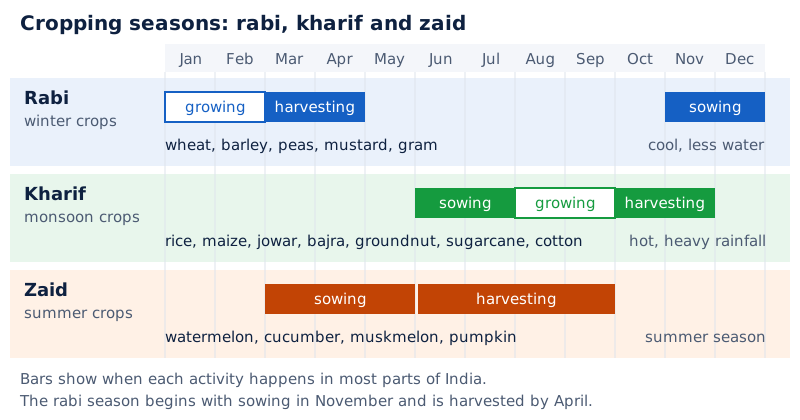
A January-to-December strip sits above separate rabi, kharif and zaid bands. Each band shows sowing and harvesting; the rabi and kharif bands also label growing periods. The calendar represents most parts of India.
Drawn by One Young India. See Fig. 1.5 in your NCERT textbook
Kharif crops depend on the timely arrival of monsoons. Excessive rain can also destroy crops and cause distress. Successful farming depends on the timing and quantity of water, as well as its availability.
How does soil form, and what are India's major soil types?
Soil is the thin upper layer of Earth's crust that supports plants. It provides nutrients, water and physical support. Rock breakdown and the decay of organic matter contribute to its formation. Organic matter is material from living or formerly living things.
Weathering breaks rocks and minerals into soil particles through physical, chemical or biological processes. Bedrock is the original rock from which new rocks and soils are derived. Humus is dark organic matter formed by decomposing plants and animals; it contains nutrients and retains moisture.
What the figure shows
Soil formation
Four panels show disintegrating bedrock, the addition of organic matter, the formation of layers and developed soil supporting vegetation. Labels include bedrock, parent material, top soil and humus. Parent material is the underlying material from which soil develops.
See Fig. 1.8 in your NCERT textbook
Soil forms over millions of years through rock breakdown and the decay of organic matter. A soil-development sequence can span a century to several millennia. Soil develops over long periods and needs careful protection.
How do the six soil types differ?
| Soil | Formation or main characteristics |
|---|---|
| Alluvial soil | Deposits carried by rivers from mountains and plateaus; rich in nutrients. |
| Black soil, also called cotton soil | Formed by weathering volcanic rocks; very fertile and holds a lot of moisture. |
| Red soil | Formed from slowly cooled lava or old rocks; iron reacting with air and water gives its reddish colour; not very fertile. |
| Laterite soil, also called brick earth | Formed by rain weathering rock; most minerals wash away, leaving largely iron and aluminium; not fertile and hardens in hot weather. |
| Desert or sandy soil | Mostly small sand grains mixed with a little water, air and organic matter. |
| Mountain or alpine soil | Freezing and melting ice weather rock; the soil is thin, rough and rocky. |
Silt consists of fine rock and mineral particles larger than clay but smaller than sand. Rivers easily carry these particles from mountains to plains. This movement helps explain the association between rivers and alluvial soils.
What the figure shows
Major soils of India
The map uses separate colours for alluvial, black, red, laterite, alpine and sandy soils. Arrows connect the regions to explanations of soil formation. Most regions have local variations.
See Fig. 1.9 in your NCERT textbook
Soil influences crop choice together with climate and water. Efficient irrigation can allow some crops to grow where the soil is not ideal for them. A broad soil category therefore does not mean every locality has identical farming conditions.
How do farmers maintain soil health?
Healthy soil is an ecosystem, a system in which living organisms and their surroundings interact. It contains bacteria, fungi, earthworms, insects, minerals, humus, water and air. Organisms break down organic material, improving the soil's ability to support healthy plants.
Soil conservation means managing soil to prevent its degradation and preserve productivity. Farmers need to maintain nutrients and protect the soil against erosion, meaning its removal by processes such as flowing rainwater. Several traditional practices continue to be useful.
| Practice | How it helps |
|---|---|
| Crop rotation | Different crops occupy the same field in different seasons, preventing the loss of particular nutrients. |
| Multiple cropping | Several crops grow in one field, reducing pest risk and helping ensure at least one crop; choices allow periodic harvests. |
| Contour ploughing | Ploughing follows the natural curves of a hillside to prevent erosion by rainwater. |
| Organic fertilisers | Materials such as cow dung replenish soil nutrients. |
| Terracing | Flat steps on hillsides slow water runoff and reduce erosion. |
| Afforestation | Planting trees helps prevent soil erosion. |
Fertilisers supply nutrients for plant growth. Precise application helps use them efficiently while maintaining soil health. Farmers also continue to return crop residue, the material remaining after harvest, to the soil by ploughing it back.
Panchagavya is a fermented mixture of cow dung, urine, milk, curd and ghee. Recent studies show that it acts as a biofertiliser, a biological preparation supporting soil fertility and plant growth, and increases crops' resistance to disease.
Plants and soil organisms support each other. Bacteria and fungi convert soil nutrients into forms plants can absorb. Plants supply energy through their roots to these organisms. Caring for soil therefore involves maintaining this living system as well as providing nutrients.
Field boundaries can serve several purposes. Banana trees planted on the raised boundaries, or bunds, of paddy fields act as windbreaks, hold soil in place and provide another crop. Protecting soil can thus be combined with growing additional produce.
How does rain-fed farming differ from irrigated agriculture?
Rain-fed agriculture relies entirely on rainfall. It is common where the monsoon supplies sufficient rain. However, drought and unpredictable monsoons create difficulties. Farmers respond by choosing drought-resistant crops or using traditional water-harvesting techniques to collect water.
Irrigated agriculture supplies water artificially. It can improve farm productivity and reduce dependence on monsoon rainfall. The development of irrigation has enabled cultivation in areas with low rainfall and helped increase crop yields, meaning the amount harvested, while making food supplies more stable.
Which traditional systems supply water?
India has built water structures since the Indus civilisation. Munsar Lake at Viramgam in Gujarat is an artificial lake constructed by Queen Minaldevi in the 11th century CE. Shrines and temples along its banks reflect the sacred importance attached to water bodies.
Kallanai, the grand anicut or water-diverting structure, was built by Karikāla across the Kaveri about 1,800 years ago. It irrigates thousands of hectares. A hectare is a unit of area equal to 10,000 square metres.
| Method | How water reaches crops |
|---|---|
| Phad system | A community-based system, particularly in Maharashtra, using small canals to divert river water to fields. |
| Bamboo drip irrigation | Bamboo pipes channel spring water to fields in parts of northeastern India. |
| Small farm ponds | Collect rainwater and provide moisture to soil for a longer period. |
| Modern drip irrigation | Tubes and small outlets deliver water slowly and directly to plant roots. |
| Sprinkler irrigation | Water is sprayed into the air and falls over crops like artificial rain. |
Why is efficient irrigation necessary?
Drip irrigation is also called trickle irrigation. Its targeted delivery minimises wasted water. Sprinklers offer another modern method of supplying water efficiently. Such methods matter because groundwater reserves are decreasing rapidly in many parts of India.
Photographs: Drip and sprinkler irrigation (NCERT Class 7 Figures 1.15 and 1.16). The first photograph shows drip irrigation delivering water efficiently to plants through dark tubes laid beside the rows. The second shows sprinklers spraying arcs of water over a wheat field.
Why are seeds and their preparation important?
Seed selection connects one harvest to the next planting season. Families have preserved seeds over generations, and communities have stored and shared them. In some areas, women bring seeds among the gifts taken to their marital homes.
Farmers carefully selected high-yielding seeds, meaning seeds that produce larger harvests, and preserved them for the next season. This practice combined the experience of growing a crop with decisions about what to plant afterwards.
How have farmers prepared seeds?
The Arthaśhāstra gives different preparations for different crops. Cotton seeds were smeared with cow dung. Cereals, beans and pulses were soaked in dew for a specified period and then dried in sunlight before planting.
The Indian Council for Agricultural Research (ICAR) has developed methods using beejamrit. This paste combines cow dung and urine with other materials and coats seeds before planting. It protects them from spoilage and reduces germination time, the time taken for seeds to begin sprouting.
The traditional Indian seed drill combined preparing the soil, planting the seed and closing the furrow in one operation. Bringing these tasks together reduced the labour required for what would otherwise have been three separate steps.
What changes when farmers buy seeds?
An increasing number of farmers buy seeds from companies. Scientific processes develop seeds with higher yields and resistance to pests, organisms that damage crops. These qualities can help farmers, but purchased seeds also raise a concern about future planting.
Often, the seeds later produced by these plants are unsuitable for planting in the next season. This has drawn criticism because it creates dependence on seed companies. The qualification matters: the problem must not be turned into a claim that every purchased seed behaves identically.
How do traditional farming systems combine crops, animals and land?
Traditional agriculture considers plants and the soil ecosystem as a complete system. The soil is the main source of nutrients, supplemented by farmyard manure, material from farm animals used to nourish the soil. Soil organisms help make nutrients available to plants.
Traditional methods typically operate on a small scale and depend on available resources and local environmental conditions. These systems are usually aligned with natural cycles, including the ṛitu chakra, or cycle of seasons, and often rely on families and domestic animals.
Farming combined crops and animals in ancient times. Animals including cattle, sheep and goats were domesticated from around 3500 BCE in the pre-urban phase of the Sindhu-Sarasvatī civilisation. Perpendicular furrows at Kalibangan provide evidence of intercropping around 2800 BCE, a practice that continued in the 1960s.
What are kulāgar and gokṛiṣhi?
Kulāgar is a homestead farming system, meaning cultivation around the family home. Its name combines the Konkani words for family and storehouse. Common in Goa's Konkan Plains, it uses a structured irrigation system for diverse crops.
Families grow food crops, crops for sale, fruits, vegetables, spices and medicinal plants. This variety places different kinds of useful plants within the same household farming system. Cultivation and irrigation are planned around the home.
Gokṛiṣhi combines the use of cows and bullocks in farming. Cows provide manure used as organic fertiliser, while bullocks plough fields. Animals contribute directly to both nourishing the soil and preparing land for crops.
How can inherited knowledge be examined?
ICAR has documented almost 5000 traditional practices and tested over a hundred. Over 85 per cent of the practices tested were validated by modern science and could help reduce chemical use and improve soil health. This is not a claim that all 5000 were tested.
Terrace farming is another example of adaptation to local conditions. Farmers cut flat steps into hillsides to conserve water and prevent erosion. The same practice appears among traditional methods and contemporary soil-conservation approaches, showing that these categories can overlap.
What were the consequences of the Green Revolution?
The Green Revolution was a major change in agriculture during the 1960s and 1970s. It brought high-yielding varieties of seeds, expanded irrigation, chemical fertilisers, pesticides and mechanised equipment. Pesticides are substances used to control organisms that damage crops.
High-yielding varieties (HYV) are crop varieties developed to produce larger harvests. Modern farms also adopted tractors, harvesters and other machinery to make farming work quicker and easier. M.S. Swaminathan was an architect of the Green Revolution and received the Bharat Ratna.
What improved?
Food-grain production increased significantly, particularly wheat and rice. India achieved self-sufficiency in food, meaning it could meet its food needs through its own production. Irrigation, seeds and machinery worked together within this agricultural change.
What limitations became visible?
Over subsequent decades, harmful effects included long-term loss of soil fertility, depletion of groundwater and contamination of soil and water by fertilisers and pesticides. Damage to human and animal health became another concern. Agricultural scientists increasingly question the sustainability of these methods.
Sustainability means being able to continue over the long term while protecting the resources farming depends on. Chemicals that dissolve and enter water sources cause pollution. They can also harm creatures such as bees, which are important for pollination, pollen transfer that helps plants reproduce.
| Approach | Strength | Limitation |
|---|---|---|
| Modern methods associated with the Green Revolution | High productivity and substantial food output in a short time. | Long-term damage to soil, water, ecosystems and health. |
| Traditional methods | Often more resilient and sustainable because they work with natural processes. | May produce lower yields. |
The comparison involves a trade-off, meaning a balance between benefits and disadvantages. The challenge is to meet food needs through innovation while adopting practices that preserve the environmental foundations of future farming.
How can farming become more sustainable?
Sustainable agriculture combines productive farming with practices that can last and protect the environment. Growing interest in this approach draws on Indian Knowledge Systems, the inherited knowledge and practices developed in India, alongside modern agricultural methods.
What does organic farming use?
Organic farming avoids chemical fertilisers and pesticides. It uses natural fertilisers such as compost, manure from animals and seed cake. Compost is decomposed organic material used to nourish soil. Seed cake is the residue left after oil is extracted from seeds.
Neem-based pesticides provide another example of inherited knowledge informing present practice. They are natural and much less harmful to the environment than chemical pesticides. “Much less harmful” does not mean that they should be described as completely harmless.
Sikkim is the world's first 100 per cent organic state. It adopted an organic farming model by banning chemical fertilisers and pesticides in 2014 and focusing on natural farming practices.
Which agricultural heritage systems are recognised?
The Food and Agriculture Organisation (FAO) has recognised three globally significant agricultural heritage systems in India. They combine particular crops and activities with the conditions of their regions.
- Kashmir: Saffron farming.
- Odisha: Traditional agriculture integrated with forest management.
- Kerala: Below-sea-level agriculture including crop cultivation and fishing.
Can plants grow without soil?
Hydroponics grows plants in nutrient-rich water solutions, with essential minerals supplied directly to the roots. It works in controlled environments and provides an option for urban farming and places with poor soil quality.
The broader task is to combine useful approaches. Efficient irrigation conserves water; soil care maintains fertility; suitable natural inputs reduce reliance on chemicals. Modern productivity and inherited practices can complement each other rather than being treated as completely separate choices.
How does government support farmers?
In many states, government support helps farmers obtain seeds, fertilisers and pesticides. It also provides weather forecasts, research and training in farming practices. These forms of assistance connect agricultural knowledge with the practical decisions farmers make.
How are costs and risks addressed?
Electricity for irrigation is supplied at lower prices to reduce input costs, the costs of resources used in farming. Access to financial assistance includes crop-insurance schemes such as the Pradhan Mantri Fasal Bima Yojana.
Crop insurance provides financial protection connected with crop losses. It is one element of support alongside cheaper irrigation electricity, supplies and information. Farmers face several kinds of difficulty, so assistance takes several forms.
How can farmers obtain better prices?
The government purchases important crops to help farmers market their produce and receive fair prices. Marketing means getting produce to buyers and selling it. Farming livelihoods depend on selling conditions as well as the amount harvested.
The promotion of cold storage, storage at low temperatures, and improved access to information and markets through digital technology help farmers obtain better prices. These measures connect the production of crops with the later task of finding buyers.
Information also reaches farmers through radio and television programmes. Weather information, research, training, supplies, financial support and market access address different parts of agricultural work. Together they show why public support extends beyond the act of sowing a crop.
Why do farmers face challenges, and what are their effects?
A landholding is the area of land a person owns. Landholdings shrink as land is divided among family members over generations. The average holding is approximately three-fourths of a hectare, about the size of an average football field.
How do small holdings affect income and machinery?
Small landholdings limit farmers' incomes. Tractors and other machines are often designed for larger farms and are expensive to buy or rent. However, machines for small farms have also been designed and invented recently. Small size creates difficulties without making mechanisation wholly impossible.
Families supplement crops with livestock, poultry, bees, fishing, forest produce and trees. Resilience means the ability to withstand difficulties; diversity helps build it. Nevertheless, these varied sources are proving inadequate today to provide farmers with a decent quality of life.
How does climate change increase risks?
Climate change involves changing climate patterns, including warming. Unpredictable weather, untimely rain and more frequent severe droughts or heavy rainfall increase the risk of crop destruction. Heavy losses can follow. This trend is likely to worsen as the planet becomes warmer.
Why is the Ganga basin under pressure?
A river basin is the area drained by a river and its tributaries. The Ganga basin's alluvial soils have supported people for millennia; today it provides food and water to over 500 million people. Yet the river is increasingly unable to replenish itself.
Contributing pressures include rapid melting of Himalayan glaciers, diversion of water for irrigation, large-scale groundwater pumping by agriculture and industry, and hundreds of dams interfering with natural flow. In summer, some parts have water levels too low for river boats.
If this condition persists, farming in the basin may become less and less sustainable, threatening livelihoods and food production. This is a conditional warning, rather than a statement that every farm in the basin has already become unsustainable.
Hardship has often led farmers to borrow and then struggle to repay. A debt trap is a situation in which repayment difficulties keep a borrower in debt. As many as 2,300 farmers a day, according to some estimates, have been compelled to leave agriculture.
Glossary
- Agriculture — Preparing soil, cultivating plants and raising livestock, often alongside growing trees and related activities.
- Intercropping — Growing two or more different crops simultaneously, as illustrated by sugarcane grown with pumpkin.
- Agroclimatic zone — A category combining climate, soils, terrain and vegetation to help plan suitable agricultural activities.
- Kharif — The monsoon cropping season, associated with crops such as rice, maize and groundnut.
- Rabi — The winter cropping season, associated with crops such as wheat, barley, peas and mustard.
- Zaid — The summer cropping season, associated with watermelon, cucumber, muskmelon and pumpkin cultivation.
- Humus — Dark organic matter formed from decomposed plants and animals, providing nutrients and retaining soil moisture.
- Weathering — The breakdown of rocks and minerals into soil particles through physical, chemical or biological processes.
- Crop rotation — Growing different crops in the same field in different seasons to prevent loss of particular nutrients.
- Rain-fed agriculture — Farming that relies entirely on rainfall and is vulnerable to drought and unpredictable monsoons.
- Drip irrigation — Supplying water slowly and directly to plant roots through a network of tubes and outlets.
- Organic farming — Farming that avoids chemical fertilisers and pesticides, using natural sources of nutrients instead.
- Hydroponics — Growing plants in nutrient-rich water solutions, with essential minerals supplied directly to their roots.
- Landholding — An area of land owned by a person, which may shrink through division among family members.
- Debt trap — A situation in which difficulty repaying borrowed money keeps a borrower caught in debt.
Common errors and misconceptions
- Misconception: Ancient rice grains prove systematic rice farming had already developed. Correct: Some experts argue that the grains need not establish this; mastering systematic cultivation may have taken a few more millennia.
- Misconception: Agriculture means growing crops alone. Correct: It also involves livestock, trees and related activities such as fish rearing and beekeeping.
- Misconception: More monsoon rain necessarily benefits crops. Correct: Timely rain is important, while excessive rainfall can destroy crops and cause distress.
- Misconception: Crop rotation and intercropping mean the same thing. Correct: Rotation changes crops between seasons; intercropping grows different crops simultaneously.
- Misconception: Every company-bought seed produces seeds that cannot be replanted. Correct: Seeds produced by these plants are often unsuitable for the next season; this qualification must be retained.
- Misconception: ICAR scientifically validated almost 5000 practices. Correct: It documented almost 5000, tested over a hundred, and validated over 85 per cent of those tested.
- Misconception: The Green Revolution brought benefits without lasting costs. Correct: It increased food production but also caused long-term problems involving soil, water, ecosystems and health.
- Misconception: Traditional farming necessarily produces higher yields than modern farming. Correct: Traditional methods are often more resilient and sustainable, but they may produce lower yields.
Exam-style questions with model answers
Q1. Evidence card: rice grains occur in the Ganga Plain as early as the 7th or 8th millennium BCE. Some experts say systematic cultivation may have taken a few more millennia. State the evidence and one caution about interpreting it. [2 marks]
- Rice grains provide evidence of rice in the Ganga Plain as early as the 7th or 8th millennium BCE.
- The grains need not prove systematic cultivation; some experts suggest that mastering it may have taken a few more millennia.
Q2. Use these facts: kharif is the monsoon season and includes rice; rabi is the winter season and includes wheat; zaid is the summer season and includes watermelon. Identify each season with its example and explain what the three-season pattern provides. [3 marks]
- Kharif is the monsoon cropping season. Rice is the supplied example of a crop associated with this part of the annual farming cycle.
- Rabi is the winter cropping season. Wheat is its supplied example, showing that the cropping cycle continues beyond the monsoon period.
- Zaid is the summer cropping season, with watermelon as the supplied example. Together, the three seasons provide different agricultural products across the year.
Q3. Four soil-care practices are described: changing crops between seasons prevents loss of particular nutrients; following a hillside's curves reduces rainwater erosion; flat hillside steps slow runoff; planting trees reduces erosion. These are crop rotation, contour ploughing, terracing and afforestation. Match each method to its benefit. [4 marks]
- Crop rotation changes the crops grown in a field between seasons. It helps prevent the soil from losing particular nutrients.
- Contour ploughing follows the natural curves of a hillside. It helps protect the soil from erosion caused by rainwater.
- Terracing creates flat steps on hillsides. These steps slow water runoff and reduce the amount of soil carried away.
- Afforestation means planting trees. It provides another method of protecting soil against erosion and maintaining the land used for cultivation.
Q4. Compare these five water arrangements using only the information given: rain-fed farming depends entirely on rain; Maharashtra's community phad systems divert river water through small canals; northeastern bamboo systems channel spring water; drip tubes supply water slowly to roots; sprinklers spray water that falls like rain. [5 marks]
- Rain-fed farming depends entirely on rainfall. Its stated water source is rain, so it differs from the arrangements that artificially carry or distribute water to crops.
- Phad irrigation is a community-based system particularly found in Maharashtra. Small canals divert river water into fields, linking a shared arrangement with an artificial supply.
- Bamboo irrigation in parts of northeastern India uses bamboo pipes. These channel spring water towards fields, using a different water source and material from the phad example.
- Modern drip irrigation uses tubes to deliver water slowly to plant roots. Its distinguishing feature is the targeted position and slow delivery of the water.
- Sprinkler irrigation sprays water into the air above crops. The water then falls like rain, unlike the direct root-level delivery described for drip irrigation.
Q5. A Green Revolution evidence card lists five facts: high-yielding seeds were introduced; irrigation increased; chemical fertilisers and pesticides were used; machinery made work faster; wheat and rice production rose and India achieved food self-sufficiency. Explain these five changes. [5 marks]
- High-yielding seeds were introduced as part of the change in farming. These varieties were intended to produce larger harvests and formed one part of the new methods.
- Irrigation expanded, increasing the artificial supply of water to crops. This was another element of the agricultural changes listed in the evidence card.
- Chemical fertilisers and pesticides became part of the methods used. Fertilisers supplied nutrients, while pesticides were used to control organisms that damaged crops.
- Mechanised equipment made farm work faster. The use of machinery changed how agricultural tasks were performed alongside the changes in seeds, water and chemicals.
- Food-grain production increased significantly, particularly wheat and rice. India achieved food self-sufficiency, meaning that its own food production could meet the country's food needs.
Q6. Use this information to explain four benefits and limitations: modern methods produce substantial food quickly but can damage soil and water; traditional methods are often more resilient and sustainable but may yield less. [4 marks]
- Modern methods have the benefit of high productivity. They can supply a substantial quantity of food within a short period.
- Modern methods also have environmental limitations. Damage to soil and water threatens the resources on which later agricultural production depends.
- Traditional methods are often more resilient and sustainable. These are qualified strengths, so they should not be described as universal guarantees.
- Traditional methods may produce lower yields. A balanced approach seeks useful modern productivity together with practices that protect farming's natural foundations.
Q7. Information card: government support includes cheaper electricity for irrigation, weather information and training, and purchases of important crops to help ensure fair prices. Explain these three forms of help. [3 marks]
- Cheaper electricity for irrigation reduces input costs. It lowers a cost connected with supplying water to crops and carrying out agricultural production.
- Weather information and training provide farmers with useful knowledge. The support connects forecasts and research on farming practices with decisions made during cultivation.
- Purchases of important crops help farmers market their produce and receive fair prices. This support addresses selling conditions as well as agricultural production.
Q8. A farmer's discussion identifies six problems: land is divided between generations; small farms earn limited income; machinery designed for larger farms is expensive; weather is increasingly unpredictable; extreme drought or rain can destroy crops; hardship loans can be difficult to repay. Explain six corresponding challenges. [6 marks]
- Division of land among family members across generations reduces the size of individual holdings. This creates the problem of shrinking areas available to each farmer.
- Small holdings limit the income farmers can earn from cultivation. The difficulty concerns livelihoods as well as the physical size of the land.
- Machinery is difficult to afford when buying or renting it is expensive. Equipment designed for large farms can also be unsuitable for small holdings.
- Increasingly unpredictable weather makes farming more uncertain. Farmers face changing conditions rather than being able to depend on a regular pattern of weather.
- Severe drought or heavy rainfall can destroy crops. Such destruction can cause heavy losses and place further pressure on a farming household.
- Loans taken during hardship may be difficult to repay. Repayment difficulties can trap farmers in debt, adding a financial challenge to production problems.
Key takeaways
- Agriculture includes crops, livestock, trees and allied activities, supporting food supplies and a large share of working people's livelihoods.
- Archaeological remains and written texts reveal early farming, but ancient rice grains need not establish that cultivation was already systematic.
- Climate, soils, terrain and water influence crop choices, while kharif, rabi and zaid organise much of the annual cropping rhythm.
- Soil is a living system; conserving nutrients and preventing erosion support healthy crops and future farming.
- Irrigation reduces dependence on rainfall, while drip and sprinkler methods help use increasingly pressured water resources efficiently.
- Traditional seed preservation continues alongside purchased seeds, which can create dependence when their offspring are unsuitable for replanting.
- The Green Revolution increased food production and achieved food self-sufficiency, alongside long-term environmental and health problems.
- Sustainable farming combines useful innovations with soil care, efficient irrigation and traditional knowledge while addressing farmers' economic difficulties.
Test yourself
What is the difference between intercropping and crop rotation?
Intercropping grows different crops simultaneously. Crop rotation grows different crops in the same field in different seasons to prevent loss of particular nutrients.
What do agroclimatic zones combine?
They combine climate factors, soil types, terrain and vegetation to help plan suitable agricultural activities.
Which months are associated with the southwest and northeast monsoons?
The southwest monsoon brings rain from June to September. The northeast monsoon prevails from October to December.
Why is humus useful to soil?
Humus contains nutrients and retains moisture. It forms through the decomposition of plant and animal matter.
What tasks did the Indian seed drill combine?
It combined soil preparation, seed planting and closing the furrow in one operation, reducing labour.
What do cows and bullocks contribute in gokṛiṣhi?
Cows provide manure used as organic fertiliser, while bullocks are used to plough the fields.
What does hydroponics supply directly to plant roots?
Hydroponics supplies essential minerals through nutrient-rich water solutions in a controlled growing environment.
What qualification belongs with the estimate of farmers leaving agriculture?
The figure is as many as 2,300 every day, according to some estimates. It must not be presented as an exact count.
Write about it
Turn a question from this chapter into a paper.
The Writing Studio has a structure guide, a rubric and citation tools for 15 formats, from essays to research papers. Drafting is free with an account. Learnacy Essential adds feedback from an AI writing coach and submission to The OYI Review.
Learnacy Essential is ₹1,499 for the year. Publication depends on review and is not guaranteed.