
The Three Orders | CBSE Class 11 History Notes
On this page
Watch & explore
Start with a few high-quality watches, then dive into the notes below.

This note covers feudal society in western Europe, the clergy, nobility and peasantry, manorial life, agricultural change, the growth of towns, the fourteenth-century crisis, peasant resistance and the rise of powerful monarchies.
What was the background to feudalism in western Europe?
After the Roman Empire collapsed, Germanic peoples occupied parts of Italy, Spain and France. Frequent warfare and the absence of a unifying political authority made protection essential. Control of land became the basis of social organisation, drawing on Roman traditions and German customs.
Christianity survived Rome's collapse and spread into central and northern Europe. The Church accumulated land and political influence. European society between the ninth and sixteenth centuries developed through changing relationships between priests, landowning nobles and peasants.
What did feudalism involve?
Definition: Feudalism describes the economic, legal, political and social relationships of medieval Europe. Its agricultural basis was the relationship between lords and peasants, combining cultivation and labour services with military protection and the lord's judicial authority.
Peasants cultivated their holdings and the lord's land. Lords received labour services and provided military protection. Their powers also extended to justice. Thus, feudalism concerned authority and social relationships as well as the organisation of agricultural production.
Its roots lay in earlier practices, including those of the Roman Empire and the age of Charlemagne, who lived from 742 to 814. It may be said to have emerged as an established way of life in large parts of Europe in the eleventh century.
Why were France and England connected?
The Franks gave their name to France, formerly the Roman province of Gaul. In 800, the Pope crowned Charlemagne Holy Roman Emperor, strengthening the connection between monarchy and Church. In 1066, the Norman conquest carried French connections into England.
William I distributed mapped land among 180 Norman nobles, who owed military assistance and knights to the king. These lords granted land to knights in turn. Private warfare by their knights was forbidden in England, while Anglo-Saxon peasants became tenants under different landholders.
How do sources and historians reveal medieval social life?
Medieval history can be reconstructed from much more than accounts of rulers and wars. Documents recording landownership, prices and legal disputes reveal relationships between people and resources. Church records of births, marriages and deaths help historians study families and changes in population.
Inscriptions in churches provide evidence about traders' associations. Songs and stories illuminate festivals, community activities and ideals of behaviour. Together, these materials make it possible to investigate both slow developments, such as population growth, and sudden events, such as peasant revolts.
What did Marc Bloch contribute?
Marc Bloch, who lived from 1886 to 1944, helped broaden history beyond political events, international relations and prominent individuals. He emphasised geography and the collective attitudes and behaviour of groups. His work examined how society functioned across a long period.
Bloch's Feudal Society studies European society, especially France, between 900 and 1300. It considers social hierarchies, land management and popular culture. This approach connects the experiences of ordinary people with institutions and economic arrangements.
What can individual accounts show?
| Source | Evidence it provides |
|---|---|
| Abbot Suger, 1081 to 1151 | His account of St Denis describes church enlargement, costly windows and arrangements for their maintenance. |
| Langland's Piers Plowman, about 1360 to 1370 | It contrasts the comfort of some monks with the faith of ordinary labouring people. |
| Giovanni Boccaccio, 1313 to 1375 | His account describes mass deaths, unattended illness and burial difficulties during the plague. |
These sources address different aspects of society: patronage, criticism of religious life and the experience of epidemic disease. Their variety complements records of land and population, allowing social and cultural life to be studied alongside economic change.
How did the three social groups differ in work and status?
The idea of three orders classified people by their supposed social function. Priests prayed, nobles fought and peasants worked. French priests presented this division as the proper arrangement of society, with the clergy placed first and the nobility second.
The clergy: those who prayed
The clergy guided religious life through churches, sermons and ceremonies. Bishops held extensive estates and lived in grand residences. Religious authority therefore existed alongside material wealth and political power, rather than being separated from landholding.
The nobility: those who fought
The nobility held a central position because it controlled land. Nobles raised troops, administered justice and received peasant labour. Their military role supported their privileges, while their estates supplied the resources necessary for their households and armed followers.
The peasantry: those who worked
The peasantry formed the great majority and sustained the other orders through cultivation and services. Peasants were not one uniform group: free tenants and serfs faced different restrictions. Women and children also contributed through agricultural and household production.
Note: The three orders were an unequal social classification, not three equally powerful groups. Priests ranked themselves first, but noble control of land gave the second order a central practical role.
In the twelfth century, Hildegard of Bingen defended distinctions between human beings as part of a divinely ordered hierarchy. Such views helped justify inequality. Yet environmental change, agricultural innovation, expanding trade and peasant resistance gradually transformed relationships that privileged groups regarded as stable.
How did nobles, manors and knights sustain feudal power?
What was vassalage?
Vassalage joined a lord and a dependent through mutual promises. The lord offered protection, and the vassal promised loyalty. Nobles acknowledged the king as their superior. Ceremonies involved vows on the Bible and symbolic grants represented by a charter, staff or clod of earth.
A noble could hold property permanently, raise feudal levies, maintain courts and even issue money. His authority extended over the people on his land. Peasants cultivated his private fields and could be required to fight as foot-soldiers.
How did a manorial estate work?
The manorial estate combined the lord's residence with villages, fields, pastures, woods and service facilities. Grain came from its fields. Blacksmiths and carpenters maintained equipment, stonemasons repaired buildings, women spun and wove, and children worked in wine-presses.
Woodlands provided hunting grounds, while pastures supported cattle and horses. A church served religious needs, and a castle provided defence. From the thirteenth century, some castles expanded into family residences. In England, castles also became centres of military power and political administration.
What the figure shows
A manorial estate in England
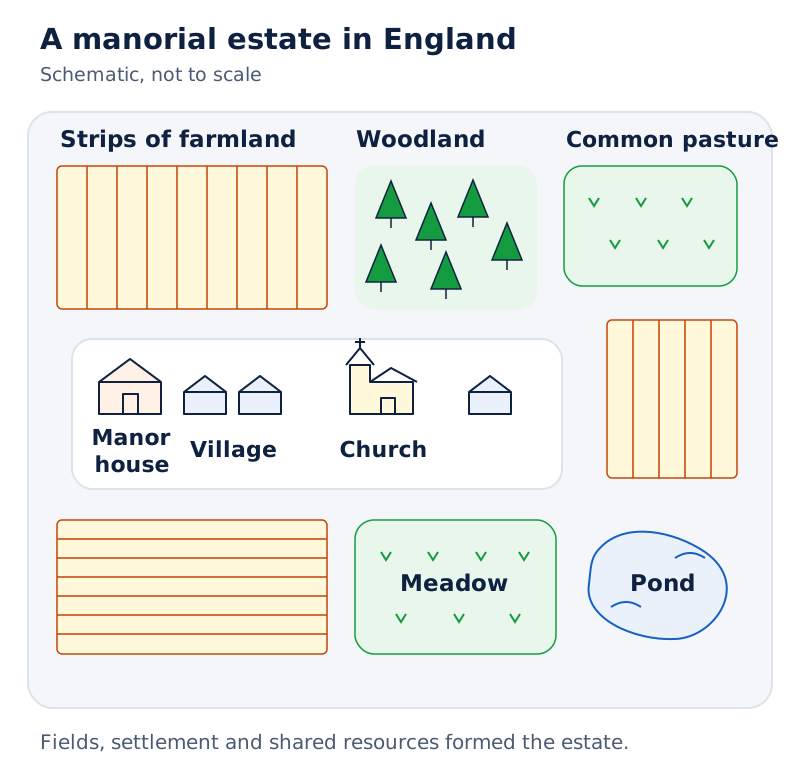
The plan shows long strips of farmland around a cluster of buildings. Labels identify the manor house, church, common pasture, pond and meadow; wooded areas appear around parts of the estate.
Drawn by One Young India. Reference: NCERT Class 11, unnumbered illustration, p. 90
A manor was not completely self-sufficient. Salt, millstones and metalware came from outside. Lords seeking luxury also obtained furnishings, musical instruments and ornaments from elsewhere. Local production therefore coexisted with dependence on supplies beyond the estate.
Why did knights become important?
Frequent local wars from the ninth century increased demand for effective cavalry because amateur peasant-soldiers were insufficient. A lord granted a knight an inheritable fief and protection. In exchange, the knight paid a regular fee and promised military service.
A fief could cover 1,000 to 2,000 acres or more, with a residence, church, watermill and wine-press. Peasants cultivated its land. Knights practised fencing and tactics daily. Although a knight could serve several lords, his primary loyalty remained with his own lord.
From the twelfth century, travelling minstrels entertained French noble households with stories of kings and knights. These combined historical and invented material. Their popularity reflected a society in which reading was limited and manuscripts were scarce.
How did the Church and monasteries shape everyday life?
The Catholic Church had its own laws, land and powers of taxation. The Pope headed the western Church from Rome, while bishops and clerics guided Christians locally. Village churches brought people together for Sunday worship and sermons.
The Church collected a tithe, a tenth of peasants' annual produce. Wealthy donors also gave endowments for their own welfare and that of deceased relatives in the afterlife. Bishops' extensive estates made them comparable in material standing to great landowning nobles.
Who could enter religious life?
Priesthood was closed to women, serfs and people with physical disabilities, and priests could not marry. Monastic life, however, admitted both men and women; except in a few cases, all abbeys were separate communities for men or women. Men became monks and women became nuns, also remaining unmarried.
Monasteries were communities devoted to prayer, study and manual labour, often located away from settlements. Important foundations included St Benedict's in Italy in 529 and Cluny in Burgundy in 910. Communities could grow into large institutions with estates, schools and hospitals.
Benedictine rules stressed obedience, restricted speech and prohibited private property. They organised time for work and sacred reading, and required necessities within the monastery. Religious communities also developed the arts: Hildegard contributed to music and communal singing.
What the figure shows
A Benedictine monk at work
A seated monk works at a sloping desk with an open manuscript. Other books appear on surrounding shelves and stands. The scene illustrates the place of manuscript work in religious life.
Reference: NCERT Class 11, unnumbered woodcut, p. 93
From the thirteenth century, friars travelled to preach and lived on charity instead of remaining in a monastery. By the fourteenth century, writers criticised the luxury of some monks, questioning whether their conduct matched religious ideals.
How did Christianity interact with older customs?
Older beliefs in magic and folk traditions continued alongside Christianity. Christmas and Easter took the place of earlier festivals. Village tours of communal lands continued, but the village was now described as a parish, an area supervised by a priest.
Holy days gave overworked peasants time away from labour. Although intended for prayer, they also involved feasting and enjoyment. Pilgrimage encouraged journeys to saints' shrines and major churches. Religious and secular life shared customs, including kneeling and vows of loyalty.
How did free peasants and serfs compare?
Both free peasants and serfs sustained landed society, but freedom did not mean exemption from burdens. Free peasants held farms as tenants. Men owed at least forty days of military service each year, while families worked regularly on the lord's estate.
Such work usually occupied three days a week, often more. Its output went directly to the lord as labour-rent. Further unpaid tasks included digging ditches, gathering firewood, repairing roads and buildings, and making fences.
| Aspect | Free peasants | Serfs |
|---|---|---|
| Access to land | Held farms as the lord's tenants. | Cultivated plots belonging to the lord. |
| Obligations | Provided labour-rent, military service and other unpaid work. | Surrendered much produce and worked on the lord's private land without wages. |
| Movement | Belonged to the free category of cultivators. | Needed the lord's permission to leave the estate. |
| Personal restrictions | Freedom coexisted with substantial service obligations. | The lord could control marriage or approve a choice for a fee. |
| Processing produce | Performed agricultural and household services for the estate. | Had to use the lord's mill, oven and wine-presses. |
Women and children helped in fields and made thread, cloth, candles and wine for the lord. The taille was a direct tax sometimes imposed by kings on peasants; clergy and nobles were exempt. It differed from the tithe owed to the Church.
Peasants resisted excessive demands through everyday actions. They devoted more time to their own plots, retained produce and avoided additional unpaid work. They also disputed control of forests and pastures, regarding them as communal resources while lords treated them as private property.
Why did agricultural production and rural relationships change?
How did climate and older methods affect farming?
Between the fifth and tenth centuries, most of Europe was covered with vast forests, and Europe experienced intense cold. Long winters shortened the growing season and reduced yields. Forests limited cultivation but also offered refuge to peasants escaping oppressive conditions.
From the eleventh century, warmer conditions extended the growing season and made less-frozen soil easier to plough. Retreating forests allowed cultivation to expand. Environmental change thus created opportunities, but improvements in tools and cultivation were also essential.
Earlier wooden ploughs scratched the soil rather than turning it deeply. Cultivators had to supplement them with strenuous digging. Under the two-field system, half the land remained fallow. Poor productivity and deteriorating soil contributed to chronic malnutrition and periodic famine.
What changed in technology and land use?
| Improvement | Effect on production |
|---|---|
| Iron-tipped ploughs and mould-boards | Deeper digging and better turning of topsoil improved the use of soil nutrients. |
| Shoulder-harness | Animals could apply greater power than with the older neck-harness. |
| Iron horseshoes | Better protection helped prevent decay of horses' feet. |
| Watermills and windmills | Water and wind supplied energy for tasks such as milling grain and pressing grapes. |
| Three-field rotation | Autumn crops, spring crops and fallow land rotated, allowing two fields to produce in each year. |
In the three-field system, one field carried autumn wheat or rye. Another carried spring peas, beans and lentils for people, and oats and barley for horses. The third rested. Uses rotated annually, allowing a field to produce in two years out of three.
Food availability increased greatly, and peas and beans improved vegetable protein intake and animal fodder. By the thirteenth century, average peasant holdings had shrunk from about 100 acres to 20 to 30 acres. Smaller holdings required less labour and could be cultivated more efficiently.
Who financed change, and how did money alter obligations?
Lords financed costly mills, while peasants extended cultivation, adopted crop rotation and established small village forges. Innovation therefore involved both groups. Locally made and repaired iron tools helped cultivators obtain equipment more cheaply.
The growing money economy weakened personal service relationships. Lords increasingly preferred cash rents, and peasants sold crops to traders. Prices became sensitive to harvest conditions: in England, agricultural prices doubled between the 1270s and the 1320s.
How did townspeople emerge as a possible fourth order?
Agricultural expansion supported growth in population, trade and towns. Europe's population rose from about 42 million in 1000 to 62 million around 1200 and 73 million in 1300. Better food supported longer lives, although women and girls generally lived less long because men ate better.
Why did towns grow?
Peasants with surplus grain needed markets where they could sell produce and buy tools and cloth. Periodic fairs and trading centres grew into towns. Other towns developed around castles, bishops' estates and large churches.
Town residents paid taxes to the lord who owned the site instead of providing services. Towns offered paid employment and an escape from rural dependence. A runaway serf who remained undiscovered for one year and one day could become free.
The urban population included free peasants, escaped serfs, unskilled workers, merchants and shopkeepers. Later, bankers and lawyers supplied specialised services. Because these livelihoods extended beyond the earlier threefold division, townspeople could be described as a possible fourth order.
How were crafts and trade organised?
A guild organised each craft or industry and controlled product quality, prices and sale. Guild heads met in the guild-hall, which also hosted ceremonies. Guards, musicians and innkeepers contributed to urban life alongside producers and traders.
Trade routes with West Asia developed from the eleventh century. Scandinavian merchants exchanged furs and hunting-hawks for cloth, while English traders sold tin. Craftsmen increasingly settled in towns, and successful merchants gained wealth that rivalled noble power.
What the figure shows
Reims as a cathedral-town
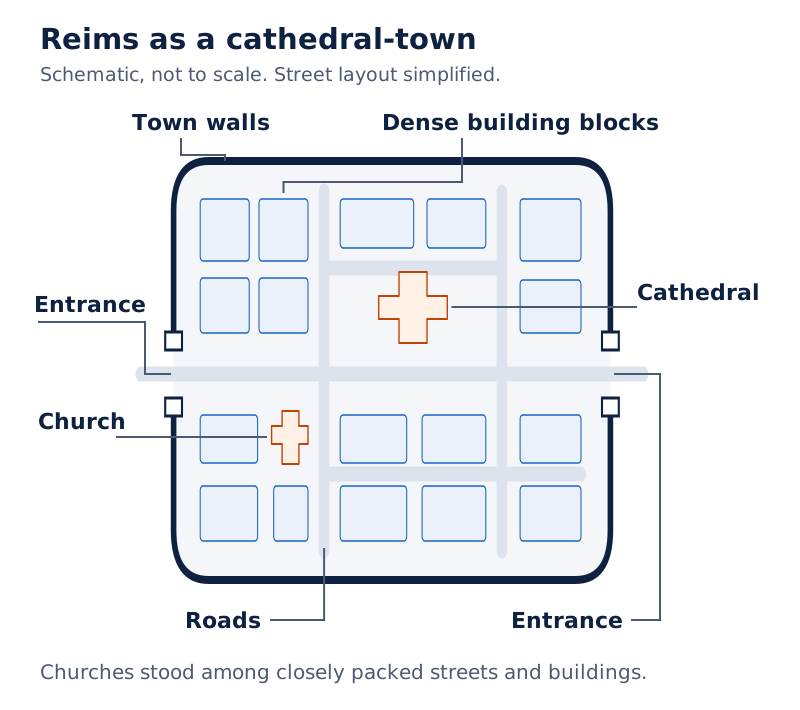
The seventeenth-century view shows a dense settlement enclosed by walls, with entrances, roads, building blocks and prominent church buildings. It presents an urban setting rather than dispersed agricultural strips.
Drawn by One Young India. Reference: NCERT Class 11, unnumbered map, p. 99
What role did cathedrals play?
From the twelfth century, large stone cathedrals were built in France with contributions of labour, materials and money. Construction attracted settlement, and completed churches drew pilgrims. Their acoustics carried sermons and singing; stained-glass windows conveyed biblical stories through pictures.
What caused the crisis of the fourteenth century?
Europe's earlier expansion slowed as environmental pressures, problems with currency and epidemic disease converged. These were connected stresses: agriculture supported the population, trade linked distant places, and both rural and urban societies were vulnerable when production and human survival were disrupted.
How did climate and resources create hardship?
By the end of the thirteenth century, northern Europe's warmer summers gave way to colder ones. Growing seasons shortened, and cultivation at higher elevations became difficult. Storms and coastal flooding destroyed farms, reducing both production and government tax income.
Intensive ploughing exhausted soil because expanded cultivation was not matched by adequate conservation. Pasture clearance reduced cattle numbers. Population growth pressed against limited resources, contributing to severe famines from 1315 to 1317. Large numbers of cattle died in the 1320s.
Why did trade and money become vulnerable?
Silver mines in Austria and Serbia produced less, causing a shortage of metal currency. Governments responded by lowering the silver content of coins and mixing in cheaper metals. This currency shortage disrupted trade alongside difficulties in agricultural production.
What was the impact of the Black Death?
Trade ships also carried rats associated with the spread of bubonic plague. The Black Death struck western Europe between 1347 and 1350. About 20 per cent of Europe's population died in this epidemic, with losses reaching 40 per cent in some places.
Trading cities were particularly badly affected. Infection spread rapidly in enclosed communities such as monasteries and convents. Infants, young people and the elderly suffered heavily. Further plague episodes occurred during the 1360s and 1370s.
Europe's population fell from 73 million in 1300 to 45 million in 1400. This wider decline should be distinguished from the estimated mortality of the initial epidemic. The crisis disrupted production, family life and the balance between available labour and demand for workers.
What were the consequences for labour, lords and peasant resistance?
Depopulation produced a serious labour shortage. Too few people remained to sustain agriculture and manufacture equally. With fewer consumers, agricultural prices fell, while demand for workers allowed surviving labourers to seek higher wages.
Lords faced pressure from both directions: produce brought lower returns and hired labour became more expensive. Many attempted to abandon cash agreements and restore compulsory labour services. Peasants resisted efforts to take away gains achieved during earlier economic expansion.
How did rural unrest develop?
| Year | Region | Event |
|---|---|---|
| 1323 | Flanders | Peasant revolt. |
| 1358 | France | Peasant revolt. |
| 1381 | England | Peasant revolt. |
The revolt in Flanders in 1323 occurred before the epidemic of 1347 to 1350. Rural unrest therefore belongs to the wider history of social tensions, rather than being explained entirely as a consequence of plague. Later resistance intensified as lords tried to restore older demands.
Better-educated and more prosperous peasants were especially active in opposition. Rebellions were strongest in areas that had enjoyed earlier prosperity, indicating that peasants were defending improvements already won. They were not simply responding as an undifferentiated mass of poor cultivators.
Although authorities crushed the revolts, the money economy was too developed for a full return to earlier relations. The intensity of resistance helped prevent the restoration of old feudal privileges. Military defeat of rebels did not mean that lords could successfully reverse economic and social change.
How did new monarchies change political power?
During the fifteenth and sixteenth centuries, rulers strengthened their finances, armies and administration. Louis XI in France, Maximilian in Austria, Henry VII in England, and Isabelle and Ferdinand in Spain are associated with these changes. Their power expanded as older lord-vassal relationships weakened.
How did kings centralise authority?
- Rulers organised standing armies and professionally trained infantry under their direct command.
- Guns and siege artillery reduced the effectiveness of aristocratic military resistance.
- Higher taxation financed larger armies, frontier defence and campaigns against internal opponents.
- Permanent administrative offices strengthened royal government, while patronage secured cooperation from influential people.
Centralisation met opposition, especially over taxation. Louis XI, who ruled from 1461 to 1483, struggled against dukes and princes. English rebellions were suppressed in 1497, 1536, 1547, 1549 and 1553. Stronger monarchy therefore developed through conflict as well as institutional change.
What changed for nobles and wealthy townspeople?
Nobles adapted by becoming loyal supporters and accepting permanent administrative positions. Their continued influence explains why royal absolutism can be described as a modified form of feudalism. The dominant class survived, although its relationship with the ruler changed.
Personal dependence gave way to an elaborate court and networks of patronage. Merchants and bankers could gain access through money, including loans used to pay soldiers. Royal government thus incorporated influential people whose power did not rest on feudal landholding.
How did France and England take different paths?
| France | England |
|---|---|
| The Estates-General represented clergy, nobility and the remaining population in three houses. | Parliament developed from the Great Council, which kings consulted over taxation. |
| After its meeting in 1614, the Estates-General was not summoned again until 1789. | The House of Lords represented lords and clergy, while the Commons represented towns and rural areas. |
| Kings resisted sharing authority with the three orders. | Charles I ruled without Parliament from 1629 to 1640, then called it because he needed money. |
A section of the English Parliament fought Charles I, who was later executed, and a republic followed. The republic was brief. When monarchy returned, it did so on the condition that Parliament would meet regularly, limiting the possibility of rule without consultation.
What timeline connects the major changes in medieval Europe?
The timeline links changes in political authority, religious institutions, population and social conflict. Early Frankish developments help explain the relationship between kings and Christianity. Later entries show economic expansion, crisis, resistance and the growth of stronger monarchies.
| Date | Development |
|---|---|
| 481 | Clovis became king of the Franks. |
| 496 | Clovis and the Franks converted to Christianity. |
| 529 | St Benedict established a monastery in Italy. |
| 800 | Pope Leo III crowned Charlemagne Holy Roman Emperor. |
| 910 | The monastery of Cluny was established in Burgundy. |
| 1000 | Europe's population was approximately 42 million. |
| 1066 | The Normans defeated the Anglo-Saxons and conquered England. |
| 1100 onwards | Cathedral construction developed in France. |
| 1200 | Europe's population was approximately 62 million. |
| 1300 | Europe's population reached approximately 73 million. |
| 1315 to 1317 | Severe famines struck Europe. |
| 1323 | Peasants revolted in Flanders. |
| 1347 to 1350 | The Black Death struck western Europe. |
| 1358 | Peasants revolted in France. |
| 1381 | Peasants revolted in England. |
| 1400 | Europe's population had fallen to approximately 45 million. |
| 1461 to 1483 | Louis XI ruled France and struggled against powerful nobles. |
| 1485 to 1547 | Period associated with the new monarchs in England. |
| 1614 | The French Estates-General met during Louis XIII's reign. |
| 1629 to 1640 | Charles I governed without calling Parliament. |
| 1789 | The Estates-General met again after its long absence. |
Read these dates as evidence of changing relationships rather than as isolated events. Rising population accompanied agricultural expansion, whereas famine and disease disrupted that growth. Peasant opposition limited the restoration of older obligations, while monarchs used taxation, armed force and patronage to enlarge their authority.
Glossary
- Feudalism — A system of economic, legal, political and social relationships centred on land, lordship, services and protection in medieval Europe.
- Order — A social category defined by an assigned function, such as praying, fighting or working in medieval society.
- Clergy — Religious officials, including bishops and priests, who guided Christian worship and constituted the first order.
- Vassalage — A relationship involving a lord's promise of protection and a dependent's promise of loyalty, formalised through ceremonies.
- Manorial estate — A lord's landed estate containing his residence, peasant settlements, fields, pastures and facilities supporting daily life.
- Fief — An inheritable grant of land given to a knight, who owed payments and military service to his lord.
- Tithe — The Church's entitlement to a tenth of the produce peasants obtained from their land during the year.
- Taille — A direct tax sometimes imposed by kings on peasants, from which clergy and nobles were exempt.
- Labour-rent — Work performed on the lord's estate whose output went directly to the lord rather than to the peasant household.
- Serf — An unfree cultivator working land belonging to a lord, owing produce and labour and requiring permission to leave.
- Friar — A religious man who travelled to preach and lived on charity instead of remaining in a monastery.
- Guild — An association organising a craft or industry and controlling the quality, price and sale of its products.
- Fallow — Land left uncultivated for a period as part of the rotation of agricultural fields.
- Parish — An area supervised by a priest, linking a local community with its church and religious observances.
- Patronage — The granting of support and positions through which rulers secured cooperation from people able to exercise influence.
Common errors and misconceptions
- Misconception: The three orders had equal power. Correct: They formed an unequal hierarchy; clergy and nobles enjoyed privileges supported by peasant production.
- Misconception: Every peasant was a serf. Correct: Cultivators included free tenants and serfs, whose restrictions and relationships with lords differed.
- Misconception: Manors produced everything they needed. Correct: Salt, millstones, metalware and desired luxury goods had to come from outside.
- Misconception: Tithe and taille were the same payment. Correct: Tithe was a share of produce owed to the Church; taille was a royal direct tax on peasants.
- Misconception: Women could become neither priests nor members of religious communities. Correct: Priesthood excluded women, but women could become nuns in monasteries.
- Misconception: All fourteenth-century peasant revolts followed the Black Death. Correct: The Flanders revolt occurred in 1323, before the epidemic of 1347 to 1350.
- Misconception: Crushing peasant revolts fully restored old feudal relations. Correct: Resistance and the advanced money economy prevented a complete return to earlier privileges.
- Misconception: Stronger kings completely removed nobles from politics. Correct: Many nobles survived politically by entering royal service and becoming supporters of the new regimes.
Exam-style questions with model answers
Q1. A peasant gives a tenth of annual produce to the Church. A king sometimes imposes a separate direct tax on peasants, exempting clergy and nobles. The first payment is called tithe and the second taille. Distinguish the two payments by recipient and basis. [2 marks]
- Tithe went to the Church and consisted of one-tenth of annual agricultural produce.
- Taille was a direct royal tax imposed on peasants; clergy and nobles were exempt.
Q2. A manor grows grain, maintains tools through resident craftsmen and produces cloth, but obtains salt, millstones and metalware from outside. Explain whether this estate is completely self-sufficient. [3 marks]
- Grain grown on the estate supplies food locally, meeting an important everyday need.
- Resident craftsmen maintain tools and local cloth production supplies fabric, so the estate also meets these manufactured-goods needs locally.
- Salt, millstones and metalware must come from outside. Dependence on these essential supplies means the estate is not completely self-sufficient.
Q3. Heavy iron-tipped ploughs dug deeper, turned soil and improved nutrient use; shoulder-harnesses allowed greater animal power; iron horseshoes prevented foot decay; and three-field rotation cropped two fields while one rested, unlike the two-field system that left half the land fallow. Explain four ways these changes supported agricultural production. [4 marks]
- Improved ploughs worked deeper and turned the soil more effectively, allowing cultivators to make better use of its nutrients.
- Shoulder-harnesses enabled animals to exert greater power while pulling agricultural equipment.
- Iron horseshoes protected horses' feet and helped prevent foot decay, supporting their use in agricultural work.
- Three-field rotation left one field fallow while two carried crops, providing a more productive arrangement than leaving half the land unused.
Q4. Consider these conditions: colder summers shortened cultivation; intensive ploughing exhausted soil; pasture clearance reduced cattle; population pressed on resources; silver production declined; and plague struck western Europe in 1347 to 1350. Explain how environmental, monetary and epidemic pressures combined in the fourteenth-century crisis. [5 marks]
- Colder summers reduced the growing season, limiting the opportunity to raise crops and weakening agricultural production.
- Intensive ploughing exhausted soil, while the reduction of pasture diminished the cattle population. These pressures damaged the resource base on which cultivation depended.
- Population growth increased pressure on available resources, making food shortages more serious when agricultural conditions worsened.
- Falling silver production created a shortage of metal money. This added a monetary problem to the difficulties already affecting agriculture.
- The plague epidemic of 1347 to 1350 added catastrophic human losses. Environmental stress, currency difficulties and disease therefore combined to disrupt the economy and society rather than operating as a single isolated cause.
Q5. After depopulation, agricultural prices fell and workers demanded higher wages. Lords tried to replace cash agreements with labour services. Peasants resisted, especially in formerly prosperous areas. Revolts were crushed, but the money economy was too advanced for earlier feudal relations to be fully restored. Explain the conflict and its outcome. [5 marks]
- Falling agricultural prices reduced what lords could receive from their produce. At the same time, higher wage demands increased the cost of employing workers.
- These pressures encouraged lords to abandon cash arrangements and demand labour services, transferring more of the burden onto peasants.
- Peasants resisted because the proposed change threatened gains they had already obtained. Strong opposition in formerly prosperous areas reflected attempts to defend these improvements.
- The suppression of revolts showed that authorities could defeat organised rebellion, but this did not remove the underlying economic changes.
- The established money economy and the strength of peasant resistance prevented a complete restoration of older relations. Defeat in revolt therefore did not mean that all earlier feudal privileges could return.
Q6. New monarchs organised standing armies, guns and siege artillery, permanent administration and higher taxation. Nobles accepted royal offices; merchants and bankers lent money used to pay soldiers. Explain how royal centralisation combined institutional change with cooperation from influential groups. [6 marks]
- Standing armies gave rulers armed forces under their direct authority, making royal military power more permanent.
- Guns and siege artillery enabled royal forces to overcome aristocratic resistance.
- Permanent administration provided continuing government through established offices.
- Higher taxation supplied revenue to maintain larger armies, defend and expand frontiers, and overcome internal opposition.
- Nobles accepted permanent royal offices and became loyal supporters, retaining political influence while helping the new regimes function.
- Merchants and bankers lent money to kings to pay soldiers, gaining access to the court and bringing non-feudal groups into the state system.
Key takeaways
- Feudalism connected landholding, agricultural labour, military protection and justice, shaping social and political life as well as production.
- The three orders were clergy, nobility and peasantry, but their assigned functions concealed substantial inequalities of wealth and authority.
- Manorial estates met many local needs while depending on external supplies of salt, millstones, metalware and luxury goods.
- Warmer conditions, improved tools and three-field rotation expanded production, while cash transactions gradually weakened older service relationships.
- Growing towns offered markets, skilled occupations and opportunities for freedom, creating groups that did not fit easily within the three orders.
- Environmental deterioration, currency shortages and plague combined in the fourteenth-century crisis, transforming population levels and labour relations.
- Peasant resistance could be suppressed militarily without enabling lords to restore all the privileges of earlier feudal society.
- New monarchies expanded through taxation, armies and administration while incorporating nobles, merchants and bankers into networks of royal patronage.
Test yourself
What linked a lord and vassal?
The lord promised protection, while the vassal promised loyalty, with the relationship formalised through ceremonies and vows.
Why did knights gain importance from the ninth century?
Frequent local warfare increased the need for effective cavalry because amateur peasant-soldiers were insufficient for military demands.
What distinguished friars from monks based in monasteries?
Friars travelled to preach and lived on charity instead of remaining within a fixed monastic community.
How did the three-field system use land?
One field carried autumn crops, another spring crops, and the third lay fallow. The uses rotated each year.
What did guilds control?
Guilds organised crafts or industries and controlled the quality, price and sale of the goods produced.
Why could surviving workers demand higher wages after depopulation?
The reduced population created a labour shortage, increasing employers' need for the workers who remained available.
Why did some nobles support stronger monarchies?
They adapted to the new regimes by accepting royal administrative positions, preserving political influence through cooperation with the crown.
What happened to meetings of the Estates-General after 1614?
It was not summoned again until 1789, because French kings did not want to share power with the orders.