
An Empire Across Three Continents | CBSE Class 11 History Notes
On this page

This note covers the Roman Empire’s geographical setting, historical sources, political institutions, provincial administration, crises, family life, cultural diversity, economic activity, labour, social hierarchies and the transformations of late antiquity.
What was the geographical setting of the Roman Empire?
The Mediterranean and the three continents
The Roman Empire extended across Europe, North Africa and western Asia. The Mediterranean Sea formed its centre, with Roman territories surrounding its northern and southern shores. Political unity therefore connected regions belonging to different continents.
Two major rivers, the Rhine and Danube, marked its northern boundaries, while the Sahara lay to the south. At its second-century peak, Roman territory stretched from Scotland towards Armenia and from the Sahara to the Euphrates, sometimes extending beyond that river.
The Mediterranean was more than a geographical feature. Cities along its shores formed the foundations of imperial administration, while the movement of wheat, wine and olive oil connected producers and consumers across the sea.
What the figure shows
Europe and North Africa
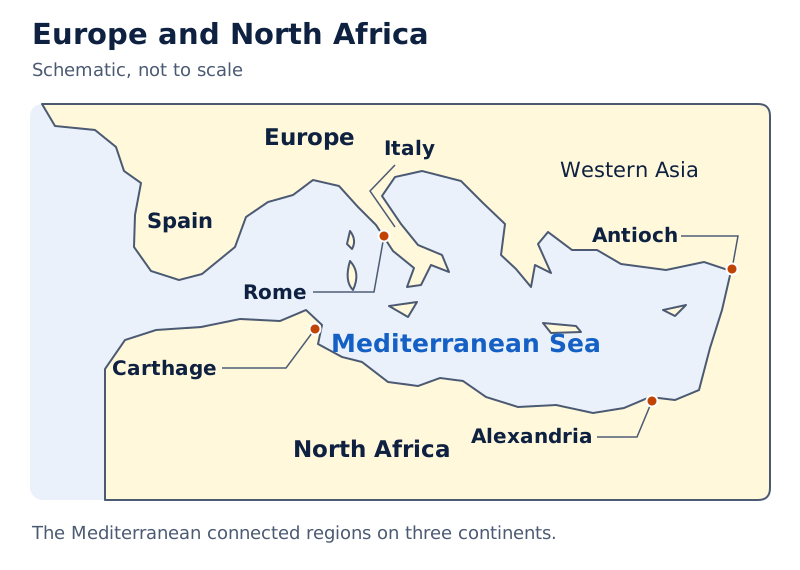
The Mediterranean occupies the centre, with Rome and Italy to the north and Carthage and Alexandria along the southern shores. Spain appears towards the west, while Antioch lies near the eastern end.
Drawn by One Young India. Reference: NCERT Class 11 Map 1
How did Rome and Iran compare?
Iran was Rome’s major rival. Their territories met near the Euphrates, and warfare between them recurred over many centuries. Iran controlled lands south of the Caspian Sea towards eastern Arabia and sometimes substantial parts of Afghanistan.
| Feature | Roman Empire | Iranian Empire |
|---|---|---|
| Population | A culturally diverse collection of territories | A population that was largely Iranian |
| Political framework | Different cultures united under an emperor | Ruled by the Parthians and later the Sasanians |
| Army | A paid professional army | A conscripted army |
Rome’s unity did not depend upon everyone sharing a language or local culture. Its inhabitants were subjects of the emperor wherever they lived. Latin and Greek served administration, with Greek prominent among eastern upper classes and Latin among western upper classes.
What do historical sources reveal about Roman society?
Texts, documents and material remains
Roman history can be reconstructed through texts, documents and material remains. Each category reveals different aspects of life. Combining them helps connect the actions of emperors with trade, property, work and the experiences of people outside the ruling elite.
| Source category | Examples | What it can reveal |
|---|---|---|
| Texts | Histories, letters, speeches, sermons and laws | Political judgements, beliefs and rules governing society |
| Documents | Inscriptions, contracts, accounts and official papers | Administrative activity and transactions in everyday life |
| Material remains | Buildings, pottery, coins and mosaics | Settlement, exchange, production and material culture |
Annals organised historical narratives year by year. Most surviving Roman histories in Greek and Latin were composed by writers from senatorial backgrounds. Their judgements of emperors often reflected how rulers treated the Senate, while their descriptions of the army could express senatorial fear and hostility.
Papyrus, made from a plant growing beside the Nile, provided a widely used writing material. Contracts, accounts, letters and official documents survive on it. Scholars called papyrologists study these records, which can reveal employment, property and money transactions.
Reading evidence critically
Tacitus, who lived from 55 to 117 CE, described the treatment of slaves and divisions within Roman society. His account of popular resistance to the execution of a murdered official’s slaves shows disagreement between ordinary people and the senatorial majority.
Augustine, who lived from 354 to 430 CE and became bishop of Hippo in 396 CE, supplies a different kind of evidence. His writings reveal domestic violence and parents placing children in long periods of servitude.
Archaeological evidence also requires interpretation. The shapes, clay and distribution of amphorae help identify their origins and the movement of commodities. Such remains can reveal patterns of trade that political narratives alone would not explain.
Note: A ruler’s inscription records what the ruler claimed. Shapur I’s claim to have destroyed a Roman army should be identified as his claim, rather than treated as an independently verified count.
How did the Principate organise political power?
The emperor, Senate and army
In 27 BCE, Augustus established the regime called the Principate. Although he held the real authority, he presented himself as the leading citizen, or princeps. This preserved an appearance of respect for institutions inherited from the Republic.
The Senate represented the aristocracy, especially wealthy landowning families of Roman and later Italian descent. It had held power during the Republic. Senators retained prestige under the emperors, although a return to republican rule was no longer a realistic possibility.
The third major political force was the army. Roman soldiers were paid professionals who had to serve for at least 25 years. Soldiers constantly agitated for better wages and service conditions; these agitations often took the form of mutinies when they felt let down by their generals or the emperor. The army had the power to determine an emperor’s survival.
These institutions did not possess equal power. Augustus remained the sole ruler, but emperors still had to manage relations with the aristocracy and army. When the armies were divided, the result usually was civil war.
Succession and relative stability
During the first two centuries, the empire was relatively free from civil war. 69 CE, when four emperors took the throne in rapid succession, was a major exception. Succession generally followed natural or adoptive family relationships.
Tiberius, who ruled from 14 to 37 CE, was Augustus’s adopted son. Adoption provided a means of arranging succession within a family framework, and the army itself remained strongly attached to this principle.
External expansion also became less frequent. The empire inherited by Tiberius was already vast. Trajan’s campaign of 113 to 117 CE extended Roman occupation across the Euphrates, but his successors abandoned these gains.
Trajan reached the head of the Persian Gulf in 116 CE and expressed a wish to campaign towards India. A wish for further conquest must be distinguished from an actual conquest: this episode does not establish Roman rule over India.
How did cities and provinces help govern the empire?
Taxation through local elites
Roman direct rule expanded partly by absorbing dependent kingdoms. These kingdoms had supported Rome with their forces while retaining their rulers. By the early second century, such kingdoms west of the Euphrates had been incorporated into Roman territory.
Outside Italy, territories were organised into provinces and taxed. Italy was not treated as a province during these early centuries. Governing such a large empire depended on the cooperation of local upper classes rather than an administration resembling a modern government.
Carthage, Alexandria and Antioch were among the great urban centres supporting the imperial system. Through cities, government taxed the surrounding countryside, where much of the empire’s wealth was produced. Local elites helped administer these territories and raise taxes.
A Roman city included an urban centre, its magistrates, a city council and a territory containing villages. Villages generally fell under a city’s jurisdiction. Imperial favour could raise a village to city status, while a settlement could also lose that status.
The growing importance of the provinces
During the second and third centuries, provincial upper classes supplied most of the administrators who governed the provinces and commanders who led the armies. Imperial backing made this new elite much more powerful than the senatorial class. This shift accompanied Italy’s declining political and economic dominance.
Gallienus, who ruled from 253 to 268 CE, strengthened the new military leadership by excluding senators from military command. Provincial origins also became increasingly common within the Senate itself. In 212 CE, all free inhabitants of the empire became Roman citizens.
Urban life could offer advantages over rural life, including public baths, entertainment and better food supplies during shortages. Galen’s account describes city residents collecting grain after harvest while peasants were left with inadequate supplies and later resorted to unhealthy foods.
The city’s advantages therefore depended partly on its relationship with the countryside. Urban prosperity and rural hardship could coexist, and the collaboration that made taxation effective did not mean resources were distributed equally.
Why did the third century become a period of crisis?
Pressure on several frontiers
The first and second centuries had generally brought peace, prosperity and economic growth. From the 230s CE, however, the empire faced warfare on several fronts at once. External attacks exposed the limits of the earlier pattern of stability.
In Iran, the rise of the Sasanian dynasty produced a more aggressive eastern rival. Its forces advanced towards the Euphrates. In a rock inscription written in three languages, Shapur I claimed to have destroyed a Roman army of 60,000 and captured Antioch.
At the same time, Germanic confederacies, including the Alamanni, Franks and Goths, pressed against the Rhine and Danube frontiers. Between 233 and 280 CE, repeated invasions affected provinces from the Black Sea towards the Alps and southern Germany.
Roman forces abandoned much territory beyond the Danube. Emperors spent long periods campaigning, and the succession of 25 emperors within 47 years indicates the severity of political instability. Military pressure and unstable leadership reinforced the strain on government.
Military expenditure and political relationships
The army’s importance increased the difficulty of managing imperial politics. Soldiers expected adequate pay and service conditions, while mounting military expenditure required heavier taxation. Senators feared the army’s violence and unpredictability, especially during these tense decades.
The crisis was therefore more than a series of frontier defeats. It involved the relationship between warfare, taxation and political authority. An emperor’s success depended on controlling the army; when the armies were divided, the result usually was civil war.
The term third-century crisis does not mean that every region stopped producing or trading. North African olive estates remained major producers through much of the third and fourth centuries. Political instability and regional economic activity must be considered together.
What were family life, literacy and cultural diversity like?
Property rights and unequal relationships
The nuclear family was widespread. Adult sons usually formed separate households, and adult brothers rarely shared one household. Roman understandings of the family also included slaves, so family membership did not imply equal rights or freedom.
By the late Republic, a typical marriage allowed a woman to retain rights in her natal family’s property. Her dowry passed to her husband for the marriage, but she remained a primary heir of her father and could become an independent property owner.
In law, the married couple consisted of two separate financial entities. Women could own and manage property, and either spouse could initiate divorce by giving notice. These rights are significant, but they should not be mistaken for complete social equality.
Men often married in their late twenties or early thirties, while women married in their late teens or early twenties. Marriages were generally arranged. The age gap would have encouraged a certain inequality, and women were often subject to domination by their husbands. Augustine records that his mother was regularly beaten by his father.
Fathers also possessed substantial legal power over children, including the power to expose unwanted children. The household combined property rights for some members with severe dependence and vulnerability for others.
Uneven literacy and many languages
Casual literacy meant reading and writing in everyday settings. Pompeii, buried in the eruption of 79 CE, preserves advertisements and graffiti suggesting widespread use of writing. In Egypt, professional scribes commonly wrote contracts for people unable to read or write.
Literacy was more widespread among some occupational groups, including soldiers, officers and estate managers. Evidence from a single city or occupation therefore cannot be applied uniformly to the whole empire.
Cultural diversity included religion, dress, food, settlement and language. Aramaic was prominent in the Near East, Coptic in Egypt, Punic and Berber in North Africa, and Celtic in Spain and the northwest. Latin and Greek administration did not erase this variety.
How did production and trade support economic expansion?
Infrastructure and regional specialisation
The Roman economy had substantial infrastructure, including harbours, mines, quarries, brickyards and olive oil factories. Wheat, wine and olive oil moved in large quantities between regions. Spain, Gaul, North Africa, Egypt and Italy contributed to these networks.
Regions specialised in different products. Campania was known for fine wine, while Sicily and Byzacium supplied wheat to Rome. Olive estates along the Guadalquivir in southern Spain formed an important centre of oil production.
The economy also displayed technical sophistication. Water-powered milling, hydraulic mining in Spain, organised commercial and banking networks, and extensive monetary exchange show the variety of methods used to produce goods and conduct business.
What can amphorae reveal?
Wine and oil travelled in containers called amphorae. Their surviving fragments can be examined for shape and clay composition. Matching the clay with production areas helps establish where containers originated, while their distribution reveals the reach of trade.
Spanish olive oil reached a commercial peak around 140 to 160 CE. Its characteristic container, called Dressel 20, occurs across Mediterranean sites. This wide distribution indicates the extensive circulation of Spanish oil and its success against Italian competitors.
North African producers later dominated much of the third and fourth centuries. After 425 CE, eastern producers became increasingly important. The Aegean, southern Asia Minor, Syria and Palestine emerged as major exporters of wine and oil in the later fifth and sixth centuries.
These changes show competition between producing regions. Regional prosperity depended on the organisation of production and transport, as well as the quality of goods. The empire’s economic centre of gravity was therefore not permanently fixed in Italy.
Uneven development
Intensive agriculture existed beside pastoral and less developed regions. In Numidia, communities practised transhumance and carried movable huts called mapalia. Expanding estates reduced their pastures and restricted their movements. Northern Spain differed from the prosperous olive-growing south.
Economic sophistication should therefore be recognised without assuming that all provinces shared the same conditions. Commercial estates, pastoral communities, cities and small villages formed parts of a varied economic landscape.
How were slaves and free workers controlled?
Slavery and economic calculation
Slavery was deeply rooted in the Mediterranean and Near Eastern worlds. Under Augustus, Italy contained about 3 million slaves within a population of 7.5 million. These Italian figures should not be treated as a measure of labour across the entire empire.
Slaves were costly investments. Owners had to feed and maintain them throughout the year, unlike workers hired only when needed. Agricultural advice against using slaves for large harvest requirements or in unhealthy locations reflected calculations about expense and loss.
As warfare became less frequent with the establishment of peace in the first century, the supply of slaves tended to decline. Owners turned towards slave breeding or alternatives such as wage labour. Free workers were extensively employed on public works at Rome because relying heavily on slaves would have been expensive.
Slaves and freedmen, former slaves released by their masters, also served as business managers. Masters sometimes supplied capital for enterprises. Their importance in management does not mean that every agricultural or industrial worker was enslaved.
Supervision, coercion and wages
Columella recommended keeping spare tools to avoid interruptions and dividing workers into groups of ten for easier supervision. Pliny the Elder condemned slave gangs as the worst way of organising production, mainly because their members were usually chained together by their feet. Both accounts reveal close attention to controlling labour.
A law of 398 CE referred to branding workers so they could be identified if they escaped. Employers also used debt contracts to strengthen control, while poor families sometimes entered debt bondage to survive.
Rural debt could generate resistance. During the Jewish revolt of 66 CE, revolutionaries destroyed moneylenders’ bonds to attract support. Augustine’s letters also describe parents placing children in servitude for periods of 25 years.
These methods of control do not establish that the bulk of labour was coerced in these ways. Anastasius attracted workers to build Dara by offering high wages. Papyri indicate that wage labour was widespread in parts of the Mediterranean, especially the East, by the sixth century.
How did different social groups experience Roman rule?
Aristocrats and military elites
Roman society contained sharp differences of wealth, status and power. Tacitus distinguished senators, leading equestrians, respectable dependants of great households, poorer people and slaves. These categories reveal hierarchy, but the position of groups changed over time.
The equites were traditionally the second major wealthy group after senators. Most equites were landowners, while many were also shipowners, traders and bankers. In the late empire, senators and equestrians merged into an enlarged aristocracy.
At least half of this later aristocracy’s families were of African or eastern origin. It possessed immense wealth but was in many ways less powerful than the military elites, who came almost entirely from non-aristocratic backgrounds. Wealth and direct command of armed force were not identical advantages.
Officials, merchants and prosperous farmers
The later middle classes included people in imperial administration and the army, together with prosperous merchants and farmers, especially in the East. Dependence on government service became an important source of their position.
Higher and middle officials received the bulk of their pay in gold and invested much of it in assets such as land. Their affluence reflected the importance of the state as an employer, although corruption in justice and military supplies accompanied these opportunities.
Lower classes and unequal security
The humiliores, or lower classes, included permanent estate labourers, industrial and mining workers, migrant harvest and building workers, artisans, casual labourers and slaves. This was a varied population, rather than a single group performing one occupation.
Casual employment and indebtedness could make poorer families insecure. At the other extreme, Olympiodorus described Roman aristocratic households receiving annual property incomes of up to 4,000 pounds of gold, apart from produce consumed directly.
The state was authoritarian: dissent was rarely tolerated, and government usually responded to protest with violence. Yet Roman law was actively used to protect civil rights and acted as a restraint on even the most fearsome emperors. Laws against corruption and criticism by intellectuals show that abuses were contested, even within a deeply unequal political order.
How did Diocletian and Constantine reshape the late empire?
Reorganisation after overexpansion
Late antiquity broadly covers the fourth to seventh centuries. It was a period of political and cultural transformation, including reforms of administration, changes in money, the growth of Christianity and continuing economic activity.
Diocletian, who ruled from 284 to 305 CE, responded to overexpansion by abandoning territories with limited strategic or economic value. He strengthened frontiers and reorganised provinces. In 297 CE, the empire was reorganised into 100 provinces.
Diocletian also separated civilian and military functions. Military commanders, called duces, gained greater autonomy and became more powerful. These changes altered the organisation of authority rather than simply restoring the earlier Principate unchanged.
Money, a new capital and growth
Constantine continued some reforms and introduced others. His gold coin, the solidus, contained 4½ grams of pure gold. Issued around 310 CE, it circulated on a large scale and outlasted the Roman Empire itself.
Exhaustion of Spanish silver mines and inadequate silver stocks had undermined the older monetary basis. Gold became central to the new system. Monetary stability, together with population growth, helped stimulate investment and economic expansion.
In 324 CE, Constantine became sole ruler and founded Constantinople at the site formerly called Byzantium. The second capital required another senate, contributing to the expansion of governing groups during the fourth century.
Archaeological remains show investment in oil presses, glass factories, screw presses and multiple water-mills. Long-distance eastern trade revived, and urban wealth found expression in new architecture and luxury. Later imperial history was therefore not simply uninterrupted economic decline.
Egypt illustrates this prosperity. Under Justinian in the sixth century, it contributed more than 2½ million solidi annually in taxes. Papyri also reveal extensive monetary exchange and large rural estates generating substantial incomes in gold.
What were the consequences of religious change and imperial fragmentation?
Gradual religious transformation
Traditional Roman and Greek religion was polytheist. Worship included deities such as Jupiter, Juno, Minerva and Mars, alongside Greek and eastern gods. Judaism was another major tradition and itself contained considerable internal diversity.
Constantine’s conversion in 312 CE marked an important change in imperial religious life. Christianity gained official imperial support, but the Christianisation of society during the fourth and fifth centuries was gradual and complex.
Polytheist practices continued, particularly in western provinces. Bishops tried to regulate beliefs more strictly than some ordinary believers did. Boundaries between religious communities were initially more flexible than later efforts at enforcing uniformity would permit.
Different outcomes in the East and West
In the West, Germanic groups established post-Roman kingdoms. The sack of Rome in 410 CE was one major event in this transformation. Visigoths ruled in Spain, Franks in Gaul and Lombards in Italy, foreshadowing a medieval political world.
The East remained united and prosperous. Justinian, who ruled from 527 to 565 CE, recovered Africa from the Vandals in 533 CE. His recovery of Italy from the Ostrogoths, however, devastated the country and helped prepare the way for the Lombard invasion of 568 CE.
Eastern prosperity continued despite plague outbreaks affecting the Mediterranean in the 540s. Political fragmentation in the West should therefore not be equated with the simultaneous collapse of the whole Roman world.
In the early seventh century, renewed Iranian attacks occupied major eastern provinces. Byzantium recovered them in the 620s CE, but Arab conquests soon transformed the region again. By 642 CE, large parts of both the eastern Roman and Sasanian empires had fallen to Arab armies.
The expansion of Islam began with the unification and subjection of Arab tribes, first in Arabia and then neighbouring regions. The empire’s final transformations thus involved both internal changes and the growth of new powers beyond its borders.
What timeline connects the main developments?
The timeline distinguishes the founding of imperial rule, changes in citizenship and administration, religious transformation and the later division of Roman territories. Dates locate developments, but long processes such as Christianisation or provincial growth cannot be reduced to one event.
| Date | Development |
|---|---|
| 27 BCE | Augustus establishes the Principate. |
| 14 to 37 CE | Tiberius rules after Augustus. |
| 69 CE | Four emperors succeed one another rapidly. |
| 79 CE | The eruption of Vesuvius buries Pompeii. |
| 113 to 117 CE | Trajan campaigns across the Euphrates. |
| 212 CE | All free inhabitants become Roman citizens. |
| 233 to 280 CE | Repeated invasions affect northern frontier provinces. |
| 253 to 268 CE | Gallienus rules and strengthens the new military leadership. |
| 297 CE | Diocletian reorganises the empire into 100 provinces. |
| About 310 CE | Constantine issues the new gold solidus. |
| 312 CE | Constantine converts to Christianity. |
| 324 CE | Constantine becomes sole ruler and founds Constantinople. |
| 378 CE | Goths defeat Roman armies at Adrianople. |
| 410 CE | Visigoths sack Rome. |
| 533 CE | Justinian recaptures Africa from the Vandals. |
| 568 CE | Lombards invade Italy. |
| 633 to 642 CE | A crucial phase of Arab conquests transforms Roman and Iranian territories. |
The sequence shows why early empire and late empire are useful distinctions. The third century forms a broad watershed, while fourth-century reforms introduce new political and monetary arrangements. Later western fragmentation coexists with a continuing eastern empire.
Glossary
- Principate — The regime established by Augustus, presenting the emperor as leading citizen while he retained real authority.
- Senate — The aristocratic body that governed republican Rome and retained considerable prestige under the emperors.
- Conscripted army — An army recruited compulsorily from specified groups or categories within the population.
- Province — A territorial unit of the empire subject to Roman administration and taxation.
- Annals — Historical narratives that arrange their account of events on a year-by-year basis.
- Papyrus — A writing material produced from a reed-like plant growing beside the Nile in Egypt.
- Amphorae — Containers used to transport liquids, including wine and olive oil, across trading networks.
- Transhumance — Regular annual movement between higher mountain areas and lower ground in search of pasture for flocks.
- Freedmen — Former slaves released by their masters, some of whom worked as business managers.
- Humiliores — The lower social groups, including varied categories of workers, artisans and slaves.
- Solidus — Constantine’s gold coin, containing four and a half grams of pure gold.
- Late antiquity — The period broadly covering the fourth to seventh centuries and the transformation of the Roman world.
- Christianisation — The process through which Christianity spread among different population groups and became the dominant religion.
- Laity — Ordinary members of a religious community, distinguished from its priests and other official clergy.
Common errors and misconceptions
- Misconception: The Principate restored the Republic. Correct: Augustus retained real authority while presenting himself as the leading citizen and respecting the Senate’s outward position.
- Misconception: Latin was the language of every Roman subject. Correct: Latin and Greek served administration, while many local languages continued to be spoken.
- Misconception: Women’s property rights meant complete equality within marriage. Correct: Legal independence coexisted with arranged marriages, age differences and domestic domination or violence.
- Misconception: All Roman labour was performed by slaves. Correct: Wage workers, artisans, peasants and other free labourers also played major roles, with regional and chronological differences.
- Misconception: A single prosperous region represents the entire Roman economy. Correct: Commercial estates and sophisticated industries coexisted with pastoral communities and less developed areas.
- Misconception: Christianity immediately displaced every older religious practice. Correct: Christianisation was gradual, and polytheist beliefs continued while bishops attempted to regulate religious life.
- Misconception: The collapse of western imperial authority ended the whole empire. Correct: The eastern empire remained united and prosperous while western provinces became post-Roman kingdoms.
- Misconception: Trajan’s interest in India proves he conquered it. Correct: His expressed wish at the Persian Gulf was an ambition, not evidence of an Indian conquest.
Exam-style questions with model answers
Q1. Augustus established the Principate in 27 BCE. He held real authority but called himself the leading citizen out of respect for the Senate. Explain the difference between the title and the reality of his power. [2 marks]
- The title presented Augustus as the leading citizen and preserved an appearance of respect for the Senate.
- In practice, he was the sole ruler and real source of authority, so the title did not indicate equal power among citizens.
Q2. Wine and olive oil travelled in amphorae. Their shape and clay can identify production areas, while their find-spots show their distribution. State two ways amphorae help reconstruct trade. [2 marks]
- The shape and clay of containers help identify where they were produced and link them with producing regions.
- The places where they are found reveal the distribution of goods and the geographical reach of trade.
Q3. Roman provincial cities had magistrates, councils and surrounding villages. Local upper classes collaborated in administration and tax collection, and much wealth came from the countryside. Explain how cities helped the emperor govern. [3 marks]
- Cities provided local institutions through their magistrates and councils, enabling administration to operate across provincial territories.
- Their jurisdiction extended beyond the urban settlement to surrounding villages, connecting city government with the countryside that generated much of the wealth.
- Cooperation from local upper classes allowed the imperial state to administer territories and collect taxes. The emperor therefore depended on this local collaboration to govern a large empire.
Q4. Married Roman women could retain natal property rights, inherit from their fathers and initiate divorce. Yet marriages were generally arranged, husbands were often older, and Augustine records domestic violence. Assess women’s position using this evidence. [4 marks]
- Women possessed significant legal and financial rights because marriage did not automatically remove their claims to natal property or inheritance.
- The ability to initiate divorce also indicates legal independence within marriage.
- However, arranged marriages and age differences could reinforce unequal relationships between spouses.
- Augustine’s evidence of domestic violence shows that formal rights did not guarantee equal treatment or safety. A balanced assessment must distinguish property and marital rights from everyday power within the household.
Q5. From the 230s CE Rome fought on several fronts. Sasanian Iran advanced towards the Euphrates; Germanic confederacies repeatedly invaded northern provinces between 233 and 280 CE. Rome abandoned territory beyond the Danube, military spending increased taxation, and 25 emperors ruled within 47 years. Explain the third-century crisis. [5 marks]
- Sasanian expansion towards the Euphrates forced Rome to fight on its eastern frontier.
- At the same time, Germanic confederacies repeatedly invaded northern provinces, forcing Rome to fight on several fronts simultaneously.
- Abandoning territory beyond the Danube demonstrated the difficulty of maintaining earlier frontier positions under this pressure.
- Increasing military expenditure required heavier taxation, linking the demands of warfare to strain within the imperial system.
- The rapid succession of emperors reveals political instability alongside military difficulty. The crisis should therefore be understood as a combination of external invasion, territorial retreat, financial pressure and unstable imperial leadership, rather than as one isolated defeat.
Q6. Slaves required year-round maintenance. Peace reduced the supply of war captives, and owners used slave breeding or wage labour. Public works employed free labour because slaves were expensive. Columella recommended close supervision; debt contracts and branding also controlled workers. Anastasius attracted workers to Dara with high wages. Explain why Roman labour cannot be described simply as slavery. [5 marks]
- Public works at Rome extensively employed free labour, showing that important work was performed by people who were not slaves.
- Slaves had to be maintained throughout the year, whereas hired labour could be employed only when needed; extensive slave labour on public works would therefore have been too expensive.
- Reduced supplies of captives encouraged alternatives, including wage labour, alongside attempts to reproduce the slave population.
- Free legal status did not necessarily remove coercion. Supervision, debt contracts and branding show that employers could restrict and discipline workers through several methods.
- At the same time, Anastasius’s high wages at Dara demonstrate recruitment through financial incentives. Roman labour therefore combined slavery, paid employment and different forms of control rather than operating through a single universal arrangement.
Q7. Diocletian abandoned low-value territories, fortified frontiers, reorganised provinces and separated military from civilian functions, giving commanders greater autonomy. Constantine introduced the gold solidus and a second capital at Constantinople. Monetary stability and population growth accompanied investment in presses, mills and factories and renewed eastern trade. Explain how these developments show transformation in the late empire. [6 marks]
- Diocletian abandoned territories of little strategic or economic value and fortified the remaining frontiers, adapting defence to an overexpanded empire.
- Reorganisation of provincial boundaries changed the territorial structure of administration.
- Separating civilian and military functions gave military commanders greater autonomy and made them more powerful.
- Constantine’s gold solidus transformed the monetary system, supporting monetary stability and economic growth.
- Constantinople became a second imperial capital, changing the geographical organisation of imperial government.
- Population growth, investment in presses, mills and factories, and renewed long-distance eastern trade show economic expansion alongside political reorganisation.
Q8. Western provinces became kingdoms ruled by Germanic groups, while the East remained united and prosperous. Justinian recovered Africa in 533 CE, but recovering Italy devastated it and preceded the Lombard invasion of 568 CE. By 642 CE Arab armies had taken large parts of the eastern Roman and Sasanian empires. Compare the eastern and western outcomes. [4 marks]
- Western imperial unity broke up into Germanic kingdoms, while the eastern empire initially remained united.
- Western political fragmentation contrasted with continuing eastern prosperity, which supported Justinian’s imperial ambitions.
- Justinian recovered Africa in 533 CE and Italy from western successor kingdoms, but the Italian campaign devastated Italy and preceded the Lombard invasion of 568 CE.
- The eastern empire later lost large territories to Arab armies by 642 CE, so its major territorial losses followed a different course and chronology from the West’s fragmentation into Germanic kingdoms.
Key takeaways
- The Mediterranean connected a culturally diverse empire whose territories extended across Europe, North Africa and western Asia.
- Imperial government depended on relations between the emperor, aristocracy and army, together with cooperation from provincial urban elites.
- The third-century crisis combined pressure on several frontiers, unstable leadership and increasing demands to finance the military.
- Roman women’s property rights and access to divorce coexisted with unequal household relationships and domestic violence.
- Trade, monetary exchange and technical sophistication flourished alongside marked differences between regions and forms of production.
- Slavery formed part of a varied labour system that also included wage work, debt bondage and business management.
- Late antiquity brought administrative, monetary and religious transformations, while western fragmentation contrasted with continuing eastern prosperity.
- Texts, documents and archaeological remains must be compared carefully because each reveals different aspects of Roman experience.
Test yourself
Which sea formed the centre of the Roman Empire?
The Mediterranean Sea connected Roman territories along its northern and southern shores.
What were the three main political forces in the empire?
The emperor, the aristocracy represented by the Senate, and the army shaped imperial politics.
Why could cities be better places to live during food shortages?
Urban residents could secure and store food supplies while the surrounding peasantry was left with inadequate provisions.
What is the difference between a slave and a freedman?
A slave remained enslaved, while a freedman had been released from slavery by his master.
Why are surviving written documents not proof that everyone was literate?
Professional scribes often prepared documents for people who could not read or write themselves.
Why did gold replace the earlier silver monetary basis?
Spanish silver mines were exhausted, and inadequate silver supplies made a stable silver coinage difficult to maintain.
What does Christianisation mean?
It means the spread of Christianity among different population groups and its emergence as the dominant religion.
Why is western fragmentation different from the end of the whole empire?
The eastern empire continued as a united and prosperous state while western provinces became separate kingdoms.