
The Union Parliament | ICSE Class 10 History and Civics Notes
On this page
This note covers the federal setting of Parliament, the Lok Sabha and Rajya Sabha, their officers and sessions, questions and motions, the passage of ordinary and Money Bills, and the legislative, financial and other powers of the Union Parliament.
What is the Union Parliament, and why does India have two Houses?
Parliament is India's national legislature. Under Article 79 of the Constitution it consists of the President and two Houses, the Lok Sabha or House of the People, and the Rajya Sabha or Council of States.
The President is a constituent part of Parliament, even though the President does not sit as a member of either House. A legislature with two Houses is called bicameral.
India has a federal arrangement in which authority is divided between the Union and the States. The Lok Sabha gives direct representation to people in territorial constituencies. The Rajya Sabha provides representation to States through members elected by their legislatures.
Together the Houses allow national decisions to be examined from more than one perspective.
The second House also provides another opportunity to discuss a proposed law. A decision made hurriedly in one House can be questioned, revised or debated again in the other. The two Houses do not have identical powers, however.
Their differences are clearest in financial business and in deciding whether the Council of Ministers continues in office.
Parliament does more than pass laws. It discusses public questions, authorises the use of public money, scrutinises ministers and gives people a way to hold their representatives accountable. Its debate and committee work matter even when a government has enough members to pass a bill.
Definition: A bicameral legislature is a law-making body with two Houses. India's Union Parliament has the Lok Sabha and the Rajya Sabha.
How is the Lok Sabha formed, and how long can it continue?
The Lok Sabha is directly elected by the people. The country is divided into territorial constituencies, and each constituency elects one representative. There are 543 Lok Sabha constituencies. The people who vote in those constituencies choose their members through universal adult suffrage.
This direct electoral link is central to the Lok Sabha's role in holding the government to account.
What qualifies a Lok Sabha member?
Article 84 requires a Lok Sabha member to be a citizen of India, to make the prescribed oath or affirmation, to be at least 25 years old, and to meet any other qualifications prescribed by Parliament by law.
Eligibility to stand as a candidate is different from a voter's right to cast a vote.
Under Article 83, the normal maximum term of a Lok Sabha is five years from the date appointed for its first meeting. It may be dissolved before that time, after which a new House must be elected.
The House is therefore not permanent. The Constitution also permits an extension during a Proclamation of Emergency, subject to the limits in Article 83; this is an exception to the ordinary five-year rule.
The Council of Ministers depends on the confidence of the Lok Sabha. A government normally comes from the party or coalition that commands a majority there. Ministers must answer questions in Parliament, but the Lok Sabha has the decisive power to withdraw confidence and require a government to leave office.
| Point | Lok Sabha | Rajya Sabha |
|---|---|---|
| Representation | People in territorial constituencies | States and Union territories through the constitutional arrangement |
| Election | Direct election by voters | Indirect election of representatives; some members are nominated |
| Normal term | Up to five years unless dissolved earlier | Six years for an elected member |
| Continuity | The whole House can be dissolved | The House is not dissolved |
| Government confidence | Can remove the Council of Ministers through a no-confidence vote | May scrutinise ministers but cannot dismiss the Council of Ministers |
How is the Rajya Sabha formed, and why is it called permanent?
The Rajya Sabha represents States in the Union legislature. Its elected members are chosen by the elected members of State Legislative Assemblies. Article 80 provides for this indirect election by proportional representation through the single transferable vote.
Representation is not equal for every State: the Fourth Schedule allocates seats, and States with larger populations have more representatives.
Who are the nominated members?
Article 80 also provides for 12 nominated members. The President nominates people with special knowledge or practical experience in literature, science, art and social service. These members are part of the Rajya Sabha, although they are not elected by State assemblies. The constitutional composition also includes representatives of Union territories.
Article 84 sets a minimum age of 30 years for Rajya Sabha membership, alongside citizenship, the prescribed oath or affirmation, and other legal qualifications. The age requirement is therefore different from the Lok Sabha's minimum age of 25 years.
An elected Rajya Sabha member serves a six-year term. About one-third of its members retire every two years, with elections held for the vacant seats.
Since all members do not retire together, the Rajya Sabha is a continuing House: it is not dissolved when the Lok Sabha is dissolved. This continuity lets the upper House continue its work between Lok Sabha elections.
The Vice-President of India is the ex officio Chairperson of the Rajya Sabha under Article 89. The House also chooses a Deputy Chairperson from among its members. The Chairperson presides over proceedings and helps maintain orderly discussion; this office is distinct from the Speaker of the Lok Sabha.
Note: “Permanent House” describes the Rajya Sabha as an institution. It does not mean that an individual elected member holds a permanent seat.
Who presides over the Houses, and what happens in a session?
The Lok Sabha elects a Speaker and a Deputy Speaker from among its members under Article 93. The Speaker presides over sittings, maintains order, interprets the House's procedure and regulates debate.
The Speaker also decides whether a bill is a Money Bill under Article 110. The Deputy Speaker presides when required under the applicable constitutional and House rules.
Article 94 permits the Speaker to resign or to be removed by a resolution of the Lok Sabha passed by a majority of all its then members. A resolution to remove the Speaker requires at least 14 days' notice.
Dissolution of the Lok Sabha does not immediately end the Speaker's office: the Speaker remains until just before the first meeting of the new House.
How are sittings called and conducted?
The President summons each House to meet. Article 85 requires that no more than six months pass between the last sitting of one session and the first sitting of the next.
A session is a period during which a House meets to conduct business; an adjournment suspends a sitting, whereas dissolution ends a Lok Sabha.
A House must have a quorum to transact business. Article 100 sets it at one-tenth of the total number of members of that House, unless Parliament provides otherwise by law.
If a quorum is absent, the presiding officer must adjourn or suspend the meeting until it is present. Quorum concerns attendance, not the number of votes needed to pass every measure.
| Term | What it means |
|---|---|
| Summoning | Calling a House to meet for a session |
| Adjournment | Suspending a sitting to a later time |
| Prorogation | Ending a session without dissolving the House |
| Dissolution | Ending the life of the Lok Sabha before a new House is elected |
| Quorum | Minimum attendance required for a House to transact business |
How do questions and motions help Parliament examine the government?
Question Hour gives members an opportunity to ask ministers for information about government decisions and administration. Answers can expose a problem, clarify policy or prompt further questioning. A starred question is answered orally and may be followed by supplementary questions. An unstarred question receives a written answer, without oral supplementaries.
What happens after Question Hour?
A short-notice question concerns an urgent matter of public importance and is asked with shorter notice than an ordinary question, subject to the House's rules.
In Zero Hour, members raise matters they consider important; ministers are not bound to reply to every issue raised there. These devices let members bring constituency and national concerns before the House.
An adjournment motion seeks to interrupt ordinary business so that the House may discuss a definite matter of urgent public importance. A no-confidence motion tests whether the Council of Ministers still has the Lok Sabha's support.
If the Lok Sabha passes such a motion, the ministry cannot continue as the government. The Rajya Sabha can question and criticise ministers but cannot remove the ministry by a no-confidence vote.
Parliament also examines government proposals while discussing bills, grants and the budget. Committees can study a bill or examine spending in greater detail than is possible in a full sitting. Together, questions, debate, motions, financial scrutiny and committee work make executive accountability more than a single vote.
Note: Asking a question and moving a no-confidence motion are different forms of scrutiny. A question seeks an answer; a no-confidence vote decides whether the ministry keeps the Lok Sabha's support.
How does the anti-defection rule affect members of Parliament?
An elected member may owe a seat to voters while also belonging to a political party. The anti-defection law addresses certain cases in which members leave their party or act against its voting direction.
The 52nd Amendment placed the Tenth Schedule in the Constitution in 1985. The provisions were later changed by the 91st Amendment.
Under the Tenth Schedule, a member elected on a party ticket may be disqualified for voluntarily giving up membership of that party.
Voting or abstaining in the House against a party direction can also lead to disqualification, subject to the Schedule's conditions about prior permission or subsequent condonation.
A member's conduct therefore matters as well as a formal letter of resignation from the party.
The Tenth Schedule also addresses an independent member who joins a political party after election and a nominated member who joins a party after the permitted period.
The Speaker decides questions of disqualification in the Lok Sabha, while the Chairperson does so in the Rajya Sabha, according to the Schedule. A member found disqualified loses the seat.
The rule aims to limit changes of allegiance that can destabilise a legislature. It also affects a member's freedom to vote differently from the party leadership.
For that reason, remember both its purpose and its consequence: the 52nd Amendment created a constitutional disqualification mechanism, and the presiding officer applies it to individual cases under the Tenth Schedule.
Definition: Defection, for this topic, means conduct that attracts disqualification under the Tenth Schedule, such as voluntarily giving up a party membership or voting against a valid party direction.
How does an ordinary bill become a law?
A bill is a draft proposal for a law. A minister can introduce a government bill; a member who is not a minister can introduce a private member's bill.
An ordinary bill, unlike a Money Bill, may begin in either the Lok Sabha or the Rajya Sabha. Article 107 requires agreement of both Houses before such a bill can be presented for assent.
Types of bills. A bill introduced by a minister is a Government Bill; one introduced by a member who is not a minister is a Private Member’s Bill. Bills may also be classified as Money Bills or Non-Money Bills. Non-Money Bills include Ordinary Bills and Constitution Amendment Bills.
The House that receives the bill discusses its purpose and provisions. It may examine the clauses itself or refer the bill to a committee for closer study. A committee reports its recommendations; the House decides what to accept.
After debate and voting, a bill passed by one House goes to the other, where it is considered in turn.
- Introduce the ordinary bill in either House.
- Discuss it and, if referred, consider a committee's report.
- Vote on its provisions and pass it in the first House.
- Send it to the other House for its own consideration and passage.
- Present the agreed bill to the President for assent under Article 111.
What if the Houses disagree?
If the two Houses disagree on an ordinary bill, Article 108 provides for a joint sitting in the circumstances specified there. Members of both Houses then consider the bill together.
A joint sitting is a way to resolve a deadlock on an ordinary bill; it is not the normal route for every bill. It does not apply to a Money Bill or a constitutional amendment bill.
Under Article 111, the President may assent to a bill or, if it is not a Money Bill, return it for reconsideration. If Parliament passes it again, with or without amendments, and presents it again, the President must give assent.
The bill becomes an Act after assent. Thus the passage by the Houses and the President's assent are separate stages.
Path of an ordinary bill. An ordinary bill may be introduced in either House, examined by a committee with public input, discussed in detail and passed by that House, and then considered by the other House. A qualifying deadlock may be resolved through a joint sitting. After parliamentary passage, the bill goes to the President and becomes law on receiving assent.
How does a Money Bill follow a different route?
A Money Bill is defined by Article 110 through specified financial subjects, including taxation, borrowing and matters relating to the Consolidated Fund of India.
Its subject must fall within the constitutional definition; a bill is not a Money Bill merely because implementing it would cost money. The Speaker of the Lok Sabha decides whether a bill is a Money Bill.
Article 109 says that a Money Bill can be introduced only in the Lok Sabha. Once the Lok Sabha passes it, the bill is sent to the Rajya Sabha for recommendations. The Rajya Sabha has 14 days to return it.
It cannot reject the bill or insist on amendments. The Lok Sabha may accept or reject any recommendation the Rajya Sabha makes.
- Introduce the Money Bill only in the Lok Sabha. If it contains provisions dealing with matters in Article 110(1)(a)-(f), obtain the President's recommendation before introduction, as required by Article 117(1).
- Debate and pass it there.
- Send it to the Rajya Sabha for recommendations.
- Return it within 14 days; if it is not returned in time, it is deemed passed in the Lok Sabha's form.
- Let the Lok Sabha decide on recommendations and present the passed bill for presidential assent.
If the Rajya Sabha does not return it within 14 days, Article 109 treats the bill as passed by both Houses in the form adopted by the Lok Sabha.
If it does return recommendations, the final text depends on what the Lok Sabha accepts. There is no joint sitting to settle disagreement over a Money Bill.
Article 111 also excludes a Money Bill from the President's power to return a bill for reconsideration.
| Stage | Ordinary Bill | Money Bill |
|---|---|---|
| Introduction | May begin in either House | Begins only in the Lok Sabha |
| Other House | Must pass the agreed text | Rajya Sabha may recommend changes |
| Time limit for Rajya Sabha | No 14-day Money Bill limit | Must return within 14 days |
| Deadlock | Joint sitting may be available under Article 108 | No joint sitting |
| Presidential return | Article 111 permits return for reconsideration | Article 111 does not permit return for reconsideration |
What powers and functions does Parliament exercise?
Parliament's legislative function includes making laws on subjects assigned to the Union and on subjects in the Concurrent List. A proposal must follow the relevant bill procedure before it becomes law.
The two Houses also debate policy and represent interests from different regions and social groups. Their role is therefore wider than approving drafts prepared by ministers.
How is money controlled?
Its financial function gives elected representatives a say over public revenue and spending. The government presents an annual financial statement under Article 112. The Lok Sabha considers demands for grants, and Parliament authorises expenditure through the constitutional budget process.
Members can question proposed spending and examine how money already granted was used.
Parliament's control over the executive includes Question Hour, discussions, motions, committees and financial scrutiny. The Council of Ministers is collectively responsible to the Lok Sabha under Article 75.
A ministry that loses the confidence of that House cannot continue in office. The Rajya Sabha participates in scrutiny even though it cannot pass the decisive no-confidence vote.
Parliament also has a constituent function: both Houses consider constitutional amendment bills under Article 368. Such a bill needs the specified special majority in each House; for certain constitutional changes, ratification by at least half the States is also required.
Neither House can simply be bypassed through a joint sitting for an amendment.
Its electoral and judicial functions include the participation of members in the elections of the President and Vice-President and constitutional proceedings concerning removal of high constitutional office holders.
The two Houses have roles in the President's impeachment and in the removal process for judges of the Supreme Court and High Courts. These powers are distinct from the ordinary work of law-making.
Which powers belong especially to one House, and where must both agree?
The Lok Sabha's exclusive position is strongest in two areas. A Money Bill begins there, and it has the final choice on Rajya Sabha recommendations.
The Council of Ministers is collectively responsible to the Lok Sabha, so only that House can make a no-confidence vote decisive for the government's survival. These powers reflect its direct election by the people.
The Rajya Sabha's special powers reflect its place in the federal arrangement. Under Article 249, it may resolve by the required special majority that it is necessary in the national interest for Parliament to legislate on a specified State List matter.
Under Article 312, it may similarly resolve that creating an All-India Service is necessary in the national interest. These are special constitutional routes, not a general power to move all State subjects to the Union List.
The Rajya Sabha can also initiate a resolution to remove the Vice-President under Article 67, with the Lok Sabha's agreement required.
In contrast, an ordinary bill ordinarily needs passage by both Houses, and a constitutional amendment bill needs the special majority in each. The two Houses also share important roles in considering removal of judges and impeachment of the President.
Do not confuse special power with overall superiority. The Lok Sabha has the final say over a Money Bill and confidence in the ministry.
The Rajya Sabha gives States a continuing voice and has particular powers concerning State List legislation and All-India Services. For much other parliamentary work, both Houses must participate.
Diagram
Comparing the two Houses
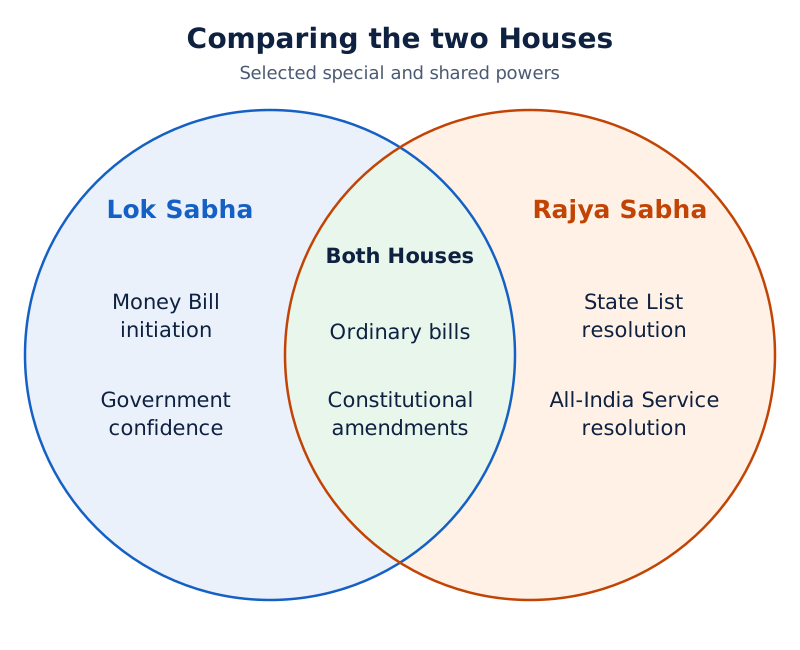
Draw two overlapping circles. Put Money Bill initiation and government confidence in the Lok Sabha circle; State List resolution and All-India Service resolution in the Rajya Sabha circle; ordinary bills and constitutional amendments in the overlap.
Drawn by One Young India.
How do committees and orderly debate support Parliament's work?
Parliament has many demands on its sitting time. A bill may need clause-by-clause examination, while the budget requires members to consider spending and the work of ministries.
Parliamentary committees allow smaller groups of members to study these matters in detail and report back to a House. The House still decides whether to accept a committee's recommendations.
Committees can examine proposed laws, demands for grants, expenditure and departmental work. Members of both Houses may serve on a joint committee for a particular task. Committee scrutiny therefore complements debate in the full House.
Referral to a committee does not itself turn a draft into an Act; the required parliamentary approval and assent still matter.
Orderly debate lets members express disagreement and ask the government to justify its choices. The presiding officer regulates proceedings so that business can continue.
Members also have parliamentary privilege for what they say in the House, which helps them speak and question ministers without fear of ordinary legal action for that speech.
Parliamentary control works best when members attend, debate, ask informed questions and examine the government's use of public money. Lack of quorum or repeated interruptions can reduce the time available for scrutiny.
The point of procedure is to make discussion and decision possible while preserving the Houses' power to hold the executive answerable.
Glossary
- Parliament — The Union legislature consisting of the President, Lok Sabha and Rajya Sabha under Article 79.
- Federal setup — An arrangement in which constitutional authority is divided between the Union and State levels of government.
- Bicameral — Describes a legislature with two Houses, each of which has a part in its work.
- Constituency — A defined electoral area whose voters choose a representative for the Lok Sabha.
- Quorum — The minimum number of members needed for a House to transact its business.
- Session — A period in which a House is summoned to meet and conduct parliamentary business.
- Question Hour — The part of a sitting used by members to seek answers from ministers.
- Zero Hour — A period used by members to raise matters they consider important, without a required ministerial reply.
- Adjournment motion — A proposal to interrupt ordinary business for discussion of a definite urgent public matter.
- No-confidence motion — A motion in the Lok Sabha testing whether the Council of Ministers retains that House's support.
- Money Bill — A bill confined to the financial matters specified in Article 110 of the Constitution.
- Joint sitting — A meeting of both Houses that can resolve certain deadlocks over an ordinary bill.
- Defection — Conduct that can disqualify a legislator under the Tenth Schedule's party allegiance rules.
Common errors and misconceptions
- Misconception: Parliament means only the Lok Sabha and Rajya Sabha. Correct: Article 79 also makes the President a constituent part of Parliament.
- Misconception: Rajya Sabha members have permanent individual seats. Correct: Elected members have six-year terms; the House continues because members retire in rotation.
- Misconception: Both Houses can remove the Council of Ministers. Correct: Ministers answer to both Houses, but collective responsibility and the decisive no-confidence vote belong to the Lok Sabha.
- Misconception: Every bill involving public spending is a Money Bill. Correct: Article 110 specifies the matters that make a bill a Money Bill.
- Misconception: The Rajya Sabha can amend a Money Bill by itself. Correct: It may recommend changes; the Lok Sabha decides whether to accept them.
- Misconception: A joint sitting settles every disagreement between the Houses. Correct: The joint-sitting route may apply to an ordinary bill, not a Money Bill or a constitutional amendment bill.
- Misconception: A bill becomes law as soon as one House passes it. Correct: The applicable parliamentary procedure and presidential assent must be completed.
Exam-style questions with model answers
Q1. Name the two Houses of Parliament and state which one is directly elected. [2 marks]
- The two Houses are the Lok Sabha, or House of the People, and the Rajya Sabha, or Council of States.
- The Lok Sabha is directly elected by voters in territorial constituencies. Rajya Sabha representatives are mainly elected indirectly through elected State legislators.
Q2. Why is the Rajya Sabha called a permanent House? [2 marks]
- The Rajya Sabha is not dissolved when the Lok Sabha is dissolved. Its elected members serve six-year terms, with about one-third retiring every two years.
- This rotation keeps the House in existence while its membership changes. “Permanent” refers to the continuity of the House, not permanent membership for an individual.
Q3. Distinguish starred, unstarred and short-notice questions, and explain the purpose of Question Hour. [4 marks]
- A starred question receives an oral ministerial answer and can be followed by supplementary questions.
- An unstarred question receives a written answer without oral supplementaries.
- A short-notice question is raised on an urgent matter of public importance with less than the ordinary notice, under House rules.
- Question Hour lets members seek information from ministers, raise public problems and hold the executive to account for its decisions and administration.
Q4. Give four differences between an ordinary bill and a Money Bill. [4 marks]
- An ordinary bill may begin in either House; a Money Bill begins only in the Lok Sabha.
- Both Houses must pass an ordinary bill in an agreed form; the Rajya Sabha may only recommend changes to a Money Bill.
- Article 109 gives the Rajya Sabha 14 days to return a Money Bill, while this special limit does not govern an ordinary bill.
- A qualifying deadlock on an ordinary bill may lead to a joint sitting; a Money Bill has no joint-sitting route.
Q5. Explain the main stages through which an ordinary bill becomes a law. [5 marks]
- An ordinary bill, whether proposed by a minister or another member, can be introduced in either House.
- Members debate its purpose and provisions. A committee may examine it closely and report recommendations to the House.
- The first House considers the provisions and passes the bill. It then goes to the other House for discussion and passage.
- If the Houses cannot agree, Article 108 provides a joint-sitting route in the specified circumstances for an ordinary bill.
- After the required parliamentary passage, the bill goes to the President under Article 111. The President may assent or return a non-Money Bill for reconsideration. Assent turns the passed bill into an Act.
Q6. Describe Parliament's legislative, financial and executive-control functions, and identify one special power of each House. [6 marks]
- Parliament makes laws through bills considered under the applicable procedure. The Houses also debate national matters and examine proposed measures in committees.
- It considers the budget, taxation and expenditure. Financial scrutiny lets representatives ask why money is requested and how earlier grants were used.
- It holds ministers accountable through Question Hour, discussion, motions and committee examination. The Council of Ministers is collectively responsible to the Lok Sabha.
- The Lok Sabha has the decisive no-confidence power and the final say on Rajya Sabha recommendations concerning a Money Bill.
- The Rajya Sabha may pass a resolution under Article 249 enabling Parliament to legislate on a specified State List matter in the national interest.
- These special powers coexist with shared work: an ordinary bill generally requires the agreement of both Houses.
Key takeaways
- Parliament consists of the President and two Houses, giving the Union a national legislature with both direct and State-based representation.
- The Lok Sabha is directly elected for a normal maximum term of five years and can withdraw confidence from the Council of Ministers.
- Rajya Sabha members are chiefly elected indirectly; rotating six-year terms keep the House in existence when the Lok Sabha is dissolved.
- The Speaker conducts Lok Sabha business and decides whether a bill is a Money Bill; the Vice-President chairs the Rajya Sabha.
- Questions, motions, debate and committees help members examine ministers, proposals and the use of public money.
- An ordinary bill may begin in either House and generally needs both Houses' passage before presidential assent.
- A Money Bill begins in the Lok Sabha; the Rajya Sabha has 14 days to make recommendations that the Lok Sabha may reject.
- Both Houses share major functions, while the Lok Sabha controls government confidence and the Rajya Sabha has special federal powers.
Test yourself
What are the three constituent parts of Parliament under Article 79?
The President, the Lok Sabha and the Rajya Sabha together constitute the Union Parliament.
Who elects most Rajya Sabha members?
The elected members of State Legislative Assemblies elect State representatives to the Rajya Sabha through the constitutional indirect election process.
What is the constitutional quorum for a House?
Article 100 sets quorum at one-tenth of the total membership of that House, unless Parliament provides otherwise by law.
Can the Rajya Sabha force changes to a Money Bill?
No. It may return recommendations within 14 days, but the Lok Sabha decides whether to accept any of them.
Which House can pass a decisive no-confidence motion?
The Lok Sabha can do so because the Council of Ministers is collectively responsible to that House.
Why may an ordinary bill go to a joint sitting?
Article 108 allows a joint sitting in specified cases of disagreement or deadlock between the Houses over an ordinary bill.
What did the 52nd Amendment add to the Constitution?
It added the Tenth Schedule's anti-defection provisions, which set out circumstances in which a legislator can lose membership for defection.