
The United Nations | ICSE Class 10 History & Civics Notes
On this page
Watch & explore
Start with a few high-quality watches, then dive into the notes below.
The United Nations, its origins and objectives, the composition and functions of the General Assembly, Security Council and International Court of Justice, the headquarters and functions of the United Nations Children's Fund (UNICEF), World Health Organisation (WHO) and United Nations Educational, Scientific and Cultural Organisation (UNESCO), and the meaning of the Universal Declaration of Human Rights.
Why was the United Nations created after the Second World War?
What problem did its founders face?
The United Nations (UN) is an international organisation through which countries work together for peace and cooperation. An international organisation is a body created by agreement among states. Here, a state means a country, rather than a province within a country.
The First World War encouraged the creation of the League of Nations, an earlier international organisation intended to help prevent war. Despite its initial success, the League could not prevent the Second World War, fought from 1939 to 1945.
The destruction of the Second World War strengthened the desire for an organisation that could help countries settle disputes peacefully. The United Nations was established in 1945 as the League's successor. Its creation expressed the hope that international cooperation could prevent another such catastrophe.
How did an agreement become an organisation?
The UN Charter is the organisation's founding document, setting out its purposes and structure. Fifty countries signed it on 26 June 1945. Poland signed later, bringing the number of original founding members to 51.
The UN came into existence on 24 October 1945, celebrated as United Nations Day. Distinguish the signing of the Charter in June from the establishment of the organisation in October. They were different stages in the creation of the same institution.
The UN was intended to prevent disputes from developing into wars and to limit hostilities if fighting occurred. Hostilities means acts of warfare between opposing sides. The organisation also sought to improve social and economic conditions because conflicts often arose from a lack of development.
Note: The UN is not a world government or a super-state with authority over its members. It was created by states and depends on their cooperation. Having an organisation for peace does not mean that every war can be prevented.
Countries can disagree without necessarily going to war. Most conflicts and differences are resolved without war. The UN gives governments a continuing place to discuss disagreements and organise joint action, even when their interests differ.
What are the main objectives of the United Nations?
An objective is a purpose that an organisation seeks to achieve. The UN's purposes link international peace with cooperation, human dignity, meaning the inherent worth of every person, and better living conditions. Preventing fighting is central, but the organisation's work also addresses problems that cross national borders.
What do its four broad purposes involve?
- Maintain international peace and security: help prevent and remove threats to peace, address aggression and encourage the peaceful settlement of disputes. Aggression means the use of armed force by a state against another state's sovereignty, meaning its independent authority, or territory.
- Develop friendly relations among nations: encourage relations based on equal rights and the self-determination of peoples. Self-determination means that peoples can determine their political status and pursue their development.
- Promote international cooperation: help solve economic, social, cultural and humanitarian problems, while encouraging respect for human rights, the rights belonging to people because they are human, and fundamental freedoms without discrimination. Humanitarian work concerns protecting life and relieving human suffering.
- Coordinate the actions of nations: provide a common centre through which countries can bring their efforts together in pursuit of these purposes. Coordination means organising separate efforts so that they work together.
Why do peace and development belong together?
Development involves improvements in people's social and economic conditions. Poverty, poor health and inadequate education are therefore relevant to international cooperation, alongside the immediate task of preventing armed conflict. The UN's work includes both peace-related institutions and bodies concerned with human welfare.
Human rights are rights belonging to people because they are human. Respect for these rights is connected with dignity and equal treatment. The UN's objectives include encouraging respect for rights without distinctions such as race, sex, language or religion. The organisation established in 1945 adopted a common declaration of human rights in 1948.
Recognising a shared problem does not automatically produce agreement about solving it. Governments can disagree over costs, responsibilities and the distribution of benefits. An international organisation can provide rules and arrangements that help countries cooperate with greater confidence.
Keep an objective distinct from a function. Maintaining peace is an objective of the UN as a whole; discussing a dispute, recommending a settlement or deciding on measures to address a threat are functions performed by particular organs.
How is the General Assembly composed and what does it do?
An organ is a principal part of an organisation with particular responsibilities. The General Assembly is the UN organ in which all member states are represented. It provides a common forum, meaning a place for discussion, for the membership as a whole.
How are members represented?
Every member state has one vote in the General Assembly. A country may send up to five representatives, but its delegation still has only one vote. A delegation is the group authorised to represent a country.
The one-vote rule applies regardless of a country's size or population. It expresses equality in voting within the Assembly. It does not mean that every country possesses equal military power, economic resources or influence in international affairs.
Important questions, including recommendations concerning peace and security, admission of new members and budgetary matters, require a two-thirds majority, meaning at least two-thirds of members present and voting. Other questions require a simple majority, meaning more than half of members present and voting.
A two-thirds majority means at least two out of every three votes counted. A simple majority means more than half the votes counted. Members who abstain, meaning they do not vote either for or against, are not counted as present and voting.
What are its main functions?
- Discussion and recommendations: it discusses matters within the Charter's scope and makes recommendations, including on international cooperation and peace, subject to the Charter's limits.
- Budgetary work: it considers and approves the UN budget and apportions the organisation's expenses among member states. A budget is a plan of income and expenditure.
- Elections: it elects the non-permanent members of the Security Council and participates with the Security Council in electing judges of the International Court of Justice.
- Admissions and appointment: on the Security Council's recommendation, it admits new members and appoints the Secretary-General, the UN's chief administrative officer.
The Assembly's recommendations generally do not bind states in the way binding Security Council decisions do. A binding decision creates an obligation to comply. However, the Assembly does make effective internal decisions, including decisions about the organisation's budget.
Its importance therefore lies in broad representation, discussion and institutional responsibilities. Do not treat it as a legislature that routinely makes laws for all countries. A legislature is a law-making body; the General Assembly has a different international role.
How is the Security Council composed and how does voting work?
The Security Council has primary responsibility for maintaining international peace and security. Its membership is smaller than that of the General Assembly. Its composition combines a permanent group with members elected for fixed terms.
Who sits on the Council?
| Category | Composition | Term and position |
|---|---|---|
| Permanent members | Five: China, France, Russia, the United Kingdom and the United States | Permanent membership; possess the veto on substantive decisions |
| Non-permanent members | Ten members elected by the General Assembly | Two-year terms; do not possess the veto |
| Total membership | Fifteen members | Each member has one vote |
The five permanent members occupied a particularly powerful position after the Second World War. Permanent membership and the veto gave them privileges within the UN structure. The ten non-permanent members represent different regions and cannot be immediately re-elected after completing a two-year term. The organisation began in 1945; its Council expanded from eleven to fifteen members in 1965, without increasing the number of permanent members.
What is the veto?
A veto is a permanent member's negative vote that can block a substantive Security Council decision. A substantive decision concerns the substance of an issue rather than the procedure by which the Council conducts its business.
Procedural decisions require nine affirmative votes. An affirmative vote is a vote in favour. Substantive decisions also require at least nine affirmative votes, with no negative vote by a permanent member. A non-permanent member's negative vote is not a veto.
A permanent member's abstention is not a veto. This distinction matters: failing to vote in favour is not the same as casting a blocking negative vote. A substantive proposal can pass with a permanent member abstaining if the required votes are secured and no permanent member vetoes it.
Note: All fifteen Council members have one vote each, but their powers are unequal. Only the five permanent members possess the veto, and it does not apply to procedural decisions.
Count the Council's membership separately from the UN's membership. Membership of the General Assembly does not automatically give a country a seat on the Security Council or the power to block its substantive decisions.
What functions help the Security Council maintain peace?
The Council's responsibilities concern threats to peace, breaches of peace and acts of aggression. A breach of peace is a disruption of peaceful relations involving conflict. Its powers allow it to move beyond discussion to decisions on measures for maintaining or restoring peace.
How can it address disputes?
The Council can investigate disputes or situations that might lead to international friction. It can call upon parties to settle their differences peacefully and recommend methods of settlement. Negotiation means direct discussion between the parties to seek agreement.
Mediation involves help from a third party trying to bring the disputing sides towards agreement. These peaceful approaches aim to prevent disagreements from escalating. Their purpose is to secure a settlement without resorting to armed force.
The Council can call for a ceasefire, meaning a halt to fighting. It can also establish peacekeeping operations. Peacekeeping involves international personnel helping to maintain peace under a UN mandate, the authority and tasks assigned to an operation.
What measures can it decide upon?
- Non-military measures: the Council may decide on sanctions, meaning restrictions intended to secure compliance. These can include economic restrictions or the severance of diplomatic relations.
- Military action: where appropriate under the Charter, it may authorise force to maintain or restore international peace and security.
- Binding decisions: member states undertake to accept and carry out the Council's decisions in accordance with the Charter.
- Institutional responsibilities: it recommends admission of new members and appointment of the Secretary-General, and participates in electing International Court of Justice judges.
These powers should not be treated as an automatic sequence in which every dispute leads to sanctions and then war. The response depends on the situation, the Charter and the Council's decisions. Peacekeeping is also distinct from authorising armed enforcement action.
The veto helps explain a limitation of the Council. A permanent member can prevent a substantive decision even when other members support it. The possession of substantial powers does not therefore guarantee agreement on their use.
The General Assembly and Security Council both discuss peace-related questions, but their roles differ. The Council's primary responsibility and capacity to adopt binding decisions distinguish it from the wider deliberative forum of the Assembly.
How is the International Court of Justice composed and what are its functions?
The International Court of Justice (ICJ) is the principal judicial organ of the United Nations. Judicial means concerned with interpreting and applying law. The Court is based at The Hague in the Netherlands.
Who are its judges?
The ICJ consists of fifteen independent judges, elected for nine-year terms by the General Assembly and Security Council. A candidate must obtain an absolute majority in each body. An absolute majority means more than half of the body's total membership.
The two organs vote separately. No two judges may be nationals of the same state. Five judges are elected every three years, helping to preserve continuity while renewing part of the Court. Judges may be re-elected.
The judges serve as independent judges, rather than representatives instructed by their governments. Candidates must be of high moral character and possess the qualifications required for the highest judicial offices in their countries or be recognised experts in international law, the rules governing relations in the international community.
What kinds of work does the Court perform?
| Function | Meaning | Important distinction |
|---|---|---|
| Deciding disputes between states | Settles legal disputes submitted to it, applying international law | States are the parties to these cases; individuals do not bring such cases |
| Giving advisory opinions | Answers legal questions referred by authorised UN organs and specialised agencies, autonomous bodies linked to the UN by agreement for particular fields | An advisory opinion is legal advice, distinct from a judgment in a dispute between states |
Jurisdiction means the authority of a court to hear and decide a case. In disputes between states, the ICJ's jurisdiction rests on state consent, which can be given in different ways. UN membership alone does not mean every dispute automatically comes before the Court.
A judgment in a contentious case, meaning a legal dispute between states, is binding on the parties in that particular case. It is final and without appeal. Advisory opinions are generally not binding, although they carry legal authority.
Note: The ICJ is not a criminal court for putting individual offenders on trial. Its two central functions are settling legal disputes between states and giving advisory opinions on legal questions referred by authorised bodies.
The Court offers a legal route for peaceful settlement. The Security Council deals with peace and security through political decisions; the ICJ decides legal disputes within its jurisdiction. Their work can support the same objective while using different methods.
What are UNICEF's headquarters and functions?
UNICEF is the United Nations Children's Fund. Its headquarters are in New York, United States. A headquarters is an organisation's main administrative centre. UNICEF works for children's survival, development, protection and rights.
Which needs does it address?
UNICEF supports child health and nutrition. Nutrition concerns obtaining and using the food needed for growth and health. Its work includes support for immunisation, meaning protection against infectious diseases through vaccination, and measures to address malnutrition, meaning inadequate or unbalanced nutrition.
It supports access to safe drinking water and sanitation, meaning arrangements for hygienic disposal of waste and the protection of health. These activities support children's well-being rather than treating health as a matter of medical treatment alone.
Education is another major field. UNICEF helps children gain access to learning, including children whose schooling has been disrupted. It also works to protect children from violence, abuse and exploitation, meaning the harmful use of children for another person's advantage.
How does emergency work fit its wider role?
UNICEF assists children affected by emergencies, including conflict and disasters. Such assistance connects immediate survival needs with protection and continued learning. Its role extends beyond emergency relief to long-term work for children's welfare and development.
- Health and nutrition: support children's survival and healthy growth.
- Water and sanitation: support safe and hygienic living conditions.
- Education: help children access and continue learning.
- Protection: support children's safety and defend their rights.
UNICEF belongs to the UN's funds and programmes. It is not one of the principal organs and should not be confused with the General Assembly, Security Council or ICJ. Its defining focus is children, even where its work overlaps with health or education organisations.
What are WHO's headquarters and functions?
The World Health Organisation (WHO) is a specialised agency concerned with international health. A specialised agency is an autonomous organisation linked to the UN through an agreement and responsible for a particular field. WHO's headquarters are in Geneva, Switzerland.
Why does health require international cooperation?
Disease does not become manageable merely because national governments recognise it as a problem. Countries may need to share knowledge and coordinate preventive action. Some diseases can only be eradicated if everyone in the world cooperates in vaccinating their populations.
Eradication means the worldwide elimination of a disease. It is a stronger term than control, which reduces a disease's occurrence or impact. Do not describe every health campaign as an eradication campaign or assume that every disease has been eradicated.
What does WHO do?
- Coordinates international health work: brings countries and health bodies together to address shared health problems.
- Supports disease prevention and control: helps countries strengthen action against communicable diseases, meaning diseases that can spread between people or through other routes of transmission.
- Provides technical guidance: develops health standards and advice and supports the use of scientific knowledge in health services.
- Collects and shares health information: supports understanding of health conditions and emerging threats.
- Supports health services: assists countries in strengthening their capacity to protect and improve people's health.
WHO's work concerns the health of populations generally. UNICEF's work centres on children. Both can contribute to vaccination and child health, so their functions overlap; overlap does not make the organisations identical.
Connect WHO with international coordination and technical support. It does not replace every national health service. Governments and health workers remain important in carrying out health measures within their countries.
What are UNESCO's headquarters and functions?
The United Nations Educational, Scientific and Cultural Organisation (UNESCO) is a specialised agency with headquarters in Paris, France. Its name identifies the main fields through which it promotes international cooperation: education, science and culture.
How does it work through education and science?
In education, UNESCO promotes access to learning and the spread of literacy. Literacy means the ability to read and write with understanding. Educational cooperation involves sharing knowledge and supporting improvements in educational opportunities.
In science, UNESCO promotes cooperation and the exchange of scientific knowledge. This includes encouraging countries to work together on scientific questions. Scientific cooperation is part of its wider effort to build understanding across national boundaries.
What does its cultural work involve?
Culture includes the ways of life, traditions, knowledge and artistic expression of communities. UNESCO encourages respect for cultural diversity, meaning the existence of different cultures, and helps protect cultural and natural heritage.
Heritage means valued cultural or natural features passed on from earlier generations and preserved for the future. UNESCO's work includes international cooperation to safeguard this heritage. It is therefore broader than the preservation of a single kind of monument.
- Education: promote learning, literacy and educational cooperation.
- Science: encourage research cooperation and exchange of knowledge.
- Culture: protect heritage and encourage understanding of different cultures.
- Communication: encourage the exchange of information and ideas.
UNESCO connects peace with understanding among peoples. Its work uses education, knowledge and cultural cooperation. It does not perform the Security Council's role of deciding measures to address threats to international peace.
Do not identify UNESCO only with heritage protection. That is an important part of its work, but education and science are equally explicit parts of its name and responsibilities.
How do the UN's main organs and welfare bodies differ?
The UN system contains bodies with different kinds of authority and different areas of work. Comparing them prevents a common error: assigning a correct function to the wrong institution. Start by separating principal organs from funds, programmes and specialised agencies.
How do the three principal organs compare?
| Basis | General Assembly | Security Council | International Court of Justice |
|---|---|---|---|
| Composition | All UN member states | Five permanent and ten non-permanent members | Fifteen independent judges |
| Main method | Discussion, recommendations and institutional decisions | Decisions on international peace and security | Application of international law |
| Central distinction | Broad representation with one vote per state | Primary peace and security responsibility; permanent members possess the veto | Judicial settlement and advisory opinions |
The Assembly gives all member states a voice. The Council has a smaller membership and particular powers for peace and security. The Court consists of judges rather than government delegations, and its authority is judicial.
How do the three welfare bodies compare?
| Body | Headquarters | Focus |
|---|---|---|
| UNICEF | New York, United States | Children's survival, development, protection and rights |
| WHO | Geneva, Switzerland | International health |
| UNESCO | Paris, France | Education, science and culture |
UNICEF is a fund, while WHO and UNESCO are specialised agencies. Their different institutional positions matter even though all three contribute to international cooperation. The term UN system includes this wider network of organs and associated bodies.
Diagram
Roles within the UN system
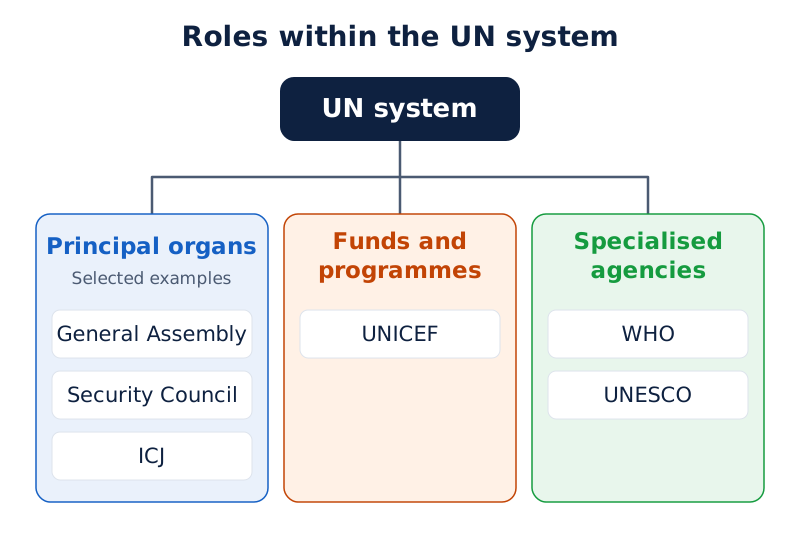
Put “UN system” above three labelled branches: “Principal organs”, “Funds and programmes” and “Specialised agencies”. Under the first, list General Assembly, Security Council and ICJ as selected examples; under the second, UNICEF; under the third, WHO and UNESCO.
Drawn by One Young India.
Label the organs as selected examples because the three listed are not the entire set of principal organs. The diagram groups institutions by type; it should not suggest that WHO or UNESCO is a department of UNICEF.
What is the meaning and significance of the Universal Declaration of Human Rights?
The Universal Declaration of Human Rights (UDHR) is a declaration of basic rights and freedoms belonging to all human beings. The UN General Assembly adopted it on 10 December 1948. A declaration is a formal statement of principles.
What does “universal” mean?
Universal means applicable to everyone. The Declaration recognises the equal dignity and rights of human beings. Its meaning does not depend on whether a person belongs to a powerful country or has a particular social position.
It sets a common standard for all peoples and nations. Rights are not limited by distinctions such as race, colour, sex, language, religion or national or social origin. Dignity means the inherent worth of a person, deserving respect.
The core idea is that all human beings are born free and equal in dignity and rights. The Declaration includes protection of life, liberty and security, as well as equal treatment before the law. Liberty means freedom.
How does this relate to the UN's wider purpose?
Promoting respect for human rights is one of the UN's objectives. The Declaration gives this commitment a common international expression. It links the treatment of individual people with the larger aims of freedom, justice and peace.
The UDHR is a declaration, not the UN Charter and not a court judgment. The Charter establishes the organisation and its structure; the Declaration expresses a common standard of human rights. Keeping these meanings separate avoids confusing different kinds of international documents.
It is also distinct from the ICJ. A declaration states principles, while a court performs judicial functions. Understanding the Declaration begins with its universal claim: people possess basic rights because they are human, rather than because a government regards them as deserving.
How does a timeline connect the UN's origins with its later development?
The creation of the UN involved several stages of international agreement. A timeline arranges events in date order. It helps distinguish wartime declarations, the signing of the founding document and the date when the organisation actually came into existence.
The Allied nations were the countries fighting against the Axis Powers, the wartime grouping led by Germany, Italy and Japan.
Which developments belong in sequence?
| Date | Development |
|---|---|
| August 1941 | United States President Franklin D. Roosevelt and British Prime Minister Winston S. Churchill signed the Atlantic Charter. |
| January 1942 | Twenty-six Allied nations supported the Atlantic Charter and signed the Declaration by United Nations. |
| December 1943 | The United States, Britain and the Soviet Union issued the Tehran Conference Declaration. |
| February 1945 | The Yalta Conference decided to organise a United Nations conference on the proposed world organisation. |
| 26 June 1945 | Fifty nations signed the UN Charter. |
| 15 October 1945 | Poland signed the Charter, bringing the original founding membership to fifty-one. |
| 24 October 1945 | The United Nations came into existence. |
| 30 October 1945 | India joined the United Nations. |
| 10 December 1948 | The General Assembly adopted the Universal Declaration of Human Rights. |
| 1965 | The Security Council expanded from eleven to fifteen members, retaining five permanent members. |
The early agreements preceded the formal establishment of the UN. The Atlantic Charter and Declaration by United Nations belong to its origins; they are distinct from the UN Charter signed in 1945.
The later entries show two different developments: a common statement of human rights and an enlargement of the Security Council. Neither should be confused with a new founding of the organisation. The Charter-signing date and the establishment date remain separate landmarks.
Who served as Secretary-General during the UN's development?
The Secretary-General is the UN's representative head and most visible public figure. The sequence of office-holders connects the organisation's early peace efforts with later work on development, human rights and climate change.
| Period in office | Secretary-General and country | Work or challenge |
|---|---|---|
| 1946 to 1952 | Trygve Lie, Norway | Worked for a ceasefire between India and Pakistan over Kashmir. |
| 1953 to 1961 | Dag Hammarskjöld, Sweden | Worked on the Suez Canal dispute and African decolonisation; received the Nobel Peace Prize posthumously in 1961 for efforts to settle the Congo crisis. |
| 1961 to 1971 | U Thant, Burma (Myanmar) | Worked to resolve the Cuban Missile Crisis and end the Congo crisis; established the UN Peacekeeping Force in Cyprus. |
| 1972 to 1981 | Kurt Waldheim, Austria | Worked on Namibia and Lebanon and oversaw relief operations in Bangladesh. |
| 1982 to 1991 | Javier Perez de Cuellar, Peru | Worked for peace in Cyprus, Afghanistan and El Salvador and negotiated for Namibia's independence. |
| 1992 to 1996 | Boutros Boutros-Ghali, Egypt | Issued An Agenda for Peace and conducted a successful UN operation in Mozambique. |
| 1997 to 2006 | Kofi A. Annan, Ghana | Created the Global Fund to fight AIDS, tuberculosis and malaria; received the Nobel Peace Prize in 2001. |
| 2007 to 2016 | Ban Ki-moon, Republic of Korea | Highlighted climate change, development goals, conflict resolution and nuclear disarmament. |
| From 1 January 2017 | António Guterres, Portugal | Took office as the ninth Secretary-General after serving as UN High Commissioner for Refugees. |
Guterres brought experience from national government and international refugee work. He had been Portugal's Prime Minister from 1995 to 2002 and UN High Commissioner for Refugees from 2005 to 2015.
Which historical sources trace the UN’s origins and changing priorities?
What do the wartime declarations record?
The Atlantic Charter of August 1941 records an agreement signed by Roosevelt and Churchill. In January 1942, twenty-six Allied nations supported it and signed the Declaration by United Nations. These documents trace cooperation before the UN became an organisation.
The Tehran Conference Declaration of December 1943 records another stage involving the United States, Britain and the Soviet Union. Read together, the declarations establish a sequence of wartime agreements, rather than a single founding event.
How do the Charter and the human rights declaration differ as evidence?
The UN Charter, signed on 26 June 1945, records the agreement through which the organisation was established. The Universal Declaration of Human Rights, adopted on 10 December 1948, expresses a common standard of rights for all peoples and nations.
These documents illuminate different purposes: establishing cooperation among states and affirming the dignity and rights of individuals. The Declaration includes life, liberty, security and equal protection of the law.
What evidence records demands for reform?
A General Assembly resolution adopted in 1992 reflected three complaints: the Security Council no longer represented contemporary political realities; its decisions reflected only Western values and interests and were dominated by a few powers; and it lacked equitable representation. On 1 January 1997, Kofi Annan initiated an inquiry into reform, including how new Council members should be chosen.
How do different groups view participation and reform in the UN?
What do India and advocates of wider representation seek?
India supports more permanent and non-permanent Security Council members, including greater representation for developing countries. Its argument links wider participation with stronger international support for Council decisions. The Council expanded from eleven to fifteen members in 1965, while permanent membership stayed unchanged.
Proposals also seek greater representation from Asia, Africa and South America. Supporters of African and South American permanent seats point to those continents' absence from the existing permanent membership.
What concerns do the United States and other Western countries emphasise?
The United States and other Western countries seek improvements in UN budgetary procedures and administration. This position concerns how the organisation manages its work, alongside the separate debate about which countries should have seats on the Security Council.
Why do critics of the veto differ from permanent members?
Critics of the veto see it as conflicting with democracy and sovereign equality. Some therefore favour abolition or modification. The five permanent members are unlikely to agree to removing this privilege, making agreement on reform difficult despite demands for a more equal system.
Glossary
- United Nations — An international organisation through which states cooperate for peace, security, development and respect for human rights.
- Charter — A founding document that sets out an organisation's purposes, structure and basic rules.
- General Assembly — The UN organ representing all member states, each possessing one vote in its deliberations.
- Security Council — The UN organ with primary responsibility for maintaining international peace and security.
- Veto — A permanent Security Council member's negative vote that can block a substantive decision.
- Abstention — A decision to vote neither for nor against a proposal under consideration.
- Sanctions — Restrictive measures, such as economic restrictions, intended to secure compliance with decisions.
- Jurisdiction — The authority of a court to hear and decide a case.
- Advisory opinion — Legal advice given by a court in response to a question from an authorised body.
- Specialised agency — An autonomous organisation linked to the UN by agreement and concerned with a particular field.
- Human rights — Basic rights and freedoms belonging to people because they are human beings.
- Universal Declaration of Human Rights — A declaration expressing a common standard of basic rights and freedoms for all peoples and nations.
Common errors and misconceptions
- Misconception: The UN was established on the day the Charter was first signed. Correct: The Charter was signed on 26 June 1945; the organisation came into existence on 24 October 1945.
- Misconception: A large country has more General Assembly votes. Correct: Each member state has one vote, regardless of its size or population.
- Misconception: All Security Council members possess the veto. Correct: Only the five permanent members possess it, and it applies to substantive decisions.
- Misconception: A permanent member's abstention is a veto. Correct: A veto requires a negative vote; abstention means voting neither for nor against.
- Misconception: The ICJ prosecutes individual criminals. Correct: It settles legal disputes between states and gives advisory opinions requested by authorised bodies.
- Misconception: UNICEF, WHO and UNESCO share one headquarters. Correct: Their headquarters are respectively New York, Geneva and Paris.
- Misconception: UNESCO works only on monuments. Correct: Its responsibilities include education, science, culture and the exchange of information and ideas.
- Misconception: The UDHR is the UN's founding Charter. Correct: It is a declaration of basic human rights adopted by the General Assembly in 1948.
Exam-style questions with model answers
Q1. The UN Charter, the organisation's founding document, was signed on 26 June 1945, and the organisation came into existence on 24 October 1945. Distinguish the two events and identify the date celebrated as United Nations Day. [2 marks]
- 26 June 1945 marks the signing of the UN Charter, the organisation's founding document.
- 24 October 1945 marks the establishment of the United Nations and is celebrated as United Nations Day.
Q2. Use these purposes to explain four UN objectives: peace and security through preventing threats and settling disputes peacefully; friendly relations based on equal rights and peoples choosing their political status; cooperation on economic, social, cultural and humanitarian problems and human rights; a common centre coordinating national efforts. [4 marks]
- The UN seeks to maintain international peace and security by helping prevent threats and encouraging peaceful settlement of disputes.
- It develops friendly relations among nations, respecting equal rights and peoples' ability to determine their political status.
- It promotes cooperation on shared economic, social, cultural and humanitarian problems while encouraging respect for human rights.
- It coordinates national efforts, giving countries a common centre through which to work towards these shared purposes.
Q3. A revision card lists four General Assembly responsibilities: discussion and recommendations on international cooperation within the Charter's scope; approving the UN budget and apportioning expenses; electing non-permanent Security Council members for fixed terms; admitting new members on the Security Council's recommendation. Explain each responsibility. [4 marks]
- The Assembly provides a forum for discussion of matters within the Charter's scope and makes recommendations to support international cooperation.
- It approves the organisation's budget and apportions expenses, giving it a responsibility for the UN's finances.
- It elects the Council's non-permanent members, allowing countries to serve for fixed terms in that smaller organ.
- It decides on admitting new member states after receiving the Security Council's recommendation, rather than acting alone in the admission process.
Q4. The Security Council has fifteen members: five permanent and ten non-permanent. Non-permanent members are elected by the General Assembly for two years. Each member has one vote. A substantive decision needs at least nine affirmative votes and no permanent member's negative vote; abstention is not a veto. Explain this structure and voting system in five points. [5 marks]
- The Council's fifteen seats combine five permanent members with ten non-permanent members, so it contains two categories of membership rather than one uniform category.
- The General Assembly elects the non-permanent members for two-year terms, allowing different countries to participate in the Council's work for a fixed period.
- Each Council member has one vote, but equal numbers of votes do not mean equal powers because permanent members also possess the veto.
- A substantive decision requires at least nine affirmative votes and no negative vote by a permanent member; such a negative vote can block it.
- A permanent member's abstention does not block the decision as a veto would, provided the required affirmative votes exist and no permanent member votes against it.
Q5. Use this information to describe the ICJ in five points: it sits at The Hague, Netherlands; has fifteen independent judges elected separately by the General Assembly and Security Council for nine years; settles legal disputes between states within its jurisdiction; and gives advisory opinions to authorised UN organs and specialised agencies. [5 marks]
- The International Court of Justice sits at The Hague in the Netherlands, which identifies the location of the Court described in the information.
- It consists of fifteen independent judges, so its membership is a body of judges rather than a gathering of government delegations representing their countries.
- Its judges are elected for nine-year terms by the General Assembly and Security Council, with the two bodies conducting their votes separately.
- It settles legal disputes between states within its jurisdiction, meaning the authority it possesses to hear and decide the cases before it.
- It gives advisory opinions, meaning legal advice on questions referred to it, when authorised UN organs or specialised agencies make the request.
Q6. Identify the three bodies described in this information and explain their distinct focus: UNICEF, the United Nations Children's Fund, is based in New York and works for children's welfare; WHO, the World Health Organisation, is based in Geneva and coordinates international health work; UNESCO, the United Nations Educational, Scientific and Cultural Organisation, is based in Paris and promotes cooperation in education, science and culture. [3 marks]
- UNICEF is the United Nations Children's Fund, based in New York. Its distinctive focus is the welfare and development of children.
- WHO is the World Health Organisation, based in Geneva. Its focus is international health coordination, rather than children's welfare alone.
- UNESCO is the United Nations Educational, Scientific and Cultural Organisation, based in Paris. Its focus combines education, scientific cooperation and culture.
Q7. The General Assembly represents all member states and makes recommendations; the Security Council has fifteen members and primary responsibility for peace and security; the ICJ consists of independent judges who settle legal disputes between states. Distinguish these three organs using the information given. [3 marks]
- The General Assembly is the broadly representative discussion organ, bringing together all member states and issuing recommendations on matters within its role.
- The Security Council is a smaller body of fifteen members with primary responsibility for maintaining international peace and security.
- The ICJ is a judicial body of independent judges, using law to settle disputes between states rather than serving as an assembly of governments.
Q8. The General Assembly adopted the UDHR on 10 December 1948 as a common standard of basic rights and freedoms for all peoples and nations. Explain its meaning and the word “universal”. [2 marks]
- The UDHR is a declaration expressing a common standard of basic human rights and freedoms.
- “Universal” means these rights belong to all human beings, rather than only to people of a particular nation.
Key takeaways
- The UN was established on 24 October 1945 to support peace, cooperation and improvements in people's social and economic conditions.
- The General Assembly represents all member states, each with one vote, and performs discussion, budgetary and electoral functions.
- The Security Council has fifteen members, including five permanent members who possess the veto over substantive decisions.
- A permanent member's negative vote can veto a substantive decision; its abstention does not have the same effect.
- The ICJ's fifteen independent judges settle legal disputes between states and give advisory opinions on questions referred by authorised bodies.
- UNICEF focuses on children, WHO on international health, and UNESCO on cooperation in education, science and culture.
- Remember the headquarters in matching order: UNICEF in New York, WHO in Geneva and UNESCO in Paris.
- The UDHR expresses a common standard of basic rights and freedoms belonging to every human being.
Test yourself
Why did the failure of the League of Nations matter?
It could not prevent the Second World War, encouraging the creation of a successor organisation for international peace and cooperation.
How many votes does each General Assembly member have?
Each member state has one vote, regardless of its size, population or number of representatives.
Name all five permanent members of the Security Council.
They are China, France, Russia, the United Kingdom and the United States.
How does abstention differ from a veto?
Abstention means voting neither for nor against. A veto is a permanent member's negative vote blocking a substantive Security Council decision.
Where is the ICJ, and how many judges does it have?
The Court is based at The Hague in the Netherlands and consists of fifteen independent judges.
Match UNICEF, WHO and UNESCO with their headquarters.
UNICEF is based in New York, WHO in Geneva and UNESCO in Paris.
How does UNESCO's work extend beyond heritage protection?
It also promotes education, literacy, scientific cooperation and the exchange of information and ideas.
What is the basic meaning of the UDHR?
It is a declaration of basic human rights and freedoms, setting a common standard for all peoples and nations.
Take this further
How does India make policy?
The Model NITI Aayog self-paced course: 41 chapters, about 19 hours of study, on how India makes policy, from the policy cycle and writing a white paper to the economy, the Union Budget and governance. It comes with Learnacy Essential.
Learnacy Essential is ₹1,499 for the year. It also adds feedback from an AI writing coach, submission to The OYI Review, World 101’s member tools and the 3D labs. Publication is not guaranteed. See what a year includes
Or create a free account to draft in the Writing Studio, explore World 101’s map and open the 2D version of every lab. Create a free account