
Business Environment | CBSE Class 12 Business Studies Notes
On this page

This note covers the meaning, features, importance and dimensions of the business environment, economic conditions in India, liberalisation, privatisation, globalisation, the effects of government policy changes, and demonetisation.
What is the business environment?
Definition: The business environment is the sum total of individuals, institutions and other forces outside the control of a business enterprise that may affect its performance.
A business operates within a wider setting. Its consumers, competitors, government, consumer groups, courts and the media exist outside its boundaries, yet can influence its activities. Economic, social, political and technological conditions also form part of this external environment.
For example, higher taxes can make purchases expensive. Technological improvements may make existing products obsolete. Political uncertainty may worry investors, while changing tastes may shift demand towards new products. Increased competition may reduce firms’ profit margins.
How did an environmental opportunity lead to an invention?
Dharamveer Kamboj, a rickshaw puller, returned to his village in Haryana after an accident. During visits to parts of Rajasthan, he saw women in self-help groups making gooseberry laddoos. Manually grating gooseberries on stone slabs was painful, while available machines were unaffordable for these small producers.
He recognised that cutting, grating, juicing and pulverising used similar techniques. This suggested a multipurpose processing machine that could make the work more affordable and safer. His limited formal education made the task difficult, but he continued developing the idea.
Worked example 1. Kamboj obtained ₹25,000 for his project. His first prototype, ready in March 2005, overheated, as did the second. The third solved this problem. GIAN North bought it and sent it to Kenya for a pilot. Feedback called for portability, so he incorporated foldable legs. He also added a sieve in the fourth machine to manage juice flow during extraction. Explain how these changes addressed users’ needs.
Answer: After his first prototype was ready in March 2005, he overcame overheating in the third and continued improving the machine. Feedback led to provision for portability, including foldable legs. He added a sieve in the fourth machine to manage juice flow during extraction.
The machine could process varied products without damaging their seeds. The case connects an observed social need with technological innovation and economic opportunity. It also shows how attention to users’ difficulties can improve the quality of working life.
What are the main features of the business environment?
The business environment has seven linked features. Together they explain why managers must observe external developments regularly and why a change cannot always be understood by examining a single influence in isolation.
- Totality of external forces: The environment includes all forces external to business firms. It is aggregative, bringing these influences together rather than referring to just one customer, institution or condition.
- Specific and general forces: Specific forces affect individual enterprises directly and immediately in their daily working. General forces influence business enterprises more widely and may affect a particular firm indirectly.
- Inter-relatedness: Environmental elements are closely connected. Increased life expectancy and health awareness raise demand for health products and services; new products and services, in turn, change lifestyles.
- Dynamic nature: The environment keeps changing through technological improvements, shifts in consumer preferences and the entry of new competitors.
- Uncertainty: Future developments are difficult to predict, especially where changes occur frequently, as in information technology and fashion.
- Complexity: Numerous changing, interrelated forces arise from different sources. The environment is relatively easier to understand in parts than in its totality.
- Relativity: The environment differs between countries and regions. Demand for sarees may be fairly high in India but almost non-existent in France.
How do specific and general forces differ?
| Basis | Specific forces | General forces |
|---|---|---|
| Effect | Direct and immediate influence on an individual enterprise | Wider influence that may affect an individual enterprise indirectly |
| Examples | Investors, customers, competitors and suppliers | Social, political, legal and technological conditions |
| Connection with operations | Affect day-to-day working directly | Form the broader setting in which enterprises work |
Keep dynamic nature, uncertainty and complexity distinct. Dynamic nature means change; uncertainty concerns predicting future events; complexity concerns understanding many connected influences. A change in product demand may involve social, economic, political, technological and legal factors whose relative effects are difficult to separate.
Why is understanding the business environment important?
An enterprise depends on its surroundings for survival and growth. Although an individual firm can do little to control many external forces, managers can understand, evaluate and respond to them. Environmental awareness supports both immediate decisions and future planning.
What advantages does environmental awareness provide?
- Identifying opportunities and gaining first-mover advantage: Opportunities are positive external trends or changes that help performance. Early recognition allows a firm to exploit them before competitors. Maruti Udyog recognised the need for small cars amid rising petroleum prices and a large middle-class population in India.
- Identifying threats and early warning signals: Threats are external changes that hinder performance. A foreign multinational entering the Indian market with new substitutes can warn existing firms to improve product quality, reduce production costs or advertise more actively.
- Tapping useful resources: Firms obtain finance, machinery, raw materials, power, water and labour from the environment. Understanding what resource providers offer and expect helps firms secure inputs and supply desired outputs.
- Coping with rapid changes: Managers need to examine less brand loyalty, market fragmentation, demanding customers, changing technology and global competition. Suitable action depends on understanding both the changes and their pace.
- Assisting planning and policy formulation: Analysis of opportunities and threats helps determine a future course of action and guidelines for decisions. The entry of new competitors may require an enterprise to reconsider its policies.
- Improving performance: Understanding the environment does appear to make a difference. Enterprises that continually monitor changes and adopt suitable practices improve present performance and continue succeeding for a longer period.
How does the exchange of inputs and outputs work?
A business takes resources from financiers, suppliers and other external providers. These providers expect something in return. The firm supplies goods and services to customers, taxes to government and returns on investment to investors. Its policies must connect available resources with outputs the environment desires.
Diagram
Business and its environment
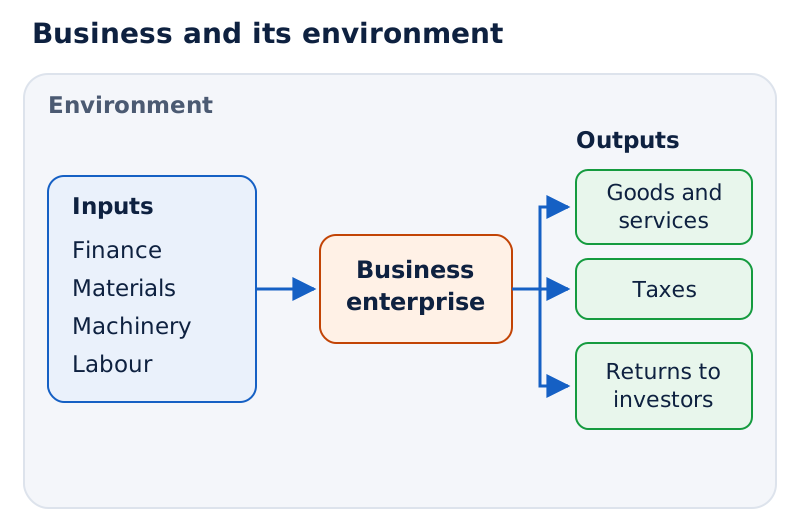
Draw a central box labelled Business enterprise. Show an incoming arrow for finance, materials, machinery and labour. Show outgoing arrows for goods and services, taxes and returns to investors. Label the surrounding area Environment.
Drawn by One Young India.
Opportunity and threat are different possible effects of external change. Recognising an opportunity is useful when the firm can act on it; recognising a threat provides time to prepare an appropriate response.
What are the dimensions of the environment, and how do economic factors work?
The five main dimensions are economic, social, technological, political and legal. These describe the general environment and mostly influence many enterprises at the same time. Managers benefit from understanding all of them because business decisions take place within their combined influence.
What the figure shows
Dimensions of Business Environment
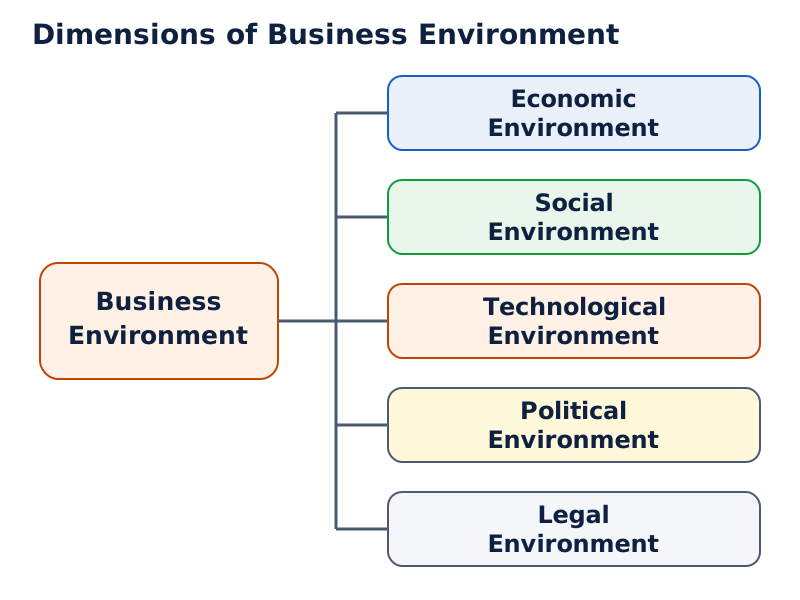
A central oval labelled Business Environment is surrounded by five segments. They are labelled Economic Environment, Social Environment, Technological Environment, Political Environment and Legal Environment.
Drawn by One Young India. Reference: NCERT Class 12, unnumbered diagram, p. 75
How do economic changes affect demand and costs?
The economic environment includes interest rates, inflation, disposable income, stock market indices and the value of the rupee. These factors can affect management practices, consumer spending and business costs.
| Economic change | Effect on business |
|---|---|
| Lower long-term interest rates | Encourage spending on homes and cars bought with borrowed money, benefiting construction and automobile businesses |
| Higher disposable income associated with growth in gross domestic product | Creates increasing demand for products |
| High inflation | Generally raises costs such as raw materials, machinery, wages and salaries |
Economic analysis also considers the structure of the economy and the relative roles of public and private sectors. Growth in national output and per capita income, saving and investment rates, imports and exports, and the balance of payments help describe this wider setting.
Other components include foreign exchange reserves, agricultural and industrial production trends, transport and communication facilities, money supply, public debt, and planned expenditure in the public and private sectors. These are broader conditions than the immediate actions of a particular supplier or customer.
The link between an economic factor and a business decision should be made explicit. For example, lower borrowing costs encourage purchases financed by loans. The resulting demand matters to firms producing the goods being purchased.
How does the social environment influence business?
The social environment includes customs, traditions, values, social trends and society’s expectations from business. Traditions are practices that have continued for decades or centuries. Values are ideas that society holds in high esteem.
Celebrations such as Diwali, Eid, Christmas and Guru Parv provide opportunities for greeting-card businesses, sweet and confectionery manufacturers, tailoring outlets and related enterprises. These opportunities arise from established social practices.
How do values and changing lifestyles affect decisions?
Individual freedom, social justice, equality of opportunity and national integration are important values in India. In business, they connect with freedom of choice, responsibility towards society and non-discriminatory employment practices.
The health-and-fitness trend among many urban residents has created demand for organic food, gyms, bottled mineral water and food supplements. This illustrates how social trends can produce business opportunities as consumption preferences change.
Other social elements include life expectancy, concern for quality of life, educational systems, literacy, birth and death rates, population shifts and family composition. Attitudes towards innovation, expectations from the workforce and shifts in women’s presence in the workforce also matter.
What the figure shows
Impact of shifts with the presence of women in the workforce
A woman using a computer is surrounded by drawings of clothes, electronic gadgets, cosmetics and packed food. The labels indicate a shift towards formal wear and packed food, and increased demand for electronic gadgets and cosmetics.
Reference: NCERT Class 12, unnumbered illustration, p. 78
The illustration links workforce participation with consumption habits. It presents several connected business effects of a social change, rather than a change confined to a single product. Recognising such connections helps explain the inter-relatedness of environmental elements.
How does technology create business opportunities and threats?
The technological environment consists of scientific improvements and innovations that provide new ways of producing goods and services and new methods of operating businesses. Technology influences production, communication, advertising, distribution and customer access.
Computerised information kiosks and web pages allow firms to present product information. Direct links between retailers and suppliers support replenishment when stocks are needed. Flexible manufacturing systems change production methods, while airline websites let customers check flights, destinations and fares and book tickets online.
What happens when new technology replaces older products?
Technological shifts create opportunities and threats. Demand has shifted from vacuum tubes to transistors, steam locomotives to diesel and electric engines, fountain pens to ballpoint pens, propeller aircraft to jets, and typewriters to computer-based word processors.
These changes open new areas of business while affecting demand for older products. Innovations in robotics, biotechnology, medicine, telecommunications, food preservatives and synthetic fuels similarly matter to many different enterprises.
An energy-efficient light bulb capable of lasting at least twenty times as long as a standard bulb offered a significant development for lighting businesses. Managers at General Electric and Phillips followed the research and used its findings profitably.
What the figure shows
Internet railway booking
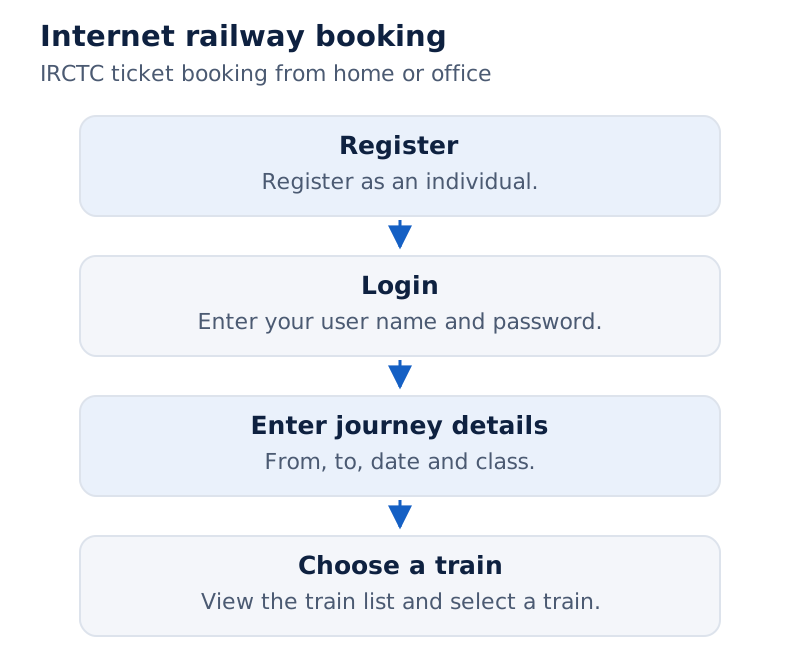
The Indian Railway Catering and Tourism Corporation guide shows registration and login instructions, journey-entry screens and a train-list screen. It illustrates booking railway tickets over the Internet from home or office.
Drawn by One Young India. Reference: NCERT Class 12, unnumbered illustrated guide, p. 79
The IRCTC example shows a change in how a service is accessed. The broader point is that technological awareness helps managers recognise developments capable of affecting demand, operating methods, growth and profitability.
How do political and legal conditions affect business?
The political environment includes stability, peace and elected representatives’ attitudes towards business. Stable conditions make business activities more predictable and build confidence for investment in long-term projects. Political unrest and threats to law and order may create uncertainty and weaken that confidence.
Relevant elements include the political system, the ideologies of major parties, political leadership, government institutions, the degree of intervention in business and relations with other countries. Officials’ attitudes may have either positive or negative effects on business.
How is the legal environment different?
The legal environment includes legislation, government administrative orders, court judgments and decisions of commissions and agencies at central, state and local levels. Management needs adequate knowledge of applicable rules because non-compliance can create legal problems.
| Dimension | Main concern | Illustration |
|---|---|---|
| Political | Stability, leadership and attitudes towards business | Peace and stability encourage confidence in long-term investment |
| Legal | Rules and authoritative decisions governing business conduct | Advertising requirements intended to protect consumer interests |
Examples of legal enactments relevant to the study of the business environment include the Companies Act 2013, Factories Act, 1948, Workmen’s Compensation Act, 1923, Industrial Disputes Act, 1947 and Competition Act, 2002. Such enactments are subject to amendment over time.
Consumer-protection examples include the prohibition on advertising alcoholic beverages, statutory health warnings associated with cigarettes, and the requirement for baby-food advertisements to inform buyers that mother’s milk is best. These illustrate how legal requirements influence business communication.
Note: Political and legal conditions are related, but their meanings differ. Political analysis examines stability and attitudes; legal analysis examines legislation, orders, judgments and other binding decisions affecting business conduct.
How did India’s economic environment develop before the 1991 reforms?
India’s economic environment includes macro-level factors concerning production and the distribution of wealth. Its mixed economy recognises both public and private sectors. Industrial, monetary and fiscal policies, economic planning, income distribution and infrastructure affect business and industry.
Economic indices include national income, growth of gross national product, per capita income, disposable personal income, saving and investment, exports and imports, and the balance of payments. Banks, financial institutions, transport and communication facilities form part of the infrastructure.
What conditions shaped the early development strategy?
At Independence, India was mainly agricultural and rural. About 70 per cent of the working population was employed in agriculture, and about 85 per cent of the population lived in villages. Production used low-productivity technology, while communicable diseases and high mortality created serious difficulties.
The government responded through state control of certain industries, central planning and a reduced role for the private sector. The main development objectives were:
- Promote rapid economic growth to raise living standards and reduce unemployment and poverty.
- Develop self-reliance and a strong industrial base, emphasising heavy and basic industries.
- Reduce inequalities of income and wealth.
- Adopt a socialist pattern of development based on equality and prevention of exploitation.
The public sector received the leading role in infrastructure industries. The private sector broadly took responsibility for consumer goods, while operating under numerous restrictions and controls. This planning experience produced mixed results.
Why did the crisis require policy action?
In 1991, India faced a serious foreign exchange crisis, a high government deficit and rising prices despite bumper crops. Foreign exchange reserves were barely sufficient for a few weeks of imports, while international confidence weakened.
Emergency measures included leasing gold to the State Bank of India (SBI) for sale with a repurchase option, and allowing the Reserve Bank of India (RBI) to pledge gold to the Bank of England to raise a loan. These events formed the background to economic reform.
What changes were introduced through the economic reforms?
The New Industrial Policy, announced in July 1991, formed part of the economic reform programme. It sought to reduce unnecessary controls, change the role of the public sector and encourage foreign participation in industrial development.
What were the broad policy measures?
- Reduced compulsory licensing: Licensing requirements were reduced, easing restrictions on industrial activity.
- Dereservation of industries: Many activities previously reserved for the public sector were opened up, while its reserved role became more limited.
- Disinvestment: Government stakes in a number of public sector industrial enterprises were reduced.
- Liberalised foreign capital policy: Foreign equity participation was increased, with 100 per cent foreign direct investment permitted in many activities.
- Technology agreements: Automatic permission was granted for technology agreements with foreign companies.
- Investment promotion: The Foreign Investment Promotion Board was established to promote and channelise foreign investment into India.
Measures also sought to remove obstacles to the expansion of large industrial houses. The small-scale sector received recognition and assurances of assistance. The direction of reform combined liberalisation, privatisation and globalisation.
Worked example 2. Under the reform policy announced in July 1991, unnecessary industrial controls were reduced, public-sector stakes were disinvested and foreign private participation was encouraged. Identify the three reform directions.
Answer: The 1991 measures represent liberalisation through reduced controls, privatisation through a greater private-sector role and reduced government stakes, and globalisation through increased foreign participation and integration with other economies.
The initial response to the crisis also included fiscal correction, changes to import arrangements and foreign exchange management, and efforts to attract funds. These measures addressed the immediate crisis while setting the direction for the continuing reform process.
When analysing the policy, distinguish an individual measure from the broader direction it supports. Reduced licensing concerns freedom from controls; disinvestment concerns government ownership; opening to international participation concerns connections with the world economy.
How do liberalisation, privatisation and globalisation differ?
The three terms refer to connected but distinct reform directions. Liberalisation reduces unnecessary restrictions, privatisation expands the private sector’s role, and globalisation integrates national economies into a more cohesive global economy.
What changes fall under liberalisation?
- Abolishing licensing requirements in most industries, apart from a short list.
- Allowing freedom to decide the scale of business and expand or contract activities.
- Removing restrictions on the movement of goods and services.
- Allowing freedom in fixing prices of goods and services.
- Reducing tax rates and removing unnecessary economic controls.
- Simplifying procedures for imports and exports.
- Making it easier to attract foreign capital and technology.
What do privatisation and disinvestment involve?
Privatisation gives the private sector a greater role in national development and reduces the public sector’s role. Reform included planned disinvestment and referral of loss-making and sick enterprises to the Board of Industrial and Financial Reconstruction.
Disinvestment involves transferring government stakes in public sector enterprises to the private sector. This dilutes government ownership. Distinguish a reduction in the government’s stake from a transfer of ownership and management.
What does a globalised economy imply?
Before 1991, India closely regulated imports through licensing, tariffs and quantitative restrictions. Trade reforms sought import liberalisation, export promotion, tariff rationalisation and foreign exchange reform. Technological advances and liberal trade policies increased interaction and interdependence between countries.
| Direction | Central change | Illustrative measure |
|---|---|---|
| Liberalisation | Greater freedom from unnecessary controls | Removal of most industrial licensing requirements |
| Privatisation | Greater role for private enterprise | Disinvestment of government stakes |
| Globalisation | Greater integration with the world economy | Import liberalisation and encouragement of foreign participation |
A truly globalised economy implies free flows of goods and services, capital, information and technology, and people across borders. It also implies a commonly acceptable mechanism for resolving disputes and a global governance perspective. These describe the idea of a boundaryless world economy.
How did government policy changes affect business and industry?
Liberalisation, privatisation and globalisation changed the setting in which Indian enterprises operated. Their effects included increased competition, more demanding customers, rapidly changing technology and a greater need for businesses to adapt.
What challenges and limitations of established practices emerged?
- Increasing competition: Enterprises faced stronger competitive pressures in the changed environment.
- More demanding customers: Businesses had to respond to customers whose requirements became more demanding.
- Rapid technological change: Enterprises faced a technological environment changing quickly.
- Necessity for change: Continuing with established practices required reconsideration as the environment changed.
- Human resource development: The new environment created a need to develop people within enterprises.
- Market orientation: Business decisions needed attention to market conditions and customer requirements.
- Loss of budgetary support: Public sector enterprises faced the loss of budgetary support in the changed environment.
What does the Krishna Furnishers Mart case show?
Worked example 3. Krishna Furnishers Mart began in 1954 and became a market leader through original designs and efficient operations. New entrants later reduced its market share. It decided to study market trends and develop products accordingly. Identify the two effects illustrated.
Answer: The enterprise established in 1954 faced increased competition as new entrants reduced its market share. Its decision to study trends before designing products shows market orientation: product development responds to the market.
The case links an external change with a managerial response. Original designs and efficiency had supported earlier success, but new competition led the firm to review operations. Its response connected analysis of demand with the design and development of products.
What was demonetisation, and what were its features and effects?
On 8 November 2016, the Government of India announced demonetisation of the existing ₹500 and ₹1,000 notes. They ceased to be legal tender except for specified purposes, such as utility payments. This invalidated 86 per cent of the money in circulation.
People had to deposit invalid currency in banks, while cash withdrawals were restricted. The measure aimed to curb corruption, counterfeiting, illegal use of high-denomination notes and the accumulation of black money from income not declared to tax authorities.
What were the four main features?
- Tax administration measure: Cash from declared income could be deposited and exchanged. Holders of black money had to declare unaccounted wealth and pay taxes at a penalty rate.
- Signal against tax evasion: The measure was interpreted as indicating that tax evasion would no longer be tolerated.
- Formal financial savings: It channelled savings into the formal financial system. Although much deposited cash was expected to be withdrawn, some new deposit schemes would continue providing a base for loans at lower interest rates.
- Less-cash economy: It sought to channel more savings through formal finance and improve tax compliance by encouraging a cash-lite economy.
What effects and practical limitations were identified?
| Area | Impact associated with demonetisation |
|---|---|
| Money and savings | Cash transactions declined; bank deposits and financial savings increased |
| Private wealth | Declined because some demonetised notes were not returned and real estate prices fell |
| Public sector wealth | No effect |
| Digitisation | Digital transactions among new users increased |
| Real estate | Prices declined |
| Tax collection | Income tax collection rose because disclosure increased |
Digital transactions require facilities such as customers’ mobile phones, merchants’ Point-of-Sale machines and Internet connectivity. These limitations have to be considered alongside the intended benefits of greater participation in formal finance, increased financial saving and reduced tax evasion.
Worked example 4. The existing ₹500 and ₹1,000 notes were demonetised on 8 November 2016. New ₹500 and ₹2,000 notes were issued. Awareness and use of Point-of-Sale machines, e-wallets and digital cash increased, while greater disclosure raised tax collection. Which dimensions are illustrated?
Answer: The withdrawal and replacement of currency in 2016 and the change in tax collection concern the economic environment. The increased use of electronic payment methods illustrates the technological environment.
Note: A less-cash or cash-lite economy means greater use of formal financial and digital channels. The aim described here is not the complete disappearance of cash.
Glossary
- Business environment — The totality of external individuals, institutions and forces that may influence the performance of a business enterprise.
- Specific forces — External forces, such as customers and suppliers, that directly and immediately affect an individual enterprise’s daily working.
- General forces — Wider conditions that influence business enterprises and may affect an individual firm indirectly.
- Inter-relatedness — The close connections between different elements of the business environment, through which changes influence one another.
- Relativity — The characteristic that business environments differ from country to country and from region to region.
- Opportunity — A positive external trend or change that helps a firm improve its performance.
- Threat — An external environmental trend or change that hinders the performance of a business enterprise.
- Economic environment — Economic factors affecting business, including interest rates, inflation, disposable income, stock market indices and the rupee’s value.
- Social environment — Social forces affecting business, including customs, traditions, values, social trends and society’s expectations.
- Technological environment — Scientific improvements and innovations that create new production methods and ways of operating businesses.
- Legal environment — Legislation, administrative orders, court judgments and decisions of government commissions and agencies affecting business.
- Liberalisation — The removal of unnecessary controls and restrictions on business and industrial activity.
- Privatisation — A reform direction giving the private sector a greater role and reducing the public sector’s role.
- Globalisation — Integration of different national economies towards a cohesive global economy with increased interaction and interdependence.
- Demonetisation — Withdrawal of the legal-tender status of specified currency notes, subject to any stated exceptions.
Common errors and misconceptions
- Misconception: The business environment means conditions inside the firm. Correct: It comprises external individuals, institutions and forces that may affect performance, even though they lie outside the firm’s control.
- Misconception: Specific and general forces affect firms in exactly the same way. Correct: Specific forces act directly and immediately; general forces have wider effects and may influence an individual firm indirectly.
- Misconception: Dynamic nature and uncertainty have identical meanings. Correct: Dynamic nature means continuous change. Uncertainty refers to the difficulty of predicting future developments, particularly when changes occur frequently.
- Misconception: Environmental awareness eliminates external threats. Correct: It helps identify threats early and prepare responses. An individual firm can do little to control many environmental forces.
- Misconception: Liberalisation means the removal of every industrial licensing requirement. Correct: Licensing was abolished in most industries, with a short list of exceptions remaining.
- Misconception: Privatisation and globalisation are interchangeable terms. Correct: Privatisation concerns the private sector’s role; globalisation concerns integration and interdependence between national economies.
- Misconception: Demonetisation aimed to eliminate all cash, and higher bank deposits meant all money would remain deposited. Correct: The aim included a less-cash economy, while much deposited cash was expected to be withdrawn.
Exam-style questions with model answers
Q1. Define business environment and name two specific forces that form part of it. [2 marks]
- The business environment is the totality of external individuals, institutions and forces outside an enterprise’s control that may affect its performance.
- Customers and suppliers are two specific forces because they directly and immediately affect the enterprise’s daily working.
Q2. Krishna Furnishers Mart became a market leader through original designs and efficient operations. New entrants later reduced its market share, so it decided to study market trends and design products accordingly. Identify and explain the two effects illustrated, and explain the importance of its environmental analysis. [3 marks]
- Increased competition: New entrants reduced the firm’s market share despite the original designs and efficient operations that had supported its earlier success.
- Market orientation: Studying trends and developing products accordingly connects the firm’s product decisions with conditions in the market.
- Planning and policy formulation: Analysing the changed environment helps the firm decide its future course of action and reconsider how to respond to competitors.
Q3. Explain the following three features of the business environment: inter-relatedness, uncertainty and relativity. [3 marks]
- Inter-relatedness: Different environmental elements are closely connected. A change in one can influence other elements, making their combined effects important to business decisions.
- Uncertainty: Future events are difficult to predict, particularly when environmental changes occur frequently. Managers cannot easily forecast such developments with certainty.
- Relativity: The business environment differs between countries and regions. Conditions relevant to enterprises in one place need not be the same elsewhere.
Q4. Explain four ways in which liberalisation increased freedom for Indian business: licensing, scale of operations, movement of goods and services, and pricing. [4 marks]
- Licensing: Requirements were abolished in most industries, apart from a short list. This reduced a major form of control over industrial activity.
- Scale: Firms received freedom to decide the scale of their operations, including expansion or contraction of business activities.
- Movement: Restrictions on the movement of goods and services were removed, reducing controls over their movement within the economy.
- Pricing: Firms gained freedom to fix prices of goods and services as part of the reduction of unnecessary controls.
Q5. Identify and explain the environmental dimension in each situation: lower long-term interest rates encourage purchases of homes on credit; festivals create demand for sweets; airline websites allow online ticket booking; political stability encourages long-term investment; baby-food advertisements must inform buyers that mother’s milk is best. [5 marks]
- Economic: Interest rates are an economic factor. Lower long-term borrowing costs encourage spending on homes bought with borrowed money and benefit construction businesses.
- Social: Festivals are established social traditions. Their celebration creates business opportunities for sweet makers and other enterprises responding to these practices.
- Technological: Online booking applies developments in computing and communications to the delivery of airline services and changes how customers access them.
- Political: General stability improves predictability and builds business confidence, encouraging investment in long-term projects.
- Legal: The requirement governing baby-food advertisements is a rule influencing business communication and intended to protect consumers’ interests.
Q6. Explain the six reasons why understanding the business environment is important for a business enterprise. [6 marks]
- Opportunities: Early identification of positive external trends enables a firm to exploit opportunities before competitors and obtain a first-mover advantage.
- Threats: Awareness provides early warning of external changes that could hinder performance, giving managers time to prepare suitable responses.
- Resources: Understanding external providers and their expectations helps the firm obtain inputs and supply outputs that the environment desires.
- Rapid changes: Environmental analysis helps managers examine fast changes in technology, customer preferences and competition and develop appropriate courses of action.
- Planning and policies: Analysis of opportunities and threats provides a basis for deciding future actions and framing guidelines for decisions.
- Performance: Continuous monitoring and adoption of suitable business practices help improve present performance and support success over a longer period.
Q7. State and explain the four main features of demonetisation as an economic policy measure. [4 marks]
- Tax administration: Declared cash could be deposited or exchanged, while holders of unaccounted wealth had to declare it and pay taxes at a penalty rate.
- Signal against evasion: Demonetisation indicated a government shift towards no longer tolerating or accepting tax evasion.
- Formal savings: It channelled savings into the banking system, with some deposits expected to provide a base for loans at lower interest rates.
- Less-cash economy: It encouraged greater use of formal financial channels and improved tax compliance as part of moving towards a cash-lite economy.
Q8. Kamboj observed women painfully grating gooseberries by hand because available machines were unaffordable. His first two processing-machine prototypes overheated; the third solved this. Feedback then prompted foldable legs for portability, and a sieve was added to the fourth machine to manage juice flow. Explain the opportunity recognised, the innovation, the response to a technical problem and the response to feedback. [4 marks]
- Opportunity: Painful manual processing and unaffordable existing machines revealed a need for a processing machine suited to these users.
- Innovation: Developing the processing machine applied a technological solution to the practical difficulties observed among the women workers.
- Technical response: Kamboj continued development after the first two prototypes overheated and resolved overheating in the third prototype.
- Feedback response: Foldable legs addressed portability, while the sieve in the fourth machine helped manage juice flow during extraction.
Key takeaways
- The business environment consists of external forces that may influence performance, even though they are outside the enterprise’s control.
- Its seven features include totality, specific and general forces, inter-relatedness, dynamic nature, uncertainty, complexity and relativity.
- Environmental understanding helps identify opportunities and threats, obtain resources, manage change, plan policies and improve performance.
- Economic, social, technological, political and legal dimensions describe the general environment and often influence many enterprises together.
- India’s economic reform programme changed industrial controls, public-sector participation, foreign investment arrangements and links with the world economy.
- Liberalisation reduces unnecessary controls, privatisation expands the private sector’s role, and globalisation increases integration and interdependence between economies.
- Policy changes brought greater competition, demanding customers, technological change, market orientation and a need to develop human resources.
- Demonetisation combined tax-administration objectives with efforts to channel savings into formal finance and move towards a less-cash economy.
Test yourself
Why is business environment described as aggregative?
It represents the sum total of forces external to business firms, bringing external influences together rather than referring to just one force.
How does complexity differ from uncertainty?
Complexity concerns understanding many interrelated forces together. Uncertainty concerns the difficulty of predicting future developments, especially when changes occur frequently.
What did Maruti Udyog’s small-car opportunity illustrate?
It illustrated early recognition of an opportunity and first-mover advantage, responding to rising petroleum prices and India’s large middle-class population.
Why can festivals create opportunities for businesses?
Established celebrations generate demand for goods and services such as greeting cards, sweets, confectionery and tailoring, linking social traditions with business opportunities.
How can high inflation constrain businesses?
It generally increases costs, including purchases of raw materials and machinery and the payment of wages and salaries to employees.
What is disinvestment?
It involves transferring government stakes in public sector enterprises to the private sector, thereby reducing the government’s ownership stake.
What did Krishna Furnishers Mart’s decision to study market trends demonstrate?
It demonstrated market orientation, as the firm decided to study trends and design products accordingly after new competitors reduced its market share.
Why does a cash-lite economy still raise practical challenges?
Digital transactions require facilities such as customers’ mobile phones, merchants’ Point-of-Sale machines and Internet connectivity, making access to these facilities important.
Write about it
Turn a question from this chapter into a paper.
The Writing Studio has a structure guide, a rubric and citation tools for 15 formats, from essays to research papers. Drafting is free with an account. Learnacy Essential adds feedback from an AI writing coach and submission to The OYI Review.
Learnacy Essential is ₹1,499 for the year. Publication depends on review and is not guaranteed.