
Business, Trade and Commerce | CBSE Class 11 Business Studies Notes
On this page
Watch & explore
Start with a few high-quality watches, then dive into the notes below.
Try an idea before you read. Let's test your understanding of business activities and economic pursuits. Explore →
This note covers economic activities, the development of Indian trade and banking, business characteristics, business, profession and employment, types of industry, commerce and trade, auxiliaries to trade, business objectives, innovation, business risks and the factors involved in starting an enterprise.
What is business and how does it differ from a non-economic activity?
Business is an economic activity involving the production and sale of goods and services with the motive of earning profit by satisfying human needs. Profit is the excess of revenue, or business income, over cost. Regular purchase, production or sale is central to business.
Economic activities enable people to earn their livelihood. A factory worker, a doctor working in a clinic, an office manager and a schoolteacher undertake economic activities. Such activities fall into three categories: business; profession, providing qualified expert services; and employment, working for an employer under a service agreement for salary or wages.
Non-economic activities arise from love, sympathy, sentiment, patriotism or similar motives. Cooking for one's family and helping an elderly person cross the road are examples. The purpose of an activity helps distinguish its economic character.
How do production, exchange, distribution and consumption connect?
Production makes goods and services available; purchase obtains them from others. Exchange transfers goods and services. Distribution, in this context, divides income among factors of production, the resources contributing to production. Consumption satisfies needs and wants through goods and services.
What the figure shows
Economic activities
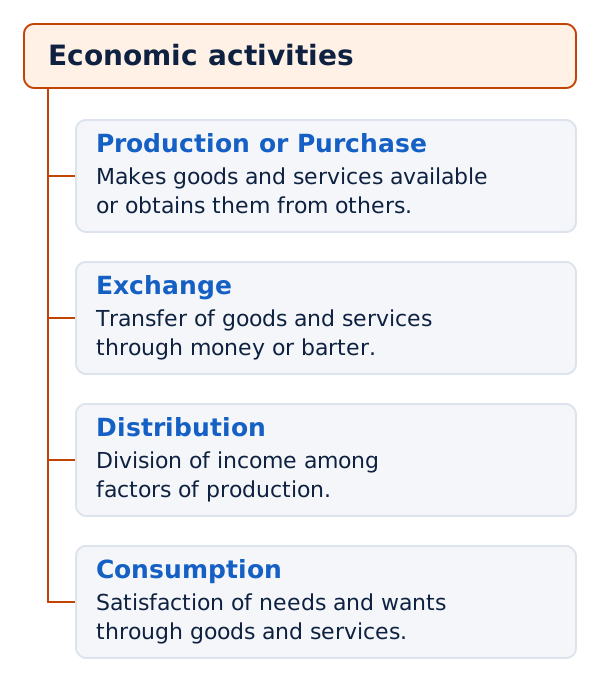
A central box labelled Economic Activities connects to four ovals: Exchange, Production or Purchase, Distribution and Consumption. Additional boxes connect exchange with transfer, distribution with division of income, and consumption with satisfaction of needs and wants.
Drawn by One Young India. Reference: NCERT Class 11, page 4, unnumbered
Barter exchanges goods or services for other goods or services. Exchange can therefore take place through money or barter. Business begins with production and extends to consumption: goods must reach the people who need them.
Business offers a career opportunity and contributes to the growth and development of a country as well as providing income.
How did trade and indigenous banking develop in India?
Trade contributed substantially to ancient India's prosperity. Goods travelled by land and water, including the Silk Route, a trading route, and maritime routes across the seas. Internal and foreign trade generated surplus income that supported further economic activity and investment.
Agriculture, animal domestication, cotton weaving, fabric dyeing, pottery, handicrafts, masonry and sculpting supported economic life. Family manufacturing workshops called karkhanas were important. Reinvestment of money encouraged an indigenous banking system, a locally developed system financing trade.
What advantages did hundis offer traders?
Hundi, literally meaning “to collect”, was a document written in a vernacular, or local, language to facilitate money transfers for trade. Chitties were also documents used for this purpose in the southern region. These arrangements reduced the dangers of carrying money over long distances.
As an instrument of exchange, the contract involved an unconditional promise or order for payment and could change hands through valid negotiation, meaning a valid transfer. Credit transactions, loans and advances expanded commercial operations and supplied additional funds to manufacturers, traders and merchants.
Darshani identifies the payment-on-presentation category; Muddati identifies the term-based category. The drawer issues the hundi, the holder possesses it, and the drawee is the party directed to pay. “Payable to order” allows payment as directed by the entitled person.
| Hundi form | Category | Payment arrangement |
|---|---|---|
| Dhani-jog | Darshani | Payable to any person, with no liability over who receives payment. |
| Sah-jog | Darshani | Payable to a specific respectable person, with liability over who receives payment. |
| Firman-jog | Darshani | Payable to order. |
| Dekhan-har | Darshani | Payable to the presenter or bearer. |
| Dhani-jog | Muddati | Payable to any person, with no liability over who receives payment, but payment over a fixed term. |
| Firman-jog | Muddati | Payable to order following a fixed term. |
| Jokhmi | Muddati | Drawn against dispatched goods; if goods are lost in transit, the drawer or holder bears the cost and the drawee has no liability. |
A favourable balance of trade means exports exceed imports. The Indian subcontinent enjoyed such a balance with large margins. Commercial and industrial banks later financed trade and commerce, while agricultural banks provided short-term and long-term loans to agriculturists.
Which trade centres and economic changes shaped Indian business?
Exports are goods sent to foreign markets; imports are goods brought from abroad. Major exports included spices, wheat, sugar, indigo, opium, sesame oil, cotton, parrots, live animals and animal products. Imports included horses, animal products, Chinese silks, linen, wine, gold, silver and copper.
What were the important trading centres?
| Centre | Commercial importance |
|---|---|
| Pataliputra | Present-day Patna; a commercial town and major centre for stone exports. |
| Peshawar | Exported wool and imported horses; important in India-China-Rome transactions in the first century. |
| Taxila | On the India-Central Asia land route, with financial and commercial banks and a major centre of learning. |
| Indraprastha | A commercial junction where most routes from different directions converged on the royal road. |
| Mathura | A trading centre touched by many routes from South India. |
| Varanasi | A textile centre famous for gold silk cloth and sandalwood workmanship, linked with Taxila and Bharuch. |
| Mithila | Traded through the Bay of Bengal and South China Sea; established trading colonies in South China, especially Yunnan. |
| Ujjain | Exported agate, carnelian, muslin and mallow cloth; linked by land with Taxila and Peshawar. |
| Surat | A centre of western trade during the Mughal period, famous for gold-bordered textiles; its hundi was honoured in Egypt and Iran. |
| Kanchi | Present-day Kanchipuram; Chinese traders bought pearls, glass and rare stones and sold gold and silk. |
| Madura | The Pandaya capital, associated with Gulf of Mannar pearl fisheries and overseas trade, particularly with Romans. |
| Broach | A major western commercial centre on the Narmada, connected by road to important markets. |
| Kaveripatta | Also Kaveripatnam; a centre for overseas trade and shipbuilding, with foreign traders' headquarters. |
| Tamralipti | A port connected with the West and Far East by land and sea, and by road with Banaras and Taxila. |
Travellers describing India's prosperity included Megasthenes, Faxian, Xuanzang, Al Beruni in the 11th century, Ibn Batuta in the 14th century and Frenchman Francois in the 17th century. Between the first and seventh centuries CE (Common Era), India is estimated to have had the largest ancient and medieval economy, controlling about one-third and one-fourth of the world’s wealth.
What dates mark the long-term economic timeline?
The timeline uses AD, meaning Anno Domini, for years in the Common Era. Regional contributions, industrial output and world income refer to different measures, so their percentages should not be treated as one uniform statistical series.
| Date | Timeline entry |
|---|---|
| 1 AD | 32%, the largest regional contribution. |
| 1000 AD | 32%, the largest regional contribution. |
| 1500 AD | 24.36%, second in regional share. |
| 1600 AD | 24.41%. |
| 1700 AD | 24.46%. |
| 1700 to 1750 AD | 25% of world industrial output. |
| 1850 AD | 5 to 10%. |
| 1870 AD | 9.2%, world income, British Empire. |
| 1900 AD | 2%, global industrial output. |
| 1913 AD | 5.4%, British Empire. |
| 1952 AD | 3.8% of world income. |
| 1973 AD | 3.1%. |
| 1991 AD | Economic liberalisation. |
What the figure shows
Economic timeline
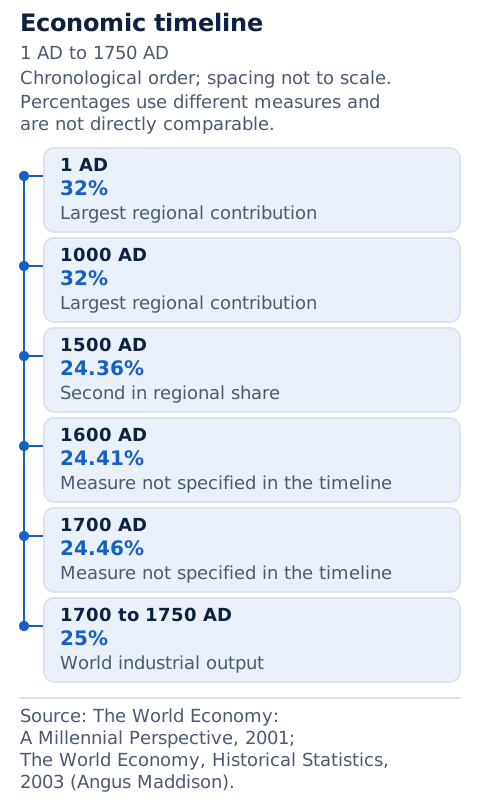
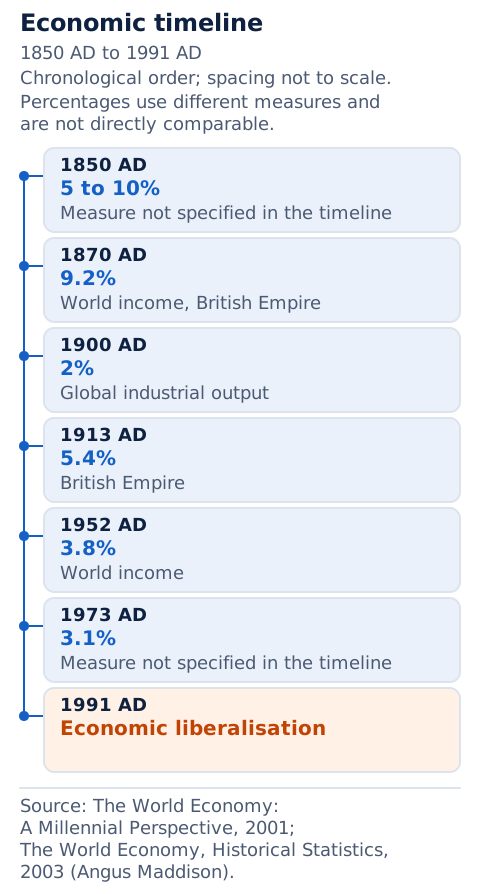
Connected rectangular boxes run across successive rows from 1 AD to 1991 AD. Labels mix percentages of regional contribution, world income and industrial output; the final box identifies economic liberalisation.
Drawn by One Young India. Reference: NCERT Class 11, page 6, unnumbered
How did the economy change over time?
Under British rule, the East India Company used provincial revenues to purchase Indian raw materials, spices and goods. India changed from an exporter of processed goods towards an exporter of raw materials and a buyer of manufactured goods.
After independence, centralised planning and public investment in basic and key industries supported rebuilding. Weak finances, inadequate infrastructure, population growth and payment difficulties contributed to the turn towards economic liberalisation, the reform of economic policies, in 1991.
The approach combined stabilisation, restructuring and globalisation: addressing instability, reorganising the economy and integrating it with the world economy. Policy changes covered taxation and expenditure, money and credit, trade, industry, agriculture, infrastructure, foreign exchange and foreign investment.
Make in India was launched on 25 September 2014 to encourage national and multinational companies to manufacture in India. Its major objectives were job creation and skill enhancement in 25 sectors. Make in India, Skill India and Digital India are expected to help exports, imports and a sustainable trade balance.
What are the main characteristics of business?
Business combines a livelihood motive, regular dealings and exposure to uncertain outcomes. Making a product alone does not establish that an activity is business: its purpose, sale or exchange, and regularity also matter. Business may operate individually on a small scale or through a larger organised enterprise.
- Economic activity: Business aims to earn money or livelihood, rather than being undertaken out of love, affection or sympathy.
- Production or procurement: A business makes goods or procures, meaning obtains, them from producers for further sale. Goods include daily-use items such as sugar and notebooks, and capital goods such as machinery and furniture. Capital goods serve business operations.
- Sale or exchange: Goods or services must be transferred for value. Production for personal consumption is not business.
- Regular dealings: Business involves repeated dealings. A single sale or purchase does not constitute business.
- Profit earning: Profit is one of the main purposes. Businesses seek to increase sales or reduce costs because they cannot survive for long without profit.
- Uncertainty of return: The amount to be earned in a given period is not known. Money invested in operations, called capital, does not guarantee profit.
- Element of risk: Risk is uncertainty associated with exposure to loss. Changes in tastes, production methods, competition, fire, theft and natural calamities can produce unfavourable outcomes.
How do the food and radio examples clarify these features?
Cooking food at home for the family is not business; cooking and selling food in a restaurant is business. The restaurant transfers food to buyers for value, whereas family cooking serves personal consumption.
Selling one's domestic radio set once, even at a profit, is not business. Selling radio sets regularly through a shop or from a residence is business. The distinction is regular dealing, rather than the location of the activity or profit from one transaction.
Note: Profit is an objective, not an assured result. Losses remain possible despite the best efforts of the business, and no business can altogether remove its risks.
How do business, profession and employment differ?
A profession provides personalised expert services requiring prescribed qualifications, expertise and training. Employment involves working under a service contract or rules laid down by an employer. An entrepreneur is a person who sets up a business. All three categories are economic activities, but their entry requirements, rewards and exposure to risk differ.
A code of conduct sets expected standards of behaviour. Transfer of interest concerns transferring one's interest in the occupation to another person; business permits it with some formalities.
| Basis | Business | Profession | Employment |
|---|---|---|---|
| Establishment | Entrepreneur's decision and legal formalities, if necessary. | Professional-body membership and certificate of practice. | Appointment letter and service agreement. |
| Work | Provision of goods and services to the public. | Personalised expert services. | Work under service contract or service rules. |
| Qualification | No minimum qualification necessary. | Prescribed qualifications, expertise and training compulsory. | Qualifications and training prescribed by the employer. |
| Return | Profit. | Professional fee. | Salary or wages. |
| Capital | Depends on size and nature. | Limited capital for establishment. | No capital required. |
| Risk | Uncertain and irregular profits; risk present. | Fee generally regular and certain; some risk. | Fixed and regular pay; no or little risk. |
| Transfer of interest | Possible with some formalities. | Not possible. | Not possible. |
| Code of conduct | No prescribed code of conduct. | Professional code applies. | Employer's behavioural norms apply. |
| Examples | Shop or factory. | Legal or medical profession and chartered accountancy. | Jobs in banks, insurance companies and government departments. |
The qualification and conduct distinctions do not cancel the legal formalities or social responsibilities attached to business. Similarly, professional income is generally regular and certain, while employment carries no or little risk. Neither description should be strengthened into an unlimited guarantee.
How are industries classified?
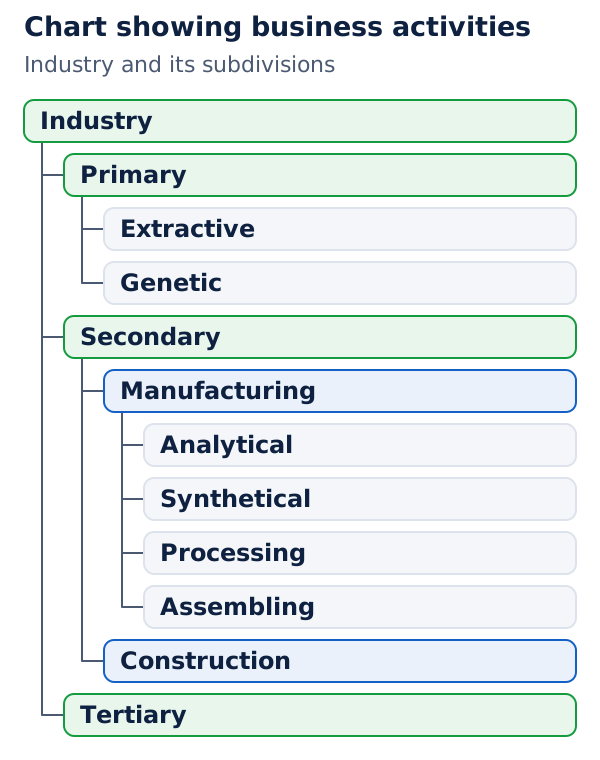
Industry covers activities converting resources into useful goods, including production, processing and breeding animals. Generally, industrial activities involve mechanical appliances and technical skills. The term also describes groups of firms producing similar goods, such as the cotton textile industry.
What distinguishes primary, secondary and tertiary industries?
| Industry | Meaning | Examples or subdivisions |
|---|---|---|
| Primary | Extraction and production of natural resources; reproduction and development of living organisms. | Extractive and genetic industries. |
| Secondary | Processing materials obtained from the primary sector for consumption or further processing. | Manufacturing and construction. |
| Tertiary | Support services for primary and secondary industries and trade. | Transport, banking, insurance, warehousing, communication, packaging and advertising. |
Extractive industries draw products from natural sources. Farming, mining, lumbering, hunting and fishing are examples. Their raw materials are mostly products of the natural environment and are usually transformed by manufacturing industries.
Genetic industries breed plants and animals for further reproduction. Seed and nursery companies, cattle-breeding farms, poultry farms and fish hatcheries belong here. Construction industries build roads, bridges, buildings, dams, tunnels and canals using engineering and architectural skills.
What are the four types of manufacturing?
Manufacturing processes raw or partly finished materials into products. It creates form utility, usefulness obtained by changing the form of materials. Mining iron ore is primary industry; processing it to manufacture steel is secondary industry.
| Type | Method | Example |
|---|---|---|
| Analytical | Separates different elements from the same material. | Oil refinery. |
| Synthetical | Combines different ingredients into a new product. | Cement. |
| Processing | Uses successive manufacturing stages. | Sugar and paper. |
| Assembling | Joins component parts to make a product. | Television, car and computer. |
Tertiary activities provide services. As business activities, they may be considered part of commerce because they assist trade. Thus, describing banking as an industry in common usage is compatible with treating it as an auxiliary to trade.
What is commerce and how is trade classified?
Commerce includes trade and the activities that facilitate exchange. Trade means the sale, transfer or exchange of goods, whether physical or virtual. Auxiliaries to trade are supporting activities such as transport, banking, insurance, warehousing and advertising.
Commerce links producers with consumers and maintains the flow of goods and services. Large-scale producers find it difficult to reach individual buyers themselves. Traders help make their goods available in different markets, supporting production on a large scale.
Which branches appear under trade?
Internal trade takes place within a country, while external trade takes place across national boundaries. Internal trade includes wholesale, buying and selling goods and services in large quantities for resale or intermediate use, and retail, selling to final consumers. External trade includes import, export and entrepot, importing goods for re-export.
What the figure shows
Chart showing business activities
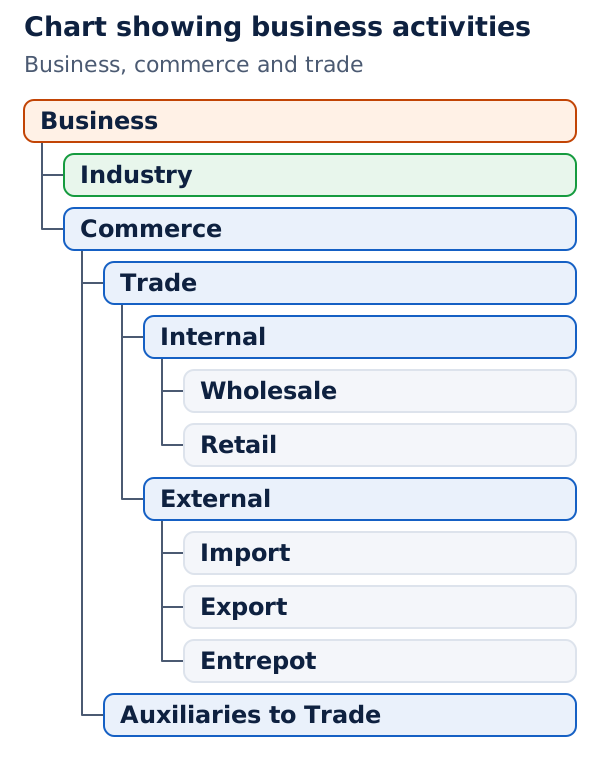
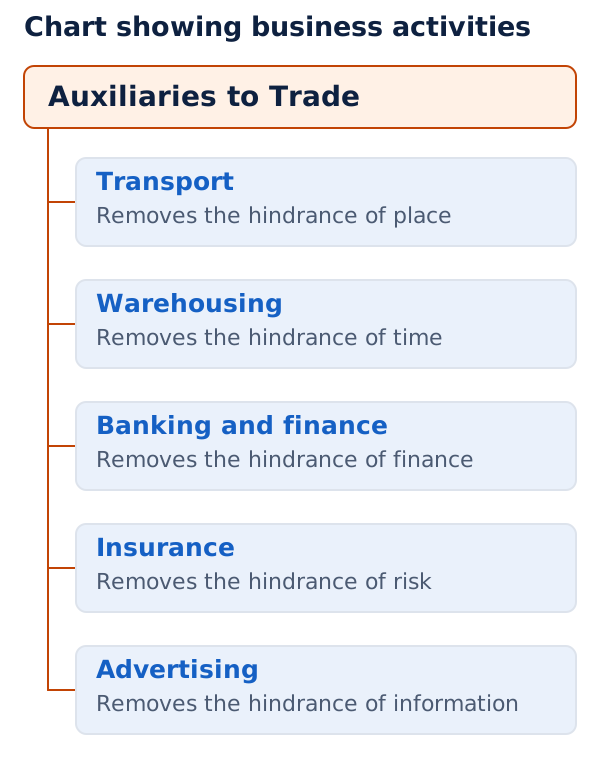
Business branches into Industry and Commerce. Commerce divides into Trade and Auxiliaries to Trade. Trade divides into Internal and External, followed by Wholesale and Retail, and Import, Export and Entrepot respectively.
Drawn by One Young India. Reference: NCERT Class 11, page 14, unnumbered
How does commerce remove hindrances?
A hindrance is an obstacle to exchange.
| Hindrance | Activity | Contribution |
|---|---|---|
| Persons | Trade | Transfers goods from producers towards consumers. |
| Place | Transport | Moves goods to the market where they are needed. |
| Time | Storage and warehousing | Holds goods until required. |
| Risk | Insurance | Protects against risks of loss or damage. |
| Finance | Banking and finance | Provides capital for business activities. |
| Information | Advertising | Informs consumers about available goods and services. |
These obstacles explain why buying and selling alone do not cover the whole of commerce. Supporting services also assist industry and therefore contribute to business as a whole.
How do auxiliaries to trade support business?
How do transport, communication and banking help?
Transport moves raw materials to production centres and finished goods to consumers. Tea is mainly produced in Assam; cotton in Gujarat and Maharashtra; jute in West Bengal and Odisha; and sugar in Uttar Pradesh, Bihar and Maharashtra. Consumption takes place across different regions.
Road, rail and coastal shipping overcome distance. Communication, the exchange of information, connects producers, traders and consumers. Postal services and telephone facilities support these exchanges alongside the physical movement of goods.
Banking and finance provide funds for assets, raw materials and expenses. Banks generally lend through loans, advances, overdrafts and cash credit. An overdraft permits withdrawal beyond an account balance; cash credit permits borrowing up to an agreed limit.
Banks collect cheques, transfer funds and discount bills, meaning provide money against bills before their payment date. They help exporters collect money from importers and help company promoters, the people organising a company, raise capital from the public.
How do insurance and warehousing help?
Insurance provides protection against risks affecting buildings, machinery, furniture, goods and employees. A premium is the payment for insurance protection. On paying a nominal premium, loss or damage and compensation for injury, if any, can be recovered from the insurer.
Warehousing stores goods safely until required. Usually, goods are not sold or consumed immediately after production. Storage creates time utility, availability when needed, and helps prevent loss or damage. Continuous supply helps maintain reasonable prices.
How do advertising and public relations differ?
Advertising is paid promotion through space in print or non-print media. Public relations (PR) involves strategic communication to build mutually beneficial relationships and is normally unpaid. A press release, an announcement supplied to the media, is a popular PR tool.
Both activities inform potential customers and encourage purchases. They communicate features, usefulness, quality, prices and competitive information. Producers and traders cannot practically contact every customer individually, so advertisements and publicity help them reach the market.
Note: Advertisements are always paid activities; public relations activities are normally unpaid. “Normally” allows exceptions and should not be replaced with “always”.
Why does business need profit and multiple objectives?
Objectives are the results business people seek from their activities. Profit is a leading objective, but enterprises also need to meet social responsibilities to survive and prosper. Specific objectives help a business review performance and decide how to improve.
What advantages does profit provide?
- Income: Profit provides income to business people for their entrepreneurial activity.
- Expansion: It can finance the additional resources needed for business growth.
- Efficiency: It indicates how efficiently the business is working.
- Social approval: It can be taken as society's approval of the usefulness of business.
- Reputation: Profit builds the reputation of the business enterprise.
What are the limitations of pursuing profit alone?
Excessive attention to immediate profit may cause managers to neglect customers, employees, investors and society. It may encourage exploitation, provoking non-cooperation or opposition. The enterprise might then lose business and may become unable to earn profit.
Which six objectives support survival and prosperity?
| Objective | Meaning and purpose |
|---|---|
| Market standing | Goodwill, reputation and identity relative to competitors; strengthened through competitive products, reasonable prices and customer satisfaction. |
| Innovation | Introducing new ideas or methods in products, services or the skills and activities used to supply them. |
| Productivity | Efficiency assessed by comparing the value of output with the value of inputs. |
| Physical and financial resources | Acquiring and efficiently using facilities such as plants, machines and offices, together with required funds. |
| Earning profits | Earning reasonable profit on the capital employed to support survival and growth. |
| Social responsibility | Contributing resources to solve social problems and working in a socially desirable way. |
Profitability relates profit to capital investment. It differs from simply stating the amount of profit. Productivity compares output, what production produces, with inputs, the resources used. Efficient use of resources helps continuing survival and progress.
How does Dipak Bharali's Chaneki case illustrate innovation?
Innovation includes introducing new ideas or methods and modifying existing products to improve their operation. It does not require manufacturing an entirely new product. Innovation can concern products and services or the skills and activities involved in supplying them.
What problem did the silk-weaving business face?
In Sualkuchi, in Assam's Kamrup district, silk weavers performed weft insertion, also called buta weaving in this case, to create motifs or designs. The process required concentration and precision, was physically and mentally exhausting, and restricted productivity and extra work.
Dipak Bharali bought a silk-weaving loom and started a business. Income was quite good, but expansion appeared to require buying more looms. He sought another means of progress instead of simply increasing the number of looms.
How did the innovation change production?
- Memories of childhood experiments with magnets, nails and safety pins helped trigger his idea for a device.
- After 80 tries, he developed Chaneki to automate weft insertion.
- The device used recyclable materials and made the machine run 40 times faster than manual insertion of motifs.
- Weavers mastered the device and increased output; productivity and quality improved, pleasing owners and weavers.
The case connects innovation with growth, productivity and product quality. It also illustrates why business requires several objectives: a change in production methods can improve resource use and output while supporting the enterprise's expansion.
Note: The “40 times faster” comparison concerns machine operation relative to manual weft insertion of motifs. It does not establish that revenue, profit or the whole business increased fortyfold.
What is business risk and what causes it?
Definition: Business risk is the possibility of inadequate profits or losses because of uncertainties or unexpected events. Uncertainty means lack of knowledge about what will happen in the future.
Demand may fall when tastes change or competition increases. A shortage of raw materials may raise their price; the resulting increase in production cost may reduce profit. These examples explain how market changes affect business returns without making every outcome certain.
How do speculative and pure risks differ?
| Type | Possible outcomes | Examples |
|---|---|---|
| Speculative risk | Gain or loss. | Changes in demand, supply, prices, fashion and tastes. |
| Pure risk | Loss or no loss. | Fire, theft and strike. |
Favourable market conditions are likely to produce gains; unfavourable conditions may produce losses. With pure risk, non-occurrence of the harmful event explains the absence of loss, rather than a gain.
What are the four characteristics of business risk?
- Essential to business: Every business has risk. It can be minimised but cannot be eliminated.
- Based on uncertainty: Future demand, policies, technology and natural events cannot be known completely.
- Dependent mainly on nature and size: Fashionable goods involve high risk; a large-scale business generally faces greater risk than a small-scale business.
- Rewarded by profit: Greater risk means a higher chance of profit. Entrepreneurs accept risk in expectation of higher profit, not with certainty of receiving it.
Which causes create business risk?
| Cause | Examples |
|---|---|
| Natural | Flood, earthquake, lightning, heavy rain and famine; human control over natural calamities is limited. |
| Human | Dishonesty, carelessness, employee negligence, work stoppage due to power failure, strikes, riots and inefficient management. |
| Economic | Demand, competition, prices, recovery of customer dues, technology, production methods, higher borrowing interest and higher taxes. |
| Other | Political disturbances, mechanical failures such as a boiler bursting, and exchange-rate fluctuations, meaning changes in one currency's value against another. |
What factors should an entrepreneur consider when starting a business?
Entrepreneurship is the process of setting up one's own business. It involves identifying a need, mobilising resources and organising production to give value to customers, returns to investors and profit to the entrepreneur while accepting business uncertainty.
The resulting business unit is a business enterprise. Entrepreneurship creates self-employment and expands opportunities for employment and professional activity. Starting a business requires interaction between individual interests and abilities and conditions in the business environment.
Which decisions precede the launch?
- Type of business: Consider customer requirements, possible profits, technical knowledge and personal interest when choosing an industrial or commercial activity.
- Size: Assess the scale of operations. A large start is possible if demand is likely to remain good and the entrepreneur can arrange the necessary capital.
- Location: Consider raw materials, labour, power, banking, transport, communication and warehousing. A poor location can raise costs and make obtaining inputs or serving customers inconvenient.
- Finance: Arrange capital both to start and continue operations. Funds are needed for fixed assets, long-use resources such as land, buildings and machinery, and current assets, resources such as raw materials and finished stock, as well as daily expenses.
- Physical facilities: Plan buildings, machinery, equipment and supporting services according to the nature and size of the business, available funds and production process.
- Workforce: Identify skilled and unskilled workers and managerial staff. Plan training and motivation so that employees can convert resources into desired outputs.
- Tax planning: Consider tax liability, the taxes the business must pay, and how different tax laws influence decisions.
- Launch: Mobilise resources, complete legal formalities, begin production and start sales promotion after taking the preceding decisions.
Financial planning determines the amount of capital required, its sources and the best ways to use it. These questions connect the initial idea with the practical ability to establish and operate an enterprise.
Glossary
- Business — Economic activity producing and selling goods and services for profit by satisfying human needs.
- Economic activity — Activity through which people earn money or obtain their livelihood.
- Hundi — Traditional document facilitating transfer of money between parties for trading activities.
- Profession — Occupation providing personalised expert services based on prescribed qualifications and training.
- Employment — Work performed for an employer under a service contract or rules for salary or wages.
- Industry — Economic activities converting resources into useful goods through production, processing or related operations.
- Commerce — Trade and supporting activities that facilitate exchange between producers and consumers.
- Auxiliaries to trade — Supporting services that facilitate trade and remove obstacles to business activities.
- Innovation — Introduction of new ideas or methods in making or doing something.
- Productivity — Efficiency assessed by comparing the value of output with the value of inputs.
- Profitability — Profit considered in relation to the capital invested in a business.
- Social responsibility — Business obligation to contribute towards solving social problems and act in socially desirable ways.
- Business risk — Possibility of inadequate profits or losses arising from uncertainties or unexpected events.
- Entrepreneurship — Process of establishing a business by identifying needs, mobilising resources and organising production.
- Public relations — Normally unpaid strategic communication intended to build mutually beneficial relationships.
Common errors and misconceptions
- Misconception: Every activity involving effort is business. Correct: Business is an economic activity; family cooking and help motivated by sympathy are non-economic activities.
- Misconception: Selling a domestic radio once at a profit establishes a business. Correct: Business requires regular dealings in goods or services.
- Misconception: Commerce means only buying and selling. Correct: It includes trade and auxiliaries such as transport, banking, insurance and warehousing.
- Misconception: Mining iron ore and manufacturing steel belong to the same industrial category. Correct: Mining is primary industry; steel manufacturing is secondary industry.
- Misconception: Profit is the sole business objective. Correct: Innovation, productivity, market standing, resources and social responsibility also support survival and prosperity.
- Misconception: Pure risk offers a chance of gain. Correct: Pure risk involves loss or no loss; speculative risk offers gain or loss.
- Misconception: Higher risk guarantees higher profit. Correct: It creates a higher chance of profit; uncertainty and possible loss remain.
- Misconception: Public relations is always unpaid. Correct: It is normally unpaid, whereas advertising is always paid.
Exam-style questions with model answers
Q1. A person sells a domestic radio set once at a profit. Another sells radio sets regularly through a shop. Identify which activity is business and explain the distinction. [2 marks]
- The one-time sale of a domestic radio is not business because an isolated sale does not constitute regular dealing.
- Regular sale of radio sets through a shop is business because it involves repeated dealings in goods for earning profit.
Q2. Distinguish business, profession and employment on the bases of establishment, return and risk. [3 marks]
- Establishment: Business begins with an entrepreneur's decision and necessary legal formalities; profession requires professional-body membership and a practice certificate; employment requires an appointment letter and service agreement.
- Return: Business yields profit, profession earns a professional fee, and employment provides salary or wages.
- Risk: Business profits are uncertain and irregular; professional fees are generally regular and certain with some risk; employment provides fixed, regular pay with no or little risk.
Q3. An oil refinery separates elements from the same material; cement production combines ingredients; sugar production uses successive stages; car production joins component parts. Classify each manufacturing activity and explain why. [4 marks]
- The oil refinery is an analytical industry because it separates different elements from a common material.
- Cement production is a synthetical industry because it combines various ingredients to create a new product.
- Sugar production is a processing industry because manufacturing passes through successive stages before obtaining the finished product.
- Car production is an assembling industry because it brings together separate component parts to produce the final product.
Q4. Explain five ways in which profit is important to a business. [5 marks]
- Income: Profit is a source of income for business people. It provides a return from their involvement in the enterprise's activities.
- Expansion finance: Profit can supply funds for business expansion. It can help meet the enterprise's requirements as its operations grow.
- Efficiency: Profit indicates efficient working. It therefore helps in understanding how well the enterprise conducts its business activities.
- Social approval: Profit can be taken as society's approval of the utility of business, reflecting the usefulness of what it provides.
- Reputation: Profit builds the reputation of the enterprise. Its significance extends beyond immediate income to the business's standing and continuing prosperity.
Q5. Explain how commerce removes the six hindrances of persons, place, time, risk, finance and information. [6 marks]
- Persons: Trade makes goods available to consumers from producers by facilitating their sale, transfer or exchange.
- Place: Transport carries goods from production centres to markets, making products available where consumers need them.
- Time: Warehousing stores goods until required, bridging the interval between production and their sale or consumption.
- Risk: Insurance protects against loss or damage affecting goods in stock or transit through events such as fire, theft and accidents.
- Finance: Banking and financial institutions provide capital needed for acquiring assets, obtaining raw materials and meeting business expenses.
- Information: Advertising informs consumers about available goods and services, including their features and prices, and encourages them to buy particular items.
Q6. Dipak Bharali's silk-weaving business faced slow manual weft insertion. After 80 tries he developed Chaneki using recyclable materials. It made machine operation 40 times faster than manual motif insertion, and weavers increased output and quality. Identify the principal business objective and explain two contributions to growth. [3 marks]
- The principal objective is innovation: Chaneki introduces a new method for performing weft insertion rather than simply expanding through additional looms.
- It improves productivity by speeding up the insertion process and enabling weavers to increase output through an improved production method.
- It improves quality, pleasing owners and weavers. Together with increased output, this supports the growth of the silk-weaving enterprise.
Q7. Explain natural, human, economic and other causes of business risk, giving examples of each. [4 marks]
- Natural causes: Floods, earthquakes, lightning, heavy rains and famine create risks; human beings have little control over natural calamities.
- Human causes: Employee dishonesty or negligence, strikes, riots, management inefficiency and work stoppage due to power failure can disrupt business.
- Economic causes: Uncertainty about demand, competition, prices, customer payments, technology, borrowing interest and taxes can affect returns or costs.
- Other causes: Political disturbances, mechanical failures such as a boiler bursting, and exchange-rate fluctuations create additional uncertainty and possible business loss.
Q8. Explain six factors to consider before starting a business: type, size, location, finance, physical facilities and workforce. [6 marks]
- Type: Select an activity by considering customer requirements, potential profits, technical knowledge and the entrepreneur's interest in producing the proposed product.
- Size: Choose the scale after assessing likely demand and available capital. Large-scale operation requires confidence in demand and access to necessary funds.
- Location: Assess raw materials, labour, power and supporting services. A poor choice can raise production costs and make serving customers inconvenient.
- Finance: Arrange funds to start and continue operations, covering fixed assets, current assets and the expenses of day-to-day business activity.
- Physical facilities: Plan buildings, machinery, equipment and services according to the nature and size of operations, available funds and production process.
- Workforce: Determine skilled, unskilled and managerial staffing requirements and plan employee training and motivation to achieve the desired output.
Key takeaways
- Business combines regular economic dealings, production or procurement, sale or exchange, a profit motive and uncertain returns.
- India's historical trade supported indigenous banking, while hundis facilitated money transfers and reduced the dangers of carrying money.
- Business, profession and employment differ in establishment, qualifications, capital requirements, rewards, risk and rules of conduct.
- Industry covers primary, secondary and tertiary activities; manufacturing includes analytical, synthetical, processing and assembling operations.
- Commerce includes trade and auxiliaries that overcome obstacles of persons, place, time, risk, finance and information.
- Profit supports survival and expansion, but business also needs innovation, productivity, market standing, resources and social responsibility.
- Business risk cannot be eliminated; its degree depends mainly on the nature and size of the enterprise.
- Starting a business requires decisions about type, size, location, finance, facilities, workforce, taxes and the actual launch.
Test yourself
Why is cooking food for the family not business?
It is undertaken for personal consumption and family needs rather than sale or exchange for earning profit.
What does a favourable balance of trade mean?
Exports exceed imports. Such a balance supported the prosperity of the Indian subcontinent's trading economy.
How does genetic industry differ from extractive industry?
Genetic industry breeds plants and animals for further reproduction; extractive industry draws products from natural sources.
Which auxiliary creates time utility, and how?
Warehousing creates time utility by storing goods safely and making them available when they are required.
What is the difference between productivity and profitability?
Productivity compares the value of output with the value of inputs; profitability relates profit to capital investment.
Why is absence of fire not a speculative gain?
Fire is a pure risk. Its non-occurrence means absence of loss rather than a gain from favourable market conditions.
Why does a larger business not necessarily earn higher profit?
A larger business generally faces higher risk, but risk creates only a chance of profit. Actual returns remain uncertain.
What happens when the enterprise is launched?
Resources are mobilised, necessary legal formalities completed, production started and the sales promotion campaign initiated.
Try it
Business, Trade and Commerce
Let's test your understanding of business activities and economic pursuits.
1According to the text, which situation would NOT be considered a business activity?
This IS a business activity. The text states that dealing in goods 'on a regular basis' through a shop or from home constitutes business.
Correct! The text explicitly states: 'A single transaction of sale or purchase does not, by itself, make a business. For example, if a person sells their old mobile phone once, even at a profit, it is not a business activity.'
This IS a business activity. The text describes business as involving 'production or procurement of goods and services' for sale.
2Based on the text, what specifically distinguishes a profession from business and employment?
This describes business, not profession. The text defines business as economic activities 'connected with the production, or purchase and sale of goods, or the supply of services, with the main object of earning profit.'
Exactly right. The text states profession 'includes those activities that require special knowledge and skill to be applied by individuals in their occupation' and are 'generally governed by guidelines or codes of conduct laid down by professional bodies.'
This describes employment, not profession. The text defines employment as 'an occupation in which people work for others and get paid a salary.'
You've completed the scenario!