
Gender, Religion and Caste | CBSE Class 10 Political Science Notes
On this page
Try an idea before you read. Test your understanding of how social differences operate in democratic politics. Explore →
This note covers gender roles, the sexual division of labour, discrimination against women, political representation, religion in politics, communalism, secularism, caste inequalities, caste in elections, and the effects of politics on caste identities.
How does the division between public and private life create gender inequality?
Gender division is a hierarchical social division based on social expectations and stereotypes. Unequal roles assigned to women and men are often treated as natural and unchangeable, although these roles are socially created rather than determined by biology.
What is the sexual division of labour?
Definition: The sexual division of labour is a system in which women do the work inside the home or organise it through domestic helpers.
Children are often brought up to regard housework and bringing up children as women's main responsibilities. Cooking, cleaning, washing clothes and caring for children are associated with women, while work outside the home is associated with men.
This division does not reflect an inability of men to perform domestic tasks. Men often undertake similar activities when payment is involved, as in tailoring or cooking in hotels. The contrast shows how social expectations shape the value attached to work.
Women also work outside the home. In villages they fetch water, collect fuel and work in fields. In towns, poor women may work as domestic helpers, while middle class women work in offices. Paid employment can therefore exist alongside substantial domestic responsibilities.
Why does unpaid work matter politically?
Unpaid domestic labour often receives little recognition. A woman may work throughout the day without her contribution being valued in the same way as income-generating employment. Describing a housewife as someone who does no work overlooks these responsibilities.
The public/private division also restricts women's participation in public life. Although women constitute half of humanity, their role in public life, especially politics, has been minimal in most societies. Household relations belong in political discussion because they involve power and male dominance.
The issue is therefore wider than a difference in daily tasks. A division of responsibilities becomes an inequality when one group's work receives less recognition and its members have less opportunity to participate in decisions outside the home.
What do time use and feminist movements reveal about women's work?
Time use makes unpaid labour visible by counting the time spent on different activities. It helps distinguish the amount of work performed from the income received. A longer working day need not produce higher earnings or greater recognition.
What did the historical time-use survey show?
The Government of India's 1998 to 1999 time-use survey in six states recorded the following daily averages. The entries are hours and minutes, so 2:40 means two hours and forty minutes, rather than a decimal number of hours.
| Activity | Men: hours and minutes | Women: hours and minutes |
|---|---|---|
| Income-generating work | 6:00 | 2:40 |
| Household and related work | 0:30 | 5:00 |
| Talking and gossip | 1:25 | 1:20 |
| No work or leisure | 3:40 | 3:50 |
| Sleep, self-care, reading and similar activities | 12:25 | 11:10 |
Women spent much longer on household-related work, while men spent longer on income-generating work. Counting both kinds of work reveals why women's contribution can be substantial even when it is less visible in earnings.
How can a household time-use survey be conducted?
- Observe the adult women and men in a household over one week.
- Record each person's daily hours of income-generating work, household work, recreation, conversation, self-care and rest.
- Add suitable categories where necessary, and total each person's time in each activity over the week.
- Calculate the daily average for every activity and compare the distribution of work among household members.
How did feminist movements challenge unequal roles?
Feminist movements demanded equal rights and opportunities for women and men. Women organised for voting rights, improved political and legal status, and better educational and career opportunities. More radical movements also sought equality within personal and family life.
Political mobilisation helped improve women's public role. Women entered professions such as science, medicine, engineering, law and university teaching that had earlier been regarded as unsuitable for them. Sweden, Norway and Finland illustrate high participation by women in public life.
A feminist may be a woman or a man. The defining belief is equality, rather than the dominance of women over men. Raising gender inequality in politics can therefore help disadvantaged people secure greater freedom and participation.
In what ways do women face disadvantage and discrimination?
Patriarchy refers to a social system that values men more highly and gives them power over women. Its effects appear in education, employment, family preferences, personal safety and access to public power. Improvement in one area does not automatically remove disadvantages elsewhere.
How do education and work reflect unequal treatment?
Girls perform as well as boys in school, if not better in some places, but drop out because parents prefer to spend their resources on boys' education rather than equally on sons and daughters. Girls' withdrawal from education cannot therefore be explained simply by differences in ability.
A smaller proportion of girls proceeds to higher studies. The proportion of women in highly paid and socially valued jobs is still very small. Meanwhile, much of their household work remains unpaid, making their contribution less visible despite the time and effort it requires.
Equal pay is another concern. The Equal Remuneration Act, 1976 laid down the principle of equal wages for equal work. Unequal payment to women and men doing the same work illustrates the gap between a principle of equality and social practice.
How do son preference and violence deepen inequality?
Preference for sons can lead to sex-selective abortion, preventing the birth of girls. The child sex ratio expresses the number of girl children per thousand boys. The 2011 Census figure of 919 illustrates the imbalance associated with this discrimination.
Women also experience harassment, exploitation and violence. These dangers occur outside the home and within it. Domestic violence shows why being inside a household does not necessarily provide safety or equal treatment.
Note: A low child sex ratio concerns the relative numbers of girls and boys. It is different from women's literacy, employment or representation, although all can reveal aspects of gender inequality.
These disadvantages are connected by unequal power and recognition. Gender equality therefore requires attention to opportunities, the value of unpaid labour, freedom from violence and a meaningful voice in decisions, rather than treating women's concerns as merely private matters.
Why is women's political representation important?
Political representation gives women a place in the institutions that make public decisions. Feminists and women's movements have argued that women's problems will receive inadequate attention unless women also exercise power. Electing more women is one way of addressing this exclusion.
What do the dated figures show?
Women constituted 14.36 per cent of elected Lok Sabha members in 2019. The separate international comparison below refers to an earlier date. Its Indian figure must therefore not be confused with the figure for the 2019 Lok Sabha.
What the figure shows
Women in national parliaments
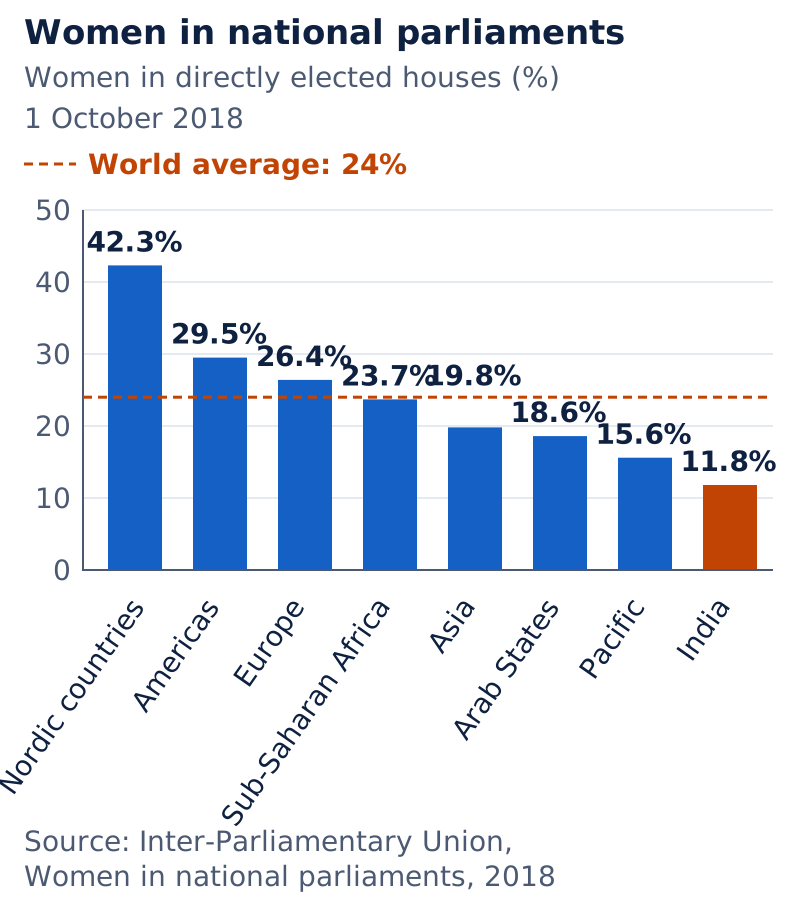
Vertical bars compare women's shares in directly elected parliamentary houses on 1 October 2018. The Nordic countries' bar is 42.3 per cent and India's is 11.8 per cent. A horizontal line marks the world average of 24 per cent.
Drawn by One Young India. Reference: NCERT Class 10, unnumbered graph, page 34
The graph compares representation across regions and India at a specified time. It illustrates unequal access to elected office. It does not measure women's share of the whole population or the amount of unpaid work they perform.
How does reservation address under-representation?
Reservation makes a share of elected seats available specifically to women. In panchayats and municipalities, one-third of seats are reserved for women. This gives women a direct place in rural and urban local government.
| Institution or measure | Relevant provision or dated fact |
|---|---|
| Panchayats and municipalities | One-third of seats reserved for women |
| Lok Sabha elected in 2019 | Women held 14.36 per cent of elected seats |
| Nari Shakti Vandan Adhiniyam, passed in 2023 | Provides for 33 per cent reservation for women in the Lok Sabha, State Legislative Assemblies and Delhi Assembly |
Women's organisations had long demanded similar reservation in the Lok Sabha and State Assemblies. The Women's Reservation Act, 2023 was passed to provide this reservation. Its passage and the existing local-government arrangements are distinct facts.
The movement for representation shows why political expression of a social difference can benefit democracy. When unequal treatment becomes a public issue, disadvantaged groups can demand a share in power and draw attention to neglected concerns.
How can religion enter politics without becoming communalism?
Religious diversity means that people follow different religions, while differences can also exist within a religion. Religion often enters political life because people bring their values, interests and experiences into public discussion. Such participation is not automatically harmful.
What forms of religious engagement can support equality?
Gandhiji believed that politics should be guided by moral values drawn from religion. His argument concerned ethics rather than the supremacy of a particular religion such as Hinduism or Islam. Moral guidance differs from making a religious community politically dominant.
Human rights groups have demanded government action to prevent communal riots and protect religious minorities. Such demands connect religion with politics while seeking protection and equal treatment for people who may face violence.
The women's movement has argued that family laws of all religions discriminate against women and has demanded that the government make these laws more equitable. Family laws concern matters such as marriage, divorce, adoption and inheritance. Demanding more equitable laws brings a religiously organised area of social life into political discussion.
| Political concern | Democratic purpose |
|---|---|
| Ethical values drawn from religion | Guide political conduct through moral principles |
| Protection of religious minorities | Prevent communal violence and protect people |
| Reform of discriminatory family laws | Make family relations more equitable for women |
What is the essential condition?
People should be able to express the needs and interests associated with their religious community. Political authorities may also regulate religious practices to prevent discrimination and oppression. These actions are acceptable when they treat every religion equally.
The distinction concerns how religion is used. Seeking protection or equality does not require presenting another religion as inferior. Communal politics begins when religious identity becomes a basis for exclusion, rivalry or the domination of one community over others.
What is communalism, and what forms can it take?
Communalism treats religion as the principal basis of social community. It assumes that all followers of a religion share the same fundamental interests, while the interests of people following different religions necessarily conflict.
Why is the communal view mistaken?
People within a religion have different occupations, economic positions, experiences and aspirations. Each person has several identities. Attempting to bring all followers of one religion together as a single political unit is bound to suppress many voices within that community.
In its extreme form, communalism denies that followers of different religions can live as equal citizens in one nation. It suggests that one community must dominate the others or that separate nations are necessary. This undermines equal citizenship.
How is communalism expressed in politics?
| Form | How it operates |
|---|---|
| Everyday prejudice | Stereotypes and claims that one's own religion is superior to other religions |
| Quest for political dominance | Majoritarian domination or a minority community's demand for a separate political unit |
| Religious mobilisation | Use of sacred symbols, religious leaders, emotional appeals or fear to gather political support |
| Communal violence | Riots, massacres and violent conflict directed along religious lines |
Majoritarian dominance occurs when members of a religious majority seek political supremacy for their own community. The concern is the use of power to dominate other groups, rather than the mere existence of a numerical majority.
During elections, communal mobilisation often appeals specially to the emotions or interests of one religion's voters in preference to others. Sacred symbols and leaders can then be used to create a political division between religious communities.
Communalism is not limited to physical violence. Everyday jokes, stereotypes and assumptions of superiority can express communal prejudice even when they seem familiar or ordinary. Recognising these beliefs matters because their frequency can make them difficult to notice.
India and Pakistan experienced severe communal riots during Partition, and communal violence also occurred after Independence. These consequences show why communalism threatens democratic coexistence and cannot be treated as a concern affecting religious minorities alone.
How does a secular state protect religious freedom and equality?
A secular state does not establish political superiority for one religion. India's constitutional framework combines freedom of religion with equal treatment and protection against discrimination. Secularism is therefore a foundation of democratic citizenship in a religiously diverse society.
What are the constitutional safeguards?
| Safeguard | Meaning for citizens |
|---|---|
| No official state religion | No religion receives special constitutional status as India's official religion |
| Religious freedom | Individuals and communities may profess, practise and propagate a religion, or follow none |
| Prohibition of religious discrimination | Religion cannot be a ground for discriminatory treatment |
| Intervention to ensure equality | The state may act within religious matters to address inequality, as with the ban on untouchability |
Freedom of religion includes the freedom not to follow a religion. It belongs to individuals and communities. The absence of an official religion does not mean that citizens must give up their beliefs.
Similarly, secularism does not require the state to ignore every religious practice. Intervention can be justified when it protects equality within religious communities. Religious freedom and opposition to discrimination must be understood together.
Why is a secular Constitution not sufficient by itself?
A constitutional commitment provides a necessary framework, but prejudice can continue in daily life and political campaigning. Communal propaganda and stereotypes must also be challenged outside formal institutions.
Religion-based mobilisation that pits communities against one another must be opposed in politics. Defending equal citizenship involves both constitutional protections and public resistance to the idea that one religious group should dominate the rest.
The difference between secularism and communalism is therefore clear. Secularism protects people across religious boundaries; communalism treats those boundaries as divisions between opposed political interests. A person need not be religious to have an interest in resisting communalism.
How has the caste system changed in modern India?
The caste system historically joined hereditary occupations with ritual rules and social hierarchy. Members of a caste were expected to follow similar occupations, marry within their caste and avoid eating with members of other caste groups.
What made caste a system of inequality?
A caste hierarchy arranged groups in a ladder of higher and lower status. Exclusion and discrimination against groups treated as outside the recognised caste order were central to this system. Untouchability subjected these groups to especially severe injustice.
Jotiba Phule, Gandhiji, B.R. Ambedkar and Periyar Ramaswami Naicker worked against caste inequalities. Their efforts helped challenge the idea that a person's birth should determine social worth, opportunities or treatment.
Which social and economic changes weakened older rules?
Urbanisation, economic development, expanding education and literacy, occupational mobility and the weakening position of village landlords contributed to change. These processes reduced the force of older assumptions about inherited rank and occupation.
Urbanisation means a shift of population from rural to urban areas. Occupational mobility means movement from one occupation to another, often when a new generation enters work different from that of its ancestors.
Most of the time, in urban public spaces, the caste identity of someone walking nearby or eating at the next restaurant table matters little. Such everyday changes contrast with older restrictions on interaction between caste groups.
The Constitution prohibited caste-based discrimination and laid the foundations for policies addressing past injustice. Legal equality and wider social change have therefore altered the caste system, even though neither has completely removed caste from society.
The correct conclusion is change without complete disappearance. Recognising the weakening of some caste rules should not lead to denying the discrimination that persists. Equally, recognising continuing inequality should not erase the importance of reforms and new opportunities.
Why do caste inequalities persist despite legal equality?
Accumulated disadvantage helps explain why caste inequalities survive after discriminatory rules are prohibited. Groups denied education, land and other resources over generations did not begin modern life with the same opportunities as groups that had enjoyed access to them.
Which social and educational inequalities continue?
Most people still marry within their own caste or tribe. Untouchability has also not disappeared completely despite its constitutional prohibition. These practices show that formal legal change does not automatically transform every social relationship.
Caste groups with earlier access to education have done very well in acquiring modern education too. Groups previously excluded have lagged behind. This helps explain the disproportionately large presence of socially advantaged castes among urban middle classes.
How is caste linked to economic status?
There are rich and poor people in every caste. Yet the presence of individual exceptions does not remove inequality between groups. Average economic position and the proportion facing poverty can still differ sharply across caste categories.
The historical National Sample Survey evidence for 1999 to 2000 shows that caste was very strongly linked to economic status. Upper castes were heavily over-represented among the rich, while lower castes were severely under-represented. The proportion living in extreme poverty was much higher among the lowest castes and much lower among the upper castes, with backward classes in between.
These patterns concern group averages and proportions. They do not mean every person from a socially advantaged caste is wealthy or every Dalit or Adivasi is poor. Caste influences access to resources without making each individual's economic situation identical.
What do the main social categories mean?
Scheduled Castes, commonly called Dalits, include groups historically subjected to exclusion and untouchability. Scheduled Tribes, often called Adivasis, include communities historically living relatively secluded lives, usually in hills and forests. Their names appear in official Schedules.
Other Backward Classes form another broad social category. These categories help discuss different histories of disadvantage, but they must not be treated as proof that every member has the same occupation, income or political preference.
How does caste influence elections without determining their results?
Caste in politics refers to ways caste identities influence political activity. Parties consider the caste composition of an electorate when selecting candidates. They also try to include representatives of different castes and tribes when forming governments.
How do parties mobilise caste support?
Candidates may appeal to caste sentiment, and some parties are associated with particular caste groups. Universal adult franchise and one-person-one-vote have encouraged leaders to seek broad support while creating political awareness among historically disadvantaged communities.
However, casteism goes further: it treats caste as the sole basis of social community and assumes that all members of a caste share interests distinct from everyone else. People's actual experiences do not support this assumption.
Why can caste alone not explain electoral outcomes?
- Wider support is necessary: candidates and parties need the confidence of more than one caste and community to win elections.
- Caste votes are not unanimous: no party receives every vote from a caste. A vote bank usually means substantial support, not complete agreement.
- Candidate choices overlap: several parties may nominate people from the same caste, while some voters have no candidate from their own caste.
- Preferences change: ruling parties and sitting representatives often lose, showing that communities are not permanently fixed to one political choice.
Voters' party loyalties are often stronger than caste attachments. People within the same caste have different interests depending on their economic condition. Rich and poor people, or men and women, from the same caste often vote very differently.
Judgements about government performance and the popularity of leaders are often decisive in elections. An explanation of an election must therefore consider caste alongside these other influences, rather than treating voters as members of a single fixed community.
This distinction also avoids confusing political mobilisation with automatic obedience. A party can seek caste support without being guaranteed the support of every person in that caste. Social identity matters, but voters still make different political choices.
How does politics reshape caste identities, and with what effects?
The relationship between caste and politics works in both directions. Caste affects political competition, while political competition alters caste identities and relationships. Politics in caste describes this second direction of influence.
How do caste groups change through political activity?
Each caste group tries to become bigger by including neighbouring castes or sub-castes previously kept outside. Various caste groups are required to enter coalitions with other castes or communities and thus engage in dialogue and negotiation.
Broader categories such as backward castes and forward castes have also emerged in political life. These developments show that political identities are shaped by cooperation and mobilisation, rather than simply reproducing every older caste boundary unchanged.
| Direction of influence | Example |
|---|---|
| Caste influences politics | Parties consider caste when selecting candidates and seeking votes |
| Politics influences caste | Caste groups broaden their membership and build coalitions with other groups |
| Political action challenges inequality | Disadvantaged communities demand dignity, resources and access to decision-making |
What are the benefits and limitations?
Political expression can give disadvantaged communities space to demand a share of power. Dalits and Other Backward Classes have gained better access to decision-making through such mobilisation. Organisations have demanded an end to discrimination and wider access to land, resources and opportunities.
Yet exclusive attention to caste can divert debate from poverty, development and corruption. Politics based only on caste identity can generate tension, conflict and even violence. Its democratic value depends on the demands being made and their effects on others.
The comparison with gender and religion is useful. A movement seeking equal rights can deepen democracy, while a movement seeking the domination of one community undermines it. The existence of social differences alone does not determine whether political expression will be healthy.
The central concern is therefore equality and inclusion. Bringing discrimination into public debate can help overcome injustice. Using identities to exclude people or demand supremacy can turn social differences into destructive political divisions.
Glossary
- Gender division — Unequal social roles assigned to women and men through expectations and stereotypes rather than biological necessity.
- Sexual division of labour — A system in which women perform household work or organise it through domestic helpers.
- Feminist — A woman or man who believes in equal rights and opportunities for women and men.
- Patriarchy — A social system that values men more highly and gives them power over women.
- Child sex ratio — The number of girl children for every thousand boy children in a population.
- Family laws — Laws governing family matters such as marriage, divorce, adoption and inheritance, which can differ between religious communities.
- Communalism — The belief that religion forms the principal basis of social community and separates people's fundamental interests.
- Secular state — A state without an official religion that protects religious freedom and prohibits discrimination on religious grounds.
- Caste hierarchy — A ladder-like ranking of caste groups from those regarded as highest to those regarded as lowest.
- Urbanisation — The shift of population from rural areas towards towns and cities.
- Occupational mobility — Movement between occupations, often when a younger generation takes up work different from its ancestors.
- Casteism — The belief that caste is the sole basis of social community and that its members share exclusive interests.
- Vote bank — A caste or community from which a party receives a large proportion of votes, rather than unanimous support.
Common errors and misconceptions
- Misconception: Household work is naturally women's responsibility. Correct: The sexual division of labour reflects social expectations; men can also cook, clean and care for children.
- Misconception: Unpaid housework is not work. Correct: Domestic labour requires time and effort even when it produces no direct income and receives little recognition.
- Misconception: Feminism seeks female supremacy. Correct: Feminism supports equal rights and opportunities for women and men; a feminist can be a woman or a man.
- Misconception: Every connection between religion and politics is communal. Correct: Ethical values, minority protection and demands for equitable family laws can support democracy when every religion is treated equally.
- Misconception: A secular state must prohibit religious belief and avoid all religious matters. Correct: It protects religious freedom and may intervene to prevent discrimination and ensure equality.
- Misconception: Prohibiting caste discrimination has ended caste inequality. Correct: Enduring marriage practices, untouchability and accumulated disadvantages show that legal prohibition alone does not remove every inequality.
- Misconception: Everyone in a caste votes for the same party. Correct: Economic interests, gender, party loyalty, government performance and leadership can produce different choices within a caste.
- Misconception: Caste affects politics, but politics leaves caste unchanged. Correct: Political competition can broaden caste groupings, encourage coalitions and create new political identities.
Exam-style questions with model answers
Q1. Women commonly perform cooking and cleaning at home, while men also undertake cooking and tailoring when paid. What does this contrast show about the sexual division of labour? Give two points. [2 marks]
- The division is based on social expectations rather than men's inability to perform these tasks.
- Payment changes the recognition given to similar work, while women's unpaid household labour is often undervalued.
Q2. In a six-state time-use survey of 1998 to 1999, men averaged 6 hours of income-generating work and 30 minutes of household work daily; women averaged 2 hours 40 minutes and 5 hours respectively. Calculate each total and explain what the comparison reveals about unpaid work. [3 marks]
- Men's combined working time was 6 hours plus 30 minutes, giving 6 hours 30 minutes daily.
- Women's combined working time was 2 hours 40 minutes plus 5 hours, giving 7 hours 40 minutes daily, which was 1 hour 10 minutes longer.
- Women spent longer working overall, but a greater share of their work was household-related. Counting only income-generating work would therefore overlook much of their contribution and make men's work appear more visible.
Q3. Women's movements demanded voting rights, better education and careers, and equality within family life. Women remain under-represented in political power. One-third of local-government seats are reserved for women. The Nari Shakti Vandan Adhiniyam, passed in 2023, provides for 33 per cent reservation in the Lok Sabha, State Legislative Assemblies and Delhi Assembly. Explain how these demands and provisions challenge gender inequality. [5 marks]
- The demand for voting rights challenges exclusion from public decisions. Women seek the ability to participate in politics as people with equal rights.
- Demands for education and career opportunities oppose social restrictions that limit women's choices and access to valued work.
- Seeking equality within family life extends the challenge to unequal power in the home, rather than restricting it to public institutions.
- Reserving one-third of local-government seats gives women a place in elected bodies and addresses their limited access to political power.
- The 2023 measure extends the provision for reservation to the named legislative bodies. Together, these efforts show how expressing gender inequality politically can support equality and greater participation.
Q4. Gandhiji wanted politics guided by moral values drawn from religion. Human rights groups seek protection of minorities from communal riots. Women's movements seek reform of discriminatory family laws. Explain why these three connections between religion and politics need not be communal, provided all religions are treated equally. [3 marks]
- Gandhiji's position concerns ethical guidance for politics, rather than establishing the superiority of one particular religion.
- Protecting minorities from communal riots defends people's safety and equal treatment. It does not require making another religious group subordinate.
- Reforming discriminatory family laws seeks greater equality within religious communities. All three activities can support democratic values because the stated condition is equal treatment of every religion, rather than religious domination.
Q5. Communal politics may involve everyday religious stereotypes, demands for majority-community domination or a separate minority political unit, mobilisation using sacred symbols and fear, and communal riots. Identify and explain these four forms of communalism. [4 marks]
- Everyday prejudice appears in stereotypes and assumptions of religious superiority. It may become so familiar that people fail to recognise it.
- The quest for political dominance seeks power for one's religious community, through majoritarian domination or a separate political unit.
- Religious mobilisation uses symbols and fear to bring followers together politically and direct their support towards communal demands.
- Communal violence turns religious divisions into riots and attacks. It is a violent expression of communal politics, but communalism also exists in the non-violent forms listed above.
Q6. India's Constitution gives no religion official status; protects the freedom to profess, practise and propagate religion or follow none; prohibits religious discrimination; and permits intervention to ensure equality within religious communities. Explain how each provision supports a secular state. [4 marks]
- The absence of an official religion prevents one faith from receiving special constitutional status as the state religion.
- Religious freedom protects individuals and communities, including people who choose not to follow any religion.
- The prohibition of religious discrimination makes equal treatment central to citizenship, regardless of a person's religious beliefs.
- Intervention for equality allows the state to oppose discriminatory practices within religious communities. Secularism therefore combines freedom with protection against oppression, rather than requiring complete state inaction.
Q7. No party receives every vote of a caste. Parties may nominate several candidates from the same caste, and sitting representatives can lose elections. Voters also consider party loyalty, economic interests, gender, government performance and leaders' popularity. Candidates need support across communities. Use this evidence to explain why caste alone cannot determine election results. [5 marks]
- A caste is not a unanimous voting unit. Receiving many votes from a caste does not mean a party receives all of them.
- Several candidates from the same caste divide the choices available to voters. A shared caste identity therefore cannot by itself identify a single preferred candidate.
- The defeat of sitting representatives shows that political preferences can change. Votes are not permanently fixed by community membership.
- Party loyalty and differences of economic interest or gender can produce different choices among members of the same caste.
- Government performance and leaders' popularity also influence decisions, while candidates must seek support across communities. Caste is consequently one influence among several, rather than a complete explanation of results.
Q8. Political competition encourages castes to include previously excluded sub-castes and negotiate coalitions. Mobilisation has helped Dalits and Other Backward Classes gain access to decision-making and demand dignity and resources. Exclusive caste politics can divert attention from poverty, development and corruption and cause conflict. Assess both the democratic value and the limitations of caste politics. [5 marks]
- Politics can change caste boundaries by encouraging wider membership. Caste identities are therefore influenced by political activity as well as influencing it.
- Coalition-building requires groups to negotiate with others. This creates political relationships that extend beyond a single caste's immediate boundaries.
- Mobilisation can improve disadvantaged communities' access to decisions. Demands for dignity and resources give public expression to inequality and can strengthen democratic participation.
- An exclusive focus on caste can displace discussion of poverty, development and corruption. These issues require attention even when caste identities remain politically significant.
- Caste-based conflict is another limitation. The democratic value of mobilisation depends on whether it advances inclusion and equality or deepens exclusion and antagonism.
Key takeaways
- Gender divisions reflect social expectations and unequal power; women's unpaid household labour is work even when it receives little recognition.
- Feminist movements seek equal rights and opportunities, including political participation, education, employment and equality within family life.
- Women's representation can bring neglected concerns into public decisions, while reservation creates a defined place for women in elected institutions.
- Religion can inform ethical demands and protection against discrimination when political action treats all religions equally.
- Communalism falsely treats religious communities as internally uniform groups with conflicting interests and can encourage domination or violence.
- Indian secularism combines the absence of an official religion with religious freedom, non-discrimination and intervention to protect equality.
- Caste inequalities have changed, but accumulated disadvantages and enduring social practices continue to influence opportunities and economic status.
- Caste influences politics and politics reshapes caste; democratic mobilisation can promote inclusion, while exclusive identity politics can deepen conflict.
Test yourself
Why is the division of household work a political issue?
It involves unequal power, recognition and responsibilities within the family and can restrict women's participation in public life.
Can a man be a feminist?
Yes. A feminist is anyone who believes in equal rights and opportunities for women and men.
What does the child sex ratio measure?
It measures the number of girl children for every thousand boy children in a population.
Why is communalism different from religious belief?
Communalism treats religion as the basis of opposed political communities and can demand domination. Religious belief alone does not require these claims.
Does secularism protect people who follow no religion?
Yes. Religious freedom includes the freedom not to follow a religion, alongside the freedom to profess, practise and propagate one.
What is occupational mobility?
It is movement from one occupation to another, often when a younger generation takes up work different from its ancestors.
Why does a caste vote bank not mean unanimous voting?
The term usually refers to a large proportion supporting a party. Members of the same caste can have different interests and preferences.
How can politics alter caste identities?
Political activity can encourage groups to include neighbouring castes or sub-castes, build coalitions and develop broader political categories.
Try it
Gender, Religion and Caste Notes | Class 10 Civics
Test your understanding of how social differences operate in democratic politics.
1In a patriarchal society like India, why do gender roles assign women to domestic work while men work outside the home?
Incorrect. The text explicitly states the division is 'not the result of any inadequacy in men or women' — it stems from how society has defined gender roles, not biology.
Correct. The text states gender differences 'are based on social expectations and stereotypes' and that the division simply reflects 'how society has defined the roles of both genders.'
Incorrect. The text frames this as a social expectation, not a personal preference. Women face 'discrimination' and 'limits' on their public roles, indicating constraint rather than choice.