
Power-sharing | CBSE Class 10 Political Science Notes
On this page
Try an idea before you read. Apply your understanding of power sharing mechanisms through these real-world scenarios. Explore →
This note covers the meaning of power-sharing, Belgium and Sri Lanka, majority domination, accommodation of communities, reasons for sharing power, government organs and levels, social groups, political parties, pressure groups, and applications of democratic power-sharing.
What is power-sharing and why does democracy require it?
Power-sharing means distributing political power among different government organs, levels, social groups or political parties. Democracy rests on the principle that people are the source of all political power and govern themselves through institutions of self-government.
Earlier ideas favoured undivided political power, concentrated in one person or group at one place. Their supporters believed that dispersing the power to decide would make quick decisions and their enforcement difficult. The emergence of democracy challenged this belief.
How does sharing give people a voice?
A good democratic government respects the different groups and views within society. Everyone has a voice in shaping public policies, meaning decisions about how government deals with public affairs. Political power should therefore be distributed among as many citizens as possible.
Sharing includes the legislature, the law-making organ; the executive, including ministers and government officials who exercise governmental power; and the judiciary, the courts and judges that can check executive action and laws. Their different roles help prevent unlimited power.
Definition: Democratic power-sharing includes those affected by the exercise of power and those who must live with its effects. People have a right to be consulted about how they are governed.
Power-sharing is relevant beyond societies with sharply divided communities. It also concerns how institutions restrain one another, how governments at different levels exercise powers, and how citizens influence decisions. Its democratic value is therefore wider than settling a particular dispute between communities.
Why did Belgium face tensions between its language communities?
Belgium is a small European country, smaller in area than Haryana. It borders France, the Netherlands, Germany and Luxembourg. Its population is a little over one crore, about half Haryana’s population. One crore means ten million.
Ethnic describes a social division based on shared culture. Members of an ethnic group believe in common descent because of similarities in physical type, culture or both. They need not always share the same religion or nationality.
How did the country and its capital differ?
| Area or population | Language composition | Significance |
|---|---|---|
| Belgium as a whole | 59 per cent Dutch-speaking, 40 per cent French-speaking and one per cent German-speaking | Dutch-speakers formed the national majority. |
| Flemish region | The 59 per cent Dutch-speaking population lived here. | Language communities had regional concentrations. |
| Wallonia region | The 40 per cent French-speaking population lived here. | The French-speaking community was a national minority. |
| Brussels, the capital | 80 per cent French-speaking and 20 per cent Dutch-speaking | The Dutch-speaking national majority was a minority in the capital. |
The minority French-speaking community was relatively rich and powerful. Dutch-speakers resented this because they received the benefits of economic development and education much later. These inequalities contributed to tensions during the 1950s and 1960s.
Tensions were more acute in Brussels. The different population balance in the capital made a simple claim that the national majority should control everything particularly problematic. A Dutch-speaking majority across Belgium did not mean a Dutch-speaking majority in Brussels.
What the figure shows
Communities and regions of Belgium
The map marks the Flemish Dutch-speaking region in the north, the Walloon French-speaking region in the south, a German-speaking area in the east, and the Brussels-Capital Region within the northern area.
Reference: NCERT Class 10, page 2
If the Dutch community had forced its will on the other language groups, conflict could have deepened. A possible partition would have been especially messy because both sides would claim Brussels. This was a possible danger, not the course Belgium ultimately adopted.
How did majoritarianism affect Sri Lanka?
Sri Lanka is an island nation a few kilometres off Tamil Nadu’s southern coast. It has about two crore people, about the same as Haryana. Sinhala-speakers account for 74 per cent and Tamil-speakers for 18 per cent of its population.
Sri Lankan Tamils, the country’s Tamil natives, account for 13 per cent. Indian Tamils are the other Tamil subgroup, whose forefathers came from India as plantation workers during the colonial period. Sri Lankan Tamils are concentrated in the north and east.
Most Sinhala-speaking people are Buddhists, while most Tamils are Hindus or Muslims. About 7 per cent of the population are Christians, who are both Tamil and Sinhala. Language and religion therefore describe different aspects of the population.
What the figure shows
Ethnic communities of Sri Lanka
The map distinguishes Sinhalese, Sri Lankan Tamil, Indian Tamil and Muslim populations. It shows the Sri Lankan Tamil concentration in the north and east, with Indian Tamil areas inland.
Reference: NCERT Class 10, page 3
Which policies established majority dominance?
Majoritarianism is the belief that a majority community should be able to rule as it wishes, disregarding minority needs and wishes. After independence in 1948, Sinhala leaders sought dominance through their majority, and the democratically elected government adopted majoritarian measures.
- In 1956, an Act recognised Sinhala as the only official language, disregarding Tamil.
- Preferential policies favoured Sinhala applicants for university positions and government jobs.
- A new constitution, the basic rules governing a country, required the state to protect and foster Buddhism.
These measures gradually increased Tamil alienation, meaning a feeling of exclusion from government. Sri Lankan Tamils felt that none of the major political parties led by Buddhist Sinhala leaders was sensitive to their language and culture. They felt that the constitution and government policies denied them equal political rights, discriminated against them in jobs and other opportunities, and ignored their interests.
How did conflict develop?
- Tamil parties and struggles demanded recognition of Tamil as an official language, regional autonomy, and equal opportunities in education and jobs. Regional autonomy means power for a region to govern its own affairs.
- Demands for greater autonomy in Tamil-populated provinces were repeatedly denied.
- By the 1980s, several political organisations demanded an independent Tamil Eelam, a Tamil state in the north and east.
- Distrust became widespread conflict and then a civil war, an internal conflict so violent that it appears like a war.
Thousands from both communities were killed. Many families left as refugees, people forced to flee their country, and many more lost their livelihoods. The war caused a terrible setback to social, cultural and economic life. It ended in 2009.
How did Belgium accommodate its different communities?
Accommodation means making arrangements that respect different communities and their interests. Belgian leaders recognised regional differences and cultural diversity. Between 1970 and 1993, they amended, or changed, the constitution four times to enable people to live together within the same country.
What were the main arrangements?
| Institution or rule | Arrangement | Purpose or effect |
|---|---|---|
| Central government | Equal numbers of Dutch-speaking and French-speaking ministers | Both major language communities share central executive power. |
| Some special laws | Support from a majority of members of each linguistic group | No single community can make decisions unilaterally, or on its own. |
| State governments of the two regions | Many central powers were transferred to them. | State governments are not subordinate to the central government. |
| Brussels government | A separate government with equal representation for both communities | Representation protects both communities in the capital. |
| Community government | Elected by members of each language community wherever they live | Deals with cultural, educational and language-related issues. |
The French-speaking community accepted equal representation in Brussels because Dutch-speakers accepted equal representation in the central government. This linked the concerns of the national French-speaking minority with those of the Dutch-speaking minority in the capital.
The community government is a third kind of government alongside central and state governments. Dutch, French and German-speaking people elect their respective community governments regardless of where they live. The basis of this arrangement is language community rather than residence alone.
Note: Equal representation in Belgium does not mean that the two communities have equal populations. The arrangement gives equal central ministerial representation despite unequal national population shares, and equal representation in Brussels despite its different language proportions.
What resulted from accommodation?
The Belgian model is very complicated, even for people living there. These arrangements have worked well so far. They helped avoid civic strife between the two major communities and a possible division of the country on linguistic lines.
When European countries formed the European Union, a grouping of countries in Europe, Brussels was chosen as its headquarters. The arrangements for sharing power reflected the understanding that national unity required respect for different communities and regions.
Photograph: Bilingual street signs (NCERT Class 10, page 4). The photograph shows a Belgian street sign with “MONTAGNE” and “BERG”, above a directional sign with “GRAND PLACE” and “GROTE MARKT”. The names and directions appear in French and Dutch.
How do prudential and moral reasons for power-sharing differ?
Belgium and Sri Lanka are both democracies, but they addressed community demands differently. Belgium developed mutually acceptable arrangements. Sri Lanka illustrates how a majority’s attempt to impose dominance and refusal to share power can undermine the country’s unity.
Prudential reasons are based on careful calculation of gains and losses. Such decisions are usually contrasted with decisions based purely on moral considerations. Prudential arguments favour power-sharing because it will bring better outcomes.
How can sharing power improve outcomes?
Power-sharing helps reduce the possibility of conflict between social groups. Social conflict often leads to violence and political instability. Reducing that possibility is therefore a good way to ensure the stability of the political order.
Imposing the majority’s will may look attractive in the short run, but undermines national unity in the long run. Tyranny of the majority, or oppressive majority rule, is not just oppressive for minorities; it often affects the majority adversely as well.
Why is participation valuable in itself?
Moral reasons value power-sharing as the very spirit of democracy. People affected by decisions have a right to be consulted. A legitimate government is one in which citizens gain a stake in the system through participation.
| Basis | Prudential reason | Moral reason |
|---|---|---|
| Central concern | Better outcomes from sharing power | The value of sharing power itself |
| Key argument | Reduced possibility of social conflict and greater political stability | People have a right to consultation about their government. |
| Democratic significance | Helps protect unity and the political order | Participation gives citizens a stake in the system. |
These reasons support the same practice from different directions. One asks about the consequences of political arrangements. The other asks whether those who must live with decisions participate in making them. Stability and participation are connected, but they are not identical arguments.
How is power shared horizontally among government organs?
Horizontal distribution of power shares power among different organs at the same level, such as the legislature, executive and judiciary. Each exercises different powers. This separation ensures that none of the organs exercises unlimited power.
Each organ checks the others, creating a balance among institutions. This is a system of checks and balances, meaning that the exercise of power by one organ is subject to checks by others.
How do the checks operate?
Ministers and government officials exercise power but remain responsible to Parliament or State Assemblies, the representative law-making bodies at their respective levels. Executive authority therefore operates alongside the legislature’s ability to hold it responsible.
Judges are appointed by the executive, yet they can check executive functioning and laws made by legislatures. The appointment relationship does not remove the judiciary’s checking role. Different functions and mutual checks together produce institutional balance.
Diagram
Horizontal sharing of power
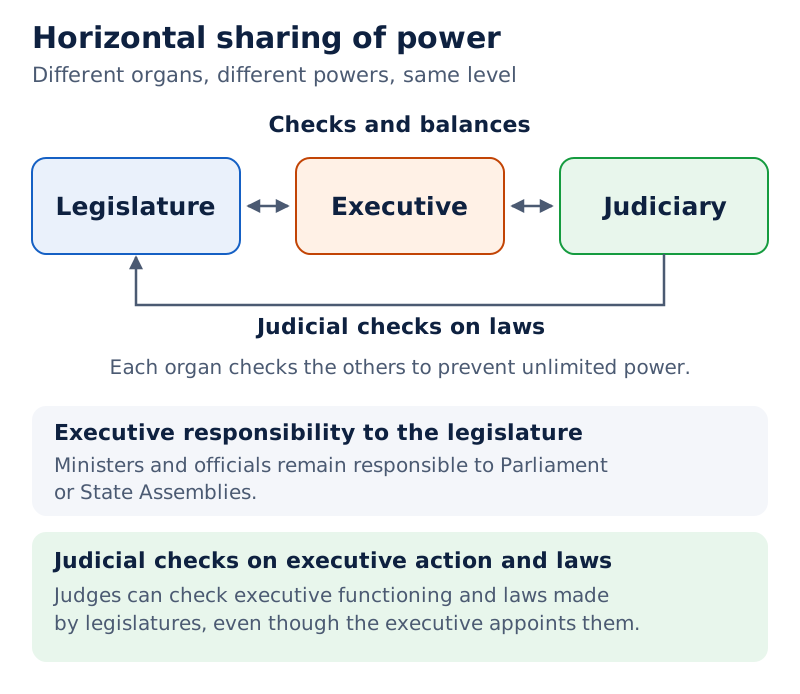
Draw three boxes on the same level labelled Legislature, Executive and Judiciary. Connect them with arrows labelled “checks and balances”. Add the examples of executive responsibility to the legislature and judicial checks on executive action and laws.
Drawn by One Young India.
The Bombay High Court ordered Maharashtra’s State Government to take immediate action to improve living conditions for the 2,000-odd children in seven children’s homes in Mumbai. This illustrates a judicial check on the executive, rather than sharing between higher and lower government levels.
The defining question is which institutions are involved. A court checking a state government remains an example of horizontal sharing because judiciary and executive are different organs. The mere presence of the word “State” does not make the relationship vertical.
How is power shared vertically between government levels?
Vertical division of power involves higher and lower levels of government. Power can be shared between a general government for the country and governments at provincial or regional levels. The general government is usually called the federal government.
In India, it is called the Central or Union Government, while governments at the regional level are called State Governments. Where different levels exist, the constitution clearly lays down their powers. This arrangement is called a federal division of power.
How far can this division extend?
The same principle can extend below the state government to a municipality, an urban local government, and a panchayat, a rural local government. Sharing across these levels brings government powers beyond the national and state institutions.
This system is not followed in all countries. Many countries have no provincial or state governments. It would therefore be incorrect to assume that every country distributes powers through the same number or kinds of government levels.
| Feature | Horizontal sharing | Vertical sharing |
|---|---|---|
| Participants | Different government organs | Governments at different levels |
| Relationship | Different powers exercised at the same level | Division involving higher and lower levels |
| Example | Judiciary checks executive functioning. | Central and State Governments exercise constitutionally specified powers. |
Belgium transferred many central powers to state governments that are not subordinate to the centre. In Sri Lanka, demands for greater autonomy for Tamil-populated provinces were repeatedly denied. These contrasting responses show why the allocation of regional power matters.
In Nigeria, state finance ministers demanded that the federal government disclose its income sources and the formula for distributing revenue, or government income, among states. This concerns relations between governments at different levels and therefore illustrates vertical sharing.
How can social groups gain a share in power?
Power may be shared among social groups, including religious and linguistic communities. The purpose is to give diverse groups space in government and administration. Without such arrangements, groups could feel alienated from government.
Belgium’s community government is an example. Its electorate, meaning the people who elect it, is defined by language community. Its authority covers cultural, educational and language-related matters. This provides a route for communities to participate in decisions affecting their identity.
How can representation prevent exclusion?
In some countries, constitutional and legal arrangements provide representation for socially weaker sections and women in legislatures and administration. Reserved constituencies are electoral constituencies set aside to secure representation for specified groups; India uses such arrangements in assemblies and Parliament.
These arrangements give minority communities a fair share in power. Their purpose is not simply to count how many groups exist, but to ensure that groups otherwise at risk of exclusion have a place within public institutions.
In Canada, Ontario’s government agreed to a land claim settlement with the aboriginal community, meaning indigenous people. The minister responsible for Native Affairs announced cooperation based on mutual respect. This illustrates power-sharing between government and a social community.
How do language questions test accommodation?
Annette attends a Dutch-medium school in northern Belgium where many French-speaking students want instruction in French. Selvi attends a school in northern Sri Lanka where all students are Tamil-speaking and want Tamil instruction. These situations concern education and language.
Belgium’s community government and accommodation make Annette’s parents more likely to obtain a favourable response than Selvi’s in the contrasting majoritarian setting. This is a comparison of likelihood, not a guarantee that a particular school must change its medium.
The Mayor of Merchtem, near Brussels, defended banning French in schools to integrate non-Dutch speakers in the Flemish town. Such a ban conflicts with the spirit of accommodation because it restricts a language instead of respecting linguistic diversity.
What dilemma does community power-sharing create in Lebanon?
Khalil’s dilemma concerns the relationship between community guarantees and individual political choice. In the story set in Beirut, Lebanon’s capital, Khalil has an Orthodox Christian father and a Sunni Muslim mother. These are religious community identities.
Different communities lived together and intermingled in Beirut, yet fought a bitter civil war. One of Khalil’s uncles was killed. Lebanon’s leaders agreed on rules for sharing offices among communities at the end of the civil war in the story.
| Office | Community specified in the agreement |
|---|---|
| President | Maronite sect of Catholic Christians |
| Prime Minister | Sunni Muslim community |
| Deputy Prime Minister | Orthodox Christian sect |
| Speaker | Shi’a Muslim community |
A sect is a religious subgroup. Christians agreed not to seek French protection, while Muslims agreed not to seek unification with neighbouring Syria. The communities were nearly equal in population when they agreed; they continued respecting the agreement though Muslims became a clear majority.
Why does Khalil object?
Khalil is popular and politically ambitious, but the top position is beyond his reach under these rules. He practises neither parent’s religion and does not want either religious identity to define him. He favours open elections without a community restriction on the presidency.
His elders, remembering the bloodshed, regard the arrangement as the best guarantee of peace. The dilemma therefore contains two concerns: protecting communities against renewed conflict and allowing individuals political opportunities without a fixed religious identity.
Community guarantees intended to preserve peace can also restrict individual political opportunities. Khalil’s preference and the elders’ defence should be distinguished from a general claim that every democracy must assign particular offices to particular communities. Democratic power-sharing can take several institutional forms.
How do political parties and pressure groups share power?
Political parties are organisations that compete for political power and represent different ideas and social groups. Democratic citizens must be free to choose among contenders for power. Competition among parties ensures that power does not remain in one hand.
In the long run, power is shared among parties representing different ideologies, or sets of political ideas, and social groups. This sharing may occur through competition over time rather than through all parties governing together at a particular moment.
When is sharing direct?
Sometimes two or more parties form an alliance, an agreement to act together, to contest elections. If elected, the alliance forms a coalition government, a government in which the participating parties directly share power.
Germany’s Christian Democratic Union and Social Democratic Party were historical rivals. Neither secured a clear majority of seats on its own in the 2005 elections. They formed a grand coalition and jointly ran government despite divergent positions on several policies.
Cartoon: German coalition (NCERT Class 10, page 6). The cartoon shows a car with two steering wheels, a “GERMAN GOVERNMENT” plate and the caption “FINE GERMAN ENGINEERING.” The two controls illustrate the problem of rivals jointly directing a coalition government.
Russia’s Union of Right Forces and Liberal Yabloko Movement agreed to unite their organisations in a coalition. They proposed a common candidate list for the next parliamentary elections. This illustrates sharing between parties.
How do organised interests influence decisions?
Pressure groups are organised groups that seek to influence those in power. Movements, meaning collective efforts to pursue a public cause, can also influence government. Their role in power-sharing need not involve becoming a governing party.
Interest groups include traders, businessmen, industrialists, farmers and industrial workers. They can gain a share in governmental power through participation in governmental committees or by influencing decision-making. The distinction is between directly holding office and having a voice in decisions made by office-holders.
How can examples of power-sharing be analysed?
To identify a form of power-sharing, examine the participants and their relationship. A policy about a social group, a dispute between levels of government and a court order do not illustrate the same arrangement merely because government appears in each.
Which relationships distinguish the four forms?
| Example | Participants sharing or checking power | Form |
|---|---|---|
| Bombay High Court order about children’s homes | Judiciary and Maharashtra’s executive | Horizontal sharing among organs |
| Ontario land claim settlement | Government and aboriginal community | Sharing with a social group |
| Russian parties proposing a common candidate list | Union of Right Forces and Liberal Yabloko Movement | Sharing among political parties |
| Nigerian states seeking federal revenue information | State governments and federal government | Vertical sharing among levels |
For reasons supporting power-sharing, distinguish outcomes from rights. Reduced conflict is a prudential argument because it concerns consequences. The right of affected people to participate is a moral argument because it concerns the value of democratic involvement itself.
Panchayati Raj, government through panchayats, illustrates this distinction. An argument that participation in planning and implementing development schemes increases public control, reduces corruption and improves administrative efficiency is prudential. Restoring power to people expresses the democratic value of participation.
What does concentration of power suggest?
In 2005, new Russian laws gave more powers to the president. During the same time, the president of the United States visited Russia. Concentrating power in leaders can restrict democratic control by the people.
Cartoon: Reigning the Reins (NCERT Class 10, page 8; dated 25 February 2005). The cartoon shows Putin and Bush riding in a carriage drawn by a horse labelled “DEMOCRACY”. Bush says, “WE GOTTA KEEP THE REIN TIGHT, VLADIMIR...” The tight reins symbolise the leaders controlling democracy.
The democratic alternative is to distribute political power widely and respect different voices. Sharing can accommodate diversity, reduce conflict and decrease arbitrariness, meaning the unchecked use of power according to personal will. These benefits differ from the claim that concentration alone makes a country stronger.
Glossary
- Power-sharing — Distribution of political power among government organs, levels, social groups or political parties.
- Ethnic division — A social division based on shared culture and belief in common descent.
- Majoritarianism — The belief that the majority community may rule as it wishes while disregarding minority needs.
- Alienation — A feeling of exclusion when people believe government disregards their interests, rights or culture.
- Civil war — Violent conflict between opposing groups within a country that becomes intense enough to resemble war.
- Community government — Government elected by a language community in Belgium, handling cultural, educational and language-related issues.
- Prudential reason — A reason based on careful assessment of gains, losses and likely outcomes.
- Moral reason — A reason valuing participation and power-sharing as part of democracy itself.
- Horizontal distribution — Sharing among different government organs at the same level, each exercising different powers.
- Checks and balances — An arrangement in which government organs check one another and prevent unlimited power.
- Vertical division — Sharing of powers between higher and lower levels of government.
- Regional autonomy — Power for a region to govern its own affairs within a country.
- Coalition government — Government formed by an elected alliance in which two or more parties share power.
- Pressure group — An organised group seeking to influence those in power and their decisions.
- Legitimate government — Government in which citizens acquire a stake in the system through participation.
Common errors and misconceptions
- Misconception: Dutch-speakers were the majority in Brussels. Correct: They were 59 per cent nationally but 20 per cent in Brussels, where French-speakers formed 80 per cent.
- Misconception: Belgium’s language communities had equal populations. Correct: Equal representation was a negotiated arrangement despite different population shares at national and capital-city levels.
- Misconception: The 1956 Act recognised Sinhala and Tamil equally. Correct: It recognised Sinhala as the only official language and disregarded Tamil.
- Misconception: Belgium’s community government is simply another regional government. Correct: It is elected by language-community members wherever they live and handles specified community matters.
- Misconception: Judicial checks on a state government are vertical sharing. Correct: They concern different organs and are horizontal sharing; vertical sharing concerns government levels.
- Misconception: Prudential and moral reasons mean the same thing. Correct: Prudential reasons concern better outcomes; moral reasons value participation and sharing themselves.
- Misconception: All parties must join government for power-sharing to exist. Correct: Competition shares power over time, while coalitions provide direct sharing among governing parties.
- Misconception: Power-sharing guarantees the end of all conflict. Correct: It helps reduce the possibility of conflict; Belgium’s arrangements have worked well so far.
Exam-style questions with model answers
Q1. Dutch-speakers formed 59 per cent of Belgium’s population but 20 per cent of Brussels; French-speakers formed 40 per cent nationally and 80 per cent in Brussels. Identify the majority in each area and explain the resulting contrast. [2 marks]
- Dutch-speakers were the national majority, while French-speakers were the majority in Brussels.
- The national Dutch-speaking majority became a minority in the capital, so the two areas presented different community interests.
Q2. Most Sinhala-speakers were Buddhists. In Sri Lanka, the 1956 Act recognised only Sinhala officially; preferential policies favoured Sinhala applicants for university positions and government jobs; the constitution required protection and fostering of Buddhism. Explain three ways these measures promoted majority dominance. [3 marks]
- The language Act privileged Sinhala while disregarding Tamil, so the majority community’s language gained official recognition without equivalent recognition for Tamil.
- Preferential university and government employment policies favoured Sinhala applicants, placing the majority in an advantageous position in access to these opportunities.
- The constitutional requirement gave Buddhism special state protection, extending the majority community’s dominance into the state’s treatment of religion.
Q3. Although Dutch-speakers formed the national majority, Belgium provided equal Dutch-speaking and French-speaking central ministers; support from a majority in each linguistic group for some special laws; state governments with transferred powers and no subordination to the centre; equal community representation in Brussels; and language-community governments for cultural, educational and language issues. Explain how each arrangement shares power. [5 marks]
- Equal numbers of central ministers give both major language communities a place in the executive. A larger population therefore does not translate into exclusive control of central ministerial representation.
- Requiring support within each linguistic group for some special laws prevents a single community from making those decisions on its own.
- Transferring powers to state governments that are not subordinate to the centre creates a division of authority between government levels.
- Equal representation in Brussels gives both communities a share in the capital’s government through an arrangement accepted by the communities.
- Community governments provide language groups with decision-making powers over culture, education and language, allowing sharing around matters directly affecting community identity.
Q4. Classify these examples and name the participants: the Bombay High Court orders Maharashtra’s government to improve children’s homes; Ontario settles a land claim with the aboriginal community; the Union of Right Forces and Liberal Yabloko Movement propose a common candidate list; Nigerian state ministers demand federal revenue information. [4 marks]
- The High Court and Maharashtra’s executive illustrate horizontal sharing, because a judicial organ checks action by the executive.
- Ontario’s government and the aboriginal community illustrate sharing with a social group through a land claim settlement.
- The Union of Right Forces and Liberal Yabloko Movement illustrate sharing between political parties through their proposed electoral cooperation.
- Nigerian state governments and the federal government illustrate vertical sharing, because revenue relations concern different government levels.
Q5. Power-sharing helps reduce possible social conflict, which often brings violence and instability. People affected by decisions also have a right to consultation, and participation gives citizens a stake in government. Distinguish the prudential and moral arguments in four points. [4 marks]
- The reduction of possible conflict is prudential because it evaluates the beneficial consequences of sharing political power.
- The concern with violence and instability is also prudential because stability is an outcome that sharing seeks to support.
- The right of affected people to consultation is moral because it values democratic participation in its own right.
- Citizens gaining a stake through participation expresses the moral basis of legitimate government, rather than merely calculating gains and losses.
Q6. Germany’s Christian Democratic Union and Social Democratic Party were historical rivals. Neither won a clear majority alone in 2005. They jointly governed despite different policy positions. Explain the type, cause and difficulty of this arrangement. [3 marks]
- The arrangement was a coalition government: the two parties shared governmental power directly rather than leaving governing authority entirely with one party.
- It arose because neither party secured a clear majority of seats on its own in the 2005 elections.
- The difficulty was joint direction by historical rivals with divergent policy positions, although they still ran the government together.
Q7. Belgium’s community governments handle educational and language issues, and its arrangements respect linguistic communities. The Mayor of Merchtem defended banning French in schools to integrate non-Dutch speakers. Is the ban consistent with that spirit? Give two reasons. [2 marks]
- No. Banning French restricts a language instead of respecting the linguistic diversity that accommodation recognises.
- It conflicts with the principle of giving communities a voice in educational and language-related matters affecting them.
Q8. Sri Lankan Tamils felt that official-language, education, employment and religious policies ignored their interests. Tamil parties and struggles sought Tamil recognition, regional autonomy and equal opportunities. Autonomy demands were repeatedly denied; by the 1980s organisations demanded an independent Tamil Eelam in the north and east. Distrust became conflict and civil war, killing thousands, displacing families and damaging livelihoods. The war ended in 2009. Explain this sequence in five points. [5 marks]
- Policies affecting language, education, employment and religion increased Tamil alienation because the community felt that its interests and equal opportunities were being disregarded.
- Tamil parties and struggles responded by demanding official recognition of Tamil, regional autonomy, and equal opportunities in education and employment.
- Repeated denial of autonomy demands preceded the emergence, by the 1980s, of organisations seeking an independent Tamil Eelam in the north and east.
- Distrust between communities developed into widespread conflict and then civil war, showing the serious consequences of deteriorating relations.
- The war killed thousands, displaced families and damaged livelihoods before ending in 2009. Its costs extended beyond political disagreement into people’s everyday lives.
Key takeaways
- Power-sharing distributes authority among government organs, levels, social groups and political parties so that power does not remain concentrated.
- Belgium’s national Dutch-speaking majority was a minority in Brussels, making accommodation of different community interests particularly significant.
- Sri Lanka’s majoritarian language, employment, education and religious policies increased Tamil alienation and contributed to strained community relations.
- Belgium combined equal community representation, regional powers and community governments; these complicated arrangements have worked well so far.
- Prudential reasons value reduced conflict and stability, while moral reasons value people’s right to participate in their government.
- Horizontal sharing connects government organs through checks and balances; vertical sharing distributes powers among different government levels.
- Community representation gives diverse groups space in government, while pressure groups influence decisions through committees and other participation.
- Party competition shares power over time, and an elected alliance can share governmental power directly through a coalition.
Test yourself
What distinguishes ethnic identity from a shared religion?
Ethnic identity rests on shared culture and belief in common descent; members need not always have the same religion or nationality.
What did Sri Lanka’s 1956 Act do?
It recognised Sinhala as the only official language, thereby disregarding Tamil.
When did Belgium amend its constitution to accommodate communities?
It amended the constitution four times between 1970 and 1993.
Who elects Belgium’s community government?
Members of the relevant Dutch, French or German language community elect it, no matter where they live.
Why is avoiding political instability a prudential reason?
It concerns a beneficial outcome of sharing power rather than the value of participation in itself.
Why can judges check the executive even though it appoints them?
The system of checks and balances gives government organs different powers, including judicial checks on executive functioning.
Does every country have state or provincial governments?
No. Many countries have no provincial or state governments; this form of division is not universal.
How can interest groups share in governmental power?
They can participate in governmental committees or influence the decision-making process.
Try it
Power Sharing Notes | Class 10 - Civics
Apply your understanding of power sharing mechanisms through these real-world scenarios.
1In Belgium, the French-speaking community was richer and more powerful than the Dutch-speaking community. Despite this imbalance, the Dutch accepted equal representation in the central government. Why did the Dutch accept this arrangement?
This is incorrect. The text states that the French accepted equal representation in the central government because the Dutch had accepted it. The French were the ones who accepted, not the ones threatening to leave.
Correct! The text explains that Brussels has a separate government with equal representation for French and Dutch, and many powers of the central government were given to regional governments. This gave the Dutch community significant autonomy, making equal representation acceptable.
Incorrect. The text does not mention any international pressure. The solution was reached through Belgian leaders recognizing regional differences and amending the constitution four times.
2In Sri Lanka, the Tamil minority launched parties and struggles to get recognition for their language and equal rights. Why did these demands arise?
Incorrect. The text shows the Tamils were the minority (18%) seeking equal treatment, not dominance. The tensions arose because the Sinhala-majority government adopted majoritarian policies that discriminated against them.
Correct! The text explicitly states that Tamils felt the constitution and government policies 'denied them equal political rights, discriminated against them in jobs and other opportunities, and ignored their interests.' This directly explains why they launched struggles for recognition.
Partially related but not the main reason for Tamil grievances. While the constitution stated the state shall protect and foster Buddhism, the primary source of conflict was the denial of equal political rights and discrimination in language policy and opportunities.