
Outcomes of Democracy | CBSE Class 10 Political Science Notes
On this page
Try an idea before you read. Think through two scenarios to test your understanding of democracy's outcomes and challenges. Explore →
This note covers the assessment of democratic outcomes, accountable and responsive government, transparency, legitimacy, economic growth, inequality and poverty, accommodation of social diversity, dignity and freedom, and citizens’ continuing expectations from democracy.
How should we assess the outcomes of democracy?
What can democracy reasonably promise?
Democracy creates conditions in which people can pursue collective goals. It is a form of government, so it cannot by itself solve every social, economic and political problem. Citizens must use the opportunities it creates to achieve those goals.
Most democracies share features such as formal constitutions, elections, political parties and guarantees of citizens’ rights. Their social conditions, cultures and economic achievements nevertheless differ. The presence of similar political institutions does not mean that every democratic country will produce identical results.
Assessment therefore requires a distinction between expected outcomes and actual outcomes. An expectation identifies what democratic government ought to achieve. Its actual record shows how far that expectation has been realised, and where improvement remains necessary.
Why is democracy preferred?
There are several reasons for preferring democracy to dictatorship or other alternatives. These concern both the treatment of individuals and the way public decisions are made.
- Political equality: democracy promotes equality among citizens.
- Individual dignity: it enhances the standing and respect of the individual.
- Decision-making: it improves the quality of decisions.
- Conflict resolution: it provides a method for dealing with disagreements.
- Correction: it leaves room to recognise and correct mistakes.
Support for these principles can coexist with dissatisfaction about how a government functions. People may prefer democracy while criticising its performance. Such criticism calls for examining particular outcomes, rather than assuming either that democracy achieves everything or that disappointment proves its complete failure.
| Area of assessment | Central question |
|---|---|
| Quality of government | Is government accountable, responsive and legitimate? |
| Economic well-being | What is its record of growth and development? |
| Inequality and poverty | Are benefits and opportunities shared more fairly? |
| Social diversity | Can differences be negotiated peacefully? |
| Dignity and freedom | Can individuals claim respect and equal treatment? |
A balanced assessment considers all these areas. Economic performance matters, but it is not the sole measure. The opportunity to question rulers, the accommodation of differences and the recognition of equal dignity are also outcomes that require attention.
How does democracy make government accountable and responsive?
What do citizens have a right to expect?
The most basic democratic outcome is a government answerable to citizens and attentive to their needs. People must have the right to choose their rulers and exercise control over them. Whenever possible and necessary, they should participate in decisions affecting them.
Definition: An accountable government is answerable to citizens for its decisions and functioning. A responsive government attends to citizens’ needs and expectations.
Accountability concerns the ability to examine and question government. Responsiveness concerns how government deals with people’s demands. The two are related, but holding elections does not automatically ensure that every need receives attention.
To assess accountability, look for regular, free and fair elections, open public debate on major policies and legislation, and citizens’ right to information about government. These practices allow people to judge rulers and scrutinise their functioning.
Does slower decision-making mean worse government?
Democratic decisions involve deliberation and negotiation. Assemblies, majority opinion and public views must be considered. This can take time. Non-democratic rulers need not face the same requirements and may decide and implement policies quickly.
Speed, however, does not establish that a decision is acceptable or effective. A rapidly taken decision may encounter resistance. A democratic decision that follows procedures may take longer, yet gain greater acceptance and work more effectively.
| Issue | Democratic decision-making | Non-democratic decision-making |
|---|---|---|
| Consultation | Depends on deliberation and negotiation | Rulers need not deliberate in assemblies or consider majorities |
| Time | Procedures can cause delay | Decisions may be taken quickly |
| Acceptance | Following procedures may improve acceptance | Speed does not ensure public acceptance |
| Scrutiny | Citizens should be able to examine procedures | Such transparency is often missing |
The actual democratic record remains mixed. Democracies have done better at establishing regular, free elections and conditions for debate. Most fall short of giving everyone a fair electoral chance or of subjecting every decision to public debate.
Democratic governments often frustrate the needs of the people, often ignore the demands of a majority of the population, and are not free of corruption. These failures must be acknowledged. They do not demonstrate that non-democratic governments are less corrupt or more sensitive to people. Democratic standards remain grounds on which citizens can demand better performance.
How does transparency help citizens question government?
What makes decision-making transparent?
Transparency means that citizens have the right and the means to examine the process of decision-making. When decisions must follow norms and procedures, people should be able to find out whether the correct procedure was actually followed.
Transparency concerns more than hearing that a decision has been announced. It enables scrutiny of how public authority has been used. Access to information therefore supports accountability and helps citizens participate in government when they consider participation necessary.
Democratic governments do not have a very good record of sharing information with citizens. The existence of a democratic system and its actual openness must be assessed separately. The expectation of transparency remains valid even when officials fail to meet it.
What does Nannu’s experience show?
Nannu, a daily wage earner living in Welcome Mazdoor Colony in East Delhi, lost his ration card. He applied for a duplicate in January 2004. His experience shows both administrative neglect and the use of information to challenge it.
- After applying for a duplicate card, Nannu repeatedly visited the local Food and Civil Supplies office over the next three months.
- Clerks and officials neither attended to his work nor told him the status of his application.
- He applied under the Right to Information Act, asking about daily progress, the officials responsible and action against their inaction.
- Within a week, a Food Department inspector visited him and said that the card was ready for collection.
- When he collected it the next day, the Food and Supply Officer treated him warmly and asked him to withdraw his information application.
The sequence illustrates how a demand for information can make official responsibility visible. Nannu asked specific questions about progress and the people expected to act. Officials who had ignored him then attended to his application.
Note: Nannu’s experience illustrates the connection between information and accountability. It does not establish that every information request produces the same result or that administrative delay has disappeared.
The larger democratic lesson is that citizens need mechanisms for questioning public officials. They are not merely recipients of official decisions. The ability to ask how government has dealt with a request helps turn formal accountability into a practical demand.
Why is democratic government considered legitimate?
What is the basis of legitimacy?
Legitimate government is accepted as people’s own government. In a democracy, people wish to be governed by representatives whom they have elected. This gives democratic rule a basis of support that cannot be measured simply by its speed or economic record.
A government may be slow, imperfectly responsive or affected by corruption, while the democratic form of government retains broad support. Acceptance of democracy does not mean approval of every action taken by those who currently hold power.
The ability of democracy to generate support for itself is an important outcome. People may want improvements in democratic practice while continuing to believe that choosing their representatives is the appropriate way to be governed.
What does the South Asian evidence illustrate?
South Asian survey evidence published in 2007 showed strong support for rule by leaders elected by the people. It also showed widespread belief that democracy suited respondents’ countries. These are related views, but they answer different questions.
| Country or region | Support for rule by elected leaders (%) | Democracy regarded as suitable or very suitable (%) |
|---|---|---|
| South Asia | 94 | 88 |
| Sri Lanka | 98 | 92 |
| Bangladesh | 96 | 93 |
| India | 95 | 92 |
| Nepal | 94 | 79 |
| Pakistan | 81 | 84 |
What the figure shows
Support for democracy in South Asia
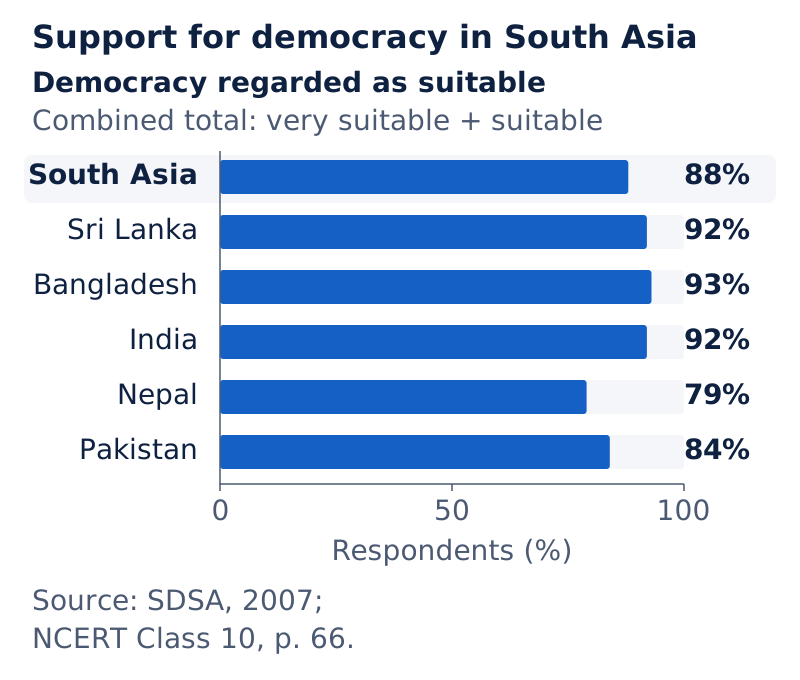
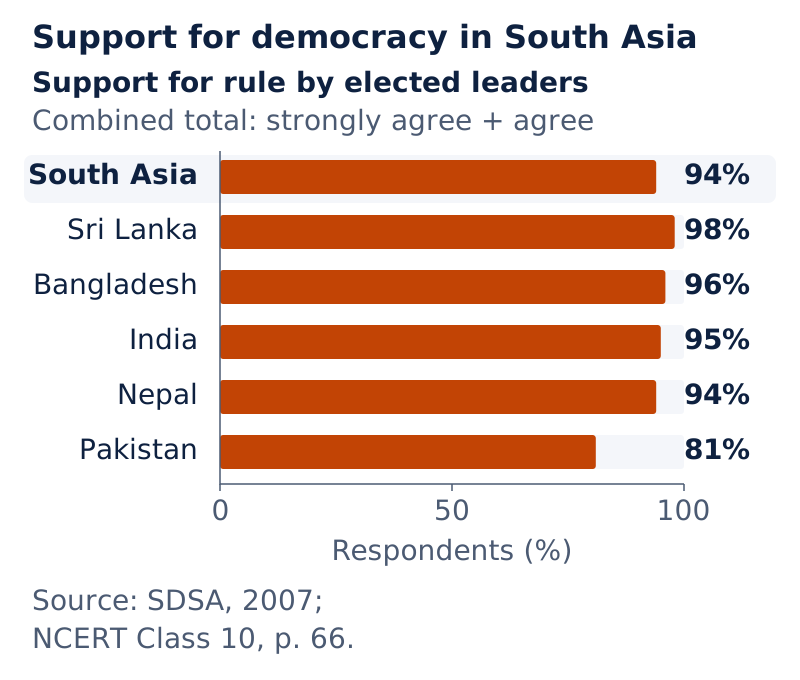
Two horizontal bar charts show views on democracy’s suitability and support for elected leaders. Each bar combines two positive response categories, and its total is printed beside it.
Drawn by One Young India. Reference: NCERT Class 10, p. 66
Support for elected rule must not be confused with satisfaction about everything a government does. Nor do these historical figures describe present-day opinion. Their significance here is the support they demonstrate for democratic principles despite the shortcomings of democratic practice.
Legitimacy therefore belongs alongside accountability and responsiveness in an assessment of government. Each asks a distinct question: whether rulers are answerable, whether needs receive attention, and whether people regard the form of rule as their own.
Does democracy guarantee economic growth and development?
What does the growth comparison show?
It is reasonable to expect good government to support economic development. Nevertheless, democracy does not guarantee a higher growth rate than every dictatorship. The comparison of democratic and dictatorial regimes over 1950 to 2000 shows a more qualified picture.
| Type of regime and country group | Growth rate, 1950 to 2000 |
|---|---|
| All democratic regimes | 3.95 |
| All dictatorial regimes | 4.42 |
| Poor countries under dictatorship | 4.34 |
| Poor countries under democracy | 4.28 |
Across all countries in the comparison, dictatorial regimes had a slightly higher average growth rate. When the comparison is restricted to poor countries, the difference becomes very small. The overall comparison and the poor-country comparison therefore need to be distinguished.
The evidence does not justify the assertion that poor countries require dictatorship to become richer. Among poor countries, democratic and dictatorial regimes recorded almost the same growth. A general preference for dictatorship cannot be established from those figures.
What else affects development?
Economic development depends on several conditions, including the country’s population size, the global situation, cooperation from other countries and its chosen economic priorities. The form of government is not the only relevant consideration.
This explains why judging democracy entirely through one economic comparison is inadequate. Countries differ in more than their political arrangements. Recognising these differences prevents an unsupported claim that democratic rule alone guarantees either rapid development or economic failure.
It is reasonable to expect democracy not to lag behind dictatorship in economic development, even though the 1950 to 2000 record shows dictatorships slightly ahead overall. Its record can be examined critically without abandoning its other positive outcomes, including accountability, dignity and the possibility of peaceful accommodation of differences.
Note: The growth figures refer to 1950 to 2000. They support a historical comparison of groups of countries, not a claim about the current growth rate of any individual country.
A separate question concerns who benefits when growth occurs. A country’s economy may grow while its people receive very unequal shares of income. Assessing distribution therefore requires evidence beyond the overall growth rate.
Why can political equality coexist with economic inequality?
How are votes different from income shares?
Democracy rests on political equality: individuals have equal weight in electing representatives. This does not mean that they possess equal income or wealth. Equal participation in elections can coexist with very unequal economic circumstances.
A small number of very rich people may hold a disproportionately large share of wealth and income. Meanwhile, those at the bottom may struggle to meet basic needs such as food, clothing, housing, education and health.
Economic growth and fair distribution are therefore separate tests. Growth raises the question of economic performance. Distribution raises the question of whether people share in its benefits and have opportunities to improve their lives.
What does the income distribution evidence show?
The following comparative figures show the shares of national income received by the richest and poorest fifths of the population. They illustrate inequality within countries and should not be treated as current income estimates.
| Country | Top 20%: share of national income (%) | Bottom 20%: share of national income (%) |
|---|---|---|
| South Africa | 64.8 | 2.9 |
| Brazil | 63.0 | 2.6 |
| Russia | 53.7 | 4.4 |
| USA | 50.0 | 4.0 |
| United Kingdom | 45.0 | 6.0 |
| Denmark | 34.5 | 9.6 |
| Hungary | 34.4 | 10.0 |
South Africa and Brazil show especially unequal shares: their top fifth receives more than 60% of national income, while their bottom fifth receives less than 3%. Denmark and Hungary display a less unequal distribution in this comparison.
Cartoon: Poor Kids (NCERT Class 10, p. 68). A child labelled “Poor Kids” lies at the foot of a staircase whose steps, from the bottom, are labelled “HUNGER”, “SCHOOLING”, “HEALTH CARE” and “HOUSING”. An adult bends over the child and asks, “How far did you fall down?” and the child answers, “You tell me...”. The cartoon shows the inequality of opportunities available to poorer sections.
Why does poverty remain a democratic concern?
Democracies do not appear to be very successful in reducing economic inequalities. In India, poor people form a large proportion of voters, and parties do not want to lose their votes. Yet elected governments do not appear to be as keen to address poverty as one would expect.
The numerical importance of poor voters does not automatically produce policies that end their deprivation. The democratic promise of political equality must therefore be assessed alongside the actual distribution of goods, income and opportunities.
This is a criticism of democratic performance, not proof that equal voting rights are meaningless. Reducing poverty and inequality remains a reasonable expectation from democracy, even though its actual achievements have fallen short.
Under what conditions can democracy accommodate social diversity?
How can differences be negotiated?
Social diversity creates differences of interests and opinions. No society can remove all conflicts fully and permanently. A realistic democratic outcome is the ability to respect differences and develop arrangements through which they can be negotiated.
Democracies usually establish procedures for political competition. These can reduce the chance that tensions become violent or explosive. The aim is not to make everyone identical, but to enable people with different views and identities to live together.
Belgium illustrates successful negotiation of differences among ethnic populations. The example of Sri Lanka shows why democratic accommodation cannot be assumed simply because majority rule exists. Democracy must satisfy conditions that prevent exclusion.
What are the two necessary conditions?
- Cooperation between majority and minority: the majority must work with the minority so that government expresses a general view. Majority and minority opinions are not permanent.
- No permanent community monopoly: rule by a majority must not become rule by a fixed religious, racial or linguistic community. Different people and groups must have the possibility of forming a majority.
Every citizen must have some chance of belonging to a majority at some point. If birth permanently prevents a person or group from joining the majority, democratic rule ceases to accommodate that person or group.
| Inclusive majority rule | Rule by a fixed majority community |
|---|---|
| Majority and minority work together | One community’s position excludes others |
| Majorities may change with decisions or elections | Birth or community identity fixes political exclusion |
| Different groups have a chance to form a majority | Some groups are denied that chance |
The distinction concerns accommodation, not just numbers. A majority cannot treat its numerical strength as a reason to ignore everyone else. Government should represent a general view through continuing engagement between groups.
Non-democratic regimes often ignore or suppress internal differences. Democracy’s advantage is its capacity to handle divisions through agreed political procedures. This reduces the danger of violent conflict without making the unrealistic promise that disagreement itself will disappear.
How does democracy support individual dignity and women’s equality?
Why does respect matter?
Dignity concerns the respect due to each individual. People may come into conflict when they feel that others do not treat them with due respect. The desire for freedom and respect is therefore central to democratic life.
Democracies recognise individual dignity and freedom at least in principle, although achievements vary. Societies with a long history of domination and subordination do not immediately accept equal status for all. Recognition of equality is important even when practice remains unequal.
Democracy is superior to other forms of government in promoting these values. It gives people a basis for questioning treatment that denies their equal standing. Assessing this outcome requires attention both to recognised principles and to people’s actual experiences.
What has changed for women?
Most societies were historically male dominated. Long struggles by women helped establish greater recognition that respect and equal treatment for women are necessary elements of democratic society.
This recognition does not mean that women are always treated respectfully. Instead, it makes unequal treatment unacceptable in principle. Women can draw on that accepted principle to challenge practices that deny their dignity and equal status.
The difference between a recognised right and its full realisation is crucial. Continuing discrimination demonstrates that the work remains incomplete. The legal and moral basis for challenging it is itself a meaningful democratic achievement.
Note: Recognising equal dignity is not the same as eliminating every instance of discrimination. It strengthens the basis on which people can oppose unequal treatment and demand change.
A non-democratic setting does not give individual freedom and dignity the same legal and moral force. Democratic commitment to those principles therefore matters even when democratic societies still need sustained struggles to put them fully into practice.
How has democracy strengthened challenges to caste inequality?
What claims have gained strength?
Democracy in India has strengthened the demands of disadvantaged and discriminated castes for equal status and equal opportunity. People who have experienced subordination can claim that their treatment should conform to democratic equality.
Instances of caste-based inequality and atrocities persist. Their existence must not be ignored. At the same time, these practices lack the legal and moral foundations that would make them acceptable within the democratic principle of equal dignity.
This creates an important distinction between what occurs in society and what can be justified as right. Discrimination may continue in practice, while democratic principles provide a basis for condemning it and challenging its continuation.
What does equal treatment involve?
An example concerns a temple in Orissa that had separate entrance doors for dalits and non-dalits. Following a High Court directive, the temple allowed everyone to use the same entrance. The change illustrates a challenge to caste-based unequal treatment.
The example does not show that caste inequality everywhere has ended. It shows a particular discriminatory arrangement being challenged. Its significance lies in the demand for equal treatment rather than acceptance of exclusion based on caste.
| Democratic principle | Continuing challenge |
|---|---|
| Equal status | Caste-based unequal treatment still occurs |
| Equal opportunity | Disadvantaged groups must continue pressing their claims |
| Individual dignity | Atrocities and disrespect remain contrary to the recognised principle |
Perhaps it is the recognition of equal status that makes ordinary citizens value their democratic rights. The strength of such claims is an outcome of democracy even where social practice falls short of the ideal.
The experiences of women and disadvantaged castes share this distinction between recognition and realisation. The acceptance of equality supports further struggles; it does not make those struggles unnecessary.
Why do complaints and rising expectations continue in a democracy?
Why is democracy’s assessment never finished?
Democratic achievement creates new expectations. When people gain some benefits, they demand further improvement. Passing one test therefore brings another: citizens continue judging government against standards of accountability, equality, dignity and effective response to their needs.
Public dissatisfaction can show that people have developed awareness and confidence to question power. They no longer treat rulers as beyond criticism. They expect government to answer to them and believe that its performance can be improved.
This expresses a change from the position of a subject to that of a citizen. People see themselves as entitled to assess power holders. Their complaints can reveal democratic awareness even while identifying serious shortcomings in government.
How does belief in voting fit this picture?
South Asian evidence published in 2007 recorded the percentages saying that their vote made a difference: South Asia 65%, Bangladesh 66%, India 67%, Nepal 75%, Pakistan 50% and Sri Lanka 65%.
What the figure shows
Belief that voting makes a difference
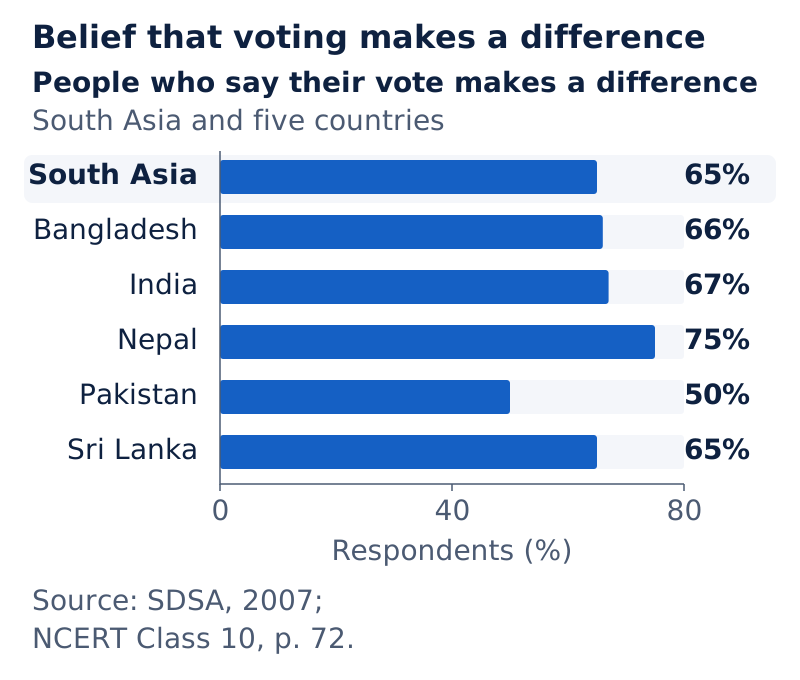
The horizontal bars display percentages for South Asia and five countries. Nepal’s bar reaches 75, while Pakistan’s reaches 50. The horizontal scale is marked from 0 to 80.
Drawn by One Young India. Reference: NCERT Class 10, p. 72
This evidence illustrates citizens’ belief in the significance of their vote. It is not a measure of turnout, nor does it say that every person is satisfied with government. Belief in democratic participation can accompany demands for better outcomes.
The appropriate conclusion is a qualified assessment. Democracy provides accountability, legitimacy, opportunities for accommodation and a basis for equal dignity. Its record on growth, poverty reduction, responsiveness and corruption remains open to criticism.
Continuing scrutiny is part of democratic life. Citizens can value democracy, identify its failures and press for improvement at the same time. The ability to make those demands is one of its significant outcomes.
Glossary
- Democracy — A form of government in which people choose their rulers and should be able to exercise control over them.
- Accountability — The requirement that government be answerable to citizens for its decisions and functioning.
- Responsiveness — Government’s attention to the needs, demands and expectations of the people it governs.
- Transparency — Citizens’ right and ability to examine how decisions are made and whether correct procedures are followed.
- Legitimacy — Acceptance of democratic government as people’s own government, based on rule by representatives they elect.
- Deliberation — Discussion and consideration involved in reaching decisions, forming part of democratic decision-making.
- Political equality — The equal weight of individuals in the election of their political representatives.
- Economic inequality — Unequal shares of income and wealth among people, which can persist despite equal voting rights.
- Accommodation — Respecting social differences and negotiating them through arrangements that allow different groups to participate.
- Majority opinion — The view supported by a majority, whose composition can change across decisions and elections.
- Dignity — The respect due to every individual, supporting claims against domination and unequal treatment.
- Equal opportunity — A claim to opportunities on equal terms, strengthened by democracy for disadvantaged and discriminated castes.
Common errors and misconceptions
- Misconception: Democracy automatically solves every social and economic problem. Correct: It creates conditions for achieving goals. Citizens must use these conditions, and outcomes vary with social and economic circumstances.
- Misconception: A faster decision is necessarily more effective. Correct: Democratic procedures may take time but can improve acceptance. Quick decisions can face problems if people do not accept them.
- Misconception: Democratic government is always responsive and free of corruption. Correct: Democracies often neglect demands and suffer corruption. Accountability and responsiveness are standards against which their actual record must be judged.
- Misconception: Political equality means equal wealth. Correct: Equal weight in electing representatives does not ensure equal income. Large economic inequalities can exist alongside equal political rights.
- Misconception: Poor countries need dictatorship to achieve growth. Correct: The historical comparison shows virtually no growth difference between poor democracies and poor dictatorships. Development also depends on several other factors.
- Misconception: Majority rule permits permanent control by a majority community. Correct: Majorities must cooperate with minorities, and different groups must have a chance to form a majority without exclusion by birth.
- Misconception: Recognition of dignity proves discrimination has disappeared. Correct: Unequal treatment of women and disadvantaged castes can persist. Recognition strengthens the legal and moral basis for challenging it.
- Misconception: Complaints demonstrate only democratic failure. Correct: Complaints can identify real failures while also showing citizens’ growing awareness, confidence and ability to question those in power.
Exam-style questions with model answers
Q1. What is transparency, and how does it support accountability in a democracy? [2 marks]
- Transparency means that citizens have the right and means to examine how government decisions are made.
- It supports accountability by allowing people to check whether correct procedures were followed and to question government’s functioning.
Q2. Explain three reasons why the time taken in democratic decision-making should not automatically be treated as inefficiency. [3 marks]
- Democracy involves deliberation and negotiation. Considering public opinion and following procedures can take time, so some delay is connected with the democratic process itself.
- A decision reached through these procedures may be more acceptable to people and therefore more effective in practice.
- A non-democratic ruler may decide quickly, but speed does not ensure acceptance. An unacceptable decision may create problems that reduce its effectiveness.
Q3. Explain how democracy is expected to produce an accountable, responsive and legitimate government. Include two limitations of its actual performance. [5 marks]
- An accountable government answers to citizens. People choose their rulers and should be able to control and question them through elections, public debate and access to information about government decisions.
- A responsive government attends to people’s needs and expectations. Citizens should also have opportunities to participate in decisions that affect them whenever possible and necessary.
- A legitimate democratic government is regarded as people’s own government because they wish to be governed by representatives they elect.
- Actual accountability is incomplete: most democracies do not give everyone a fair electoral chance or subject every decision to public debate.
- Actual responsiveness is also limited: democratic governments often frustrate people’s needs, often ignore the demands of a majority of the population and are not free of corruption, despite the standards citizens expect them to meet.
Q4. Explain the conditions under which democracy accommodates social diversity. Why does accommodation not mean the disappearance of every conflict? [5 marks]
- The majority must cooperate with the minority so that government represents a general view. Numerical strength does not justify ignoring minority opinions or interests.
- Majority and minority opinions are not permanent. Different people and groups should be able to form a majority in different decisions and elections.
- Rule by majority must not become permanent rule by a religious, racial or linguistic community. Birth must not prevent any citizen from having a chance to join a majority.
- No society can fully and permanently resolve all conflicts. Accommodation means respecting differences and creating mechanisms through which disagreements can be negotiated.
- Democratic procedures for political competition help reduce the possibility of tensions becoming explosive or violent. Their value lies in managing differences rather than eliminating diversity.
Q5. For 1950 to 2000, the growth rates were 3.95 for all democratic regimes, 4.42 for all dictatorial regimes, 4.28 for poor democracies and 4.34 for poor dictatorships. What do these figures show, and why do they not prove that dictatorship is necessary for poor countries to develop? [4 marks]
- Across all regimes, the dictatorial average of 4.42 exceeds the democratic average of 3.95. Democracy therefore did not guarantee the higher growth rate in this comparison.
- Among poor countries, the rates of 4.34 and 4.28 are very close. The figures do not establish that dictatorship is necessary for development.
- Development also depends on population size, the global situation, cooperation from other countries and economic priorities.
- The historical growth comparison cannot settle democracy’s overall value, because accountability, dignity and accommodation of differences are also relevant outcomes.
Q6. In an income comparison, South Africa’s top 20% received 64.8% of national income and its bottom 20% received 2.9%. Denmark’s corresponding shares were 34.5% and 9.6%. Compare these distributions and explain why equal voting rights do not ensure economic equality. [4 marks]
- South Africa shows a highly unequal distribution: its top fifth receives 64.8% of income, while its bottom fifth receives only 2.9%.
- Denmark is less unequal in this comparison. Its top fifth receives a smaller share, 34.5%, and its bottom fifth a larger share, 9.6%.
- Political equality concerns individuals’ equal weight when electing representatives. It does not mean that everyone has equal income or wealth.
- Democratic performance must therefore be assessed through distribution and poverty reduction as well as elections. Political equality can coexist with substantial economic inequality.
Q7. Explain why recognition of women’s equal dignity is a democratic achievement even when unequal treatment continues. [3 marks]
- Long struggles by women helped establish the principle that respect and equal treatment are necessary features of democratic society.
- Once accepted, this principle gives women a legal and moral basis for challenging practices that deny their dignity. Such treatment becomes unacceptable in principle.
- Recognition does not mean complete achievement. Unequal treatment may continue, but democratic equality strengthens the grounds for opposing it and demanding further change.
Q8. Nannu’s duplicate ration-card application was ignored during three months of repeated office visits. He then requested information about daily progress, responsible officials and action against their inaction. Within a week, an inspector told him the card was ready. When he collected it the next day, the officer treated him warmly and asked him to withdraw the information request. Explain what this case shows about transparency and accountability. [4 marks]
- The ignored application and absence of progress information show a failure of responsiveness. Repeated visits had not made officials attend to Nannu’s need.
- His request sought information about how the application had been handled. Asking about progress and responsible officials made administrative conduct open to scrutiny.
- The subsequent visit, ready card and changed treatment show that the information request was followed by official action. The case illustrates information’s role in strengthening accountability.
- The result is evidence of a mechanism citizens can use to question government. It does not prove that every request succeeds or that all administrative neglect has ended.
Key takeaways
- Democracy creates conditions for collective achievement, but citizens must use them; it cannot automatically solve every social and economic problem.
- Accountability, responsiveness and legitimacy are distinct standards: answerability to citizens, attention to needs, and acceptance as people’s own government.
- Democratic deliberation may delay decisions while making them more acceptable; transparency allows citizens to examine how decisions were taken.
- Democracy does not guarantee the highest growth rate, and the historical comparison shows virtually no growth difference among poor democracies and dictatorships.
- Equal political rights can coexist with unequal incomes, making poverty reduction and fair distribution continuing tests of democratic performance.
- Social accommodation requires cooperation between majority and minority and the possibility for different groups to form a majority.
- Recognition of equal dignity strengthens women’s and disadvantaged castes’ struggles, even though discrimination and unequal treatment can continue.
- Rising expectations and public complaints can express democratic awareness, showing that citizens feel entitled to question and improve government.
Test yourself
Why should democracy not be expected to solve every problem automatically?
Democracy is a form of government that creates conditions for achieving goals. Citizens must use those conditions, and outcomes also depend on social and economic circumstances.
Which three practices help assess democratic accountability?
Regular, free and fair elections; open public debate on major policies and legislation; and citizens’ right to information about government and its functioning.
How does responsiveness differ from legitimacy?
Responsiveness concerns attention to people’s needs and demands. Legitimacy concerns acceptance of democratic government as people’s own government, based on representatives they elect.
Why does a high growth rate not establish a fair distribution of income?
Economic growth and distribution are different questions. The economy may grow while a small wealthy group receives a disproportionate share and poorer people struggle with basic needs.
What makes majority rule different from rule by a majority community?
Democratic majorities can change across decisions and elections. A fixed community must not permanently exclude others from the chance of joining a majority.
Does accommodation of social diversity require the removal of every disagreement?
No. No society can permanently resolve every conflict. Accommodation involves respecting differences and negotiating them through procedures that reduce the danger of violence.
How can democracy strengthen equality while discrimination continues?
Recognition of equal dignity gives people a legal and moral basis for challenging discrimination. The recognised principle is an achievement even when its practical realisation remains incomplete.
Why can complaints indicate democratic success as well as shortcomings?
Complaints may expose failures while demonstrating citizens’ awareness and confidence to question rulers. People expect improvement because they see themselves as citizens entitled to judge government.
Try it
Outcomes of Democracy Notes | Class 10 Civics
Think through two scenarios to test your understanding of democracy's outcomes and challenges.
1A citizen wants to verify whether the government followed proper procedures when a new education policy was passed. Based on the text, which option describes a right they definitely have in a democracy?
The text doesn't mention petitioning the President. It focuses on the right to information about how government works and the ability to participate in decisions.
The text states: 'A citizen who wants to check whether a decision was taken correctly has the right to find out.' This transparency is key to democratic accountability.
The text emphasizes that democracy allows room to correct mistakes, but through discussion and negotiation—not immediate reversal. Decisions take time.
2A country held elections where every citizen had one vote, but after ten years, the richest 10% controlled 60% of the nation's wealth while the poorest half had barely any income growth. Based on the text, which statement best explains this outcome?
The text acknowledges democracies are 'often slower at delivering fast economic growth,' but this scenario is specifically about inequality, not growth rate. The text discusses this separately.
The text explicitly states: 'In practice, democracies have not been very effective at reducing this economic gap between the rich and the poor.' Political equality (one vote per person) doesn't automatically translate to economic equality.
The text defines legitimacy differently—a government is legitimate when it is 'chosen by the people themselves' through free elections and follows established procedures. Economic inequality doesn't automatically make a government illegitimate.