
Force | ICSE Class 6 Physics Notes
On this page

This note covers pushes and pulls, changes in how objects move, changes in their form and how large they are, the amount of matter in objects, resistance between touching surfaces, and its useful and harmful effects in everyday life.
What is a force, and how do we recognise pushes and pulls?
Definition: A force is a push or pull on an object resulting from its interaction with another object. An interaction means that the objects act on one another.
Moving a cardboard box helps us recognise a force. We can push the box with our hands, pull it using a rope, or lift it. Lifting the box involves pulling it upwards. These actions look different, but each involves a push or a pull.
Which objects are involved?
When a hand pushes a table, the hand and the table are the interacting objects. The hand applies a force to the table. Naming both objects makes an explanation clearer than simply saying that something moves.
A rope can help us pull a box. Contact means touching. The contact need not be directly between our hand and the box because the rope connects them. In this example, describe the action as pulling the box through the rope.
What the figure shows
Moving a box
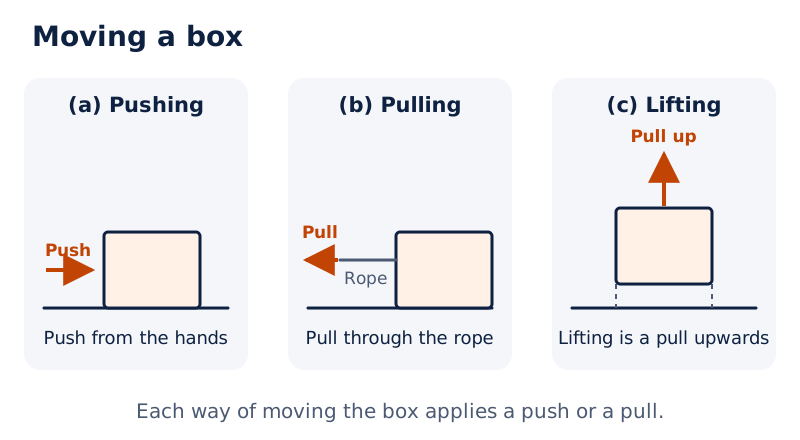
The drawings show a person pushing a box in part (a), a person pulling a box with a rope in part (b), and a person lifting and carrying a box in part (c).
Drawn by One Young India.
How should an example be described?
Use three parts: identify the object receiving the force, identify what applies the force, and describe the action. For example, when hands stretch a rubber band, the rubber band receives a pull from the hands. Its shape, meaning its form, changes.
The International System of Units is abbreviated as SI. The SI unit of force is the newton. Its symbol is N. The word newton begins with a small letter, while its symbol is a capital letter.
Recognising a force does not require a numerical measurement in every example. A push, a pull or a visible change in an object can be described in words. Keep the action separate from its effect: pushing is an action; starting to move is a possible effect.
How can a force start, slow or stop an object?
An object is at rest when its position does not change relative to its surroundings. It is in motion when its position changes relative to them. A stationary object is an object at rest. A force can make such an object start moving.
Speed describes how fast an object moves. A force can change the speed of an object that is already moving. The object may speed up, slow down or come to rest. Stopping is therefore one possible change in motion.
What do familiar actions show?
| Action | Object affected | Possible effect |
|---|---|---|
| Kicking a stationary football | Football | It starts moving. |
| A friend holding a moving bicycle from behind | Bicycle | It stops or its speed decreases. |
| A fielder stopping a moving ball | Ball | It comes to rest. |
| Applying brakes on a moving bicycle | Bicycle | It slows down or stops. |
In the bicycle example, the pull from behind acts on an object already in motion. The effect is different from the kick that starts a stationary football moving. Both examples involve forces, but the starting conditions and the observed changes differ.
A change in speed is evidence of a change in motion. Do not describe slowing down as the absence of a force. A force can be responsible for the decrease in speed just as it can be responsible for starting motion.
Must every push produce visible movement?
A force may make an object move. The word may matters: applying a push does not mean that visible movement must follow. When we try to move a box, friction, the force opposing movement or attempted movement between touching surfaces, can oppose the attempt before the box begins to slide.
Describe what actually happens. If a pushed object starts moving, say that the force changed it from rest to motion. If a moving object slows down, identify the decrease in speed. These observations distinguish the effect from the action used to produce it.
How can force change the direction of motion?
Direction of motion means the direction in which an object is travelling. Speed and direction describe different features of motion. Speed tells us how fast an object moves; direction tells us which way it moves.
A force can change the direction of a moving object. When a bat hits a moving ball, the push can send the ball in a different direction. The ball was already moving before the hit, so the force need not be described as starting it from rest.
What is meant by a change in the state of motion?
The state of motion of an object is described by its speed and direction of motion. Changing its speed, changing its direction, or changing both changes its state of motion. Bringing a moving object to rest is also a change in its state of motion.
Turning the steering handle of an autorickshaw provides another familiar example of changing direction. Compare this with a fielder stopping a ball. In one situation the path changes; in the other the moving ball is brought to rest.
| Observation | Feature to describe | Explanation |
|---|---|---|
| A moving ball is hit into a different direction. | Direction | The force changes where the ball travels. |
| A moving bicycle slows down. | Speed | The bicycle moves less quickly. |
| A fielder stops a moving ball. | Motion to rest | The ball stops moving. |
Can more than one effect occur?
A force may cause some or all of its possible effects. Therefore, a change in direction does not prove that speed remained unchanged. To describe the speed as unchanged, that information must also be given or observed.
Note: If an example tells you only that a moving ball changes direction, identify that effect. Do not add an increase or decrease in speed unless the information supports it.
To explain a change in motion, compare the object before and after the force acts. Ask whether it was stationary or moving, whether its speed changed, and whether its direction changed. This keeps different effects distinct without assuming that only one can happen.
How does force affect shape, size and mass?
Shape means the form of an object, while size refers to how large it is. Pressing an inflated football can change its shape. Stretching a rubber band changes its shape and size. Both actions show effects of force without requiring the whole object to travel across a surface.
Mass is the amount of matter in an object. Matter is the material of which objects are made. A force does not change the object's mass merely by pushing, pulling, stretching or pressing it. A change in shape or size should not be confused with a change in the amount of matter.
What do pressing and stretching show?
When an inflated balloon is pressed, its shape changes. The push is applied to the balloon, and the altered shape is the effect. When hands pull a rubber band, stretching shows the effect of the pull.
What the figure shows
Different effects of force
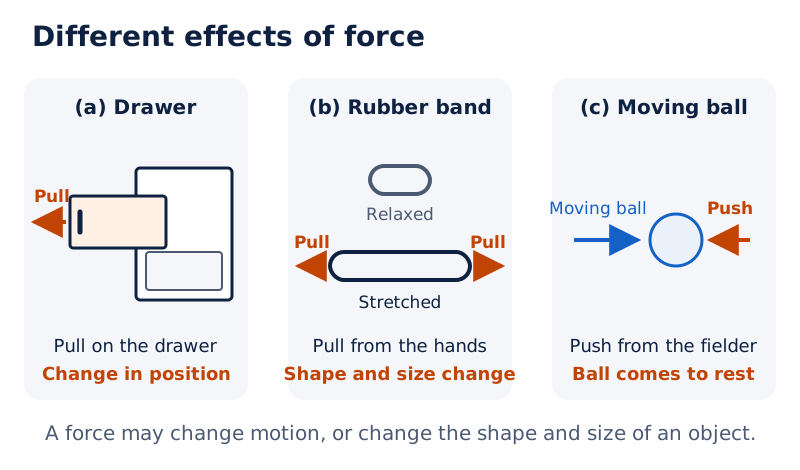
The illustrations show a hand opening a drawer, two hands stretching a rubber band, and a fielder reaching to stop a ball. They show different actions involving force.
Drawn by One Young India.
Rolling a chapati is another example of changing shape by applying force. Compare it with opening a drawer: the drawer changes position, while the material being rolled changes form. The same general idea of a push or pull explains both situations.
How can the effects be kept separate?
| Feature | Meaning | Effect of force |
|---|---|---|
| Speed | How fast an object moves | May increase or decrease |
| Direction | Which way an object travels | May change |
| Shape and size | Form and how large an object is | May change |
| Mass | Amount of matter in an object | Not changed merely by applying force |
When describing the rubber band, identify stretching rather than saying that it gains matter. When describing the football, identify the change in shape. These examples separate visible changes in form from mass, which is a different property of the object.
What is friction, and why does a moving object slow down?
Definition: Friction is the force that comes into play when an object moves or tries to move over another surface. It opposes the relative motion, or attempted relative motion, of the surfaces in contact.
Relative motion means the movement of one surface compared with the other. A book sliding across a table moves relative to the table. Friction acts between the two touching surfaces and opposes this sliding motion.
A contact force acts when objects are in physical contact. Friction between a book and a table is a contact force because the surfaces touch. The force need not be a visible push from a hand.
What happens after a push ends?
Gently push a book across a table. It moves some distance and then stops. The disappearance of the hand's push does not mean that no force acts. Friction between the book and the table opposes its motion and brings it to rest.
- Place a book on a table and gently push it across the surface.
- Observe the book moving and then coming to rest after travelling some distance.
- Repeat the activity by pushing the book in the opposite direction.
- Explain both observations using friction between the book and the table.
In which direction does friction act?
If the book slides to the left, friction on the book acts to the right. If it slides to the right, friction acts to the left. The direction is described in relation to the sliding, so friction does not have one fixed direction.
A ball rolled on a floor also slows and stops after some time. Friction acts between the ball and the floor. Similarly, a bicycle on a flat road slows and stops after pedalling stops. These examples connect friction with changes in motion.
Note: Friction can act when an object is trying to move, even before it starts sliding. The absence of visible movement does not by itself show that friction is absent.
Why does friction differ between surfaces?
Surfaces have irregularities, meaning small uneven parts. Even surfaces that appear smooth have minute irregularities. When two surfaces touch, their irregularities can lock into one another. This interlocking opposes an attempt to move one surface over the other.
To move the surfaces relative to each other, a force must overcome this resistance. Here, resistance means opposition to motion. Friction is greater when a rough surface is involved in the comparisons considered here.
What the figure shows
Irregularities in touching surfaces
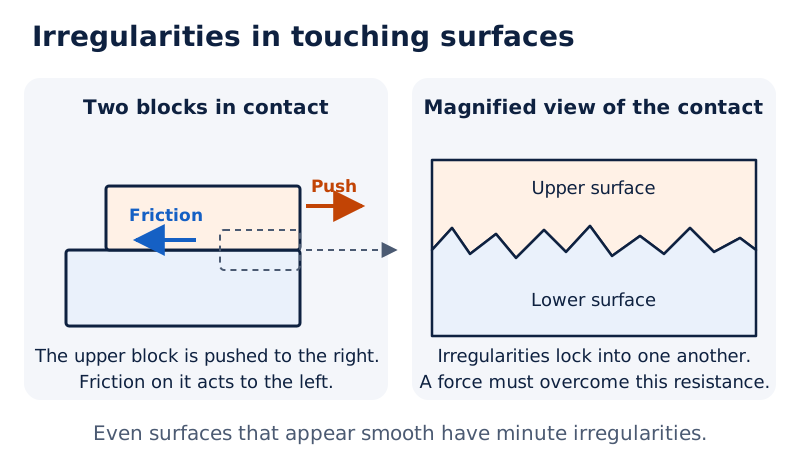
The drawing shows an upper block resting on a lower block. Their touching edges are drawn as uneven lines that fit into one another, illustrating interlocking surface irregularities.
Drawn by One Young India.
How can different surfaces be compared?
A flat-based object, such as an empty lunch box or notebook, can be pushed over different surfaces. Examples include glass, cloth, wood, ceramic tile and sand. The object does not stop after the same distance on every surface.
The different stopping distances show that friction depends on the nature of the surfaces in contact. Identify both surfaces in an explanation: the bottom of the object and the surface beneath it. Looking only at the table or floor gives an incomplete description.
Does pressing surfaces together matter?
Friction also depends on how hard the surfaces press together. Compare dragging a mat with nobody sitting on it and dragging it with a person sitting on it. Pressing the surfaces together more strongly increases friction.
Surface smoothness and how hard surfaces press together are different factors. A comparison of rough and smooth surfaces concerns their nature. A comparison involving a person sitting on the mat concerns how strongly the surfaces are pressed together.
A surface that looks polished is not completely free of irregularities. Therefore, a smooth appearance does not mean that friction is absent. The useful conclusion is that friction can differ between surfaces, rather than that every smooth surface allows motion without resistance.
How do static, sliding and rolling friction differ?
Static friction comes into play when we try to move an object that is at rest. Sliding friction acts when one object slides over another surface. Rolling friction is the resistance to motion when one body rolls over the surface of another.
What happens when a box begins to move?
Consider moving a heavy box across a floor. At first, the box is at rest and the applied push must overcome static friction to start it moving. After it starts sliding, sliding friction opposes its motion.
The force needed at the instant the box starts moving from rest provides a measure of static friction. The force needed to keep it moving at the same speed provides a measure of sliding friction.
Sliding friction is slightly smaller than the static friction that must be overcome to start movement. Once the box slides, the contact points do not have enough time to lock into the contact points on the floor. Moving the box already in motion is somewhat easier.
| Type of friction | When it acts | Example |
|---|---|---|
| Static friction | When an object at rest is being made to move | Trying to start a heavy box moving |
| Sliding friction | When surfaces slide over one another | A box sliding across a floor |
| Rolling friction | When a body rolls over a surface | Rollers carrying luggage across a floor |
Why do rollers help?
Rolling friction is smaller than sliding friction. This is why luggage fitted with rollers is convenient to pull. The rollers turn as the luggage moves, replacing sliding with rolling.
Another demonstration uses cylindrical pencils, meaning pencils with round cross-sections, placed parallel beneath a thick book. When the book is pushed, the pencils roll. Moving the book this way is easier than sliding it directly over the table.
Classify the friction using what happens at the surfaces. Trying to start motion, sliding and rolling describe different situations. An object need not be moving for static friction to act, and a rolling object is not free of friction.
How is friction useful in everyday life?
Friction provides grip, meaning resistance to slipping between touching surfaces. This makes many everyday actions possible. Walking, holding objects, writing and stopping a bicycle all depend on useful friction in different ways.
How does friction help us grip and write?
Without friction, holding a glass would be difficult. A greasy glass tumbler is harder to hold because the oily surface reduces friction. The example shows why reducing friction is not helpful in every situation.
Writing with a pen or pencil depends on friction. When chalk moves across a blackboard, the rough board rubs off some chalk particles, which stick to it. The visible writing is connected with contact between the chalk and the board.
Friction is also needed for walking. A wet marble floor or a wet muddy track can be difficult to walk on. Grooves in shoe soles provide better grip on the floor and help us move safely.
| Situation | Useful effect of friction |
|---|---|
| Holding a glass | Helps prevent the glass slipping from the hand |
| Writing with chalk | Helps rub chalk particles onto the blackboard |
| Walking in grooved shoes | Provides grip between the soles and the floor |
| Applying bicycle brakes | Helps slow or stop the wheel |
| Fixing a nail in a wall | Helps keep the nail in place |
How does friction help a bicycle stop?
Brake pads are the parts that press against the wheel rim in the bicycle brake arrangement considered here. The rim is the outer circular part of the wheel. Pressing the brake lever brings the pads into contact with the rim.
Friction between the pads and the rim opposes its motion and helps stop the wheel. In this situation friction is deliberately increased. Tyres also need grip with the road for starting, stopping and turning.
A useful explanation names the surfaces and the benefit. For brakes, name the pads and rim, then explain slowing or stopping. For writing, name the chalk and board, then explain how chalk particles are rubbed off and remain on the board.
What disadvantages can friction cause?
Friction can oppose movement that we want to continue. It can also damage rubbing surfaces and cause heating, meaning a rise in temperature. These disadvantages do not cancel its useful effects; they show why the value of friction depends on the situation.
What is wear?
Wear is the gradual loss or damage of material through rubbing. Soles of shoes wear out because of friction. Screws and other machine parts can also wear. The surfaces change after repeated contact and rubbing.
The same shoe sole illustrates both sides of friction. Friction provides grip while walking, which is useful. Repeated rubbing wears out the sole, which is harmful. Describing both effects explains why friction cannot simply be labelled good or bad.
How does friction produce heat?
Rubbing the palms together makes them feel warm. A matchstick struck against a rough surface can catch fire. These examples show that friction can produce heat, although the usefulness of that heat differs between situations.
Energy is the capacity to do work, such as moving an object by applying a force. In a running machine, unwanted heating due to friction causes wastage of energy. Reducing friction where moving parts rub can reduce this problem. The aim is to reduce unwanted resistance and heating at those surfaces.
| Disadvantage | Example | What happens |
|---|---|---|
| Wear | Soles of shoes | Material wears away through repeated rubbing. |
| Unwanted heating | A machine in operation | Friction produces heat and wastes energy. |
| Resistance to desired movement | A box sliding on a floor | A force is needed to keep it moving at the same speed. |
Do not treat all heating as harmful. The warmth of rubbed palms and the lighting of a match are different from unwanted heating in machinery. First identify what the activity is meant to achieve, then explain whether friction helps or hinders that activity.
Similarly, friction at bicycle brakes is useful because stopping is intended. Friction that resists the motion of other moving parts is undesirable. The role of friction must be judged at the particular surfaces being discussed.
How can we increase or reduce friction where needed?
We increase friction where grip is useful and reduce friction where unwanted rubbing obstructs movement. The choice depends on the purpose of the contact. A shoe needs grip on a floor, while a door hinge should move smoothly.
How is useful friction increased?
Shoe soles have grooves, and vehicle tyres have treads, meaning patterns cut or formed on their surfaces to improve grip. These features increase friction with the floor or ground. Brake pads deliberately provide friction for stopping.
Kabaddi players rub their hands with soil to improve their grip on opponents. Gymnasts apply a coarse substance to their hands for better grip. Both examples show deliberate efforts to increase friction where slipping would be unhelpful.
How do lubricants reduce friction?
Lubricants are substances that reduce friction. Oil, grease and graphite are examples. Oil on a door hinge helps it move smoothly, while grease is used between moving parts of bicycles and other machines.
A lubricant forms a thin layer between moving surfaces so that they do not rub directly against each other. Interlocking of irregularities is avoided to a great extent. Friction is reduced, but it is not entirely eliminated.
Sprinkling fine powder on a carrom board also reduces friction. The purpose is different from the purpose of grooves in a shoe sole: one helps objects move more easily, while the other improves grip.
How does rolling reduce resistance?
Ball bearings use balls between moving parts so that rolling replaces sliding. Since rolling friction is smaller than sliding friction, sliding is replaced by rolling in most machines through the use of ball bearings.
The book supported on cylindrical pencils demonstrates the same basic advantage of rolling. Rollers beneath luggage also make it easier to pull. These examples reduce resistance without claiming that friction disappears.
To choose a method, first decide whether slipping is useful or unwanted. Then name the relevant surfaces and explain the change: grooves for grip, brake pads for stopping, lubricants for smoother movement, or rollers to replace sliding.
Glossary
- Force — A push or pull on an object arising from interaction with another object.
- Motion — A change in an object's position relative to its surroundings.
- Speed — A description of how fast an object is moving.
- State of motion — The condition of an object's motion described by its speed and direction.
- Mass — The amount of matter in an object, distinct from its shape or size.
- Friction — A force opposing relative movement or attempted movement between surfaces in contact.
- Contact force — A force acting when the interacting objects are in physical contact.
- Static friction — Friction that comes into play when we try to move an object at rest.
- Sliding friction — Friction acting when one object slides over the surface of another.
- Rolling friction — Resistance to motion when a body rolls over another surface.
- Interlocking — The locking together of small irregularities on surfaces touching each other.
- Wear — Gradual loss or damage of material caused by repeated rubbing.
- Lubricant — A substance placed between moving surfaces to reduce friction between them.
- Ball bearings — Balls used between moving parts to replace sliding with rolling and reduce friction.
Common errors and misconceptions
- Misconception: A force can only start motion. Correct: A force may also change speed or direction, stop a moving object, or change an object's shape and size.
- Misconception: Stretching a rubber band increases its mass. Correct: Stretching changes its shape and size; applying the pull does not itself increase the amount of matter in it.
- Misconception: Friction acts only after an object begins moving. Correct: Static friction comes into play when we try to move an object at rest.
- Misconception: Friction on a sliding book acts in its direction of sliding. Correct: Friction opposes the book's sliding relative to the table.
- Misconception: A surface that looks smooth has no irregularities. Correct: Even apparently smooth surfaces have minute irregularities, so a smooth appearance does not mean zero friction.
- Misconception: Sliding friction is much smaller than static friction. Correct: It is slightly smaller than the static friction that must be overcome to start movement.
- Misconception: Friction is harmful in every situation. Correct: It causes wear and unwanted heating, but it also provides grip and helps in writing and braking.
- Misconception: Lubricants or rollers remove friction completely. Correct: Lubricants reduce friction, and rolling friction is smaller than sliding friction; friction is not entirely eliminated.
Exam-style questions with model answers
Q1. Define force and name the two kinds of action included in this definition. [2 marks]
- A force is a push or pull on an object resulting from its interaction with another object.
- The two kinds of action are pushing and pulling; both involve applying a force to an object.
Q2. An inflated football changes shape when pressed. A rubber band becomes longer when stretched. State the effect of force in each case and whether these actions themselves change mass. [3 marks]
- Pressing the inflated football applies a push that changes its shape. This is a change in the form of the football.
- Stretching applies a pull to the rubber band, changing its shape and size as it becomes longer.
- These actions do not themselves change mass, which is the amount of matter in each object. Shape and size are different from mass.
Q3. A book slides to the left on a table after a gentle push and then stops. Identify the force that slows it, the surfaces involved and the direction of that force on the book. [3 marks]
- The force that slows the sliding book and brings it to rest is friction. A hand need not continue touching the book for friction to act.
- Friction acts between the bottom surface of the book and the surface of the table. These surfaces are in contact.
- The frictional force on the book acts to the right because it opposes the book's sliding motion to the left relative to the table.
Q4. A heavy box is initially at rest on a floor. It is pushed until it starts sliding, then kept sliding at the same speed. Identify the friction before and during sliding, compare the forces needed, and explain the difference. [4 marks]
- Static friction comes into play while an attempt is made to move the box from rest. It must be overcome to start the box moving.
- Sliding friction acts once the box slides across the floor. The force needed to maintain the same speed measures this sliding friction.
- Sliding friction is slightly smaller than the static friction overcome at the start, so moving the already sliding box is somewhat easier.
- During sliding, contact points on the box do not get enough time to lock into contact points on the floor.
Q5. Explain one role of friction in each situation: walking in grooved shoes, writing with chalk on a blackboard, stopping a bicycle with pads pressing against its wheel rim, shoe soles wearing out, and unwanted heating in a running machine. [5 marks]
- Grooved shoe soles provide better grip on the floor. Friction helps prevent slipping during walking, so it is useful in this situation.
- The rough blackboard rubs off chalk particles, which stick to the board. Friction between the chalk and board therefore helps produce writing.
- Friction between the brake pads and wheel rim opposes the rim's motion. It helps slow or stop the wheel, which is the intended effect.
- Repeated rubbing wears away material from shoe soles. This is a disadvantage of friction because the soles become worn with use.
- Friction between rubbing machine parts produces unwanted heat. This causes wastage of energy during operation, so reducing that friction is useful.
Q6. A thick book is first slid directly across a table. It is then placed on parallel cylindrical pencils, which roll when the book moves. Name the friction involved in each arrangement and explain why the second arrangement is easier to move. [3 marks]
- Sliding friction acts when the book slides directly over the table. The surfaces of the book and table move relative to one another.
- Rolling friction occurs when the cylindrical pencils roll beneath the moving book. The pencils act as rollers in this arrangement.
- Rolling friction is smaller than sliding friction, so replacing sliding with rolling reduces resistance and makes the book easier to move.
Q7. Oil is applied to a door hinge so that it moves more smoothly. Explain how oil helps and state whether it eliminates friction completely. [2 marks]
- Oil acts as a lubricant, forming a thin layer between moving surfaces and reducing their direct rubbing and interlocking.
- It reduces friction but does not eliminate friction completely.
Q8. For each observation, identify the effect of force: a stationary football starts moving after a kick; a bicycle slows when brakes are applied; a moving ball changes direction when hit by a bat; a pressed balloon changes form. [4 marks]
- The kick changes the football from rest to motion. The force makes an initially stationary object start moving.
- Braking decreases the speed of the moving bicycle. This is a change in how fast the bicycle moves.
- The bat changes the direction of the ball's motion. The stated observation does not tell us whether its speed also changes.
- Pressing changes the balloon's shape. This is an effect on its form rather than a stated change in its motion.
Key takeaways
- A force is a push or pull arising from interaction between objects, and it can produce different effects.
- Force may start or stop motion, change speed or direction, or change an object's shape and size.
- Applying a force does not itself change mass; mass means the amount of matter in an object.
- Friction opposes relative movement or attempted movement between touching surfaces, including before an object begins sliding.
- Sliding friction is slightly smaller than the static friction overcome to start motion; rolling friction is smaller than sliding friction.
- Friction helps with grip, walking, writing and braking, but it also causes wear and unwanted heating.
- Surface irregularities and how hard surfaces press together affect friction; apparently smooth surfaces still have minute irregularities.
- Grooves improve grip, while lubricants and rollers reduce unwanted friction without removing friction completely.
Test yourself
What two interacting objects are involved when a hand pushes a table?
The hand and the table are the interacting objects; the hand applies a push to the table.
What does the symbol N stand for?
N stands for newton, the SI unit used to express force.
A moving ball changes direction after a hit. Must you also claim its speed increased?
No. The observation establishes a change in direction. An increase in speed needs additional information.
Why is stretching a rubber band not evidence that its mass increases?
Stretching changes its shape and size, while mass describes the amount of matter in the rubber band.
Which friction acts when you try to move a box that remains at rest?
Static friction acts when an attempt is made to move the box from rest.
Why is luggage fitted with rollers easier to pull than luggage that slides?
Rollers replace sliding with rolling, and rolling friction is smaller than sliding friction.
How can friction be useful and harmful to shoe soles?
Friction provides grip during walking, but repeated rubbing also wears away the soles.
What do lubricants do to the interlocking of surface irregularities?
They form a layer between moving surfaces and avoid interlocking to a great extent, reducing friction.
Write about it
Turn a question from this chapter into a paper.
The Writing Studio has a structure guide, a rubric and citation tools for 15 formats, from essays to research papers. Drafting is free with an account. Learnacy Essential adds feedback from an AI writing coach and submission to The OYI Review.
Learnacy Essential is ₹1,499 for the year. Publication depends on review and is not guaranteed.