
Magnetism | ICSE Class 6 Physics Notes
On this page

This note covers magnets and magnetic materials, poles, attraction and repulsion, magnetic fields, Earth and the compass, making magnets, permanent and temporary magnets, electromagnets, their uses, demagnetisation, and the care and storage of magnets.
What is a magnet, and which materials does it attract?
Definition: A magnet is a substance that attracts iron. Magnetism is the property associated with this attraction and with the attraction or repulsion between magnets.
Attraction means a pull towards something. Repulsion means a push away. A magnet can pull certain objects towards itself without touching them. It does not attract every material placed near it.
How do magnetic and non-magnetic materials differ?
Magnetic materials are materials attracted towards a magnet. Iron, nickel and cobalt are examples. Some of their combinations with other metals are also attracted towards magnets. This does not mean that every metal is magnetic.
Non-magnetic materials are materials that are not attracted towards a magnet. Glass, plastic and wood are examples. Classifying an object requires attention to its material, rather than simply its appearance or shape.
| Material | Response to a magnet | Classification |
|---|---|---|
| Iron | Attracted | Magnetic |
| Nickel | Attracted | Magnetic |
| Cobalt | Attracted | Magnetic |
| Glass | Not attracted | Non-magnetic |
| Plastic | Not attracted | Non-magnetic |
| Wood | Not attracted | Non-magnetic |
To test materials, first predict which objects will be attracted. Bring a magnet near each object separately and record what happens. Compare each prediction with the observation. The classification should follow the observation, even when the prediction was different.
What are natural and artificial magnets?
Natural magnets occur in nature; naturally occurring magnets are known as lodestones. Artificial magnets are made by people. Magnets used in school laboratories, pencil boxes, stickers and toys are artificial magnets.
A bar magnet has the shape of a bar. Other shapes include U-shaped and ring magnets. Shape and material are separate features: a magnet may be made in a useful shape, but an object does not become magnetic simply because it has that shape.
Where are the poles of a magnet?
The poles of a bar magnet are the regions near its ends where attraction is strongest. A freely suspended magnet hangs so that it can turn freely. Its North pole is the end that points north when it settles; its South pole is the end that points south.
N stands for North pole and S stands for South pole when these letters label a magnet. They name poles, rather than different materials. Both belong to the same magnet.
How do iron filings reveal the poles?
Iron filings are very small pieces of iron. They are attracted by a magnet and make the unequal attraction along a bar magnet easy to observe.
- Spread some iron filings over a sheet of paper.
- Place a bar magnet over the filings.
- Tap the paper and observe where the filings collect.
- Compare the collection near the ends with the collection along the remaining part.
The maximum number of filings sticks near the ends of the bar magnet. Very few stick to the remaining part. Most of the iron filings stick to the poles of a magnet of any shape.
What the figure shows
Iron filings on a bar magnet
The photograph shows thick clusters of dark iron filings at both ends of a red bar magnet, with much less accumulation along its middle.
Can a magnet have just one pole?
A magnet's poles exist in pairs. Breaking a magnet into smaller pieces does not separate a North pole from a South pole. Each smaller magnet still has both poles. A single North pole or a single South pole cannot be obtained in this way.
Note: “Very few filings along the remaining part” does not mean “no attraction except at the ends”. The observation compares the amounts of filings attracted at different places.
How do magnets attract and repel one another?
Like poles are poles of the same kind: North with North, or South with South. Unlike poles are opposite kinds: North with South. Like poles repel one another, while unlike poles attract one another.
| First pole | Second pole | Interaction |
|---|---|---|
| North | North | Repulsion |
| South | South | Repulsion |
| North | South | Attraction |
| South | North | Attraction |
How can movement demonstrate the interaction?
Use two bar magnets with marked poles. Place one magnet across five to six round pencils. Bring an end of the second magnet near an end of the first, without letting them touch. Observe whether the first magnet moves towards or away from the approaching magnet.
Next, bring the other end of the second magnet near the same end of the first. Reversing the approaching pole changes attraction to repulsion, or repulsion to attraction. Identify the facing poles before explaining the movement.
What the figure shows
Interaction between bar magnets
Photographs: Each photograph shows one bar magnet lying across pencils and another held nearby. In part (a), the facing ends are South and North; in part (b), the facing ends are both South.
Why is repulsion useful for identifying a magnet?
An ordinary iron bar is attracted by a magnet. Both ends of that iron bar can be attracted by either pole of the magnet. Therefore, attraction alone does not establish that the iron bar is itself a magnet.
Repulsion identifies a magnet when tested with another magnet. If an unknown end repels a known North pole, that end is also a North pole. The opposite end of the same bar magnet is then a South pole.
Use both observations carefully: attraction reveals an interaction, while repulsion distinguishes a magnet from an unmagnetised iron bar. Here, unmagnetised means that the iron bar has not been made into a magnet.
What is a magnetic field, and how can it be detected?
Definition: The region around a magnet where its magnetic effect can be detected is said to have a magnetic field.
A force is a push or a pull. A magnet exerts a magnetic force in the surrounding region. Magnetic materials can respond to that force, and another magnet can be attracted or repelled without the magnets touching.
How does a compass reveal a field?
A magnetic compass is a direction-finding device containing a magnetised needle that can rotate freely. Magnetised means made into a magnet. A deflection is a change in the direction in which its needle points. A nearby bar magnet can deflect the needle because the needle is itself a magnet.
Bring a North pole near the North pole of the compass needle. The needle's North pole moves away. Bring a South pole near that same end of the needle, and it moves closer. These observations follow the same attraction and repulsion rule as bar magnets.
What can iron filings show?
Place a bar magnet on paper fixed to a drawing board. Sprinkle iron filings around it and tap the board gently. The filings arrange themselves in a pattern under the influence of the magnet's field.
Magnetic field lines are lines used to represent the magnetic field. The pattern along which the iron filings align represents these lines. The filings make the field's effect visible; the magnetic field itself is not a collection of iron filings.
Can the effect act through another material?
Place wood between a bar magnet and a deflected compass needle without disturbing their positions. Repeat with cardboard, a thin plastic sheet and a thin glass sheet. There is no appreciable change in the needle's deflection in this activity.
This shows that the magnetic effect can act through non-magnetic materials. Non-magnetic means “not attracted by a magnet”; it does not mean “blocks the magnetic effect”. Keep this distinction when explaining a magnet acting through a sheet.
How do Earth's magnetism and a compass help us find directions?
Earth behaves like a giant magnet and has a magnetic field. This explains why a freely suspended magnet comes to rest along the north-south direction. Freely suspended means hung so that the magnet can turn without being held in a fixed direction.
How can a suspended magnet be tested?
- Tie a thread around the middle of a bar magnet and adjust it until the magnet balances horizontally.
- Turn the magnet gently in the horizontal direction and let it come to rest.
- Mark the positions corresponding to its ends on paper below it, and join the marks with a line.
- Give one end another gentle push, wait again, and compare its resting direction with the marked line.
The magnet settles along the same north-south direction. The end pointing north is the North-seeking pole or North pole. The other end points south and is the South-seeking pole or South pole.
Repeat the activity with an ordinary small iron bar. It does not consistently settle along north-south; it can rest in any direction. Thus, being made of a magnetic material is different from already being a magnet.
How is a compass used?
A compass is usually a small circular box with a transparent cover. Its magnetised needle is balanced on a pin so it can turn freely. A dial is the marked face beneath the needle. The north-pointing end is usually painted red.
Place the compass where directions are needed. Wait for its needle to settle. Gently rotate the box until north and south on the dial line up with the needle. The other directions can then be read from the dial.
A nearby magnet can deflect a compass needle, so it can interfere with this direction-finding use. The needle must be allowed to settle rather than read while it is still turning.
What the figure shows
Magnetic compass
The photograph shows a circular compass with a central needle and a dial marked with directions. The needle is the magnetic part used to find the north-south direction.
How can a needle be made into a magnet?
Magnetisation means making a magnetic material into a magnet. An iron sewing needle can be magnetised by repeatedly moving one pole of a bar magnet along it in the same direction. This is the stroking method.
A permanent magnet retains its magnetism for a long time. It supplies the magnetic influence used in this activity.
What is the correct stroking procedure?
- Place an iron sewing needle on a wooden table and choose one pole of a permanent bar magnet.
- Put that pole at one end of the needle and move it along the needle's length to the other end.
- Lift the magnet when the stroke is complete. Bring the same pole back to the starting end.
- Repeat in the same direction, using the same pole, at least 30 to 40 times.
- Bring iron filings or steel pins near the needle. Their attraction shows that the needle has become a magnet.
The repeated strokes are made consistently; rubbing backwards and forwards is not the procedure described here.
How can the needle become a simple compass?
Pass the magnetised needle horizontally through a piece of cork. Float the cork in a glass bowl of water so that the needle remains above the water. The cork supports the needle while allowing it to turn.
Wait until it comes to rest and note its direction. Turn the cork gently and wait again. Repeating this observation shows the needle returning to the same direction, like the freely suspended bar magnet.
What the figure shows
Making a needle compass
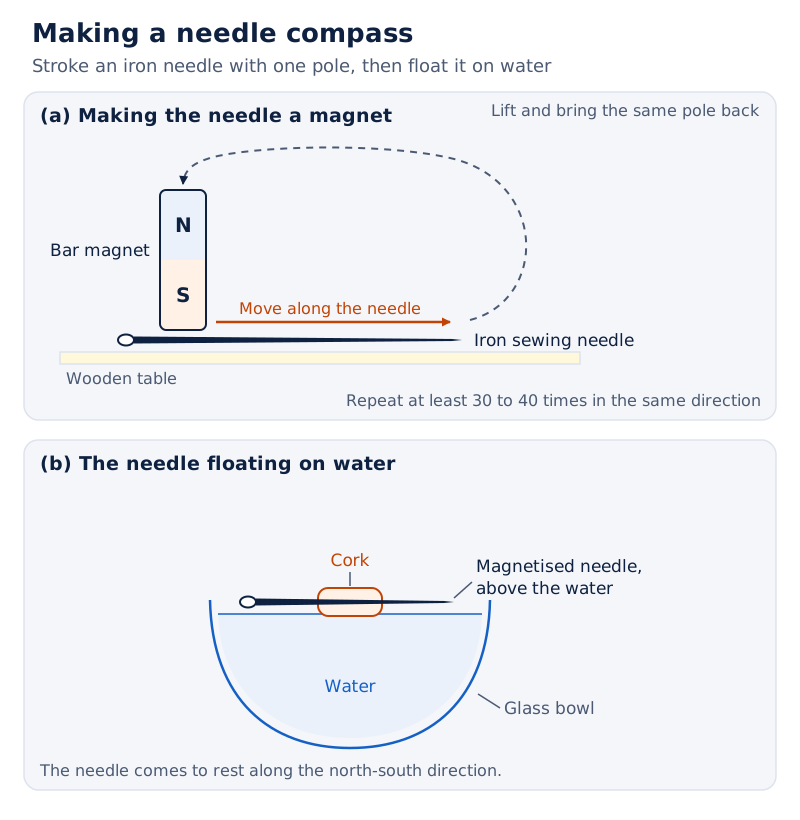
Part (a) shows a hand moving a bar magnet along a needle, with arrows indicating the stroke and return. Part (b) shows a needle passing through cork floating in a bowl of water.
Drawn by One Young India.
Making the magnet and testing it are separate steps. Attraction of filings tests the newly magnetised needle. Floating it so that it can turn demonstrates the direction-finding property. A needle simply resting on a table cannot turn as freely as the floating arrangement.
How do permanent and temporary magnets differ?
A permanent magnet retains its magnetism for a long time. A temporary magnet behaves as a magnet only while it is under the influence of a magnetic field. These terms describe how magnetism is retained, rather than the shape of the object.
An electric current is a flow of electric charges. An electric charge is a property of matter associated with electrical effects. A coil is wire wound into loops or turns; its core is the material placed inside it.
For a temporary magnet made with a coil, the magnetising field comes from current flowing through the coil.
What does the comparison mean in practice?
| Feature | Permanent magnet | Temporary magnet |
|---|---|---|
| Retention of magnetism | Retains magnetism for a long time | Acts as a magnet while under the magnetising field |
| Example used in an activity | Bar magnet used to magnetise a needle | Iron core magnetised by a current-carrying coil |
| Useful behaviour | Provides a continuing magnetic effect | Allows a magnetic effect that can be removed |
The permanent bar magnet used for stroking can attract filings and magnetise the needle without being connected to an electric cell, a source of electrical energy. Its magnetic property is already present before the stroking activity begins.
Why does the core material matter?
Soft iron is iron that is readily magnetised and readily loses the induced magnetism when the magnetising field is removed. Here, induced magnetism means magnetism produced by an external magnetic field.
These properties make soft iron useful for a temporary magnet that must attract and then release objects. Choosing a material that remains strongly magnetised would make quick release less effective.
Note: “Permanent” means that magnetism is retained for a long time. It does not mean that the magnet cannot lose its magnetic property through heating, hammering or improper handling.
How can a simple electromagnet be made?
An electromagnet is a current-carrying coil that behaves like a magnet. When electric current flows through a wire, it produces a magnetic field around the wire. Winding the wire into a coil provides a way to make a controllable magnet.
An electric cell supplies electrical energy. Its terminals are its connection points. An electric circuit is a complete, closed path through which current can flow. A switch, also called a key, opens or closes that path.
How is electric current measured?
Electric current is the rate of flow of electric charge. If charge passes through a cross-section of a conductor in time , the current is:
Charge is measured in coulombs (C), time in seconds (s), and current in amperes (A). One ampere means one coulomb of charge passes through the cross-section each second:
Smaller currents can be expressed in milliamperes (mA) or microamperes ():
Worked example 1. A current of 0.5 A flows through the filament of an electric bulb for 10 minutes. Find the charge that flows through the circuit.
The given current is . Convert the time to seconds: .
Rearrange the current formula to find charge: . Substitute the current and time:
Answer: The charge flowing through the circuit is 300 C.
What materials and steps are needed?
Use an iron nail, flexible insulated wire, an electric cell and iron paper clips. Insulated wire has an outer covering that prevents electrical contact along its covered surface. The nail forms the core, and the wire wound around it forms the coil.
- Wrap the insulated wire tightly around the iron nail to make a coil, and secure it with adhesive tape.
- Expose the metal at the two wire ends and connect them to the cell terminals so that current flows through the coil.
- Bring the nail near iron paper clips and lift it. Observe the clips clinging to the electromagnet.
- Disconnect the wire from the cell to stop the current. Observe that the clips no longer cling to it.
Do not keep the wires connected to the cell for more than a few seconds during this simple activity, because the cell may weaken quickly. Disconnect after the observation rather than leaving the circuit connected.
Why is an iron core useful?
A current-carrying coil itself behaves like a magnet. Inserting an iron nail makes it a stronger magnet. This can be observed as greater deflection of a nearby compass needle and attraction of iron clips.
For practical applications, most electromagnets have an iron core to make them stronger. This does not mean that a coil without an iron core has no magnetic effect. The current in the coil already produces the field.
What the figure shows
Coil with and without an iron nail
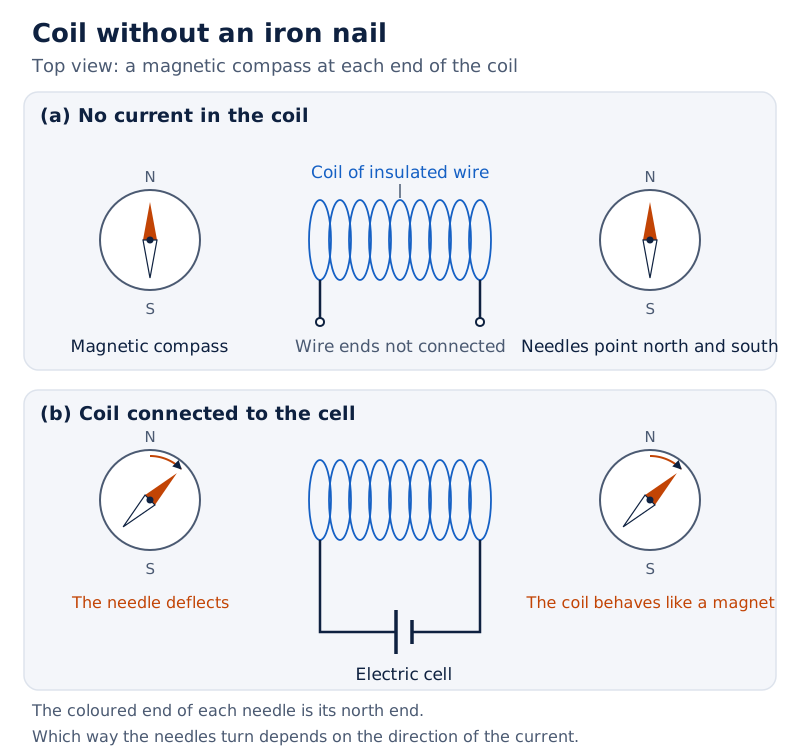
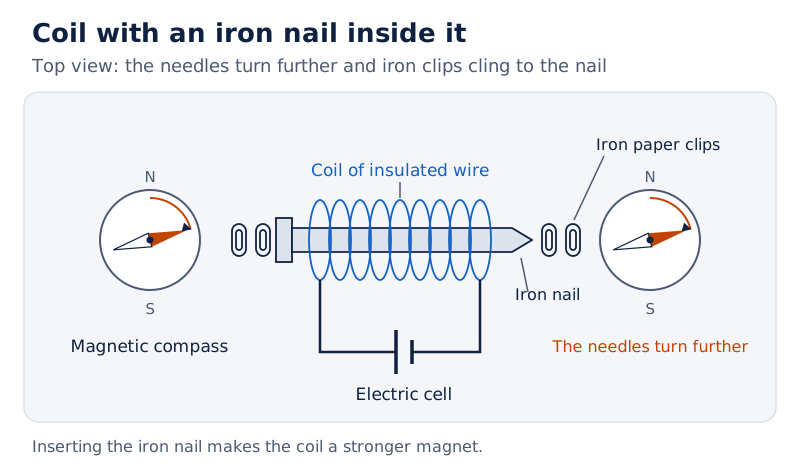
The panels show compasses beside a coil, the coil connected to a cell, and an iron nail inserted inside it. Photograph: Part (e) shows a hand holding the cell above the connected coil and nail, with paper clips hanging from the nail ends.
Drawn by One Young India.
The electrical method and the stroking method both make use of a magnetic influence. Stroking uses an existing magnet; the electromagnet uses the magnetic field produced by current in a coil.
How are electromagnets controlled and used?
An electromagnet can be switched on and off by controlling the electric current in its coil. When the current flows, the coil has a magnetic field. When the current stops, the coil loses its magnetic effect.
How can strength and poles be changed?
The strength of an electromagnet refers to how strong its magnetic effect is. Increasing the current through the coil makes it a stronger magnet. Increasing the number of turns of the coil also makes it stronger.
An electromagnet has a North pole and a South pole. Its poles can be reversed by reversing the direction of the current. Polarity means which end is North and which is South. Reversing polarity changes the pole at each end.
| Change made | Magnetic result |
|---|---|
| Switch current on | The coil behaves as a magnet |
| Switch current off | The coil loses its magnetic effect |
| Increase current in the coil | The electromagnet becomes stronger |
| Increase the number of turns | The electromagnet becomes stronger |
| Reverse current direction | The North and South poles reverse |
Why are lifting electromagnets useful?
Lifting electromagnets are strong electromagnets that may be hung from cranes. They are used in factories and scrap yards to move, lift and sort iron or steel objects. The operator controls the current to control the lifting and release.
With current on, the electromagnet attracts and lifts the iron or steel. With current off, its magnetic field disappears and the objects are released. The ability to release the load is as useful as the ability to attract it.
Permanent magnets supply a continuing magnetic effect, while this application needs a controllable effect. In a lifting arrangement, switching the field on and off makes the temporary magnetic behaviour especially useful.
How do magnets lose magnetism, and how should they be stored?
Demagnetisation is the loss of magnetic property. Heating, hammering and electricity can be used to demagnetise a magnet. Dropping and hammering magnets should be avoided, and magnets should not be heated during ordinary handling.
How can electricity cause demagnetisation?
Electricity can produce magnetism, but it can also be used in a controlled method to remove it. In electrical demagnetisation, the magnet is subjected to a magnetic field that repeatedly reverses direction while its strength is gradually reduced.
Alternating current is current that repeatedly changes direction. A coil carrying alternating current can provide the reversing field used in this method. The field acting on the magnet is gradually reduced to complete demagnetisation.
This is different from simply switching off the current in a classroom electromagnet. In that activity, switching off removes the field produced by the coil. It does not show that every use of electricity destroys permanent magnets.
How should bar magnets be stored?
- Place bar magnets in pairs, side by side.
- Arrange unlike poles on the same side: North beside South at each end of the pair.
- Keep a piece of wood between the magnets.
- Place pieces of soft iron across their ends.
The soft iron pieces used across the ends are called keepers. Their purpose is to help preserve the magnets' magnetism during storage. The wooden separator lies between the bars; the keepers lie across the ends.
What the figure shows
Storage of bar magnets
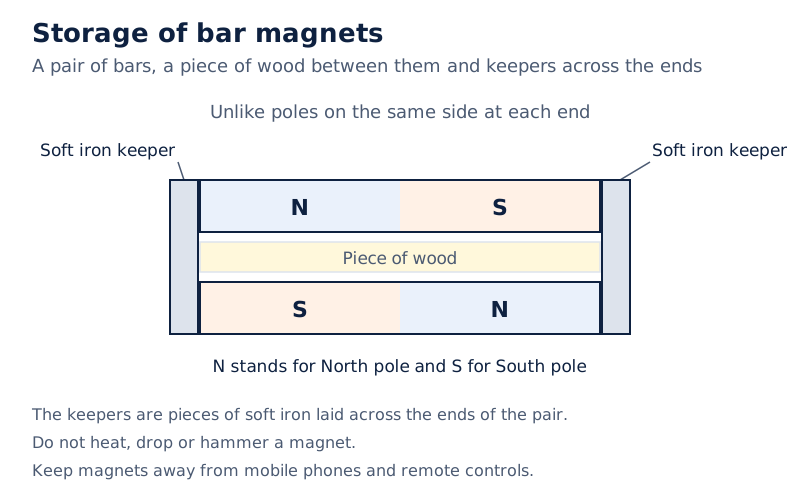
The drawing shows two bars arranged with unlike poles beside each other, a wooden piece between the bars, and iron pieces across the ends. Cartoon: Under the heading “How to keep the magnets safe?”, a smiling red bar magnet accompanies the storage advice and a sad red bar magnet accompanies the handling warnings. The text headed “Magnet says,” reads: “Store me properly. Keep me in pairs with unlike poles on the same side. Keep a piece of wood in between. Place two pieces of soft iron across the ends.” It also says: “Do not heat me or drop me or hammer me. Do not keep me near mobile phones or remote controls.”
Drawn by One Young India.
Keep magnets away from mobile phones and remote controls. Careful storage and handling belong together: arranging the bars correctly does not make heating, dropping or hammering harmless. Treat the magnet as equipment whose useful property needs to be preserved.
Glossary
- Magnet — A substance that attracts iron and has a North pole and a South pole.
- Magnetic material — A material attracted towards a magnet, such as iron, nickel or cobalt.
- Non-magnetic material — A material not attracted towards a magnet, such as glass, plastic or wood.
- Magnetic poles — Regions of a magnet where attraction is strongest, named North and South.
- Attraction — A pull towards another object, occurring between unlike poles of magnets.
- Repulsion — A push away from another object, occurring between like poles of magnets.
- Magnetic field — The region around a magnet or current-carrying wire where its magnetic effect can be detected.
- Magnetic compass — A direction-finding device containing a magnetised needle that can turn freely.
- Magnetisation — The process of making a magnetic material into a magnet.
- Permanent magnet — A magnet that retains its magnetic property for a long time.
- Temporary magnet — A magnet that behaves magnetically while under the influence of a magnetising field.
- Electromagnet — A current-carrying coil that behaves as a magnet; most electromagnets have an iron core.
- Core — The material placed inside a coil, such as iron in an electromagnet.
- Demagnetisation — Loss of magnetic property, which can result from heating, hammering or an electrical method.
- Keepers — Soft iron pieces placed across the ends of magnets to help preserve their magnetism.
Common errors and misconceptions
- Misconception: A magnet attracts every metal. Correct: Iron, nickel and cobalt are magnetic, and some combinations with other metals are magnetic. Do not classify all metals as magnetic.
- Misconception: The middle of a bar magnet has no attraction. Correct: Maximum filings collect near the ends, while very few collect along the remaining part.
- Misconception: Breaking a magnet separates its two poles. Correct: Each smaller piece still has a North pole and a South pole; the poles remain paired.
- Misconception: Attraction proves that an unknown iron bar is a magnet. Correct: Unmagnetised iron is also attracted. Repulsion with a known magnet identifies magnetic behaviour more decisively.
- Misconception: A non-magnetic sheet blocks a magnetic effect. Correct: The compass experiment shows no appreciable change with the wood, cardboard, thin plastic and thin glass used.
- Misconception: A permanent magnet can never lose magnetism. Correct: It retains magnetism for a long time, but heating, hammering and electrical demagnetisation can remove its magnetic property.
- Misconception: The iron core alone creates the electromagnet's field. Correct: The current-carrying coil produces a field; an iron core makes its magnetic effect stronger.
- Misconception: Any rubbing motion magnetises a needle by the stroking method. Correct: Use the same pole, stroke in the same direction, and lift the magnet before returning.
Exam-style questions with model answers
Q1. Classify iron and glass as magnetic or non-magnetic materials, and explain each classification. [2 marks]
- Iron is a magnetic material because it is attracted towards a magnet.
- Glass is a non-magnetic material because it is not attracted towards a magnet.
Q2. Iron filings collect most densely at both ends of a bar magnet, with very few along the rest. Explain the observation, name the two poles, and state what happens to the poles if the magnet is broken. [3 marks]
- The ends attract the most filings because the magnetic attraction is strongest near the poles; the observation does not show zero attraction elsewhere.
- The magnet's two poles are called the North pole and the South pole. They form a pair belonging to the same magnet.
- If the magnet is broken, each smaller magnet still has both poles. Breaking does not produce an isolated North or South pole.
Q3. A known North pole repels one end of an unlabelled bar magnet. Identify that end and the opposite end. State the rule used and explain why attraction alone would not distinguish a magnet from an ordinary iron bar. [4 marks]
- The end repelled by the known North pole is a North pole, because the interacting poles are alike.
- The opposite end of the unlabelled bar magnet is a South pole, since its two poles occur as a pair.
- The rule is that like poles repel each other, while unlike poles attract each other.
- Attraction alone is insufficient because an ordinary unmagnetised iron bar is also attracted by either pole of a magnet.
Q4. You have a bar magnet, thread and paper, and the north-south direction at your location is already known. Describe five steps to test the magnet's resting direction and identify its poles. [5 marks]
- Tie the thread around the middle of the bar magnet, adjusting its position until the magnet balances horizontally and can turn freely.
- Rotate the magnet gently in the horizontal direction and release it. Wait for the magnet to stop turning before observing its position.
- Mark the positions corresponding to its ends on the paper below and join these marks to record its first resting direction.
- Give the magnet another gentle push and let it settle again. Compare its new position with the line to confirm the repeated resting direction.
- Compare this direction with the known north-south direction. Name the north-pointing end the North pole and the south-pointing end the South pole.
Q5. You have an iron sewing needle, a permanent bar magnet, a wooden table, iron filings, cork and a bowl of water. Give six steps to magnetise the needle, test it and make a floating compass. [6 marks]
- Place the iron needle on the wooden table and select one pole of the permanent bar magnet to use throughout the stroking procedure.
- Move that pole from one end of the needle along its length to the other end, then lift the magnet away.
- Return the same pole to the original starting end and repeat in the same direction at least 30 to 40 times.
- Bring iron filings near the needle. Attraction of the filings shows that the needle has become magnetised and can act as a magnet.
- Pass the needle horizontally through the cork and float the cork in the bowl, keeping the needle above the water level.
- Let the needle settle, note its direction, and turn the cork gently. On settling again, the magnetised needle returns to the north-south direction.
Q6. A coil connected to a cell deflects a nearby compass. Inserting an iron nail increases the deflection. Disconnecting the cell removes the coil's magnetic effect. Explain these three observations. [3 marks]
- Current flowing in the coil produces a magnetic field. The compass needle is itself a magnet, so it responds to that field by turning.
- The iron nail acts as a core and makes the electromagnet stronger, producing the observed increase in the compass needle's deflection.
- Disconnecting the cell stops the current. The coil then loses the magnetic effect that it had while current was flowing through it.
Q7. A crane must lift iron objects and then release them. Explain four relevant features of an electromagnet: attraction, release, core material and adjustable strength. [4 marks]
- When current is switched on, the electromagnet develops a magnetic field and attracts the iron objects, allowing them to be lifted.
- Switching the current off removes the coil's magnetic effect, allowing the lifted objects to be released where they are required.
- A soft iron core strengthens the electromagnet and readily loses its induced magnetism when the magnetising field is removed.
- The electromagnet's strength can be changed by changing the current flowing through its coil or by changing the number of turns.
Q8. You have two bar magnets, a wooden separator and two soft iron pieces. State four steps for storing the pair and one handling precaution, explaining its purpose. [5 marks]
- Place the two bar magnets side by side as a pair, so their ends can be connected by the soft iron pieces provided.
- Arrange the pair with unlike poles on the same side: a North pole beside a South pole at each end of the pair.
- Place the wooden separator between the two bar magnets. This is the central piece in the storage arrangement, rather than an end piece.
- Place a soft iron piece across each pair of ends. These pieces are called keepers and help preserve the magnets' magnetic property.
- Avoid hammering the magnets during handling, because hammering can cause loss of magnetism. Correct storage should be accompanied by care while using them.
Key takeaways
- Iron, nickel and cobalt are magnetic materials; glass, plastic and wood are non-magnetic materials that are not attracted by magnets.
- Most iron filings collect at a magnet's poles, and every smaller magnet produced by breaking still has both poles.
- Like poles repel and unlike poles attract; repulsion with a known magnet helps identify another magnet.
- A magnetic field surrounds a magnet, and a compass needle can detect its effect by changing direction.
- Earth behaves like a giant magnet, causing a freely suspended magnet or compass needle to settle along north-south.
- A needle can be magnetised by repeated strokes using the same magnet pole in the same direction.
- An electromagnet uses current in a coil, and most electromagnets used in practice have an iron core to strengthen the effect.
- Store bar magnets in pairs with unlike poles together at each end, a wooden separator and soft iron keepers.
Test yourself
What does non-magnetic mean?
A non-magnetic material is not attracted by a magnet; glass, plastic and wood are examples.
Why do iron filings reveal the ends of a bar magnet so clearly?
The attraction is strongest near the poles, so maximum filings collect near the two ends.
What does a North pole repelling an unknown magnet end tell you?
The unknown end is also a North pole, because like magnetic poles repel one another.
Why must a compass needle be able to turn freely?
It must be able to settle along the north-south direction for the compass to indicate directions.
What should happen between successive strokes when magnetising a needle?
Lift the magnet and return the same pole to the original starting end before repeating the stroke.
Does a coil need an iron core to have any magnetic effect?
No. A current-carrying coil already produces a field; inserting an iron core makes the electromagnet stronger.
How can the poles of an electromagnet be reversed?
Reverse the direction of the current flowing through its coil to reverse its North and South poles.
Does permanent mean impossible to demagnetise?
No. A permanent magnet retains magnetism for a long time, but it can still lose its magnetic property.
Write about it
Turn a question from this chapter into a paper.
The Writing Studio has a structure guide, a rubric and citation tools for 15 formats, from essays to research papers. Drafting is free with an account. Learnacy Essential adds feedback from an AI writing coach and submission to The OYI Review.
Publication depends on review and is not guaranteed.