
Light | ICSE Class 6 Physics Notes
On this page

This note covers light and visibility, straight-line travel of light, experiments with aligned holes and a flexible pipe, pinhole camera construction and working, factors affecting image size, shadow formation, umbra and penumbra, and lunar eclipses.
What does light do, and which objects produce it?
Light helps us see objects. A source of light is something that gives out light. The Sun is the main source of natural light on Earth. Stars, lightning and natural fire also emit light, meaning that they give it out.
How do luminous and non-luminous objects differ?
Luminous objects emit their own light. Non-luminous objects do not emit their own light. This distinction concerns where light comes from, rather than whether an object looks bright to us. An object can be visible without producing light itself.
The Moon is non-luminous. It reflects sunlight that falls on it. Here, reflection means the return of light from a surface. Moonlight is therefore reflected sunlight, rather than light produced by the Moon.
| Object | Does it emit its own light? | Classification |
|---|---|---|
| Sun | Yes | Luminous |
| Stars | Yes | Luminous |
| Moon | No; it reflects sunlight | Non-luminous |
This distinction helps explain a lunar eclipse, an event in which Earth blocks sunlight from reaching the Moon. To understand it, first identify the source supplying light, then the object blocking that light, and finally the place where the shadow falls.
A shadow is a dark region formed when an object blocks light. An image is a representation of an object formed by light. A screen is a surface on which a shadow or an image can be observed. A wall, floor or the ground can serve as a screen; a screen need not be a separate sheet.
Definition: A luminous object emits its own light. A non-luminous object does not emit its own light, even when it is visible by reflected light.
What is rectilinear propagation of light?
Rectilinear propagation means the travel of light in straight lines. “Rectilinear” means straight-line, while “propagation” means travelling or spreading. It explains why the arrangement of a light source, an opening and a screen matters in simple experiments.
A ray of light is a line used to represent the path and direction in which light travels. An arrow on the line shows its direction. A beam is a group of light rays travelling together.
How does a straight path explain blocking?
When an object that does not let light through is placed in a light path, it blocks that path. Such an object is called opaque. Light travelling along that path does not simply follow a bent route around the object in these experiments.
The region behind the object receives less light from the source. On a suitably placed screen, this appears as a shadow. The explanation connects two facts: light travels in straight lines, and the opaque object prevents light from passing through it.
The same principle helps explain a pinhole camera, a device in which light passes through a tiny hole and forms an image on a screen. The image in this camera is upside down.
How should the principle be applied?
Use straight paths to follow light through the experimental arrangement. Check whether the holes line up, whether an object blocks a path, and where light can reach the screen. These questions connect the observations to their explanation.
Note: Straight-line travel explains these activities. Light can sometimes even bend around corners; that behaviour requires a more advanced explanation. Do not turn this introductory principle into a claim that light cannot change direction under any circumstances.
How can aligned holes demonstrate straight-line travel?
Three matchboxes, a torch and a cardboard screen provide evidence for straight-line travel. Make a hole at exactly the same position in the inner tray of each matchbox. Arrange the boxes so that the holes lie along a common straight line.
What is the method?
- Place the three matchboxes in a straight line, with their holes at the same height.
- Put the torch on one side, with its lamp at the height of the holes.
- Place the cardboard screen on the other side. Adjust the boxes slightly if necessary to obtain a bright spot on the screen.
- Move one matchbox slightly sideways, upwards or downwards so that its hole no longer lines up with the others.
- Observe whether the bright spot can still be obtained on the screen.
When all three holes are not in the same line, the bright spot is not obtained. The observations suggest that light travels in a straight line. The displacement changes the available light path while the torch continues to provide light.
| Arrangement | Observation | Explanation |
|---|---|---|
| Holes aligned with the torch | A bright spot appears on the screen | Light passes through the aligned openings |
| One hole moved out of line | The bright spot is not obtained | The straight path through the openings is blocked |
What the figure shows
Light through aligned holes
The photograph shows a torch directed through holes in three upright matchbox trays towards a cardboard screen. Arrows identify a hole and the screen, where a small bright spot is visible.
Keep the observation, what is seen, separate from the conclusion, what it suggests. The missing bright spot is the observation. Straight-line travel is the conclusion supported by comparing the aligned and displaced arrangements.
What does the straight-pipe and bent-pipe experiment show?
A flexible hollow pipe offers another way to investigate the path of light. Point a straight pipe towards a lighted candle so that the flame can be seen through it. Then bend the pipe and try to see the same flame.
Use a lighted candle under adult supervision only. The purpose is to compare visibility through a straight passage and a bent passage. It is not necessary to change the candle or to make the flame brighter between the observations.
What changes when the pipe bends?
The candle flame can be seen through the straight pipe, but not through the bent pipe. The straight pipe allows light from the flame to reach the eye along a straight path. The bent pipe interrupts that direct path.
The flame has not stopped giving out light. Instead, the route between the flame and the eye has changed. This distinction prevents a common error: interpreting failure to see a source as evidence that the source has stopped shining.
What the figure shows
Viewing a candle through a pipe
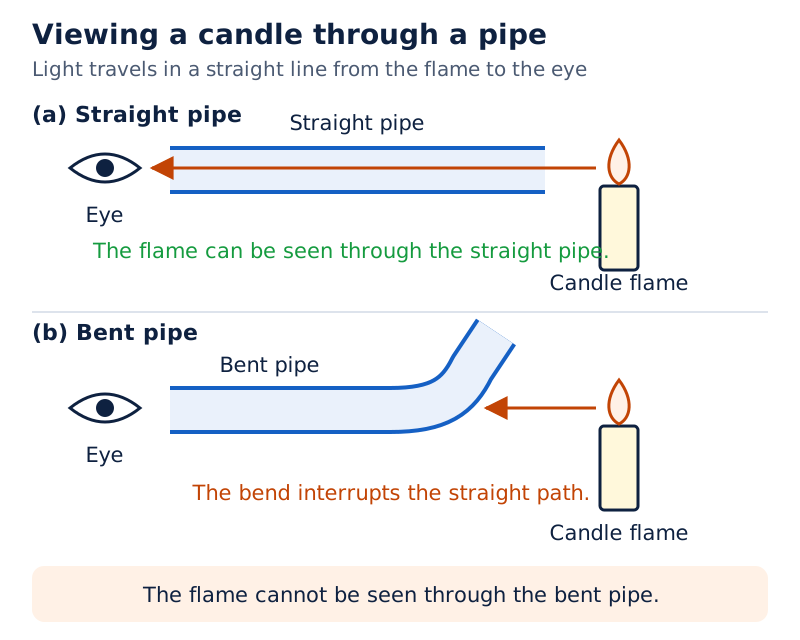
The two drawings show a child looking towards a candle through a pipe. In part (a), the pipe is straight; in part (b), it is bent. The candle stands beyond the far end.
Drawn by One Young India.
How does this compare with the aligned-hole activity?
Both activities test whether light reaches a destination along an unobstructed straight path. In the matchbox activity, that destination is a screen. In the pipe activity, it is the eye. Moving a hole or bending the pipe interrupts the direct path.
Together, the experiments connect arrangement, observation and explanation. Describe the original arrangement, state what was changed, record what happened, and explain the result using straight-line travel. This sequence makes an experimental account complete and easy to follow.
How do materials affect light and the formation of shadows?
Materials differ in how much light passes through them. Transparent materials allow light to pass almost completely. Translucent materials allow light to pass partially. Light does not pass through opaque materials. These distinctions help explain differences between shadows.
| Material group | Passage of light | Shadow observation |
|---|---|---|
| Transparent | Light passes almost completely | Some transparent objects can create faint shadows |
| Translucent | Light passes partially | Translucent objects make lighter shadows |
| Opaque | Light does not pass through | Opaque objects form darker shadows |
How can the passage of light be investigated?
In a dark room, direct a torch towards a wall or cardboard screen to obtain a spot of light. Place a material between the torch and the screen. Observe whether light still reaches the screen through that material.
First make a prediction, meaning an expected result before testing. Then record the observation after placing the material in the light path. Comparing the two helps distinguish a tested result from an assumption about the material.
Tracing paper is a translucent material used as the screen of a pinhole camera. Its role differs from that of the camera's cardboard walls. The tracing paper receives the image and allows it to be viewed, while the walls restrict unwanted light.
What wording matters?
“Almost completely” does not mean “completely”. Likewise, “some transparent objects can create faint shadows” does not mean that every transparent object produces an equally noticeable shadow. Preserve these distinctions when comparing materials or explaining an observation.
Note: Do not state that transparent objects never cast shadows. Opaque objects form darker shadows, translucent objects make lighter shadows, and even some transparent objects can create faint shadows.
How is a pinhole camera constructed and used?
A pinhole is a very small opening through which light enters the camera. A simple sliding pinhole camera uses two cardboard boxes, one fitting inside the other. The screen is made from thin translucent paper, such as tracing paper.
What are the construction steps?
- Select two cardboard boxes so that one slides inside the other with very little gap between them. Cut open one side of each box.
- Make a small hole in the middle of the opposite face of the larger box.
- Cut a square opening in the opposite face of the smaller box, with a side of about 5 to 6 centimetres. A centimetre is a unit of length, written cm.
- Cover this square opening with thin tracing paper to make the screen.
- Slide the smaller box inside the larger box with its tracing-paper face inside. Leave the open side accessible for viewing the screen.
How is the image viewed?
Face the pinhole towards a distant object, such as a tree or building, in bright sunlight. Look through the open side of the smaller box. Cover the head and camera with a dark cloth and move the smaller box forwards or backwards until an image appears.
The screen and the pinhole perform different jobs. The pinhole admits light into the camera; the tracing paper receives the image. Looking at the screen is therefore an essential part of using the completed device.
What the figure shows
A sliding pinhole camera
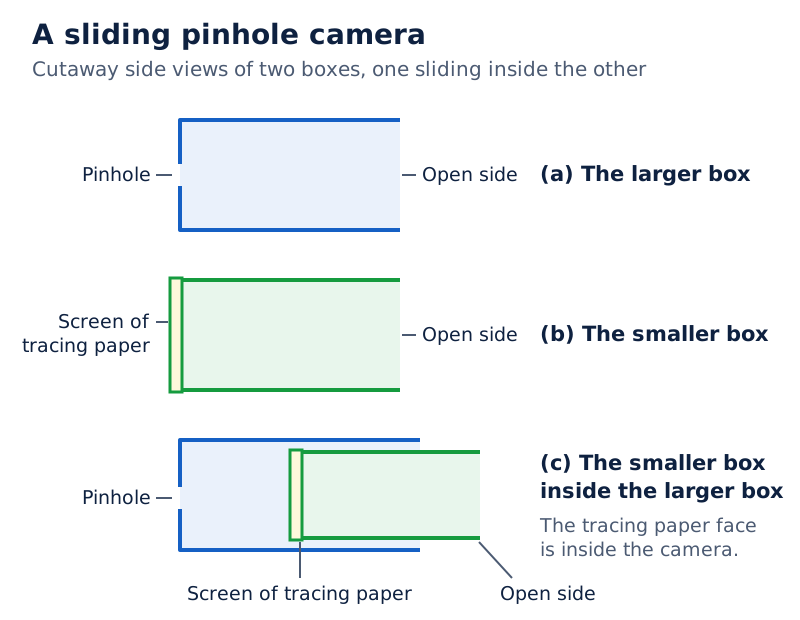
Part (a) shows the larger box with its pinhole and open side. Part (b) shows the smaller box with its screen and open side. Part (c) shows the smaller box inserted into the larger one.
Drawn by One Young India.
Check the arrangement before interpreting an unsuccessful attempt. The pinhole must face the object, the screen must lie inside the camera, and the viewing opening must allow the screen to be seen. These are distinct parts of the construction and use.
Why does a pinhole camera form an inverted image?
A pinhole camera works through rectilinear propagation. Light from an object passes through the tiny opening and reaches the screen. The resulting image is inverted, meaning upside down relative to the object.
How can the light paths be followed?
Consider a lighted candle in front of a pinhole. Light from the top of the flame travels through the hole and continues towards the lower part of the screen. Light from the bottom of the flame reaches the upper part of the screen.
The paths cross at the pinhole. They continue along straight lines after passing through it. The exchange of top and bottom positions explains the inverted image; the light does not bend at the opening to turn the picture upside down.
Other points on the object also send light through the hole to corresponding points on the screen. Together, these contributions form an image. The image can show the object's colours, unlike a shadow, whose colour does not change when an opaque object's colour changes.
What the figure shows
A candle image on a screen
Photograph (a) shows a lighted candle, a cardboard sheet labelled Pinhole, and a screen with the image marked. Photograph (b) shows the upside-down image of the flame on the screen.
How is an image different from a shadow?
| Feature | Pinhole image | Shadow of an opaque object |
|---|---|---|
| Cause | Light passes through a small opening | The object blocks light |
| Appearance | An inverted representation of the object | A dark region that may suggest the object's shape |
| Colour | Can show the object's colours | Changing the object's colour does not change the shadow's colour |
Both effects can be observed on a screen, so the presence of a screen alone does not distinguish them. Ask whether light is forming a representation through the pinhole or whether an object is blocking light from reaching the screen.
What factors affect the size of a pinhole image?
The size of a pinhole image depends on the object's size and on two distances. The object distance here means the distance from the object to the pinhole. The screen distance means the distance from the pinhole to the screen.
What happens when one factor changes?
| Change | What is kept fixed? | Effect on image size |
|---|---|---|
| Move the same object nearer the pinhole | Pinhole-to-screen distance | The image becomes larger |
| Move the same object farther from the pinhole | Pinhole-to-screen distance | The image becomes smaller |
| Move the screen farther from the pinhole | Object and its distance from the pinhole | The image becomes larger |
| Move the screen nearer the pinhole | Object and its distance from the pinhole | The image becomes smaller |
| Use a taller object | Both distances | The image is taller |
These comparisons require the stated conditions. Saying “moving it closer makes the image bigger” is incomplete because “it” might mean the object or the screen. Name the moving part and the point from which its distance is measured.
Why do these changes occur?
Follow the straight paths from the top and bottom of the object through the pinhole. Beyond the opening, the paths separate as they continue. A screen placed farther along those paths intercepts them farther apart, producing a larger image.
For a fixed screen distance, bringing the same object nearer the hole makes the paths from its top and bottom spread more widely after crossing. Moving the object farther away produces the reverse effect. The image remains inverted during these comparisons.
In a sliding-box camera, moving the screen changes its distance from the pinhole. To investigate this factor, keep the same object at the same distance from the hole. Record which part moved, which distances stayed fixed, and how the image size changed.
Note: These are qualitative comparisons: they describe larger and smaller images. Do not infer an exact image height unless the necessary measurements and a valid numerical relationship are supplied.
How do shadows form, and what changes their appearance?
To observe a shadow in the torch activity, we need a light source, an opaque object and a screen. Put the object between the source and the screen. It blocks light from reaching part of the screen, producing a dark patch.
What does each part contribute?
The torch supplies light. The object blocks some of its paths. The screen makes the shadow visible at its position. Walls, floors and the ground serve as screens in everyday situations, so shadows can be observed without a specially prepared screen.
Removing the screen removes the surface used to observe the shadow there; it does not make the object transparent. Removing the object removes the obstruction. Switching off the torch removes the light supplied by that source. These are different changes to the arrangement.
How do position and colour matter?
The shape, size and sharpness of a shadow depend on the position of the object relative to the source and screen. Sharpness means how clearly defined the boundary appears. Tilting the object can change the shape of the shadow seen on the screen.
With a torch and screen fixed, moving an opaque object nearer the torch makes its shadow larger. Moving it nearer the screen makes its shadow smaller. Keep the positions of the torch and screen unchanged when comparing these movements.
Changing the colour of an opaque object does not change the colour of its shadow. A shadow is not a coloured picture of the object's surface. It records where light is blocked, rather than reproducing the object's surface colours.
A shadow may give information about an object, or we may not be able to guess the object at all. Do not assume that every shadow reveals the object's exact shape or identity. The arrangement affects the view obtained on the screen.
What are umbra and penumbra?
The umbra is the full dark part of a shadow. The penumbra is the partial outer shadow. These terms distinguish regions according to how completely the object blocks light from a source.
Why can a shadow have different regions?
An extended source is a source with an appreciable size, so that light comes from different parts of it. Behind an opaque object, some positions receive no direct light from that source. Other positions receive light from only part of it.
In the umbra, the object blocks direct light from the entire source. In the penumbra, it blocks direct light from only part of the source. The penumbra is therefore partly illuminated, meaning that some source light reaches it.
| Feature | Umbra | Penumbra |
|---|---|---|
| Kind of shadow | Full dark shadow | Partial outer shadow |
| Direct source light | Completely blocked | Partly blocked |
| Relative appearance | Darker region | Lighter region outside the umbra |
How does this help explain Earth's shadow?
The Sun is an extended light source and Earth blocks sunlight. Behind Earth, away from the Sun, its shadow has an umbra and a penumbra. A Moon passing through these regions encounters different amounts of direct sunlight.
The terms describe regions of a shadow, rather than two different objects. They also describe more than a difference in the colour of a surface. The relevant distinction is how much direct light is prevented from reaching each region.
When labelling a shadow diagram, identify the source and the blocking object first. Then distinguish the fully shaded region from the partial outer region. This links each name to its physical meaning instead of treating the words as labels to memorise separately.
How does a lunar eclipse occur?
A lunar eclipse occurs when Earth comes between the Sun and the Moon and blocks sunlight from reaching the Moon. Full Moon describes the phase when its visible face appears fully illuminated. Sometimes, on a full-moon day, the Moon passes through Earth's shadow.
What is the arrangement?
The order is Sun, Earth, Moon, with the Moon passing through the shadow behind Earth. The Sun supplies light, Earth blocks it, and the Moon is the body on which the shadow falls. The Moon is not producing the light being blocked.
Keep the word sometimes: a lunar eclipse does not occur on every full-moon day. A full Moon by itself is not enough; the Moon must pass through Earth's shadow. This condition is part of the explanation, rather than an optional detail.
An orbit is the path followed by a body as it travels around another body. “Not to scale” means that the drawing does not preserve the actual relative sizes and distances. Use this diagram to understand the arrangement, not to measure distances.
What the figure shows
Geometry of a lunar eclipse
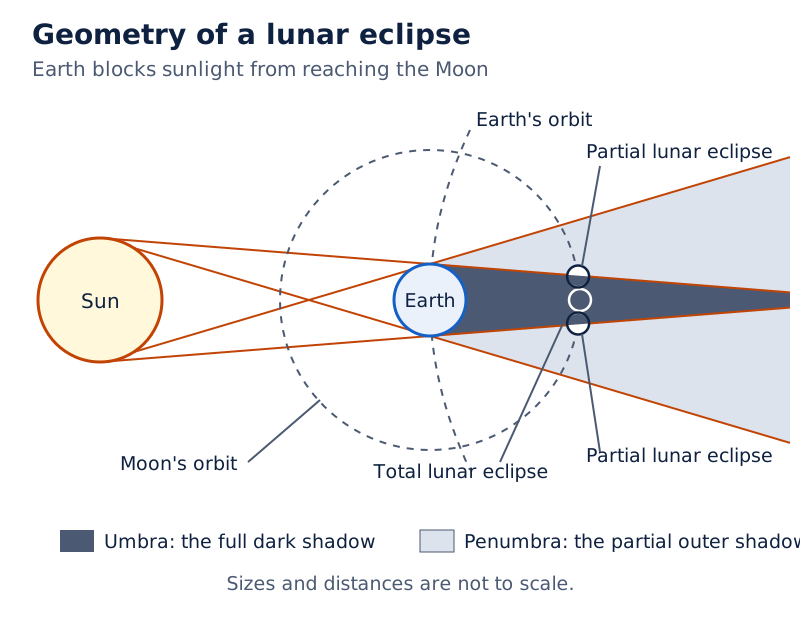
The drawing places the Sun on the left, Earth between it and the Moon, and shaded regions behind Earth. Moon positions are labelled for partial and total lunar eclipses. Earth's orbit and the Moon's orbit are shown. Sizes and distances are not to scale.
Drawn by One Young India.
How do total and partial lunar eclipses differ?
In a total lunar eclipse, the whole Moon enters Earth's umbra. The Moon's bright disc starts to appear dark red and stays that way until it moves out of Earth's shadow. In a partial lunar eclipse, only part of the Moon enters the umbra.
We can safely watch an eclipsed full Moon with the naked eye, meaning without an optical instrument. This applies to viewing the Moon. Direct viewing of the Sun, including during a solar eclipse when the Moon blocks our view of the Sun, must be avoided.
Glossary
- Luminous object — An object that emits its own light rather than merely reflecting light from another source.
- Non-luminous object — An object that does not emit its own light, such as the Moon.
- Rectilinear propagation — The travel of light in straight lines, explaining the aligned-hole and straight-pipe experiments.
- Ray of light — A line representing the path of light, with an arrow indicating its direction.
- Transparent material — A material through which light passes almost completely; some transparent objects can create faint shadows.
- Translucent material — A material that allows light to pass partially, rather than blocking it completely.
- Opaque material — A material that does not allow light to pass through it.
- Screen — A surface on which an image or a shadow can be observed.
- Pinhole camera — A device that forms an image on a screen using light passing through a tiny hole.
- Inverted image — An image that is upside down relative to the object producing it.
- Shadow — A dark region formed when an object blocks light from a source.
- Umbra — The full dark shadow region where an object blocks all direct light from the source.
- Penumbra — The partial outer shadow region receiving direct light from only part of the source.
- Lunar eclipse — An event in which Earth blocks sunlight from reaching the Moon as it passes through Earth's shadow.
Common errors and misconceptions
- Misconception: The Moon is luminous because it looks bright. Correct: The Moon does not emit its own light. It reflects sunlight that falls on it.
- Misconception: Light follows the bend of a pipe to the eye. Correct: In the flexible-pipe experiment, the flame is visible through the straight pipe but not the bent pipe.
- Misconception: Transparent materials pass all light and never make shadows. Correct: Light passes almost completely through them, and some transparent objects can create faint shadows.
- Misconception: A pinhole camera forms an upright shadow. Correct: It forms an inverted image using light that passes through the pinhole and reaches the screen.
- Misconception: Moving the screen nearer the pinhole enlarges the image. Correct: For the same object at the same object distance, this makes the image smaller.
- Misconception: Changing an opaque object's colour changes its shadow's colour. Correct: The shadow's colour does not change when the opaque object's colour changes.
- Misconception: Umbra means the partial outer shadow. Correct: Umbra is the full dark region; penumbra is the partial outer region.
- Misconception: Every full Moon produces a lunar eclipse. Correct: Sometimes the Moon passes through Earth's shadow on a full-moon day. That shadow crossing is necessary.
Exam-style questions with model answers
Q1. Define rectilinear propagation of light. A candle flame is visible through a straight flexible pipe. Predict what happens when the pipe is bent, and explain why. [2 marks]
- Rectilinear propagation means that light travels in straight lines.
- The flame cannot be seen through the bent pipe because the bend interrupts the straight path of light from the flame to the eye.
Q2. A torch shines through holes in three matchbox trays onto a cardboard screen. The holes and torch lamp are at the same height and in a straight line. State the initial observation, the result of moving one tray sideways out of line, and the conclusion. [3 marks]
- A bright spot appears on the cardboard screen because light from the torch passes through the three aligned openings.
- When one tray moves sideways out of line, the bright spot is not obtained: the tray interrupts the straight path through the openings.
- The comparison suggests that light travels in a straight line, a behaviour called rectilinear propagation.
Q3. Describe five stages in making and using a sliding pinhole camera. Use two cardboard boxes, one fitting inside the other, tracing paper and a dark cloth. Make the screen opening about 5 to 6 centimetres across, and observe a distant tree in bright sunlight. [5 marks]
- Choose boxes that slide together with very little gap between them. Cut open one side of each box to prepare them for assembly.
- Make a small pinhole in the centre of the face opposite the open side of the larger box.
- Cut the specified square opening in the opposite face of the smaller box. Cover it with tracing paper to form the screen.
- Insert the smaller box into the larger one, placing the tracing-paper face inside and leaving the open side available for viewing.
- Face the pinhole towards the tree. Cover the head and camera with the dark cloth, look at the screen, and slide the smaller box until an image appears.
Q4. A lighted candle stands before a small hole in cardboard, with a screen behind the hole. Explain the image's orientation by tracing light from the top and bottom of the flame, and state the principle involved. [4 marks]
- The screen receives an inverted image of the flame, meaning that the image is upside down relative to the candle.
- Light from the top of the flame travels through the small hole and continues towards the lower part of the screen.
- Light from the bottom of the flame passes through the hole and reaches the upper part of the screen.
- The paths cross at the hole and continue straight. The principle involved is rectilinear propagation of light.
Q5. Compare four separate changes to a pinhole camera. For the same object with screen distance fixed, move the object nearer, then farther from the pinhole. For the same object with object distance fixed, move the screen farther, then nearer. State the image-size effect of each change. [4 marks]
- Moving the same object nearer the pinhole makes its image larger, provided the pinhole-to-screen distance stays fixed.
- Moving the same object farther from the pinhole makes its image smaller, with the screen distance unchanged.
- Moving the screen farther from the pinhole makes the image larger, while the object and its distance remain fixed.
- Moving the screen nearer the pinhole makes the image smaller, with the same object at the same object distance.
Q6. An opaque object is placed between a torch and a screen. Explain shadow formation, predict the effect of changing only the object's colour, and distinguish umbra from penumbra when the source has an appreciable size. [4 marks]
- The object blocks light travelling towards the screen, so the region receiving no direct light from the source appears dark.
- Changing only the colour of the opaque object does not change the colour of its shadow on the screen.
- The umbra is the full dark region, where the object blocks direct light from every part of the source.
- The penumbra is the partial outer shadow, where the object blocks light from only part of the source.
Q7. Explain a lunar eclipse in five points: identify the source of moonlight, give the arrangement of the Sun, Earth and Moon, explain the shadow's cause, state the full-Moon condition without claiming an eclipse every month, and distinguish total from partial lunar eclipses. [5 marks]
- The Moon does not produce its own light. It is visible because it reflects sunlight falling on it.
- During a lunar eclipse, Earth lies between the Sun and the Moon, with the Moon passing through the shadow behind Earth.
- Earth blocks sunlight that would otherwise reach the Moon. This makes the eclipse an application of shadow formation and straight-line travel.
- Sometimes, on a full-moon day, the Moon passes through Earth's shadow. A lunar eclipse therefore does not happen on every full-moon day.
- In a total lunar eclipse, the whole Moon enters Earth's umbra. In a partial lunar eclipse, only part of the Moon enters this full dark region.
Key takeaways
- Rectilinear propagation means straight-line travel of light, demonstrated by aligned openings and the straight-pipe experiment.
- The Moon reflects sunlight; its bright appearance does not make it an object that emits its own light.
- Transparent materials pass light almost completely, translucent materials pass it partially, and opaque materials block its passage.
- A pinhole camera forms an inverted image on a screen using light that passes through a tiny opening.
- Pinhole image size depends on object size, object-to-pinhole distance and pinhole-to-screen distance; comparisons require other factors to stay fixed.
- A source, an opaque object and a screen allow a shadow to be observed in the torch activity.
- Umbra is the full dark shadow region, while penumbra is the partial outer region receiving some direct source light.
- Sometimes a full Moon passes through Earth's shadow, producing a lunar eclipse with Earth between the Sun and Moon.
Test yourself
Why is the Moon called non-luminous?
It does not emit its own light. It reflects sunlight that falls on its surface.
What must be aligned in the three-matchbox activity?
The three holes and the torch lamp must be at the same height and along a straight line.
What does “almost completely” tell us about transparent materials?
They let light pass almost completely, rather than necessarily passing all light. Some transparent objects can create faint shadows.
Which part of a sliding pinhole camera receives the image?
The tracing-paper screen receives the image formed by light entering through the pinhole.
Why is a pinhole image inverted?
Light from the object's top reaches the screen's lower part, while light from its bottom reaches the upper part. The straight paths cross at the pinhole.
For the same object at a fixed object distance, what happens when the screen moves farther from the pinhole?
The image becomes larger because the light paths are farther apart when they reach the more distant screen.
How do umbra and penumbra differ?
Umbra is the full dark shadow region. Penumbra is the partial outer shadow where some direct light from the source still arrives.
Does every full Moon produce a lunar eclipse?
No. Sometimes the Moon passes through Earth's shadow on a full-moon day. The Moon must enter that shadow for a lunar eclipse to occur.
Write about it
Turn a question from this chapter into a paper.
The Writing Studio has a structure guide, a rubric and citation tools for 15 formats, from essays to research papers. Drafting is free with an account. Learnacy Essential adds feedback from an AI writing coach and submission to The OYI Review.
Learnacy Essential is ₹1,499 for the year. Publication depends on review and is not guaranteed.