
Geomorphic Processes | CBSE Class 11 Geography Notes
On this page
Watch & explore
Start with a few high-quality watches, then dive into the notes below.

This note covers geomorphic forces and agents, endogenic and exogenic processes, weathering, mass movements, landslides, erosion and deposition, soil formation, and the influence of parent material, topography, climate, organisms and time.
Why is the earth’s surface uneven?
The earth’s crust is dynamic: it moves vertically and horizontally. Differences in forces operating within the earth create variations in its outer surface. Internal forces remain active with different intensities, while external forces continuously act upon the surface.
How do the opposing forces work?
Endogenic forces originate within the earth and are mainly land-building forces. Exogenic forces originate within the atmosphere and are mainly land-wearing forces. Their energy is derived basically from sunlight.
External action wears down elevations through degradation and fills depressions through aggradation. Wearing down surface relief variations through erosion is called gradation. Internal forces continuously elevate or build up parts of the surface, preventing external processes from completely levelling it.
Relief variations therefore remain as long as these opposing actions continue. Most of the earth’s surface has been shaped over hundreds and thousands of years. Human overuse of resources diminishes its potential to sustain life.
What distinguishes a process from an agent?
Definition: Geomorphic processes are the endogenic and exogenic forces that produce physical stresses and chemical actions in earth materials, changing the configuration of the earth’s surface.
A process is a force applied to earth materials. An agent is a mobile medium that acquires, transports and deposits them. Running water, groundwater, glaciers, wind, waves and currents are geomorphic agents.
Gravity gives downslope movement its direction and produces stresses in materials. Gradients allow movement from higher to lower levels or from higher to lower pressure. Without gravity and gradients, mobility, erosion, transportation and deposition would not be possible.
How do endogenic processes build and deform the crust?
Endogenic processes draw their main energy from within the earth. This energy is mostly generated by radioactivity, rotational and tidal friction, and primordial heat remaining from the earth’s origin.
Geothermal gradients and outward heat flow induce diastrophism and volcanism in the lithosphere. Differences in heat flow, geothermal gradients, crustal thickness and crustal strength make endogenic action uneven. Consequently, the original crustal surface controlled by tectonic forces is uneven.
What comes under diastrophism?
Diastrophism includes processes that move, elevate or build portions of the crust. Its different forms vary in the area affected and the kind of crustal movement involved.
| Process | Characteristic movement |
|---|---|
| Orogenic processes | Mountain building through severe folding in long, narrow crustal belts. |
| Epeirogenic processes | Uplift or warping of large portions of the crust, associated with continental building. |
| Earthquakes | Local, relatively minor movements of the crust. |
| Plate tectonics | Horizontal movements of crustal plates. |
Orogeny severely deforms the crust into folds. Epeirogeny may involve simple deformation. These processes, together with earthquakes and plate tectonics, can produce faulting and fracturing.
They also cause changes in pressure, volume and temperature. These changes in turn induce the metamorphism of rocks. Crustal movement therefore affects both surface configuration and the character of rocks.
What does volcanism include?
Volcanism includes magma moving onto or towards the earth’s surface. It also includes the formation of intrusive and extrusive volcanic forms. The term thus covers movement of molten rock as well as the forms produced by that movement.
What controls the action of exogenic processes?
Exogenic processes obtain energy from the atmosphere, ultimately from the sun, and from gradients produced by tectonic factors. Temperature and precipitation are the important climatic elements controlling these processes.
How do stresses affect earth materials?
Stress is force applied per unit area. Pushing and pulling produce stress and deformation in solids. Shear stresses act along the faces of materials, causing separation, angular displacement or slippage.
Temperature changes, crystallisation and melting commonly produce molecular stresses. Chemical processes normally loosen bonds between grains or dissolve soluble minerals and cementing materials. Developing stresses in earth materials underlies weathering, mass movements and erosion.
What the figure shows
Denudational processes and their driving forces
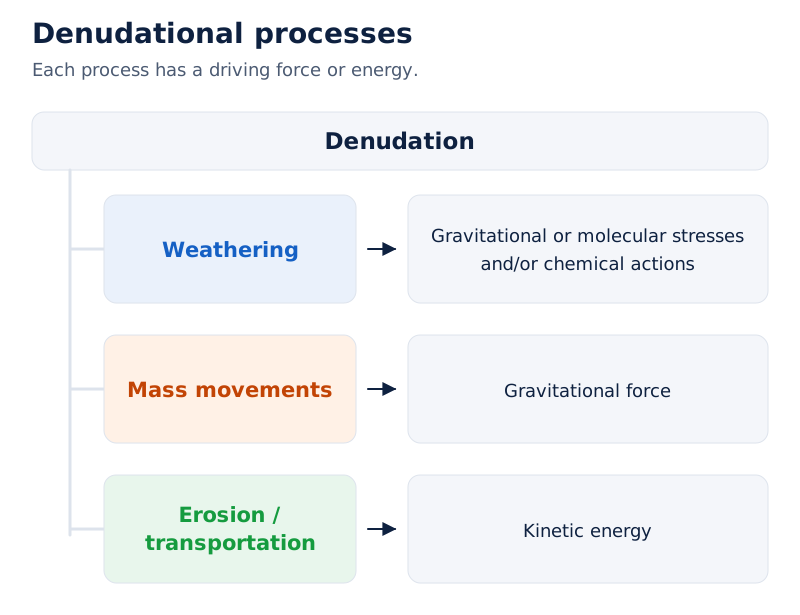
The flow chart branches into weathering, mass movements, and erosion/transportation. The corresponding boxes show gravitational or molecular stresses and/or chemical actions, gravitational force, and kinetic energy.
Drawn by One Young India. See Fig. 5.1 in your NCERT textbook
Denudation means stripping off or uncovering. It includes weathering, mass wasting or movements, erosion and transportation. These processes act differently because their driving forces and the conditions affecting them differ.
Why does their intensity vary?
Climatic regions differ in temperature conditions, precipitation and vegetation. Even within a region, altitude, slope aspect, insolation, wind, evaporation and freezing and thawing create local variations in geomorphic activity.
With climate held equal, the type and structure of rocks control the intensity of exogenic action. Structure includes folds, faults, bedding, joints, mineral hardness, chemical susceptibility and permeability.
A rock may resist one process but not another. Under different climates, it may offer different degrees of resistance. Most exogenic effects are small and slow and may be imperceptible over short periods, but continued fatigue severely affects rocks over time.
What is weathering, and how does chemical weathering act?
Definition: Weathering is the mechanical disintegration and chemical decomposition of rocks through the action of weather and climate.
Weathering reduces earth materials to a fragmental state. Very little or no movement of materials occurs, so it is an in-situ, or on-site, process. This distinguishes it from removal and transportation by an erosional agent.
What controls weathering?
Geological, climatic, topographic and vegetative factors condition weathering. Climate is particularly important: both the processes and the depth of the weathering mantle vary between climatic regimes.
What the figure shows
Climatic regimes and depth of weathering mantles
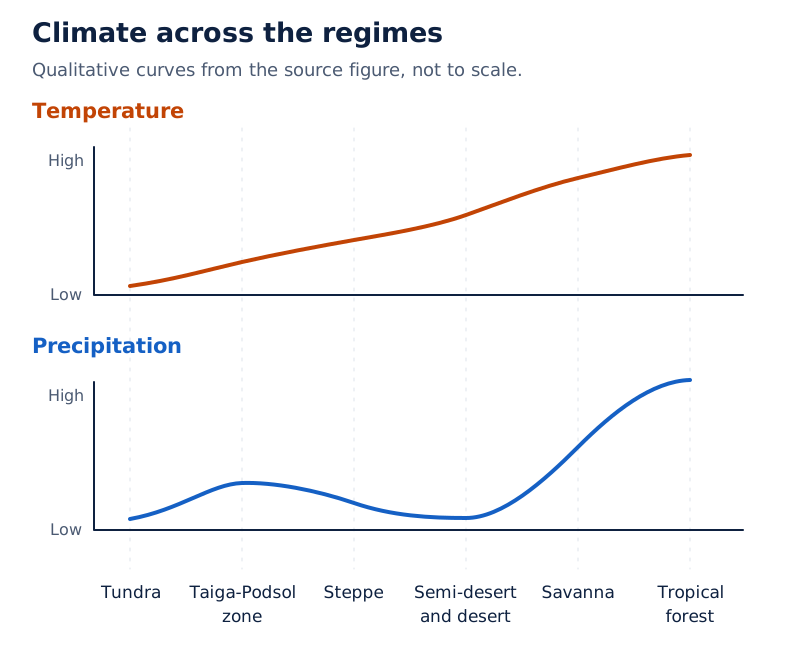
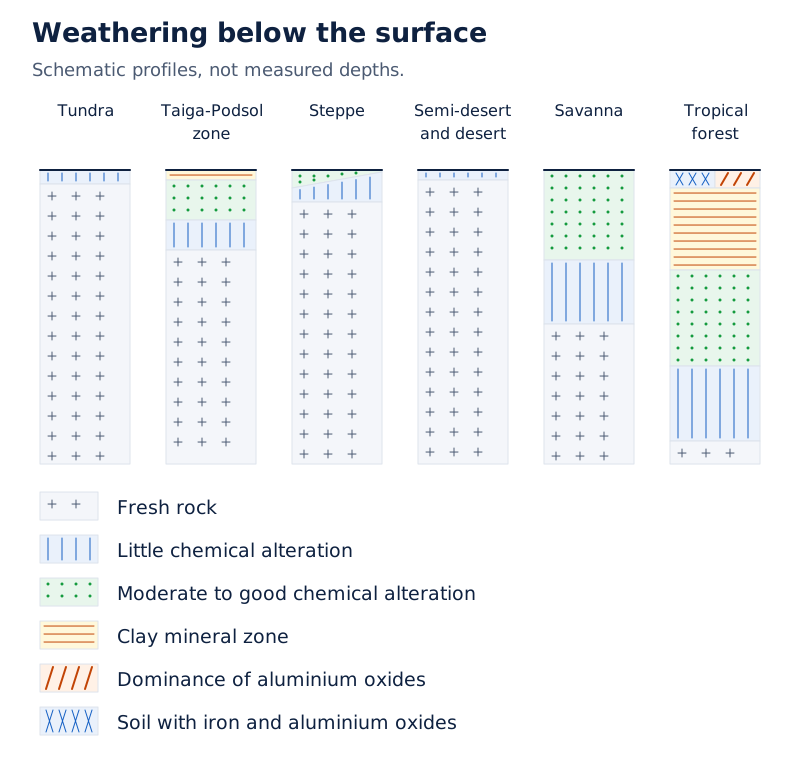
The chart combines precipitation and temperature curves with a cross-section of weathered material across climatic regimes. Its legend distinguishes fresh rock, degrees of chemical alteration, clay minerals, and zones containing aluminium and iron oxides.
Drawn by One Young India. See Fig. 5.2 in your NCERT textbook
The major groups are chemical, physical or mechanical, and biological weathering. Very rarely does a process operate completely by itself, but quite often one process is dominant. Weathering should therefore be understood as interacting actions.
Weathering classifications distinguish the main groups, the chemical processes and the types of force involved in physical breakdown.
| Classification | Number of groups or processes | Members |
|---|---|---|
| Major weathering groups | 3 | Chemical, physical or mechanical, and biological weathering. |
| Chemical weathering processes | 5 | Solution, carbonation, hydration, oxidation and reduction. |
| Types of applied force in physical weathering | 3 | Gravitational forces, expansion forces and water pressures. |
Which reactions contribute to chemical weathering?
Solution, carbonation, hydration, oxidation and reduction decompose or dissolve rocks, or reduce them to fine clastic material. These reactions involve oxygen, surface or soil water, and other acids.
Water, air containing oxygen and carbon dioxide, and heat must be present to speed up chemical reactions. Decomposing plants and animals add carbon dioxide underground, over and above the carbon dioxide already present in the air.
Chemical weathering changes minerals through reactions. Physical weathering instead depends on applied forces that fracture materials. Their interaction helps explain why chemical attack and mechanical breakdown can affect the same rock rather than forming completely separate systems.
How do physical and biological weathering break down rocks?
Physical weathering depends on forces acting both at the surface and within earth materials. Most physical weathering processes are caused by thermal expansion and pressure release.
Which forces cause mechanical breakdown?
| Applied force | Examples or controls |
|---|---|
| Gravitational forces | Overburden pressure, load and shearing stress. |
| Expansion forces | Temperature changes, crystal growth and animal activity. |
| Water pressures | Wetting and drying cycles. |
Repeated contraction and expansion subject rocks to continued fatigue. Although the processes are small and slow, repeated action can cause great damage. Fractures develop as materials respond to the applied forces.
How do organisms contribute?
Biological weathering includes the addition or removal of minerals and ions in the weathering environment. It also includes physical changes caused by the growth and movement of organisms.
Earthworms, termites and rodents burrow or wedge into material. They expose new surfaces to chemical attack and assist the entry of moisture and air. Plant roots exert pressure that mechanically breaks earth materials apart.
Humans disturb vegetation, plough and cultivate soil. These actions mix materials and create fresh contact between minerals, air and water. Decaying organisms produce humic, carbonic and other acids, enhancing decay and the solubility of some elements.
What is exfoliation?
Exfoliation is the flaking away of more or less curved sheets or shells from rocks or bedrock. It produces smooth, rounded surfaces and can result from expansion and contraction caused by temperature changes.
Photograph: Exfoliation and granular disintegration (NCERT Class 11 Figure 5.3). The photograph shows exposed rock with curved, flaking surfaces and broken material.
Exfoliation domes result from unloading, while tors result from thermal expansion. Exfoliation is a result, not a process: the term identifies the outcome of the weathering actions.
Why is weathering significant for landscapes and resources?
Weathering breaks rocks into smaller fragments and prepares the way for regolith and soil formation. It also aids mass movements and erosion, connecting the breakdown of rock with the later movement of material.
How does weathering support vegetation?
Forests depend on the depth of weathering mantles. Biomes and biodiversity are basically a result of vegetation, so weathering has significance beyond breaking rocks. Its role in preparing material for soil formation connects it with the conditions supporting plant growth.
Weathering aids the reduction of relief, while changes in landforms are a consequence of erosion. Distinguishing these roles helps separate the preparation of material from its subsequent removal.
Note: Weathering aids both erosion and mass movement, but it is not a prerequisite for either. Its importance in preparing loose material should not be confused with a requirement that every moving rock must first be weathered.
How does enrichment occur?
Weathering of rocks and deposits helps enrich and concentrate valuable ores of iron, manganese, aluminium and copper. Groundwater removes some materials through chemical or physical leaching, increasing the concentration of what remains.
- Rocks and deposits undergo weathering.
- Groundwater removes some materials through chemical or physical leaching.
- The remaining valuable materials become more concentrated.
- This enrichment can make a difference to whether the material is economically viable to exploit, process and refine.
Without weathering, the concentration of a valuable material may not be sufficient for economic use. Enrichment refers to this increase in the concentration of remaining material, rather than simply to the production of smaller rock fragments.
What causes mass movements down slopes?
Mass movements transfer rock debris downslope under the direct influence of gravity. Air, water or ice does not carry the debris from place to place; instead, the moving debris may carry air, water or ice within it.
Movement ranges from slow to rapid and affects shallow to deep columns of material. It includes creep, flow, slide and fall. Heave, flow and slide are forms of movement; heave includes the lifting of soil through frost growth and other causes.
What conditions favour movement?
Gravity acts on bedrock as well as weathered material. Weathering aids mass movements but is not a prerequisite. Mass movements are very active over weathered slopes rather than unweathered materials.
Materials yield when the disturbing force exceeds their shearing resistance. Weak unconsolidated material, thinly bedded rocks, faults, steeply dipping beds, cliffs, steep slopes, abundant precipitation, torrential rain and scarce vegetation favour movement.
Which changes can activate mass movement?
- Removal of support from below by natural or artificial means.
- An increase in slope gradient or height.
- Overloading through natural additions or artificial filling.
- Heavy rainfall that overloads, saturates and lubricates slope materials.
- Removal of material or load from the original slope surface.
- Earthquakes, explosions or machinery.
- Excessive natural seepage.
- Heavy drawdown from lakes, reservoirs and rivers, followed by slow outflow from beneath slopes or river banks.
- Indiscriminate removal of natural vegetation.
Mass movement and erosion differ despite both shifting material. Running water, glaciers, wind, waves and currents do not participate as transporting agents in mass movements. The direct action of gravity is the defining distinction.
How do landslides differ, and why are some Indian hills affected?
Landslides are relatively rapid and perceptible movements involving relatively dry material. The detached mass depends in size and shape on rock discontinuities, the degree of weathering and slope steepness.
What are the main differences between landslide movements?
| Movement | Distinguishing feature |
|---|---|
| Slump | One or several debris units slip with backward rotation relative to the slope. |
| Debris slide | Earth debris rolls or slides rapidly without backward rotation. |
| Debris fall | Earth debris falls nearly freely from a vertical or overhanging face. |
| Rockslide | Individual rock masses slide down bedding, joint or fault surfaces. |
| Rock fall | Rock blocks fall freely from a steep slope, keeping away from the slope. |
Rock falls involve superficial layers of a rock face. Rockslides affect material to substantial depth and can be very fast and destructive on steep slopes. Slides involve planar failures along discontinuities such as steeply dipping bedding planes.
What the figure shows
Slumping of debris with backward rotation
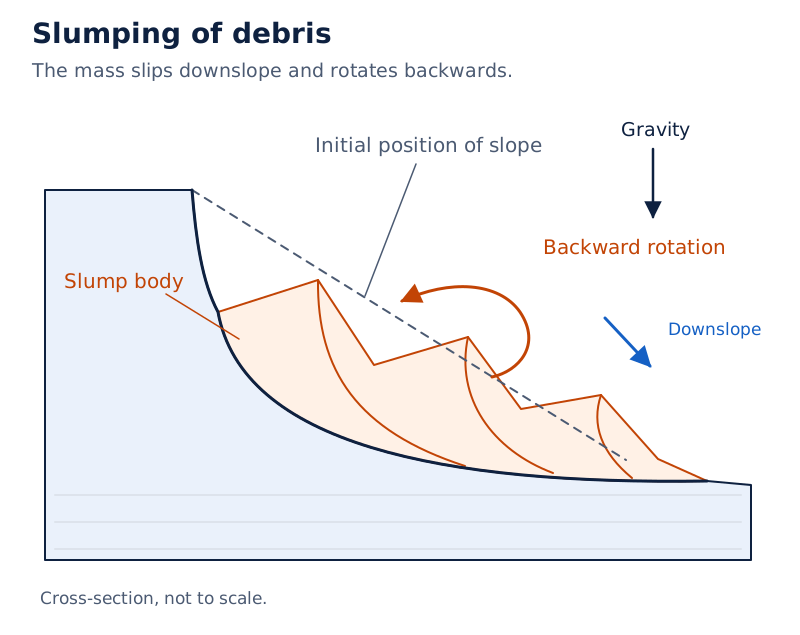
The cross-section labels the initial position of the slope and a slump body showing backward rotation of materials. Curved boundaries separate the rotated material from the slope behind it.
Drawn by One Young India. See Fig. 5.4 in your NCERT textbook
Case study: Why are Himalayan slopes vulnerable?
Debris avalanches and landslides occur very frequently in the Himalayas. These mountains are tectonically active, mostly consist of sedimentary rocks and unconsolidated or semi-consolidated deposits, and have very steep slopes.
Photograph: Landslide scars in the Shiwalik Himalayan ranges (NCERT Class 11 Figure 5.5). The photograph shows pale exposed scars on steep slopes bordered by vegetation, near river Sarada at the India-Nepal border, Uttar Pradesh.
Case study: Why do the Nilgiris and Western Ghats also experience landslides?
The Nilgiris, bordering Tamilnadu, Karnataka and Kerala, and the Western Ghats along the west coast are relatively tectonically stable. They are mostly made of very hard rocks, yet landslides and debris avalanches occur, though not as frequently as in the Himalayas.
Many slopes are steeper, with almost vertical cliffs and escarpments. Mechanical weathering from temperature changes and ranges is pronounced, and heavy rain falls over short periods. Almost direct rock fall occurs quite frequently along with landslides and debris avalanches.
How do erosion and deposition alter relief?
Erosion involves acquiring and transporting rock debris. Running water, groundwater, glaciers, wind and waves remove fragments produced by weathering or other processes. Their ability to move material depends on the dynamics of each agent.
Rock debris carried by these agents also causes abrasion, greatly aiding erosion. Erosion degrades relief and is largely responsible for continuous changes in the earth’s surface. Weathering aids erosion but is not a precondition for it.
How do the agents differ?
| Control of erosion agents | Number of agents | Agents and characteristics |
|---|---|---|
| Climatic conditions | 3 | Wind represents the gaseous state, running water the liquid state, and glaciers the solid state. |
| Coastal location or lithological character | 2 | Waves: work is determined by location at the coastal interface of the lithosphere and hydrosphere. Groundwater: work is determined more by the lithological character of the region. |
Karst topography develops only where rocks are permeable and soluble and water is available. Groundwater action therefore depends on the properties of the rock as well as the availability of water.
Why does transported material settle?
Deposition is a consequence of erosion. On gentler slopes, erosional agents lose velocity and energy, and their load begins to settle. Coarser material is deposited first and finer material later.
Deposited material fills depressions, producing aggradation. The same running water, glaciers, wind, waves and groundwater associated with erosion also act as depositional agents. Deposition follows their loss of energy rather than an additional force that actively lays down particles.
How does weathered material become soil?
Soil is a dynamic medium with continuing chemical, physical and biological activity. It results from decay but is also a medium for growth. It is a changing, developing body rather than simply a layer of loose rock particles.
Soil characteristics fluctuate with the seasons. Soil may alternate between cold and warm or dry and moist conditions. Biological activity slows or stops when it becomes too cold or too dry, while falling leaves and dying grasses increase organic matter.
What are the stages of pedogenesis?
Pedogenesis, or soil formation, depends first on weathering. The weathering mantle supplies the basic material, but organisms and their activity help turn that material into mature soil.
- Weathered material or transported deposits are colonised by bacteria and plant bodies such as mosses and lichens.
- Minor organisms may shelter in the material, while dead plants and organisms help humus accumulate.
- Minor grasses and ferns may grow, followed by bushes and trees from seeds carried by birds and wind.
- Roots penetrate downward and burrowing animals bring particles upward, making the material porous and sponge-like.
- The material develops the capacity to retain water and admit air, eventually forming mature soil containing mineral and organic products.
The distinction between weathering and soil formation is therefore important. Weathering supplies the initial material; humus accumulation, biological mixing and the development of a porous structure contribute to the formation of soil.
What is pedology?
Pedology is soil science, and a pedologist is a soil scientist. Studying soil involves both the process through which it develops and the interacting factors that control its characteristics and maturity.
How do parent material, topography and time influence soils?
The basic soil-forming factors are parent material, topography, climate, biological activity and time. They act together and affect one another. Parent material and topography are passive controls, while the duration of soil-forming activity influences maturity.
What does parent material contribute?
Parent material may be on-site weathered debris forming residual soils, or transported deposits forming transported soils. Its texture, structure, mineral composition and chemical composition influence soil formation.
Texture refers to debris sizes; structure concerns the arrangement of individual grains or particles. The nature and rate of weathering and the depth of the weathering mantle are also important.
Similar bedrock may support different soils, while dissimilar bedrocks may support similar soils. Very young, immature soils show strong links with parent rock. Soils in some limestone areas also show a clear relationship because the weathering processes are specific and peculiar.
How does topography affect soil development?
Topography influences sunlight exposure and surface and subsurface drainage. Soils are thin on steep slopes and thick over flat uplands. Gentle slopes favour formation where erosion is slow and water percolates well.
Flat areas may develop a thick clay layer with good organic accumulation, giving soil a dark colour. Thus, topography affects the conditions under which the parent material develops into soil.
How long does soil take to mature?
Time determines how long soil-forming processes operate and how far the profile develops. A mature soil forms when these processes act sufficiently long to produce a profile.
Soils on recently deposited alluvium or glacial till are young, with absent or poorly developed horizons. No specific absolute length of time can be fixed for soil development and maturity.
How do climate and organisms control soil formation?
Climate is an active soil-forming factor. Moisture conditions include the intensity, frequency and duration of precipitation, evaporation and humidity. Temperature influences development through seasonal and daily variations.
How does moisture redistribute soil materials?
Precipitation supplies moisture needed for chemical and biological activity. Excess water transports soil components downward through eluviation and deposits them below through illuviation.
In wet equatorial rainy areas, calcium, sodium, magnesium, potassium and a major part of silica are removed. The removal of silica is desilication. In dry climates, evaporation exceeds precipitation because of high temperature.
Groundwater rises by capillary action and evaporates, leaving salts that form crusts called hardpans. Tropical climates and areas with intermediate precipitation develop calcium carbonate nodules called kanker.
What changes with temperature?
Chemical activity increases at higher temperatures, decreases in cooler conditions with an exception of carbonation, and stops under freezing conditions. Tropical soils have deeper profiles, while frozen tundra soils largely contain mechanically broken material.
How does biological activity alter soils?
Vegetation and organisms add organic matter and nitrogen and help retain moisture. Dead plants supply humus, the finely divided organic matter in soil. Organic acids produced during humification help decompose parent-material minerals.
Humus accumulates in cold climates because bacterial growth is slow. Low bacterial activity leaves undecomposed organic matter, producing peat layers in sub-arctic and tundra climates. Intense bacterial action rapidly oxidises dead vegetation in humid tropical and equatorial climates, leaving very low humus content.
Nitrogen fixation converts gaseous nitrogen into a chemical form plants can use. Rhizobium bacteria live in leguminous root nodules and fix nitrogen beneficial to the host plant.
Ants, termites, earthworms and rodents mechanically rework soil upward and downward. Earthworms also alter the texture and chemistry of soil passing through their bodies. Biological activity therefore contributes both chemical changes and physical mixing.
Glossary
- Geomorphic processes — Forces producing physical stresses and chemical actions in earth materials and changing the configuration of the surface.
- Geomorphic agent — A mobile natural medium that acquires, transports and deposits earth materials.
- Diastrophism — The processes that move, elevate or build up portions of the earth’s crust.
- Orogeny — Mountain building involving severe crustal folding within long and narrow belts.
- Epeirogeny — Continental building involving uplift or warping of large parts of the crust.
- Denudation — Stripping or uncovering through weathering, mass movements, erosion and transportation of earth materials.
- Weathering — Mechanical disintegration and chemical decomposition of rocks by elements of weather and climate.
- Exfoliation — Flaking of curved rock sheets or shells, producing smooth and rounded surfaces.
- Mass movement — Downslope transfer of rock debris under the direct influence of gravity.
- Slump — Slipping of debris units with backward rotation relative to the slope.
- Erosion — Acquisition and transportation of rock debris by mobile geomorphic agents.
- Pedogenesis — Soil formation beginning with weathered material and involving biological activity and humus accumulation.
- Humus — The finely divided organic matter in soil supplied by dead plants.
- Desilication — Removal of silica from soil in conditions such as wet equatorial rainy climates.
- Nitrogen fixation — Conversion of gaseous nitrogen into a chemical form that plants can use.
Common errors and misconceptions
- Misconception: Exogenic action will completely flatten the earth’s surface. Correct: Endogenic forces continue to elevate and build portions of the surface, so relief variations remain while the opposing actions continue.
- Misconception: Weathering requires transportation of broken material. Correct: Weathering is an in-situ process with very little or no material movement; erosion involves acquisition and transportation.
- Misconception: Chemical, physical and biological weathering work independently. Correct: Very rarely does a process work completely by itself, although quite often one process dominates.
- Misconception: Exfoliation is a separate weathering process. Correct: It is a result of weathering, expressed as curved sheets or shells flaking from rock.
- Misconception: Mass movements are erosion because both move debris. Correct: Mass movements occur directly under gravity without geomorphic agents carrying the debris; erosion involves such agents.
- Misconception: Slumps and debris slides both involve backward rotation. Correct: Slumps involve backward rotation, whereas debris slides involve rapid rolling or sliding without it.
- Misconception: Weathering alone produces mature soil. Correct: It supplies the basic material, but organisms, humus accumulation and other soil-forming processes contribute to development.
- Misconception: Every soil matures after the same fixed interval. Correct: No specific absolute length of time can be fixed; maturity depends on soil-forming processes operating sufficiently long to develop a profile.
Exam-style questions with model answers
Q1. Distinguish between a geomorphic process and a geomorphic agent. [2 marks]
- A geomorphic process is a force applied to earth materials that affects them and changes the surface.
- A geomorphic agent is a mobile medium, such as running water or wind, that acquires, transports and deposits materials.
Q2. Why is weathering an in-situ process? [2 marks]
- Weathering mechanically disintegrates and chemically decomposes rocks through the action of weather and climate.
- Very little or no motion of materials takes place, so the breakdown occurs on site rather than through transportation to another location.
Q3. Explain the distinction between orogeny and epeirogeny and their effects on rocks. [3 marks]
- Orogeny is mountain building involving severe folding and deformation of the crust in long, narrow belts.
- Epeirogeny involves uplift or warping of large crustal areas and is a continental-building process. There may be simple deformation.
- These processes can produce faulting and fracturing. Along with earthquakes and plate tectonics, they cause pressure, volume and temperature changes that induce metamorphism of rocks.
Q4. Why are landslides frequent in the Himalayas, and why do they also occur in the Nilgiris and Western Ghats? [4 marks]
- The Himalayas are tectonically active and mostly consist of sedimentary rocks and unconsolidated or semi-consolidated deposits. Their slopes are very steep.
- The Nilgiris and Western Ghats are relatively tectonically stable and mostly consist of very hard rocks. Landslides and debris avalanches occur, though not as frequently as in the Himalayas.
- Many slopes there are steeper, with almost vertical cliffs and escarpments. Mechanical weathering caused by temperature changes and ranges is pronounced.
- Heavy rainfall over short periods also contributes to conditions in which almost direct rock fall occurs quite frequently, together with landslides and debris avalanches.
Q5. Explain how soil forms from weathered material or transported deposits. [5 marks]
- Pedogenesis depends first on weathering, which supplies the weathering mantle as the basic input for soil formation.
- Bacteria and plant bodies such as mosses and lichens colonise weathered material or transported deposits. Minor organisms may also take shelter within them.
- Dead organisms and plants help humus accumulate. Minor grasses and ferns may grow, followed by bushes and trees from seeds carried by birds and wind.
- Plant roots penetrate downward while burrowing animals bring particles upward. The material becomes porous and sponge-like, developing the capacity to retain water and allow air to pass.
- A mature soil eventually forms as a complex mixture of mineral and organic products. Weathering therefore supplies the starting material but does not alone account for the whole process.
Q6. Explain how climate and biological activity influence soil formation. [5 marks]
- Precipitation supplies moisture for chemical and biological activity. Excess water moves soil components downward through eluviation and deposits them below through illuviation.
- Wet equatorial conditions remove several elements and a major part of silica. In dry climates, capillary rise and evaporation leave salts that form hardpans.
- Higher temperatures increase chemical activity. Cooler temperatures reduce it, with an exception of carbonation, while freezing conditions stop it.
- Dead plants supply humus. Slow bacterial growth promotes humus accumulation in cold climates, whereas intense bacterial activity leaves very low humus content in humid tropical and equatorial soils.
- Organisms also fix nitrogen and mechanically mix soil. Rhizobium fixes nitrogen in leguminous root nodules, while earthworms alter soil texture and chemistry as soil passes through their bodies.
Q7. Describe the sequence connecting erosion, transportation and deposition. [3 marks]
- Erosional agents acquire rock debris and transport it according to their dynamics. Abrasion by carried debris greatly aids erosion, wearing down relief.
- On gentler slopes, agents lose velocity and therefore energy. The material they carry begins to settle.
- Coarser particles are deposited first and finer particles later. Deposition fills depressions, so the same agents involved in erosion also act as aggradational or depositional agents.
Q8. Explain how biological activity contributes to weathering. [3 marks]
- Burrowing and wedging by earthworms, termites and rodents expose fresh surfaces to chemical attack and help moisture and air penetrate.
- Plant roots exert pressure that mechanically breaks apart earth materials. Humans mix materials and create new contact between air, water and minerals through cultivation and disturbance of vegetation.
- Decaying plants and animals produce humic, carbonic and other acids, enhancing decay and the solubility of some elements.
Key takeaways
- Endogenic forces mainly build land, while exogenic processes mainly wear it down; their continuing opposition maintains relief variations.
- Gravity and gradients enable movement, while climate and rock structure influence the intensity and pattern of exogenic action.
- Weathering acts on site through chemical, physical and biological actions that very rarely operate completely independently.
- Mass movements transfer debris directly under gravity, whereas erosion involves geomorphic agents acquiring and transporting material.
- Landslide types differ in rotation, movement and material; rock falls involve superficial layers, while rockslides can affect substantial depths.
- Deposition follows declining velocity and energy, with coarser material settling before finer material and filling depressions.
- Weathering supplies material for pedogenesis, while organisms, humus accumulation and mixing help produce mature soil.
- Parent material, topography, climate, biological activity and time act together, and no fixed absolute duration determines soil maturity.
Test yourself
What is the difference between degradation and aggradation?
Degradation wears down relief or elevations, while aggradation fills basins and depressions with deposited material.
Which processes belong to chemical weathering?
Solution, carbonation, hydration, oxidation and reduction chemically decompose or dissolve rocks or reduce them to fine clastic material.
Is weathering a prerequisite for mass movement?
No. Gravity acts on both bedrock and weathered material. Weathering aids mass movement, which is very active on weathered slopes.
How does a slump differ from a debris slide?
A slump involves backward rotation of debris units relative to the slope; a debris slide involves rapid rolling or sliding without backward rotation.
Which conditions are needed for karst topography?
The rocks must be permeable and soluble, and water must be available for karst topography to develop.
Why can cold climates accumulate humus and peat?
Bacterial growth is slow in cold climates, allowing humus to accumulate. Low bacterial activity leaves undecomposed organic matter that forms peat layers in sub-arctic and tundra climates.
How do eluviation and illuviation differ?
Eluviation transports soil components downward through the soil, while illuviation deposits those components farther below.
Why are soils on recent alluvium or glacial till considered young?
They have no horizons or only poorly developed horizons, indicating that soil-forming processes have not yet produced a mature profile.