
Human Resource Management | ISC Class 12 Business Studies Notes
On this page

This note covers human resource management, job and manpower planning, recruitment, selection, training, morale, motivation, remuneration, leadership, appraisal, promotion, transfer, separation and emerging human resource practices.
What is human resource management and why is it important?
Definition: Human resource management (HRM) concerns acquiring, developing, rewarding and maintaining the people who work in an organisation. Human resources are the people whose knowledge, skills and effort contribute to its activities.
Staffing is the managerial function of filling and keeping filled the positions in an organisation. It forms part of HRM, which also includes employee welfare, working relationships, complaints and reward arrangements. Staffing is more extensive than merely appointing new employees.
What are its characteristics?
- People oriented: it centres on employees and their working relationships.
- Comprehensive: it covers the range of activities concerned with employees, from their entry to their departure.
- Staff function: specialists advise and assist operating managers, who remain responsible for managing their own people.
- Pervasive: it concerns managers across departments and organisational levels.
- Challenging: people differ in expectations, abilities and responses.
- Continuous: employee needs and organisational requirements require continuing attention.
- Individual oriented: it recognises differences between employees rather than treating everyone as identical.
- Development oriented: it improves capabilities and provides opportunities for growth.
- Action oriented: it seeks practical solutions to problems involving people.
- Future oriented: it prepares people and staffing arrangements for future requirements.
- Interdisciplinary: it draws on several fields of knowledge concerning people and organisations.
- Art and science: it combines organised knowledge with judgement and skill in applying it.
- Young discipline: its specialised modern form developed from earlier labour welfare and personnel management practices.
How does HRM support an organisation?
Effective staffing finds competent people and matches them to suitable jobs. It helps avoid both surplus employees and staff shortages. Succession planning, preparing people to occupy positions that become vacant, supports continuity and growth.
Fair assessment and rewards improve job satisfaction and morale, meaning employees' confidence and enthusiasm about their work. Training develops skills, while career opportunities help attract and retain talented employees. Specialists support these activities, but managing people remains a responsibility of all managers.
How do job analysis and manpower planning differ?
Manpower planning determines the number and kinds of employees an organisation requires. Counting employees alone is insufficient: jobs also require particular qualifications, skills and experience. Planning connects the work to be performed with the people available to perform it.
What information does each activity provide?
| Term | Meaning and relevance |
|---|---|
| Job analysis | Systematic collection and examination of information about a job, including its tasks, responsibilities and requirements. |
| Job description | A written account of the job, its duties, responsibilities and working relationships; it explains the work to be done. |
| Job specification | A statement of the qualifications, skills, experience and other qualities needed in the person performing the job. |
| Manpower estimation | Assessment of the number and types of people needed, compared with the workforce available. |
| Job enlargement | Addition of tasks at a similar level of responsibility, widening the range of work performed. |
| Job enrichment | Redesign of work to provide greater responsibility, autonomy, skill requirements and opportunities for personal growth. |
Autonomy means freedom to make decisions about one's work. Enlargement widens a job; enrichment increases its depth and meaningful responsibility. Neither should be confused with job analysis, which studies the job rather than necessarily changing it.
How are staffing requirements estimated?
- Identify the jobs created by the organisational structure and the work each involves.
- Use workload analysis to assess the number and types of people required to perform that work.
- Use workforce analysis to identify the number and types of employees already available.
- Compare requirements with availability to identify shortages, surpluses or an appropriate staffing level.
- Translate requirements into job descriptions and candidate profiles before seeking applicants.
A shortage can lead to recruitment; a surplus can require movement of employees to other work. Job information also supports selection and training because it identifies what successful performance requires. Planning therefore concerns both the quantity and suitability of employees.
How does recruitment attract suitable applicants?
Recruitment means searching for prospective employees and encouraging them to apply for jobs. It develops a pool of applicants from which selection can be made. It is a positive, searching activity: an invitation to apply is not an appointment.
The process involves identifying sources of labour supply, assessing them, choosing suitable sources and inviting applications. Recruitment recurs as staffing needs change. Its effectiveness depends on attracting people with the qualifications required for the available work.
Which internal and external sources are available?
Internal sources include promotion, transfer, ex-employees and recommendations by employees. Promotion moves an employee to a higher position; transfer moves an employee between jobs without a substantive change in status. Ex-employees are former staff considered for re-employment; recommendations introduce candidates through existing employees.
| External source | How it works |
|---|---|
| Advertisements | Published vacancy notices communicate job requirements and invite applications from a wider field. |
| Campus recruitment | Employers seek candidates through educational institutions, including management and technical institutes. |
| Casual callers | Unsolicited applications are retained and screened when suitable vacancies arise. |
| Gate hiring | Job seekers respond to a notice at the organisation's premises; recruitment usually meets casual unskilled or semi-skilled needs. |
| Employment exchanges | Government employment services connect job seekers with employers seeking workers. |
| Placement agencies | Specialist agencies recommend suitable candidates and charge fees for their services. |
| Labour contractors | People maintaining contact with labourers can provide unskilled workers at short notice. |
What are the merits and limitations?
Internal recruitment costs less, uses known candidates and supports motivation through advancement. Transfers can balance staff surpluses and shortages. Its limitations include restricted fresh talent and possible complacency when promotion is taken for granted. Frequent transfers may often reduce productivity.
External recruitment widens choice and brings qualified people and fresh talent. Its limitations include advertising and processing costs, a longer recruitment period and possible dissatisfaction among existing employees whose promotion prospects appear reduced.
How does e-recruitment work?
E-recruitment uses electronic networks to advertise jobs and receive applications. The internet is a public network with wide reach; an intranet is a private organisational network accessible to authorised users.
Internet recruitment offers broad access and quick communication, but can attract unsuitable responses and exclude people without access. Intranet recruitment circulates opportunities conveniently among staff, but reaches a restricted pool. Both require accurate vacancy information and screening of applications.
Worked example 1. A manufacturer produces 1,00,000 paper plates and bowls daily and receives an urgent festival order for 50,000 extra. Which recruitment method suits this temporary rush of work?
Answer: Choose direct recruitment, or gate hiring, to meet a casual labour requirement. It can provide workers for a rush of work without the expense of advertising. This recommendation concerns the temporary requirement described.
How does staff selection find the right person?
Selection identifies and chooses suitable people from the applicants obtained through recruitment. It assesses suitability rather than simply increasing the number of applicants. It involves judgement about future performance, and its effectiveness is ultimately tested by performance on the job.
What are the stages and their purposes?
- Preliminary screening: eliminate applicants who do not meet basic requirements, saving further assessment time.
- Application blank: obtain information through a standard form covering qualifications, experience and other relevant details, allowing comparison.
- Selection test: assess characteristics relevant to the job through tests or practical exercises.
- Group discussion: observe candidates discussing a topic to assess communication, participation and interaction with others.
- Final interview: hold an in-depth conversation about suitability and clarify information about the candidate and the job.
- Medical test: assess fitness for the work before completing the appointment decision.
- Reference check: verify information and obtain further details from people who know the applicant.
- Final approval: obtain the authorised decision to appoint the selected person.
- Placement: assign the selected employee to the position for which the person has been chosen.
An aptitude test assesses potential to learn new skills; a trade test assesses skills already possessed. Intelligence tests examine learning and judgement ability. Personality tests explore characteristics such as reactions and maturity; interest tests examine preferences for different kinds of work.
How is selection different from recruitment?
| Basis | Recruitment | Selection |
|---|---|---|
| Purpose | Attract prospective employees. | Choose suitable employees. |
| Activity | Search for applicants and invite applications. | Assess applicants through screening and other checks. |
| Relationship | Creates the applicant pool. | Works with that pool to make appointment decisions. |
Orientation introduces employees to colleagues, organisational rules and policies. It differs from placement, which concerns occupying the assigned post. A person can be placed in a position and still need help becoming familiar with the organisation.
How do training, education and development improve employees?
Training increases the skills and abilities needed for specific jobs. Education develops knowledge, understanding and reasoning. Development provides learning opportunities for broader growth and future responsibilities. These overlap, but training is job oriented while development is career oriented.
What types and methods of training are used?
| Type | Main purpose |
|---|---|
| Induction | Familiarise a new employee with the organisation, people, rules and working arrangements. |
| Job training | Teach the knowledge and skills needed for the assigned work. |
| Remedial training | Correct identified gaps or weaknesses in performance. |
| Safety training | Develop safe working practices and awareness of hazards. |
| Promotional training | Prepare employees for the responsibilities of higher positions. |
| Refresher training | Update existing knowledge and skills and renew familiarity with methods. |
On-the-job training takes place while the employee performs work. Off-the-job training takes place away from the actual workplace. The former links learning directly to work; the latter separates learning from immediate production duties.
- Apprenticeship: a trainee learns skilled work under an experienced master worker for a prescribed period.
- Internship: educational institutions and firms cooperate so that students combine study with practical experience.
- Vestibule training: employees use equipment and materials resembling their actual work, away from the work floor. It is usually used for sophisticated machinery.
- Classroom training: instruction explains information, procedures or methods; demonstrations and audiovisual material can often assist understanding.
What benefits and hindrances matter?
Training reduces waste from trial and error, improves the quantity and quality of output and prepares future managers. It increases morale and reduces absenteeism, meaning absence from scheduled work, and employee turnover, meaning employees leaving and needing replacement.
Employees gain skills, career opportunities and the possibility of higher earnings through better performance. They become more efficient in handling machines and less prone to accidents. Training also increases satisfaction and supports adaptation to technological and economic change.
Hindrances include cost, lack of time, inadequate trainers or facilities, resistance to learning and programmes poorly matched to actual needs. Without opportunities to apply learning, improved knowledge may not translate into improved performance.
Worked example 2. Factory workers cannot operate new machines and repeatedly ask their overburdened supervisor for help. What should management arrange?
Answer: Arrange job training in machine operation. Teaching the required skills addresses the stated lack of operating knowledge and reduces reliance on repeated individual help from the supervisor.
Worked example 3. Output quality is below the required standard. Investigation shows that most workers do not understand proper machinery operation. What action should be taken?
Answer: Provide training in correct operation. The identified problem is insufficient operating knowledge among most workers, so the response should develop that knowledge and the relevant skills.
Worked example 4. Workers remain idle because they do not understand high-technology machines, while frequent engineer visits increase overhead costs, meaning indirect operating expenses. Which training method should be chosen?
Answer: Choose vestibule training. It allows employees to learn on equipment away from the actual work floor before applying the skills in production.
What is staff morale and how does it affect productivity?
Staff morale is the confidence, enthusiasm and attitude employees have towards their work, colleagues and organisation. It can concern an individual or a group. It is psychological, changes with circumstances and reflects how employees experience their working environment.
Productivity relates output to the resources used to produce it. Morale and productivity are related, but high morale does not automatically establish high productivity. Skills, equipment, methods and supervision also affect what a workforce achieves.
What does the morale-productivity matrix show?
| Combination | Interpretation |
|---|---|
| High morale, high productivity | Employees feel positive and productive work accompanies that attitude. |
| High morale, low productivity | Employees feel satisfied, but inadequate skills, resources or direction may restrict output. |
| Low morale, high productivity | Output is high despite dissatisfaction; pressure or fear may sustain work without enthusiasm. |
| Low morale, low productivity | Negative attitudes accompany weak productive performance. |
How can the same factor raise or lower morale?
Morale stimulants raise confidence; morale depressants lower it. Fair pay can stimulate morale, while perceived unfairness can depress it. Supportive supervision and recognition encourage employees; harsh treatment and ignored effort can have the opposite effect.
Other influences include working conditions, job security, promotion opportunities, participation and relations with colleagues. Management can improve morale through fair policies, communication, recognition, grievance handling and better working conditions. A grievance is an employee's work-related complaint or sense of unfair treatment.
Cooperation, enthusiasm and willingness to accept responsibility indicate high morale. Persistent complaints, conflict, absenteeism and employee departures can indicate low morale. These are indicators requiring investigation, rather than conclusive proof of a single cause.
High morale supports cooperation and commitment; low morale can weaken them and increase disruption. Morale describes employees' attitude or spirit, whereas motivation concerns the forces that move them towards action. The two can influence each other without being identical.
How do incentives and motivation theories explain employee effort?
Motivation is the process of stimulating people to act towards desired goals. It is an internal feeling expressed through goal-directed behaviour. Positive motivation uses rewards; negative motivation uses threats or penalties. It is complex because people differ in expectations and reactions.
Motivation helps improve performance, change indifferent attitudes, reduce turnover and absenteeism, and introduce change. Employees benefit when work helps satisfy needs and offers recognition and growth. An incentive is a measure used to encourage better performance.
How do monetary and non-monetary incentives differ?
Monetary incentives provide money or benefits measurable in money. They include pay and allowances, productivity-linked wages, bonuses, profit sharing, shares, retirement benefits and perquisites. A bonus is payment beyond normal wages; perquisites are additional benefits such as housing or medical aid.
Non-monetary incentives primarily provide psychological, social or emotional satisfaction. They include status, recognition, career opportunities, job enrichment, job security, participation and empowerment. Empowerment gives employees greater decision-making freedom and authority. Status means the rank and prestige attached to a position.
Note: A monetary aspect may also accompany a non-financial incentive. Promotion can involve extra pay while providing satisfaction through increased status, authority and responsibility. Non-financial does not mean that money can never be involved.
What does Maslow's hierarchy propose?
- Physiological needs: basic needs such as hunger, thirst, shelter and sleep; basic salary helps meet them.
- Safety needs: protection and security, including stable income and pension arrangements.
- Belonging needs: affection, friendship and acceptance within a group.
- Esteem needs: self-respect, autonomy, status and recognition.
- Self-actualisation: growth and the fulfilment of one's capabilities.
The theory assumes that behaviour rests on needs, that needs follow a hierarchy, that a satisfied need no longer motivates, and that a person moves higher only after the lower need is satisfied. These are assumptions of the theory.
Its classification and hierarchy of needs have been questioned. Nevertheless, recognising employees' needs remains relevant to understanding behaviour and choosing incentives. The theory helps managers consider the employee's need level rather than assuming everyone wants the same reward.
What the figure shows
Maslow's need hierarchy
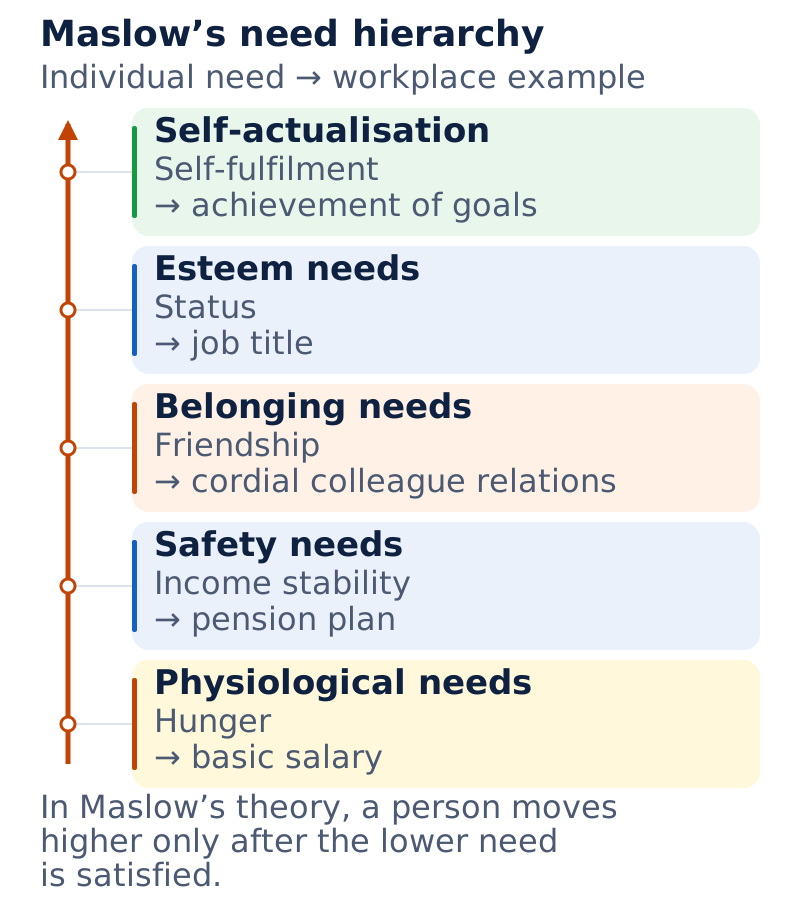
The pyramid rises from basic physiological needs through safety, belonging and esteem to self-actualisation. Flanking boxes connect hunger with basic salary, income stability with a pension plan, friendship with cordial colleague relations, status with job title, and self-fulfilment with achievement of goals.
Drawn by One Young India.
What does Herzberg's two-factor theory propose?
Hygiene factors concern the job environment, including pay, policies, supervision, security, relationships and working conditions. Their inadequacy produces dissatisfaction; improving them removes sources of dissatisfaction without necessarily creating strong positive motivation.
Motivators concern the work itself: achievement, recognition, responsibility, advancement and growth. They foster satisfaction and motivation. The distinction is between preventing dissatisfaction and creating satisfaction, rather than treating these as a single identical process.
How are employees paid and what benefits accompany remuneration?
Remuneration is the pay and rewards received for work. It includes direct financial payments and indirect benefits. Pay arrangements must consider the work, organisational policy and fairness. Time-related and output-related methods use different bases for calculating wages.
What are the merits, limitations and suitability of wage systems?
| Basis | Time rate | Piece rate |
|---|---|---|
| Calculation | Time worked multiplied by the rate per time unit. | Units produced multiplied by the rate per unit. |
| Merits | Simple calculation and relatively predictable earnings; allows attention to quality. | Direct reward for output and an incentive to produce more. |
| Limitations | No direct wage reward for producing more; supervision remains important. | Haste may reduce quality; earnings vary with output. |
| Suitability | Work where output is difficult to measure individually or quality is especially important. | Standardised, measurable output where individual production can be identified. |
In these calculations, rate means the agreed payment for one time unit or one output unit. The time or output unit must match the quoted rate. No allowance, bonus or deduction should be assumed unless it is specified.
How do a pay slip and payroll differ?
A pay slip records one employee's earnings, deductions and net pay for a pay period. A payroll is the organisation's consolidated record for its employees. Gross earnings are total earnings before deductions; net pay is gross earnings less deductions.
Basic pay is the core wage or salary before additions. Allowances are additional payments for specified purposes; overtime pay pays for additional working time. A deduction is an amount subtracted from earnings. The following unfilled specimens show the required components.
| Pay-slip field | Entry required |
|---|---|
| Identification | Employer, employee name or identifier, designation and pay period. |
| Earnings | Basic pay, applicable allowances, overtime and bonus; total gross earnings. |
| Deductions | Applicable employee contributions, tax and other authorised deductions; total deductions. |
| Payment | Net pay, payment date and payment details. |
| Payroll employee entry | Earnings record | Deductions record | Payment record |
|---|---|---|---|
| Employee name and identifier | Basic pay and applicable additional earnings. | Applicable deductions listed separately. | Net pay and payment details. |
| Pay-period totals | Total gross earnings for all employees. | Total deductions for all employees. | Total net pay for the period. |
What benefits and leave arrangements are recognised?
Employee Provident Fund provides accumulated retirement savings; the National Pension System provides contribution-based retirement saving. Group medical and life insurance cover employees collectively against specified health and life risks. Leave encashment converts eligible unused leave into money; gratuity is a service-related terminal benefit.
Casual leave meets short personal needs; medical or sick leave covers illness. Earned or privilege leave accumulates through service. Maternity and paternity leave concern childbirth and parenthood. Sabbatical or study leave permits an extended break for study or development; leave without pay carries no pay for that period.
How do leadership styles influence staff?
Leadership means influencing people to work willingly towards common goals. Management coordinates work through planning, organising, staffing, directing and controlling. Leadership centres on influence and the relationship with followers; it forms part of the manager's wider responsibilities.
Leadership helps guide effort, build confidence, introduce change and resolve conflict. Followers' skills, commitment and willingness to cooperate also matter. An effective relationship requires more than the leader's personal qualities alone.
What are the advantages and disadvantages of different styles?
| Style | Approach | Advantage | Disadvantage |
|---|---|---|---|
| Autocratic | The leader makes decisions and expects obedience. | Facilitates quick decisions and clear direction. | Limited participation can discourage initiative. |
| Democratic | The leader consults employees and encourages participation. | Uses employees' ideas and supports commitment. | Consultation can take time. |
| Laissez-faire, or free-rein | Employees have considerable independence; the leader supplies support and information. | Provides freedom for capable, responsible employees. | Weak coordination can arise when employees need more guidance. |
A leader may combine styles according to the situation. Even a free-rein leader has rules, and a democratic leader may need to decide independently during an emergency. An autocratic leader may listen to others while retaining the final decision.
What do the continuum and managerial grid explain?
The leadership continuum shows a range from manager-centred decisions to greater freedom for subordinates. Situational leadership means adapting leadership to circumstances and followers' needs rather than applying one approach regardless of conditions.
The Blake and Mouton managerial grid compares concern for production with concern for people. Each dimension runs from 1, low concern, to 9, high concern. In a pair, the first number gives production concern and the second gives people concern.
- (1,1), impoverished: low concern on both dimensions.
- (9,1), task-oriented: high production concern and low people concern.
- (1,9), country-club: low production concern and high people concern.
- (5,5), middle-of-the-road: moderate concern on both dimensions.
- (9,9), team: high concern for both people and production.
How do performance appraisal and potential appraisal differ?
Performance appraisal evaluates current or past performance against predetermined standards. Potential appraisal assesses a person's capacity to take on future or higher responsibilities. Good present performance and readiness for a different role are related questions, but they are not identical.
Appraisal clarifies expectations, identifies strengths and training needs, provides feedback and supports decisions about rewards and advancement. Feedback is information given to employees about their performance so that they understand achievements and areas needing improvement.
What methods can be used?
| Method | Meaning | Advantage and limitation |
|---|---|---|
| Merit grading | Rate an employee against stated qualities or performance criteria. | Offers a common comparison framework, but ratings can be subjective. |
| Appraisal by results | Compare achieved results with agreed objectives. | Focuses on outcomes, but results may also reflect conditions beyond the employee's control. |
| Appraisal by superior | The immediate superior evaluates the employee's work. | Uses direct knowledge of performance, but personal bias can influence judgement. |
| Self-appraisal | The employee reviews personal performance and development needs. | Encourages reflection, but the employee may overestimate or underestimate performance. |
| 360-degree appraisal | Obtain feedback from several relevant sources around the employee, such as superiors, colleagues, subordinates and customers. | Offers several perspectives, but gathering and interpreting feedback takes time and care. |
How should appraisal lead to improvement?
The job and standards must be clear before performance is judged. The employee should know those standards, and the superior should communicate the assessment. Identifying weaknesses without discussing improvement leaves the development purpose incomplete.
Potential appraisal looks ahead to responsibilities the employee has not yet undertaken. Performance appraisal looks at work already undertaken or currently being performed. Neither should be reduced to a general judgement about whether the employee is liked.
How do promotion and transfer change an employee's position?
Promotion places an employee in a position of greater responsibility and status. It usually brings more pay and job satisfaction. Transfer shifts the employee between jobs, departments or shifts without a substantive change in status or responsibility.
What makes a sound promotion policy?
Promotion can encourage learning, loyalty and retention while filling higher positions with known employees. Its limitations include disappointed unsuccessful candidates, rivalry and the possibility that strong performance in one job does not establish suitability for another.
An open promotion policy announces opportunities so eligible employees can apply. A closed policy identifies candidates through management consideration without openly inviting applications. Openness widens awareness; closed consideration gives management greater control over the candidate pool.
A sound policy states eligibility, assessment criteria, procedures and the basis of promotion clearly. Consistent application, fair assessment and communication reduce uncertainty. Dry promotion gives higher responsibility or status without an accompanying pay increase; upgrading raises the grade or pay of the existing job.
| Basis | Meaning | Merit and limitation |
|---|---|---|
| Seniority | Emphasises length of service. | Provides an easily understood basis, but may overlook differences in ability. |
| Merit | Emphasises ability, performance and suitability. | Rewards competence, but assessment can be disputed or biased. |
| Seniority-cum-merit | Considers both service and competence. | Balances experience with suitability, but requires clear criteria for combining them. |
Why are different transfers used?
- Replacement transfer: move a senior employee into a position held by a junior employee when work is reduced, helping retain experienced staff.
- Versatility transfer: expose an employee to different work to broaden skills and usefulness.
- Remedial transfer: correct an unsuitable placement or adjustment problem.
- Production transfer: move employees from areas with surplus staff to areas where work requires additional staff.
Transfers can meet staffing imbalances, support training and address individual problems. The employee must be capable of the new work. A transfer is not necessarily accompanied by a salary change, and it should not be treated as automatically equivalent to promotion.
How do staff separation and exit interviews work?
Staff separation means the ending of employment. Related changes such as lay-off and suspension can interrupt work without ending employment. The reason and permanence of the change matter when distinguishing departure from a temporary interruption of work.
What are the different forms?
| Form | Meaning and distinction |
|---|---|
| Compulsory retirement | Retirement required on reaching the prescribed retirement point under applicable service conditions. |
| Voluntary retirement | Retirement chosen by the employee under the available retirement arrangements. |
| Lay-off | Temporary inability of the employer to provide work; distinguish it from permanent termination. |
| Retrenchment | Termination because staff are surplus to requirements, rather than punishment for misconduct. |
| Resignation | The employee initiates departure from employment. |
| Suspension | Temporary exclusion from duties, including while an allegation is examined; it does not itself mean dismissal. |
| Dismissal | The employer terminates employment on disciplinary grounds. |
What does a fair dismissal process involve?
Grounds can include serious misconduct, dishonesty, wilful disobedience or habitual neglect of duty. An allegation is not itself proof. The applicable rules and service conditions govern the action; the basic distinction is between investigating a charge and deciding its consequence.
- Identify and record the alleged misconduct and relevant evidence.
- Communicate the charges and give the employee an opportunity to explain.
- Conduct an impartial enquiry and consider the evidence and response.
- Reach a reasoned decision and communicate the outcome under the applicable procedure.
An exit interview is a discussion with a departing employee about the reasons for leaving and the employment experience. It can reveal problems in supervision, work, rewards or career opportunities and inform improvements intended to retain other employees.
What emerging arrangements change where and how people work?
Employment arrangements can vary in working time, location and the way responsibility is shared. Understanding the arrangement requires identifying what changes. A different location does not necessarily mean different hours, and fewer hours do not necessarily mean temporary employment.
Which terms describe these arrangements?
- Flexible hours: employees have some choice over starting and finishing times within agreed working requirements.
- Permanent part-time work: an ongoing employment arrangement with fewer working hours than comparable full-time work.
- Work from home: employees perform their work from their residence rather than attending the employer's workplace for that work.
- Retainership: an arrangement under which a professional's services or availability are secured through an agreed continuing fee.
- Virtual teams: people collaborate across locations using communication technology rather than working together in one physical place.
- Self-managing teams: groups take responsibility for organising and managing their own assigned work with substantial autonomy.
Flexible hours concern timing; part-time employment concerns the amount of working time. Work from home concerns location. Virtual teams concern collaboration across locations, while self-managing teams concern responsibility for organising work. Retainership describes a continuing arrangement for professional services.
Glossary
- Human resource management — Management of acquiring, developing, rewarding and maintaining the people who contribute to organisational activities.
- Staffing — The managerial function of filling and keeping filled the positions within an organisation.
- Job analysis — Systematic examination of a job's tasks, responsibilities and requirements to provide information for staffing decisions.
- Job specification — A statement of the qualifications, skills, experience and qualities required of a job holder.
- Recruitment — Searching for prospective employees and encouraging suitable people to apply for available jobs.
- Selection — Assessing applicants and choosing suitable people from the pool developed through recruitment.
- Training — Learning that increases employees' knowledge, skills and abilities for performing specific jobs.
- Morale — Employees' confidence, enthusiasm and attitude towards their work, colleagues and employing organisation.
- Motivation — The process of stimulating people to act in pursuit of desired goals.
- Remuneration — The pay and rewards received by employees in return for their work.
- Leadership — Influencing people so that they work willingly towards the achievement of common goals.
- Performance appraisal — Evaluation of an employee's current or past performance against standards established in advance.
- Promotion — Movement to a position with increased responsibility and status, usually accompanied by increased pay.
- Transfer — Movement between jobs, departments or shifts without a substantive change in responsibility or status.
- Exit interview — A discussion with a departing employee about reasons for leaving and experiences within the organisation.
Common errors and misconceptions
- Misconception: Recruitment and selection are identical. Correct: Recruitment attracts applicants; selection assesses them and chooses suitable people.
- Misconception: Job description states the applicant's qualifications. Correct: It describes the job; job specification states the required qualities of its holder.
- Misconception: Job enlargement necessarily increases authority. Correct: Enlargement adds tasks at a similar level; enrichment adds depth through responsibility and autonomy.
- Misconception: High morale guarantees high productivity. Correct: The matrix allows high morale with low productivity because productive performance also depends on other conditions.
- Misconception: Non-financial incentives cannot involve money. Correct: Their main purpose is psychological or social satisfaction, although a monetary aspect may accompany them.
- Misconception: Every promotion immediately increases pay. Correct: Promotion usually increases pay, but dry promotion increases status or responsibility without a pay increase.
- Misconception: Suspension is the same as dismissal. Correct: Suspension temporarily excludes an employee from duties; dismissal terminates employment.
- Misconception: A democratic leader must consult on every decision. Correct: A democratic leader may need to decide independently in an emergency.
Exam-style questions with model answers
Q1. Distinguish recruitment from selection using their purpose and main activity. [2 marks]
- Recruitment attracts prospective employees by searching for suitable people and encouraging applications for available jobs.
- Selection chooses suitable employees from those applicants by assessing their qualifications and suitability through screening and other checks.
Q2. Explain three differences between training and development: their immediate purpose, scope and orientation. [3 marks]
- Training improves knowledge and skills for a specific job; development seeks the broader learning and growth of the employee.
- Training concentrates on particular work requirements, whereas development includes wider growth in capabilities and personality as well as training.
- Training is job oriented, helping the employee perform work better; development is career oriented, preparing the person for growth and future responsibilities.
Q3. Explain four merits of filling vacancies through existing employees by promotion or transfer. [4 marks]
- Promotion opportunities motivate employees to improve through learning and practice because advancement is available within the organisation.
- Existing employees are already known, making assessment and selection more reliable and economical than assessing unfamiliar candidates.
- Transfers can move employees from departments with surplus staff to departments with shortages, improving the use of available people.
- Filling vacancies internally is cheaper than seeking external applicants and processing applications from a wider outside pool.
Q4. Explain the five levels of Maslow's hierarchy in ascending order, giving the meaning of each level. [5 marks]
- Physiological needs are the most basic needs, including hunger, thirst, shelter and sleep. In an organisation, basic salary helps employees satisfy them.
- Safety needs concern protection from physical and emotional harm. They include security of employment, stable income and provision for retirement.
- Belonging needs concern affection, acceptance and friendship. They reflect the desire to form relationships and feel part of a group.
- Esteem needs concern self-respect, autonomy, status and recognition. Employees seek respect for themselves and acknowledgement of their contribution by others.
- Self-actualisation is the highest level in the hierarchy. It concerns growth, self-fulfilment and becoming what the individual is capable of becoming.
Q5. Explain six steps in staff selection: preliminary screening, application blank, selection test, group discussion, final interview and medical test. [6 marks]
- Preliminary screening removes applicants who fail to meet the basic requirements of the vacancy, saving time in later assessment stages.
- An application blank collects relevant information in a common format, making qualifications, experience and other details easier to examine and compare.
- A selection test assesses characteristics relevant to the job. A trade test examines existing skills, while an aptitude test examines learning potential.
- A group discussion allows observation of how candidates communicate, participate and interact with others while considering a shared topic.
- The final interview is an in-depth conversation used to judge suitability, clarify information and allow discussion of the job and candidate.
- A medical test assesses the candidate's fitness for the work before the appointment decision is completed, supporting an appropriate match between person and duties.
Q6. Compare autocratic and democratic leadership in three respects: decision-making, employee participation and speed of consultation. [3 marks]
- An autocratic leader retains decision-making authority and expects obedience; a democratic leader develops decisions and action plans through consultation with subordinates.
- Autocratic leadership provides limited employee participation, whereas democratic leadership encourages employees to contribute opinions and participate in decisions affecting work.
- Autocratic leadership facilitates quick decisions because extensive consultation is unnecessary; democratic consultation can require time, although the leader may decide independently in an emergency.
Q7. Explain the four combinations in the morale-productivity matrix, distinguishing employees' attitudes from productive performance. [4 marks]
- High morale and high productivity combine positive employee attitudes with strong productive performance; enthusiasm accompanies effective work.
- High morale and low productivity mean employees feel positive, but skills, resources or direction may limit productive performance.
- Low morale and high productivity mean strong output occurs despite dissatisfaction; pressure or fear may sustain performance without enthusiasm.
- Low morale and low productivity combine negative employee attitudes with weak productive performance, indicating problems in both dimensions.
Q8. Explain how performance appraisal and potential appraisal differ in their time focus and assessment purpose. [2 marks]
- Performance appraisal evaluates current or past work against predetermined standards, identifying achievements and areas needing improvement.
- Potential appraisal considers future capability, assessing whether an employee can undertake higher or different responsibilities.
Key takeaways
- Human resource management combines acquiring, developing, rewarding and maintaining employees; staffing is an important part of this wider responsibility.
- Manpower planning compares required work and employee capabilities with the number and types of people already available.
- Recruitment creates an applicant pool; selection assesses suitability; placement assigns the post and orientation introduces the organisation.
- Training develops job skills, education broadens understanding, and development supports wider personal growth and future career responsibilities.
- Morale and motivation differ, and positive employee attitudes do not by themselves guarantee high productivity.
- Monetary and non-monetary incentives meet different needs, while motivation theories help explain why employee responses vary.
- Leadership can combine different styles; performance appraisal assesses work, while potential appraisal examines readiness for future responsibilities.
- Promotion, transfer and separation have distinct meanings; work arrangements also differ in timing, location, hours and responsibility.
Test yourself
What distinguishes job description from job specification?
A job description describes the work and responsibilities; a job specification states the required qualities of the person doing it.
How does job enrichment differ from job enlargement?
Enrichment adds depth through autonomy and responsibility; enlargement adds tasks at a similar level of responsibility.
What does an aptitude test measure?
It measures potential to learn new skills, rather than skills already possessed by the candidate.
Why can a non-financial incentive involve money?
Its main effect may be psychological satisfaction, even when extra money accompanies increased status or responsibility.
What separates hygiene factors from motivators?
Hygiene factors address sources of dissatisfaction in the job environment; motivators create satisfaction through the content of the work.
How is a pay slip different from payroll?
A pay slip concerns one employee's pay; payroll consolidates the organisation's employee pay records for a period.
What is dry promotion?
It increases an employee's responsibility or status without an accompanying increase in pay.
Does permanent part-time work mean temporary employment?
No. It is continuing employment with fewer hours than comparable full-time work.
Write about it
Turn a question from this chapter into a paper.
The Writing Studio has a structure guide, a rubric and citation tools for 15 formats, from essays to research papers. Drafting is free with an account. Learnacy Essential adds feedback from an AI writing coach and submission to The OYI Review.
Learnacy Essential is ₹1,499 for the year. Publication depends on review and is not guaranteed.