
Nobel Peace Prize 2003: Shirin Ebadi and the Fight for Rights in Iran
On this page

What was the Nobel Peace Prize 2003 awarded for?
The Nobel Peace Prize 2003 was awarded to Shirin Ebadi with the citation: "for her efforts for democracy and human rights. She has focused especially on the struggle for the rights of women and children".
This is the exact wording used by the Norwegian Nobel Committee when it announced the prize.
In plain words, the committee was honouring a single person for two linked things. First, her long struggle to build democracy and protect human rights in her home country, Iran.
Second, her special focus within that broader struggle on the rights of women and children, two groups she believed were most often denied fair treatment under the law.
The award is formally called the Nobel Peace Prize, one of the five original prizes set up by Alfred Nobel's will, given each year to a person or organisation judged to have done the most for peace and human rights in the world.
Who is the laureate?
Shirin Ebadi
Shirin Ebadi was born on 21 June 1947 in Hamadan, Iran. At the time of the award her residence was Iran, and she received the whole prize, a full share of 1/1, since she was the sole laureate that year.
She trained and worked as a lawyer and judge, and the Nobel Committee also described her as a lecturer, writer and activist whose voice, in the committee's words, "has sounded clearly and powerfully in her native country Iran, and also far beyond its national borders".
Before the award she had already built a public reputation inside Iran for taking on difficult legal cases, writing books on family law, and founding an organisation that worked for children's rights.
The presentation speech notes that she took up the cause of refugees in a part of the world where enormous numbers of them needed help, and that she drew attention to the rights of all citizens, including their right to freedom of expression, regardless of religion, ethnic origin or political opinion.
Her contribution, as described by the Nobel Committee, was her consistent and courageous work for democratic government and basic human rights, carried out mainly through her legal practice, her writing and her public activism, with a particular emphasis on defending women and children whose rights were being ignored or denied. The committee summed this up by calling her "a sound professional" and "a courageous person" who had "never heeded the threats to her own safety".
What situation in Iran shaped her work?
Shirin Ebadi had been one of Iran's first female judges before the Islamic revolution led by Ayatollah Khomeini in 1979. After the revolution she was dismissed from her judicial post, since the new system removed her from the judiciary.
Rather than stop working in law, she opened a legal practice and took on cases of people facing persecution by the authorities, often politically sensitive cases that other lawyers avoided. The presentation speech notes that, as a lawyer, she brought cases to court that "few others would venture to get involved in".
This work was risky: in the year 2000 she was herself imprisoned after criticising her country's hierocracy, meaning rule by religious leaders.
This background matters because it explains why the prize was not simply for an idea or a theory.
It recognised someone who had personally faced dismissal from her profession and imprisonment because of the positions she took, and who continued her human rights work regardless of the risk to her own safety.
The committee also placed her award inside a wider, decades-long shift it said it had tried to encourage: by comparison with only 10 to 15 years earlier, the speech notes, democratic forms of government had spread across much of eastern Europe, Russia, several former Soviet states, parts of eastern Asia, Latin America and a few African countries, even though each nation had to fight its own battle for this change.
What did Shirin Ebadi actually do as a lawyer and activist?
Ebadi's work took several concrete forms rather than staying at the level of general statements about rights. She used her legal training directly to help ordinary people, and she also tried to change the laws themselves through writing and organising.
| Area of work | What she did |
|---|---|
| Legal practice | Defended people being persecuted by the authorities, taking on cases few other lawyers would risk |
| Children's rights | Founded and led the Association for Support of Children's Rights in Iran, with about 5,000 members, based in Tehran, producing material for schools and running an emergency hotline for children |
| Law reform writing | Wrote books proposing amendments to Iran's succession and divorce laws |
| Political argument | Argued for withdrawing political power from the clergy and for separating religion and state |
Taken together, this shows a person working on multiple fronts at once: representing individuals in court, running an organisation focused on children, publishing proposed changes to family law, and making a public argument about how the state itself should be structured.
How did she connect democracy, non-violence and women's rights?
According to the Nobel Committee's press release, Ebadi believed that "no society deserves to be labelled civilized unless the rights of women and children are respected." She treated the struggle for basic human rights as her main arena of work.
She consistently supported non-violence even while living in what the committee called "an era of violence", and she held that the supreme political power in any community must rest on democratic elections, not on force or religious authority alone.
She favoured enlightenment and dialogue, rather than confrontation, as the way to change attitudes and settle conflicts.
Ebadi described herself as a practising Muslim who saw no conflict between Islam and fundamental human rights. The press release notes that dialogue between different cultures and religions should start from the values they share.
On women's education specifically, the presentation speech records that around 60 percent of students at the University of Tehran were women at the time, a fact the committee cited while stressing that women still needed full equality before the law.
What did the Norwegian Nobel Committee say in honouring her?
The Norwegian Nobel Committee explained that Ebadi "has spoken out clearly and strongly in her country", referring to her work as a lawyer, judge, lecturer, writer and activist, both inside Iran and beyond its borders.
The committee also said it hoped the award would be "an inspiration for all those who struggle for human rights and democracy in her country", extending that hope to the wider Muslim world and to every country where such work needed support.
The committee highlighted that this was the first time a woman from the Muslim world had received the Peace Prize, and said it was a pleasure to honour someone of whom that world, and all who fight for human rights everywhere, could be proud.
It also noted that Ebadi was the first Iranian citizen ever to receive the Nobel Peace Prize, a fact it hoped would bring joy to the people of Iran.
The facts page adds that the committee's choice was also shaped by a wish to ease tensions between the Islamic and Western worlds after the September 2001 terrorist attacks on the United States, and to support Iran's internal reform movement.
How did the work develop?
Ebadi's path from a young judge to a Nobel laureate unfolded over several decades, shaped by political change in Iran and by her own choices after setbacks.
| Year | Event |
|---|---|
| 1947 | Shirin Ebadi is born in Hamadan, Iran |
| 1979 | Khomeini's revolution takes place; Ebadi is dismissed from her post as a judge |
| 2000 | Ebadi is imprisoned after criticising Iran's hierocracy |
| 2001 | Terrorist attacks on the United States on 11 September increase tension between the Islamic and Western worlds |
| 2003 | On 10 October, the Norwegian Nobel Committee announces the Peace Prize for Shirin Ebadi |
| 2003 | On 10 December, the award ceremony is held in Oslo City Hall |
Through these years her role shifted from a serving judge, to a defence lawyer for persecuted people, to a founder of a children's rights organisation and legal reform author, and finally to an internationally recognised human rights figure.
Diagram
Shirin Ebadi's areas of work
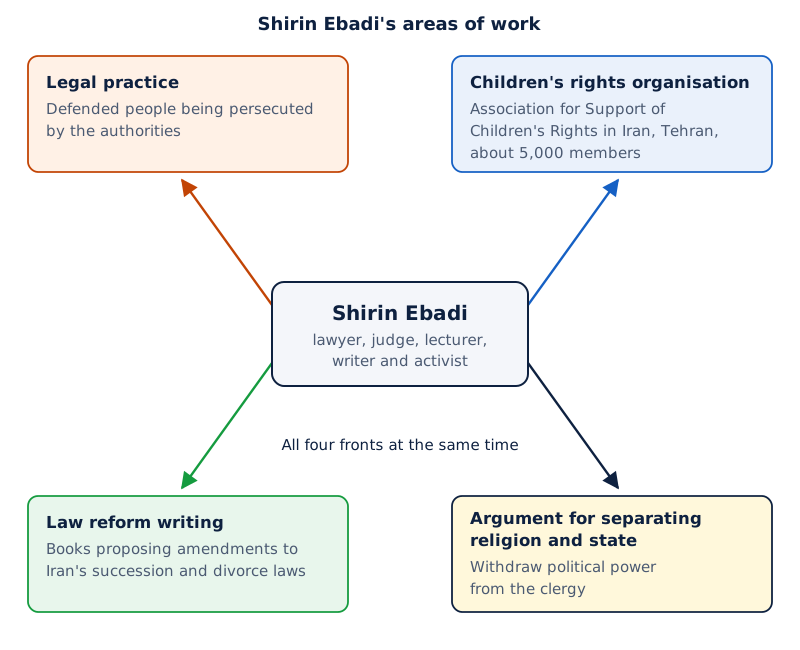
Draw a simple diagram with "Shirin Ebadi" written in the centre and four branches leading outward, labelled legal practice, children's rights organisation, law reform writing, and argument for separating religion and state, to show how her efforts spread across several connected fields.
Drawn by One Young India.
Why does the prize matter?
The prize mattered first because it was a symbolic breakthrough: the committee's speech states she was the first woman from the Muslim world to win the Peace Prize, and the first Iranian citizen to win the Nobel Peace Prize.
This gave international visibility to a human rights struggle that had largely been carried out inside Iran's own courts and civil society.
It also mattered as a message about dialogue rather than confrontation between cultures. In a period of rising tension after the 2001 attacks, the committee used the award to argue that Islam and human rights were not in conflict, and that the path toward change lay through democratic elections and dialogue rather than violence.
The committee also hoped the prize would directly help the cause of children's rights, given Ebadi's work founding and running the Association for Support of Children's Rights in Iran, and would encourage Iran's own reform movement at a difficult time.
At the same time, the presentation speech acknowledges a limit: it notes that in the short term a Peace Prize may lead to more hostility than peace inside a laureate's own country, even while the committee's underlying belief remained that repression cannot persist indefinitely.
How does this connect to what you study?
This prize connects directly to topics studied in civics and political science, especially the idea of democracy resting on free elections rather than on force or inherited religious authority, and the broader meaning of fundamental rights guaranteed to every citizen regardless of gender.
Ebadi's argument that supreme political power in a community must come from democratic elections, not from clerical or military authority, mirrors core ideas taught about constitutional government and the separation of powers between religion and the state.
Her focus on the rights of women and children also links to classroom study of equality before the law, and of how legal systems can be reformed gradually through activism, writing and organised institutions, such as the children's rights association she founded, rather than through revolution or violent upheaval.
Her life also illustrates how a single profession, in her case law, can become a tool for wider social change. By using court cases, books and an organisation together, she showed students of civics a practical model connecting legal training to activism.
Finally, the committee's stress on dialogue between cultures and religions, built on shared values rather than differences, connects to lessons on international relations and on how conflicts between communities or nations can be eased through conversation instead of confrontation.
What risks and personal sacrifices did she face?
Shirin Ebadi's human rights work was not without cost to her own life and career. Losing her position as a judge in 1979, after the revolution led by Khomeini, meant giving up the formal legal authority she had held under the earlier system.
Rather than withdraw from public life, she chose to continue inside the legal profession by opening a private practice, which the facts page describes as beginning with taking on cases of people facing persecution by the authorities.
This choice carried direct personal danger. In the year 2000 she was herself imprisoned, specifically for criticising her country's hierocracy, meaning rule exercised by religious leaders rather than elected representatives.
The presentation speech notes that this meant, in the chairman's words, "a life in fear" for her, yet one in which she had learned to live with that fear while remaining optimistic about the future of her country.
The speech also records that she repeatedly stressed her identity as an Iranian, insisting she intended to keep living in Iran for as long as she possibly could, despite the dangers her work had already brought her.
These details matter for understanding why the Nobel Committee repeatedly described her as courageous: the prize recognised not only her ideas about democracy and rights, but her willingness to keep acting on them after being dismissed and imprisoned for doing so.
How did the world react to the award?
According to the presentation speech, the announcement of Ebadi's prize reached her while she was travelling in Paris and had left her mobile telephone at home in Teheran; the news still reached the conference she was attending very quickly, and it broke out in enthusiastic celebration. The speech adds that she had not even known she had been nominated.
Reactions then poured in from around the world. The chairman's speech says that not everyone knew her name beforehand, but that people understood immediately what the committee meant by the award: that all people are entitled to fundamental rights.
The speech notes this mattered particularly at a time when, in its words, Islam was "being demonized in many quarters of the western world", so the committee wanted to show how valuable dialogue between peoples and civilisations could be.
Not every reaction was equally warm. The chairman remarked that the committee understood if Ebadi had hoped for more congratulations from the authorities of her own home country and region, even as the wider world's response was strongly positive.
One welcome message the speech highlights came from the Pope, among the first to congratulate her, which pleased her because she held that there need be no fundamental conflict between Islam and Christianity.
The speech also places her alongside earlier Peace Prize laureates honoured for human rights and democracy, naming Martin Luther King (1964), Andrei Sakharov (1975), Amnesty International (1977), Lech Wałęsa (1983), Desmond Tutu (1984), Aung San Suu Kyi (1991), Rigoberta Menchú (1992) and Nelson Mandela (1993), as part of a long tradition stretching back, in the committee's own account, to Albert Lutuli's 1960 award.
Quick facts for exams
The Nobel Peace Prize 2003 was awarded to Shirin Ebadi, a lawyer and former judge from Iran, "for her efforts for democracy and human rights. She has focused especially on the struggle for the rights of women and children".
The award was announced by the Norwegian Nobel Committee on 10 October 2003, and the ceremony was held in Oslo on 10 December 2003.
Ebadi, born on 21 June 1947 in Hamadan, Iran, received the whole prize, a share of 1/1. She was the first woman from the Muslim world, and the first Iranian, to win the Nobel Peace Prize.
Her work included legal defence of persecuted people, founding a children's rights organisation, and writing on reform of succession and divorce laws.
| Fact | Detail |
|---|---|
| Prize | Nobel Peace Prize 2003 |
| Laureate | Shirin Ebadi |
| Born | 21 June 1947, Hamadan, Iran |
| Residence at the award | Iran |
| Share | 1/1 (the whole prize) |
| Citation | "for her efforts for democracy and human rights. She has focused especially on the struggle for the rights of women and children" |
| Date announced | 10 October 2003 |
| Prize amount | 10,000,000 Swedish kronor |
| Awarding body | Norwegian Nobel Committee |
Note: Source. The prize facts in this note are from the Nobel Prize's official site, nobelprize.org.
Glossary
- Laureate — a person who has been given a Nobel Prize.
- Citation — the official short sentence explaining why a prize was awarded.
- Norwegian Nobel Committee — the body that selects and announces the Nobel Peace Prize each year.
- Democracy — a system of government in which political power comes from free elections by the people.
- Human rights — basic rights and freedoms that every person is considered to be entitled to.
- Hierocracy — rule by religious leaders or priests over political and legal matters.
- Judiciary — the system of courts and judges that applies and interprets the law.
- Succession law — the set of rules deciding who inherits property or rights after a person's death.
- Divorce law — the rules governing how a marriage can be legally ended.
- Non-violence — the practice of pursuing change without using force or physical harm.
- Reform movement — a group working to change existing laws or institutions gradually rather than through revolution.
- Secular — not controlled by or connected to religious authority.
- Activist — a person who campaigns actively for social or political change.
- Prize share — the fraction of a Nobel Prize given to each laureate when more than one person shares it.
Common errors and misconceptions
- Misconception: Shirin Ebadi won the Nobel Peace Prize for a single book. Correct: the citation covers her overall efforts for democracy and human rights, especially for women and children, not one publication.
- Misconception: She was Iran's president or a government official. Correct: she was a lawyer, former judge, lecturer, writer and activist working largely outside government.
- Misconception: She opposed Islam itself. Correct: she described herself as a practising Muslim who saw no conflict between Islam and fundamental human rights.
- Misconception: The prize was shared between several people. Correct: Ebadi received the whole prize, a share of 1/1.
- Misconception: She supported violent revolution to achieve change. Correct: she consistently supported non-violence and democratic elections as the route to change.
- Misconception: She was the first woman ever to win the Nobel Peace Prize. Correct: she was the first woman from the Muslim world to win it, not the first woman overall.
- Misconception: Her children's rights organisation was a government department. Correct: the Association for Support of Children's Rights in Iran was an independent organisation she founded and led.
Exam-style questions with model answers
Q1. In which year was Shirin Ebadi born, and where? [1 mark]
- She was born on 21 June 1947 in Hamadan, Iran.
Q2. State the exact citation for the Nobel Peace Prize 2003. [2 marks]
- The citation reads: "for her efforts for democracy and human rights. She has focused especially on the struggle for the rights of women and children."
Q3. Describe two concrete activities through which Shirin Ebadi worked for human rights. [3 marks]
- She opened a legal practice and defended people being persecuted by the authorities, taking on sensitive cases few other lawyers would accept.
- She founded and led the Association for Support of Children's Rights in Iran, a Tehran-based organisation with about 5,000 members that produced school materials and ran an emergency hotline for children.
- She also wrote books proposing amendments to Iran's succession and divorce laws, aiming to change the legal framework itself.
Q4. Why was 1979 an important turning point in Shirin Ebadi's career? [3 marks]
- In 1979 the Islamic revolution led by Khomeini took place in Iran.
- As a result of the new political system, Ebadi was dismissed from her position as a judge.
- This dismissal pushed her toward opening her own legal practice and defending persecuted people, which later became central to her human rights work.
Q5. Explain, with reference to the committee's own statements, why the Norwegian Nobel Committee chose Shirin Ebadi in 2003. [5 marks]
- The committee stated she had worked for democracy and human rights, with special focus on the rights of women and children.
- It praised her as speaking out "clearly and strongly in her country" despite personal risk, including an earlier imprisonment in 2000.
- It noted this was the first time a woman from the Muslim world received the Peace Prize, calling it a source of pride for that world.
- It hoped the award would ease tensions between the Islamic and Western worlds after the 11 September 2001 attacks.
- It also wished to support Iran's internal reform movement and inspire others working for human rights and democracy elsewhere.
Q6. What did Shirin Ebadi believe about the relationship between Islam and human rights, and how did she apply this belief? [5 marks]
- Ebadi described herself as a practising Muslim and said she saw no conflict between Islam and fundamental human rights.
- She believed dialogue between different cultures and religions should be built on values they already share rather than on their differences.
- She argued that political power should come from democratic elections rather than from religious or clerical authority, and favoured separating religion from the state.
- She argued for women's equality before the law; the Nobel Committee separately noted that around 60 percent of students at the University of Tehran were women.
- She applied these beliefs practically through her legal practice, her writing on family law reform, and her children's rights organisation, consistently choosing non-violent methods over confrontation.
Q7. Discuss the significance of Shirin Ebadi's Nobel Peace Prize for Iran and for the wider Muslim world. [6 marks]
- Ebadi was the first Iranian citizen to win the Nobel Peace Prize, which the committee hoped would bring joy to the people of Iran.
- She was also the first woman from the Muslim world to receive the Peace Prize, a fact the committee highlighted as a source of pride for that world.
- The committee explicitly connected the award to the tensions between the Islamic and Western worlds following the 11 September 2001 attacks, hoping it would help build understanding.
- It also aimed to support Iran's reform movement at a time when Ebadi herself had already faced dismissal as a judge and imprisonment for her views.
- The committee acknowledged that, in the short term, the award might create more friction than peace inside a laureate's home country, yet it held to its belief that repression cannot persist indefinitely.
- Overall, the prize was presented as both recognition of one individual's courage and a broader message about democracy, dialogue and non-violence.
Key takeaways
- Shirin Ebadi won the Nobel Peace Prize 2003 for her efforts for democracy and human rights, especially the rights of women and children.
- She was born on 21 June 1947 in Hamadan, Iran, and received the whole prize of 10,000,000 Swedish kronor.
- She was dismissed from her post as a judge after Iran's 1979 revolution and was imprisoned in 2000 for criticising the country's hierocracy.
- She founded the Association for Support of Children's Rights in Iran, which had about 5,000 members and ran an emergency hotline for children.
- She wrote books proposing reforms to Iran's succession and divorce laws and argued for separating religion from the state.
- She was the first woman from the Muslim world, and the first Iranian, to win the Nobel Peace Prize.
- The committee linked the award to easing tensions between the Islamic and Western worlds after the 11 September 2001 attacks.
- Ebadi consistently supported non-violence, democratic elections and dialogue as the route to political change.
Test yourself
Where and when was Shirin Ebadi born?
Shirin Ebadi was born on 21 June 1947 in Hamadan, Iran.
What was Shirin Ebadi's profession before she was dismissed in 1979?
She was one of Iran's first female judges before being dismissed after the 1979 revolution.
What happened to Shirin Ebadi in the year 2000?
She was imprisoned after criticising her country's hierocracy, meaning rule by religious leaders.
What organisation did Shirin Ebadi found for children's rights?
She founded the Association for Support of Children's Rights in Iran, based in Tehran with about 5,000 members.
What was unique about Ebadi being awarded the prize, according to the Nobel Committee?
She was the first woman from the Muslim world, and the first Iranian citizen, to receive the Nobel Peace Prize.
What method did Ebadi favour for achieving political change?
She favoured non-violence, democratic elections and dialogue rather than revolution or confrontation.
How did Ebadi view the relationship between Islam and human rights?
She saw no conflict between Islam and fundamental human rights, describing herself as a practising Muslim.
When was the Nobel Peace Prize 2003 announced and when was it presented?
It was announced on 10 October 2003 and presented at the Oslo ceremony on 10 December 2003.