
Nobel Peace Prize 2006: Muhammad Yunus, Grameen Bank and Microcredit
On this page
This note covers the Nobel Peace Prize 2006: who won it, what microcredit is and how Grameen Bank used it, the background of poverty in Bangladesh that the work addressed, how the idea developed from a small personal loan into a large bank, the committee's stated reasons for linking poverty relief to peace, and quick facts for exams.
What was the Nobel Peace Prize 2006 awarded for?
The official citation reads: "for their efforts to create economic and social development from below".
This means the prize honoured work that lifted people out of poverty not through top-down government schemes or foreign aid handed from above, but by giving ordinary poor people, especially women, the tools to build their own livelihoods from the ground up.
The Norwegian Nobel Committee explained the link to peace directly in its press release, saying lasting peace cannot be achieved unless large population groups find ways to break out of poverty, and that micro-credit is one such means. The press release added that development from below also serves to advance democracy and human rights, tying the economic idea of self-support to the Committee's broader concept of peace.
The press release also praised Muhammad Yunus personally, saying he had turned his ideas into real-world action that helped millions of people in Bangladesh and in other countries too, starting from a small beginning three decades earlier.
The prize is formally called the Nobel Peace Prize, and it was shared equally between an individual and the institution he founded.
Who are the laureates?
Muhammad Yunus
Muhammad Yunus was born on 28 June 1940 in Chittagong, British India, in what is now Bangladesh. At the time of the award his residence was Bangladesh, and his role was described as founder of Grameen Bank. He received one half of the prize.
Yunus studied economics in Bangladesh and the United States, then became a professor of economics at the University of Chittagong in 1972.
During the Bangladesh famine of 1974 he decided that teaching economic theory was not enough while people around him were starving, and two years later, in 1976, he began lending small sums directly to poor villagers.
Grameen Bank
Grameen Bank was founded in 1976 in Dhaka, Bangladesh, and received the other half of the prize. Its name means "village bank".
The bank's contribution was to turn Yunus's personal lending experiment into a lasting institution that gave small, long-term loans on easy terms to people without any financial security, mostly women, trusting them to manage their own development.
What problem was the prize addressing?
Traditional banks in Bangladesh and elsewhere were reluctant to lend to anyone who could not offer collateral, which shut the poorest people out of the financial system entirely.
The press release noted that before Yunus tried it, giving loans to people with no financial security had seemed to many an impossible idea. The presentation speech repeated this point about loans to poor people, most often women, who had no financial security to offer, noting that Grameen Bank's own practice proved such lending could work.
The presentation speech described a wider picture of global poverty, in which about half of all people survived on under two dollars a day and over a billion on under one dollar a day, a condition it called extreme poverty.
The Committee stressed that most of the world's poor were women and children, and that this was likely to remain one of the greatest challenges facing the world over the next few decades, calling it shameful that far over half the world's people lived under such conditions.
The Committee also connected poverty to conflict, citing research summarised in the Human Security Report 2005 which found that most wars occur in poor countries and that the risk of war declines as income per person rises. The speech added that wealthier governments also have more resources with which to resolve problems that could otherwise lead to conflict.
This gave the Committee its reasoning for treating the fight against poverty as, in its words, "work for peace of the first order".
The speech used everyday reasoning alongside the research findings, pointing out that most people would agree wealthy Europe had stayed at peace in recent decades while poverty-stricken parts of Africa had seen many conflicts, and that this probably had something to do with living conditions. It cautioned, however, that the causal connections involved are complicated and rarely owe to a single factor, and that poor people are not necessarily more violent than the prosperous; rather, richer central governments simply have more resources to resolve disputes before they turn into conflict.
Yunus himself described poverty, according to the facts page, as being deprived of all human value, and he treated microcredit as both a human right and a practical way out of such deprivation.
How does microcredit work?
Microcredit means giving very small loans, repaid over time on easy terms, to people who have no collateral and would never qualify for a normal bank loan.
Grameen Bank built its whole method around trust rather than security, on the belief that even the poorest of the poor can manage their own money if given a fair chance.
- Poor people, most often women, organise themselves voluntarily into small groups, commonly of five.
- The group as a whole, rather than one individual, is granted the loan and takes joint responsibility for repayment.
- The group meets regularly to discuss borrowing, work, repayment and saving, sharpening each member's financial understanding.
- Members commit to practical goals beyond money, such as food production, clean drinking water, hygiene, health and family planning.
- Groups link up into wider networks, which has also become a base for vaccination and health programmes at the village level.
By the time of the award, Grameen Bank had almost seven million borrowers, was lending about 800 million dollars a year in loans that averaged just above one hundred dollars, and kept a very high repayment rate while remaining self-financing and profitable.
Over 95 per cent of borrowers were women, because the Committee's speech noted that money given to a woman tends to benefit the whole family, since women generally spend it on the household while men more often spend it on themselves.
The presentation speech quoted a borrower, Mazeda Begum, who described the effect of the bank on her life in her own words: "My parents gave me the birth, but Grameen Bank gave me a life". The speech added that Yunus firmly believed alms destroy the initiative and creativity of poor people, which is why the bank relied on repayable loans rather than charity.
Yunus also described microcredit as a well-tried and well-founded method that helps the poorest of the poor obtain financial services, promoting entrepreneurship and putting each poor person, especially women, "in the driving-seat in their own lives", as quoted in the presentation speech. The speech added that even beggars had become borrowers at the bank, showing how far the group-lending method had been able to reach into the poorest section of society.
Diagram
The group-lending cycle
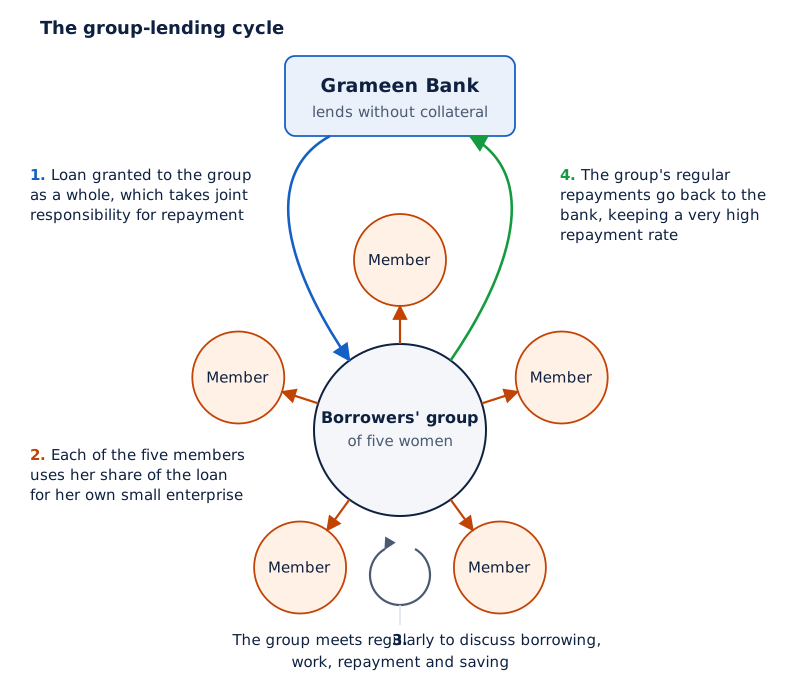
Draw a circle of five small figures representing a borrowers' group, with arrows showing the loan arriving from Grameen Bank, flowing to each member for her small enterprise, and then arrows showing regular repayments flowing back to the bank, with a smaller loop showing the group meeting to discuss savings and discipline.
Drawn by One Young India.
What ownership and structure did Grameen Bank have?
Grameen Bank was structured so that the borrowers themselves owned most of it. Through their deposits, poor people owned 94 per cent of the bank, while the remaining 6 per cent belonged to the Government of Bangladesh.
This made it unusual among banks, since its own customers were also its main shareholders.
The table below sets out the key figures given about the bank at the time of the award.
| Measure | Figure given |
|---|---|
| Borrowers | Almost seven million |
| Average loan size | Just over 100 dollars |
| Annual lending | 800 million dollars per year |
| Total lent since 1983 | Almost six billion dollars |
| Share of loans to women | Over 95 per cent |
| Ownership by borrowers | 94 per cent |
| Ownership by Government of Bangladesh | 6 per cent |
Yunus himself is quoted as saying, "Lend the poor money in amounts which suit them, teach them a few sound financial principles, and they manage on their own".
This captured his view that microcredit was less about money and more about trust, since the word credit itself comes from a root meaning to trust.
How did the work develop?
| Year | Event |
|---|---|
| 1972 | Yunus returned to Bangladesh and became professor of economics at the University of Chittagong. |
| 1974 | A famine struck Bangladesh; Yunus underwent what the speech called a personal crisis seeing such poverty. |
| 1976 | Yunus lent 27 dollars from his own pocket to 42 craftsmen in a village, and Grameen Bank was founded in Dhaka. |
| 1983 | Grameen Bank formally opened as an institution. |
| 2002 | Bill Clinton publicly said Yunus should long ago have won the Nobel Prize. |
| 13 October 2006 | The Nobel Peace Prize 2006 was announced for Yunus and Grameen Bank. |
| 10 December 2006 | The award ceremony was held in Oslo, with the presentation speech delivered by Ole Danbolt Mjøs. |
What began as an informal personal loan of 27 dollars grew, over three decades, into an institution lending hundreds of millions of dollars a year, present in the vast majority of Bangladesh's villages, as the presentation speech described it.
What were the committee's stated reasons for this choice?
The presentation speech set out three specific reasons the Committee wished to highlight through this award.
First, it wanted the prize to serve as a bridge of dialogue with the Muslim world, noting a tendency after 11 September 2001 to "demonize Islam", and stating that the award to Yunus and Grameen Bank was also support for the Muslim country Bangladesh and Muslim communities working for dialogue.
Second, the speech placed women at the centre of the story, noting that over 95 per cent of Grameen Bank's borrowers were women and calling their liberation a major concern of the work, describing microcredit in modern terms as a form of female empowerment.
Third, and described as most important, was the fight against poverty itself. The Committee argued that lasting peace requires large population groups to find a way out of poverty, and that development built from below, through tools like microcredit, also serves to advance democracy and human rights, as stated directly in the press release.
The speech also addressed a question the Committee said it is often asked: which concept of peace does it apply when choosing a laureate? It pointed out that Alfred Nobel's will names only three narrow criteria for the prize, namely fraternity between nations, the abolition or reduction of standing armies, and the holding of peace congresses, which leaves the Committee a great deal of room to interpret the idea of peace for itself. It recalled that this interpretation has been disputed ever since the first prize in 1901, when the choice of Henri Dunant alongside the pacifist Frédéric Passy was questioned by some who doubted whether humanitarian relief work was truly relevant to peace.
The speech traced how the Committee's idea of peace had widened over the decades, from early prizes to peace activists and statesmen, to later awards recognising campaigners for human rights, a choice that likewise drew counter-arguments at the time about whether human rights had anything to do with peace. It noted that from the 1980s onward, political scientists increasingly studied the philosopher Immanuel Kant's argument linking democracy and peace, and that this link between democratic government and peaceful relations has since become one of the most robust findings in modern political science. The speech also recalled that in 2004 the Committee had drawn a connection between environmental damage and conflict, just as in 2006 it was now drawing a connection between poverty and conflict.
Why does this prize matter?
The award helped establish microcredit as a recognised tool in the global fight against poverty.
The press release noted that Grameen Bank had become a source of ideas and models for microcredit institutions that had sprung up around the world, and the facts page on Grameen Bank records that it inspired similar institutions in over one hundred countries, including, as the presentation speech noted, programmes that had reached Norway itself.
The Committee was explicit that microcredit alone could not fully achieve Yunus's long-term goal of eliminating poverty, but said it must play a major part in continuing efforts toward that goal.
The presentation speech also linked the award to the United Nations' Millennium Development Goal of halving global poverty by 2015, framing the struggle against poverty as requiring mobilisation by every country and nation, and quoting the United Nations Secretary-General Kofi Annan's remark that borders today run between the powerful and the powerless rather than between nations.
The speech also placed the 2006 prize in a longer history of Peace Prizes connected to humanitarian relief and the fight against poverty, mentioning earlier laureates such as the founder of the Food and Agriculture Organization, John Boyd Orr, and the agricultural scientist Norman Borlaug, while noting that microcredit itself was a genuinely new tool in that history.
The speech recorded that Bangladesh had seen considerable economic growth over the preceding decades, and credited some of that growth to the work of Grameen Bank and other microcredit institutions, while saying it would be important to increase the use of this instrument further.
Yunus's own book, Banker to the Poor: The Story of the Grameen Bank, was quoted in the speech asking whether a world without poverty could really be imagined. His answer, as quoted, compared it to humanity's past achievements of creating a slavery-free, polio-free and apartheid-free world, arguing a poverty-free world would be an even greater accomplishment while reinforcing the others. The speech closed by saying the Committee hoped the prize would be a source of inspiration in the continuing work toward a world without poverty, while acknowledging plainly that this was not a goal to be reached within the next few decades.
How did reactions to the award compare across countries?
The presentation speech described the award as having been well received internationally, in Norway, and particularly in Bangladesh itself.
It recorded that politicians and newspapers in large parts of the world commented on, and largely applauded, the Committee's choice once it was announced, and that in Bangladesh the news set off what the speech called an outbreak of joyful demonstrations, with people describing it as among the greatest things to have happened to the country since its independence in 1971.
The speech also noted that not every journalist covering the announcement at the Nobel Institute knew who Yunus and Grameen Bank were, and that some mistakenly thought Grameen Bank was the name of a person rather than an institution, a mix-up the speech treated lightly as the reporters' own problem.
It added that many people who did already know of Yunus and Grameen Bank felt the Peace Prize had been overdue, citing a remark that Bill Clinton had made publicly in 2002, that Yunus was a man who should long ago have won the Nobel Prize, and that Clinton had said he would keep repeating this until the prize was finally given to him.
This combination of long-standing international recognition and strong domestic celebration in Bangladesh showed how directly the award was felt by ordinary people whose lives the bank's lending had touched over three decades.
Quick facts for exams
The Nobel Peace Prize 2006 was awarded jointly to Muhammad Yunus, an economist from Bangladesh, and Grameen Bank, the institution he founded, for creating economic and social development from below through microcredit.
The announcement came on 13 October 2006 from the Norwegian Nobel Committee, and the ceremony followed in Oslo on 10 December 2006. Yunus was born in Chittagong in 1940 and was based in Bangladesh at the time of the award;
Grameen Bank was founded in Dhaka in 1976 and formally opened in 1983. Each side received one half of the prize of 10,000,000 Swedish kronor.
The prize highlighted microcredit, group lending and the central role of women borrowers in fighting poverty.
The Committee's presentation speech stressed three specific aims behind the choice: opening dialogue with the Muslim world, recognising women's economic empowerment, and advancing the wider struggle against poverty, which it called "work for peace of the first order".
| Fact | Detail |
|---|---|
| Prize | Nobel Peace Prize |
| Year | 2006 |
| Laureates | Muhammad Yunus and Grameen Bank |
| Country of birth (Yunus) | British India (now Bangladesh) |
| Country of affiliation | Bangladesh |
| Shares | One half each |
| Citation | "for their efforts to create economic and social development from below" |
| Date announced | 13 October 2006 |
| Prize amount | 10,000,000 Swedish kronor |
Note: Source. The prize facts in this note are from the Nobel Prize's official site, nobelprize.org.
Glossary
- Microcredit — small, long-term loans given on easy terms to poor people who have no collateral or financial security.
- Collateral — property or assets a borrower promises to a lender as security, forfeited if the loan is not repaid.
- Grameen Bank — a bank founded by Muhammad Yunus in Bangladesh in 1976, meaning "village bank" in Bengali.
- Group lending — a method where a small group of borrowers, rather than one person, shares responsibility for repaying a loan.
- Repayment rate — the proportion of a loan amount that borrowers actually pay back, described as very high for Grameen Bank.
- Development from below — improving lives by building capacity among ordinary people themselves, rather than through aid or policy handed down by governments.
- Norwegian Nobel Committee — the body that selects and announces the Nobel Peace Prize laureates each year.
- Prize citation — the official short sentence the Committee gives as the reason for an award.
- Female empowerment — giving women greater control over economic resources and decisions affecting their own lives.
- Extreme poverty — living on less than one dollar a day, as described in the presentation speech.
- Self-financing — an institution that covers its own costs from its own income rather than depending on continuous outside funding.
- Millennium Development Goals — a set of United Nations targets, including halving global poverty by 2015, referred to in the presentation speech.
Common errors and misconceptions
- Misconception: Grameen Bank is a person's name. Correct: Grameen Bank is an institution; the presentation speech itself noted some journalists mistakenly thought otherwise.
- Misconception: Microcredit loans are given mainly to men. Correct: Over 95 per cent of Grameen Bank's borrowers were women.
- Misconception: Grameen Bank is owned entirely by the Government of Bangladesh. Correct: Borrowers themselves owned 94 per cent of the bank through their deposits; the government held 6 per cent.
- Misconception: Yunus started Grameen Bank as a government programme. Correct: It began as a personal loan of 27 dollars from Yunus to 42 craftsmen before becoming an institution.
- Misconception: Grameen Bank requires borrowers to provide collateral like ordinary banks. Correct: It lends to people without any financial security, relying instead on group responsibility and trust.
- Misconception: The Nobel Committee said microcredit alone would end world poverty. Correct: The Committee said microcredit must play a major part but cannot by itself achieve the long-term goal of eliminating poverty.
- Misconception: This was the first time the Nobel Peace Prize addressed poverty. Correct: The presentation speech noted earlier prizes had also gone to anti-poverty work, such as to John Boyd Orr and Norman Borlaug.
Exam-style questions with model answers
Q1. In what year was Grameen Bank founded? [1 mark]
- Grameen Bank was founded in 1976 in Dhaka, Bangladesh.
Q2. State the official citation for the Nobel Peace Prize 2006. [2 marks]
- The citation read: "for their efforts to create economic and social development from below".
Q3. Explain how group lending works under Grameen Bank's microcredit system. [4 marks]
- Poor people, usually women, form small groups, often of five members, who together receive and are jointly responsible for a loan.
- The group meets regularly to discuss borrowing, repayment and saving, which builds financial discipline among members.
- Members also commit to wider goals such as clean water, hygiene and family planning alongside their financial obligations.
- Groups connect into larger networks, which has supported community activities like vaccination programmes at the village level.
Q4. Why did the Norwegian Nobel Committee connect the fight against poverty to the cause of peace? [5 marks]
- The Committee's press release stated that lasting peace cannot be achieved unless large population groups find ways to break out of poverty.
- The presentation speech cited research from the Human Security Report 2005 showing that most wars occur in poor countries, and that the risk of war declines as income rises.
- It argued that development built from below also advances democracy and human rights, not just economic security.
- The speech noted that wealthy regions had generally stayed at peace while poverty-stricken regions saw more conflict, suggesting a link between living conditions and stability.
- On this basis the Committee described the struggle against poverty as "work for peace of the first order".
Q5. Describe the roles of Muhammad Yunus and Grameen Bank in the award, including how each contributed. [6 marks]
- Muhammad Yunus, born in Chittagong in 1940, was an economics professor who, during the 1974 Bangladesh famine, decided to lend money directly to poor people rather than only teach economic theory.
- He personally lent 27 dollars to 42 craftsmen in a village in 1976, which became the seed of a wider institution.
- Grameen Bank, founded in Dhaka in 1976 and formally opened in 1983, turned this idea into a large-scale institution offering microcredit on easy terms without collateral.
- By the time of the award, the bank had almost seven million borrowers and had lent almost six billion dollars since opening.
- Over 95 per cent of its loans went to women, and borrowers themselves owned 94 per cent of the bank through their deposits.
- Together, Yunus provided the vision and leadership while Grameen Bank provided the lasting institutional structure that spread microcredit to over one hundred countries.
Q6. What share of the prize did each laureate receive, and what was the total prize amount? [2 marks]
- Muhammad Yunus and Grameen Bank each received one half of the prize, which totalled 10,000,000 Swedish kronor.
Q7. Why did the Committee emphasise lending to women in particular? [4 marks]
- Over 95 per cent of Grameen Bank's borrowers were women, making this a central feature of its lending model.
- The presentation speech explained that money given to a woman tends to benefit the whole family, since women generally spend it on food and clothing for children.
- The Committee said economic growth and democracy cannot reach their full potential unless women participate on an equal footing with men.
- Microcredit was therefore described in the speech as a form of female empowerment in societies where women faced repressive social and economic conditions.
Key takeaways
- The Nobel Peace Prize 2006 went jointly to Muhammad Yunus and Grameen Bank for development from below.
- Microcredit means small, long-term loans to poor people without collateral, repaid reliably through group responsibility.
- Grameen Bank began from a personal loan of 27 dollars in 1976 and grew into a bank with almost seven million borrowers.
- Over 95 per cent of Grameen Bank's borrowers were women, who owned most of the bank through their deposits.
- The Committee linked poverty reduction directly to peace, citing research that most wars occur in poor countries.
- The award also aimed to build dialogue with the Muslim world and to highlight female empowerment.
- Grameen Bank's model inspired similar microcredit institutions in over one hundred countries.
- Yunus and the Committee both stressed microcredit was a major tool against poverty, not a complete solution on its own.
Test yourself
Where and when was Muhammad Yunus born?
Muhammad Yunus was born on 28 June 1940 in Chittagong, in British India, in what is now Bangladesh.
What event in 1976 marked the start of Grameen Bank's work?
Yunus lent 27 dollars from his own pocket to 42 craftsmen in a Bangladeshi village, which led to Grameen Bank's founding.
What proportion of Grameen Bank's loans went to women?
Over 95 per cent of Grameen Bank's loans went to women or groups of women, according to the official facts page.
Who owned most of Grameen Bank at the time of the award?
Borrowers themselves owned 94 per cent of Grameen Bank through their deposits, while the Government of Bangladesh owned 6 per cent.
What date was the Nobel Peace Prize 2006 announced?
The Norwegian Nobel Committee announced the prize on 13 October 2006, awarding it to Yunus and Grameen Bank.
What research did the presentation speech cite to link poverty and conflict?
It cited the Human Security Report 2005, which found that most wars take place in poor countries and war risk falls as income rises.
What was Grameen Bank's average loan size at the time of the award?
The average loan given by Grameen Bank was just over one hundred dollars, according to the official facts page.