
Nobel Peace Prize 2008: Martti Ahtisaari and Decades of Conflict Mediation
On this page
What was the Nobel Peace Prize 2008 awarded for?
The Norwegian Nobel Committee awarded the prize "for his important efforts, on several continents and over more than three decades, to resolve international conflicts."
In plain words, this means one man spent most of his working life helping warring sides talk to each other instead of fighting, in several different parts of the world, not just once but again and again over about thirty years.
He was not a soldier or a head of an army; he was a mediator, someone trusted enough by both sides of a dispute to sit between them and search for an agreement that each side could accept, even when they hated each other.
The official name of this award is the Nobel Peace Prize. It is the only Nobel Prize presented in Oslo, Norway, rather than Stockholm, Sweden, and it is awarded by the Norwegian Nobel Committee, a group of five people chosen by the Norwegian parliament (the Storting), rather than by a Swedish institution.
Who are the laureates?
Martti Ahtisaari
Martti Ahtisaari was born on 23 June 1937 in Viipuri (now called Vyborg), a city that was then part of Finland but later became part of the Soviet Union. He died on 16 October 2023 in Helsinki, Finland.
At the time of the award in 2008 his residence was Finland, and he received the whole prize (a share of 1/1), with no co-laureates.
Ahtisaari was a career diplomat and politician who became President of Finland from 1994 to 2000.
Before and after his presidency he worked as an international mediator, often connected with the United Nations, and later through an organisation he founded called Crisis Management Initiative (CMI).
His contribution, as the prize committee summed it up, was decades of patient, practical conflict mediation: helping Namibia gain independence, helping end the long war in Aceh in Indonesia, and repeatedly trying to resolve the dispute over Kosovo, among other efforts in Northern Ireland, Central Asia and the Horn of Africa.
What was the background to this prize?
Ahtisaari's own life was shaped by conflict from childhood. He was born in Viipuri, Finland's second largest city at the time.
During the Winter War of 1939-40, fought between Finland and the Soviet Union, the city was ceded to the Soviet Union after the war ended and almost its entire Finnish population, including young Ahtisaari and his mother, had to leave while his father was at the front. His family moved first to Kuopio and later to Uleåborg.
According to the presentation speech, Ahtisaari later said this experience "explains my desire to advance peace and thus help others who have gone through similar experiences as I did".
Ahtisaari worked abroad from a young age, including three years in Karachi, Pakistan, where he helped set up a YMCA facility offering sports education and instructor training, starting when he was only 23, before studying at the Helsinki University of Technology and joining Finland's Ministry for Foreign Affairs in 1965.
In 1965 he joined Finland's Ministry for Foreign Affairs, focusing on development aid, and in 1973 he became Finnish Ambassador to Tanzania.
In 1977 the United Nations appointed him Commissioner for Namibia and the Secretary-General's Special Representative there, a role that pulled him into the world of peace negotiation for the rest of his career.
The presentation speech also mentioned a lighter detail: Ahtisaari had Norwegian roots, since his great-grandfather came from Tistedalen in the Østfold county of Norway, and he had reportedly wondered whether being "12.5 per cent Norwegian" might count against him with the Norwegian Nobel Committee. The speech noted that before him, two Norwegians, five Swedes and one Dane had already won the Peace Prize, but no Finn had ever received it until Ahtisaari in 2008.
The wider background is the series of long, difficult conflicts that followed decolonisation, the Cold War and its aftermath, and ethnic disputes in the Balkans: Namibia under South African control, the separatist war in Aceh, and the deep split between Serbia and Kosovo's ethnic Albanian majority, a dispute the speech described as divided by "centuries of bitter history".
Each of these needed someone both sides could trust enough to talk to, even without either side fully trusting each other.
What did Ahtisaari actually do, region by region?
Namibia: independence after a long struggle
Namibia was formally supervised by the United Nations but actually ruled by South Africa, while the independence movement SWAPO grew steadily stronger.
The Cold War made the dispute harder, with the United States and the Soviet Union both engaged, and a civil war next door in Angola involving Cuban and South African forces.
As UN Commissioner for Namibia for fourteen years, Ahtisaari held together the threads of a mediation that depended on many players and the eventual end of the Cold War and change in South African leadership under F.W. de Klerk.
Namibia became independent on 21 March 1990, and the presentation speech called Ahtisaari "Namibia's midwife", noting he later became an honorary citizen of the country.
Aceh, Indonesia: ending a bloody separatist war
In Aceh, a province of Indonesia, the separatist Free Aceh Movement (GAM) had sought independence since 1976, and at least 15,000 people had died in the fighting.
A 2002 peace accord broke down in 2003 and the two sides had not spoken for 20 months. Through his organisation Crisis Management Initiative (CMI), without any international mandate, Ahtisaari brought the parties together in Finland in January 2005.
The devastating Indian Ocean tsunami, which killed at least 170,000 people in Aceh, is described in the presentation speech as having helped prepare the ground for peace.
Seven months after the January talks, the government and GAM signed a peace treaty in Helsinki, under which Aceh stayed part of Indonesia but with extensive autonomy, and GAM disarmed to become a political party.
Kosovo: a conflict mediated but not fully resolved
Ahtisaari was involved in Kosovo twice. In 1999, working with Russia's Prime Minister Viktor Chernomyrdin, he helped persuade Yugoslav leader Slobodan Milosevic to stop the war over Kosovo;
Ahtisaari himself said in an interview that they "did not negotiate with Milosevic", but simply offered terms that made it easier for him to stop the bombing.
In November 2005 the United Nations made him Special Envoy for Kosovo's future status. In January 2007 he proposed that Kosovo become virtually independent under limited international supervision, with the Serb minority given autonomy and ties to Serbia.
Serbia rejected the plan and Russia blocked it at the UN Security Council, so Ahtisaari declared his mission over in July 2007.
On 17 February 2008 Kosovo Albanians declared independence unilaterally, which the United States and most European Union states recognised, though Serbia and Russia did not.
| Conflict | Ahtisaari's role | Outcome mentioned in the sources |
|---|---|---|
| Namibia | UN Commissioner for Namibia, 1977-1990 | Independence on 21 March 1990 |
| Aceh, Indonesia | Mediator through Crisis Management Initiative | Peace treaty signed in Helsinki, 2005 |
| Kosovo | Mediator in 1999, UN Special Envoy 2005-07 | Proposal rejected at the UN; Kosovo declared independence, February 2008 |
| Iraq | Senior adviser to CMI talks, 2008 | 36 Iraqi politicians agreed a declaration favouring dialogue |
What reasons did the committee give for the award?
The Norwegian Nobel Committee said these efforts "have contributed to a more peaceful world and to 'fraternity between nations' in Alfred Nobel's spirit." It noted that although the parties to a conflict carry the main responsibility for avoiding war, the committee has "on several occasions" honoured mediators, and it placed Ahtisaari in a line going back to Theodore Roosevelt in 1906 and including Kofi Annan in 2001 and Jimmy Carter in 2002.
The presentation speech by committee chairman Ole Danbolt Mjøs explained why the citation stretched across "more than three decades" rather than a single year's achievement, admitting that 2008 itself was not an especially remarkable year for Ahtisaari, but that the Nobel Committee had chosen to recognise his long career of mediation as a whole.
The committee also described qualities it saw in Ahtisaari's method: untiring effort, good results, and a willingness to tell parties uncomfortable truths.
It quoted him as saying, "I have learned that you do not achieve peace just by saying nice things to the parties. You have to be sincere... I am not always amiable." In Aceh he is reported to have asked negotiators directly, "Do you want to win the war, or do you want peace?" The speech also noted Ahtisaari's belief that "every conflict can be resolved", which the committee linked to a spirit of optimism it considered important for successful mediation.
The speech also credited Ahtisaari's ability to listen and to go straight to the core of a problem, and suggested that having Finnish "sisu" (a word for inner toughness and determination) and the support of his wife, Eeva, had helped him through decades of difficult negotiation. Mjøs added that mediators tend to achieve most when they are not too concerned with winning personal credit, a general reflection on mediators that, he noted, had not stopped Ahtisaari himself from being recognised with the Nobel Peace Prize.
Diagram
Ahtisaari's three main mediations on a world outline map
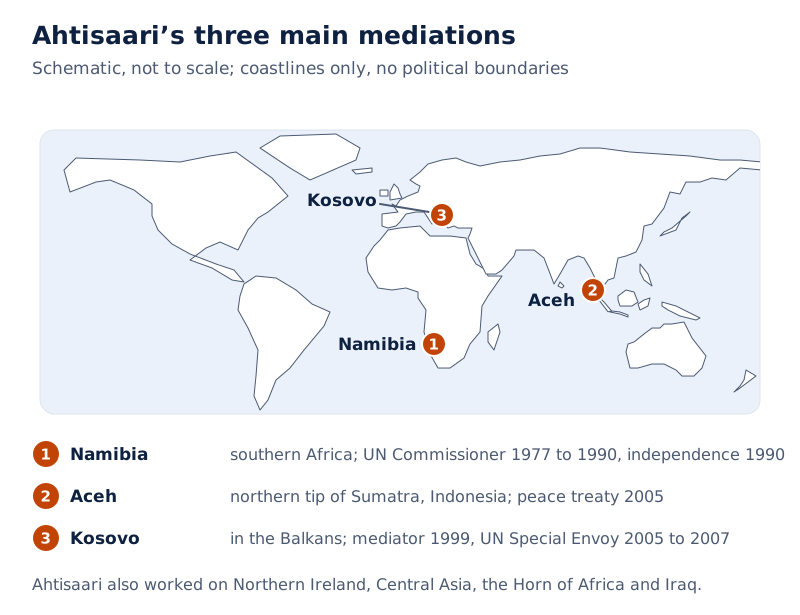
Mark Namibia in southern Africa, Aceh at the northern tip of Sumatra in Indonesia, and Kosovo in the Balkans, with a short label by each naming the years Ahtisaari was involved there.
Drawn by One Young India.
How did Ahtisaari's work as a peace mediator develop?
| Year | Event |
|---|---|
| 1937 | Born in Viipuri, Finland (now Vyborg). |
| 1939-40 | Winter War; his family had to leave Viipuri after Soviet annexation. |
| 1960 | Went to Karachi, Pakistan, to help establish a YMCA facility for sports education and instructor training. |
| 1965 | Joined Finland's Ministry for Foreign Affairs after studying at Helsinki University of Technology. |
| 1973 | Became Finnish Ambassador to Tanzania. |
| 1977 | Appointed UN Commissioner for Namibia and the Secretary-General's Special Representative there. |
| 1990 | Namibia became independent, on 21 March. |
| 1994-2000 | Served as President of Finland. |
| 1999 | Helped bring the Kosovo war to an end alongside Viktor Chernomyrdin. |
| 2005 | CMI-mediated peace treaty between the Indonesian government and GAM signed in Helsinki. |
| 2005-07 | UN Special Envoy for Kosovo's future status; proposal presented in January 2007. |
| 2008 | Kosovo declared independence (17 February); CMI worked on Iraq talks; awarded the Nobel Peace Prize on 10 October. |
Why does this prize matter?
The committee's stated hope was that "others may be inspired by his efforts and his achievements." The presentation speech argued that most people will never become international mediators, but that the same qualities, listening carefully, being honest even when it is unwelcome, and looking for workable compromises, can be used in everyday disputes "at a national or local level, in the neighbourhood, at schools, or in families."
The speech quoted Ahtisaari's own advice for anyone wanting to contribute to peace in daily life: "We must all look in the mirror and ask ourselves have I done my best for peace."
The prize also illustrates an open and unresolved problem in international affairs: mediation can bring an end to fighting without settling every underlying disagreement.
The speech itself noted that Ahtisaari's Kosovo proposal was never approved by the UN Security Council, that Serbia and Russia continued to object to Kosovo's independence, and that the Serbian minority inside Kosovo appeared likely to stay closely tied to Serbia, "contrary to Ahtisaari's plan".
This shows that a Peace Prize can honour someone's efforts and partial success even where a conflict is not completely resolved.
Mjøs closed his speech with lines from the Finnish writer Frans Eemil Sillanpää, the only Finn to have won the Nobel Prize in Literature, who wrote in 1926 that "whoever builds peace, builds humanity," a sentence the chairman offered as a greeting from Finland's literature laureate to Finland's first peace laureate, underlining how the committee saw Ahtisaari's work as part of a much larger, ongoing human effort rather than a finished achievement.
How does this connect to what you study?
Students of political science, history or general studies often meet the idea of conflict resolution: the use of negotiation, mediation and compromise instead of armed force to settle disputes between states or groups within a state.
Ahtisaari's career is a concrete example of how a neutral third party mediator can work, carrying proposals between sides that refuse to speak directly, as described in Aceh where the two sides had not spoken for 20 months before Ahtisaari brought them together.
His case also shows how international bodies such as the United Nations use special envoys and commissioners to manage long-running disputes, and how outcomes can remain contested even after an agreement, as with Kosovo's disputed independence.
These are useful real-world illustrations for anyone studying international relations, diplomacy or the working of the United Nations system.
What else did Ahtisaari contribute to, beyond Namibia, Aceh and Kosovo?
Besides his three best-known mediations, the sources describe several other efforts that the Norwegian Nobel Committee counted as part of his record over "more than three decades".
In Bosnia-Herzegovina the presentation speech records that Ahtisaari worked as a mediator for the United Nations, part of the same Balkan peacemaking record that later included his two spells of work on Kosovo.
In 2008, through Crisis Management Initiative and in cooperation with several American institutions, Ahtisaari worked as "senior adviser" in Helsinki negotiations that brought together 36 Iraqi politicians, who agreed on a declaration stating that dialogue and negotiation, rather than violence, must be the key to solving Iraq's problems.
The speech notes that "facilitators" from Northern Ireland and South Africa also took part in that Iraq process, and that CMI and Ahtisaari continued to assist the ongoing effort.
The press release separately credits him with "constructive contributions" to resolving conflicts in Northern Ireland, in Central Asia, and on the Horn of Africa, though it gives no further detail on these cases.
The presentation speech also points out that Ahtisaari managed all this mediation work while serving six years as President of Finland, from 1994 to 2000, a period during which Finland's economy improved, the country joined the European Union, and Helsinki hosted a meeting between Boris Yeltsin and Bill Clinton, although the speech itself cautioned against giving Ahtisaari too much personal credit for these national developments.
Taken together, these additional episodes show why the committee chose to frame the citation around a whole career rather than any single peace deal: Ahtisaari's name kept reappearing, continent after continent, wherever international mediators were needed.
Quick facts for exams
The Nobel Peace Prize 2008 was awarded in full to Martti Ahtisaari of Finland, announced on 10 October 2008 by the Norwegian Nobel Committee, "for his important efforts, on several continents and over more than three decades, to resolve international conflicts".
Ahtisaari was born in Viipuri (now Vyborg) in 1937, served as President of Finland from 1994 to 2000, and was best known for mediation work in Namibia (independence in 1990), Aceh, Indonesia (peace treaty in 2005, through Crisis Management Initiative), and Kosovo (1999 and 2005-07).
He received the prize alone, with no co-laureates, and the prize amount that year was 10,000,000 Swedish kronor.
| Fact | Detail |
|---|---|
| Prize | Nobel Peace Prize 2008 |
| Laureate | Martti Ahtisaari |
| Share | 1/1 (whole prize) |
| Country of birth | Finland (Viipuri, now Vyborg) |
| Country of affiliation/residence at award | Finland |
| Citation | "for his important efforts, on several continents and over more than three decades, to resolve international conflicts" |
| Date announced | 10 October 2008 |
| Award ceremony | Oslo, 10 December 2008 |
| Prize amount | 10,000,000 Swedish kronor |
Note: Source. The prize facts in this note are from the Nobel Prize's official site, nobelprize.org.
Glossary
- Mediator — a neutral person or organisation who helps two or more disputing sides talk and search for an agreement without taking either side.
- Crisis Management Initiative (CMI) — an organisation founded by Martti Ahtisaari that worked on conflict mediation, including in Aceh and Iraq.
- Norwegian Nobel Committee — the five-person body, chosen by the Norwegian parliament, that selects the Nobel Peace Prize laureate each year.
- Winter War — the war of 1939-40 between Finland and the Soviet Union, during which Ahtisaari's home city of Viipuri was affected.
- UN Commissioner for Namibia — the United Nations post Ahtisaari held from 1977, overseeing Namibia's path towards independence.
- SWAPO — the South West Africa People's Organisation, Namibia's independence movement mentioned in the committee's speech.
- Free Aceh Movement (GAM) — the separatist group in Aceh, Indonesia, that had sought independence from Indonesia since 1976.
- UN Special Envoy — a United Nations representative given a specific task, such as Ahtisaari's role on Kosovo's future status from 2005.
- Autonomy — a region's right to govern many of its own affairs while remaining part of a larger state, as proposed for Kosovo's Serbs and granted to Aceh.
- UN Security Council — the United Nations body whose approval Ahtisaari's Kosovo plan needed but did not receive, due to Russian opposition.
- Prize citation — the official sentence explaining exactly why the Nobel Committee chose a laureate.
Common errors and misconceptions
- Misconception: Ahtisaari won the prize for a single event in 2008. Correct: the citation explicitly covers "more than three decades" of work, and the presentation speech said 2008 itself was not unusually special for him.
- Misconception: the Nobel Peace Prize is awarded in Stockholm like the science prizes. Correct: the Peace Prize is awarded in Oslo, Norway, by the Norwegian Nobel Committee.
- Misconception: Kosovo's independence was approved by the United Nations. Correct: Ahtisaari's plan was never adopted by the UN Security Council because Russia opposed it; Kosovo declared independence unilaterally in February 2008.
- Misconception: Ahtisaari worked alone without any organisation. Correct: much of his later mediation, including in Aceh and Iraq, was carried out through Crisis Management Initiative, which he founded.
- Misconception: the Aceh peace treaty was caused only by the tsunami. Correct: the tsunami is described as having helped prepare the ground for peace, but the committee stressed that disasters do not automatically lead to peace, citing Sri Lanka as a contrast.
- Misconception: Namibia's independence was achieved by Ahtisaari alone. Correct: the speech notes many players were involved, including the end of the Cold War and change in South African leadership, though Ahtisaari held the mediation together over fourteen years.
- Misconception: the prize was shared between Ahtisaari and his organisation CMI. Correct: the prize share was 1/1, awarded to Ahtisaari alone.
Exam-style questions with model answers
Q1. In which year was Martti Ahtisaari awarded the Nobel Peace Prize? [1 mark]
- He was awarded the Nobel Peace Prize in 2008, announced on 10 October that year.
Q2. State the official citation for the Nobel Peace Prize 2008. [2 marks]
- The citation reads: "for his important efforts, on several continents and over more than three decades, to resolve international conflicts."
Q3. Describe Ahtisaari's role in Namibia's path to independence. [4 marks]
- Ahtisaari was appointed UN Commissioner for Namibia in 1977 and held the role for fourteen years.
- Namibia was formally under UN supervision but actually controlled by South Africa, with the independence movement SWAPO growing stronger over time.
- The dispute was complicated by Cold War rivalry, with the United States and Soviet Union both engaged, and a related civil war in neighbouring Angola.
- Namibia became independent on 21 March 1990, and the presentation speech called Ahtisaari "Namibia's midwife" for his long-held, central role in the mediation.
Q4. Explain how the Aceh conflict in Indonesia was brought to an end. [4 marks]
- The separatist Free Aceh Movement (GAM) had sought independence from Indonesia since 1976, and at least 15,000 people had died in the fighting.
- A 2002 peace accord broke down in 2003, after which the two sides did not speak for 20 months.
- Ahtisaari, through his organisation Crisis Management Initiative, brought the parties together in Finland in January 2005, without any international mandate.
- Seven months later the government and GAM signed a peace treaty in Helsinki, under which Aceh remained part of Indonesia with extensive autonomy and GAM disarmed to become a political party.
Q5. Discuss Ahtisaari's involvement in Kosovo and explain why his proposed solution was not fully implemented. [6 marks]
- Ahtisaari first worked on Kosovo in 1999, helping end the war there alongside Russia's Prime Minister Viktor Chernomyrdin by persuading Slobodan Milosevic to stop the bombing campaign.
- In November 2005 the United Nations appointed him Special Envoy to resolve Kosovo's future status, a task made difficult by "centuries of bitter history" between Serbia and the Kosovo Albanian majority.
- In January 2007 he proposed that Kosovo become virtually independent under limited international supervision, with the Serb minority granted considerable autonomy and ties to Serbia.
- Serbia strongly opposed the plan while Kosovo Albanians strongly supported it, and Russia, as Serbia's ally, blocked approval at the UN Security Council.
- Ahtisaari declared his mission over in July 2007 after further negotiations involving the USA, EU and Russia failed to find an agreement both sides could accept.
- On 17 February 2008 Kosovo Albanians declared independence unilaterally; this was recognised by the United States and most EU countries but opposed by Serbia and Russia, showing that Ahtisaari's mediation brought partial but not complete resolution.
Q6. What does the Norwegian Nobel Committee's reasoning tell us about the value of mediation in international conflicts? [5 marks]
- The committee said the parties to a conflict carry the main responsibility for avoiding war, yet it has "on several occasions" honoured mediators who help them reach agreements.
- It placed Ahtisaari alongside earlier mediator-laureates such as Theodore Roosevelt, Kofi Annan and Jimmy Carter, suggesting a recognised tradition of honouring this kind of peace work.
- The committee praised Ahtisaari's untiring effort and good results across many different conflicts over three decades rather than any single achievement.
- It highlighted his willingness to be honest with the parties rather than only agreeable, quoting him as saying he is "not always amiable".
- The committee expressed hope that "others may be inspired by his efforts and his achievements," showing it saw the prize as encouraging mediation as a method more broadly, even where outcomes like Kosovo remained contested.
Q7. Name three conflicts, besides Namibia, Aceh and Kosovo, where Ahtisaari made contributions, according to the press release. [2 marks]
- The press release mentions his constructive contributions to conflicts in Northern Ireland and in Central Asia, as well as on the Horn of Africa.
Q8. What personal experience is said to have shaped Ahtisaari's commitment to peace work? [3 marks]
- Ahtisaari was born in Viipuri, Finland's second largest city at the time.
- During the Winter War of 1939-40 the city was annexed by the Soviet Union and almost its entire Finnish population, including his family, had to leave.
- He later said this experience explained his desire to advance peace and help others who had gone through similar experiences.
Key takeaways
- Martti Ahtisaari of Finland won the Nobel Peace Prize 2008 alone, for decades of international conflict mediation.
- The citation covered "more than three decades" of work, not any single event in 2008 itself.
- He played a central role in Namibia's independence in 1990, after fourteen years as UN Commissioner there.
- Through Crisis Management Initiative he helped end the Aceh conflict in Indonesia with a 2005 peace treaty.
- His Kosovo mediation in 2005-07 proposed autonomy and near-independence but was never approved by the UN Security Council.
- Kosovo declared independence unilaterally in February 2008, recognised by many countries but opposed by Serbia and Russia.
- The Norwegian Nobel Committee compared Ahtisaari to earlier mediator-laureates such as Theodore Roosevelt, Kofi Annan and Jimmy Carter.
- The prize was announced on 10 October 2008 and presented in Oslo on 10 December 2008.
Test yourself
Who won the Nobel Peace Prize 2008?
Martti Ahtisaari of Finland won the whole Nobel Peace Prize 2008, with no co-laureates sharing the award.
What was the official citation for the award?
The citation was "for his important efforts, on several continents and over more than three decades, to resolve international conflicts."
What role did Ahtisaari hold in Namibia from 1977?
He served as the United Nations Commissioner for Namibia, working on its path to independence for fourteen years.
What organisation did Ahtisaari found to help mediate conflicts?
He founded Crisis Management Initiative, which helped mediate the Aceh conflict in Indonesia and worked on Iraq talks in 2008.
What happened in Kosovo on 17 February 2008?
Kosovo Albanians unilaterally declared Kosovo's independence, which the United States and most EU countries recognised but Serbia and Russia opposed.
What natural disaster is linked to the Aceh peace process?
The Indian Ocean tsunami, which killed at least 170,000 people in Aceh, helped prepare the ground for the 2005 peace treaty.
Where is the Nobel Peace Prize ceremony held, and by whom is it awarded?
It is held in Oslo, Norway, and awarded by the Norwegian Nobel Committee, unlike the other Nobel Prizes presented in Stockholm.
Which earlier Peace Prize laureates did the committee compare Ahtisaari to?
The committee compared him to earlier mediators Theodore Roosevelt, Kofi Annan and Jimmy Carter.