
Nobel Prize in Economics 2005: Game Theory, Conflict and Cooperation
On this page
This note covers the Nobel Prize in Economics 2005: who won it, what game theory is and how it explains conflict and cooperation, Thomas Schelling's work on strategic commitment, Robert Aumann's work on repeated games, how their ideas developed over time, why the prize matters, and quick facts for exams.
What was the Nobel Prize in Economics 2005 awarded for?
The official citation reads: "for having enhanced our understanding of conflict and cooperation through game-theory analysis".
In plain words, the two laureates were honoured for showing that game theory, the mathematical study of how people and groups behave when the outcome for each of them depends on what the others do, could explain real conflicts and real cooperation. The prize committee noted that interaction between people, firms or countries is almost never one-sided: each side's best move depends on what the other side does, and on what each side expects the other to do next. Thomas Schelling and Robert Aumann took this abstract mathematical idea and connected it to pressing real-world problems, from the nuclear stand-off between superpowers during the Cold War to how firms decide whether to compete or quietly cooperate, and how neighbours sort themselves into communities. Their work turned game theory from a specialist mathematical tool into a framework used across the whole of the social sciences.
The prize's official name is the Sveriges Riksbank Prize in Economic Sciences in Memory of Alfred Nobel, which is widely called the Nobel Prize in Economics. It was announced on 10 October 2005 by the Royal Swedish Academy of Sciences.
Who are the laureates?
Robert J. Aumann
Robert J. Aumann was born on 8 June 1930 in Frankfurt-on-the-Main, Germany. At the time of the award he was affiliated with the Center for Rationality at the Hebrew University of Jerusalem, Israel. He received one half of the prize.
According to the press release, Aumann "was the first to conduct a full-fledged formal analysis of so-called infinitely repeated games", working out precisely which outcomes of cooperation can be sustained when the same players interact with each other again and again over a long, open-ended period.
Thomas C. Schelling
Thomas C. Schelling was born on 14 April 1921 in Oakland, California, USA, and died on 13 December 2016 in Bethesda, Maryland, USA.
At the time of the award he was affiliated with the Department of Economics and School of Public Policy at the University of Maryland, College Park, USA. He also received one half of the prize.
Schelling's 1960 book The Strategy of Conflict set out his vision of game theory as a tool for studying strategic behaviour across the whole of the social sciences, and his ideas on commitment and retaliation shaped thinking on how to avoid war during the Cold War.
What problem were they trying to solve?
The Royal Swedish Academy of Sciences framed the underlying question this way: why do some groups, organisations and countries succeed in building cooperation, while others fall into conflict? This question had troubled thinkers for centuries, and the academy's background material quoted Thomas Hobbes' description of life without cooperation as "solitary, poor, nasty, brutish, and short".
Game theory itself had been founded in 1944 by John von Neumann and Oscar Morgenstern, and the 1994 Economics laureates John Harsanyi, John Nash and Reinhard Selten had added refinements and extensions to these tools, building on the Nash equilibrium that John Nash had already introduced decades earlier, a situation where no player can do better by changing strategy alone, given what the other players are doing.
But according to the academy, these mathematical tools needed to be connected to real social and political problems before they could be useful, and that connecting work is what Aumann and Schelling did.
Schelling approached the problem from economics, against the backdrop of the Cold War nuclear arms race between the United States and the Soviet Union in the late 1950s.
Aumann approached it from mathematics, asking what happens when the same strategic situation repeats indefinitely, as it does between rival firms, neighbouring countries or farmers sharing a resource.
The background material notes they worked from "different angles" but shared the belief that game theory could reshape how we study human interaction.
How did Schelling's work on commitment and coordination explain conflict?
Schelling's central insight in The Strategy of Conflict (1960) was that most real conflicts are not pure win-lose contests like chess; they mix common interests (both sides prefer avoiding disaster) with conflicting interests (each side wants the better deal). He used simple, often non-mathematical reasoning to show several surprising results.
- A side can strengthen its bargaining position by deliberately limiting its own options, for example a general who burns the bridges behind his troops so retreat is impossible, which makes his threat to stand and fight credible.
- The capability to retaliate can matter more than the ability to resist an attack outright, because a credible threat of retaliation can deter aggression before it starts.
- An uncertain, gradual threat of retaliation can be more believable and cheaper to carry out than a threat of certain, instant retaliation, an idea Schelling called making "threats that leave some things to chance".
- In situations with no obvious way to coordinate, people often still manage to settle on a shared choice, called a focal point, more often than formal theory alone would predict; in his classroom experiments, when asked to pick a number and match a partner, most people chose 1, because it is the smallest positive integer and so stands out as the natural choice.
Schelling also explained segregation using a simple model: even if every individual is tolerant and willing to live near people of a different group, a mild preference for having at least a few neighbours like themselves can, through people moving house one by one, produce strongly segregated neighbourhoods overall.
This showed that extreme individual prejudice is not needed to produce a troubling social outcome.
How did Aumann's theory of repeated games explain cooperation?
Aumann's key contribution was to study what happens when the same game is played over and over, forever, between the same players, so-called infinitely repeated games.
In a single one-off encounter such as the famous prisoners' dilemma, each player's best individual choice is to "defect" (not cooperate), even though both would do better if both cooperated.
Aumann showed that when the same players meet repeatedly without a fixed end point, cooperation can become a stable, rational strategy, because any attempt to cheat today can be punished by the other player refusing to cooperate in future rounds.
| Game setting | Likely outcome | Why |
|---|---|---|
| Single one-off encounter | Both sides defect | No future interaction to threaten punishment with |
| Infinitely repeated encounter | Cooperation can be sustained | Future loss of cooperation outweighs today's short-term gain from cheating |
| Many participants, infrequent interaction | Cooperation harder | Punishment is weaker and deviation harder to detect |
The press release notes that Aumann's repeated-games approach accounts for the existence of many institutions, from guild structures and organised crime networks to pay bargaining and treaties between countries, because all of these rely on the expectation of future interaction to keep present cooperation credible.
According to the academy, cooperation becomes harder to sustain "when there are many participants, when they interact infrequently, when interaction is likely to be broken off, when the time horizon is short or when others' actions cannot be clearly observed".
Diagram
the repeated prisoners' dilemma
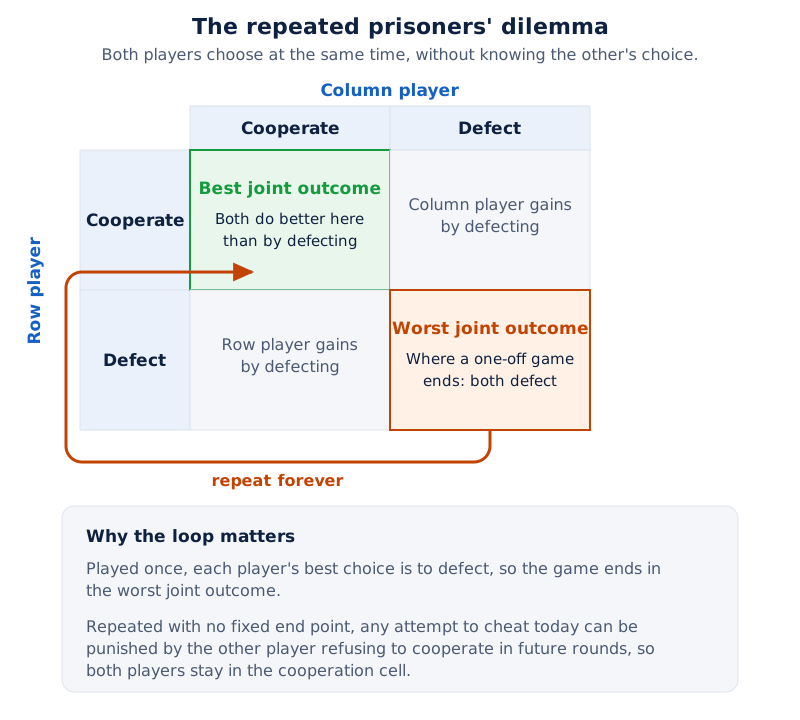
Draw a 2 by 2 payoff grid with "Cooperate" and "Defect" as the row player's choices and the same two options as the column player's choices.
Mark the mutual-cooperation cell as the best joint outcome and the mutual-defection cell as the worst joint outcome, then draw an arrow looping from the grid back to itself labelled "repeat forever" to show how the threat of future punishment keeps both players in the cooperation cell.
Drawn by One Young India.
Aumann, working with Michael Maschler, also extended this theory to situations of incomplete information, where one side knows something the other does not, such as a rival firm's true production costs or a country's real military strength.
He additionally introduced the idea of common knowledge, a formal way of describing what each party knows about what the other party knows, and a solution concept called correlated equilibrium, which is weaker than a Nash equilibrium and can explain why negotiating parties sometimes benefit from using an impartial mediator who gives each side different pieces of information.
How did the work develop?
| Year | Event |
|---|---|
| 1930 | Robert J. Aumann born in Frankfurt-on-the-Main, Germany. |
| 1921 | Thomas C. Schelling born in Oakland, California, USA. |
| 1955 | Aumann receives his PhD in mathematics from the Massachusetts Institute of Technology. |
| 1956 | Aumann moves to Jerusalem, Israel, and joins the mathematics faculty at the Hebrew University. |
| 1959 | Aumann publishes his foundational result on strong equilibria in infinitely repeated games. |
| 1960 | Schelling publishes The Strategy of Conflict, setting out game theory as a framework for conflict and cooperation. |
| 1965 to 1968 | Aumann, Michael Maschler and Richard Stearns research repeated games with incomplete information, inspired by arms-control negotiations during the Cold War. |
| 1971 | Schelling publishes his analysis of racial segregation arising from mild individual preferences. |
| 1978 | Schelling publishes Micromotives and Macrobehavior, exploring how individual choices combine into social patterns. |
| 2005 | Aumann and Schelling are jointly awarded the Prize in Economic Sciences, announced on 10 October 2005. |
| 2016 | Thomas Schelling dies in Bethesda, Maryland, USA. |
Why does this prize matter?
Game theory, as developed and applied by Aumann and Schelling, became what the presentation speech called "the dominant tool" used by economists, political scientists and sociologists whenever they study conflict and cooperation. Their ideas reach far beyond economics textbooks into practical questions of security, business strategy and everyday social life.
Schelling's analysis of strategic commitment has been used to explain why firms sometimes build larger, more expensive factories than seem efficient, because the commitment to high output discourages rivals from competing aggressively.
It has also been applied to understand why societies sometimes benefit from delegating decisions, such as handing control of interest rates to an independent central banker rather than an elected politician who might be tempted to change policy for short-term gain.
Aumann's theory of repeated games helps explain real-world patterns such as price wars and trade wars between firms or countries, and why some communities manage shared resources, like grasslands or irrigation systems, more successfully than others.
The presentation speech also pointed out a less comfortable implication: when firms sustain high, collusive prices through repeated interaction, this can be good for the firms but bad for consumers, since in that case conflict in the form of price competition would actually serve the public better than cooperation.
How does this connect to what you study?
If you study economics or mathematics at school, game theory links directly to topics on decision-making under uncertainty and market behaviour. Many syllabi touch on how firms compete or collude, which is exactly the kind of strategic interaction that Aumann and Schelling studied in depth.
The idea of a Nash equilibrium, where no player gains by changing strategy alone, underlies many classroom discussions of competition between a small number of firms, known as oligopoly, while Aumann's repeated-games approach helps explain why real firms sometimes keep prices high without any formal agreement between them, a pattern that competition regulators watch for closely.
Schelling's focal-point idea, where people coordinate their behaviour without communicating directly, is a useful everyday example of how shared expectations and social conventions guide behaviour. This is relevant to civics and sociology discussions of social norms and institutions, since the scientific background material notes that language itself has been explained by philosophers as a convention that emerged to help people coordinate, inspired by Schelling's analysis.
Students of history and political science will also find Schelling's Cold War context useful: his ideas about credible threats and deterrence were developed directly against the backdrop of the nuclear arms race between the United States and the Soviet Union, connecting economics to the study of twentieth-century international relations.
Quick facts for exams
The Sveriges Riksbank Prize in Economic Sciences in Memory of Alfred Nobel 2005 was awarded jointly to Robert J. Aumann and Thomas C. Schelling "for having enhanced our understanding of conflict and cooperation through game-theory analysis".
It was announced on 10 October 2005 by the Royal Swedish Academy of Sciences, and each laureate received an equal half-share of the prize money of 10,000,000 Swedish kronor.
Aumann, born in Germany, was based at the Hebrew University of Jerusalem in Israel and is known for his work on repeated games, common knowledge and correlated equilibrium.
Schelling, born in the United States, was based at the University of Maryland and is known for his work on strategic commitment, focal points and segregation models. Together their work made game theory a standard tool across the social sciences.
| Fact | Detail |
|---|---|
| Prize | Sveriges Riksbank Prize in Economic Sciences in Memory of Alfred Nobel 2005 |
| Laureates | Robert J. Aumann and Thomas C. Schelling |
| Countries of birth | Germany (Aumann); USA (Schelling) |
| Affiliation at award | Hebrew University of Jerusalem, Israel (Aumann); University of Maryland, USA (Schelling) |
| Share | One half each |
| Citation | "for having enhanced our understanding of conflict and cooperation through game-theory analysis" |
| Date announced | 10 October 2005 |
| Prize amount | 10,000,000 Swedish kronor |
Note: Source. The prize facts in this note are from the Nobel Prize's official site, nobelprize.org.
Glossary
- Game theory — the mathematical study of situations where the outcome for each participant depends on the choices of all participants.
- Nash equilibrium — a set of strategies, one per player, where no player can improve their outcome by changing strategy alone, given the others' strategies.
- Repeated game — a game where the same players interact with each other many times, often with no fixed end point.
- Infinitely repeated game — a repeated game that continues indefinitely, with no known final round.
- Prisoners' dilemma — a classic two-player game where each player's individually best choice leads to a worse outcome for both than if they had cooperated.
- Strategic commitment — deliberately limiting one's own future choices to make a threat or promise more credible.
- Focal point — an option that people tend to choose when coordinating without communication, because it stands out as natural or obvious.
- Common knowledge — a formal description of what all parties know, and know that the others know, about a situation.
- Correlated equilibrium — a solution concept, weaker than Nash equilibrium, where an outside signal or mediator can help coordinate players' strategies.
- Incomplete information — a situation in a game where at least one player does not fully know another player's preferences, costs or strength.
- Folk theorem — a result in repeated-game theory showing which payoff outcomes can be sustained as equilibria when a game is played indefinitely.
- Segregation model — Schelling's model showing how mild individual preferences for similar neighbours can produce strongly segregated neighbourhoods overall.
Common errors and misconceptions
- Misconception: Game theory only applies to literal games like chess or cards. Correct: The prize committee stressed that it applies to vital real-world issues such as security policy, price formation in markets and political negotiations.
- Misconception: Cooperation always needs a signed agreement or a central authority to enforce it. Correct: Aumann's repeated-games theory shows cooperation can arise purely from the threat of future punishment, with no outside enforcer.
- Misconception: Limiting your own options always weakens your bargaining position. Correct: Schelling showed that deliberately worsening or restricting your own alternatives can make your threats more credible and so strengthen your position.
- Misconception: Segregation always requires strongly prejudiced individuals to explain it. Correct: Schelling's model shows that even mild, tolerant individual preferences can produce strongly segregated outcomes at the group level.
- Misconception: A certain, immediate threat of retaliation is always the most effective deterrent. Correct: Schelling argued that uncertain, gradual retaliation can sometimes be more credible and less costly.
- Misconception: Aumann and Schelling developed identical methods. Correct: Aumann worked mainly through rigorous mathematical proof, while Schelling relied largely on verbal, conceptual reasoning with little formal mathematics.
Exam-style questions with model answers
Q1. In which year was the Sveriges Riksbank Prize in Economic Sciences awarded to Aumann and Schelling? [1 mark]
- The prize was awarded in 2005, announced on 10 October 2005.
Q2. State the official citation for the 2005 Prize in Economic Sciences. [2 marks]
- The citation reads: "for having enhanced our understanding of conflict and cooperation through game-theory analysis".
Q3. Explain, with an example, what Schelling meant by strategic commitment. [4 marks]
- Strategic commitment means deliberately reducing one's own future options to make a threat or promise believable to the other side. Schelling's example was a general who burns the bridges behind his troops, removing the option to retreat, which makes his resolve to fight credible to the enemy. The same logic applies to a firm investing in a large, expensive factory to commit to high output, discouraging rivals from competing aggressively, or a politician making a public promise that would be embarrassing to break. The key point is that an irreversible commitment changes how the other party expects you to behave, and so changes their own best strategy.
Q4. What did Robert Aumann contribute to the theory of repeated games? [4 marks]
- Aumann was the first to give a full, formal mathematical analysis of infinitely repeated games, where the same players interact with each other indefinitely. He showed precisely which cooperative outcomes could be sustained as stable equilibria over time, because any player who cheats today can be punished by the loss of future cooperation. This explained why cooperation is often easier in long-term relationships than in one-off encounters, and it helped explain real phenomena such as price wars, trade wars and the management of shared resources like pastures or irrigation systems.
Q5. Discuss how Aumann and Schelling's work changed the use of game theory in the social sciences. [6 marks]
- Before their work, game theory had strong mathematical foundations, built by von Neumann, Morgenstern, and later refined by the 1994 laureates Harsanyi, Nash and Selten, but it had not yet been widely applied to real social and political problems. Schelling, approaching the subject from economics against the backdrop of the Cold War arms race, showed that familiar social interactions, including bargaining, deterrence and coordination, could be understood as non-cooperative games mixing common and conflicting interests. His ideas on commitment, credible threats and focal points influenced thinking on arms control, firm strategy and even language and social conventions. Aumann, approaching the subject from mathematics, demonstrated that long-run social interaction could be rigorously analysed using repeated-game theory, showing exactly which cooperative outcomes are sustainable when players interact repeatedly. His later work on common knowledge and correlated equilibrium deepened understanding of how players' knowledge about each other's knowledge shapes strategic behaviour. Together, their contributions turned game theory into what the award ceremony speech called the dominant tool used by economists, political scientists and sociologists to analyse conflict and cooperation, moving it from abstract mathematics into practical application across the social sciences.
Q6. What is a Nash equilibrium, and how does it differ from a strong equilibrium as used by Aumann? [4 marks]
- A Nash equilibrium is a set of strategies, one for each player, such that no single player can improve their own outcome by changing strategy alone, given what the other players are doing. Aumann's concept of a strong equilibrium is stricter: it requires that no group, or coalition, of players can jointly change their strategies to make every member of that group better off. A Nash equilibrium only considers deviations by one player at a time, so every strong equilibrium is also a Nash equilibrium, but not every Nash equilibrium is strong.
Q7. Name the affiliations of Aumann and Schelling at the time of the 2005 award. [2 marks]
- Robert Aumann was affiliated with the Center for Rationality at the Hebrew University of Jerusalem, Israel, and Thomas Schelling was affiliated with the Department of Economics and School of Public Policy at the University of Maryland, USA.
Q8. Explain Schelling's model of segregation and what it shows about individual versus group behaviour. [5 marks]
- Schelling built a simple model in which every individual is assumed to be tolerant, meaning they are willing to live near people of a different culture, religion or race, but each person also wants at least a few neighbours who share their own characteristics. If this condition is not met, the person moves to a different neighbourhood. Schelling showed that even when these individual preferences are quite weak, repeated small moves by many individuals can combine to produce strongly segregated living patterns across the whole neighbourhood or city. The important lesson is that a troubling group-level outcome, strong segregation, does not require strong or extreme prejudice at the individual level; mild preferences, acted on by many people, are sufficient. This separated the explanation of segregation from the assumption that it must always stem from deliberate oppression or strong individual bias.
Key takeaways
- Aumann and Schelling shared the 2005 Prize in Economic Sciences for applying game theory to real conflict and cooperation.
- Schelling showed that limiting one's own options can make threats and promises more credible in bargaining.
- Schelling's work on focal points showed people can coordinate without communicating by picking the most natural shared choice.
- Schelling's segregation model showed mild individual preferences can still produce strong group-level segregation.
- Aumann gave the first rigorous analysis of infinitely repeated games, showing how cooperation can be sustained through the threat of future punishment.
- Aumann's work on common knowledge and correlated equilibrium deepened the understanding of how players' mutual knowledge shapes strategy.
- Their combined work made game theory the standard tool for studying conflict and cooperation across economics, political science and sociology.
- The theory of repeated games can explain both helpful outcomes, like managing shared resources, and harmful ones, like sustained price collusion against consumers.
Test yourself
Who were the two laureates of the 2005 Prize in Economic Sciences?
The two laureates were Robert J. Aumann and Thomas C. Schelling, who jointly shared the prize equally.
What field connects both laureates' work?
Both laureates used game theory, the study of strategic interaction, to explain real conflict and cooperation between people, firms and countries.
What book made Schelling's ideas widely known?
Schelling's 1960 book The Strategy of Conflict set out his vision of game theory as a framework for the social sciences.
What kind of game did Aumann analyse most rigorously?
Aumann gave the first full formal analysis of infinitely repeated games, where the same players interact with each other over an indefinite future.
What is a focal point in game theory?
A focal point is a choice that stands out as natural, helping people coordinate their behaviour even without communicating directly.
Where was Aumann affiliated at the time of the award?
Robert Aumann was affiliated with the Center for Rationality at the Hebrew University of Jerusalem in Israel.
What did the prize committee say about cooperation and the number of participants?
The committee said cooperation is more difficult when there are many participants, when interaction is infrequent, or when actions cannot be clearly observed.