
Pollution | ICSE Class 10 Biology Notes
On this page
Watch & explore
Start with a few high-quality watches, then dive into the notes below.
Try an idea before you read. Analyze how chemical runoff triggers aquatic degradation through eutrophication and biomagnification. Explore →
This note covers pollution and its sources, air, water, thermal, soil, biomedical, radiation and noise pollution, biodegradable and non-biodegradable wastes, biological magnification, the greenhouse effect, global warming, acid rain, ozone depletion, sewage treatment and measures to control pollution.
What is pollution, and how are its sources classified?
Definition: Pollution is an undesirable change in the environment caused by harmful substances or energy. A pollutant is a substance or form of energy that causes such contamination or harm.
The environment includes living organisms and their physical surroundings. Pollution can affect air, water and soil, as well as human health and other organisms. Waste substances are important, but excessive sound and heat also cause pollution.
Sources and receiving environments
A source is the activity or place from which pollution originates. A vehicle, for example, can release exhaust gases and produce unwanted sound. Therefore, one activity can contribute to more than one type of pollution.
| Type | Sources or examples | What to identify |
|---|---|---|
| Air pollution | Vehicles, industries, burning garbage and brick kilns | Harmful gases and suspended particles entering air |
| Water pollution | Household detergents, sewage, industrial waste and oil spills | Contamination of water by wastes |
| Thermal pollution | Hot water discharged from factories and thermal power plants | Heat entering a water body before the discharge is cooled |
| Soil pollution | Industrial, urban commercial and domestic wastes; chemical fertilisers | Polluting substances accumulating in land |
| Noise pollution | Motor vehicles, industries, construction sites and loudspeakers | Excessive or unwanted sound |
Biomedical waste is waste arising from medical activities, including used needles, syringes and soiled dressings. Radiation sources include X-rays and radioactive fallout from nuclear plants. These require attention to the nature of the hazard as well as the place affected.
Pollution also moves between environmental components. Rainwater can carry pollutants through soil into groundwater, the water beneath the ground. Chemicals used on fields can reach rivers and lakes. Studying the source, route and effect together explains why disposal at one place can affect another.
How does air pollution affect organisms and their surroundings?
Air pollution occurs when unwanted substances contaminate air in amounts and for durations that may harm organisms or property. Important sources include vehicular exhaust, industrial processes, burning garbage and smoke from brick kilns. Burning coal, petrol and diesel releases several pollutants.
Gases and particulate matter
Particulate matter consists of small solid or liquid particles suspended in air. Dust, smoke and mist are examples. Industrial activities and fuel combustion release these particles. Air pollution is therefore not limited to gases, and smoke is not its only visible form.
Carbon monoxide, written CO, is produced by incomplete combustion, meaning burning that does not fully oxidise the fuel. It reduces the oxygen-carrying capacity of blood. Carbon dioxide, written CO₂, has a different role: its increasing atmospheric concentration contributes to warming.
Other major pollutants include sulphur dioxide, written SO₂, and nitrogen dioxide, written NO₂. These gases are associated with acid rain. In each formula, the letters identify the elements and a subscript gives the number of atoms of that element in a molecule.
Air pollution can cause diseases affecting the respiratory, nervous and circulatory systems. It also affects plants, animals, buildings and the atmosphere. Smog is smoky fog over polluted cities and is harmful to human health.
Source examples
At a busy traffic intersection, many vehicles stop briefly throughout the day and release exhaust gases. Switching off engines at traffic signals helps control these emissions. Dry leaves should be converted into compost, a decomposed organic material used to improve soil, instead of being burnt.
The Bhopal gas tragedy illustrates the danger of toxic industrial gas leakage. It was associated with methyl isocyanate, a toxic industrial chemical. Industrial pollution includes both routine discharges and accidental releases, so controlling smoke alone does not address every hazard.
How do water pollution and thermal pollution differ?
Water pollution is deterioration of water quality through contamination. Household detergents, sewage, industrial wastes and oil spills are important sources. Sewage is municipal wastewater containing human excreta, organic matter, meaning carbon-containing waste material here, and microbes, microscopic organisms, many of which are disease-causing.
Effluent means wastewater flowing out of an industrial process or treatment system. Industries can discharge acids, dyes, salts, detergents and heavy metals such as lead and mercury. These substances differ from suspended dirt because dissolved pollutants may remain even when water appears clear.
How pollutants reach water
Run-off is water flowing over the land surface. It can wash agricultural chemicals into rivers, lakes and tanks. Pollutants can also enter soil and reach groundwater. This connects water pollution with fertiliser use, pesticide use and disposal of industrial waste on land.
A point source is an easily identified entry point, such as a municipal or industrial discharge pipe. A non-point source cannot be traced to one such easily identified entry point. Agricultural run-off and acid rain are examples.
Contaminated water can spread diseases, including diarrhoea and intestinal worm infections. Clear-looking water may contain harmful microorganisms and dissolved impurities. Potable water means water fit for drinking; appearance alone does not establish that it is potable.
Heat as a pollutant
Thermal pollution occurs when hot water from factories or thermal power plants enters rivers or ponds before cooling. Here the temperature change is the important feature. It should be distinguished from contamination by dyes, metals or sewage, even when the same establishment causes both.
Hot discharges should be cooled and industrial effluents treated before release. Reusing and recycling industrial water can reduce the amount required for processing. Treatment must address the type of discharge: removing suspended material does not, by itself, describe how excess heat is controlled.
Note: Water that looks clean is not necessarily safe to drink. Dissolved pollutants and disease-causing microbes may be present without obvious visible dirt.
Why do soil, biomedical and radiation pollution need attention?
Soil pollution results from contamination of land by harmful wastes and chemicals. Sources include industrial wastes, commercial refuse, domestic garbage and chemical fertilisers. Refuse means discarded material. Pesticides, chemicals used to control pests, can also pollute soil and water.
Movement through soil
Dumping glass, packaging, salts, industrial effluents and harmful chemicals degrades land. Rainwater passing through polluted soil can carry contaminants into groundwater. Thus, disposal on land may produce a water-pollution problem as well as a soil-pollution problem.
Urban solid wastes can produce unpleasant smells and harbour flies and rodents. These conditions create health hazards. Reducing waste, collecting it properly and treating suitable organic wastes as resources for composting help address the problem.
Biomedical waste
Used and discarded needles, syringes and soiled dressings are examples of biomedical waste. Their possible contamination makes safe handling important. Used sharp objects may cause injury, and contaminated medical waste may transmit infection. Such materials should not be handled as ordinary classroom waste.
Radiation pollution
Radiation is energy transmitted as waves or particles. X-rays and radioactive fallout from nuclear plants are relevant sources. Radioactive fallout means radioactive material deposited after its release into the environment.
X-rays and gamma rays can damage DNA, deoxyribonucleic acid, the hereditary material in cells. Such damage can lead to cancerous changes. Nuclear wastes are associated with cancers, birth defects and miscarriages. Radiation hazards therefore involve effects on living cells, not merely visible contamination.
Three Mile Island and Chernobyl are examples of disasters associated with accidental radioactive leakage. Biomedical waste and radioactive waste must not be treated as interchangeable categories: the former is identified by its medical origin, while the latter involves radioactivity.
How do biodegradable and non-biodegradable wastes differ?
Definition: Biodegradable substances can be broken down by biological processes. Non-biodegradable substances are not broken down by these processes and may persist in the environment for a long time.
Decomposers, including bacteria and fungi, break down dead remains and organic wastes into simpler substances. Their activity helps return materials to the environment. However, biological breakdown does not act equally on every material discarded by humans.
Enzymes are biological catalysts that help reactions occur. They are specific in their action. Many human-made materials, including plastics, are not broken down by the enzymes of decomposing organisms under ordinary environmental conditions.
| Feature | Biodegradable waste | Non-biodegradable waste |
|---|---|---|
| Biological breakdown | Can be broken down by biological processes | Is not broken down in this manner |
| Examples | Paper and vegetable peels | Plastics, glass and Styrofoam, a plastic foam |
| Fate in the environment | Can be decomposed into simpler substances | Can remain for long periods under ambient conditions |
| Possible environmental effect | Organic waste can increase oxygen demand in water | May remain inert or may harm organisms |
| Management emphasis | Separate suitable organic wastes for composting or treatment | Reduce generation and arrange suitable reuse, recycling or disposal |
Ambient conditions are the surrounding environmental conditions. Non-biodegradable does not mean that heat, pressure or other physical processes can never change a substance. The distinction concerns breakdown by biological processes.
The disposable-cup example
Disposable plastic cups create persistent waste. Clay cups, called kulhads, were suggested as alternatives, but their large-scale manufacture removes fertile topsoil. Paper cups illustrate another material choice. Comparing alternatives requires considering both disposal and the resources used to make them.
Biodegradable also does not mean harmless in every quantity or situation. Organic pollution can reduce dissolved oxygen in water. Waste segregation, meaning separation into categories, is therefore useful even when much of the waste can eventually decompose.
How do persistent pesticides become concentrated in food chains?
A food chain is a sequence of organisms feeding on one another. Each feeding step is a trophic level. Plants and certain other organisms make food; animals obtain it by feeding on plants or other animals.
Biological magnification, also called biomagnification, is the progressive increase in concentration of certain non-degradable harmful chemicals at successive trophic levels. It connects pollution of soil or water with contamination of food.
Route from the field to consumers
- Pesticides applied to protect crops can be washed into soil or nearby water bodies.
- Plants absorb some of these chemicals from soil along with water and minerals; aquatic organisms take them up from polluted water.
- Animals consume contaminated organisms, allowing persistent chemicals to enter and pass along the food chain.
- Because these chemicals are not degraded, their concentration increases progressively through successive trophic levels.
DDT stands for dichloro diphenyl trichloroethane, a pesticide. It is an example of a persistent chemical associated with biological magnification. Mercury is another substance that can show this increase in concentration through feeding relationships.
Pesticide residues are the amounts of pesticides remaining in food or the environment. Food grains such as wheat and rice, fruits, vegetables and meat can contain varying quantities. These residues cannot always be removed by washing or other means.
Diagram
Entry of persistent pesticides into a food chain
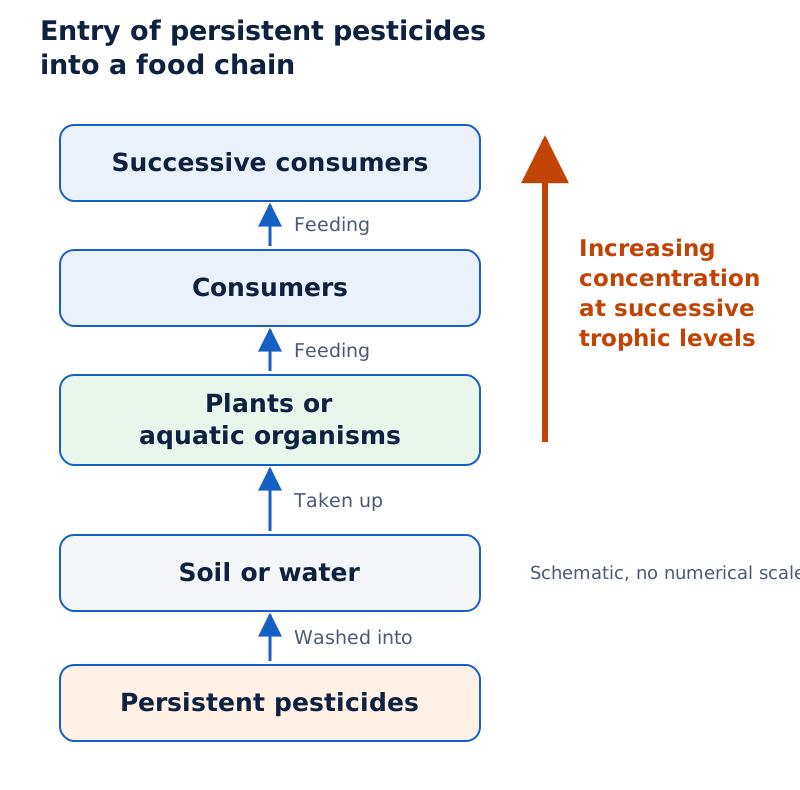
Draw labelled boxes for pesticides, soil or water, plants or aquatic organisms, and successive consumers. Join them with arrows showing transfer. Add a separate upward arrow labelled increasing concentration at successive trophic levels.
Drawn by One Young India.
The diagram represents a process, not a numerical prediction. Without measured concentrations, no exact concentration in a consumer can be calculated. The important relationship is persistence of the chemical and its transfer through feeding.
Reducing dependence on toxic pesticides addresses this route of pollution before chemicals reach food chains. Biological pest control uses living organisms or biological methods to keep pests under control.
How does noise pollution harm health, and how can it be reduced?
Noise is unpleasant sound. Noise pollution is the presence of excessive or unwanted sound in the environment. A sound normally enjoyed as music can become disturbing when it is too loud.
Major sources include motor vehicles, industrial establishments, construction sites and loudspeakers. Machinery, generators, drills, horns and explosions also contribute. In homes, televisions and music systems at high volume can add to the noise.
Effects on people
Excessive noise may cause lack of sleep, anxiety and hypertension, meaning high blood pressure. Continuous exposure to loud sound may cause temporary or even permanent hearing impairment. Hearing impairment means a reduced ability to hear.
Unwanted sound can also cause irritation and stress. These effects explain why noise is a health concern even though it leaves no pile of solid waste. The absence of smoke or rubbish does not make a noisy environment free from pollution.
Control at the source and along its path
- Install silencing devices in transport vehicles, industrial machinery and appropriate appliances.
- Minimise the use of automobile horns and keep television and music volumes low.
- Locate noisy industrial operations away from residential areas.
- Plant trees along roads and around buildings to reduce the sound reaching residents.
Trees and shrubs near boundary walls also act as dust catchers. Noise intensity declines as distance from the source increases. This supports separating residential areas from noisy activities, together with controlling noise where it originates.
The Air (Prevention and Control of Pollution) Act, 1981 was amended in 1987 to include noise among air pollutants. The inclusion recognises that environmental harm is not confined to chemical substances.
How are the greenhouse effect and global warming connected?
The greenhouse effect is warming associated with gases in the atmosphere absorbing heat and reducing its escape to space. Greenhouse gases include carbon dioxide, methane, nitrous oxide and water vapour. Methane is a gas produced, among other sources, during breakdown of animal waste.
Global warming is a gradual increase in the average temperature of the Earth's lower atmosphere associated with increasing greenhouse gases. The greenhouse effect describes heat retention; global warming describes the rise in average temperature.
Human activities and warming
Burning fossil fuels, fuels such as coal and petroleum formed from ancient organic matter, increases atmospheric carbon dioxide. Deforestation, the removal of forests, also increases atmospheric carbon dioxide. Much of the recent observed and projected warming is human-induced.
- Human activities, including fossil-fuel burning and deforestation, increase concentrations of greenhouse gases.
- These gases have the capacity to absorb heat within the atmosphere.
- Adding such gases, with no other changes, makes the Earth's surface warmer.
- Warming contributes to longer-term environmental changes, including melting polar ice and rising sea level.
Other longer-term consequences include coastal flooding, disruption of drinking-water supplies dependent on snowmelt, loss of species as their suitable living conditions disappear, more frequent tropical storms and increased incidence of tropical diseases.
Responses to warming
Reducing fossil-fuel use and protecting or increasing tree cover address important causes. At a United Nations climate conference in Kyoto, Japan, in 1997, an international agreement called for industrialised nations to reduce greenhouse-gas emissions.
Climate refers to long-term patterns of atmospheric conditions. Global warming concerns average temperature over time, so the concept is broader than whether one particular day feels hot. Pollution control needs attention to continuing emissions and their environmental effects.
Ozone depletion is a separate process. It concerns loss of protection against ultraviolet radiation, whereas enhanced heat retention is central to global warming. Keeping the two mechanisms distinct helps identify the correct pollutants and control measures.
How does acid rain form, and why does it damage buildings?
Acid rain is rainfall containing acids formed from atmospheric pollutants. Sulphur dioxide and nitrogen dioxide are major gases involved. They can be released during industrial activity and the burning of fuels.
From gaseous pollution to acidic rainfall
Sulphur dioxide and nitrogen dioxide react with water vapour in the atmosphere to form sulphuric acid and nitric acid respectively. Water vapour is water in its gaseous state. These acids make the rainfall harmful to affected materials.
The process links air and water pollution. The initial release is into air, but the pollutants take part in reactions involving atmospheric water. Therefore, the consequences are not restricted to the place where the smoke or gas was first released.
Diagram
Formation of acid rain
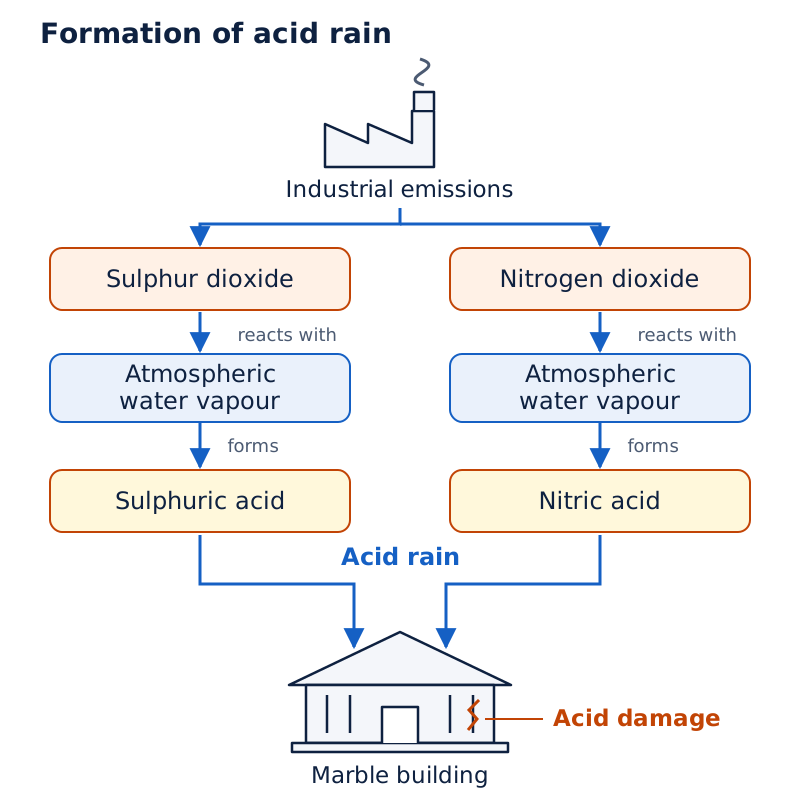
Draw industrial or vehicle emissions labelled sulphur dioxide and nitrogen dioxide. Add arrows to atmospheric water vapour, followed by sulphuric acid and nitric acid respectively. Draw downward rain arrows towards a marble building labelled acid damage.
Drawn by One Young India.
The Taj Mahal example
Air pollutants discolour the white marble of the Taj Mahal in Agra. Acid rain damages marble, a problem called marble cancer. The term describes damage to stone; it is not biological cancer in living tissue.
Industries in the Taj Mahal zone are advised to use cleaner fuels such as compressed natural gas and liquefied petroleum gas. Compressed natural gas, abbreviated CNG, and liquefied petroleum gas, abbreviated LPG, are fuel choices used to reduce pollution.
Controlling the responsible gases at their sources addresses the cause of acid rain. Merely cleaning a discoloured surface does not explain how further atmospheric contamination is prevented. For this reason, the example connects industrial fuel choice with conservation of buildings.
How does ozone protect life, and why does its depletion matter?
Ozone, written O₃, is a molecule containing three oxygen atoms. Ordinary molecular oxygen, O₂, contains two. Ozone is poisonous, but at higher atmospheric levels it performs an essential protective function.
The ozone layer absorbs harmful ultraviolet radiation from the Sun. Ultraviolet radiation, abbreviated UV, is radiation that can damage living organisms. Damage associated with UV exposure includes skin cancer in humans.
Formation and depletion
- High-energy ultraviolet radiation acts on oxygen molecules in the upper atmosphere.
- Some oxygen molecules split into separate oxygen atoms.
- These atoms combine with oxygen molecules to form ozone.
- The ozone absorbs harmful ultraviolet radiation, helping shield the Earth's surface.
Ozone depletion means a reduction in the amount of ozone in the stratosphere, the atmospheric region containing the protective ozone layer. A reduction allows more harmful ultraviolet radiation to reach the Earth.
Chlorofluorocarbons, abbreviated CFCs, are synthetic chemicals used as refrigerants, substances used for cooling, and in other applications. Their release has been linked to ozone depletion. CFC use in refrigerators and air conditioners is an important example.
Effects and international action
The amount of atmospheric ozone began to drop sharply in the 1980s. In 1987, the United Nations Environment Programme, abbreviated UNEP, helped secure an agreement to freeze CFC production at 1986 levels.
The Montreal Protocol addresses ozone-depleting substances. Controlling these substances protects the atmospheric shield against UV radiation. This is different from controlling carbon dioxide to reduce global warming, although both involve human changes to the atmosphere.
Ozone loss can also affect aquatic organisms by lowering the production of phytoplankton, microscopic photosynthetic organisms in water. Increased UV exposure can influence the growth of land plants. The protective layer therefore matters to ecosystems as well as human health.
An ecosystem comprises interacting organisms and the non-living environment around them. Changes affecting its producers can influence other organisms that depend on them, which explains the wider significance of atmospheric protection.
How do sewage treatment plants make wastewater less polluting?
Sewage treatment plants remove pollutants before wastewater is discharged into natural water bodies. Treatment combines physical removal of particles with biological breakdown of organic matter. Organic matter here includes waste substances that microbes can use and decompose.
Primary and secondary treatment
- Primary treatment removes floating debris by filtration and grit by sedimentation, the settling of particles under gravity. The settled solids form primary sludge.
- The remaining liquid, the primary effluent, enters an aeration tank. Air is pumped in and the liquid is mechanically stirred.
- Aerobic microbes, which grow using oxygen, consume much of the organic matter. They form flocs, mesh-like masses of bacteria associated with fungal filaments.
- The liquid passes into a settling tank. The flocs settle as activated sludge, and a small part is returned to the aeration tank to start further microbial growth.
- Most remaining sludge goes to anaerobic digesters, tanks where bacteria break it down without oxygen. The process produces biogas, a combustible mixture containing methane and other gases.
The treated effluent is generally released into rivers or streams. The purpose of the process is to make sewage less polluting. Treating sewage before release reduces the organic burden entering natural water bodies.
Diagram
Main stages of sewage treatment
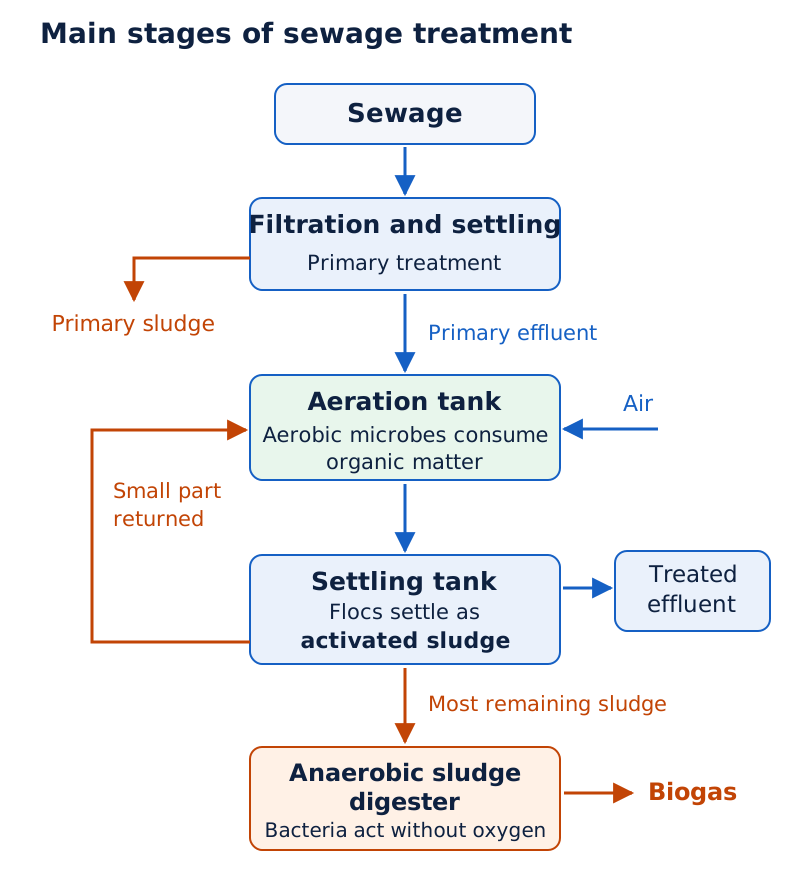
Draw arrows from sewage to filtration and settling, then to an aeration tank, and finally to a settling tank and treated effluent. Add a return arrow for some activated sludge and another arrow to an anaerobic sludge digester.
Drawn by One Young India.
Interpreting oxygen demand
Biochemical oxygen demand, abbreviated BOD, is the amount of oxygen bacteria would consume in oxidising organic matter in a water sample. Higher BOD indicates more organic matter and greater polluting potential. Treatment reduces BOD by removing much of this organic material.
Worked example 1. Samples A, B and C have BOD values of 20, 8 and 400 mg/L respectively. Here mg/L means milligrams per litre. They represent secondary treated effluent, relatively clean river water and untreated sewage, in an unknown order. Identify them.
Answer: C is untreated sewage because it has the highest BOD. B is the relatively clean river water because it has the lowest BOD. A is secondary treated effluent. The assignment uses the stated assumption that the river water is relatively clean.
The Ganga Action Plan and Yamuna Action Plan include proposals for sewage treatment plants so that treated sewage, rather than untreated sewage, enters these rivers.
Which measures can individuals, communities and industries use to control pollution?
Effective control addresses waste generation, release and treatment. A measure should match the pollutant involved: reducing traffic emissions, treating sewage and limiting loudspeakers each address different sources. Combining measures is necessary where several kinds of pollution occur together.
Transport and industrial measures
Use unleaded petrol, petrol without added lead, or CNG in automobiles, and switch off engines at traffic signals. CNG use in Delhi's public transport provides an example of a change in fuel that lowered air pollution.
Euro and Bharat vehicular emission standards set limits on pollutants released by vehicles. Their purpose is to control vehicular emissions. Cleaner fuels, emission controls and reduced unnecessary engine running work together; adopting one measure does not remove the need for others.
Industries should treat effluents and cool hot wastewater before discharge. Devices such as filters and electrostatic precipitators, which remove suspended particles from exhaust, reduce particulate pollution. Industrial noise should also be controlled at its source.
Forestry, waste reduction and farming
Social forestry involves managing and protecting forests and planting trees on barren land to support environmental, social and rural development. Trees and shrubs help control pollution by catching dust and reducing sound reaching buildings.
Bans on polythene and plastics address persistent waste. Carrying cloth shopping bags reduces reliance on disposable bags. Separate biodegradable waste for suitable treatment, and convert garden wastes into compost rather than burning them.
Organic farming reduces dependence on chemical fertilisers and pesticides by using biological approaches. Biofertilisers are organisms that enrich soil nutrients. Biological pest control uses feeding relationships and useful organisms to keep pests at manageable levels.
Ladybird beetles help control aphids, small plant-feeding insects. Organic farming aims to maintain useful relationships among organisms, rather than eradicate every organism described as a pest. This approach reduces reliance on toxic chemicals.
Community action and source examples
Swachh Bharat Abhiyan is a national campaign for Clean India. Cleanliness efforts connect waste collection and proper disposal with public participation. Preventing careless disposal is part of reducing the pollution burden around homes and public places.
In Daurala near Meerut, groundwater contaminated by untreated industrial wastewater drew attention in 2003. Community members, a non-governmental organisation and industries worked towards solutions. The water-supply pipeline was extended by 900 metres, the village pond was desilted, rainwater-harvesting structures were built and 1,000 trees were planted.
Other legal milestones include the Water Act, 1974 and Environment Protection Act, 1986. Together with the Air Act and its noise-related amendment, these illustrate the recognition of pollution control as a public responsibility.
Glossary
- Pollutant — A substance or form of energy that causes environmental contamination or harm.
- Particulate matter — Small solid or liquid particles suspended in air, including dust, smoke and mist.
- Sewage — Municipal wastewater containing human excreta, organic matter and microbes, many of which are pathogenic.
- Effluent — Wastewater flowing out of an industrial process or a treatment system.
- Thermal pollution — Pollution caused when hot water from factories or thermal plants enters water bodies before cooling.
- Biodegradable waste — Waste that can be broken down into simpler substances through biological processes.
- Non-biodegradable waste — Waste not broken down by biological processes, which may persist for long periods.
- Biological magnification — Progressive increase in the concentration of certain persistent harmful chemicals at successive trophic levels.
- Trophic level — A feeding step occupied by organisms within a food chain.
- Greenhouse effect — Atmospheric warming associated with gases absorbing heat and reducing its escape into space.
- Global warming — Gradual increase in the average temperature of the Earth's lower atmosphere associated with increasing greenhouse gases.
- Acid rain — Rain containing acids formed through reactions involving atmospheric pollutants such as sulphur dioxide and nitrogen dioxide.
- Ozone depletion — Reduction in stratospheric ozone, weakening protection against harmful ultraviolet radiation from the Sun.
- Biochemical oxygen demand — Oxygen that bacteria would consume while oxidising the organic matter in a water sample.
- Social forestry — Forest management, protection and planting on barren lands to support environmental, social and rural development.
Common errors and misconceptions
- Misconception: Pollution consists only of harmful chemicals. Correct: Excess heat and unwanted sound also cause pollution.
- Misconception: Clear water must be potable. Correct: It may contain disease-causing microbes and dissolved impurities.
- Misconception: Biodegradable waste cannot harm the environment. Correct: Organic waste can raise oxygen demand and reduce dissolved oxygen in water.
- Misconception: Every non-biodegradable substance poisons organisms in the same way. Correct: Such substances may remain inert or may harm organisms.
- Misconception: Washing always removes pesticide residues. Correct: Residues cannot always be removed by washing or other means.
- Misconception: Ozone depletion and global warming are the same process. Correct: One reduces protection against UV radiation; the other involves rising average temperature associated with greenhouse gases.
- Misconception: High BOD means clean water because much oxygen is available. Correct: BOD measures oxygen demand; a higher value indicates greater organic polluting potential.
- Misconception: Noise causes discomfort but cannot harm hearing. Correct: Continuous exposure to loud sound may cause temporary or permanent hearing impairment.
Exam-style questions with model answers
Q1. Biological processes break down vegetable peels, but do not break down glass. Classify each waste and explain your classification. [2 marks]
- Vegetable peels are biodegradable because biological processes can break them down into simpler substances.
- Glass is non-biodegradable because it is not broken down by those biological processes.
Q2. At a traffic signal, vehicles release carbon monoxide from incomplete fuel burning. Carbon monoxide reduces the oxygen-carrying capacity of blood. Identify the source, explain the health effect and suggest an action during the stop. [3 marks]
- The source is vehicular exhaust at the traffic signal. Incomplete burning of fuel produces carbon monoxide, which then enters the surrounding air.
- Carbon monoxide reduces the capacity of blood to carry oxygen. Its harmful effect therefore involves oxygen transport within the body.
- Switching off engines while waiting at the traffic signal reduces unnecessary exhaust release during the stop and helps control pollution at its source.
Q3. Sulphur dioxide and nitrogen dioxide react with atmospheric water vapour to form sulphuric acid and nitric acid respectively. Acid rain damages marble, including that of the Taj Mahal. Explain the sequence in four points. [4 marks]
- The process begins with air pollution by sulphur dioxide and nitrogen dioxide. These gases provide the starting pollutants for the reactions described.
- Sulphur dioxide reacts with atmospheric water vapour to form sulphuric acid, contributing an acidic substance to atmospheric water.
- Nitrogen dioxide reacts with atmospheric water vapour to form nitric acid. This supplies another acid involved in acid rain.
- Rain containing these acids damages marble, including the Taj Mahal's marble. This deterioration of the stone is known as marble cancer.
Q4. Persistent pesticides are washed from fields into soil and water, enter plants and aquatic organisms, and pass to successive consumers. Their concentrations increase at successive trophic levels, and washing cannot always remove food residues. Explain the process and its significance in five points. [5 marks]
- The process is biological magnification, meaning an increase in the concentration of certain persistent harmful chemicals at successive feeding levels in a food chain.
- The first route of entry is the washing of pesticides from fields into soil and water, connecting agricultural chemical use with environmental contamination.
- Plants and aquatic organisms take up these chemicals. This brings the pollutants into living organisms that may become food for other organisms.
- Consumers obtain the chemicals by feeding on contaminated organisms. Because the chemicals persist, their concentration increases progressively through the successive trophic levels described.
- Contaminated food may retain pesticide residues even after washing. Control must therefore address entry of pesticides into the environment, rather than depend entirely on cleaning food.
Q5. Three samples have biochemical oxygen demand values of A: 20 mg/L, B: 8 mg/L and C: 400 mg/L. The unit means milligrams per litre. Higher values indicate greater organic polluting potential. The samples are relatively clean river water, secondary treated effluent and untreated sewage. Identify each sample using this ordering. [3 marks]
- C is untreated sewage. Its value of 400 mg/L is the highest of the three, indicating the greatest organic polluting potential.
- B is the relatively clean river water. Its value of 8 mg/L is the lowest, matching the stated assumption about the river.
- A is secondary treated effluent. Its intermediate value of 20 mg/L places it below untreated sewage but above the relatively clean river water.
Q6. Sewage passes through filtration and sedimentation, aeration with microbial growth, settling of flocs, return of some activated sludge and anaerobic digestion of most remaining sludge. Explain these five stages. Flocs are masses of bacteria associated with fungal filaments. [5 marks]
- Filtration removes floating debris and sedimentation removes settling particles. Together, these physical operations form primary treatment and produce primary sludge and liquid effluent.
- Air is pumped into the primary effluent in an aeration tank. Aerobic microbes grow and consume much of the organic matter, reducing biochemical oxygen demand.
- The liquid then enters a settling tank where the microbial flocs settle. This settled microbial material forms the activated sludge.
- A small portion of the activated sludge is returned to the aeration tank. It supplies microbes that start further growth and treatment of incoming effluent.
- Most remaining sludge enters anaerobic digesters, where bacteria act without oxygen. Their activity breaks down sludge and produces a combustible gas mixture called biogas.
Q7. Ozone absorbs harmful ultraviolet radiation. CFCs are linked with ozone depletion. Atmospheric ozone began dropping sharply in the 1980s, and a 1987 UNEP-supported agreement froze CFC production at 1986 levels. Explain the protection, problem and response in three points. [3 marks]
- Ozone in the upper atmosphere absorbs harmful ultraviolet radiation from the Sun. This shields the Earth's surface and helps protect living organisms from radiation damage.
- CFCs are linked with depletion of that protective ozone. The sharp decline beginning in the 1980s therefore represented a weakening of atmospheric protection.
- The agreement supported by the United Nations Environment Programme in 1987 froze CFC production at 1986 levels, addressing chemicals linked with ozone depletion.
Q8. Continuous loud sound may impair hearing, and trees can reduce sound reaching residents. State one possible health effect and one planting measure for a noisy road beside homes. [2 marks]
- Continuous exposure may cause temporary or even permanent hearing impairment, meaning a reduced ability to hear.
- Plant trees along the road and around buildings to reduce sound reaching the residents.
Key takeaways
- Identify pollution by its source, the substance or energy involved, and the environment or organisms affected.
- Biodegradable wastes can decompose biologically, but large organic discharges can still increase oxygen demand in water.
- Persistent pesticides can enter food chains and become progressively concentrated at successive trophic levels.
- Global warming involves increasing average temperature, while ozone depletion weakens protection against harmful ultraviolet radiation.
- Sulphur dioxide and nitrogen dioxide contribute to acid rain, which can damage marble buildings such as the Taj Mahal.
- Sewage treatment combines physical separation with microbial activity to reduce the organic polluting burden before discharge.
- Noise pollution may affect sleep, blood pressure and hearing; control should reduce unwanted sound at its sources.
- Cleaner transport, social forestry, waste segregation, organic farming and community participation address different but connected pollution problems.
Test yourself
Why can one industry cause more than one type of pollution?
It may release gases into air, discharge polluted or hot water, dump solid wastes and produce unwanted noise.
What makes thermal pollution different from chemical contamination of water?
Thermal pollution involves hot water entering a water body before cooling, rather than identifying a particular contaminating chemical.
Give two biodegradable and two non-biodegradable waste examples.
Paper and vegetable peels are biodegradable; plastics and glass are non-biodegradable examples.
Why does high biochemical oxygen demand indicate pollution?
It indicates that bacteria require more oxygen to oxidise the organic matter, reflecting greater organic polluting potential.
How can noise affect hearing?
Continuous exposure to loud sound may cause temporary or even permanent hearing impairment.
What does social forestry mean?
It means managing and protecting forests and planting on barren land for environmental, social and rural development.
Why are microbes useful in sewage treatment?
They consume much of the organic matter in sewage, lowering its biochemical oxygen demand and polluting potential.
What is Swachh Bharat Abhiyan?
It is a national campaign for Clean India, connecting cleanliness with public participation.
Try it
ICSE Class 10 Biology: A Deep Dive into Pollution and Its Environmental Impact
Analyze how chemical runoff triggers aquatic degradation through eutrophication and biomagnification.
1Runoff containing agricultural fertilizers rich in nitrates and phosphates has washed into a freshwater lake, causing a massive algal bloom. Shortly after the bloom dies off, testing reveals a high Biological Oxygen Demand (BOD) and widespread fish deaths. What directly caused this lethal drop in dissolved oxygen?
According to the text, when algae die following an algal bloom, aerobic bacteria multiply rapidly to decompose them. This process consumes almost all the dissolved oxygen in the water, resulting in a high Biological Oxygen Demand (BOD) and causing fish to die.
The text explains that the algal bloom blocks sunlight at the surface, but oxygen starvation occurs after the algae die, when decomposing aerobic bacteria consume the dissolved oxygen.
Binding to hemoglobin 200 times faster than oxygen describes how carbon monoxide (CO) causes chemical suffocation in the bloodstream during air pollution, not how fertilizers deplete oxygen in a lake.
2Biologists sampling the same lake ecosystem find that non-biodegradable DDT concentrations rise from 0.04 ppm in microscopic plankton to 25 ppm in predatory birds of prey, causing fragile eggshells. Why does the toxin concentrate so heavily at the top of the food chain?
The text explains that unlike energy, non-biodegradable toxins like DDT cannot be excreted and are stored in fat tissues. As small fish consume thousands of plankton and large fish eat hundreds of small fish, the toxin concentration amplifies over 600x by the time it reaches top predators like birds of prey.
Stratospheric UV radiation breaking molecules down into reactive chlorine atoms refers to Chlorofluorocarbons (CFCs) during ozone depletion, not the movement of DDT through the food web.
The text notes that energy decreases by 90 percent at each trophic level, whereas non-biodegradable toxins remain stored in fat tissues and accumulate upward through feeding relationships.
Water pollution alters aquatic ecosystems through two distinct systemic mechanisms: nutrient overload fuels eutrophication, leading to bacterial oxygen starvation (high BOD), while persistent non-biodegradable toxins magnify up the food chain to inflict severe harm on apex predators.