
The Living World | ISC Class 11 Biology Notes
On this page

This note covers the need for classification, taxonomy and systematics, the species concept, taxonomic hierarchy, classification of man, housefly, mango and wheat, binomial nomenclature, artificial, natural and phylogenetic systems, and numerical taxonomy, cytotaxonomy and chemotaxonomy.
Why do living organisms need classification?
Biology is the study of life forms and living processes. Living organisms differ in size, colour, structure and habitat, meaning the place where an organism lives. This variety makes studying organisms individually without an organised arrangement difficult.
Biodiversity refers to the number and types of organisms present on Earth. Familiar plants and animals represent only part of this diversity. Organisms that cannot be seen with the naked eye also occur around us, and new organisms continue to be identified.
How does grouping make study manageable?
Classification means placing organisms into convenient groups using their characteristics. A character is an observable or studied feature used in comparison. Grouping allows organisms with shared features to be considered together while retaining distinctions between different groups.
Words such as plants, animals, mammals and insects already suggest groups. Mammals have features such as body hair and external ears. Insects share three pairs of jointed legs. These shared features help us recognise and compare the groups.
The groups are not all equally broad. Mammals belong within animals, while dogs belong within mammals. A useful classification therefore needs several levels, rather than a single list in which every group has the same status.
What is the value of an organised classification?
Classification makes the study of the kinds and diversity of organisms manageable. It provides a framework for recognising similarities and differences, attaching names to identified organisms, and examining relationships. The arrangement becomes more informative as more relevant characters are considered.
Studies of identification, naming and classification also help us understand bio-resources, the living resources available to us, and their diversity. Such studies are useful in agriculture, forestry and industry. Correct recognition matters because knowledge about one organism must be attached to the appropriate organism.
How do taxonomy and systematics organise biological knowledge?
Definition: Taxonomy is the branch of biological study concerned with characterisation, identification, classification and nomenclature of organisms.
Characterisation means describing an organism's features. Identification establishes what organism is being studied by recognising its characteristics. Nomenclature is the standardised naming of organisms. Classification arranges the identified organisms into groups using shared features and differences.
These activities are connected. A name must refer to a correctly described organism, and placement in a group requires knowledge of its characters. Learning a name without knowing what it describes does not complete the task of identification.
What information supports modern taxonomy?
Modern taxonomic studies consider external and internal structure, cell structure, developmental processes and ecological information. A cell is the basic structural and functional unit of an organism. Ecological information concerns organisms in relation to their environment.
The evidence is therefore broader than outward appearance alone. Comparing organisms involves recognising both similarities within a kind and differences from other kinds. The earliest classifications, by contrast, were based on human uses of organisms for food, clothing and shelter.
How is systematics related to taxonomy?
Systematics studies organismal diversity and relationships, including evolutionary relationships. Evolutionary relationships concern connections through descent over time. The word comes from the Latin systema, meaning a systematic arrangement of organisms. Linnaeus used Systema Naturae as a publication title.
Systematics includes identification, nomenclature and classification, while taking evolutionary relationships into account. It therefore connects the recognition and arrangement of organisms with questions about how they are related. Taxonomy and systematics overlap rather than being wholly separate activities.
- Characterise the organism by recording relevant features of its structure and other available biological information.
- Identify the organism by using its description and comparing similarities and differences with known organisms.
- Classify it by placing it in appropriate groups on the basis of its characteristics.
- Apply standardised nomenclature so that the scientific name refers to the correctly identified organism.
Why are scientific names useful, and how are they written?
Local names can change between places, even within a country. A scientific name provides a standard name that biologists in different places can use for the same organism. This reduces confusion when information about an organism is exchanged.
A species is a group of individual organisms with fundamental similarities. A genus is a group of related species.
Binomial nomenclature is the system of giving a scientific name in two components. The first is the generic name, identifying the genus. The second is the specific epithet, identifying the species within that genus.
In mango, Mangifera indica, Mangifera is the generic name and indica is the specific epithet. The complete species name needs both components, rather than the epithet alone.
Which rules should be followed?
- Use the generic name first and the specific epithet second. This two-component naming system was given by Carolus Linnaeus.
- Biological names are generally in Latin. Names derived from other origins are Latinised, meaning given a Latin form.
- Begin the generic name with a capital letter and the specific epithet with a small letter.
- Print both components in italics. When writing by hand, underline the two words separately to indicate their Latin origin.
- Where the author's name is supplied, place its abbreviated form after the specific epithet, as in Mangifera indica Linn.
In this example, Linn. is the abbreviation indicating that Linnaeus first described the species. It follows the two-part name; it does not replace either the generic name or the specific epithet.
What advantages follow from standardisation?
The same standardised name can be used across regions and languages. A correct description enables people in different places to arrive at the same name. The naming rules also aim to prevent the same name from being used for another known organism.
Note: In Homo sapiens, Homo begins with a capital letter and sapiens begins with a small letter. The epithet alone is not the complete binomial name.
What does the species concept mean in classification?
The species is the lowest of the main taxonomic categories considered here. Organisms assigned to a species have fundamental similarities. Distinct morphological differences help distinguish that species from closely related species. Morphology means the study of form and structure.
For example, mango is Mangifera indica, potato is Solanum tuberosum, and lion is Panthera leo. Their first words identify their genera, the plural of genus. Their second words are specific epithets: indica, tuberosum and leo, respectively.
How can different species share a genus?
A genus may include one or more species. Potato and brinjal are different species in Solanum. Lion, leopard and tiger are different species in Panthera. Sharing a genus expresses their close relationship without making them a single species.
The names Panthera leo, Panthera pardus and Panthera tigris therefore share a generic name but have different specific epithets. This shows how a binomial simultaneously gives a broader grouping and distinguishes a species within it.
Why must the two components be kept together?
Human beings have the scientific name Homo sapiens. Homo identifies the genus, and sapiens is the specific epithet. Calling the epithet the entire scientific name would omit the generic component required by binomial nomenclature.
Keep three ideas distinct: the organism being identified, the rank called species, and the two-part name used for that species. A rank tells us the level of classification; the name tells us which organism or group is being discussed.
Recognising a species also requires comparison. Fundamental similarities within a species must be considered alongside differences from closely related species. Merely noting that two organisms share a broad feature does not, by itself, place them in the same species.
How is the taxonomic hierarchy arranged?
A taxonomic category is a rank in classification. A taxon, plural taxa, is a unit of classification at a particular rank. The ordered arrangement of categories is the taxonomic hierarchy. Classification therefore involves several levels rather than one grouping step.
The main categories, from lower to higher, are species, genus, family, order, class, phylum or division, and kingdom. Division is used for plants at the level corresponding to phylum in animals. Each successive category brings related lower groups together.
| Category | Meaning in the hierarchy | Example |
|---|---|---|
| Species | Individuals with fundamental similarities | Homo sapiens |
| Genus | A group of closely related species | Homo |
| Family | A group of related genera | Hominidae |
| Order | Related families sharing some characters | Primata |
| Class | A group of related orders | Mammalia |
| Phylum | A grouping of classes sharing common features | Chordata |
| Kingdom | The highest of these broad categories | Animalia |
What changes when we move upwards?
As we move from species towards kingdom, the number of common characteristics decreases. Members within a lower taxon share more characteristics. Higher categories are broader, so determining relationships between taxa at the same high level becomes more difficult.
What the figure shows
Taxonomic hierarchy
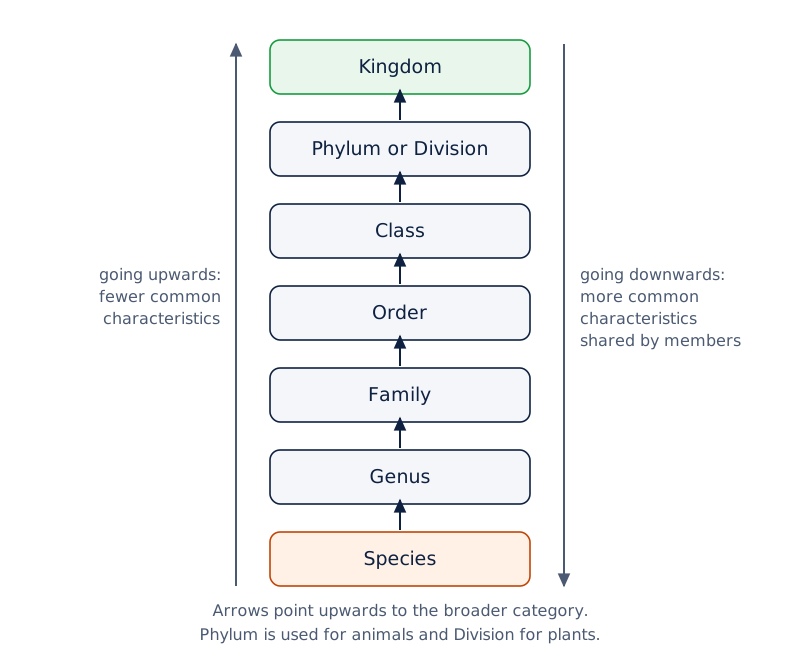
A vertical sequence has Species at the bottom, followed upwards by Genus, Family, Order, Class, Phylum or Division, and Kingdom at the top. Arrows point upwards between successive categories.
Drawn by One Young India.
The upward arrows indicate ascending rank. They do not mean that a species changes into a genus during its lifetime. The same organism occupies a place at each level of the classification, from its species to the broader categories containing it.
These are broad categories. Additional subcategories can be used for more precise placement. Learning the main sequence gives the framework within which such finer divisions can be understood, without confusing a group's name with its rank.
How do genus, family and order differ?
A genus contains related species with more characters in common than species belonging to other genera. Potato and brinjal belong to Solanum. Lion, leopard and tiger belong to Panthera, which differs from Felis, the genus including cats.
A family groups related genera. Compared with genus and species, its members have fewer similarities. Plant families are characterised using both vegetative features, concerning growth structures, and reproductive features, concerning the production of new individuals.
Which examples connect these categories?
Solanum, Petunia and Datura belong to the plant family Solanaceae. In animals, Panthera and Felis belong to Felidae. Cats and dogs are placed in different families, Felidae and Canidae respectively, despite having some similarities.
An order groups families that exhibit a few similar characters. The shared characters are fewer than those used to connect genera within a family. Generally, orders and other higher categories are identified using aggregates of characters, meaning combinations of features.
The animal order Carnivora includes Felidae and Canidae. The plant families Convolvulaceae and Solanaceae belong to Polymoniales, mainly on floral characters, meaning features of flowers. Retain the distinction between a genus, its family and the order containing that family.
Diagram
Related animal groups
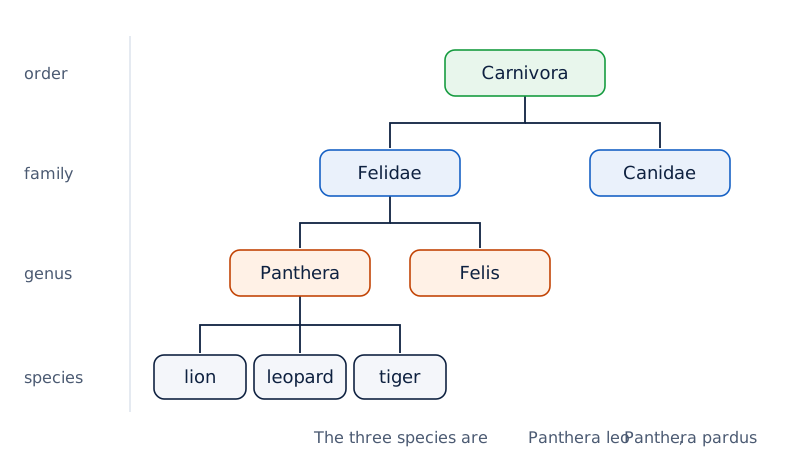
Write Carnivora above Felidae and Canidae, joining each family to the order. Below Felidae, join the genera Panthera and Felis. Below Panthera, add lion, leopard and tiger. Label the levels order, family and genus.
Drawn by One Young India.
This arrangement explains why sharing an order does not necessarily mean sharing a family. Cats and dogs are in Carnivora but belong to separate families. Similarly, two organisms can share Felidae while belonging to different genera within that family.
When comparing relationships, use the most specific shared category available. A broad shared category records a relationship, but the hierarchy also preserves differences within that group. Moving downwards reveals the narrower groupings concealed by the broader name.
How do class, phylum, division and kingdom relate?
A class brings related orders together. Mammalia includes Primata, containing animals such as monkeys, gorillas and gibbons, and Carnivora, containing animals such as tigers, cats and dogs. Mammalia includes other orders as well; these examples are not an exhaustive list.
A phylum groups classes sharing common features. Fishes, amphibians, reptiles, birds and mammals are included in Chordata on features such as a notochord and a dorsal hollow neural system. Here, dorsal means towards the back.
Which shared structures are relevant?
A notochord is a rod-like supporting structure, while a neural system is a nervous system. These terms describe structural features used in recognising the broad group Chordata. The phylum includes several classes rather than being another name for Mammalia.
For plants, classes with a few similar characters are assigned to a division. Thus the hierarchy uses phylum or division at the corresponding level above class. In the examples considered here, mango and wheat both belong to Angiospermae.
What is the role of kingdom?
A kingdom is the highest of these main categories. Animalia groups animals from different phyla, while Plantae groups plants from different divisions. These broad names do not replace the lower categories that distinguish groups within them.
Human beings and houseflies both belong to the animal kingdom but differ at phylum and class levels. Mango and wheat share a plant division but belong to different classes. These comparisons show why several ranks are necessary to express relationships accurately.
The hierarchy should be read as an arrangement of nested groups. An organism is not placed in just one category. Its species belongs within a genus, that genus within a family, and so on through the progressively broader levels.
How are man, housefly, mango and wheat classified?
The classification of these four organisms links names to ranks. Read each row as one organism's placement across the hierarchy. Read a column to compare the same rank between organisms. A biological name is the complete two-component scientific name.
| Common name | Biological name | Genus | Family | Order | Class | Phylum/Division |
|---|---|---|---|---|---|---|
| Man | Homo sapiens | Homo | Hominidae | Primata | Mammalia | Chordata |
| Housefly | Musca domestica | Musca | Muscidae | Diptera | Insecta | Arthropoda |
| Mango | Mangifera indica | Mangifera | Anacardiaceae | Sapindales | Dicotyledonae | Angiospermae |
| Wheat | Triticum aestivum | Triticum | Poaceae | Poales | Monocotyledonae | Angiospermae |
What does comparing the rows reveal?
Man and housefly belong to different genera, families, orders, classes and phyla. Human beings are in Mammalia and Chordata, while houseflies are in Insecta and Arthropoda. The distinction between a class and a phylum must remain clear.
Mango and wheat share Angiospermae but belong to different classes: Dicotyledonae and Monocotyledonae respectively. They also differ in order, family and genus. Sharing a division therefore does not imply that the two plants share all the categories below it.
The first word in each biological name matches the genus column. The complete name, however, includes the specific epithet as well. For wheat, Triticum is the genus and aestivum the epithet; together they form Triticum aestivum.
Diagram
Parallel plant classifications
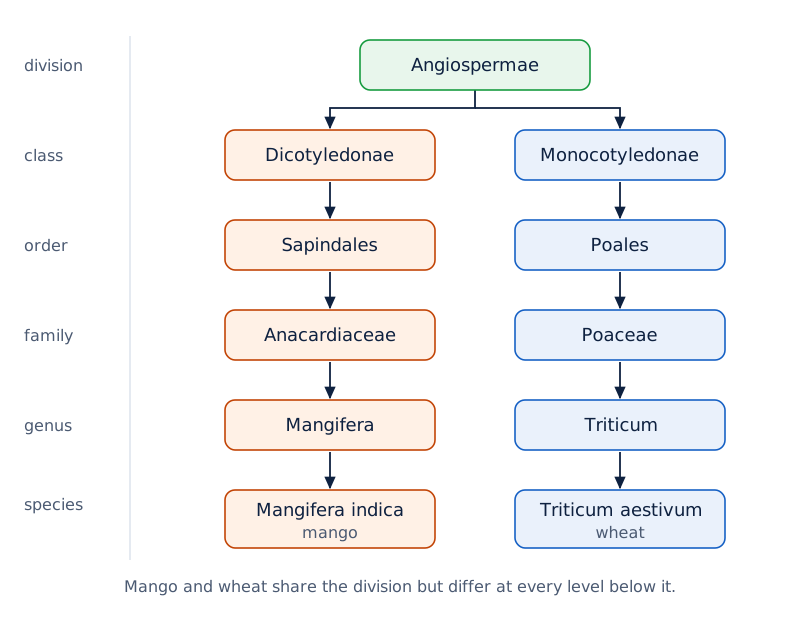
Place Angiospermae above two branches. On one branch write Dicotyledonae, Sapindales, Anacardiaceae, Mangifera, and Mangifera indica. On the other write Monocotyledonae, Poales, Poaceae, Triticum, and Triticum aestivum. Label each successive level class, order, family, genus and species.
Drawn by One Young India.
Use the rank labels to interpret the unfamiliar names. Hominidae, Muscidae, Anacardiaceae and Poaceae are family names in this table. Primata, Diptera, Sapindales and Poales are orders. Keeping each name attached to its rank prevents incorrect sequences.
How do artificial, natural and phylogenetic systems differ?
An artificial classification uses a few selected characteristics. Early plant systems used gross, superficial morphological features such as habit, meaning general growth form, colour, and leaf number or shape. They relied mainly on vegetative features or on the structure of the androecium.
The androecium is the male reproductive part of a flower. Linnaeus used its structure in classification. Artificial systems separated closely related species because their groupings depended on too few characteristics to represent relationships adequately.
Why did natural classification develop?
Artificial systems also gave equal weight to vegetative and sexual characteristics. This is problematic because often vegetative characters are more easily affected by the environment. Equal weighting of a few such features can therefore produce an unsatisfactory arrangement.
Natural classification considers natural affinities, meaning similarities and relationships among organisms, using external and internal features. Evidence includes ultrastructure, anatomy, embryology and phytochemistry. Ultrastructure means fine structural detail; anatomy concerns internal structure; embryology concerns embryo development; phytochemistry concerns plant chemicals.
George Bentham and Joseph Dalton Hooker developed a natural classification for flowering plants. Considering several kinds of evidence gives a broader basis for grouping than reliance on a few superficial features.
What is the basis of phylogenetic classification?
Phylogenetic classification is based on evolutionary relationships. It assumes that organisms belonging to the same taxa have a common ancestor. A common ancestor is an ancestral organism from which related organisms have descended.
| Comparison | Artificial | Natural | Phylogenetic |
|---|---|---|---|
| Main basis | A few selected characters | Natural affinities | Evolutionary relationships |
| Features emphasised | Superficial morphology or selected reproductive features | External and internal features | Evidence of common ancestry |
| Key point | Closely related species were separated | Several kinds of structural and other evidence are considered | Members of the same taxa are assumed to share an ancestor |
| Illustration of the basis | Linnaeus used androecium structure | Bentham and Hooker classified flowering plants | Relationships through descent guide grouping |
These systems differ in the basis used to group organisms. Keep that distinction separate from hierarchy: species, genus and family describe ranks, whereas artificial, natural and phylogenetic describe approaches to constructing a classification.
How do numerical taxonomy, cytotaxonomy and chemotaxonomy help?
Taxonomists can use information from several sources to resolve difficulties in classification. Such evidence becomes more important when supporting fossil evidence is absent. A fossil is a preserved remain or trace of an organism from the past.
Numerical taxonomy uses all observable characteristics and can be carried out with computers. Numbers and codes are assigned to characters, and the resulting data are processed. Each character receives equal importance, and hundreds of characters can be considered together.
How is numerical information prepared?
- Record the observable characteristics of the organisms being compared, so that the comparison draws on a broad range of features.
- Assign numbers and codes to the recorded characters, representing the observations in a form suitable for processing.
- Give each character equal importance within the numerical treatment, rather than selecting just one conspicuous feature.
- Process the coded data using computers, allowing hundreds of characters to contribute to the comparison used in classification.
What other kinds of evidence are useful?
Cytotaxonomy uses cytological information, meaning information about cells, particularly chromosome number, structure and behaviour. Chromosomes are structures carrying hereditary material, the information passed between generations. Their features provide another basis for taxonomic comparisons.
Chemotaxonomy uses the chemical constituents of plants to resolve confusion in classification. The important distinction is the type of evidence: chromosome features in cytotaxonomy, plant chemicals in chemotaxonomy, and coded observable characters in numerical taxonomy.
Equal weighting appears in the descriptions of both artificial systems and numerical taxonomy, but the two are not identical. Artificial systems relied on few selected features; numerical taxonomy can consider hundreds of observable characters. The range of evidence is therefore a crucial distinction.
These approaches supply information for classification; they are not extra ranks above kingdom or below species. A plant does not acquire a rank called chemotaxonomy. Instead, chemical information helps a taxonomist decide how that plant should be placed.
Glossary
- Biodiversity — The number and types of organisms present on Earth, expressing the variety of living forms.
- Classification — Arrangement of organisms into convenient groups using shared characteristics and differences between them.
- Taxonomy — Biological study involving the characterisation, identification, classification and standardised naming of organisms.
- Systematics — Study of organismal diversity and relationships that also takes evolutionary relationships into account.
- Identification — Recognition of an organism through its description and comparison with the characteristics of known organisms.
- Nomenclature — Standardised naming of organisms so that a recognised name refers to a correctly identified organism.
- Binomial nomenclature — Naming system in which the scientific name contains a generic name followed by a specific epithet.
- Specific epithet — Second component of a binomial name, distinguishing the species within its genus.
- Species — Group of individual organisms with fundamental similarities, distinguishable from closely related species by distinct morphological differences.
- Genus — Group of closely related species sharing more characters than species in other genera.
- Taxonomic hierarchy — Ordered arrangement of classification categories from species through progressively broader ranks to kingdom.
- Phylogenetic classification — Classification based on evolutionary relationships, assuming that organisms in the same taxa share a common ancestor.
- Numerical taxonomy — Taxonomic approach using coded observable characters, with equal importance assigned to each character during data processing.
- Cytotaxonomy — Taxonomic approach using information about cells, including chromosome number, structure and behaviour.
- Chemotaxonomy — Taxonomic approach using the chemical constituents of plants to help resolve difficulties in classification.
Common errors and misconceptions
- Misconception: A local name is sufficient for universal communication. Correct: Local names vary between places. Standardised scientific names reduce confusion when people refer to the same organism.
- Misconception: indica alone is mango's complete scientific name. Correct: It is the specific epithet. The complete binomial is Mangifera indica, containing the generic name as well.
- Misconception: Both components of a binomial begin with capitals. Correct: The generic name begins with a capital; the specific epithet begins with a small letter.
- Misconception: A family contains related species directly at the next rank. Correct: Related species form a genus; related genera form a family. Do not omit the genus level.
- Misconception: Higher categories share more common characteristics. Correct: The number of common characteristics decreases upwards from species towards kingdom; lower taxa share more characteristics.
- Misconception: Mango and wheat share the same class because both are Angiospermae. Correct: They share a division but belong to Dicotyledonae and Monocotyledonae respectively.
- Misconception: Numerical taxonomy and artificial classification are identical because both can use equal weighting. Correct: Artificial systems used few selected features, whereas numerical taxonomy can process hundreds of observable characters.
- Misconception: Cytotaxonomy uses plant chemicals and chemotaxonomy uses chromosomes. Correct: Cytotaxonomy uses cellular evidence such as chromosome features; chemotaxonomy uses plant chemical constituents.
Exam-style questions with model answers
Q1. Define classification and state one reason why organisms need to be classified. [2 marks]
- Classification is the arrangement of organisms into convenient groups on the basis of their characteristics.
- It makes the study of the great variety of organisms manageable by allowing shared features and differences to be considered systematically.
Q2. A mango name is printed without italics as “mangifera Indica”. Rewrite it correctly, identify its two components, and explain the correction in presentation. [3 marks]
- The correctly printed binomial is Mangifera indica. It contains both components required for the scientific name of the mango.
- Mangifera is the generic name and begins with a capital letter. indica is the specific epithet and begins with a small letter.
- Both words must be printed in italics. If the name were handwritten instead, the two words would be underlined separately.
Q3. Define taxonomy and systematics, and explain how their scopes overlap. [3 marks]
- Taxonomy concerns characterisation, identification, classification and nomenclature. These activities connect the description and recognition of organisms with their grouping and standardised names.
- Systematics studies the diversity of organisms and their relationships. It takes evolutionary relationships into account when considering how organisms are connected.
- The scopes overlap because systematics includes identification, nomenclature and classification. The emphasis on evolutionary relationships connects this arrangement with relationships through descent.
Q4. Compare artificial, natural and phylogenetic classification in five points: artificial basis, its limitation, environmental influence, natural basis and phylogenetic basis. [5 marks]
- Artificial systems use a few selected features, such as superficial morphology or androecium structure. Such an arrangement can depend heavily on the particular characters selected.
- Artificial systems separated closely related species because they used few characteristics. This limitation shows why a classification based on too few selected features can give an unsatisfactory arrangement.
- Artificial systems gave vegetative and sexual characters equal weight, although often vegetative characters are more easily affected by the environment. This creates a difficulty in classification.
- Natural systems use natural affinities and consider external as well as internal evidence, including ultrastructure, anatomy, embryology and phytochemistry, rather than just superficial features.
- Phylogenetic systems use evolutionary relationships. They assume that organisms assigned to the same taxa share a common ancestor, making relationships through descent central to the arrangement.
Q5. Explain numerical taxonomy in four steps, from observation to processing. [4 marks]
- Record all observable characteristics of the organisms under comparison, providing a broad collection of features for taxonomic study.
- Assign numbers and codes to the characters so that the observations can be represented as data for processing.
- Give each character equal importance within the numerical treatment, rather than restricting attention to a few selected features.
- Process the coded data using computers. This makes it possible to consider hundreds of characters together in the taxonomic comparison.
Q6. Distinguish cytotaxonomy from chemotaxonomy by the evidence each uses. [2 marks]
- Cytotaxonomy uses cellular information, including chromosome number, structure and behaviour, to support classification.
- Chemotaxonomy uses the chemical constituents of plants to help resolve confusion about their classification.
Q7. Given these placements: man, Homo sapiens, Homo, Hominidae, Primata, Mammalia, Chordata; housefly, Musca domestica, Musca, Muscidae, Diptera, Insecta, Arthropoda. The entries after each common name are biological name, genus, family, order, class and phylum. Compare their genus, family, order, class and phylum in five separate points. [5 marks]
- At genus level, man belongs to Homo, while housefly belongs to Musca. Each genus is also the first component of the corresponding biological name.
- At family level, man is placed in Hominidae, whereas housefly is placed in Muscidae. These are the groups above their respective genera in the hierarchy.
- At order level, man belongs to Primata and housefly to Diptera. The order is the category above family and below class in this sequence.
- At class level, man belongs to Mammalia, while housefly belongs to Insecta. Their different class placements distinguish broader groups than the genera and families already compared.
- At phylum level, man belongs to Chordata and housefly to Arthropoda. Phylum is the broader category above class, so the organisms differ at this level too.
Q8. Mango is placed in Dicotyledonae, Sapindales, Anacardiaceae and Mangifera; wheat in Monocotyledonae, Poales, Poaceae and Triticum. These entries are class, order, family and genus respectively. Both belong to division Angiospermae. State their shared division, compare their classes, and explain what the other supplied categories show. [3 marks]
- Both plants belong to division Angiospermae. This is their shared category in the supplied classification, above the class level.
- Mango belongs to Dicotyledonae, whereas wheat belongs to Monocotyledonae. Sharing a division therefore does not mean that the plants share a class.
- The supplied orders, families and genera also differ. Their common division contains distinct lower groups rather than making the two plants identical throughout the hierarchy.
Key takeaways
- Classification organises living diversity into manageable groups, using similarities and differences to support biological study.
- Taxonomy connects characterisation, identification, classification and nomenclature; systematics also takes evolutionary relationships between organisms into account.
- A binomial contains a generic name followed by a specific epithet, with capitalisation and presentation governed by naming rules.
- The main ascending hierarchy is species, genus, family, order, class, phylum or division, and kingdom.
- Members of lower taxa share more characteristics; the number of common characteristics decreases towards higher categories.
- Mango and wheat share division Angiospermae but differ in class, order, family, genus and species.
- Artificial systems use few selected features, natural systems use natural affinities, and phylogenetic systems use evolutionary relationships.
- Numerical taxonomy codes observable characters; cytotaxonomy uses chromosome information; chemotaxonomy uses plant chemical constituents in classification.
Test yourself
What is the difference between identification and nomenclature?
Identification establishes which organism is being studied through its characteristics. Nomenclature gives the correctly identified organism a standardised name.
What are the two components of Homo sapiens?
Homo is the generic name, and sapiens is the specific epithet; together they form the binomial.
Which category comes immediately above genus, and what does it contain?
Family comes immediately above genus and groups related genera sharing similarities.
How does the number of common characteristics change from species towards kingdom?
It decreases as the categories become broader; members within lower taxa share more characteristics.
Which order contains both Felidae and Canidae?
Carnivora contains both families, illustrating that related families can belong to the same order.
Why can environmental effects make artificial classification problematic?
Often vegetative characters are more easily affected by the environment, yet artificial systems gave them equal weight with sexual characters.
Which three chromosome features are used in cytotaxonomy?
Chromosome number, structure and behaviour provide cytological information for taxonomic comparisons.
What assumption underlies phylogenetic classification?
It assumes that organisms belonging to the same taxa share a common ancestor.
Write about it
Turn a question from this chapter into a paper.
The Writing Studio has a structure guide, a rubric and citation tools for 15 formats, from essays to research papers. Drafting is free with an account. Learnacy Essential adds feedback from an AI writing coach and submission to The OYI Review.
Learnacy Essential is ₹1,499 for the year. Publication depends on review and is not guaranteed.